This member of the kitchen team grabbed a box grater, some herbs, and showed the chef how to separate leaves from stems.
In response, conjuring his best impression of TikToker Khaby Lame, Chef Duffy simply pinched the herbs with his fingertips and separated them with a simple pull.
So, the chef wasn’t convinced using a box grater to separate herbs was an improvement. That’s not the true point of the story.
The actual takeaway is that this kitchen staff member was comfortable with approaching Chef Duffy.
That the idea he presented wasn’t embraced doesn’t matter. The worker wasn’t made to feel as though new ideas were unwelcome.
Will every idea be great? Probably not. But will making it clear that leadership is open to new ideas pay dividends? Absolutely.
For the most part, if your team is recommending things that will improve the business, it means they’re engaging. An engaged team is a happy, dynamic team that in turn creates guest engagement. An engaged guest base is loyal and gives you repeat business.
Accepting Feedback
The other side of this coin is workplace feedback. Obviously, this can be tougher to swallow.
After all, if a team member is suggesting internal improvements, they’re usually identifying what they see as operational problems.
On the lighter side, such suggestions could address training shortfalls or persistent scheduling problems.
However, on the darker side, staff feedback may expose toxicity within the team, or from leadership or ownership.
As KRG Hospitality president Doug Radkey makes clear, and as Chef Duffy says on Bar Hacks, we’re in a new phase.
Operators are facing the same labor struggles as many other industries. Our workforce isn’t afraid to put their feet down or use them to walk out and never return.
Staff want to be heard. More importantly, they want ownership and leadership to act on their feedback. And most importantly, they want respect.
You and your leadership should communicate clearly that staff feedback is welcome. Some scheduling platforms make it easy for staff to reach out and offer feedback.
Leadership Buy-in
Now, will every bit of feedback lead to operational changes? No, of course not. But every bit deserves consideration, discussion among the leadership team, and a decision whether to make a change or stay the course.
However, the real key is your buy-in here, not just your staff’s. If you’re unwilling to implement a feedback policy that you’ll actually treat respectfully, don’t do it all.
Once you make feedback a part of your operation, you have to commit to utilizing properly. Otherwise, your workplace will suffer, guests will pick up on it and avoid your business, and your turnover rate will increase.
If you’re open to new ideas and feedback, communicate that with your staff. Ensure your leadership team feels the same way. If you’re not open to any of this, well, there are much deeper issues that need addressing.
You know about the gig economy but are you familiar with the incentive economy?
It’s quite simple, and there are myriad ways for operators to engage with it. In fact, you likely already participate in the incentive economy in some way.
To put it succinctly, the incentive economy is all about the perks of a job beyond a paycheck.
First, he tackles the lack of transparency in leadership by some operators. As Chef Duffy says, “That’s an old school way of doing it. That was an old school way, that was the Eighties.”
According to the chef, and we wholeheartedly agree, we now find ourselves in a “different phase” in the industry.
Then, Chef Duffy takes on how leadership in the industry treats staff.
One effective recruiting and hiring incentive Chef Duffy offers on the podcast deals with scheduling. None of his cooks close both nights of a weekend. He also posts schedules two weeks in advance so there are, A) no surprises, and B) if staff need to swap or drop, they have time to do so without impacting the business.
This simple scheduling incentive is attractive to new hires and existing staff. Why? Because working unpredictable, erratic hours is stressful.
“That ruins your life,” explains Chef Duffy.
If operators want to attract new hires, keep their team together, and reduce turnover, listening to staff about scheduling is crucial.
Things Need to Change
Chef Duffy shares a story on the podcast about his daughter and her experience working at a restaurant operated by a hospitality group.
No, he doesn’t name the group or the concept. The who isn’t the point here, it’s the what.
That what is how leadership bungled not only a scheduling issue but also how they botched Chef Duffy’s daughter’s two-week notice, her final shifts, and her final pay.
For more context, his daughter wasn’t a new hire who bailed after perceiving she had been treated poorly. She had worked at that restaurant for a year, there were ongoing issues, and she finally left.
As we all know, we’re down about a million jobs in this industry. That loss isn’t simply because of the pandemic. Our industry is undergoing a seismic cultural shift and we’re losing people who won’t return to hospitality.
Things need to change if we’re going to reverse this trend and strengthen the industry. KRG Hospitality president Doug Radkey addresses the change we need in his latest book, Hacking the New Normal. Chef Duffy addresses some of the necessary changes on our podcast as well.
“We can complain as much as we want, but we created it,” Chef Duffy says. “We as owners and operators and managers, we created what’s happening right now.”
Get Creative
The only limits to incentivizing your staff are your imagination, staying consistent with policies and procedures, being respectful of your staff and guests, and the law. Remain in those confines and get creative.
An incentive doesn’t need to be a grand gesture or prize. In many instances, something that makes a shift more fun and breaks up the monotony is enough to energize the staff.
“I want my staff, I want my front-of-house staff, to know what my sales goal is for the day,” says Chef Duffy. “And then I want to run a contest with that.”
One of the chef’s favorite contests is simple and highly motivating: Follow the Twenty.
Chef Duffy puts a twenty-dollar bill into play against a particular item or menu category. For example, either a specific dessert or any dessert.
Whenever a team member sells a dessert, they get the $20 that’s in play. If a different person sells another dessert, they get the twenty. Follow the Twenty incentivizes the first person to sell more of an item to hang onto the money, and the game motivates the rest of the staff to outperform their coworker to get the prize.
The last member of staff to sell a dessert that shift or day keeps the money.
Offering another creative incentive he’s seen, Chef Duffy shares that there’s a restaurant out there offering a free tattoo to kitchen staff that stays for at least 30 days. Will some staff leave after they get their tattoo? Possibly. Hiring wisely, implementing training policies and procedures, treating staff with respect, making scheduling easier and more flexible, ensuring clear communication is embedded in the fabric of your brand’s culture, and offering further incentives can prevent that turnover.
Offer Ongoing Education
“We live in an incentive world now,” says Chef Duffy. Explaining that he doesn’t operate large kitchens, large bars, or employ large teams, he admits he can only do so much in terms of incentives.
However, his approach to incentivizing staff to stay starts with this example of true leadership: “The one thing I can do is treat my employees well.”
With decades of experience in the industry, Chef Duffy’s knowledge is something he can offer his staff. A big believer in education, passing down information that can enrich team members’ careers and lives is an incredibly valuable incentive.
During a recent training session with a very young kitchen staff, the chef started with the very basics of education.
“Hey, guys, here’s a knife. This is a knife,” he said to the kitchen staff. “There’s seven different parts to a knife. Here’s the most powerful part, here’s the most precise part. This is how you hold it, this is what we do…”
Just reading that, it may seem like Chef Duffy was being condescending. That’s not the case. He wants to share as much of what he’s learned over the years to pass on his collected knowledge.
“I want people to feel as if they’re gaining something from me and the knowledge that I have rather than, ‘Go cut those onions and I’m gonna yell at you if you do it the wrong way,'” says Chef Duff.
Make Meaningful Change Today
Making impactful change can feel overwhelming. Let’s face it, it’s easier to just stay the course. But these days, staying the course can cost you your staff, then your guests, and then your business.
One way to start making change is to look inward at yourself, and at your leadership team.
Are your staff gaining anything from you beyond a job and paycheck? Is your leadership team mentoring and incentivizing staff? Are you, your leaders, and your team happy at work?
If the answer to those questions is “no,” do what’s reasonable to improve your brand’s work culture.
As Chef Duffy says, “The whole dynamic of it has to change and we have to take better care of our employees.”
Moreover, if you know what I’m talking about, do your managers and staff have access to it?
A marketing fund—not your marketing budget—is a useful tool that can solve guest experience issues quickly.
What it Is
Both Doug Radkey and I mentioned marketing funds last week.
First, I brought it up in my article about communication and staff empowerment. Next, Doug included the marketing fund on last week’s Bar Hacks bonus episode, titled “Empowerment.” There, he shared the story that inspired my article.
Simply put, a marketing fund is a bit of cash kept on hand for use in a variety of situations.
Some people call it petty cash. Others refer to it as an “emergency” fund. We call it a marketing fund.
Whatever you choose to call it, it’s a small amount of cash most accessible by a manager or, often times, a bartender.
How to Use It
Operators will have to decide on the amount set aside; how often to replenish it; and who has access to the marketing fund.
For some, $40 may be feasible. Others may find that setting aside $200 for the week may work best.
In most cases, a register behind the bar serves as the marketing fund’s home. A manager or bartender knows where it is and can find it quickly.
Now, you’re likely noticing the word “quickly” is coming up a lot in reference to the marketing fund. That’s the point—quick, smooth problem solving.
So, come up with your rules and expectations regarding the marketing fund. Communicate those expectations. Then empower specific team members each shift to access it.
Of course, this requires trust in the team, their integrity, and their sense of what is and isn’t reasonable.
When to Use It
Again, this is about what’s reasonable and acceptable to an individual operation.
Will buying a round ease tensions and put a guest’s experience back on a positive track? Use the marketing fund.
Is there a promo that’s going wrong for a guest that a manager can solve with cash (a gift card problem, for example)? Access the marketing fund.
Will running across the street to grab an item solve a guest problem? The marketing fund can help.
This works for several reasons:
Staff can solve a guest’s issue quickly. This eases tensions and improves the guest experience.
Guest-facing or other issues can be solved smoothly. In some instances, the guest won’t even catch on that there’s really a problem.
Marketing fund transactions are traceable.
The marketing fund holds the operator and staff accountable. Are issues consistently arising during certain shifts or with specific team members? Something needs addressing.
The marketing fund is a practical, useful tool. Its use is trackable and ensures accountability. Consider implementing this fund today.
During episode 50 of the Bar Hacks podcast, Travis Tober sums up restaurant and bar leadership in just ten words.
In fact, this seemingly “small” sentence explains leadership and buy-in for essentially every type of business.
Let’s take a look at what Tober, co-owner of Nickel City and owner Old Pal, says that resonates with me.
10 Important Words
So, what does Tober say during his first appearance on Bar Hacks that embodies leadership?
The following, about his general manager:
“He knows the brand just as good as I do.”
How do those words exemplify leadership and buy-in? For several reasons:
They illustrate transparency from the owners.
Those words show trust.
The ten words put buy-in and mentorship on display.
They show that the GM possesses a sense of ownership of the brand.
The brand is obviously defined clearly.
Buy-in is Crucial
As an entrepreneur, consider what you’re asking of the people who work for you. You’re expecting others to help you achieve your dream.
So, why would they take their role in your business seriously rather than only seeing it as a paycheck? The answer is simple: buy-in.
Staff want to feel as though they’re a part of something—they don’t want to work just to pay bills.
As difficult as it may be, an operator needs to trust the people they hire.
Why would you want them on your team—and you need to build a team, not just have employees—if you don’t trust them? Filling roles just to have bodies in the building is a losing strategy, labor shortage or not.
In addition to trust, there needs to be brand indoctrination. Every employee should be a brand evangelist for you and your business.
One of the most powerful recruiting and marketing resources at your disposal is your team. People they encounter should want to spend time and money at your business because of your team. They should want to work for you after observing your team at work and out and about.
If that’s not happening, something is wrong. Your team doesn’t trust you; doesn’t feel as though you trust them; doesn’t feel empowered; or doesn’t believe they’re really a part of your brand and business.
So, ask yourself a simple question: Can my GM, management team, and staff say they know my brand as well as I do?
To truly embody the spirit of hospitality, internal communication and empowering staff must be part of your operation’s culture.
A situation KRG Hospitality president Doug Radkey found himself in recently could have been resolved quickly and smoothly.
However, it’s clear the staff lacked communication from the top. Nor did they have the ability to solve problems as they arose.
Let’s dive in.
Guest Experience
First, I’m not going to reveal where this incident took place. In fact, I’m not even going to provide the location.
Second, the problem arose at the front desk of a hotel. A well-staffed front desk—there were four team members working.
The issue was fairly minor but impacted the guest experience.
So, Doug and Jennifer Radkey booked a hotel over the weekend. They made their decision in part because of an available package. Among the perks of the package was a $50 gift card for a nearby restaurant.
Stopping by the desk on the way up to their room, Doug asked for the gift card. The desk clerk he asked had no idea what he was talking about.
In fact, none of the four front desk clerks knew about the promotion. Doug pulled up the hotel’s website and promotion on his phone, and showed the clerks.
Doing so jogged one clerk’s memory. However, details were still mostly unknown. There was no manager on duty and the staff searched through drawers looking for the restaurant gift cards.
After about ten minutes of searching, Doug said he and Jennifer were headed up to their room to get ready for dinner. They’d be down in an hour for the card (hopefully).
A Resolution, Kind Of
True to their word, Doug and Jennifer returned to the front desk for the gift card.
Miraculously, the front desk clerks had found one. (However, Doug thinks one of the team members ran over to the restaurant, bought a card, and brought it back to the hotel.)
One more note: A housekeeping team member had overheard the incident at the front desk as it was unraveling. She chimed in to suggest the front desk just knock $50 off the hotel stay or give Doug and Jennifer $50 cash to take to dinner.
Instead, as I just explained, the front desk clerks got their hands on a gift card.
But let’s look at what wrong here:
The guest encountered a service issue and waited more than ten minutes for any sort of resolution.
That resolution didn’t come for more than an hour.
It’s clear the staff received insufficient notice and details about the promotion.
The staff was also most likely not empowered to provide quick resolutions to guest problems.
Doug’s incident could have been resolved quickly and smoothly through communication and staff empowerment.
Communication
Clearly, communication is key for any business to operate smoothly. That’s not limited in any way to hotels or hospitality—all businesses in all industries need to value communication.
In fact, clear communication is a foundational value. Communicating clearly needs to be part of every operator’s core values and ingrained in their brand’s culture.
If there’s a promotion, if there’s a special, if there’s anything “unique” happening at a hotel, restaurant, bar, entertainment venue, etc., the staff needs to know.
Operators should email the details to staff members. Managers should share the details of a promotion or special during shift meetings. Staff should know how to enter promotions into the POS.
It’s doubtful that Doug would’ve encountered this gift card issue if clear communication was an important element of the hotel’s culture.
The front desk clerks would’ve known about it, and likely would’ve handed over the gift card upon check-in. Barring that, they would’ve known where to find the cards quickly and easily so they could’ve handed one out upon request for those guests who booked a room via the promotion.
Empowerment
There’s a second element of this particular guest experience equation: empowerment.
Had the front desk staff been empowered to correct mistakes as quickly as they may arise, it’s possible Doug would never have noticed there was an issue.
As difficult as it may be, operators and managers need to trust their staff. If that’s not happening, there are deeper issues at play that must be addressed and corrected.
If this hotel staff—remember, four clerks deep—were accustomed to adapting and resolving problems on the fly, that would’ve been evident.
This article wouldn’t exist because Doug wouldn’t have had a memorable negative guest experience to share with me.
Up to a reasonable point, guest-facing staff need to be empowered to solve problems quickly. It’s up to individual operators to decide what’s reasonable.
Upset guests don’t like encountering issues, obviously. Do you know what they really don’t like? Having to repeat themselves or watch staff flounder to reach a satisfactory resolution.
An empowered staff can assess a situation, target the problem, and resolve it without involving anyone else. And they can do so quickly and smoothly.
A Better Resolution
How could this issue have been resolved faster, accounting for the poor communication regarding the promotion? A daily or weekly “marketing fund.”
Some operators set aside an amount of cash for bartenders or other front-of-house staff to use at their discretion to solve problems. When that marketing fund is accessed, it’s reported and management can review the who, how much, and why at the end of the night.
In this case, $50 could have been handed over and accounted for with a, “I’m so sorry, we seem to be out of gift cards at the moment, this offer has been so popular,” and Doug would’ve only had a slight inkling of an issue.
Again, there were four front desk clerks present when this happened. Three didn’t know about the promotion. One clerk had a foggy idea about the promotion.
This wasn’t a staffing issue, nor was it a pandemic issue. And 19 months in, as harsh as this may seem, the pandemic can’t be the fallback excuse for every issue that comes up.
The following day, a manager learned of the incident upon Doug and Jennifer checking out the next day. He apologized and knocked $50 off their stay.
That wouldn’t have been necessary had leadership communicated about the promotion clearly. It certainly wouldn’t have been a painful incident had the staff felt empowered to make impactful guest experience decisions.
Today, commit to reviewing your operation’s communication. In all honesty, is it clear? Can it be improved? Have there been issues lately that could’ve been avoided if clear communication was part of your brand’s culture?
Once you’ve reviewed communication, as yourself if your staff feels empowered to solve guest issues quickly and reasonably. If not, that must change as soon as possible.
In a busy world, and what sometimes seems to be an even busier industry, when do we stop to allow time for gratitude? And why should we?
The hospitality industry is built on the premise of providing a welcoming, friendly environment to guests. There have been countless articles written upon how to provide our guests with a positive and memorable experience.
Most of us are very aware of the need to thank our guests for their loyalty through customer appreciation programs, etc. We train our staff on the importance of thanking guests, ensuring that they will choose to visit our establishment again in the future.
To have a successful hospitality establishment our gratitude needs to go deeper than that. We don’t need to just thank our guests, we need to establish a culture of gratitude within our team; and it starts at the top.
Why Gratitude
Gratitude has been found to build stronger relationships, increase helping behaviours, improve quality of sleep, and just improve our overall well-being.
Martin P. Seligman, a psychologist at Penn State University, is one of the leading and founding psychologists in the field of Positive Psychology. His PERMA model dictates what well-being consists of: Positive Emotion, Engagement, Good Relationships, Meaning and Purpose, and Achievement/Accomplishment.
There are obviously many ways in which to achieve the five different components of PERMA, but one of the key character strengths that contributes to all of them is gratitude.
Why should we take on the responsibility of establishing gratitude within our team culture? Well, when you feel good about yourself you are more likely to share skills with others. You can be motivated to work harder and in turn inspire those around you to do so as well.
A team that feels appreciated and learns to be grateful for each other and for the opportunities and experiences the job affords them, is a team that will more likely stick together; support each other; work through problems more effectively; show compassion; embrace differences and creativity; and generally be stronger.
It Starts with You
So, how do we go about establishing a gratitude practice in our workplace? To do that you need to start with yourself.
People are smart—they can sense “fake” gratitude. It needs to be genuine. For some people, gratitude comes naturally; it is one of their character strengths. For others, expressing thanks may feel awkward, so gratitude needs to be practiced daily to build this skill.
Start by taking five minutes at the end of the day before you fall asleep and write down three good things that happened to you that day, and why they happened. Seligman calls this the Three Blessings activity.
Try this for a few weeks. Once you start taking just a few minutes each day to think about what went well, you will naturally find yourself seeking out and recognizing the good things in the moment.
The How
Once you feel comfortable expressing gratitude, it’s time to share with your team and watch the magic happen!
There are countless ways of establishing a gratitude practice in your team culture. One simple way to start is to call team members out on the great stuff they do and genuinely thank them for it.
Example: There is a particularly challenging guest who is upset and taking out their frustrations on one of your servers. Your server remains poised and offers various solutions to ease the guest’s frustration, in turn diminishing what could have been an ugly scene. You then approach your server afterwards and express thanks for the way the situation was handled.
Be specific in your praise and be genuine in your gratitude. Your server will go from feeling potentially upset or stressed about the situation to feeling good about themselves for how they handled it. And you will feel grateful for having such a responsible and stellar employee. Win-win situation.
A Grateful Team
Besides taking the time to notice and be outwardly grateful for the small things your team members do daily to contribute to the success of your vision and business, there are team-building gratitude activities you can initiate.
Try setting up a “Thanks for Being Awesome” board, either a physical one in a back room/staff room or an online one where team members can write quick thank-you notes to each other and post them.
“Thanks for taking my shift so I could take care of my sick mom.”
“Thank you for making me laugh with that ridiculous joke the other night!”
“Thanks for teaching me that new bartending flair trick!”
A team who is thankful for each other is a team who will build each other up, and in turn build up your business and revenue.
Silver Linings
Team meetings are an easy place to insert a gratitude practice. During the team meeting insert a “silver linings” activity.
Have team members discuss things that did not go well that week and then brainstorm together the “silver lining” from the situation. Maybe a new menu item was introduced and did not receive positive feedback. Perhaps there was a blow out between two team members when they didn’t agree on something, Maybe the new hire came for the first few scheduled shifts and then quit.
Whatever the bad situation was, what good thing came from it and what was learned from it that could make the team and business stronger? By looking for the good things in bad situations it enables us to be grateful for growth opportunities.
Building a culture of gratitude within your team can be as creative as you like, and there is no “one size fits all.” If one practice doesn’t work, try another. From team events and outings, to weekly gratitude emails, to shout-outs on your social media page, the possibilities are endless.
It is a small and simple change with little to no cost, and when it comes down to it…it just feels good. Here’s to personal and professional well-being! Cheers!
Those who remember last week’s Friday post will recall that there’s more than one 10-second rule.
Interestingly, this “other” rule also relates to communication.
As we all know, communication is paramount to leading teams and building relationships with others.
Last Week’s Rule
Deceptively simple, last week’s 10-second rule focuses on easing tensions.
If a situation is about to boil over or is already out of control, going silent for 10 seconds can cool things off.
First, shutting up for ten seconds stops the argument cold. Second, it provides time for the person leveraging this tactic to respond rationally.
Third, it humanizes the other person. Rather than seeing an opponent, the person going quiet for ten seconds remembers that this is a team member they’re engaging.
Finally, people who use this rule say going silent tends to snap the other party out of their hostility.
Treating others with respect and dignity, along with encouraging open communication and a free flow of ideas, are hallmarks of a healthy workplace culture.
This Week’s Rule
There are, of course, similarities between this week’s rule and last week’s. Obviously, they both call for a ten-second “timeout” to talking.
Also, they both focus on humanizing the other person in the conversation.
I came across the other 10-second rule on the Accounting Today website. Accountant and author Kyle Walters writes that his rule is also simple: If Walters talks for ten consecutive seconds during a client meeting, he stops to ask an open-ended question. Crucial to the process is that Walters then gives the person answering time to talk.
Now, while Walters applies this to client meetings, it’s useful for conversation in general. As he points out, it breaks the bad habits of dominating conversations; giving off the impression that you’re selfish and don’t care about the others in conversations; and not listening to others.
Anyone who leads a team; needs to develop relationships with suppliers, distributors, contractors, investors, banks, inspectors, etc.; and wants to build relationships with guests knows that listening is crucial.
Sure, ten seconds doesn’t seem like a lot of time. However, take the time to actually see how many thoughts you can fire off in ten seconds. You’ll see how much talking for that “small” amount of time can quickly seem domineering if you don’t stop to include others in the conversation.
There’s also the “small” detail that you’re not having a conversation if you’re not listening—you’re just delivering a speech…and it’s probably not a good one.
It takes work to break bad habits. However, the benefit to your personal growth, leadership abilities, and business are worth the effort.
Anyone who spends any time reading publications that focus on business will come across the “10 Second Rule.”
So, what is this rule? And why should you care?
After all, many entrepreneurs who enter hospitality do so partially to reject “corporate life.”
Adapt Rather than Reject
First, let me say that we understand the allure of eschewing the traditional business world. KRG Hospitality is itself a rebellion against corporate life.
However, we believe that some proven business strategies absolutely have a place in independent restaurant and bar operations.
Indeed, there are lessons independent and boutique operators can learn from their chain and corporate counterparts.
Conversely, independent and boutique entrepreneurs can teach chains quite a few things.
In fact, there are chain operations out there that go to great lengths to appear independent. They strive to leverage the perception that they’re local and small.
So, rather than outright reject corporate strategies and tactics, operators should adapt them to streamline operations, reduce costs, maximize profits, and thrive long-term.
Ten Seconds
Hospitality and foodservice are fast-paced—that’s not news. When front and back of house find themselves in the weeds, passions rise quickly. Often, a blow-up is on the menu.
The same can be true during shift and staff meetings. Perhaps one or two employees aren’t engaging, or maybe there’s a long-simmering issue that’s close to boiling over.
Or, perhaps a change to operations and expectations—the reason for the meeting—immediately ruffles feathers. This rule also applies to one-on-one discussions between ownership, management, and staff.
Engaging in a dust-up can be tempting. Not many people appreciate having their authority questioned or perceived slight left unaddressed.
The 10 Second Rule I’m addressing pertains to communication. Of course, we all know communication is often two things: crucial and difficult.
Simply put, the 10 Second Rule tells us to be quiet for ten seconds. If tensions are rising (often accompanied by volume), put an end to the situation by shutting up and counting to ten.
According to people who champion this rule, a few things happen: the person who implements stops feeding the tension; that same person can now respond without emotion; it provides time to remember that the other party isn’t just an opponent; and the other party tends to also cool off.
It’s a simple rule that can have a huge impact on workplace culture. A healthier, more positive culture leads to happier staff, which improves recruiting and retention. That’s a huge payoff for just ten seconds.
When thinking about opening a restaurant an important question to answer is, “What am I going to serve?”
There is one answer that tempts too many restauranteurs: “I’ll offer something for everyone!” The thinking is that doing so translates into everyone coming to their restaurant or bar.
The truth is, everyone isn’t coming. Sadly, many of these places don’t survive long, and 60 percent of restaurants don’t make it past their first year. Having an overwhelming menu is one of the key contributors to that statistic.
Massive menus are stressful for guests, making it difficult for them to decide. At a certain point, too many items create what’s called the Paradox of Choice. Overwhelm guests with possibilities and they’ll just choose something simple and familiar rather than exploring the entire menu, impacting the guest experience negatively.
Too many options also lend to the perception of low-quality food. How can a kitchen staff possibly excel at so many dishes? How can the ingredients be fresh and not frozen? What is the quality of dishes if people only order them once or twice a week?
Those reasons and more are why it’s important to have a laser-focused menu from the onset.
Inventory Challenges
If a large portion of your menu isn’t moving out of the kitchen to hungry diners, guess where that food is going. A large menu creates tracking issues, a high percentage of ingredient spoilage, and opens the door to theft from staff. The best establishments do just a handful of things well, with a select few complementary items to round out the menu.
Having a kitchen full of product for dishes on the menu that might get ordered can quickly turn into dead stock. If there are boxes sitting in dry storage shelves collecting dust, it’s a good time to consider removing any dishes that require them from the menu.
Setting a scheduled review of inventory and menu sales breakdowns can be a great way to avoid dead stock eating into your food budget for any significant length of time. Not all dishes end up being winners—ignoring the losers will limit profitability significantly. A massive, unchecked menu just compounds the issue.
Another profit-eater is food waste. Ordering usually means receiving product in bulk and breaking it down. It’s near impossible, as an example, to order just two or four of something like cabbage for a dish that doesn’t move. The cabbage sits, and half a case gets thrown out for every dish sold. Having a focused menu will help quickly highlight items that need to be removed from a menu.
Tracking Issues
Then there’s the issue of theft. Unfortunately, theft happens. Having some deterrents in place can help mitigate opportunities for those who seek to steal in this industry.
If there aren’t robust tracking systems in place along with an honest team who uses them correctly, things can (and will) disappear. A much harder time will be had spotting losses and what’s causing them when it takes a long time to track inventory. Again, this leads to compounded profit losses on dead stock and product spoilage. We haven’t even begun to prepare any food yet and already our food cost is trending in a bad direction.
A restaurant budget needs to be established before opening and needs to be adhered to strictly. That can quickly go out the window when it comes to ordering food to stock your kitchen. A massive addition to your operating costs can set you back a few months, particularly when you’re not seeing a return on purchases for the reasons stated above.
With the current climate of the restaurant industry and a post-Covid dining scene, avoiding these pitfalls is crucial to success. Rising food and labour costs, recovering from months of closures, and a shortened patio season (if you’re lucky enough to have one), have made strict cost controls more important than ever going forward.
Keep in mind, if your seating capacity matches or is less than the amount of menu items you’re serving, that equates to minimal product turnover, which translates to minimal profits. That number is multiplied by product loss of any kind.
Training & Retention
When an owner can’t match their concept to food and drink offerings, it leads to poorly trained staff and frustration during service. There will be plenty of room for error (more loss!) and, unsurprisingly, low staff retention. That all keeps this never-ending cycle in motion.
If you can’t clarify your vision, how can you expect staff to showcase it to guests with any confidence?
At every “big menu” restaurant I’ve worked in, the owners were always in the building or kitchen. This wasn’t because they were driven to be hands on. It was because they couldn’t train staff properly to run the whole menu reliably, things would go “missing,” or staff simply couldn’t accomplish daily tasks consistently.
Interestingly, the opposite was true at establishments with small, focused menus. Staff were confident and knowledgeable, problems with food and service didn’t spiral out of control, and food moved out the door to some degree of consistency. The owners were freed up to run their business rather than micromanage everyone.
With all the issues currently hampering the food industry, the last thing you want right now is another level of frustration among your staff. Retention rates are at an all-time low. The struggle to fill job openings industry-wide are at all-time high, as are reported cases of staff walking out mid-service. A properly structured menu can keep your business on track and make the lives of your employees much more simplified.
Editing Your Menu
Focusing on cohesion between menu and concept doesn’t require offering all the dishes under the sun. Avoiding the “something for everyone” approach leads to improved guest experiences and employee confidence. Streamlining your menu simplifies inventory and sales tracking; differentiates high-profitability items from the rest; and makes identifying items that don’t sell easier.
Paring down your menu into a tight, focused version allows you to quickly retool it every few months. Just try tracking and editing a large four-page menu as frequently. It’s costly to reprint and you have better things to do with your time.
Keeping things tight also creates space to take advantage of seasonal offerings, local specialties, or customer favorites. You can also offer specials throughout the week that can drive traffic and give your talented cooks a chance to show off!
I would suggest looking over your sales data to identify your highest-selling dishes and the slow movers every one to two months. If you have a seasonal menu, this can be done at the midpoint of a seasonal change.
Think about what items are being purchased and only used in one dish. They can start to pile up in your stockroom and lead to dead stock. Consider the versatility of ingredients when planning a menu change—cross-utilize everything you can.
Fluctuating Costs
Another important point that can get forgotten is that the prices of food items fluctuate constantly. Maintaining a large menu, therefore, can become a nightmare cost scenario quickly. Limes, beef, avocados—even celery—are experiencing tremendous jumps in price. A small menu allows for damage control when prices jump, giving your room to make quick, lower-cost moves.
Of course, the alternative is to have your staff rattle off everything the kitchen is out of to your guests. Not cool.
The underlying theme here is to avoid tying up your finances in product that is sitting, turning to waste instead of profit, or not moving at all. Your mission is to have product moving out of the kitchen constantly and consistently.
It might seem like a wise decision to offer a large menu that’s all over the place. Maybe you’re making that choice for fear of alienating guests or reducing your traffic. However, the points made in this article should illustrate why a cohesive link between concept and menu is crucial, and how a smaller, more focused menu can deliver more for you than a large, out-of-touch menu.
One non-negotiable for operating a restaurant, bar, nightclub or other hospitality venue is ensuring the safety of guests.
Harassing, threatening and violent behavior cannot be tolerated, period. Some venues employ trained and certified security tasked with keeping patrons safe.
However, not every business in this industry, restaurants for example, employ or retain security personnel. There are online and in-person security courses that owners, managers and staff can complete, and I encourage operators to look into doing so. Some courses can not only empower participants, they can result in the lowering of insurance premiums they’re considered so effective.
Additionally, it’s wise to study conflict resolution and de-escalation. Both are valuable skills in hospitality and other areas of our lives.
In the meantime, a global movement called Hollaback! has come up with the Five Ds of Bystander Intervention. These began as the Three Ds by Green Dot in the early 2000s. In 2015, they became the Four Ds. In 2017, a fifth “D” was introduced.
You’ll find the Five Ds below. Not every step works perfectly on the operations side but they’re still helpful. Doing nothing is simply not an option.
Distract
Per Hollaback!, distraction is a subtle and creative way to intervene, and the goal is “to derail the incident by interrupting it.” The witness employing distraction engages the victim of harassment directly, ignoring the harasser. Hollaback! provides the following examples of distraction:
Pretend to be lost. Ask for the time. Pretend you know the person being harassed. Talk to them about something random and take attention off of the harasser.
Get in the way. Continue what you were doing, but get between the harasser and the target.
Accidentally-on-purpose spill your coffee, the change in your wallet, or make a commotion.
It’s important to note that staff will need to read the situation if they witness harassment. Also, some of the above examples don’t really work in a hospitality setting, but you understand the idea.
Delegate
Delegation is simply asking for assistance or help. In many cases, if a staff member is witnessing harassment they’ll have a manager on duty on which they can rely for assistance.
Conversely, a manager can delegate to a staff member to employ the distract technique. In this situation, the staff member engages the victim of harassment and asks if they want them to call law enforcement. The manager can also direct a staff member to call law enforcement.
However, as Hollaback! notes, “a history of being mistreated by law enforcement has led to fear and mistrust of police interventions,” so the victim may not want to involve police. However, the venue must also protect themselves, so it may be necessary to involve law enforcement for documentation and other purposes.
Document
Along with protecting the victim and putting a stop to harassment, documentation is a crucial step.
All hospitality venues should be set up to complete incident reports. This protects victims (and therefore other guests and the community) and the business.
Hollaback! instructs a bystander to assess the situation first. If another bystander is already intervening, the witness must assess their own safety. Record the incident only if safe to do so.
Anyone who records the incident should ask the victim what to do with the recording. Don’t post it online—this is a traumatic experience and doing so is a violation in and of itself.
Delay
As Hollaback! explains, many incidents of harassment take place very quickly. It’s possible the incident will be over before a bystander can distract, delegate or document the harassment.
In a restaurant, bar or other hospitality setting, the harasser may exit the venue immediately, before staff can step in. That doesn’t mean everything is back to “normal.”
Hollaback! suggests engaging the victim in the following ways:
Ask them if they’re okay and tell them you’re sorry that happened to them.
Ask them if there’s any way you can support them.
Offer to accompany them to their destination or sit with them for awhile.
Share resources with them and offer to help them make a report if they want to.
If you’ve documented the incident, ask them if they want you to send it to them.
Direct
More than likely—and unfortunately—this is the step most familiar to bartenders, servers and other front-of-house staff.
Direct means to confront the harasser directly. Of course, this is the riskiest step.
Hollaback! suggests assessing the situation to ensure the bystander is safe physically; the victim is safe physically; the victim wants someone to intervene; and the situation may be unlikely to escalate if they confront the harasser.
Again, operators will have to come up with a plan for addressing harassment, threats and violence. Staff must be aware of policies and what’s expected of them, and they should feel comfortable sharing their thoughts on policies.
Incidents can happen at any type of venue in any location at any time. Doing nothing, however, is unacceptable.
Disclaimer
This content is for informational purposes only, and should not be used as legal or other advice. This article does not constitute professional advice, nor does any information constitute a comprehensive or complete statement of the matters discussed, the law, or liability. This information is of a general nature and does not address the circumstances of a specific individual or entity. The reader of this information alone assumes the sole responsibility of evaluating the merits and risks associated with the use of any information before making any decisions based on such information.
Is Gen Z the solution to the industry’s workforce problem?
That’s one big question posed during the 2021 Restaurants Canada Show.
A panel consisting of Philip Mondor, president and CEO of Tourism HR Canada; Adam Morrison, president and CEO of Ontario Tourism Education Corporation; Jody Palubiski, CEO of the Charcoal Group; and Lori Wilson, manager of people and change at BDO Consulting have answers.
The Problem
Canada’s hospitality industry is facing a labour shortage. In fact, that has been the case since before the pandemic.
According to several sources, the hospitality industry is Canada’s fourth-largest private-sector employer. And yet, there’s a labour crisis.
This is partially due to Baby Boomers retiring. As they leave the workforce, there’s a disparity in the number of people in Canada working or seeking work.
According to a January 2020 report from The Globe and Mail, there were at least 60,000 empty positions in foodservice before Covid-19 lockdowns.
Mondor concurs with that article’s sentiment. He expects “a very large shortfall” over the next year that could force the industry into a four-year recovery.
The Solution?
Neither Wilson, Mondor, Morrison or Palubiski see Gen Z as the solution to Canada’s labour shortage problem.
Now, that isn’t to suggest that operators and managers should dismiss Gen Z. Rather, Mondor suggests including this generation as they enter the workforce without viewing them as the only solution.
“Relying on youth alone is not going to meet the demand,” says Mondor.
Instead, Mondor posits that new Canadians—immigrants—will play a significant role in the hospitality industry moving forward. In fact, Mondor expects immigrants to make up 50 percent of Canada’s workforce.
Recruitment and Training
Palubiski says that what separates Gen Z from other generations is how connected and informed they are. Screen time provides Gen Zers plenty of information about social, regional and global issues.
To recruit Gen Z, Palubiski suggests brands and businesses be transparent about their stances on issues such as sustainability and the climate.
However, that approach to recruiting isn’t just effective when it comes to Gen Z—employees and guests alike want to know where a brand stands.
Morrison says that it’s important to be cognizant of the employment market. Knowing what people are being paid, even if an operator can’t match or beat that rate, is helpful. It’s also part of an effective strategy, says Morrison, to understand the ambitions of candidates to see if available roles will match their motivations.
Retention
Once an operator has built a team, the next step—training—is key to staff retention. And not just training for the specifics of one particular role in a restaurant or bar.
Rather, the panel agrees that this industry does a poor job of documenting transferrable skills. For example, operators can help develop employees’ leadership and conflict resolution skills (among many others) that they can take into other careers. Operators must explain that benefit to employees and help nurture it.
Additionally, the panel suggests looking at training and retention in the following ways to adapt and make businesses in this industry stronger:
Invest in people, don’t just hire them. That means training and developing their skills and careers.
View hiring and training as investments, not costs.
Everyone makes mistakes. True leaders admit their mistakes, fix them, and move forward.
Ask this question: Do your employees feel a greater affinity for this industry and your business after they’ve started working with you?
In parting, operators and managers should consider this: Palubiski had to furlough 950 employees due to the pandemic. A staggering 95 percent returned when they were called back. That is effective hiring, training, development and retention to emulate.
Contrary to popular opinion, LinkedIn isn’t just for serious and stuffy executives and “corporate” types.
In our view, all hospitality professionals should be building networks on the platform. Nobody in this industry is “just” a restaurant or bar worker—everyone is skilled.
When it comes to hospitality, anyone passionate about their role and interested in moving up is a professional.
Foodservice Jobs are Real Jobs
Just about everybody who works in a restaurant, bar, nightclub, lounge or brewpub faces this disrespectful question:
“When are you going to get a real job?”
One-third of Americans get their start in the workforce with jobs in foodservice. In America, nearly half of adults will work in the industry at some point.
Some people work in the industry to pay their way towards a degree. Some work in restaurants or bars while they hunt for jobs in their chosen industry. In some cases, people realize hospitality is their calling and they remain in the industry.
The point is, jobs in hospitality are real, skilled jobs. In other words, this is a real job.
Transferrable Skills & Opportunity
The skills hospitality professionals learn are valuable to more than just employers within the industry.
Leadership, teamwork, customer service, conflict resolution, crisis management, sales, marketing… These are just a handful of the skills companies in other sectors seek out and find valuable.
Further, a LinkedIn profile is valuable even if one isn’t looking to change jobs. Just filling one out effectively speaks to another important, transferrable skill: attention to detail. The same goes for building a resume that illustrates an understanding of transferrable skills.
Also, hospitality is, by its nature, a connected and engaging industry. It only makes sense, therefore, that hospitality professionals in all roles should have LinkedIn profiles to connect with one another and people in other industries.
One never knows where the next opportunity will come from.
Stay Informed
Generally speaking, Instagram is great for sharing memes and photos. Twitter…well, Twitter is often described as a chaotic dumpster fire.
Facebook has groups and there are people who present a professional image on the platform. However, LinkedIn is laser-focused on bringing professionals across several industries together.
Because of their approach, LinkedIn helps facilitate conversations about topics related to a vast array of sectors. People who take their careers seriously—whatever they may be—will likely find value in a platform not dominated by photos, memes, and users seeking nothing more than clout.
It’s common for LinkedIn users to share professional advice, company and career wins, and reports loaded with industry data.
Tobin Ellis and Barmagic’s Relief Dashboard Contains Hundreds of Restaurant and Bar Resources
by David Klemt
In keeping with this week’s focus on good news, KRG Hospitality would like to shine a light on Barmagic’s Bar & Restaurant Revival Guide.
First, some background.
Tobin Ellis founded Barmagic of Las Vegas in 1997. He’s done so much for the hospitality industry that it feels almost criminal to just attach a few labels to describe him, but here we are.
Ellis is a hospitality industry innovator, advocate, designer, marketer and consultant. Anyone who has ever attended an hospitality trade show and sat in on a presentation, panel or Q&A session featuring him knows he’s passionate, quick-witted, real-world solution-oriented, and doesn’t suffer pretenders lightly.
He’s also more than put in the work to for the recognition he deserves as an industry icon. Ellis has been in the trenches for decades, beginning his hospitality journey washing dishes in upstate New York. He has worked around the world in essentially every type of venue, from sleepy dives to hyperkinetic high-volume cocktail bars, and everything in between.
A few years back, Perlick partnered with Ellis to create the Tobin Ellis Signature Cocktail Station. This innovative hardware was designed with ergonomics in mind, focusing on improving bar team member’s physical comfort and safety.
Since restaurants and bars found themselves fully in the devastating and nearly inescapable grip of the pandemic, Ellis has focused on the health and longevity of the industry as a whole.
To help operators navigate the pandemic and the myriad challenges (again, a criminal label for what operators and workers have been facing for almost 12 months) it continues to present, Ellis added a Hospitality Relief dashboard to the Barmagic website.
Visitors will find hundreds of links for US- and Canada-based resources, including a relief map for those who need aid or who want to donate to relief efforts. There’s also a link to the Barmagic Bar & Restaurant Revival Guide, a 96-page download loaded with information and ideas that Ellis hopes “might just spark a thought or two” in the minds of restaurant and bar owners, operators, leaders and workers.
We’re not going to get through this if we don’t come together, save as many businesses as possible, and help new venues open and flourish. We applaud the Barmagic relief resources—more like this, please.
Take Steps to Become a More Sustainable Operation this Green Monday
by David Klemt
You’re probably being inundated with emails about Green Monday today.
Given how the meaning of the word “green” has evolved over the past couple of years, many people may think Green Monday is similar to Earth Day. In reality, it’s about the color of money.
Green Monday, a term coined by eBay, is sometimes called Cyber Monday 2. It’s the busiest online shopping day of December and second only to Cyber Monday in terms of online sales.
eBay and other retailers often promote the idea that shopping online is greener than shopping in person since people aren’t driving to and from stores. The reality is likely closer to the meaning of Black Friday—businesses are trying to boost revenue.
We’ve decided to take a different approach to Green Monday. Sustainability and responsible business practices are important to today’s consumer, including restaurant and bar guests. Significant swaths of people want to know they’re supporting businesses that share their values.
This Green Monday, take a look at the sustainability of your business. Evaluate what can be changed to make operations greener and implement those initiatives for 2021.
Go local. Source produce and other ingredients from local farmers and suppliers to reduce carbon emissions.
Go hyper-local. Grow produce using a restaurant garden or containers. Garnishes, items for salads, veggies for entrees… Get creative.
Reduce and reuse. Inventory software can help reduce food waste by sending alerts when items are nearing their expiration dates. Reconsidering portion sizes can also help avoid food waste, as can cross-utilization: use as much of an item in as many ways as possible, such as tying food and beverage together with the same ingredients. If you can do so safely and legally in your area, donate excess food items before they expire.
Recycle and compost. Getting in the habit of recycling can be as easy as placing dedicated bins in strategic locations throughout the back of house and bar. Composting can be more complicated, particularly for venues with limited space, but there are local organizations and farms that will pick up compostable items.
Be efficient. The more energy-efficient pieces of equipment you can use, the better. Flow restrictors and low-flow toilets can save millions of gallons of water. Eco-friendly cleaners and sanitizers are safer for people and the environment.
Audit your packaging. Are you using recyclable or compostable packaging?
Audit your suppliers’ packaging. Many brands have committed to reducing packaging or opting for more sustainable materials. Speak with your suppliers and request reduced packaging.
How to Address Temporary Restaurant and Bar Closures: 5 Social Media Examples
by David Klemt – 12/1/2020
Repeated restaurant and bar closures have, tragically, become a hallmark of 2020.
Operators have had to learn how to communicate closures to potential indoor guests, as well as delivery and takeout guests.
For most operators, the possibility of closing their doors—temporarily or otherwise—has moved well past “if” territory. At this point, it’s not even a question of when a restaurant or bar will have to close, it’s a matter of when it will happen again.
There are a few reasons a F&B business will have to close due to the Covid-19 outbreak: official mandate, reduced indoor and outdoor dining capacities, and voluntary temporary closures.
Mandated closures are, on the surface, straightforward. Government officials decree that certain types of businesses must close their doors by a specific date and time, and owners are expected to comply.
Closures induced by capacity restrictions are less straightforward. It has become woefully apparent that most lawmakers don’t understand (or don’t care) that at a certain threshold, reducing indoor and outdoor dining capacities is as good as forcing a restaurant or bar to close; the value proposition of remaining open simply isn’t there.
A voluntary temporary closure can come about because of capacity limitations, but they can also be the result of other factors. A significant workforce reduction, lack of traffic, rising costs of goods, or an internal Covid infection.
The stark reality is that the likelihood today’s operators are going to have to craft social media posts and emails announcing temporary (and possibly extended) closures is anything but slim.
Below are four examples of effective closure announcements that bars across America have posted to Instagram recently.
Machine, an upscale cocktail bar and restaurant in Chicago, made the difficult decision to close their doors to in-person dining guests throughout the remainder of 2020. The post addressed the reason for the decision but made it clear that Machine would continue to operate for delivery and curbside pickup orders placed online. Community health and safety was held up as a priority, and though the news was disappointing and no doubt difficult to break, Machine’s post was positive.
Award-winning Chicago cocktail bar Lazy Bird, located in the basement of the Hoxton hotel, was forced to close due to indoor dining restrictions. The post image was short and to the point, with the caption explaining in detail why the bar was closing temporarily. Lazy Bird is part of the Boka Restaurant Group and their post included a call to action for people to support venues within the portfolio that would still be able to offer outdoor dining, delivery and takeout.
Three days ago, award-winning restaurant Compère Lapin announced a temporary closure due to a team member being exposed to Covid-19. Like the Machine post, Compère Lapin’s message explained their decision was based on safety. Similar to Lazy Bird, the restaurant urged guests to visit James Beard Award winner Chef Nina Compton’s other restaurant, Bywater American Bistro (BABs).
In Woburn, Massachusetts, just ten miles northwest of Boston, the Baldwin Bar alerted guests to their temporary closure because a staff member tested positive for Covid-19. The message, like that of Machine’s, was transparent, straightforward, reassuring, and positive overall. Not only did the Baldwin Bar share that the venue was undergoing a deep clean, they named the company tasked with providing the service.
The Baldwin Bar, thankfully, got to post the following message a little more than a day after posting their closure announcement:
Operators who find themselves in the terrible and frightening position of having to announce a temporary closure would do well to follow the examples above. While hope isn’t a viable business strategy, a hopeful tone can help garner support from the community.
Equally important are an emphasis on health, safety and cleanliness so guests feel comfortable placing orders for delivery and takeout, and returning when the doors open once again. As difficult as it may be when faced with closure, focusing on the well-being of the guests can help ensure there are guests lined up upon reopening.
Hotel Food & Beverage in a Post-Pandemic Landscape
By Doug Radkey – 07/22/2020
Nearly all of our favorite and most popular travel destinations around the world have been impacted by the Covid-19 pandemic, resulting in a horrendous financial loss for hotels, resorts, and the entire hospitality industry alike.
Research by the American Hotel & Lodging Institution suggests that hotel recovery to pre-COVID-19 levels could take until the year 2023—or perhaps even later with the expected ‘long-term’ loss of business travel and international leisure travellers.
Sadly, many properties have not survived and will not be opening their doors again. Some of those who rely on international travel see little benefit in resuming service while many borders remain closed. And those who are ready to reopen face a very different business environment to the one they were once accustomed to.
There are numerous strategies and alterations to consider moving forward for the operation of a hotel property post-pandemic; but one area that can help properties to regain their guests’ trust plus revenue and profits is that of the food & beverage program.
The Opportunity
For years, one could rely on a hotels restaurant and bar for a steady supply of traditional fare. Hotel food wasn’t necessarily an after-thought, but menus lacked (and in some cases continue to lack) inspiration.
However, in today’s global hotel market; both pre-covid and post-pandemic, a cities best and most innovative and creative food & beverage menu could be found in a hotels restaurant and bar.
But it is not longer just about the food. Hotels obviously have their chef(s) – but moving forward they must also consider a ‘director of mixology’ – even for smaller boutique properties.
Consider for a moment, instead of creating cocktails to match the food menu, doing it the other way around and starting with the beverages. You may be surprised by the results.
This is a secret to a successful, high-profit full-sensory on-premise (and off-premise) program.
While there is significant social and economic changes expected (post-pandemic), there will be a growing and potential multi-billion dollar opportunity for hotels to better cater to guests through their food & beverage options – if the venue can weather the current storm.
As the population regains their confidence to book a hotel stay, guests who visit for either business or leisure may be reluctant to travel to too many spots around town due an ongoing fear that it may not be 100% safe to do so.
Furthermore, many (potential) guests will find their finances dramatically affected by the economic downturn which is now inevitable throughout most of the world, and this will also lead to demand for more affordable cuisine and experiences.
Therefore, a food & beverage program with multiple revenue streams including a balance in pricing found within a trusted hotel that provides a consideration towards a full sensory experience for multiple day-parts is critically important.
Hyper-Local Programming
Hotels today must increasingly try to attract local residents partly because today’s visitors increasingly want to eat where the locals hang out and secondly – because that noted business & leisure travel is expected to be slow for the next 12-18 months.
The food & beverage programs and experiences must shape guests’ understanding of the hyper-local region by supporting local farms, vendors, & culture.
Hotels today and moving in a post-pandemic landscape must promote strong relationships & partnerships with local farmers and producers and introduce their products & flavors to guests in delicious and sometimes, surprising ways.
It is anticipated that hotel guests will expect venues to rely less on imported goods while using more locally-produced items within a 75 mile (100 km) radius due to support local initiatives, the need to embrace the local culture, current (and future) supply chain restrictions, and simply more robust, fresh flavors.
Buffet Pivots
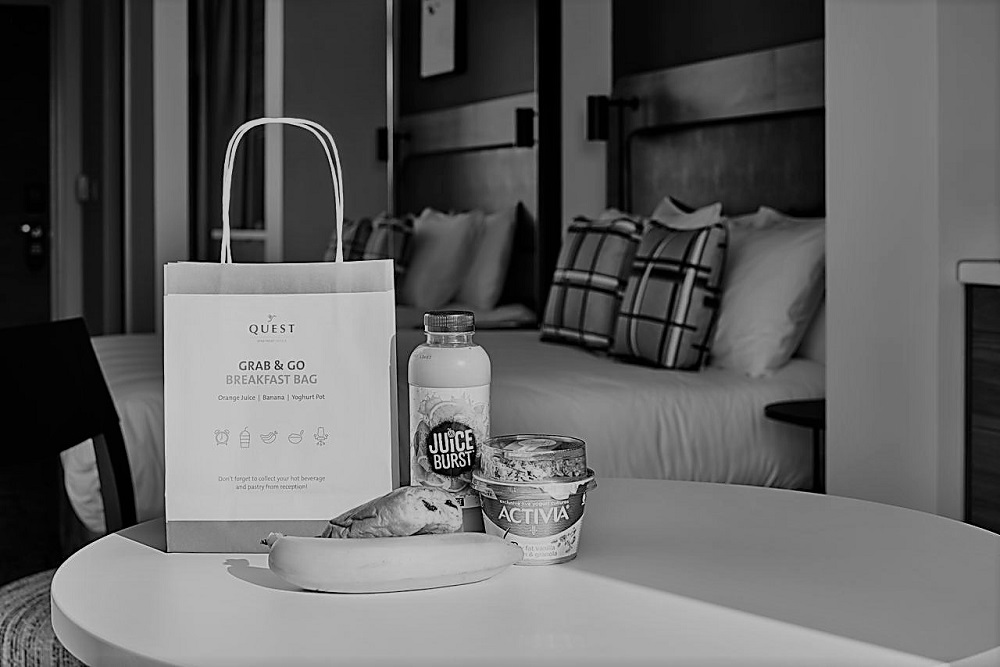
Remember waking up at a hotel and strolling down to the lobby for the breakfast buffet? Sadly, that will be just a memory for most moving forward. It’s likely no secret that it will be a long time before buffets come back. Even with sneeze guards, hotels must (temporarily) shift to à-la-carte menus, made-to-order options, and individually packaged grab-and-go items.
The buffet concept (for breakfast and other day-parts) could also opt to switch to cafeteria-style model instead of self-serve stations (with physical distancing measures in place). Even hotel restaurants with self-serve beverage stations, breakfast bars, salad bars, and a toppings bar will likely need to eliminate these self-serve stations in order to comply with guidelines from both a government point of view and guest sentiment point of view.
These “serving stations” could be individually prepared & plated in real-time by staff from behind the counter which likely means more labor – but providing a safe experience which will win guests over – providing opportunity for further awareness, revenue & profits.
Off-Premise Revenue
Many hoteliers and hotel brands around the world have begun to shift their food & beverage operations amid the pandemic, catering to locals by launching both takeout and curbside pickup options.
With the introduction of this new revenue channel, it is anticipated that it will stick around for quite some time.
Hotel F&B programs must also offer access to more premium grab & go options and also meal-kits. Whether for a day out exploring the city (remember they may be hesitant to stop in a restaurant they don’t know), or on the way to a business meeting, hotels are uniquely positioned to meet guest needs by leveraging their full-service kitchens to supply pre-made meals, snacks, and even F&B experience kits.
Micro-Experiences
From mid-scale to luxury, some hotel brands are taking the resurgence of “at-home” dining to the next level by creating unique F&B packages for micro-groups at the hotel itself.
As an add-on at booking, guests for example can upgrade to a private dining package that includes customized tastings, cooking tutorials, wine pairings, and cocktail making – all in a private space.
For some hotel & resort properties, the often abundance of outdoor space can also provide ample opportunity for seasonal or year-round food & beverage experiences. Picture open-fire kitchens, bar pavilions, and an atmosphere complete with comfortable seating, temperature control systems, and (hopefully) impeccable views for couples, families, and small group gatherings.
Technology Stack
There are a lot of ways technology will enhance hotel operations and experiences moving forward, both in and outside the food & beverage department.
Inside the kitchen, remodels are expected to happen over the next 1-3 years to adhere to the quick-service demand, the demand for the noted new experiences, and the potential lack of qualified staff. This means more self-cooking oven stations, simplified processes, smaller footprints, and smart kitchen technology.
A high level of convenience and contactless service will also be critical on the consumer side, when it comes to on-premise (F&B) room service.
One way to ensure a frictionless experience is through the use of technology.
Approximately one in four hotel guests surveyed by the American Hotel & Lodging Institute, think it’s important for hotels to have 24-hour room service. They want the option to have incredible food and beverage, no matter the time of day.
Post-pandemic, this will still hold true but the service sequence needs to change so that it includes the use of technology and contact-less service, both in the hotel restaurant(s) and in-room. The data shows that one in five guests also want the convenience of ordering with technology – via the hotels app on their phone or even through the TV in their room.
The order can then be packaged & delivered to the outside of the room, to their table in the restaurant, or by having a technology-driven “pick-up locker” in the lobby with mobile phone use to access the food delivered via the hotels kitchen or any third-party delivery partners.
And when it comes to customizing mini bars, 14 percent of guests would choose a hotel where the mini bar is personalized to snack and drink preferences based on the historic data from previous stays or allergies. While some argue the mini-bar is done due to the pandemic – we think hotels just need to personalize it and then make it a point of sanitation between stays.
—
Quick summary; hotel food & beverage programs must continuously react, adapt, and execute as consumer demand and sentiment fluctuates; both short-term and long-term while providing both unique one-of-a-kind experiences and brand activations.
Articles Submitted To Media Partners During Covid-19 Pandemic
By Doug Radkey (March 2020-July 2020)
Take Time to Recharge: Self-Care During a Crisis
During times of crisis, everyone feels something: sadness, confusion, fear, anxiety, or anger.
It can be easy for many within the industry to become overwhelmed with the amount of decisions that need to be made not only for their business, but for their family, staff, and community.
One area that often gets overlooked, particularly among business and community leaders, is their own self care.
From watching the news every hour to making tough decisions, to hours of volunteering, to scrolling through your social media a little too much, it’s easy to get lost in the noise of what’s going on around us in the time of crisis.
When faced with a lengthy business shutdown, it can be a roller coaster of emotions when you learn it’s time to re-open. While it is understandable that you want to open your doors as quickly as possible, you also want to ensure you’re doing it correctly and in a way that will not cause further damage to your brand, bottom line, staff, or guests.
The truth is, as a variety of government bodies have indicated; you’re likely going to have to open your venue in a series of phases. Are you financially & mindfully prepared for that?
You are also going to have to pivot (are you tired of that word yet?) if you haven’t already in addition to diversifying your menu and offerings.
Understanding flexibility and a willingness to embrace change will make you a valuable leader — one who can reliably deal with many different opportunities and scenarios. You will then find change is not something to fear, but something to welcome and turn into an advantage. For restaurants with a large on-premise business model, change is happening and you need to prepare – now!
The biggest fear factors for many with a significant dining room are the new seating recommendations and capacity levels for dine-in restaurants. Everyone reading this will be in a slightly different scenario, pending the size of venue, location, and style of concept, so it is hard to create a cookie-cutter solution.
However, there are some new strategies and standards to consider that will help you adapt, pivot, and embrace these changes. Continue Reading on Resto Biz
Adapting to Change; Seating (Part 2)
To maximize your seating, encourage guests to make reservations, preferably online. Your guests will want to pick their spots, their proximity to others, and their proximity to high-traffic areas. Your new seating arrangement should ideally be online to review and should also be flexible.
Having a reservation system will also allow your staff the appropriate time to fully sanitize and prepare each area for the next number of guests in a reserved party.
With reservations, it may be wise to also consider time restrictions; guests who are used to travelling to tourism hot spots will be accustomed to these types of rules. Don’t be scared to put a 60- or 90-minute timestamp on reservations to encourage more table flips, which you’ll want to do as many times as possible within safety guidelines. Continue Reading on Resto Biz
Maintaining Financial Health During Pandemic
You already know the majority of restaurants run their business on extremely thin margins, and in the the time of COVID-19, the financial health of the industry has become all the more precarious. In fact, a recent (U.S.) National Bureau of Economic Research paper gave restaurants a 30 per cent chance of reopening if the pandemic lasts four months; this estimate drops to 15 per cent if it lasts six months.
The average restaurant, it found, had enough cash on hand to last approximately two weeks. Why such little time? Because the 3- to 5-per cent profit margin of the average restaurant or bar simply can’t cut it in this environment.
Here’s the thing – we can’t continue down this doom and gloom route. The industry will prevail, and some will come out even stronger – if they push forward now. Restaurants must operate with the mindset of achieving 12- to 15-per cent profit margins – and the secret is, it is possible. Continue Reading on Resto Biz
Hotel F&B in a Post-Pandemic Landscape
early all of our favorite and most popular travel destinations around the world have been impacted by the Covid-19 pandemic, resulting in a horrendous financial loss for hotels, resorts, and the entire hospitality industry alike.
Research by the American Hotel & Lodging Institution suggests that hotel recovery to pre-COVID-19 levels could take until the year 2023—or perhaps even later with the expected ‘long-term’ loss of business travel and international leisure travellers.
There are numerous strategies and alterations to consider moving forward for the operation of a hotel property post-pandemic; but one area that can help properties regain their guests’ trust plus revenue and profits is that of the food & beverage program. Continue Reading on KRG Hospitality
Once your idea has been researched and the market, location, technical, business, and financial viability of the idea has passed a series of reviews throughout a feasibility study, a concept development plan can then be started.
Remember, outside of being scalable, you want to build a concept that is sustainable, profitable, memorable, and consistent.
Bar concepts over the years have gone from being tame (or lame) or overplayed, like tiki bars or sports bars, to concepts that push the boundaries of what a bar can be. One of the best ways to build a customer base is to go off the beaten path to create a bold and fresh new bar concept.
A concept plan will focus on ‘chapters’ and visual storyboards that include an overall:
Concept Summary (a one page summarization similar to that of an Executive Summary)
Owning a bar is a dream for most that must be met with the right research, planning, and mind-set.
One’s market will, and must, define the concept. To be successful, you must be open to building a venue the market both wants and needs.
Concept development is giving your ‘idea’, both soul and character. A bar’s concept is the lifeline of its brand and longevity in the market. It makes your venue stand apart from the competition, and it’s ultimately your bar’s unique selling proposition.
Have you ever walked into a bar and been confused about its identity? The interior doesn’t match the beverage offerings, the social media experience doesn’t reflect the actual experience, and even the music doesn’t seem to match the vibe of the bar.
This is what happens when there isn’t a clear and detailed concept development plan in place, and it is a sure fire way to be just average at best.
It’s More Than Just a Drink
Most conceptual ideas start at the food & beverage level. A bar however, needs to remember that they don’t just sell food & beverage; they sell experiences through the enhancement of guest emotions.
When planning a concept, it’s imperative to have a focus on the style of menu and niche of entertainment – but a winning concept will elevate a guest’s variety of senses. Here’s how:
Visual: Use the mindset of a traditional bar meeting on-trend beverage effects. Consider the style of beverage vessels, the use of unique ice cubes or even dry ice, the garnishes used, and potentially a variety of ‘smoking’ techniques within a variety of your signature cocktails, providing a visual effect that grabs every guest’s attention.
Plus, it will be hard to find a guest who is not taking a photo and sharing it on social media – an easy promotional tool to make each of their individual networks feel as if they’re missing out (FOMO) on the best experience in town.
Auditory: Music, drinks, and food share an intimate connection. From the beginning, this should be a focus. Every day, every weeknight, and every weekend must be filled with strategic decisions around sound.
From your day-part strategies, to the sound of cocktail shakers, to live music calendars and even proper speaker placement – your venue must see why 76 percent of bar customers surveyed believe they stay longer due to the sound of the environment.
Olfactory (smell) System: Like sound, a pleasant and subtle fragrance can lead to an improved perceived quality of the environment and can enhance the mood of guests, causing them to stay longer. Our sense of smell is after all, directly linked to the part of the brain responsible for memory and emotion – two things bars need to strive for.
For example; consider a Smoked Cedar Plank Whiskey around the Christmas season. The scent of the smoked cedar will fill the bar area with a subtle Christmas tree aroma, prompting the guests attention and need to spend more money.
Gustatory (taste) System: Food & beverage pairings have never been more important, and it isn’t just for wine. Consider appetizers (snacks) within your food & beverage program that pair with miniature versions of your signature beverages (beers, wines, and even cocktails) that could be served on flight boards; elevating all flavor profiles.
Your remaining food & beverage menu should be small, balanced, and targeted around flavor profiles that your ideal guests desire.
Summary; When you combine these efforts, it’s easy to see how a successful brand can build a community around thousands of fans – within 30 days of opening.
This is something you can easily replicate if you focus your decisions on layout, design, food, beverage, training, and events around the above sensories.
We Have a Problem – There’s No Team Spirit in Many Bars
Within the industry, we always talk about ‘experiences’ – and rightfully so. At the end of the day, experiences are what bars and restaurants sell to customers. All of the emphasis however, is on customer or guest experiences; but what about staff experiences?
Do your staff show up, do their job, and go home? Is there any sense of ‘family’ in your establishment? Is there laughter, or just silence, or even worse…complaining?
Time to Hit the Reset Button!
Desirable experiences shouldn’t stop with just your customers – your team craves experiences too! As owners, operators, and managers, it is up to you to make your concept more than just a ‘job’ or way for staff to ‘pay their bills’.
Implementing the right culture statement and team-based strategy, will assist in controlling your labor costs and reduce turnover – resulting in not only stronger consistency within your operations, but a positive environment that will flow to your customers and help amplify word-of-mouth marketing.
Here are some #BarHacks to help you get started:
Web Presence & Social Media
Bar enthusiasts are seeking to learn and understand the culture of a bar when deciding on their eating, drinking, patio, or party destination.
This is a great opportunity to showcase your team on your social media channels and on your website. Create a bio for your staff noting something unique about them, take a photo (or better yet, a video) of them and share this content to your ‘community’.
This will equally make your staff feel like they’re a part of a team and the business development process.
Create That Stay Interview
Many of you have likely heard the term ‘exit interview’, but what about a ‘stay interview’? Take video to the next level by interviewing your staff and developing a series of testimonials as to why they love working for your bar.
This tactic will create a sense of place and family among your team and also assist in your hiring process; positioning you to attain higher quality candidates who seek a positive working environment.
Continuous Education
A great team member is one who craves learning and one who brings the same set of values as you do to the table. Keep in mind …
“A bar is only as good as its worst bartender”
Every bartender must be of the same quality at your bar. If not, guests may become a fan of one bartender (and not the bar itself) – leading them to follow the bartender if he/she were to leave for another bar.
Take the time to invest in further training and education for your entire team.
Depending on your overall bar concept and financial model, consider developing an educational program for your team.
Think outside the box and create culinary/hospitality scholarships and/or consider sending your team to farms, breweries, wineries etc. to learn about specific products you offer and their development processes.
Continuous education will create a sense of appreciation, enticing your team to stay loyal to your establishment while benefiting not only their experience, but your customers’ experience as well.
Profit Sharing Programs
It’s safe to say, everyone enjoys working towards a common goal. Consider creating a realistic monthly revenue goal (slightly above your current average) for your bar. Now share this goal with your staff and create a SMART plan for the month on how to collectively obtain that goal.
If you surpassed that goal (congratulations), distribute a percentage (5% for example) of the monetary difference among your team.
Repeating this process each month will not only increase your revenue and profit, but will develop a team working environment, reduce turnover, and make your team feel important to the business and its success.
SMART Staff Reviews
Speaking of goals, there should be team oriented goals (profit sharing) and also personal goals developed within an overall action plan.
You should sit down with each individual teammate at least once every three months.
During this meeting and using SMART (Specific. Measureable. Attainable. Realistic. Timely) objectives, give each teammate something to work on over the next three months.
This could be increasing revenue per transaction averages, providing accurate inventory counts, reducing waste levels, or having accurate end-of-day cash out reports.
Of course, reaching objectives should be rewarded; therefore create a reward program that works for your concept and financial model.
Creative Mindset
Don’t let your staff get complacent behind the bar by having the same menu month-after-month and year-after-year.
This will lead to boredom, which will eventually lead to turnover. Allow your team to be creative by ‘creating’ food or beverage options that fit within the confines of your concept.
Consider holding an in-house contest each month to choose one featured food and one featured beverage option created by a staff member.
Highlight this on your social media and in-house marketing (effectively creating a story) while rewarding that individual with a commission on sales from that item for the remainder of the month.
If the product sells really well, consider adding that item to your everyday menu the next time you re-engineer your food & beverage menu.
In summary, execute a marketing plan approach to your staff recruitment and staff development program.
The time, resources, and effort spent on this will be well worth it in the long-run.
Let’s be honest, the traditional bar setting serving cocktails is an environmental nightmare.
Let’s think about it; there is high use of energy within ice machines, refrigeration, and glass cleaning appliances. There is enormous waste in garnishes, straws, bottles, and napkins (to name a few). And finally, there are corporate wineries, distilleries, and breweries producing a large carbon footprint delivering spirits to the bar.
When it comes to bars; (or any other food & beverage service provider) the producers, manufacturers, delivery drivers, owners, managers, and servers ultimately share the responsibility to create an enjoyable guest experience within ones concept. As we have seen with restaurant kitchens over the past 3-5 years, there is now also a ‘movement’ towards eco-friendly and sustainable bars, something many guests are seeking as part of their desired experience.
On the surface, it may sound like an easy change, but creating cocktails in particular that are ‘sustainable’ (zero waste), is in-fact difficult to produce while maintaining the required quality, speed, and profit margins both operators and guests, look for.
So how can independent bars make a simple impact within this craft-cocktail ‘movement’? Let’s begin to have a look at some strategies (#barhacks) that one can implement starting today:
Re-Purposed Ingredients – How can you use 100% of an ingredient? Start by looking at the beverage menu. How large is it? Does it have focus? What ingredients are used in each and every drink that’s made? Which ones are used for infused flavour versus visual appeal? Which ingredients are only partially used with the remaining components discarded into compost, for example fruit scraps? Review each drink and look for ways to re-purpose ingredients and their counter-parts, within both the bar and/or kitchen.
Edible Garnishes – Obviously, cocktail garnishes are decorative ‘ornaments’ that often add character or style to a cocktail. They are often used to complement and enhance the flavours in a drink by stimulating the special nerve cells in our nose and mouth. The days of plastic straws, festive umbrellas, plastic skewers, and other non-edibles however, need to stop. Instead, use fresh fruits, flavour infused salts, edible stir sticks, edible flowers, house-made flavor-infused lollipops on candy sticks (yes), and steel skewers for olives and other edible garnishes, if so desired.
Energy Conservation – Take a close look at your glassware and how it is washed. Are you using over-sized glasses (ie. martini glasses) that are taking up too much space on the wash-rack, leading to unnecessary additional washes (which costs money and uses more detergents)? How many glasses could you fit if you changed glassware sizes?
How much ice are you using in each drink? Does the beverage really need ice or could the glass be simply pre-chilled? Take a look at your menu, glassware, fridge space, freezer space, and use of ice machine. Is there a way to reduce used energy within the bar itself to help create sustainable cocktails?
Supply Chain Management – Transparency, traceability, and accountability must be a top concern when deciding on vendors to ensure all products (both food and beverage) entering your bar or other food service business, are not only safe & sustainable for your customers, but for your community. Work with beer, wine, and spirit makers who are equally trying to make a difference. With the growth of local distilleries, breweries, wineries, and produce suppliers; supporting local and reducing the carbon footprint within a bar, is so much easier! Collaborate and work together to make a difference.
In summary, don’t start a goal of 100% zero waste or sustainability – it’s likely not going to happen overnight. Instead, set SMART realistic goals to reduce waste by 15 or 30% over the next 6 to 12 months to begin building a sustainable cocktail and/or bar venue. Once that goal is obtained – double down on that goal for the next 6 to 12 months. You and your customers will notice a positive difference!
Festive Season. These two words signal colder weather (in most areas), delicious comfort food, creative drinks, memorable parties, laughter with friends & family, and of course – gift giving.
These are also two words that nearly everyone seems to look forward to throughout the year, including that of restaurant owners. The reason is quite simple; consumers are often in a generous mood which equals longer stays and more spending dollars.
Restaurants, bars, and cafes have the opportunity to generate an abundance of awareness, an increase in revenue per guest, and even repeatable business in what can be defined as the often slower months following the Festive Season (yes it is possible).
Let’s jump right into some Festive strategies your concept or venue should consider this holiday season:
1. Cross-Promotions
Make sure that special events and other winter-related promotions are planned for well in advance, ideally 1-2 months prior. This season is such a large opportunity, that a true marketing plan should be developed just for the season. The festive cheer that starts the season, for example, can act as a forerunner to both Christmas and New Years Eve parties, packages, and other revenue generating opportunities such as gift card sales.
Speaking of gift cards – create a marketing program specifically around these money-makers. Restaurants are the most popular choice for consumers to purchase gift cards, with 41% of total gift card spend going to restaurants. But don’t just sell the one card. Create a promotion that includes spending an ‘x’ amount of dollars on a card before Christmas, and receive a second card with an amount of ‘x’ that can only be used in January or February. Add value, be aggressive, and get people through your doors over the next two months when sales are traditionally lagging.
2. Labor Management
Similar to that of the retail sector and depending on the size of the restaurant, additional staff may need to be hired to handle the extra covers that are waiting to come in. This is where planning ahead really comes into play. To be fair to yourself, your team, your new hires, and your guests, you need to ensure you leave yourself enough time for interviewing, talent selection, onboarding, and training before the peak of Christmas season truly hits.
Both front-of-house and back-of-house systems and their teams need to be reviewed to ensure your operations are prepared. Customer service and speed in the kitchen or bar should not be hindered by the fact it’s getting busier. You can ‘scale’ your business by being prepared; create mock schedules and see where there may be gaps to ensure a high standard of service is available when your restaurant needs to shine.
Speaking of staff, let’s not forget about their valuable time! Ensure they’re given time to spend with their friends and family too. Be flexible with your scheduling – and don’t forget to thank them for their loyalty and commitment!
3. Off-Premise Dining
With the increase in delivery and off-premise dining, the Festive Season may not show any signs of slowing that segment down this year. Is your restaurant prepared to market the catering and delivery of food and beverage to office parties and house parties?
This presents an opportunity to offer the catering of a traditional or concept-infused, Christmas focused meal or buffet style dinner — right to their door!
Create a variation of value-added packages for different sized parties and request 72 hours (or more) notice (with deposit) to have it prepped and delivered, right on time. Just don’t forget the high-quality take-out containers and plates for an easy clean-up afterward!
Pre-ordered packages such as this will generate cash-flow, control potential waste, and control staff costs.
4. Food Menu
Is your restaurant in a position to offer a traditionally plated meal or other harvest/winter flavors? How about a unique variation or infusion based on your restaurant’s concept and kitchen structure?
Don’t be afraid to think outside-the-box and get creative. For example, if you’re a Quick Service Restaurant (QSR) near a parade route, create an easy-to-eat holiday inspired option for ‘on-the-go’.
Develop a holiday-themed menu with your entire team (kitchen and bar team) with your target market and concept kept close in mind. Make it a fun exercise for everyone. As always, keep the specialized menu small and inviting to reduce inventory, prep-time, additional staff requirements, and potential waste.
You also want to keep in mind that a lot of the guests visiting may have never stepped foot in your establishment before because they’re just tagging along with a large party. Think of allergens and include dishes that vegans, vegetarians, and guests with other primary food sensitivities would still enjoy.
5. Beverage Menu
Having the right drinks on your menu is just as important as the food. The Christmas season is the best time of year to sell both pre-and-after-dinner drinks if you’re a dine-in restaurant.
You have to have the mindset that every drop counts!
While pre-and-after dinner drinks are big sellers, you can make a larger impact by offering ‘session drinks’ – drinks with a lower level of alcohol – or just zero-proof drinks all-together.
The drinking ‘culture’ associated with alcohol, in particular, has definitely changed over the past decade thanks to strict driving laws, the cost of ‘going out’, and the sophistication of consumers.
Show off your bar teams talent by creating ‘theatre’ in your beverages in addition to a balance in alcohol levels which should be promoted with the right mix of marketing.
When crafting your beverage menu, keep sustainability, speed, price, and perception of value in mind – for both non-alcohol and alcohol driven drinks.
6. Christmas & New Year’s Parties
You have the square footage, you have the approved capacity, and you have the kitchen/bar. These are the needed ingredients required to host an exclusive or intimate type event at any venue. Whether you have the capacity for 20 or 200 plus guests, there is an opportunity to generate awareness, revenue, and repeat customers by becoming known within your community for being the ‘best host in town’.
To make event management work for your restaurant, it must create a unique and memorable guest experience, which is no different than traditional dining strategies. Whether you’re hosting your own New Year’s Eve party or renting out your space before Christmas for a variety of private events – ensure there are defined (but value driven) food & beverage packages and a financial deposit made to protect your bottom line.
You also want to ensure there is a communication strategy in place to let other guests know if your venue is closed for a private event. Maximize each event by being organized, well staffed, and engaged. Take it a step further by providing guests at the event – an opportunity to revisit in January or February with a measurable gift (a coupon for a free appetizer or $10 gift card, for example).
By truly knowing and understanding your target market, your concept, and the neighboring business environment, the Festive Season is an excellent time to showcase your brand and your creativity – ultimately generating awareness, revenue, and repeat business opportunities, ultimately setting the tone for the following year!
Should restaurants ditch third party delivery apps and create their own in-house off-premise strategy? I recently took part in a few online conversations surrounding third party delivery apps – from both the consumer and the restaurant operator point-of-view.
If you follow along – I am not a fan of these services (at all). I’ve never used them nor suggested a brand to use them.
While I embrace technology in the restaurant space (and off-premise dining options) – I feel the business model surrounding these apps (in particular UberEats and Skip the Dishes during these most recent discussions) are lacking in both customer service and transparency while further killing overall restaurant profits (like operators today need anymore of that).
Let’s look at a recent transaction. I recently saw a screenshot from a consumer using a third party delivery application. After a delivery fee, a busy area fee, a peak delivery time fee, and the delivery fee taxes, a meal that was listed as $8.89 on the menu ended up costing them $30.36.
Of that, the restaurant earned a mediocre $6.67 of that order.
It’s not exactly a traditional breakdown of revenue that we see in restaurants, and operators today are struggling to adapt to this ever-changing restaurant landscape. I feel it came at them much too fast and many have jumped on board because they felt they had to.
But I have a question – why are we not doing a better job to get guests to spend that $30.36 they were willing to spend – in the restaurant or at least through our own off-premise dining program?
With a little effort – it can happen!
Here is what we know. Delivery and off-premise dining has disrupted the restaurant industry more in the last five years than anything else. Digital ordering paired with the outsourcing of delivery has impacted restaurant traffic, revenue, profit and overall restaurant operations like no other piece of industry-wide technology.
Based on the conversations this past weekend it seemed liked the only party benefiting from the use of these apps – was the third party. However, if you ask them, they’re apparently not making ‘huge profits’ either.
Here are a few notable quotes from the public chat that took place on Facebook – again from both consumer & operators:
“I’ve deleted the app – every time I’ve ordered, something goes wrong and a lot of times it’s the drivers fault not paying attention” – Consumer
—
“If you’re doing takeout, pick it up from your local business. Other than that you’re rolling the dice” – Operator
—
“Their chat-bot told me ‘we are deeply disappointed that we have failed to provide you with optimum service during your orders and for this reason we have decided that it is best to remove ourselves from this relationship’” – Consumer
—
“Best thing to do is get out and support your local restaurants, leave these rip off merchants congeal back in the gutter where they belong” – Operator
—
“I had no idea these apps take such a percentage from the restaurant on top of the delivery fee. I will no longer order through an app. I thought I was supporting my favorite restaurant, but apparently I wasn’t” – Consumer
—
Not much of anything positive.
Here’s the thing; recent stats are showing staggering numbers such as 60% of consumers ordering delivery in the past 30 days. Based on trend reports, this is ‘unfortunately’ only going to climb – even though I personally wish more people would visit restaurants, engage in the experience, get out of their home, and socialize with others away from their smart-phone.
But out of those that do order delivery through these third parties, 30% are experiencing poor customer experiences – with either the app or the restaurant – or both.
That is significantly higher than the number of complaints one would receive at the restaurant level without a third party being involved.
Here’s the next problem; according to a study by Steritech, consumers are placing over 80% of the problems on the restaurant through the use of these apps (even if most problems are not their fault).
Due to the third party app, a gap in communication immediately happens between the consumer and the restaurant. This leads to the restaurant not being able to often resolve the problem in a timely manner before that consumer blasts them for something on social media.
Not a pleasant situation.
This is because they’re sending their complaints directly to the third party app (the platform that ultimately placed the order for them) – which I suppose makes sense from a consumer point-of-view. This however leads to over 25% saying they would not order from the restaurant ever again – not entirely fair considering the restaurant may never have even known about this unhappy experience.
Furthermore:
14% say food quality was not as expected (likely due to travel time or packaging)
19% say the order took too long
19% say the food wasn’t the correct temperature when it arrived (timing or packaging issue)
29% say the order was incorrect or missing something
All of this could be avoided! When partnering with these mainstream third party apps – you’re also:
Losing a direct communication channel
Losing positive brand perception
Losing much needed profits to sustain yourself
Losing consumer data for future marketing
Losing foot traffic in your dine-in real estate
Most importantly – you’re losing control once that food leaves your four walls.
Why on earth are we doing this to ourselves for such limited margins?
If you are operating a restaurant and are currently using these apps – though you will never have full control of the situation, there are a number of options available to you to leverage more control.
That said I encourage you to consider your own in-house off-premise program. These options below should be considered whether you’re partnering with a third party or if you’re offering your own in-house platform:
Offering a limited delivery only menu option with higher margins (consumers are obviously willing to spend more)
Offering limited day-part delivery times (example; not at 6pm on a Saturday when the kitchen is slammed)
Using specialized take-out packaging for certain menu items to protect the quality of your unique food options
Using tamper-proof packaging so delivery drivers cannot alter the order (happens often)
Having a quality control program (or expeditor) reviewing meals before it leaves the restaurant
Sending printed customer care promises (how to reach the restaurant directly) delivered with the meal
There are much better options out there for digital take-out, delivery, catering, and off-premise dining that will allow you to keep control of all of the above while maximizing profits including the introduction of your own off-premise strategy – which will often keep costs to under 10% – no joke!
Then, use these ‘savings’ to increase your own marketing & advertising efforts. It surely won’t be 25-30% like what these third party delivery apps are currently taking from independent operators (which you were willing to give up anyway); keeping more money in your pocket.
This type of in-house strategy will also differentiate your brand from the competition that is also increasing each day on these main-stream app platforms.
How will you stand out and make your brand memorable? How will you position your brand for a sustainable future? How will you protect your brand, its profits, and utilize the available customer data?
Don’t partner with them just because it seems like the easy thing to do or ‘because everyone is using them.’
The notion that you must be on them to survive is 100% inaccurate. If you need to use them for ‘marketing’ – you need to learn more about marketing.
Take a stand and learn about your options first.
I am yet to hear a positive story on how these main-stream third party delivery apps have actually helped their business grow in the long-term. In my professional opinion, restaurants should ditch third party delivery apps.
Originally Posted on Typsy – By Doug Radkey 10/02/2018
The development of a restaurant can be extremely daunting with its many moving parts and it’s easy to miss crucial start-up strategies within the mix of it all.
One you don’t want to overlook is your intended media launch strategy. Today, the word ‘media’ means so much more than your local newspaper outlet.
The worst thing you can do is start your marketing and promotional campaigns one week before opening or simply expect a Field of Dreams “if you build it, they will come” type of scenario to work.
Hint: it doesn’t!
A successful restaurant launch includes building plenty of buzz for the three-four months leading up to the opening. It also means developing what we call a communications strategy to deal with the variety of media outlets both before and after opening.
A strong communications strategy will prepare you for the most effective social, digital, and community-related marketing tools in relation with targeted media partnerships which will then target your specified audience across a multitude of touch-points.
Aside from the established chain restaurants, many aspiring and independent restaurateurs do not have the budget for their own in-house marketing team (or outsourcing an award-winning agency). And that’s okay. In order to be fully present within your community both before and after opening, restaurateurs just need to ensure they have the necessary marketing plans in place.
This means projecting the right voice to attract the right audience. This also means determining the tone of your content, the nature of your interaction, and the overall approach to your brands messaging.
It also means knowing how to handle any third party media attention before and after opening.
To develop an effective communications strategy – you want to focus on three key areas: your social media, your public relations, and your direct-to-consumer channels. Let’s have a look at each.
Social Media
Within both your marketing and communications plan, you firstwant to develop a social media strategy. There is no getting around this today. Use plenty of simple, cost-effective strategies in the weeks prior to opening to create the buzz you want (and need). These methods will also maximize exposure (to both the public and other media outlets) in addition to early revenue opportunities during what’s known as your ‘honeymoon period’ – the first three months of operating.
This includes developing and/or executing on:
Social media channels, like Facebook, Instagram and Twitter, that your target audience actually uses each and every day
The development of strategic monthly content calendars for each social channel
The creation of social media contests and sales-driven promotions
Social media paid-advertising campaigns to further build your targeted community
Digital marketing partnerships where you can leverage both social media and email marketing
Food and beverage photography and videography strategies to enhance your visuals
It’s not easy building an online community from scratch. Your social media presence must have a strategy behind it – not a ‘spray and pray’ method of posting a food photo and hoping your target market will engage with it. It is imperative that you’re consistent, unique, and strategic. You also want to build digital partnerships that will help you successfully piggy-back on another’s already built social media community.
Public Relations
Leading up to the opening and for the first one-to-two months after – you want to build strong relations with your local media partners. Pairing this with a strong social media strategy is crucial in developing the awareness you need to get a head start in generating revenue.
You want to consider the following methods:
The development of your key brand messages to create consistency and reduce confusion
The creation, management, and distribution of press materials including a press kit, fact sheets, press releases, and owner/chef biographies
The development of a targeted media list – online, print, and broadcast. Know beforehand who you want and don’t want to associate throughout your local media. Don’t waste time meeting with media outlets that don’t have the same target audience as you do
Partnering with key influencers (bloggers) and tastemakers (farmers, breweries, wineries, and other key suppliers to your restaurant)
The identification and training of your start-up brand ambassadors; this includes ownership, management, and other priority personnel
At a minimum, you want to send out press releases and contact your local restaurant bloggers, podcasters, food critics, and social media influencers. Engage with your local industry dignitaries on social media and then inform them of your newly developed restaurant. Create an invite only event either before or during your soft opening to maximize on their value and to amplify your story.
Direct-to-Customer
To tie all of your social media and public relations together to create a winning communications strategy, you want to include a variety of direct-to-consumer campaigns throughout the first 30-90 days of opening.
You want to ensure your target market is seeing your brand across a variety of channels. Pending your choice of concept – you want to entice them to visit your venue approximately three times before the end of your honeymoon period.
You can achieve this by creating the emotion that your target audience is going to miss out on the hottest new restaurant in town (FOMO – Fear Of Missing Out). You can do this by creating the following:
A variety of menu tasting and beverage pairing events
Direct mail marketing campaigns to targeted hyper-local neighborhoods
Community marketing outreach and partnership opportunities (events, donations, and sponsorships)
Site sampling and street activations by personally taking food samples and marketing material to local businesses (using your developed brand ambassador strategy)
In-house return visit campaigns that measure the return-frequency of customers
How will you reach the maximum number of targeted customers with the least amount of spending to maximize your return-on-investment? How will you plan to be memorable and stand out from the competition as time goes on? Start early and be creative, imaginative, and bold in all of your efforts while being prepared to handle social media, public relations, and direct-to-consumer strategies.
Originally Posted on FoodableTV – By Doug Radkey 08/08/2018
With technology continuously advancing in the restaurant industry, it can be easy to get absorbed and caught up in the next big thing. Technology platforms can help you save time, financial resources, and improve ‘customer service’ levels, just to name a few.
But sometimes when you get so caught up in technology, you can forget some of the fundamentals that will never be replaced by technology, but still play a large role in the success of today’s restaurants.
The key is the right balance of technology that will assist you in meeting both short-term and long-term goals.
This article is not about how to not use technology (it’s a great asset,) but don’t let it fail you, your staff, or your customers. Let’s strip back the technology for a moment and remind ourselves as an owner, operator, manager, or front-line employee – some of the tactics that we must never forget or stop learning.
First Impressions
Curb appeal and first impressions must meet and exceed your guests’ expectations. When stripping back technology, restaurateurs must understand that first impressions are essentially a means of effective communication that positions a restaurant to develop positive customer emotions and “touch points.”
As always, one must thoroughly think about the consistent message and experience that’s intended to be delivered.
Key Performance Indicators
Technology provides an operator with a great amount of data, but restaurateurs still need to learn and understand this data and know how to use it to their advantage. Understanding key performance indicators such as staff turnover percentages, prime costs, percentage of repeat guests, and proper menu engineering statistics (to name a few) – are all essential to making the right business decisions that will eventually impact your bottom line.
Concept Characteristics
Outside of having the right location, the right concept, and the right chef or mixologist – a restaurant needs to inherit five key concept characteristics that technology cannot simply implement on its own.
Restaurateurs need to develop scalability, sustainability, profitability, and consistency – while providing a memorable experience. Finding a successful, individual approach for managing each of these characteristics is the key to success in any economic situation. All five of these characteristics are important and must work in unison to be successful.
The 3 Elements of Marketing
In terms of restaurant & bar marketing, it comes down to three things– driving awareness, increasing revenue per customer, and generating repeat business.
Technology can help execute marketing strategies, but operators still need to know their target market and their hyper-local competition to understand which strategies will drive the best return on investment.
An ‘old school’ approach to developing a marketing plan will still deliver success in today’s technology driven world.
Continuous Education
It doesn’t matter which role one plays in the restaurant, everyone must continue to learn. Owners, managers, and front-line staff should have the mindset and a personal development plan in place to continuously learn the industry. It’s important to stay up to date with customer service strategies, product details (visiting suppliers), and how the supply chain works within the restaurant. In addition; reading books and listening to podcasts for example are a great learning tool everyone can take part in.
Customer Service
It’s no secret, we’re all witnessing a shift in how technology affects customer service and ordering sequences.
As the technology continues to evolve, restaurateurs must not forget that engaging guests on a personal level will always build on those positive customer emotions. These “touch points” are required to make not only a positive first impression, but a lasting memorable impression.
This is especially important if you’re considering adding third party delivery to your revenue & service mix. How will you protect your brand and enhance customer service after the food has left your venue and is in the hands of their delivery drivers?
Make sure there is a plan in place that engages customers on a personal level.
Focus on Systems
Having the correct systems in place will create consistency, develop operating capital, enhance team morale, and build business value– while also positioning a restaurant’s concept for future growth opportunities (being scalable & sustainable).
This includes proper communication between front-of-house and back-of-house, day-to-day checklists, quality control methods, and human resource management, among others.
Again, there is technology that can assist operators with their systems, but they can’t develop the process of implementing the right systems for specific concepts. That is up to you to know which ones are needed to maximize each moment of the day.
Collaboration
Lastly, a sense of community is a driving force in this industry. We can build online communities (social followings,) but the best way to develop a sense of community is through collaborating with local farms, breweries, chefs, charities, and even the competition. Understanding this fundamental strategy will amplify your messaging throughout the community, improve a restaurants perception, increase staff morale, and generate revenue opportunities– while developing a destination, not just a restaurant.
Sometimes it is nice to just step back and review the bigger picture and remind ourselves not only why we’re in the restaurant business, but to revisit the basic fundamentals for restaurant success.
Once that is truly understood and the proper ground work is in place, technology can be implemented to enhance and support operations to save time, financial resources, and improve those needed ‘customer service’ levels.