Kitchen operations

by David Klemt David Klemt No Comments

Who Really Owns the Kitchen?

Who Really Owns the Kitchen?

by David Klemt

AI-generated image of a clean, well-equipped restaurant kitchen

AI-generated image.

Who owns the kitchen? One of our favorites, Chef Brian Duffy, has some thoughts, and they boil down to taking ownership of the systems.

His 2025 Bar & Restaurant Expo session title, “Owners & Chefs: Who Owns the Kitchen?” sounded like Chef Duffy was teeing up a showdown: chef versus operator. But he had something else in mind.

During his session, Chef Duffy addressed ownership not as a title, but as an operating philosophy.

If you ask him who really owns the kitchen, his answer will be simple: Whoever takes responsibility for its systems.

Chef Duffy isn’t just theorizing from the pass. The chef and operator has opened more than 100 venues, and actively oversees ten restaurants each week. His experience and position in the business have helped him develop a uniquely sharp eye for what separates kitchen chaos from culinary consistency.

Spoiler alert: It’s not talent. It’s not even creativity.

What matters is taking ownership of systems, communication, and accountability. Are talent and creativity important in the kitchen? Absolutely. Will a restaurant survive (and thrive) without the development and strict adherence to effective systems? I think we all know the answer to that question.

Assumption Leads to Dysfunction

If you’ve ever attended a Duffified education session or demo, you know he jumps straight in. He’s passionate about this business. He loves talking about it, sharing his knowledge, sharing new ideas, and collaborating on ways to move the industry forward.

So, while I wasn’t fully expecting Chef Duffy’s opening provocation, it didn’t entirely surprise me that he kicked off his session with it: Restaurant owners are expecting too much without saying anything at all.

“They assume chefs and kitchen managers just know what to do,” he said. “Daily, weekly, monthly.”

That assumption is where dysfunction takes root.

Duffy plans six weeks out because that’s what it takes to run a kitchen like a business. With that proactive approach to lead time, he can lock in pricing with suppliers, ensure the products he needs are available, give teams time to plan events, schedule staff fairly and effectively, and control costs with precision.

When you don’t plan ahead (or don’t plan far enough ahead), your kitchen becomes reactive. Simply put, reactive kitchens are expensive.

Worse, they’re chaotic. And chaos burns people out.

Daily: Predictable Results

Chef Duffy doesn’t do ambiguity. Anyone who has spoken or worked with him can attest to this truth.

It should come as no surprise, then, that his expectations are decidedly unambiguous. They’re detailed, repeatable, and focused on communication, clarity, and control.

Here’s his daily checklist:

  • POS Counts: Know what you have. Open the line of communication with front-of-house.
  • Tasting: Everyone tastes the specials, cocktails, wines, and even a core menu item daily.
  • Pre-meal: Shift briefings with intention. Share what to sell, what’s 86ed, any kitchen concerns, etc.
  • Prep List: Created at the end of the shift, while everything’s fresh so nothing is missed.
  • Protein Counts: Same timing as the prep list to eliminate guessing on inventory.
  • Daily Recap: Communicate staffing, equipment, prep issues, and anything else those working the next shift should know.

You’ll notice none of these are flashy, and that’s the point: These rituals are how kitchens run efficiently, end of.

Chef Duffy’s clearly communicated expectations are how you reduce waste, avoid surprises, and build team alignment.

Crucially, he has tracked the results of his approach, and says a system like this can shave one to two percent off your costs. That’s a lot of dollars over the course of a year.

Know and Sell

One of Chef Duffy’s biggest irritants? Hearing a server say, “Let me go ask the chef.”

“If a guest asks if they can have a menu item without a certain ingredient, and the server doesn’t know the answer, it means the chef never had that conversation,” he said.

It’s a trust issue, an unforced service error. And it’s preventable.

Chef Duffy makes tasting part of the daily ritual. His teams rotate through core menu items so everyone understands the food. Therefore, they can talk about it like they believe in it.

The result? More confident service, better upsells, and fewer avoidable mistakes.

Let staff know the menu, and then step back and let them sell it.

Start with a Stretch, Not a Spiral

Culture isn’t built by luck or happenstance, it’s modeled. In some cases, it’s modeled physically.

Case in point: Chef Duffy uses pre-meal to reset the tone of the shift, not just brief the team. That includes a moment of breathing, and even light stretching.

“Don’t take last night’s negativity into today’s service,” he says when breathing and stretching with a team.

In high-stress environments, leaders don’t just direct traffic, they set the emotional baseline. That moment of reset might sound small, but it says something big: We show up intentionally.

Weekly: Breathing Room

Chef Duffy doesn’t stop at sharing day-to-day expectations.

Weekly deliverables create space for the kitchen to operate with their team, not against them.

  • Specials: Planned one to two weeks out.
  • Schedules: Also one to two weeks out. Give people time to plan and live their lives.
  • Inventory: Always on Mondays. It’s the cleanest window between Sunday close and Monday service.
  • Management Meeting: Review the past week, preview the next, and talk specials, events, holidays, and team concerns.

Chef Duffy also uses scheduling software that empowers the team to submit availability and day-off requests. Why? Because quality of life matters.

“Give your team a life,” he said.

People stay where they’re respected, and that absolutely, inarguably, non-negotiably includes considering their time.

Contests and Creativity

One of Duffy’s favorite ways to build buy-in? A little friendly competition.

He and I have talked about this on the Bar Hacks podcast, and I’ve shared this competitive approach of his in previous articles.

Like I said earlier, creativity is important; it just has its time and place.

“Go into the walk-in, come up with a special,” he’ll say to the kitchen team.

He’ll cost the special, price it out, and then add a dollar. For every special that sells (usually over a 30-day period), Chef Duffy gives that added dollar to the creator of the menu item.

It’s brilliant in its simplicity: The culinary team engages their creativity, the restaurant gets a low-risk special, and staff are rewarded directly.

That kind of engagement isn’t just fun, it’s a culture builder.

Monthly: Big Picture

Monthly meetings bring the business lens into focus.

For Chef Duffy, that includes:

  • Owner/Leadership Meetings: Discuss sales, budget, events, catering, and marketing.
  • Food & Labor Cost Reviews: Not just reporting numbers, but talking about them to ensure everyone understands the situation.
  • Marketing Roundtables: Let’s not forget that the kitchen is a core element of the brand experience.

There’s no mystery to what’s discussed. Everyone at the table knows what they’re accountable for, and what needs improvement.

Importantly, everyone must also be given the tools to improve. Otherwise, these big-picture sessions are essentially just performative.

The Common Thread

Chef Duffy flies more than 140,000 miles a year checking in on restaurant operations.

So, what’s the most persistent problem he encounters across his travels?

“Operators don’t talk to their teams,” he says.

That’s it. Not bad food (though that’s certainly a problem). Not weak concepts and uninspired menus (also issues, industry-wide). It’s poor communication.

To be honest, that’s such a mundane problem to have, and too many operators are letting it spiral out of control. Want to improve operations? Be clear about their expectations, and transparent about the business.

Communication fixes everything.

Clear communication is also a cost-controlling measure. Put yourself in the shoes of a back- or front-of-house team member. Which do you think inspires more confidence and buy-in, knowing exactly what’s expected of you every day, or having to figure things out as you go without direction? Clear communication is an effective retention tool.

It’s also a core element of consistency.

To that point, this is why Chef Duffy insists on daily, not weekly, prep lists. When lists are weekly, people feel like they’ve got time, and their urgency disappears. Tasks get pushed, and accountability drops.

Whenever a new chef joins one of his kitchens, Chef Duffy requires a manager to sign off on their prep tasks. This isn’t done to just check a box. Instead, this requirement confirms the food is tested, tasted, and good to go.

That’s ownership not in title but in action.

Heed Warning Signs

This is one of the quotes from Chef Duffy’s session that most resonated with me:

“If your head chef or kitchen manager has a problem with over-communication, that’s not your person.’

Too many operators ignore early warning signs in leadership. They tolerate resistance to systems, and avoid hard conversations.

To be blunt, that’s unacceptable. This is, at the end of the day, business. True leaders don’t run away from difficult discussions, they stride confidently toward them; it’s the job.

Red flags don’t get less red if they’re ignored; they start to glow. When left unaddressed, red flags just get more expensive.

Identifying issues is a leadership skill. Having the courage to address them immediately is a leadership skill. Taking ownership of systems is a leadership skill.

Last Bite: Ownership Is a Verb

This wasn’t a session about chefs versus owners; this session was about chefs and owners working together to own their restaurant’s systems.

It was a call to action for anyone leading a kitchen, hiring a chef, or trying to build a better back-of-house culture.

Ownership isn’t about who’s in charge, it’s about who’s committed to clarity, systems, and communication. Ownership is about who shows up consistently for the business: the team, the guests, and the bottom line.

Want to own your kitchen? Take ownership of your systems.

Image: Canva

Client Intake Form - KRG Hospitality

by David Klemt David Klemt No Comments

Kitchen Doctrine: The Culinary Holy Trinity Across Cuisines

To some, the Holy Trinity refers to the Christian doctrine of the Father, the Son, and the Holy Spirit. But what’s the Cajun Holy Trinity?

Well, that’s a whole different story with which some people may not be as familiar. However, it carries equal weight in certain kitchens of the world.

Lending its name from religious credo, the Cajun Holy Trinity was developed in the state of Louisiana in the southern United States. Chef Paul Prudhomme gets the credit for introducing the term in 1981, along its popularization.

Cajun or Creole cuisine evolved from French, Spanish, and West African immigrants. French traditions blended into a melting pot of West African, Spanish, and Native American cuisines. The French and the Acadians (French colonists deported from Acadia in what is now Nova Scotia, Canada) both influenced Louisiana’s cuisine. The Acadians became known as Cajuns to English speakers, and thus Cajun cooking grew out of necessity in Louisiana.

It’s incredible what three (and sometimes just one or two more) simple ingredients can do to create incredible dishes.

by Nathen Dubé

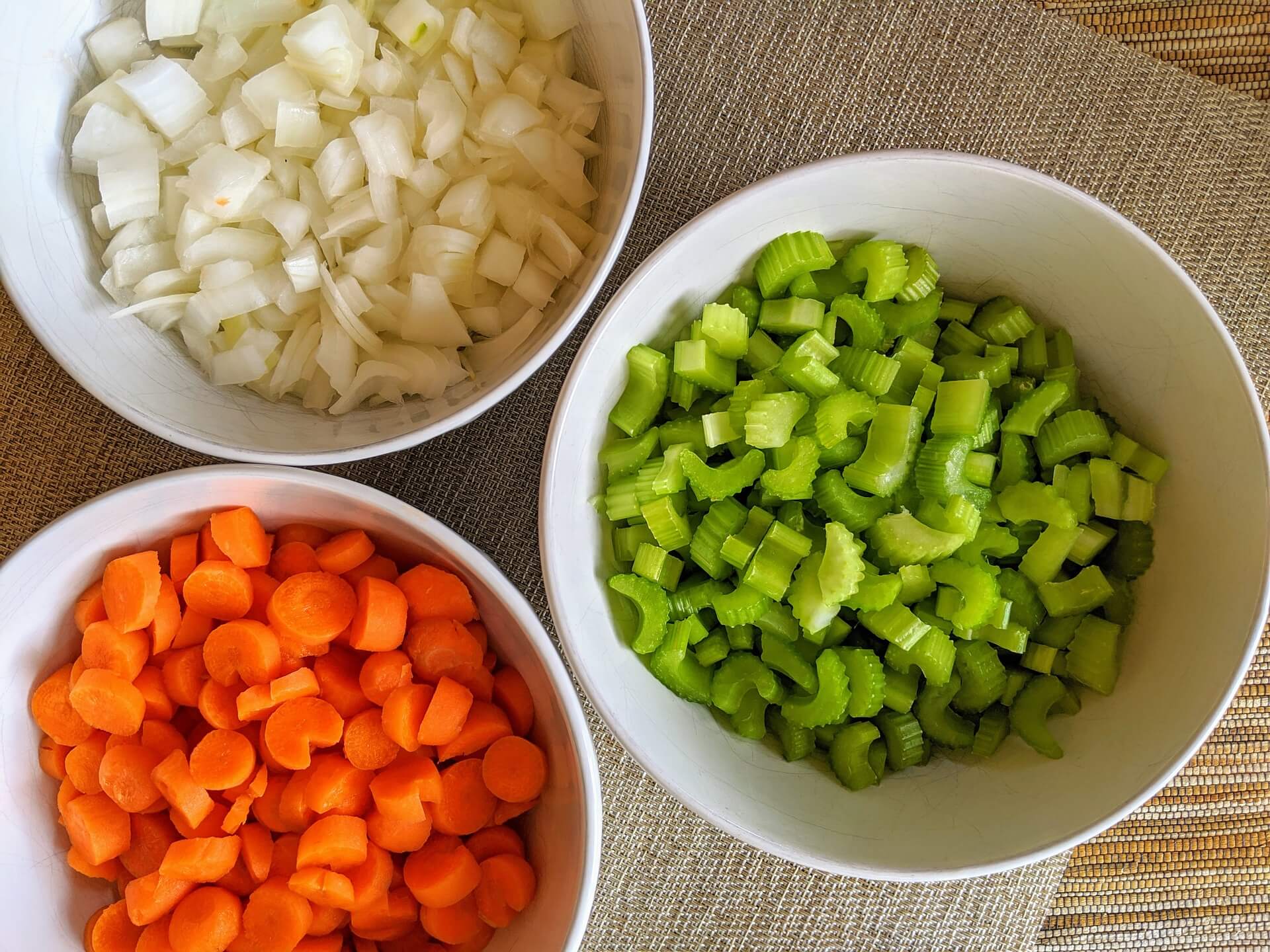
Carrots, celery and onions

Understanding the Culinary Holy Trinity

Mirepoix 101

The French contributed two staples directly to Cajun and Creole cooking: roux-based cooking and the trinity of mirepoix, or onions, celery, and carrots. In Louisiana, however, carrots didn’t grow as easily as bell peppers. So, bell peppers, typically the more bitter green version, replaced them.

Some cooks were so bold as to add garlic to the Holy Trinity, referring to it as the Pope. Other variants use garlic, parsley, or shallots in addition to the three Trinity ingredients. Unlike the elaborate French dishes using mirepoix, the Holy Trinity is more symbolic of rustic, family-style meals.

These ingredients are the first to go into the pot or skillet, creating a flavorful foundation for gumbo, jambalaya, crawfish étouffée, and more. Often, by adding a bit of flour and whisking, a roux is built right on top of these sweet and colorful aromatics to form a thicker base.

The ratio is also overturned from the traditional mirepoix of two parts onion, one part celery, one part carrot, with three parts onions to two parts celery to one part bell pepper.

Practical Application

So, now that we know what it is, how do we use it?

First, the ingredients are finely diced, then sauteed in oil, fat, or butter until translucent and tender. This stage of cooking draws the water from the vegetables, concentrating their natural flavors.

You can continue cooking the ingredients down until they’re caramelized, which is to say the sugars come out and brown them in the pan. They’ll become easy to break down with the back of a spoon. There’s a further concentration of flavors but we’re approaching the law of diminishing returns.

The shorter the cooking time of the end dish, the smaller size the pieces should be. For longer times, they can be cut into larger pieces. For obvious reasons, we want our ingredients to cook evenly, as well as withstand the timeframe of the cooking. You don’t want minced vegetables in a stock that’s going to simmer for 10 hours, the same way we don’t want giant chunks in a soup that’s done in 30 minutes. Texture of the end product are also important, not just flavor.

Here are examples of some recipes that include the Cajun Holy Trinity:

  • Chicken and Sausage Jambalaya
  • Cajun Gumbo with Andouille Sausage
  • Chicken and Okra Gumbo

Looking at other cuisines of the world, we’ll find some interesting variations. Interestingly, however, we’ll find similarities in the use of a category of vegetables and herbs called “aromatics.” In the Western world, these are vegetables like garlic, onions, carrots, celery, and herbs like bay leaves, thyme, parsley, and peppercorns.

In Asia you’ll find green onions, ginger, garlic, and warming spices like cinnamon and clove. These mixes are usually sautéed to slowly draw out flavors that can carry a dish. Sofrito and its Italian counterpart, soffritto, literally mean to stir-fry.

French Cuisine

The term mirepoix is encountered regularly in French culinary texts by the 19th century.

In 1814, Antoine Beauvillier wrote a recipe for Sauce à la Mirepoix in his book L’Art du Cuisinier. It’s a short recipe for a buttery, wine-laced stock garnished with an aromatic mixture of carrots, onions, and a bouquet garni. Marie-Antoine Carême created a similar recipe in 1816, calling it simply “Mire-poix.”

The origins are cloudy but what’s clear is the basic mirepoix ratio: two parts onions, one part celery, one part carrots by weight. These vegetables are often finely chopped and sautéed, but they can be used whole or roughly chopped in slowly simmered stocks or braises. A simple ratio for bones to mirepoix for a stock is 10:1.

When chopping, be particular about uniformity. This ensures even cooking when sweating or deeply browning them for a heartier flavor.

If cooking further, the addition of tomato purée creates a mixture called pinçage, which smells incredibly rich and transforms a braise into a near-religious experience. The addition of some chopped thyme and rosemary elevates further.

Another alternative is the mirepoix au gras (“with fat”): the addition of diced ham or pork belly.

Hands down, however, the most famous example of the power of French mirepoix is the humble chicken soup. It capitalizes on the aromatic qualities and depth of the caramelized vegetables. Similar combinations—both in and out of the French culinary repertoire—can include leeks, parsnips, garlic, tomatoes, shallots, mushrooms, bell peppers, chilies, and ginger.

White mirepoix (which substitutes leeks and parsnips for the onions and carrots) is used when you want a white color in the final dish. It might be a stretch to include the French duxelles (mushrooms and often onion or shallot and herbs, reduced to a paste), but leave no stone unturned, I say.

Mirepoix Recipes to Try

  • Roasted meats, like turkey
  • Chicken Noodle Soup
  • Braised Short Ribs
  • Vegetable soups

Italian Soffritto

Referred to as battuto before it’s cooked, soffritto is the combination of onions, celery, carrots, garlic, and parsley, although there are quite a few variations on this mixture. Soffritto can also include bell peppers, fennel, and finely diced cured meats like pancetta or prosciutto.

There’s no set ratio for the ingredients. This combination forms the foundation for soups like minestrone, the base for pasta sauces such as ragù, stews, and braises throughout Italian cuisine.

While both mirepoix and soffritto serve as building blocks of flavor, there are a few subtle differences.

Mirepoix is made by sweating onions, celery, and carrots. Soffritto uses minced rather than diced vegetables. And, indicative of Italy, the use of olive oil trumps butter in the cooking process.

Soffritto recipes to try

  • Ragú Bolognese
  • Italian Wedding Soup
  • Pasta e Fagioli (Pasta and Bean Soup)
  • Braised Sausage, and Kale with Rosemary

Spanish Sofrito

While saffron and seafood are the clear stars of the classic paella, it’s sofrito—the mixture of onion, garlic, bell peppers, and tomatoes (sometimes paprika) cooked in olive oil—that sets the stage. Although it may seem ludicrous, the removal of the sofrito and not the prime seafood on top would do more damage to the final dish.

This is where we begin to see the introduction of the New World. After the 16th century, Catalonia in particular “discovered” the tomato and began using it in everything. Bell peppers, onions, and garlic are the other ingredients that make up sofrito.

The medieval recipe book Libre de Sent Sovi shows that Catalan cuisine historically used native ingredients to make sofregit. Most Old World-style dishes call for onions, leeks, carrots, and salt pork, in place of the yet to be discovered tomato, so the sofritos of the 1300s can be interpreted loosely.

From the Mexican American border to the tip of Argentina, and all of the islands in between, Latin America has taken the Spanish sofrito and adapted it to its local offerings. Cuban sofrito tends to look the closest to Chef Prudhomme’s Holy Trinity, but with more garlic, while the Ecuadorian version includes freshly toasted cumin, tomatoes, onions, garlic, and sweet cubanelle peppers.

Sofrito recipes to try

  • Seafood Paella
  • Spanish Beef Stew with Pimentón and Piquillo Peppers
  • Spanish Chickpea and Spinach Stew
  • Nicaraguan Arroz con Pollo

Puerto Rican Sofrito

In Puerto Rico, many dishes start with recaíto, the perfumed flavor of culantro, ají dulce, onions, cubanelle peppers, and garlic. Often referred to as “blessed thistle,” the long, jagged-edged, leafy culantro has a similar taste to cilantro.

For this Caribbean island’s sofrito, known as recaíto, culantro leaves are minced and added to ajíes dulces, small but essential chilies in Puerto Rican cuisine. Add onions, cubanelles, garlic, and cilantro, and you have a mild, bright-green paste that adds a fresh, herbal punch to stews and rice dishes.

In the Caribbean, sofrito refers to a wide variety of mixtures; one common type includes lard colored with annatto seeds and mixed with ingredients like chiles, bell peppers, onion, cilantro, oregano, and ham. You can find variations on this sofrito throughout Central and South America.

Suppengrün

In case the umlaut didn’t give it away, the German answer to mirepoix—suppengrün—translates to “soup greens.” The Dutch equivalent is soepgroente.

Suppengrün typically consists of carrots, celery root, and leeks in no set ratio. Sometimes onions, parsnips, and potatoes are added. It may also contain parsley, thyme, celery leaves, rutabaga (a.k.a. swede), or parsley root.

The mix depends on regional traditions. Vegetables used are cold-climate roots and bulbs with long shelf lives. Suppengrün acts like herbs and imparts hearty, strong flavors to the soup or sauce, providing a foil for other strong-tasting ingredients such as dried peas and beans, or pot roast.

Large chunks of vegetables can be slow cooked to make rich soups and stocks, and are discarded when they have given up most of their flavor. Finely chopped suppengrün are browned in fat and create the base for a finished sauce. The vegetables may be cooked long enough to fall apart and become part of the sauce or pureed.

Suppengrün recipes to try

  • Beef Sauerbraten with Red Cabbage and Pretzel Dumplings

Włoszczyzna

From Poland, włoszczyzna is similar to its German counterpart but with red cabbage as the main ingredient.

Włoszczyzna is the Polish word for “soup vegetables” or greens. The literal translation is “Italian stuff,” stemming from Queen Bona Sforza d’Aragona—who was Italian—who married Polish King Sigismund I the Old in 1518. The queen no doubt brought her own cooks to the Polish court and introduced this concept to Polish cuisine.

A włoszczyzna may consist of carrots, parsnips or parsley root, celery root or celeriac, leeks, and savoy or white cabbage leaves. Sometimes, cooks also use celery leaves and flat-leaf parsley. Bay leaves and allspice grains are found in certain iterations.

The most typical packaged combination is celery root, parsley root, carrots, and leeks. Włoszczyzna is usually cut to uniform size and boiled as a flavor base for soups and stews.

Włoszczyzna recipes to try

  • Pork, Cabbage, and Potato
  • Barszcz (traditional Polish borscht)

Other Variations from Around the World

The Ukrainian or Russian smazhennya or zazharka consists of onion, carrot, and beets (and sometimes celery).

Refogado is the Portuguese base is made from onions, olive oil, minced garlic, and bay leaf. There’s a variation with tomato paste instead of fresh tomato influenced by the Eastern Mediterranean and Balkans regions.

Chinese/Cantonese cooking uses a base of scallions, ginger, and garlic. In Sichuan cooking you’ll often find a mixture of chili peppers, Sichuan peppercorns, and white pepper.

The amount of varied flavors and spices in Indian cuisine is incredibly vast and can differ from neighbor to neighbor. However, many of these dishes begin with basic mixture of garlic, ginger, and onion.

West African cuisine is another example of a huge amount of variety, but one common flavor base is the trio of tomatoes, onions, and spicy chiles.

The Haitian Epis has African origins with similarities to sofrito which is used in Hispanic cuisine. Parsley, scallions, garlic, citrus juice, and Scotch bonnet peppers are combined to create this base. Haitian Epis is used for finishing sauces, marinating meat and fish, and flavoring rice and bean dishes, as well as soups, and stews.

Hopefully you’re now inspired to try out a new combination or two, or even make up your own Holy Trinity. The possibilities are literally endless. But first, you owe it to yourself to learn a new Cajun recipe, starting with Chef Prudhomme’s Holy Trinity.

Image: Cindy from Pixabay

Related Reading

Work with Us

Click the image below to work with us on your restaurant concept.

Client Intake Form - KRG Hospitality

Top