#KRGBars

by David Klemt David Klemt No Comments

Relentless Pursuit: Future-Proof Your Bar

Relentless Pursuit: Future-Proof Your Business

by David Klemt

AI-generated image of a closeup of a wakeboard surfing a boat's wake

This image will make sense when finish the article, I promise. AI-generated image.

“This business is wildly rewarding but also wildly capital intensive.”

That’s a hard truth that anyone in hospitality learns sooner or later. It’s also a quote from Dave Kaplan, from one of a trio of presentations and panels he hosted or co-hosted during Bar & Restaurant Expo 2025.

In this case, Kaplan was addressing an important topic: raising capital, including via non-traditional avenues, to expand or future-proof your business.

It stands to reason that the topic of capital conjures thoughts of opening a hospitality business’ doors for the first time. However, it relates just as much to scaling an existing bar or restaurant.

One has only to look at how Gin & Luck has leveraged a series of capital raises to expand Death & Co. for proof.

Do You Want to Scale?

This is an honest question. Do you want to put yourself through the grueling process of expanding your business? Or do you think it’s what’s expected of you once your business is profitable, so you’re going through the motions?

The rewards, of course, are real: Building a brand and an empire from scratch, satisfying a creative itch and putting a different spin on your existing concept, the energy of the process, boosting revenue for longevity (and potentially a lucrative exit).

Equally real, however, are the demands of scaling your business: Longer hours, new and possibly unanticipated pivots, higher stakes (like a new location failing to catch), and higher costs, to name a few.

So, again, I ask you: Do you even want to scale your business? If you do, do any partners or investors you have want to come with you on the expansion journey? Does your leadership team want to come along on this adventure?

Relentless Pursuit

How do you scale in this industry without losing your soul or shirt?

In two words, relentless pursuit. That’s how Kaplan describes his approach to business. [And that of his business partners, presumably; I don’t want to put words in their mouths.]

In this context, that means, as Kaplan explains, waking up each day “and doing hard shit.” Systematize operations. Have difficult conversations rather than avoid them. Tackle challenging, mundane, and unappealing tasks instead of procrastinating. Learn every day how to lead with intention.

Implement and adhere to relentless pursuit so that the list of hard things shrinks for tomorrow. It’s about compounding effort, not chasing a quick win.

Kaplan isn’t shy or coy about his mindset. In fact, he’s more than willing to share what he’s learned about hospitality, business, and himself.

“I do not wake up thinking, ‘I’m going to be the best cocktail bar in the world.’ I wake up thinking about how I’m going to drive value for my brand, my team, and my investors.”

That mindset shift is powerful. It’s less about ego and more about legacy, and legacy starts not with your concept, but with you.

Start with Self

Before you define your brand, define yourself.

What are your values? What’s your mission as a human, not just as a founder?

Identifying core values, developing brand pillars, and crafting mission statements isn’t something we here at KRG do with our clients just for fun. The most impactful hospitality brands are extensions of the people behind them. That means that if you’re fuzzy about what’s driving you, that lack of clarity will impact your business.

If your team doesn’t know your core values or understand your mission statement, they won’t buy in and take a degree of ownership. That impacts the guest experience directly and affects their perception of your brand negatively.

With strategic clarity in place, everything else starts to lock in: your brand DNA, your aesthetic, your hiring philosophy, your service style…clarity coupled with relentless pursuit ties everything together.

And here’s the part too many operators skip, in our experience: documentation. Not just for investors. Not just for the employee handbook, onboarding process, and SOPs. Do it to plan ahead to scale the business in the future, even if you decide never to expand.

Why? Because scaling without structure is chaos. Creativity actually thrives when boundaries are defined. Documentation creates accountability, culture, and clarity. You’ll need all three just to lead your first business to success, never mind when you undergo the process of opening your second, third, or tenth location.

Who, Not How

Another game-changing mindset shift: Stop asking how and start asking who.

Scaling is about building a team of people who are smarter, more capable, and more experienced in their areas of expertise than you. That means you’re going to have to set aside your ego if you want to build a legacy. It also means putting your trust in others, and building a team you don’t feel the need to micromanage.

Who can you add to your team who won’t add to your workload? Who can you trust to stay on mission while you’re away? Have you built, or are you building, a team of people who help you work on your business, not in it?

Another way to look at it: Are you building a business, or have you just given yourself a job?

One of our goals is to help our clients eventually make themselves less essential to daily operations while remaining essential to the mission. We want every one of our clients to be able to step away from the business for a week at a time without chaos ensuing. That means not feeling the need to check emails, P&Ls, taking work calls, or answering work texts while away from the business.

Actual, real, unplugged vacations.

Trusting people does mean there will be failures. People you trust will make mistakes. You’ll make mistakes. Standards will slip.

But as Kaplan put it, “If you’re not falling, you’re not trying hard enough.”

He views the difference between hospitality and other businesses to the difference between wakesurfing and skateboarding. When someone falls on water instead of concrete, it tends to hurt much less, and recovery often takes less time.

Likewise, when you fall in hospitality, it can be easier to get back up. In Kaplan’s experience, this business forgives the ones who keep going.

Revenue Streams and Resilience

When we talk about scaling, it’s tempting to immediately think of square footage. But sustainable scaling often starts by thinking beyond your four walls.

Are you able to envision opportunities that exist outside your doors?

  • Can your brand live in e-commerce?
  • Are events like pop-up and takeovers authentic to your brand?
  • Is licensing a realistic option?
  • Can guests experience your brand outside of your venue?

Going further, new revenue streams should mean more than just generating more revenue. Rather, they should make your brand more resilient. They’re a means to drive brand awareness, and to not just convert first-time guests to regulars but transform them into brand evangelists.

However, it’s important to ensure that a new revenue stream isn’t a distraction from your core offering, but an extension of it.

If your systems are dialed in, your brand values are intact, and your team is empowered, scaling isn’t about copying and pasting—it’s about evolving with purpose.

Last Call

Here’s the truth we don’t hear nearly enough from people who speak at trade shows and conferences: They also fail.

Refreshingly, Kaplan had zero qualms about admitting that during his final presentation of BRE 2025.

“We still fail consistently, and we’re good with that.” As he pointed out, not a single speaker has done anything perfectly, and nobody ever will.

The difference appears to be that Kaplan, his partners, and his team have learned to fail, recover, and move forward.

Scaling a hospitality business with purpose means knowing your “why,” surrounding yourself with the right “who,” and never letting perfection get in the way of pursuing your vision.

You may never feel the urge to scale. However, developing and implementing the systems and teams to do so will only benefit your business.

At the end of the day, this business doesn’t reward perfection; it rewards the people who show up, fall down, get back up, and stay relentlessly on mission.

Image: Microsoft Designer
Client Intake Form - KRG Hospitality

by David Klemt David Klemt No Comments

Travis Tober: Entertain Like You Mean It

Why Travis Tober Says to Toss the QR Codes and Entertain Like You Mean It

by David Klemt

An AI-generated image of a sign onstage that reads "5-cent City"

This was a fun AI-generated image to create.

If you ever get the chance to hear Travis Tober speak, do it. You’ll leave with a notebook full of quotables, and strategic clarity.

You’ll get a much-needed reminder that the hospitality industry isn’t about perfection; it’s about presence.

[Side note: If you ever get to hear Tober speak on a panel with Nectaly Mendoza and/or Eric Castro, do whatever it takes to not miss that golden opportunity.]

Tober, the force behind 13 bars and restaurants across Texas (and now expanding into Chicago, Hawaii, and Florida), stood on stage and did what few multi-unit operators can do: He told the truth about scale, struggle, and how to actually make money in this business, while hopefully avoiding burnout.

He opened his first venue in 2017. Eight years and more than a dozen properties later, 2025 is the first year he’s been able to take off for a weekend. That alone tells you plenty.

The real insights, however, came from how he views operations, branding, and the guest experience. That is to say, not as a checklist, but as a form of entertainment.

“Guys, we’re in the entertainment business, not the bar business,” noted Tober after asking how many people in the room thought they were in the drinks business.

So, let’s start there.

Bartender at Heart, Operator by Design

Tober doesn’t pretend to be the best bartender in the room. In fact, he said half the people attending were probably better bartenders than he.

But, as he made clear, “I can tend bar better than you.”

What he meant was simple: he knows how to read the guest in front of him. Guest-facing hospitality pros, that’s the job. It’s not just pouring the drink, dropping food, and touching tables; it’s knowing when to be the party, and when to shut it down.

Tober trains his teams not just to serve, but to entertain.

I’ve enjoyed the privilege of attending several sessions and panels hosted by Tober. One point he made years ago has stood out to me ever since: He views recruitment and hiring, at least in part, like casting a film or TV show.

He wants the super-dialed-in bartender who’s almost too serious about their job. He wants the young gun who thinks they can tend bar better than anyone else, neophyte or world-traveled veteran. Tober himself often steps into the role of old-school bartender who can put that young gun in their place in a single shift.

The smartass, the surly lifer, everyone’s best friend, the bubbly and energetic one…he wants a full cast capable of entertaining the guests at any one of his bars.

That full cast, by the way, also means there’s a personality that appeals to (just about) any guest. This bartender and that guest aren’t connecting? Let another bartender step in, see if they can recover the guest experience, and turn around that guest’s visit.

Consistency, Not Complexity

At his Nickel City locations, a bartender in Fort Worth can walk into the Houston bar and get to work immediately; the bar stations are identical. That’s not just convenience, that’s operational intelligence and strategic clarity in action.

The same goes for the drinks: Tober tracks what sells across the portfolio. Every LTO gets tested. If a cocktail moves, it stays. If not, it goes. There are 250 drinks in the system, and the data tells him what hits.

“McDonald’s tastes like shit here [Las Vegas], and it tastes like shit in every other city. There’s a reason they’re the most-successful restaurant brand in the world.”

Consistency wins. Period.

And yet, consistency isn’t boring. His menus are a design language. He works with a designer who gets his colors, paper stock preferences, layout…everything. Every menu is a training tool for guests, and a brand story rolled into one. The goal is clarity, not clutter.

That’s why you won’t find a bloated 30-drink cocktail list at his spots. Eight to 12 is the sweet spot now, and it has been for several years. Give guests a clear path. Include some quality alcohol-free options (otherwise, you’re leaving money on the table).

When met with a guest uncertain about stepping outside of their beverage comfort zone, train your staff to redirect: “You might not like that, but you might like this.”

Paper Menus, With a Twist

Speaking of menus, Tober doesn’t mince words, nor would I ever expect him to pull his punch: “Fuck QR codes.”

He wants guests to feel something. Literally.

Tober wants guests to hold the menu in their hands. And why is that? Because he wants to hold the menu in his hands. And if he wants something specific from the bar experience, why wouldn’t he deliver it to his own guests?

However, Tober’s not a purist. In fact, he acknowledges that a paper menu with a QR code for large wine or spirits inventories could be the right blend of physical and digital. The key? Use tech to complement, not replace, the tactile experience.

Further, not everything has to be on the menu. Discovery is part of the magic of any guest experience. So, you and your team need be in the habit of asking the right questions, offering the right off-menu item that will resonate with a guest and convert them to a regular.

Let the guest feel like they just unlocked something special. Do that, and they’ll want friends and family to experience the same thing.

Make Money, Not Passion Projects

This might’ve been one of his most grounded takes of the day: “I want to make money. I want to make sure my people are making money, I’m making money, my investors are making money.”

There’s room for passion, but it better be profitable. Tober recounted a conversation with a bar owner who’d never taken inventory. Eight years of running a bar…and no inventory or costing system in place.

That’s not just risky—that’s irresponsible. And let’s be clear: That irresponsible approach to operations, if it can be deemed an approach, affects more than just the bottom line. People’s jobs are at risk when an operator doesn’t put in the work to learn and nail the fundamentals. The community will be worse off if a third place with the potential to bring people together has to close due to incompetence.

If you don’t know what your drinks cost, you don’t know what you’re making. And if your team doesn’t know how to negotiate with suppliers or ask for items that are perfect for traffic-boosting, revenue-generating LTOs, like closeout wines, you’re leaving thousands on the table.

Your Menu Is Your Mission

Tober said it best, so I won’t even try to paraphrase him: “That menu is your whole journey.”

He wants a diverse menu for a diverse crowd. The business professional, the ironworker, the sorority girl, the guest with just $20 in their pocket, all should feel comfortable, respected, and relevant when gathering at and enjoying the same bar.

While that’s building a brand and vibe, it’s also smart business: curated chaos, energy, memorable stories, and, yes, entertainment.

Final Pour

Tober didn’t get here by accident. He got here by obsessing over the stuff that many owners ignore: station layout, menu flow, vendor strategy, staff training, drink tracking, and yes, whether or not the paper stock feels right.

Further, one of the things I admire about Tober the most is his dedication to knowing his numbers. He’ll readily admit that he’s loud, and can come across as a bar owner who’s just in it for a fun time. Honestly, I think just about anyone would want to have a beer and a shot with Tober.

And while, yes, Tober knows how to have fun, and sometimes he’ll share his opinions loudly, he’ll also probably run circles around the average bartender. Most importantly, he doesn’t just know his business intimately, he knows the business inside and out.

I’ve said it before and I’ll say it again now: If I didn’t believe Tober’s approach to operations was one to emulate, or that it didn’t align with ours at KRG Hospitality, I wouldn’t share what I learned after attending one of his education sessions. In fact, I wouldn’t even attend in the first place.

If there’s one takeaway from his session, it’s this: Run your bar like a business. Even better, run it like an entertainment business.

Make your bar look like a fully realized brand, and make it feel like a show. You’re not just serving drinks, you’re entertaining and producing experiences.

And maybe, just maybe, you’ll attain a goal we at KRG Hospitality aim for all of our clients to achieve: taking an entire week off work.

Image: Canva

Client Intake Form - KRG Hospitality

by David Klemt David Klemt No Comments

Heavy-Hitter Hardware: Bar Equipment

Heavy-Hitter Hardware: Bar Equipment

by David Klemt

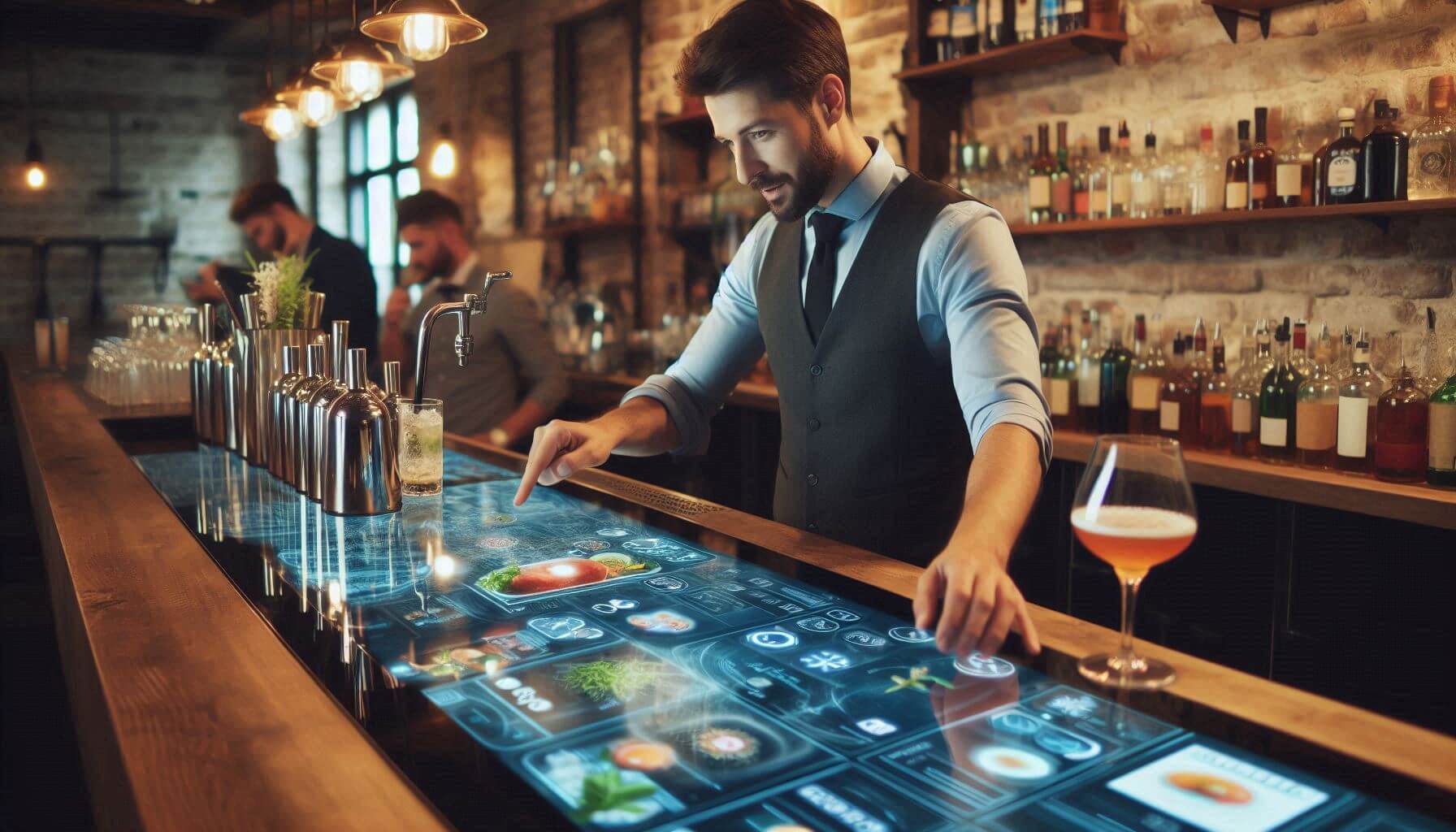
A bartender behind a bar top that's one giant touch screen, reviewing recipes

In how many years do we all think this type of bar top will be more mainstream? Note: AI-generated image.

We have clients planning to open their new concepts in 2025, so we’re sharing bar equipment innovations to inspire you and your bar plans.

There’s a lot to consider when transforming the vision for your space into a brick-and-mortar reality. Some of it is fun and exciting—drink menus and recipes, logo and branding, theme—and some is more technical (read: less exciting).

Of course, if you’re into design, precision, and equipment, selecting hardware and planning layout is probably fairly exciting. It is to us at KRG Hospitality!

To be clear, you won’t find bar tools in this article. I think the Flavour Blaster is rad, and I’ve been to my fair share of bars that use rotovaps, centrifuges, immersion circulators, liquid nitrogen, and sous vide machines.

Instead, I’m talking about the hardware that creates each bartender’s workstation; the cocktail cockpits that help ensure consistency, elevate the guest experience, and generate revenue.

Speaking of which…

Ergonomic Bar Stations

Roughly a decade ago, Perlick’s engineers partnered with one of the world’s most famous bartenders.

The company has been designing and manufacturing commercial bar equipment for decades. In 2015, they took their manufacturing to an entirely new level with the Tobin Ellis Signature Cocktail Station.

If you don’t know Tobin Ellis, definitely Google him after you finish this article. What you need to know now is that he has always been a proponent of proper bar design. I’ve attended many of his speaking appearances over the years, and he has driven one key point home during almost every presentation: Bartenders need to be involved in the bar design process.

Simply put, many interior designers have never worked behind a bar. Often times, they design bars that are inefficient; it’s just a reality of this business.

When Perlick and Ellis unveiled their cocktail station, it changed the game. Putting an emphasis on ergonomics and efficiency wasand still istransformative.

Benefits

Bartenders who aren’t blowing out their backs over the course of every shift are happier and healthier. Ergonomic bar stations are designed to fight strain, pain, hyperextension injuries, and fatigue.

Further, not having to leave their station to find tools, drinkware, bottles, and ingredients makes bartenders more efficient, and faster.

I shouldn’t have to point out that bar owners and operators should want their bartenders to work without risking damage to their bodies. Nor should I have to point out that a happy bartender improves the guest experience.

Of course, this goes for every role in a hospitality business. There are choices and investments owners and operators can (and should) make at the start of their projects to improve the employee experience. There should be no division between the guest and team experience; both are paramount, and both must be valued.

While ergonomic bar stations aren’t cheap, their pricing is fair in contrast to the revenue they can help bartenders generate. A reduction in injuries and fatigue, and related callouts, are just some of the benefits. Increased efficiency and speed are two more key advantages over standard stations.

Perlick, the pioneer, is no longer the only company manufacturing ergonomic bar stations. Behind Bars, EuroBar, and Krowne are a few examples of other brands with similar bar stations, so there are other options out there.

Modular Bar Stations

Ergonomics aren’t the only innovation in bar stations. While planning and laying out your bar, you can take advantage of modular offerings.

Different concepts have different needs, it’s that simple. If this were false, bar station manufacturers wouldn’t offer modular options; it wouldn’t make financial sense.

Operators are now able to select the hardware they want. The days of paying for, and putting up with, features that simply take up space and serve no purpose for a particular concept are over.

Bar sinks, speed rails, drain boards, trash stations, drawers and storage, blender stations, coffee benches… There are even manufacturers who make “voids” available. These are dies that hide lines and cords, and cut installation time significantly.

In addition to customizing your layout from the start, modular components mean your concept your grow. Your needs, and those of your bar team, may change over time. Rather than having to rip out bar stations and start over, a modular design allows hardware to be moved or replaced, saving time and money.

While this approach requires more consideration during the planning process, it’s far more efficient and beneficial than settling for pricey equipment that’s not exactly what you and your team want. Further, many items meant for modular bar design are now off the shelf, reducing lead time.

Interactive Bar Tops

The image at the top of this article alludes to this particular innovation. There are bar tops out there that are essentially giant touch screens.

For the most part, these bar tops appear to be focused on wowing guests. They register touch, so they offer an interactive element that some guests will find engaging.

However, I’ve seen more than one demo suggesting that interactive bar tops are also capable of recognizing drinkware. So, a bartender, when serving a drink to a guest, would be able to do so with an accompanying animation. Think of a Dark n Stormy followed by a wave, or a Cosmo with a cosmic, comet trail.

Another feature is the ability to display promotional videos or advertisements. Personally, I’d only want to see the occasional ad for an inhouse promotion, but I can see where the sponsor for a special event would find ads appealing.

However, I expect, some time in the future, for bartenders to have access to more features. POS integration could be powerful, as could the ability to look up a recipe. (Of course, I’d prefer the bar team have signature cocktail recipes memorized, but I see training program potential here.)

Anyone considering an interactive bar top should look for a few features. For one, strength. If glassware can scratch or damage the bar top, it’s not a good idea. Guests don’t always use coasters or bevnaps when they’re provided.

Another consideration is longevity, and therefore terms of any warranty. Finally, operators should take installation into account; if liquid can get underneath the bar top, that’s no good.

Basically, I don’t think these are past the gimmick stage. But I do think operators should keep tabs on interactive bar tops and their eventual improvement.

Self-Service Kiosks

Self-ordering kiosks have, at this point, become ubiquitous. This is particularly true in the QSR space.

Makes sense, right? A guest can stroll through the doors of their favorite fast-food restaurant, head straight to an ordering kiosk, pay, and wait for their order rather than wait in a line if there’s a rush at the counter.

However, I’m talking about a different type of self-service kiosk: the self-pour variety.

Announced earlier this year, as an example, was the iPourIt Kiosk.

You may be familiar with their flagship product, the iPourIt Tap Wall. These impressive, custom installations empower guests to try a range of products on their own schedule. They don’t have to wait for a server to come by every time they want to sample a different beverage. Further, the beverage options aren’t limited to wine or beer; operators can offer cocktails (with or without alcohol), coffee, tea, kombucha, etc.

The custom tap walls also serve as stunning centerpieces, with some venues opting for more than 100 self-serve panels. Of course, that means planning for the construction of the tap wall.

Or, you can opt for a self-pour kiosk.

These operate similarly to tap wall panels, but they’re a self-contained bit of kit that can be rolled and locked into place. I can certainly see the potential for bars or restaurants to leverage such kiosks for brunch service, or to introduce and test new beverages. And there’s definitely potential for hotels to use these kiosks to offer guests convenience and a memorable experience.

Efficient Washers

I’m sure you’re familiar with energy-efficient equipment. In America, it has become common for people seeking equipment in both commercial and residential settings to look for the Energy Star logo.

However, there’s more to consider than just energy costs related to electricity. For example, operators should search for “temperature recovery” or “heat recovery” when choosing glass washers.

These washers make use of internal heat “boosters” to sanitize glassware; they only need a cold water hookup. That’s just one way in which these washers operate in an energy-efficient way, and reduce operational costs.

The heat recovery system also dries and sanitizes glasses more quickly. Further, they’re designed to reduce how much water vapor escapes from the unit, meaning they’re far better for underbar placement.

In addition to washers that are recovery system equipped, operators should look for other energy-efficient features. There are washers that operate at low temperature, and washers that use less water than their standard counterparts.

Other features to consider are soft start (reduces noise, and prevents damage to glassware); reduced time per cycle (two minutes is a good place to start); unit height (ergonomics for the user); individual internal components that are easily accessed, removed, and serviced; and the material used for construction. To explain the latter, a washer built to retain heat and prevent it from escaping too quickly.

When operators plan ahead, including starting with a feasibility and identifying the ideal site, they can maximize their return on investment. Ergonomics and efficiency come at an initial cost, but the ROI has the potential to pay for these benefits and generate profit quickly.

Image: Microsoft Designer

KRG Hospitality Contact Request for Proposal 30 Minute Discovery Session

Book Below to Setup a 30-Minute Complimentary Discovery Call and Request for Proposal.


Top