Food hall

by David Klemt David Klemt No Comments

Credit Card Competition Act, Take Two

Credit Card Competition Act, Take Two

by David Klemt

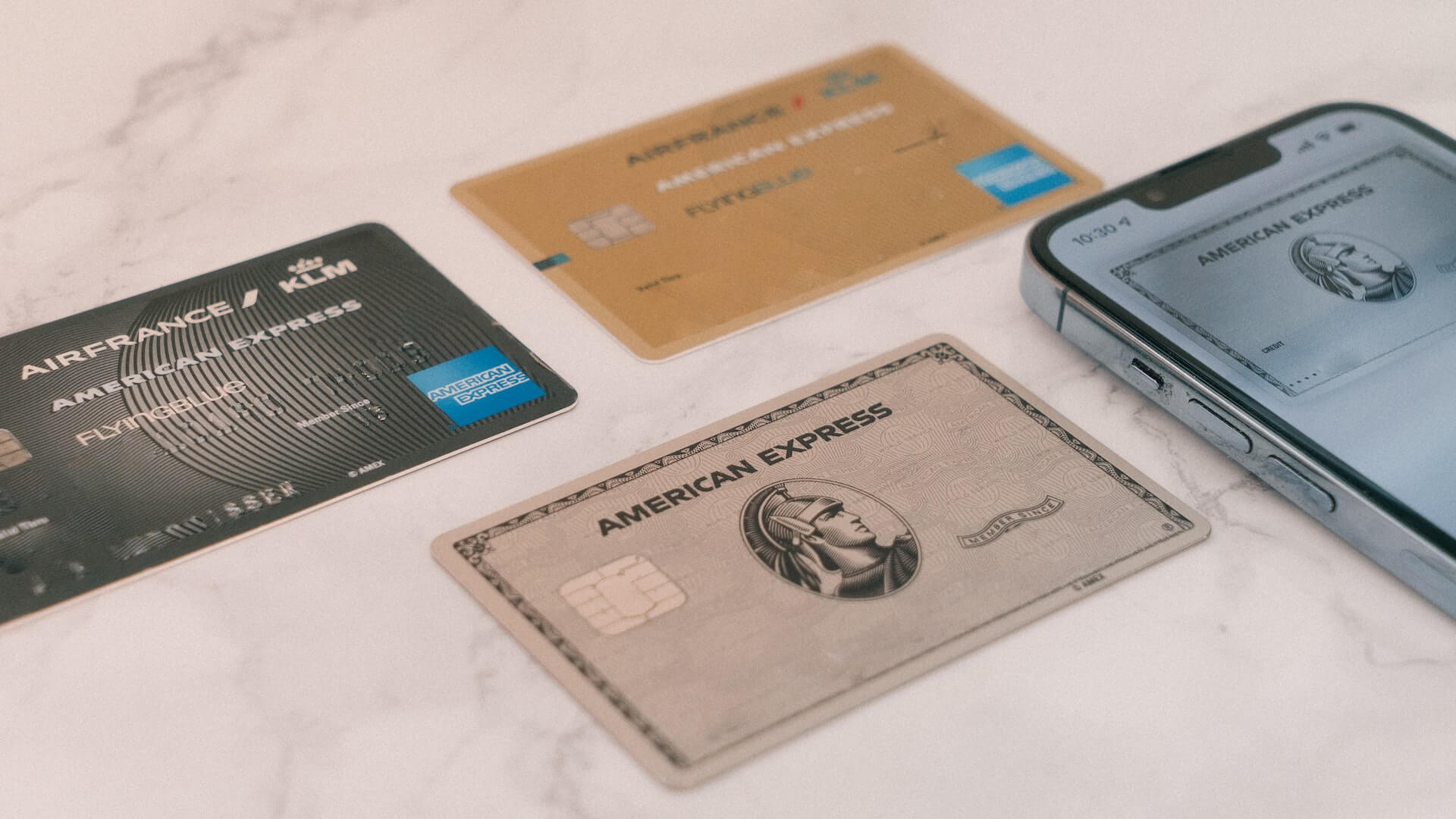
American Express charge cards

As we approach Election Day on November 8, it’s important to keep in mind that the Credit Card Competition Act of 2022 is still in play.

In fact, reports predict that another attempt to pass the bipartisan bill will take place in November. If reports are accurate, Senators Dick Durbin (D-IL) and Roger Marshall (R-KS) will try to include the bill in the National Defense Authorization Act (NDAA).

Now, that sentence and strategy may have you scratching your head. What, you may be asking yourself, do credit card fees have to do with defense spending?

Well, not much, truthfully. But you’re probably well aware that politicians will try to amend bills in bids to pass legislation they want. The common term for such a provision is “rider.”

It’s not difficult to understand why the Credit Card Competition Act has gone nowhere when we view Sens. Durbin and Marshall’s rider tactic.

Earlier this month, the senators attempted to include their bill within the NDAA. The reason is simple: the bill specifies the US Department of Defense’s (DoD) budget and expenditures each year. In other words, this is a “must-pass” bill.

However, Sens. Durbin and Marshall aren’t the only senators sponsoring bills. And they’re certainly not the only senators attempting to attach riders to the NDAA.

“It’s a bold strategy, Cotton.”

I will say, at least Sen. Durbin’s effort to attach the Credit Card Competition Act rider to the NDAA is somewhat related to the DoD.

You see, he and Sen. Marshall tried to tack on two amendments to push their bill through. The first amendment theorizes that veterans are being hurt by credit card fees. According to the senators, when military veterans make purchases at a military commissary, they are sometimes subjected to surcharges related to merchant interchange fees.

The second amendment brings the US Treasury Department and US Defense Department into the mix. This effort directs the departments to research just how much veterans are paying (annually, one would assume) in surcharges, and which companies these fees benefit. Then, the departments are to issue this report to Congress.

So, hey, points for attempting to make including the Credit Card Competition Act of 2022 relate to the NDAA for FY 2022. Of course, other senators are attempting to include their own riders. Should reporting prove accurate, some 900 amendments have been proposed. Supposedly, a few dozen might just make it.

This strategy didn’t work this month because the NDAA vote isn’t taking place in October. Instead, the plan is for the vote to take place sometime mid-November, when the US Senate reconvenes.

To learn more about the Credit Card Act of 2022, click here. If it’s a bill you support, let your elected officials know. Should you oppose the bill, let that be known to lawmakers as well.

Image: CardMapr.nl on Unsplash

by David Klemt David Klemt No Comments

F&B in Canada: Top Menu Items

F&B in Canada: Top Menu Items

by David Klemt

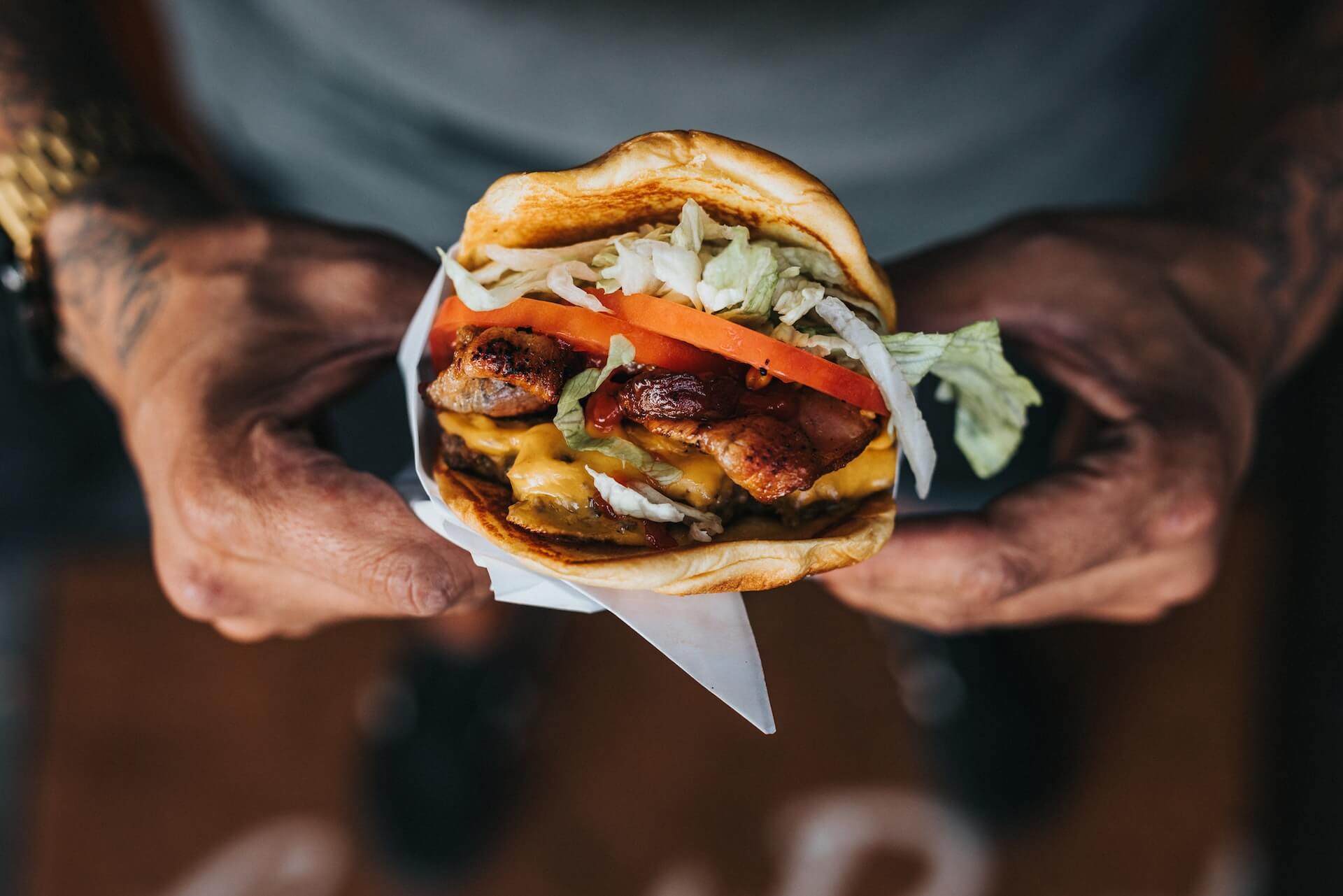
Closeup of hands holding burger

Those wondering what food and beverage menu items are performing best among consumers throughout Canada need wonder no more.

And why is that? Well, Restaurants Canada has the answers, revealing the top ten food and top ten beverage items.

Further, the organization compares each item’s performance. In this instance, Restaurants Canada analyses the percentage of orders that contained each food or beverage item from January to April 2022 in comparison to 2019.

These insights (and many more) are available in Restaurants Canada’s 2022 Foodservice Facts report. In fact, you can find our reviews of several of the restaurant advocacy group’s report topics via the links below:

For your own copy of this year’s Foodservice Facts report, click here.

Top 10 Canadian Drink Menu Trends

As you’ll see below, coffee is outperforming nearly every other beverage category. Specifically, Hot coffee is at the top, while Iced or frozen coffee is ranked third.

Unsurprisingly, Carbonated soft drinks / Pop / Soda split the two coffee categories. According to Restaurants Canada, the Carbonated soft drink category can credit its performance in large part to QSRs.

  1. Milk: 1.8% (2019) to 1.8% (2022)
  2. Iced tea: 2.9% (2019) to 1.6% (2022)
  3. Milkshakes / Smoothies: 2.1% (2019) to 2.0% (2022)
  4. Fruit juice: 3.8% (2019) to 3.0% (2022)
  5. Hot tea: 5.5% (2019) to 4.5% (2022)
  6. Alcohol beverages: 5.1% (2019) to 5.7% (2022)
  7. Water: 6.6% (2019) to 5.0% (2022)
  8. Iced or frozen coffee: 5.3% (2019) to 7.5% (2022)
  9. Carbonated soft drinks / Pop / Soda: 19.7% (2019) to 20.2% (2022)
  10. Hot coffee: 40.9% (2019) to 41.9% (2022)

Compellingly, Alcohol beverage performance in restaurants fluctuated by age group between 2021 and 2022. Alcohol order shares in restaurants, per Restaurants Canada:

  • Legal drinking Age (LDA) to 34: 46% (2021) to 43% (2022)
  • 35 to 49: 17% (2021) to 21% (2022)
  • 50-plus: 37% (2021) to 36% (2022)

Alcohol order shares in bars, according to Restaurants Canada:

  • LDA to 34: 35% (2021) to 35% (2022)
  • 35 to 49: 17% (2021) to 19% (2022)
  • 50-plus: 49% (2021) to 47% (2022)

Overall, the 35 to 49 age group appears to be consuming less alcohol in bars and restaurants in comparison to the LDA to 34 and 50-plus cohorts.

Top 10 Canadian Food Menu Trends

As Restaurants Canada notes, the Sandwich / Sub category has grown in 2022. Interestingly, the category just below it in growth, Chicken, is partially responsible for boosting Sandwich / Sub performance.

As far as entrees or “main attractions,” the Burger category remains at the top, beating out Breakfast, Sandwich / Sub, Chicken, and Pizza menu items.

  1. Cake / Squares / Muffins: 3.7% (2019) to 3.3% (2022)
  2. Salad: 4.3% (2019) to 3.8% (2022)
  3. Donuts / Beignets: 3.0% (2019) to 3.8% (2022)
  4. Breads: 4.3% (2019) to 3.4% (2022)
  5. Pizza / Panzerotti / Calzone: 4.1% (2019) to 4.3% (2022)
  6. Chicken: 7.6% (2019) to 8.5% (2022)
  7. Sandwich / Sub: 8.0% (2019) to 8.5% (2022)
  8. Breakfast: 10.8% (2019) to 11.4% (2022)
  9. Burger: 9.0% (2019) to 10.9% (2022)
  10. French fries / Potato / Sweet potato / Onion rings: 15.0% (2019) to 16.1% (2022)

Image: Nathan Dumlao on Unsplash

by David Klemt David Klemt No Comments

Members of Congress Send Letter to SBA

Members of Congress Send Letter to SBA Regarding $180 Million

by David Klemt

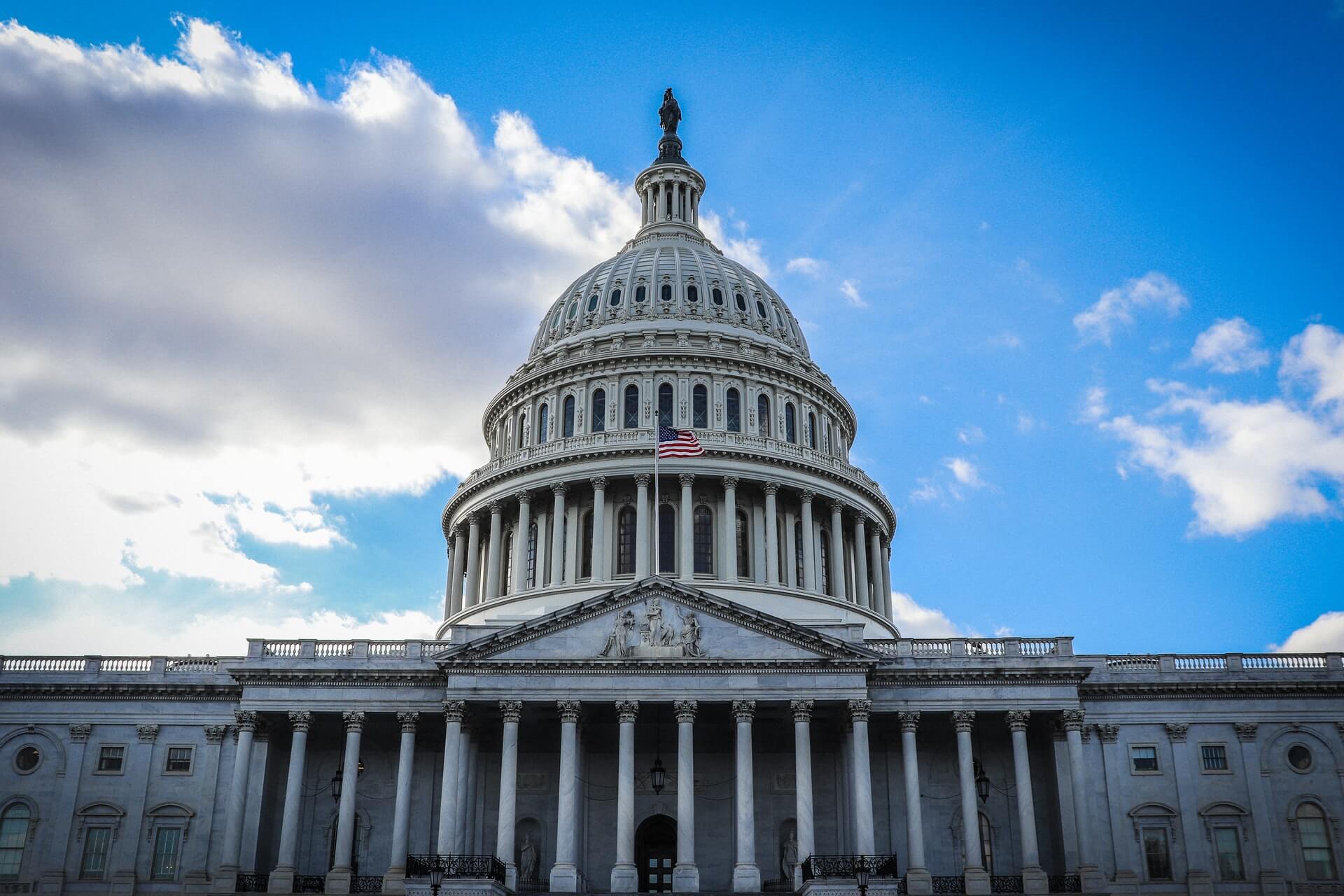
United States Capitol Building and Capitol Grounds

More than 70 members of Congress are urging the Small Business Administration to act quickly to fund eligible RRF applicants.

This news comes on the heels of the findings of the Government Accountability Office’s investigation into the RRF. As you may recall, the GAO discovered $180 million in unobligated funds.

In response, 73 representatives and senators sent the SBA a letter. Sen. Catherine Cortez Masto (D-NV) and Rep. Earl Blumenauer (D-OR) are leading the effort to quickly and fairly distribute the $180 million.

At the start, members of Congress ask that the SBA take immediately action. Also, that the SBA give priority consideration to RRF applicants who didn’t receive funds even though they were awarded grants.

By the way, that’s about 7,000 applicants.

Unfortunately, the recently passed Inflation Reduction Act of 2022 doesn’t include funds to replenish the RRF. And while $180 million is nowhere near the $42-43 billion our industry needs and deserves, it’s something. In fact, it’s a reason to keep pushing Congress to do the right and responsible thing.

Interestingly, the letter sent to the SBA also urges the clawing back of funds for various reasons. One social media user, in response to the letter, suggested auditing the recipients. Presumably, this would also lead to a clawback and, in turn, the further awarding of grants.

Key Segments of the Letter

“Last month, the Government Accountability Office (GAO) released a report titled Restaurant Revitalization Fund: Opportunities Exist to Improve Oversight that stated that as of as of June 2022, $180 million of RRF funding was unobligated. As you know, about 177,000 restaurants that applied to the program did not receive awards. While we understand the remainder of the funding will not reach every business that applied, it is imperative that the SBA distribute every dollar to help as many struggling restaurants as is feasible.

“In addition to these actions, we are also urging that SBA take action to recover funds that have been awarded to ineligible applicants, were found to be accepted fraudulently, or could otherwise be returned. For example, the aforementioned GAO report states that SBA does not require recipients to report their operating status, despite the statute requiring that businesses that permanently close to return the unused funds to SBA. SBA has itself identified potentially ineligible recipients, such as clubs and hotels that failed to meet statutory eligibility criteria. Money recovered from fraudulent and ineligible businesses can subsequently be used to help
fund the many businesses who were unable to receive grants. We urge you to take action on this matter and provide us with detailed information on the amount of funding that may be recovered as well as SBA’s progress in doing so.”

Image: Francine Sreca from Pixabay

by David Klemt David Klemt No Comments

Breakdown: How Senators Voted on RRF

Breakdown: How Senators Voted on RRF

by David Klemt

U.S. Capitol Building exterior, cloudy blue skies

After a year of waiting, we now know the fate of the Restaurant Revitalization Fund: a 52 to 43 vote that saw RRF replenishment fail on the Senate floor.

Last Thursday, the US Senate voted to debate the Small Business COVID Relief Act of 2022 (S.4008). A filibuster put an end to this effort to replenish the RRF.

To be blunt, this is a disgrace. Eligible RRF applicants have been awaiting needed and deserved grants for a year. We were left out of Build Back Better, we were left out of the $1.5 trillion omnibus spending bill passed in March.

A contributing factor to why this is so disappointing is the passing of S.3811. Of particular note, 32 of the senators who voted against $40 billion for American restaurants and bars voted in favor of $40 billion for supplemental aid for Ukraine.

Now, I’m not saying that Ukraine doesn’t deserve our support. Likewise, I’m not saying that we shouldn’t have voted to provide the war-torn country $40 billion in aid.

However, I am saying that I find it indefensible that dozens of our senators would send that kind of money overseas, then turn around and deny relief for American businesses.

In one moment we have senators saying America needs to come first. They then proceed to turn their backs on hard-working Americans.

Nay Votes

Unfortunately, 43 senators—all Republican—voted against the Small Business COVID Relief Act of 2022. Therefore, they voted against replenishing the RRF.

However, that doesn’t mean all Republican senators voted against the bill. Indeed, four Republicans voted with their Democrat and Independent peers.

  • Barrasso (R-WY)
  • Blackburn (R-TN)
  • Boozman (R-AR)
  • Braun (R-IN)
  • Burr (R-NC)
  • Capito (R-WV)
  • Cornyn (R-TX)
  • Cotton (R-AR)
  • Cramer (R-ND)
  • Crapo (R-ID)
  • Cruz (R-TX)
  • Daines (R-MT)
  • Fischer (R-NE)
  • Graham (R-SC)
  • Grassley (R-IA)
  • Hagerty (R-TN)
  • Hawley (R-MO)
  • Hoeven (R-ND)
  • Hyde-Smith (R-MS)
  • Inhofe (R-OK)
  • Johnson (R-WI)
  • Kennedy (R-LA)
  • Lankford (R-OK)
  • Lee (R-UT)
  • Lummis (R-WY)
  • McConnell (R-KY)
  • Moran (R-KS)
  • Paul (R-KY)
  • Portman (R-OH)
  • Risch (R-ID)
  • Romney (R-UT)
  • Rounds (R-SD)
  • Rubio (R-FL)
  • Sasse (R-NE)
  • Scott (R-FL)
  • Scott (R-SC)
  • Shelby (R-AL)
  • Sullivan (R-AK)
  • Thune (R-SD)
  • Tillis (R-NC)
  • Toomey (R-PA)
  • Tuberville (R-AL)
  • Young (R-IN)

Yea Votes

It’s important to remember that the Small Business COVID Relief Act of 2022 was a bipartisan effort. Sens. Ben Cardin (D-MD) and Roger Wicker (R-MS) introduced the bill, which included $40 billion for the RRF and $8 billion for other businesses.

Four Republican senators and two Independents voted in the affirmative with all Democrats.

  • Baldwin (D-WI)
  • Bennet (D-CO)
  • Blumenthal (D-CT)
  • Blunt (R-MO)
  • Booker (D-NJ)
  • Cantwell (D-WA)
  • Cardin (D-MD)
  • Carper (D-DE)
  • Casey (D-PA)
  • Cassidy (R-LA)
  • Collins (R-ME)
  • Coons (D-DE)
  • Cortez Masto (D-NV)
  • Duckworth (D-IL)
  • Durbin (D-IL)
  • Feinstein (D-CA)
  • Gillibrand (D-NY)
  • Hassan (D-NH)
  • Heinrich (D-NM)
  • Hickenlooper (D-CO)
  • Hirono (D-HI)
  • Kaine (D-VA)
  • Kelly (D-AZ)
  • King (I-ME)
  • Klobuchar (D-MN)
  • Leahy (D-VT)
  • Lujan (D-NM)
  • Manchin (D-WV)
  • Markey (D-MA)
  • Menendez (D-NJ)
  • Merkley (D-OR)
  • Murkowski (R-AK)
  • Murphy (D-CT)
  • Murray (D-WA)
  • Ossoff (D-GA)
  • Padilla (D-CA)
  • Peters (D-MI)
  • Reed (D-RI)
  • Sanders (I-VT)
  • Schatz (D-HI)
  • Schumer (D-NY)
  • Shaheen (D-NH)
  • Sinema (D-AZ)
  • Smith (D-MN)
  • Stabenow (D-MI)
  • Tester (D-MT)
  • Warner (D-VA)
  • Warnock (D-GA)
  • Warren (D-MA)
  • Whitehouse (D-RI)
  • Wicker (R-MS)
  • Wyden (D-OR)

Not Voting

Three Democrat and two Republican senators didn’t vote on S.4008.

  • Brown (D-OH)
  • Ernst (R-IA)
  • Marshall (R-KS)
  • Rosen (D-NV)
  • Van Hollen (D-MD)

Yay Votes for Ukraine, Nay Votes for RRF

The following senators, all Republican, voted to send $40 billion in aid to Ukraine.

The same day, they voted against $40 billion to replenish the RRF, voting against American restaurants and bars.

  • Barrasso (R-WY)
  • Burr (R-NC)
  • Capito (R-WV)
  • Cornyn (R-TX)
  • Cotton (R-AR)
  • Cramer (R-ND)
  • Cruz (R-TX)
  • Daines (R-MT)
  • Fischer (R-NE)
  • Graham (R-SC)
  • Grassley (R-IA)
  • Hoeven (R-ND)
  • Hyde-Smith (R-MS)
  • Inhofe (R-OK)
  • Johnson (R-WI)
  • Kennedy (R-LA)
  • Lankford (R-OK)
  • McConnell (R-KY)
  • Moran (R-KS)
  • Portman (R-OH)
  • Risch (R-ID)
  • Romney (R-UT)
  • Rounds (R-SD)
  • Rubio (R-FL)
  • Sasse (R-NE)
  • Scott (R-FL)
  • Scott (R-SC)
  • Shelby (R-AL)
  • Sullivan (R-AK)
  • Thune (R-SD)
  • Tillis (R-NC)
  • Toomey (R-PA)
  • Young (R-IN)

Image: PartTime Portraits on Unsplash

by David Klemt David Klemt No Comments

8 Glendalough Cocktail Recipes for St. Patrick’s Day and Beyond

Offer your guests something different for your St. Patrick’s Day promotion with Glendalough Distillery cocktail recipes.

Without a doubt, you should have plenty of the expected Irish whiskeys on hand. However, Glendalough Distillery Double Barrel, Pot Still, Wild Gin, and Rose Gin are extraordinary Irish whiskeys and gins.

Each spirit the distillery crafts honors the art of Irish distillation, a craft that stretches back centuries. What’s more, each whiskey Glendalough crafts is single malt—there are no light-bodied blends in their lineup.

To learn more, check out episode 71 of the Bar Hacks podcast with Glendalough Distillery co-founder and national brand ambassador Donal O’Gallachoir.

by David Klemt

Glendalough Distillery Wild Gin Irish gin

8 Amazing Irish Whiskey and Gin Cocktails

Below, eight refreshing and sophisticated drink recipes made with Glendalough whiskeys and gins. Sláinte!

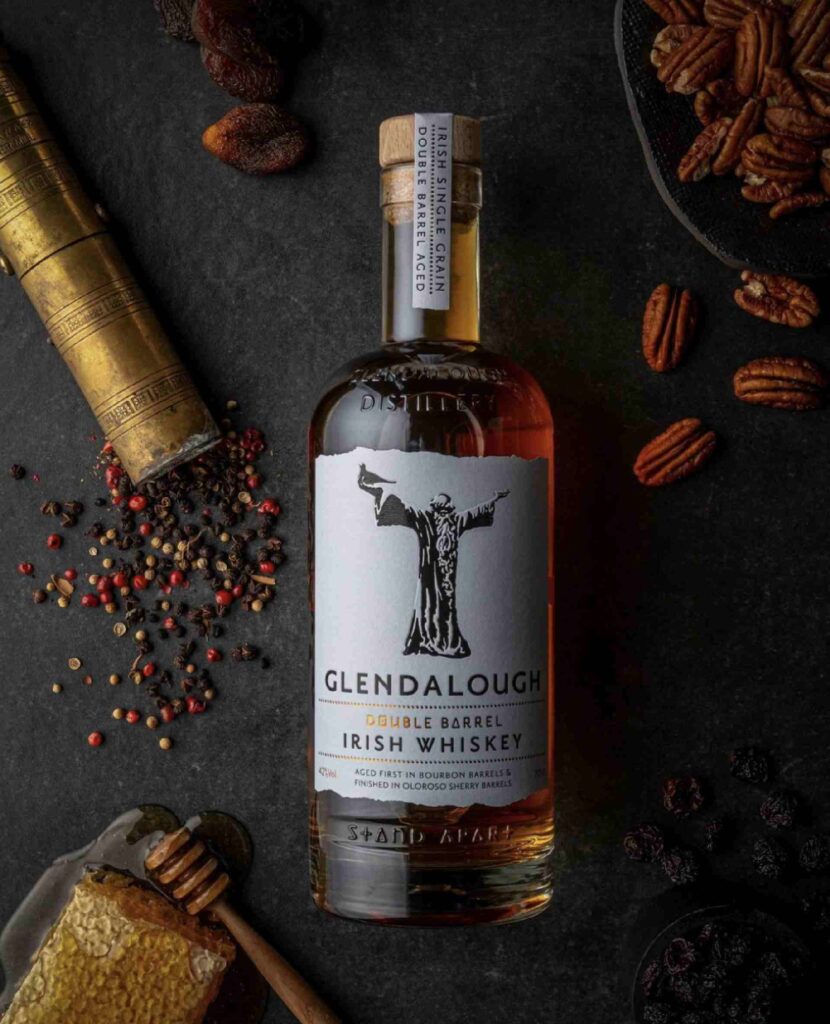
Glendalough Distillery Double Barrel Single Malt Irish Whiskey

The Lough Inn

This highball is made with Glendalough Double Barrel, a single-grain Irish whiskey aged in ex-bourbon barrels before being finished in Oloroso sherry casks.

  • 2 oz. Glendalough Double Barrel Single Grain Irish Whiskey
  • 1 oz. Spiced honey syrup (see note)
  • 1 oz. Fresh lemon juice
  • Soda to top
  • Lemon wheel or slice to garnish
  • Mint leaf to garnish
  • 1 cup Honey for spiced honey syrup
  • 0.5 cup Water for spiced honey syrup
  • 4 Cinnamon sticks for spiced honey syrup
  • 1 pod Star anise for spiced honey syrup

Add ice to a highball glass, then add first three ingredients. Top with soda water. Garnish with lemon wheel or slice and freshly torn mint leaf.

For spiced honey syrup: Add honey, water, cinnamon sticks, and star anise to pot. Bring to a boil, then stir. Strain into container.

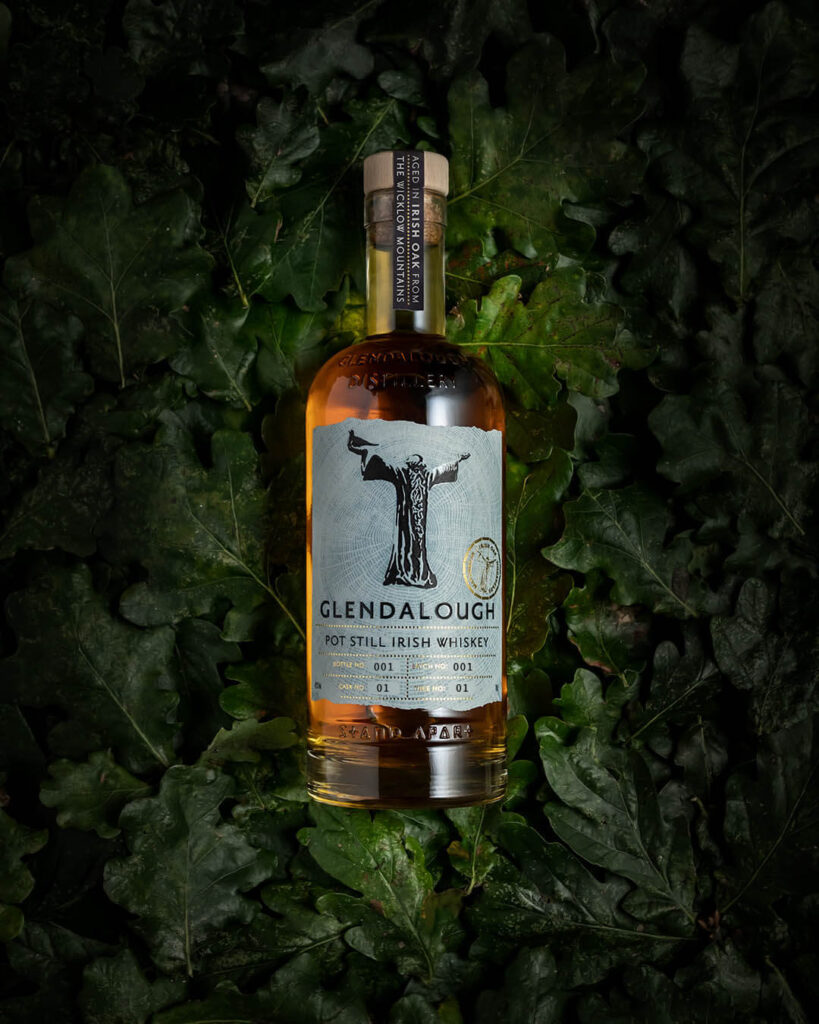
Glendalough Distillery Pot Still single malt Irish whiskey

Pot Still Highball

Deceptively simple to build, this cocktail highlights the terroir of the land surrounding Glendalough Distillery.

  • 1.5 oz. Glendalough Pot Still
  • Soda to top
  • Grapefruit peel to garnish
  • Mint leaf to garnish (freshly torn and slapped, of course)

Prepare a highball glass with an ice shard, spear or cylinder. Pour in Glendalough Pot Still whiskey, then top with soda. Glendalough Distillery recommends a 1:2 ratio, Pot Still to soda. Garnish with mint leaf.

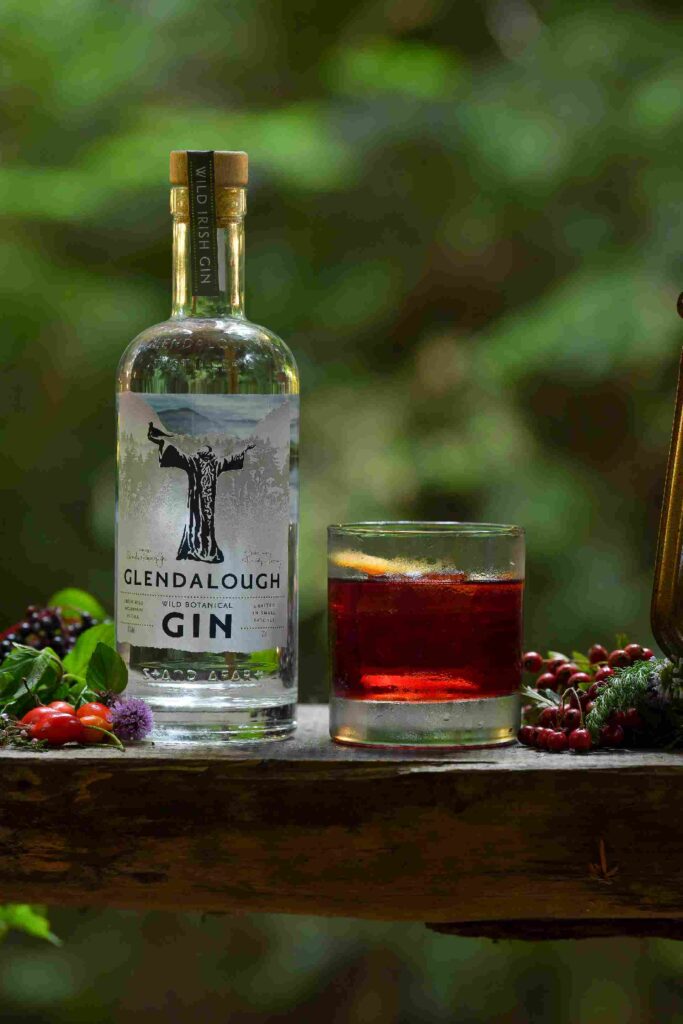
Glendalough Distillery Wild Gin Negroni cocktail

Glendalough Negroni

The foraged botanicals in Glendalough Wild Gin add even more complexity and depth to the classic Negroni. In fact, the flavors work so well this recipe maintains the Negroni’s crucial 1:1:1 ratio.

Prepare an Old Fashioned with ice. Add first three ingredients to glass in the above order. Add more ice if necessary. Stir, express orange peel, and place as garnish.

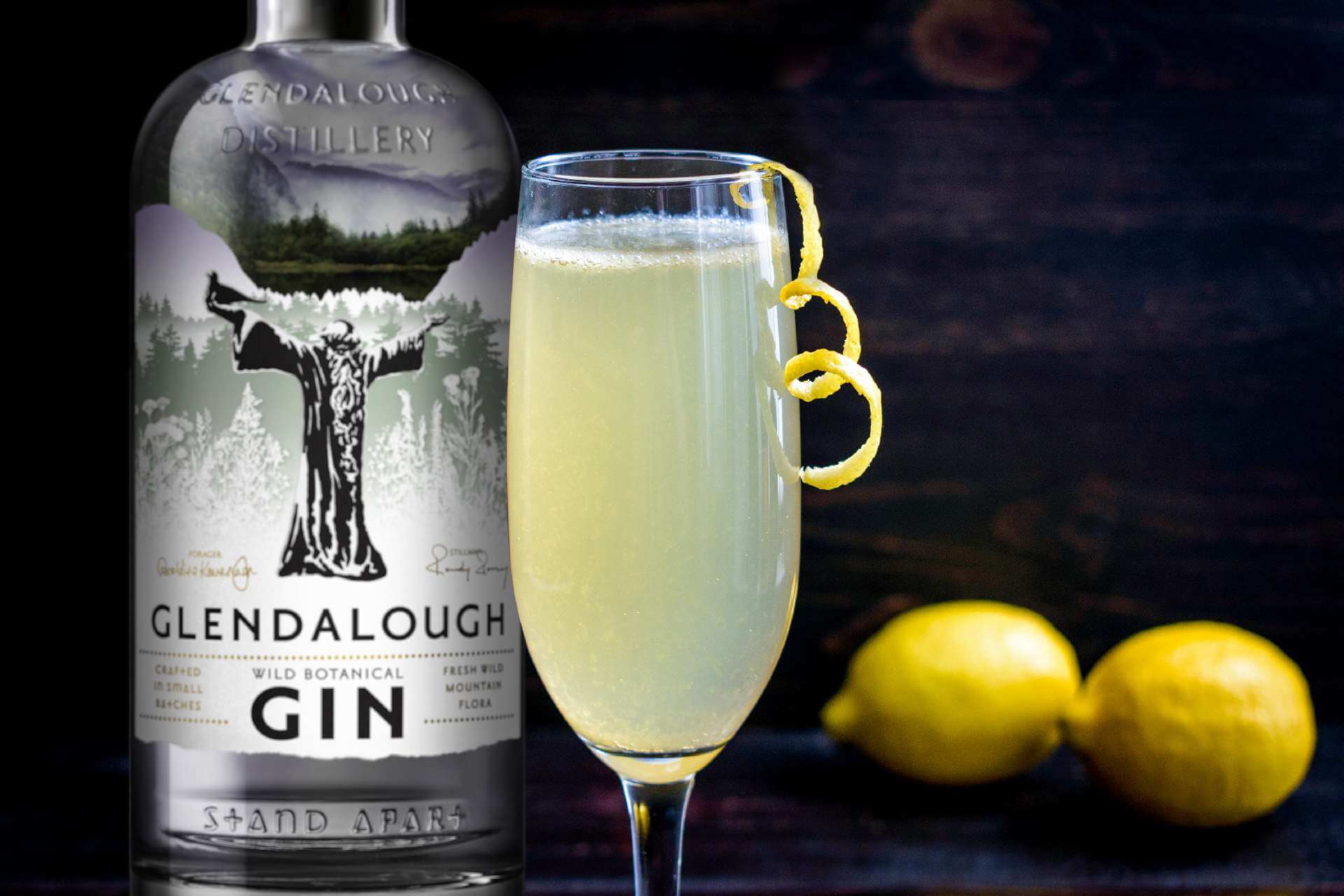
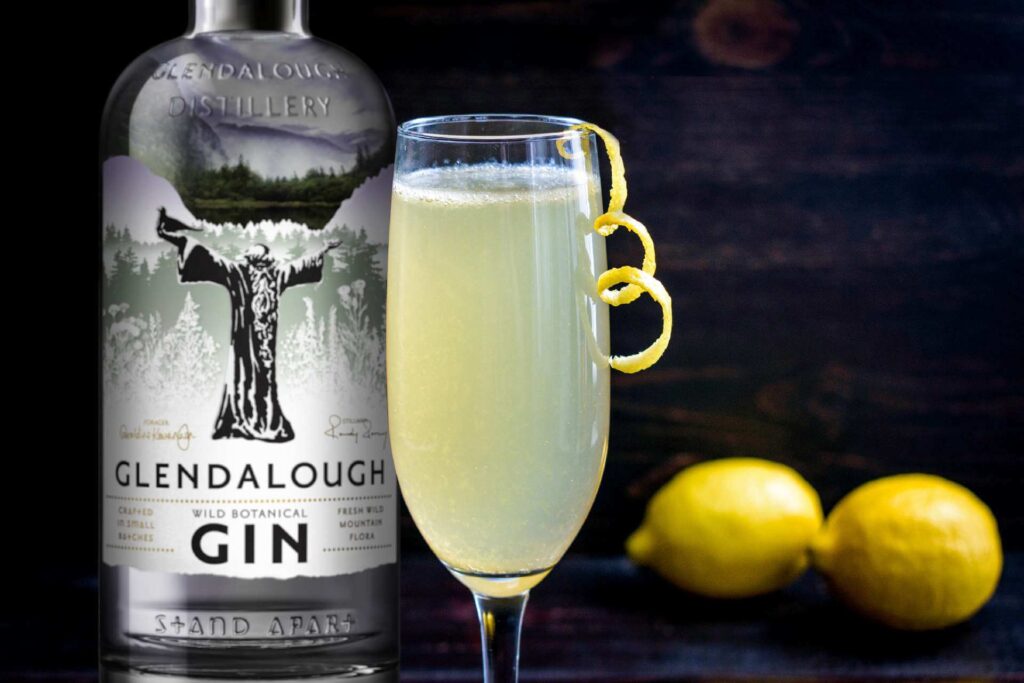
Glendalough Distillery Wild Gin Irish gin

Glendalough Wicklow 75

Bubbles make everything better and everyone happier.

Add all ingredients to shaker. Add ice and shake until well chilled. Strain into Champagne flute, top with Prosecco, and garnish with lemon twist.

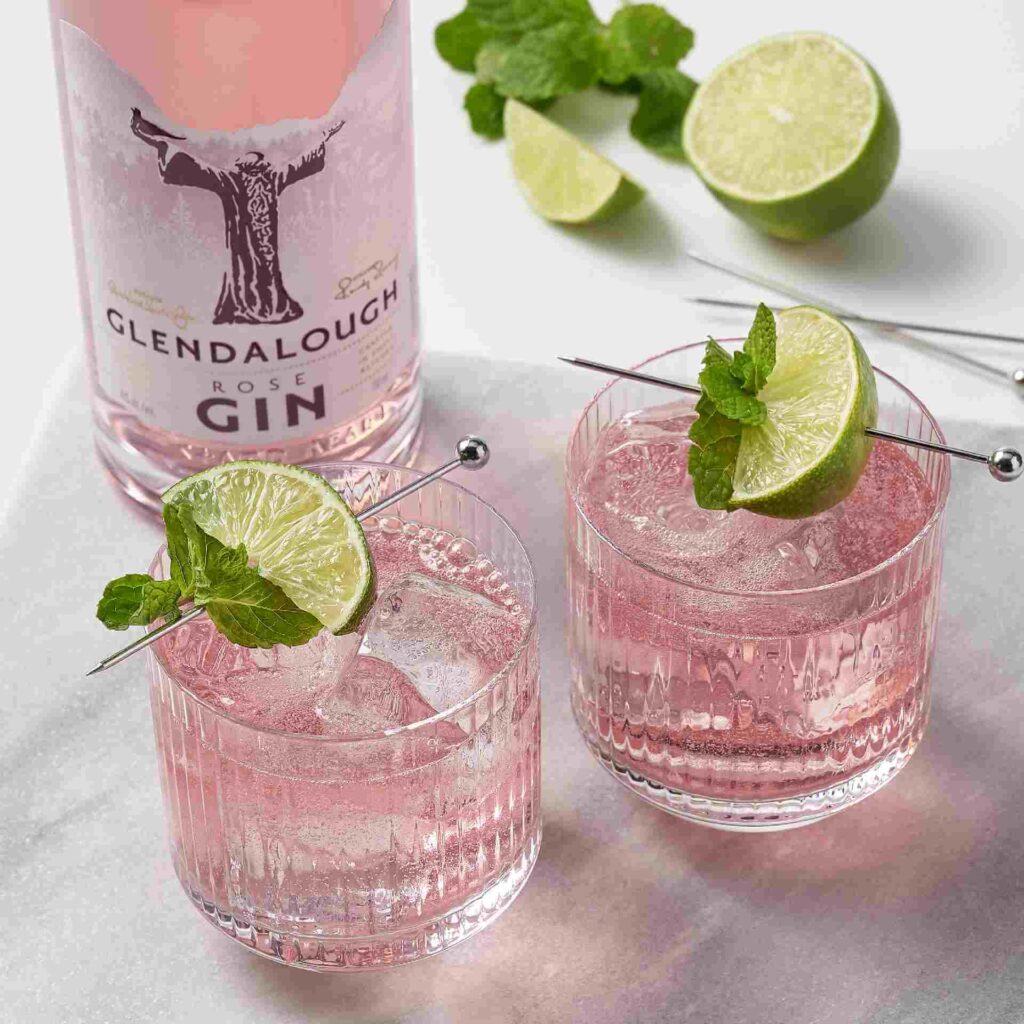
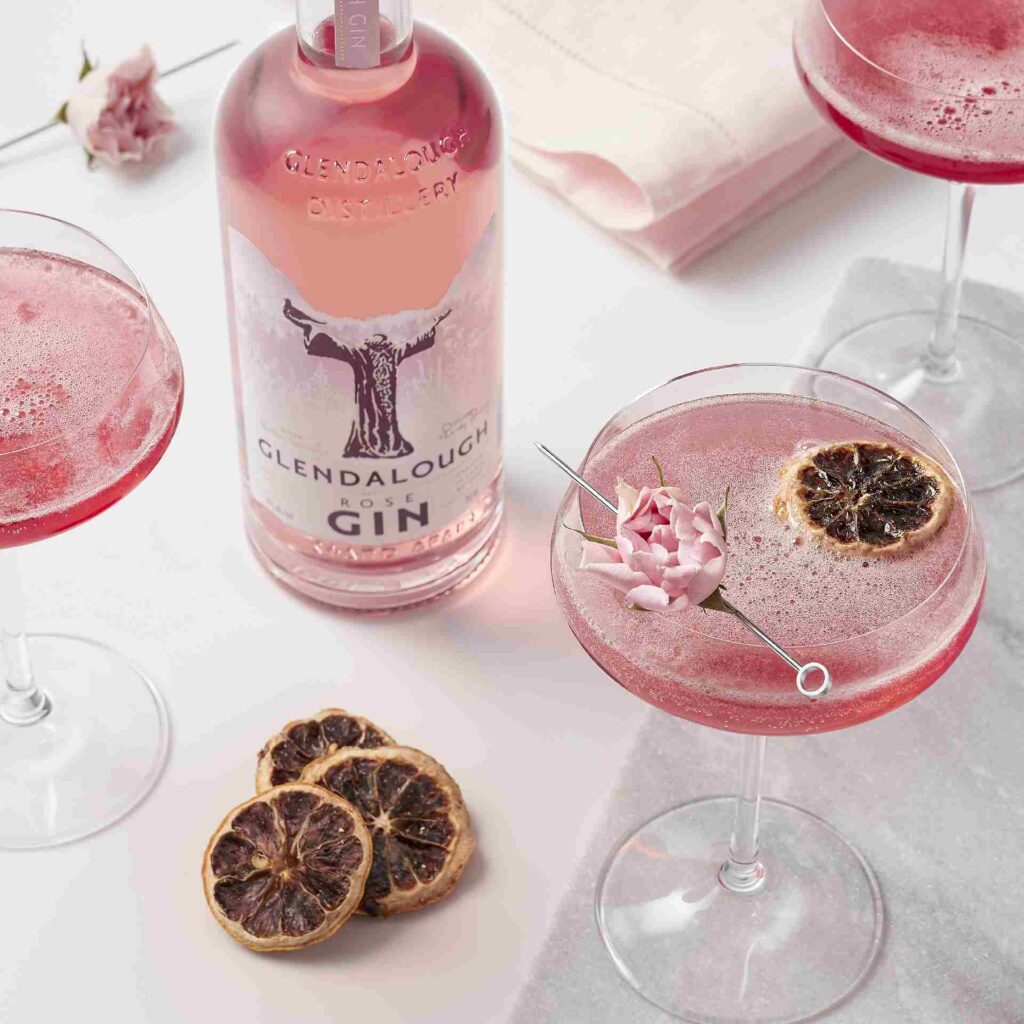
Glendalough Distillery Rose Gin Irish gin and cocktails

Glendalough Rose G&T

This simple classic receives a huge visual and aromatic boost from Glendalough Rose Gin.

  • 2 oz. Glendalough Rose Gin
  • Tonic to top (the higher the quality, the better)
  • Lime slice
  • Mint leaves

Add ice to glass, then add Rose Gin. Top with tonic, and garnish with lime slice and mint leaves.

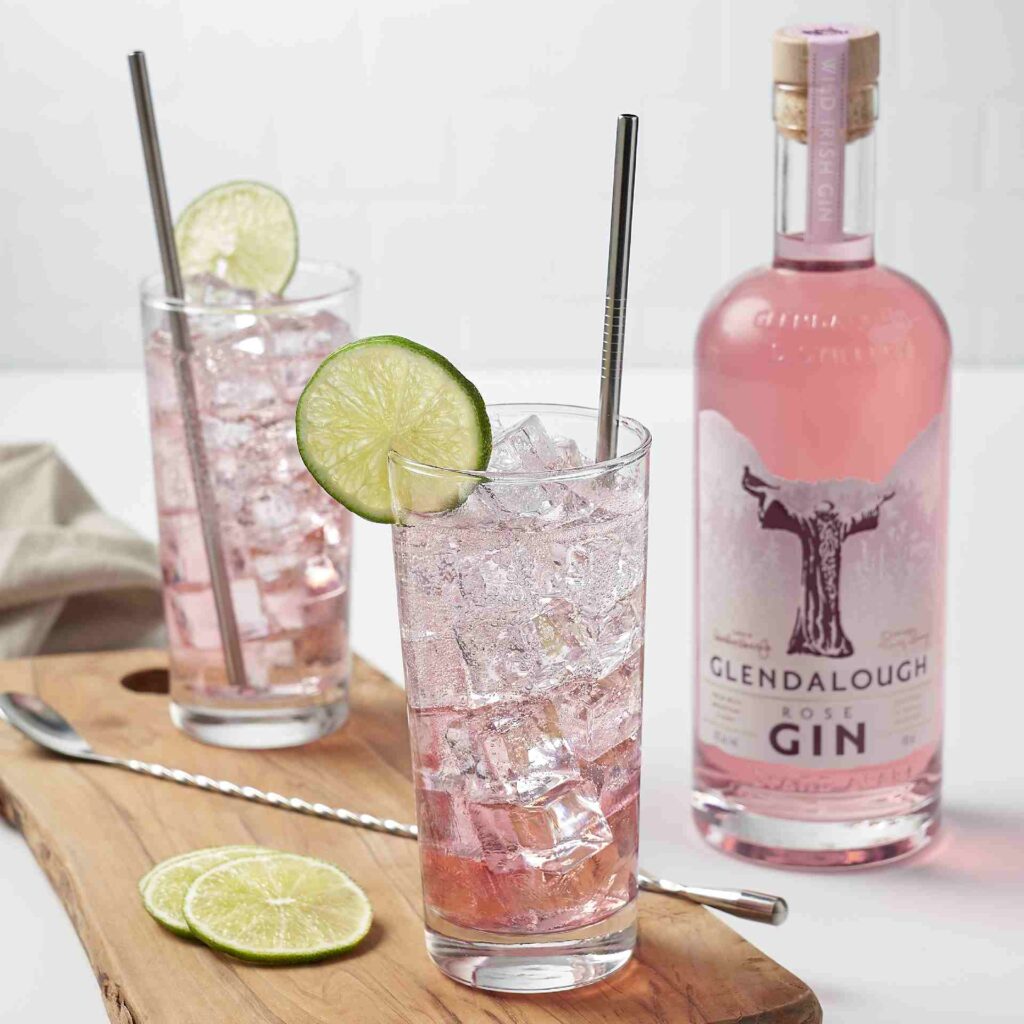
Glendalough Distillery Rose Gin Fizz

Glendalough Rose Gin Fizz

One way to elevate the highball is to use a striking pink-hued Irish gin.

  • 1.5 oz. Glendalough Rose Gin
  • 0.5 oz. Elderflower liqueur
  • Raspberry & Lime sparkling water to top
  • Lime wheel to garnish

Add ice (spear, shard or cylinder for impact), Rose Gin, and liqueur to highball glass. Stir, then add sparkling water to top. Garnish with lime wheel.


View this post on Instagram


A post shared by Glendalough US (@glendaloughus)

Glendalough Rose Collins

Boost the classic Collins with Glendalough’s striking rose-petal gin.

  • 1.5 oz. of Glendalough Rose Gin
  • 1 oz. of Lemon juice (freshly squeezed)
  • 0.5 oz. of Sugar syrup (1:1 ratio, hot water to sugar)
  • Soda to top
  • Lemon peel to garnish
  • Cherry to garnish

Combine first three ingredients in a shaker with a cup of ice. Place an ice shard, spear or cylinder to a highball glass. Shake until well chilled, then strain into glass. Top with soda, and garnish with lemon peel and cherry.

Glendalough Distillery Rose Gin Hibiscus Rose

Glendalough Hibiscus Rose

Refreshing and flavorful, the hibiscus tea syrup plays incredibly well with Glendalough Rose Gin.

  • 1.5 oz. Glendalough Rose Gin
  • 0.5 oz. Hibiscus tea syrup (see note)
  • 0.5 oz. Lemon juice (fresh squeezed)
  • Prosecco to top
  • Dehydrated lemon wheel to garnish
  • Rose petals to garnish
  • 33 oz. Water for hibiscus tea syrup
  • 16 oz. Sugar for hibiscus tea syrup

Add first three ingredients and ice to a shaker. Shake until well chilled and double strain into a coupe.  Top with Prosecco, and garnish with dehydrated lemon wheel and rose petals.

For the hibiscus tea syrup: Steep seven hibiscus tea bags in 33 ounces of water for 15 minutes. Add 16 ounces of sugar.

Images & Recipes: Glendalough Distillery

Related Reading

Work with Us

Click the image below to partner with us on your project.

Client Intake Form - KRG Hospitality

by krghospitality krghospitality No Comments

House Passes $1.9B Covid Relief Bill, RRF

House Passes $1.9B Covid Relief Bill, RRF

by David Klemt

US Capitol Building Dome

The Senate version of the American Rescue Plan Act of 2021 is through the House, awaiting the signature of President Joe Biden.

Once the bill is signed by the president, it will be the law of the land.

That means our industry is finally receiving at least a portion of the relief it so desperately needs. After nearly a year of campaigning and fighting, the Restaurant Revitalization Fund (RRF) is a reality.

Restaurant Revitalization Fund

Managed by the Small Business Administration properly, the RRF is a critical lifeline for small- and mid-sized operators.

The SBA will prioritize women- and veteran-owned and operated businesses for the first 21 days. Economically and socially disadvantaged businesses will also receive priority.

Maximum grant amounts are $5 million per individual restaurant or $10 million per restaurant group.

Eligible Expenses

Importantly, eligible expenses fall between February 15, 2020 through December 31, 2021.

Eligible expenses include but are not limited to:

  • payroll and benefits;
  • mortgage (no prepayment);
  • rent (no prepayment);
  • utilities, maintenance;
  • supplies (including PPE and cleaning materials);
  • food;
  • operational expenses;
  • covered supplier costs (as defined by the SBA under the PPP program); and
  • sick leave.

American Rescue Plan Provisions

Of course, the RRF is just a small portion of the American Rescue Plan. The bill includes many provisions for national Covid-19 testing and vaccine distribution.

States and local governments receive $20 billion to assist low-income households with rent, utility bills, and back rent. There’s an increase to benefits of 15 percent through September for those on food stamps.

Also, the Emergency Injury Disaster Loan (EIDL) program receives $15 billion, which will help small business owners.

The $300-per-week federal boost to unemployment benefits remains the same rather than climbing to $400 per week.

Crucially, the bill waives the first $10,200 of unemployment benefits from 2020. That amount rises to $20,400 for married couples. To receive the waiver, a household must have an adjusted gross income of $150,000. That AGI is the same for individual and combined households.

Individuals with an AGI of up to $75,000 will receive stimulus payments of $1,400. That amount phases out completely at $80,000 for individuals, $160,000 for couples.

What’s Next

The SBA is responsible creating and implementing the RRF application process.

For now, it’s wise for operators to calculate their grant amounts:

  • Open prior to 2019: 2019 revenue minus 2020 revenue minus PPP loans.
  • 2019 opening: Average of 2019 monthly revenues times 12 minus 2020 revenues.
  • 2020 opening: Eligible to receive funding equal to eligible expenses incurred.

Since the SBA is the agency overseeing the $28.5 billion RRF, it’s a good idea to monitor their site for pertinent dates, details and requirements.

Image: Joshua Sukoff on Unsplash

Top