
Hotel bar

by David Klemt David Klemt No Comments

The Real Cost of Business

The Real Cost of Business: What Independent Operators Must Do to Win

by Doug Radkey

KRG Hospitality president and principal consultant Doug Radkey on stage with his fellow panelists at Bar & Restaurant Expo Denver 2025

On stage at BRE 2025 in Denver, Co.

We need to get much more comfortable having uncomfortable conversations about the reality of being a hospitality operator these days.

On a recent trip to Denver, I had the privilege of joining Ashley Bray, Chef Adrianne Calvo, and Lauren Barash on stage at The Hospitality Show and Bar & Restaurant Expo for a conversation that every operator needs to have.

The topic and panel title was “The Real Cost of Business: Economic Pressures & Policy Shocks for Independent Operators.”

This session wasn’t theory. It wasn’t sugar-coated optimism.

This session was raw, real, and filled with straight talk about what’s actually happening across the hospitality landscape right now.

And it was exactly the kind of conversation this industry needs more of, because let’s be honest: today’s operators aren’t just fighting one battle.

They’re fighting them all.

The Stacked Deck: What’s Hitting Operators Right Now

It’s no secret. Tariffs are up. Labor costs are up. Packaging and product costs are up. Rent is up.

And consumer spending? It’s currently on some shaky ground.

Margins continue to be thin for most operators, and while these operators are navigating inflation, interest rate hikes, and volatile supply chains, they’re also facing the human tolls: fatigue, burnout, and turnover at every level.

But here’s the thing: this industry is not broken. It may be bruised, and it may be tired. But it’s resilient.

The bigger problem? It’s too reactive. And reactivity is what often kills profitability.

Hospitality is built on anticipation, such as reading the room before the guest even realizes what they want. But too many owners have lost that skill.

Instead of leading, they fight fires. Rather than anticipate, they react.

To win in this era, you need a playbook supported by clarity, not chaos.

Back to the Fundamentals of Hospitality

Let’s start here, because it’s something I said on the panel. I’m going to keep saying it: Operators need to get back to the fundamentals of hospitality.

Hospitality is not a product, it’s a performance. It’s a feeling. Hospitality is how people are made to feel when they walk through your door.

This is a people-first business. This is a people-over-profits business.

That’s your anchor.

When operators start chasing trends instead of refining fundamentals, they lose sight of what this business is really about:connection.

The businesses that are navigating the challenges and winning right now aren’t necessarily the ones spending the most or cutting the deepest. They’re the ones doubling down on service, culture, and consistency.

Operators confronting today’s challenges successfully have strategic playbooks, onboarding systems, the right tech stack, SOPs, and leadership frameworks in place. Their well-developed systems turn daily operations into muscle memory.

That’s the foundation.

Lead with Strategy and Anticipation

One of the most powerful themes from our conversation was about mindset.

Operators who win in this climate are those who lead with strategy, not emotion.

They’re also the operators who anticipate challenges instead of just react to them.

It’s not strategic to wait for your accountant’s monthly report to tell you where you stand. By then, it’s too late.

You need to have real-time visibility into your numbers, your labor productivity, your inventory, and your guest behaviors.

That’s how you lead with anticipation rather than panic.

The right strategy doesn’t live on a whiteboard, it lives in your systems. It lives in your team meetings. It lives in the mindset you reinforce daily.

If your business only moves when you do, you don’t have a strategy, you have stress-induced operations.

Data is the New Cash

Here’s a truth that every operator should be repeating: Data is just as valuable as cash.

In a volatile market, your ability to make decisions quickly—based on evidence, not instinct—is your competitive edge.

You should know your key metrics at all times:

  • Guest frequency.
  • Average spend per guest.
  • Labor efficiency.
  • Food, beverage, and prime costs.
  • Revenue and profit per square foot.
  • Marketing conversion.

If you can’t track these easily, it’s time to upgrade your tech stack.

Technology shouldn’t stress you out, it should simplify your life. The tech you trust to help you run your business should help you see clearly.

It’s simple: When you understand your data, you control your business instead of being controlled by it.

Menus Built with Intention

Another powerful part of our discussion was about menus. During times of uncertainty, your menu is both your marketing strategy and your financial engine.

Here’s the shift: You need to develop your menu strategically. Focus on what sells, what tells your story, what aligns with your guest, and what aligns with your financial obligations.

Every menu item should have a purpose. Every ingredient should do double duty.

Have a menu of 12 to 15 items that are high-impact items.

Use storytelling to create perceived value. Guests don’t just buy what’s cheapest, they buy what feels meaningful to them.

That’s how you maintain profitability without discounting yourself into irrelevance.

As I said during the panel, “Focus on the guest experience first,” and “sales are a vanity metric. Profit tells your story.

Perception of Value Without Discounts

Discounting can become a slippery slope. It’s a tactic that has closed more restaurants than it has saved.

You don’t need to lower your price to drive traffic or raise perceived value. Instead of discounting, you need to improve your storytelling.

Bundle thoughtfully. Offer curated experiences. Create tiered packages. Add personalization.

A guest who feels understood will spend more, and return more often.

Discounts train guests to expect less from you; experiences train them to expect more of you.

That’s the difference between a transactional business and a memorable brand.

Build Around People, Processes, and Profit

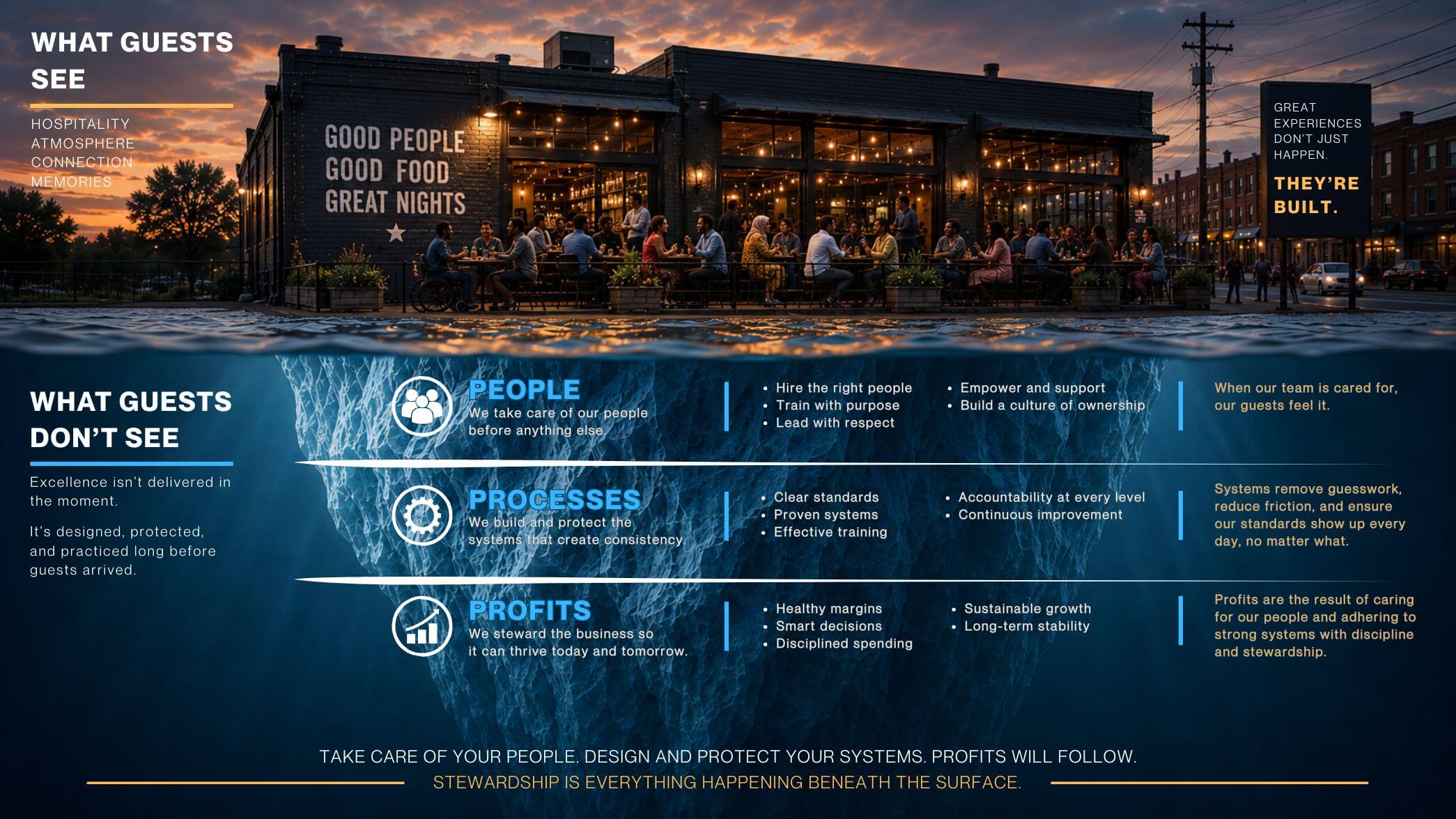
It always comes back to this: Your people, your processes, and your profit.

If any one of those three is off-balance, your business becomes fragile.

Strong operators know how to hire for values, not just skill. They know how to train through systems, not emotion. They know how to communicate relentlessly and delegate with trust.

That’s not “soft leadership,” that’s a non-negotiable to win in this industry.

It’s also the reason some independent operators are scaling to multiple venues while others are still trapped in the trenches. The old adage remains: Work on your business, not in it.

Culture: Your Ultimate Competitive Advantage

Labor is expensive. Recruiting is hard. Retention is harder.

But the best operators aren’t competing on wage alone, they’re competing on culture.

If your business doesn’t feel purposeful to your team, you’ll never build staff loyalty.

You need to make your staff experience more than a paycheck. Your staff experience is just as important as your guest experience.

Show them the vision. Create career paths. Celebrate wins. Encourage ownership thinking.

And here’s something I say often: You don’t need a “family.” You need a champion team; people who want to win together.

Create stay interviews, not just exit interviews. Find out why your team loves working for you, and document their feedback. Build engagement before burnout.

When people feel seen and supported, they become your greatest marketing engine. In fact, they become your brand ambassadors.

Leadership in a Time of Pressure

Leadership today requires a new kind of stamina.

Stop trying to control people; empower them. Don’t bark orders in the kitchen or on the floor; build alignment. In an age where stress levels are high and margins are thin, empathy is not weakness, it’s strategy.

The best leaders know when to listen, when to decide, and when to step aside. They know that delegation isn’t a loss of control, it’s the gaining of stabilization and scale.

If you want to build a high-performing culture, communication and accountability must be daily habits, not quarterly goals.

Clarity is the Currency of the Future

When you strip everything back—the data, the menus, the systems, the tech—what this conversation in Denver really came down to was one word: clarity.

Clarity around who you are, and what you offer. Clarity around your numbers, your guests, your team, and your future.

Without clarity, you drift. With it, you build momentum.

The operators who have clarity are playing offense.

They’re not waiting for the next trend, policy, or economic shift to tell them what to do. They’re already five moves ahead.

Intentionality in Every Decision

Another phrase highlighted during the panel was “being intentional.”

Intentionality is everything.

Every decision you make, from menu design to hiring to marketing, should serve a clear purpose.

Don’t do things because “that’s what everyone else does,” or “this is how we’ve always done it.” Those mindsets keeps you average.

You need to differentiate.

Every single touchpoint should feel deliberate. Each and every staff and guest interaction should reflect your values. Every operational decision should move you closer to your vision.

Operators who just chase volume lose vision; operators who chase clarity create longevity.

The Operator’s Wellness: You Matter Too

Here’s something I made sure to say on stage, and something I’ll keep repeating until it sticks:

You, as the operator, matter too.

You can’t lead effectively when you’re depleted, and you can’t make smart decisions when you’re burnt out. Make time for yourself.

The energy of an independent business starts with its owner and operator. If your energy is chaos, your team feels it. If your energy is grounded, they follow.

Hospitality demands everything from us, but it doesn’t have to take everything from you.

Remember, structure, boundaries, and recovery are leadership traits, not weaknesses.

From Chaos to Clarity

When you zoom out, the message from our session in Denver was simple:

The independent operators who continue to win move from chaos to clarity.

They have systems and strategy.

They anticipate rather than feel anxious.

Their costs are controlled, not cut.

They understand that technology isn’t replacing hospitality, it’s refining it.

Their numbers are balanced with narrative.

They know their financials before their accountant does.

They lead from clarity, not fear.

The 45-Minute Reality Check

We covered all of this, and more, in just 45 minutes. It was so impactful.

Because conversations like this aren’t just about sharing ideas, they’re about sparking a mindset shift across the industry.

This business is tough. It always has been.

However, when you step back, create structure, and move forward with intention, it becomes something incredible.

We’ve survived prohibition, recessions, and a global pandemic. We’ll survive this era too.

But not by chance, by design.

The Final Challenge

I’ll leave you with you with two questions. First, are you running your business from clarity, or from chaos?

Because the truth is, your numbers won’t lie. Your systems won’t lie. Your team won’t lie.

If you’re still chasing hours instead of strategy, still reacting instead of leading, still trying to outwork the problems instead of out-thinking them, you’re not ready for what’s coming next.

But if you’re ready to anticipate, adapt, and lead with clarity, then your future isn’t just secure, it’s scalable. The operators who build systems and culture today will be the ones setting the standard tomorrow.

The second question is, which type of operator will you be?

Image: KRG Hospitality

Client Intake Form - KRG Hospitality

by David Klemt David Klemt No Comments

Ditch Draconian Drink Development

Ditch Draconian Drink Development

by David Klemt

Hand throwing two red dice on a dark gaming table

This is not a viable business strategy.

As we enter the holiday season we need to reiterate that a single person can influence the bar and restaurant decision for an entire group.

Let me be even more blunt, now that I’ve got you here. As we head into 2026, I find it a bit shocking that we still need to address alcohol-free programming.

A recent trip to Colorado is putting this topic back in the spotlight for me. Pair it with menu programming for clients and I simply can’t let it go.

KRG Hospitality was in Denver for The Hospitality Show and Bar & Restaurant Expo 2025. President and principal consultant Doug Radkey spoke on a panel with chef and restaurateur Adrianne Calvo and chief marketing officer Lauren Barash.

While we were in town for the show, we attended other education sessions. One of these was “Trend on Tap,” which focused on beverage trends.

The entire panel was insightful, but something said by Miranda Breedlove, the national director of bars for the Lifestyle Division of Hyatt Hotels, really stood out to me.

To summarize, a single person—the non-drinker—has the power to decide which bar or restaurant a group chooses to visit.

Who, not Why

Let’s be clear about a crucial point: It doesn’t matter why someone has chosen to not consume alcohol.

A person may never drink alcohol. They may choose to forego alcohol for a month, week, or day. Someone may decide to stop consuming alcohol during a visit to a bar or restaurant.

None of that matters. What’s important is being respectful of that decision, being hospitable regardless.

One effective way of showing respect for that choice is giving more than a few seconds consideration to your zero-proof options.

In this situation, the who is more important than the why.

Who is the guest your zero-proof program is trying to reach? The guest who decides they want a zero-proof drink.

Why don’t they want to drink alcohol? It doesn’t matter. Why doesn’t it matter? It’s nobody’s business.

The only “why” relevant to this situation is, why are you taking the time to consider a well-crafted, zero-proof program? To be hospitable and serve all of your guests to the best of your ability. That’s good business in the hospitality business.

Which Sounds Better?

I’m going to present you with two options to consider.

Which sounds like a more enjoyable experience to you:

Option 1: Guests who want a non-alcohol drink are limited to water, soda, or juice in a bottle or can, or off the gun.

Option 2: Guests find a curated, zero-proof section on your menu, and experience the same service and presentation as guests who order low- or full-proof cocktails.

Of those two options, which seems like it delivers a memorable guest experience? Which option ensures a guest who doesn’t want to consume alcohol feels comfortable and valued?

I know I wouldn’t bother returning to a bar or restaurant that made me feel alienated rather than welcomed. And if I’m in a group of people, as Breedlove said, I can influence them to avoid that venue while we’re discussing where to go.

Rolling the Dice

Failing to develop an intentional, well-curated non-alc program is rolling the dice.

You’re rolling the dice on the guest experience. Rolling the dice on transforming first-time visitors into repeat guests.

And, in 2025, nearing 2026, you’re rolling the dice on your brand’s perception.

Sure, ten years ago or so the viability of zero-proof was debatable. Some operators and bartenders saw the value in appealing to guests, whether sober or sober in the moment, and treating them to the same experience as every other guest.

In the other camp, operators and bartenders who saw non-alc cocktails as a waste of time. I remember hearing bartenders say that making zero-proof drinks was pointless because they didn’t make the bar money, and didn’t make them tips.

However, it’s no longer debatable; refusing to be intentional about a zero-proof program for your bar or restaurant is bad business.

The proof is in the decision-making process. If the non-alcohol drinker can make the final choice for bar or restaurant selection for an entire party, it proves the importance of non-alc.

Not Done Yet

Breedlove made another excellent point that also relates to outdated thinking about beverage programs.

To paraphrase Breedlove, “batching” is not a bad word.

This is particularly true for high-volume bars. Likewise, it’s true of high-demand signature drinks that drive sales for a particular bar or restaurant.

As Breedlove said, if the drink won’t suffer, put your high-volume orders on draft. The reasoning is simple: your team likely can’t put out as many of a high-performing, high-volume drink to order as they can if it’s batched.

More of that popular, revenue-driving order going across the bar means more revenue, more tips, and reduced ticket times. Overall, it’s a win-win: better for the bottom line, and better for the guest experience.

And, as I’m sure you’ve put together, this can apply to your zero-proof menu. Have a killer non-alc Margarita? Put it on draft, save time in service.

The key to success, whether batching alcohol or non-alcohol drinks, is in the presentation. Give careful consideration to your ice program, glassware, garnish, and presentation so guests don’t feel shafted regarding the experience.

We’re having to adapt in hospitality once again. We need to make sure we’re moving past outmoded ways of thinking so we can move forward quickly and with strategic clarity.

Image: Leon-Pascal Jc on Unsplash

Client Intake Form - KRG Hospitality

by David Klemt David Klemt No Comments

Excellence Fuels Influence in Hospitality

Excellence Fuels Influence in Hospitality

by David Klemt

The word "excellent" in a vintage script, superimposed over the image of a pint on a bar top.

Cool grabs attention. Good builds trust. And excellence? Excellence transforms your brand into an industry benchmark others want to emulate.

When someone recognizes a hospitality brand’s excellence, when they admire it, that means they respect how its team operates. They see consistency, character, leadership, and the brand’s aesthetic.

They see something that resonates with them. Something they’d recommend, talk about, maybe even want to copy to some degree. When a brand’s excellence is grounded in authenticity rather than performance, it becomes a serious competitive advantage.

The Five Traits of Excellence

When I first looked into these traits, they were described as “admirable,” or the characteristics associated with “admirability.”

However, I’ve had time to sit with these traits, and I feel it’s more appropriate to view them through the lens of excellence.

With that out of the way, research reveals five recurring traits of excellence (or admirability, if you prefer):

  • Attractive
  • Competent
  • Desirable
  • Friendly
  • Trendy

These traits represent perceived value. Not just operational performance, either. They’re tied to the vibe, confidence, and cultural relevance that set brands operating at a higher levelexcellenceapart from the rest.

Attractive: First Impressions Still Matter

Let’s not pretend aesthetics don’t matter.

Attractive brands look the part. They photograph well. They feel polished. However, the polish goes deeper than surface level. The aesthetic is part of a greater brand alignment.

Branding communicates and supports identity. Design supports the experience. Everything feels intentional.

You don’t need marble countertops or $300,000 lighting installs to succeed. Yes, those can be fantastic details, but they don’t automatically lead to excellence.

What’s necessary is cohesion, confidence, and strategic clarity in how your brand shows up every day.

Look like you believe in your concept. Most importantly, just don’t look it, live it.

Competent: Show Your Mastery Without Flash

Competence is often invisible when it’s done right. On the flip side, it’s painfully obvious when it’s missing.

Competent brands:

  • run tight ops;
  • deliver consistent product and/or service;
  • empower their teams to handle problems before they escalate; and
  • communicate clearly, inside and out.

Guests and staff trust competent brands because they follow through.

It’s not about perfection. As Bruce Lee is quoted as saying, “If you are cursed with perfectionism, then you’re absolutely sunk. This ideal is a yardstick which always gives you the opportunity to browbeat yourself.”

Instead, it’s all about professionalism and developing leadership skills.

Desirable: Create Pull Without the Performance

Desirability isn’t just about being booked out or trending. I’m not saying those are problems; both are excellent goals to pursue.

What I’m saying is an even better goal is to become someone’s desired brand. You want to lead your business to the level of excellence that makes it the first that comes to mind when someone wants to feel seen, celebrated, cool, or impressed.

People want to be associated with desirable brands. This absolutely applies to hospitality businesses. Guests want to be wowed and motivated to post about your business. They want to host their friends at your spot. They want to bring dates to you and your team, to visit with their colleagues and clients after meetings.

But you have to blow them away with excellence and make your brand desirable.

Desirability shows up when your space aligns with identity. It’s when people say, “This feels like me,” or, “I fit in here.”

Friendly: Be Approachable Without Losing Edge

Hospitality can’t be excellent if it’s cold. Friendliness is the bridge between capability and connection.

In admired brands, friendliness isn’t a script, it’s embedded.

It’s how the hosts greet guests. How managers lead the floor, and how bar teams communicate under pressure. Friendliness, like excellence itself, is achieved by nailing every step and every detail.

Your team is a reflection of your brand’s personality, and leadership’s reinforcement of standards surrounding tone and attitude. Regardless of personality, friendliness needs to be a pillar of your brand; it’s a cornerstone of hospitality.

That doesn’t mean dulling your edge if you, your team, and your brand have one. In that case, it means balancing edginess with professionalism and being warm and welcoming.

So, make sure friendliness isn’t something you or your team fake. Just like believing in your own brand, your team needs to actually live hospitality.

Trendy: Be Culturally Aware, Not Chameleonic

Trendiness is tricky.

Do it well and you feel current. You and your team are plugged in, exciting.

Do it wrong? You feel desperate.

Excellent, admirable brands don’t chase trends, they curate them. Excellent brands set the pace rather than follow someone else’s.

These are the brands that understand what fits their DNA, and, perhaps more importantly, what doesn’t.

Think of trendiness as a signal that you’re paying attention and evolving but not forgetting who you are and losing your brand identity.

Excellence Attracts Talent, and Keeps It

It’s no secret this industry has a labor challenge. But what’s often missed is that excellence works like gravity on guests and on talent.

People want to work somewhere led by someone that gives them a sense of pride. They want to work somewhere that gets talked about for the best reasons. They’re eager to be part of a brand that provides them near-daily opportunities to say, “I helped build this.”

So, give that to them. Become the leader in your market with the team that others are eager to join.

When your brand is admired, recruiting becomes less about chasing candidates and more about filtering them. You attract people aligned with your mission, energy, and culture.

Even better? Admiration born of excellence drives retention; people stay where they feel proud, seen, empowered, and challenged.

Excellence Inspires the Next Generation

When you lead your brand to excellence, you’re not just running a business, you’re helping shape the future of hospitality.

Operators who work toward, achieve, and maintain excellence become case studies. They get quoted, referenced, and emulated.

And whether they know it or not, they spark ambition in others. They inspire the bartender who dreams of opening their own cocktail bar. The server who’s sketching out a fast-casual concept. They’re a mentor to the GM who eventually moves on in their hospitality journey and launches their own successful concept.

Excellent leaders turn staff into students, and transform students into operators, and the cycle continues.

That’s a legacy. That’s leadership. It’s one of the most underrated impacts of getting all of this right.

Why Excellence Drives Long-Term Value

Cool is magnetic. Good is reliable. Excellence is memorable.

Excellent brands get the press, the partnerships, and the loyalty that goes beyond convenience.

They attract talent that wants to grow with them, not just collect a paycheck.

Admired brands:

  • operate with integrity;
  • evolve with purpose;
  • communicate with confidence; and
  • stay consistent in chaos.

To that last point, an excellent brand’s standards are so concrete, so non-negotiable, that they’re capable of thriving in chaotic situation. In fact, they defeat chaos and learn from it.

In short, excellence leads whether it’s trying to or not.

Reflection Questions for Operators

  1. What’s one thing your brand does that genuinely earns admiration rather than just attention?
  2. Are your aesthetics aligned with your service culture?
  3. Do your team members feel proud to represent your concept?
  4. What trends have you adopted that actually fit your identity?

The Final Bite: Know Who You Are, Then Amplify It

Now that you’ve seen all three dimensions —coolness, goodness, and excellenceyou’ve got a strategic lens most operators never even consider.

It may seem overwhelming to consider 21 traits and how they relate to your brand. Luckily, you don’t need to master all of them. What you need to do is lead with intention.

Know who you are, amplify that, and remember:

  • Cool gets them in.
  • Good keeps them in.
  • Excellence makes them talk.

Want to build a brand that lasts? Get intentional about how people perceive you, and how your team lives that perception every single shift.

Image: Canva

Client Intake Form - KRG Hospitality

by David Klemt David Klemt No Comments

Good: Trust & Comfort Build Loyalty

Good: Trust & Comfort Build Loyalty

by David Klemt

The word "good" in a vintage script, superimposed over the image of a pint on a bar top.

Cool grabs attention because it’s magnetic and buzzworthy. But if you want people to come back and bring others with them, cool isn’t enough.

You need to be good.

However, when I say “good” I’m not talking about being nice, or offering competent service. This is hospitality; those are (or damn well should be) a given.

In hospitality, in this context, good is about emotional safety, reliability, and the kind of consistency that turns a first-time guest into a regular.

The best hospitality brands do more than just impress, they reassure.

The Eight Traits of Good

According to cross-cultural psychology research, eight traits consistently define what people perceive as “good” in others. We can apply these traits to brands as well.

I shared them earlier this year:

  • Agreeable
  • Calm
  • Conforming
  • Conscientious
  • Secure
  • Traditional
  • Universalistic
  • Warm

If cool is what gets guests in the door, good is what makes them feel welcome, seen, and safe enough to stick around.

Agreeable: Cooperative and Empathetic

Just as you can pick up on tension within moments of stepping inside a given venue, you can feel it when a venue is easygoing.

The team’s on the same page. The energy is collaborative. There’s a sense of mutual respect between staff and guests, and between team members and leadership.

Notably, however, being agreeable in hospitality isn’t about people-pleasing. In reality, it’s about creating a culture of empathy and professionalism.

When you step into such a venue you notice that hospitality isn’t forced, it’s practiced.

Calm: Clear-Headed Under Pressure

Calm hospitality environments feel better. They’re emotionally steady.

The pace may be fast, but the energy is measured, controlled, and confident. Guests pick up on this instantly, and so do team members.

When your culture is calm, you and your team don’t just survive a busy night, you all come together, thrive, and make it look easy.

Conforming: Reliable and Predictable (In the Best Way)

Let’s redefine “conforming.” When I use it in this context, I’m not talking about suppressing creativity. Instead, conformity is an alignment with expectations.

Guests return when they know what to expect. They come back when they trust that the experience will meet the impeccable standard you and your team have set every time.

It’s the culmination of onboarding, continuous training, non-negotiable SOPs, structure, and consistency.

Conformity, in this way, isn’t boring, it’s dependable.

Conscientious: Detailed and Purpose-Driven

Conscientious brands care about the little things. They’re organized, thoughtful, and consistent, and that shows up every shift in a multitude of ways.

It’s how the bar team garnishes each drink. How clean the bathrooms are kept. How team members communicate with each other, leadership, and guests throughout their shifts.

It comes through in your consideration of each and every touch point that guides the guest journey.

Conscientiousness builds trust. You’re delivering on the promise to your guests and your team that you don’t cut corners.

Secure: Safe, Seen, and Stable

Safety in hospitality isn’t just physical, it’s emotional.

Guests want to know that you’re going to take care of them because you respect them. You respect their decision to visit your venue, spend their time with you and your team, and spend their money inside your business.

Likewise, your team members want to feel protected, heard, supported, and empowered. To provide an example, I’ve made it clear more than once in articles and on the Bar Hacks podcast that I expect leadership to support team members. No, the guest isn’t always right. “The customer is always right” isn’t just an abused misquote, it’s an outdated sentiment any way you slice it.

I expect leaders to step in and handle all guest complaints; that’s a crucial part of the job. Do you want your team to believe in your concept? They had better be given proof that they should believe in leadership.

Security is built through:

  • clear boundaries;
  • steady leadership;
  • well-trained staff;
  • staff that feels cared for and respected; and
  • real accountability, regardless of role.

If your guests feel nervous or confusedand they will if that’s how your team feelsyou’ve lost them.

Traditional: Grounded, Not Outdated

Tradition gets a bad rap in modern branding. Traditional valuescommunity, respect, attention to ritualare deeply comforting.

When used well, tradition creates familiarity and nostalgia, particularly at neighborhood spots, legacy venues, or family-forward brands.

And even modern, forward-thinking spots can lean on traditional service values without feeling dated.

Universalistic: Fair, Equal, and Consistent

This is where your hospitality values shine.

Universalistic brands don’t treat some guests better than others. They don’t ignore or dismiss certain demographics.

A universalistic hospitality brand operates from a belief that everyone deserves a great experience.

That belief, that value, creates equity. Equity creates trust.

Once you’ve earned that trust, you need to commit to keeping it. As the saying goes, “Trust takes years to build, seconds to break, and forever to repair.”

Warm: Friendly, Kind, and Human

Warmth is the final, and arguably most important, “good” trait.

Warmth shows up in tone, body language, follow-through, and how guests are made to feel the moment they walk in.

Anyone can serve someone. Warmth is what makes someone feel welcome.

Why “Good” Hospitality Brands Last

Good is often invisible. It doesn’t always get the hype but it builds return visits.

Goodness is what builds reputation, earns word-of-mouth referrals, and retains guests and team members.

Good brands become a reliable part of someone’s routine. They’re the go-to when friends visit from out of town. The default when someone asks, “Where should we go tonight?” They’re the first venue that pops into someone’s head when they think “date night.”

Reflection Questions for Operators

  1. Where does your team already show strength in “good” traits?
  2. Which of these eight traits does your guest journey express naturally?
  3. Which ones feel like gaps, and how could they be reinforced operationally?
  4. Are your brand values visible in your culture and your service, or are they just words on a website and inside an employee manual?

Up Next: Quantifying Excellence

In the final part of this series, we’ll unpack what it means to be seen as excellent, and how that perception drives brand equity, team pride, and long-term influence.

Because once you’ve nailed cool and good, excellence is what turns your brand into a benchmark.

Image: Canva

Client Intake Form - KRG Hospitality

by David Klemt David Klemt No Comments

Cool: Magnetism Matters in Hospitality

Cool: Magnetism Matters in Hospitality

by David Klemt

The word "cool" in a vintage script, superimposed over the image of a pint on a bar top.

We all know what it feels like to walk into a cool space. The room hums, the lighting hits just right. The music, the people, the energy…it’s magnetic.

But when we talk about cool in hospitality, too often we’re referring to aesthetic alone: the vibe, the lighting, and the playlist, among other details.

The truth? Cool isn’t just visual. And it’s not trend-chasing.

Cool is a collection of behavioral traits. When those traits are intentional, the perception of cool becomes strategic. In turn, that magnetism becomes a strategic element.

The Six Traits of Cool

Cool can feel elusive, but it’s not mystical.

Cross-cultural research has identified six traits that people consistently associate with coolness.

They are:

  • Extraverted
  • Hedonistic
  • Powerful
  • Adventurous
  • Open
  • Autonomous

Let’s break them down, and apply them to hospitality.

Extraverted: Show Up and Stand Out

Cool brands don’t hide in the background.

They communicate clearly, loudly, and often. They show up on social and in the community. Cool brands own their tone.

However, they’re not loud for the sake of making noise. It means that they own the room without apology.

Think confident service teams, guest-forward experiences, and spaces designed for connection rather than just consumption.

Hedonistic: Make People Feel Good

Let’s kill the negative spin on the word “hedonistic” right from Jump Street.

In this context, it simply means “pleasure-oriented.”

Cool brands create experiences that feel good. Not just pleasant, memorable.

Drinks that hit flavor and presentation. Lighting that makes everyone look and feel attractive. Flow that feels frictionless.

This is about sensory impact. It’s why people will choose your place even if another spot has better prices or faster service.

Guests aren’t really buying food or drink; they can make either at home. They’re buying the feeling you, your team, and your venue gives them. In reality, they’re buying your cool, expecting it to reflect onto them.

Powerful: Influence, Not Ego

Power in a hospitality setting doesn’t mean dominating the scene.

For a hospitality brand, power means having influence. That influence makes guests feel like they’re somewhere that matters.

Power shows up when:

  • your venue sets trends instead of following them;
  • your team leads with confidence and autonomy; and
  • people talk about your space and brand when you’re not in the room.

A powerful brand doesn’t have to scream, it simply can’t be ignored.

Take the phrase, “real wealth doesn’t scream, it whispers.” Now, replace “wealth” with “coolness.” Do you believe someone when they loudly tell you that they’re cool? Or do you sense when they communicate it without having to say a word?

Adventurous: Show Some Edge

Cool brands take risks.

Try new menu items, new event formats, new collaborations. Don’t wait for permission, just do it.

However, keep in mind that risk and adventure don’t necessarily require recklessness. They simply require you to indicate, with confidence, that you’re willing to experiment publicly.

This could look like a pop-up collab with a neighboring venue. Hosting an event, a person, or a brand that’s never been seen or experienced in your market. Reinventing a tired night of the week with a totally new promotion.

Predictability is comforting, but adventure creates buzz. Be the buzz.

Open: Let the Culture In

Being open means staying curious to new ideas, influences, voices, and formats.

Guests notice when a brand is receptive, diverse, and dynamic. They reward that with their loyalty.

Openness in hospitality looks like:

  • Welcoming feedback, and acting on it.
  • Hiring for perspective rather than just experience.
  • Rotating menus or programming to reflect seasonality and community.

Cool doesn’t look the same in every city or concept. Openness helps you localize your identity without diluting your brand.

Autonomous: Lead with Vision, Not Imitation

The coolest brands feel like they were born fully formed,  even if we know the reality is messier and took years to perfect.

Why? Because they make decisions as themselves, not in response to what others are doing.

Autonomy shows up when your voice and values are clear across every touch point. When you stay consistent, even when competitors pivot. Your autonomy comes through when finally figure out what you’re not trying to be.

Hospitality is full of sameness. Cool stands out when it’s driven by clarity.

Why Cool Still Matters

Cool isn’t shallow, and it isn’t fleeting. Not when it’s rooted in these six traits.

Cool matters because it creates curiosity, conversation, and connection.

It’s what gets people to check you out, to take a risk and try you. That decision to try you is the first step to becoming a loyal guest, team member, or partner.

But remember that while cool can grab people’s attention and create energy, it’s not capable of creating sustainability on its own. You need systems in place to stabilize and scale.

A Few Reflection Questions

  1. What part of your guest experience feels truly cool right now?
  2. What parts feel tired, safe, or imitative?
  3. Which one of the six traits comes to your concept most naturally?
  4. Which one could you amplify intentionally this month?

Next Up: Quantifying “Good”

In the next installment, we’ll talk about the eight traits that make a brand feel good, the kind of hospitality that builds trust, reputation, and retention.

Until then, stay cool.

Image: Canva

Client Intake Form - KRG Hospitality

by David Klemt David Klemt No Comments

Talkhouse Encore Aims for Iconic

Talkhouse Encore Aims for Iconic

by David Klemt

Person holding a can of Talkhouse Encore against their blue sweater with a bear on it

That’s a rad sweater.

In a move that highlights the brand’s forward-thinking commitment to growth, Talkhouse Encore is appointing a Vice President of Marketing.

If you’re a regular reader you’re aware that I don’t share every bit of industry news. Hospitality moves quickly, and developments flow steadily. Appointments, case sales, market expansions… There’s a lot to monitor.

However, I do love to watch Bar Hacks podcast guests grow. It’s a privilege to check in with them and share where they are in their journeys with listeners and readers. On episode 141,  I speak with Talkhouse Encore’s president and co-founder Robert Minucci.

We dive into the story behind the premium RTD brand’s inception: its connection to an iconic music venue, putting in the work to grow in a highly competitive category during the pandemic, and facing skeptical (sometimes cynical) distributors.

Minucci shares how his business partner, Ruby Honerkamp, sought to bring the spirit of Stephen Talkhouse to the masses through “dive bar classic” vodka and tequila seltzers.

At the brand’s core: authenticity and flavor. In particular, there’s a focus on earning brand loyalty from legal-age Gen Z consumers. Speaking broadly, Gen Z wants a story and a connection to a brand. Really, it’s what most people want these days.

Connection Through Authenticity

During our conversation, Minucci explains how the small-but-nimble team focuses on building a strong local presence before considering expansion, ensuring that they meet consumer demands with quality ingredients and an engaging brand narrative.

If, as the saying goes, you can’t do epic things with basic people, it stands to reason that you can’t build an iconic brand with a basic team. And when your brand has a direct connection to an icon—in this case, a revered live music venue—the pressure to reach similar status is very real.

This is where the newly-appointed Vice President of Marketing takes the stage to help tell the Talkhouse Encore story.

Boasting nearly a decade of experience building and growing brands, Courtney Roth is a clear signal to the market: Talkhouse Encore is here.

“At Talkhouse Encore, our mission is to be more than just another canned cocktail. We want to be the drink that brings people together for unforgettable moments,” says Roth. “I’m excited to lead marketing efforts that connect with consumers through authentic experiences, social storytelling, and grassroots programs that make Talkhouse Encore the go-to choice for today’s drinkers.”

Aiming for Iconic

Aiming for epic and iconic certainly seems to be a key driver of Roth’s brand storytelling. She developed her mastery of lifestyle brand marketing at Diageo. Pepsi benefited from her positioning prowess when she led their Super Bowl LVII activations.

Proving she knows how to build connections at the consumer level, Roth led the sampling of 1.5 million cans of Alani Nu. Earlier this year, Alani Nu was acquired for $1.8 billion by Celsius, which itself saw PepsiCo increase its stake in the energy drink brand juggernaut to 11 percent.

Those are just a few of Roth’s marketing and expansion accolades.

“I’m thrilled to step into the VP of Marketing role at Talkhouse Encore,” says Roth. “My focus is on building out an omni-channel marketing strategy that introduces more consumers to our premium vodka and tequila sodas. We’re setting the stage for significant growth in 2026 and beyond!”

This appointment is a signal that Talkhouse Encore intends to expand to an increasing number of markets over the course of the next 12 months. Keep your eyes peeled for activations and your opportunity to sample and engage with the brand.

To learn more about Talkhouse Encore, visit their website. Give them a follow an Instagram for news, activations, and more.

Disclaimer: Neither the author nor KRG Hospitality received compensation, monetary or otherwise, in exchange for this post.

Image provided by Talkhouse Encore

Client Intake Form - KRG Hospitality

by David Klemt David Klemt No Comments

Cool, Good, Excellent: 19 Defining Traits

Cool, Good, Excellent: 19 Defining Traits

by David Klemt

"Good. Cool. Excellent." Retro baseball jersey-style font superimposed over the image of a brick wall, bar top, and pint of beer

Cool gets people through your doors. Good impresses guests and keeps them coming back. Excellence inspires people to talk about you.

We throw around words like “cool,” “good,” and “excellent” all the time in this industry.

“Cool new spot.” “Good service.” “Excellent experience.”

But what do these terms actually mean when it comes to hospitality brands and strategy? More importantly, what do they mean to your guests, your team, and your community?

The truth is that perception is everything.

Cool. Good. Excellent. These aren’t just vibes, they’re measurable. If you’re not intentional about which of these traits your brand is projecting, the market will decide for you.

Let’s dig into the 19 traits that shape how your concept is perceived, trusted, and remembered.

Cool: The Magnetism Factor

Cool is what gets people talking. It draws guests in through a mix of confidence, curiosity, and charisma.

Researchers have identified six traits that consistently define cool across a multitude of cultures:

  • Extraverted: Social, talkative, and expressive.
  • Hedonistic: Oriented toward pleasure, excitement, and sensory experience.
  • Powerful: Assertive, influential, and bold.
  • Adventurous: Willing to take risks, and try new things.
  • Open: Curious, flexible, and adaptive.
  • Autonomous: Independent, self-driven, and unconcerned with conformity.

Sound familiar? These are the brands that pop off on social. The ones that get the influencer love, and that make guests feel seen.

You probably thought of a cool brand or two when you started reading this article. Hopefully, one was your own.

That said, there’s a catch: cool alone doesn’t carry a brand. It grabs attention, but without something deeper underneath, people move on. And they move on fast.

Good: The Retention Engine

If cool gets people through the door, good is what keeps them there.

The “good” brand traits are quieter, and that’s the point. They’re what make a concept feel dependable, thoughtful, and rooted.

There are eight of them:

  • Agreeable: Cooperative, empathetic, easy to work with, and accommodating.
  • Calm: Emotionally stable, composed, and clear-headed.
  • Conforming: Consistent, reliable, and willing to follow a structure.
  • Conscientious: Responsible, organized, and focused on detail.
  • Secure: Trustworthy, steady, and emotionally and physically safe.
  • Traditional: Grounded in shared values and norms.
  • Universalistic: Treats all people equally and fairly.
  • Warm: Friendly, kind, and welcoming.

Good brands don’t always make headlines, but they build habits. They’re the spots people go back to week after week. The places that make guests feel like regulars before they even are regulars.

Excellence: The Aspiration Layer

Cool is attention. Good is trust. Excellence? That’s respect.

When a brand is seen as excellent, it carries influence. It becomes a reference point, not just for guests but for peers, media, talent, and even future collaborators.

Five traits define excellence (or admirability):

  • Attractive: Physically appealing, well-designed, and aesthetically impactful/appealing.
  • Competent: Skilled, knowledgeable, and consistently excellent.
  • Desirable: Sought after, relevant, and aspirational.
  • Friendly: Approachable, kind, and human.
  • Trendy: Aligned with current culture without being performative.

Excellent brands don’t just do things well, they inspire.

19 Traits. One Brand. What’s Your Mix?

Let’s be clear: you don’t need to embody all 19 traits at once. You shouldn’t even try to do so. That would be overwhelming for you, your team, and your guests.

But you do need to know which of these traits your brand currently embodies, and which it should emphasize more intentionally based on where you are in your journey.

Here’s a way to think about it:

  • Goal 1: Focus your brand’s defining traits.
  • Goal 2: Boost foot traffic or hype (leverage coolness)
  • Goal 3: Improve retention, reviews, and culture (leverage goodness)
  • Goal 4: Increase brand equity, word of mouth, and influence (leverage excellence)

This applies internally, too. Are you hiring for culture fit? Think about the traits your current team exudes.

Launching a new concept? Choose the traits that will define it from Day One.

At KRG Hospitality, our clients undergo an exercise that helps them identify their values. In turn, this exercise helps them identify the traits that will define their brand long before they ever open their doors for the first time.

Final Thought: Brand Perception is a Strategy, Not an Accident

You’ve built a concept. A vibe. A brand. But your guests don’t just see what you say you are, they feel what you are.

They feel cool, or calm, or cared for. They notice when things flow or when they don’t.

Cool gets them in. Good keeps them in. Excellence makes them talk.

Get the balance right, and you’re no longer reacting to perception, you’re shaping it. And in today’s market, that’s one of the most valuable competitive advantages you can have.

To help you strike that balance, I’ve got three deep-dive articles coming over the course of the next three weeks. One about coolness, one about goodness, and, you guessed it, one focused on excellence. Cheers!

Image: Canva

Client Intake Form - KRG Hospitality

by David Klemt David Klemt No Comments

America’s Best New Restaurants Insights

What America’s Best New Restaurants Say About Us

by David Klemt

AI-generated image of a globe on a plate inside a restaurant

Garnish that includes a clock? That’s an interesting choice, AI.

Bon Appétit‘s recent release of The 20 Best New Restaurants of 2025 provides deep insight into the state of restaurants, cuisine, and guest expectations.

Each restaurant on the list was opened between March 2024 and March 2025. That means that these restaurants have now been open for six to 18 months, at most.

The list organizes the 20 restaurants into four regions: the Midwest, the Northeast and Mid-Atlantic, the South, and the West.

As someone who reviews a lot of “best of…” lists, I appreciate that New York, Los Angeles, Miami, and Chicago don’t dominate this one. A restaurant from each city receives recognition (in the case of Los Angeles, two eateries), of course. But Cincinnati, Minneapolis, Pittsburgh, Baltimore, and more are also represented.

Below, the 20 restaurants chosen by Bon Appétit for this year’s list.

The Midwest

Feld (Chicago, IL)

Cuisine: Contemporary American, Global

Vinai (Minneapolis, MN)

Cuisine: Hmong

Wildweed (Cincinnati, OH)

Cuisine: Contemporary American, Italian, Japanese

The Northeast & Mid-Atlantic

Baan Mae (Washington, DC)

Cuisine: Laotian, Cambodian, Malaysian, Burmese

Dōgon (Washington, DC)

Cuisine: Afro-Caribbean

Fet-Fisk (Pittsburgh, PA)

Cuisine: Nordic, Appalachian

Ha’s Snack Bar (New York City, NY)

Cuisine: French, Vietnamese

Provenance (Philadelphia, PA)

Cuisine: French, Korean

The Wren (Baltimore, MD)

Cuisine: Irish, European, American

The South

Acamaya (New Orleans, LA)

Cuisine: Mexican, Seafood

Avize (Atlanta, GA)

Cuisine: Alpine

Perseid (Houston, TX)

Cuisine: French, Vietnamese, Creole

Recoveco (Miami, FL)

Cuisine: Contemporary American, Global, Seasonal

The West

Camélia (Los Angeles, CA)

Cuisine: French, Japanese

Giovedi (Honolulu, HI)

Cuisine: Italian, Pan-Asian

Komal (Los Angeles, CA)

Cuisine: Mexican, Latin American

Lenox (Seattle, WA)

Cuisine: Puerto Rican, Cuban, Latin American, Caribbean

Mezcaleria Alma (Denver, CO)

Cuisine: Mexican

Minnie Bell’s Soul Movement (San Francisco, CA)

Cuisine: Soul Food, American Comfort Food

Sun Moon Studio (Oakland, CA)

Cuisine: Contemporary American, Global

The State of Culinary in America

These days, categorizing a restaurant by cuisine isn’t as easy (or as relevant) as it once was.

Sure, some venues still wear their culinary identities on their sleeve, proudly representing a specific region or culture. Others showcase influence from one or more cuisines, presenting them in ways that are both deliberate and nuanced.

But increasingly, restaurants are embracing a global, borderless approach to food. However, it’s not fusion for the sake of novelty. Instead, it’s inventive, thoughtful, and driven by a desire to engage guests through flavor and curiosity.

While reviewing Bon Appétit’s 2025 Best New Restaurants list, I found it somewhat challenging to pinpoint the exact culinary focus of some of these concepts. I view that struggle as a good “problem” to have.

This ambiguity signals a broader movement: today’s guest is more willing than ever to explore global cuisines. They’re curious. They want discovery to be a key element of their dining experience.

This extends into comfort foods. A great strategy for easing someone into the unfamiliar is to bridge it with the familiar.

Take Sun Moon Studio’s Taiwanese sausage on steamed brioche. Visually reminiscent of a hot dog, it invites guests to try something new without overwhelming them. It’s an accessible entry point to a new experience.

Boston is a shining example of this culinary evolution. It’s one of the most competitive, restaurant-dense cities in the country, and also one of the most dynamic. From old-school neighborhood institutions to cutting-edge, globally influenced newcomers, the city proves there’s room for everything and everyone when the food is compelling.

The Rise of Experiential Dining

A number of the concepts on this year’s best new restaurants list embrace tasting menus. Provenance, for instance, offers a four-course tasting that actually includes 20 or more dishes. Their summer menu clocks in at 21.

Tasting menus tend to split the critics. Some hail them as a canvas for culinary storytelling, while others still see them as relics of highbrow, try-hard fine dining. But based on this list, the format is very much alive, and clearly still resonates with guests.

At the end of the day, it’s about delivering an experience. Guests aren’t necessarily chasing formality or prestige when they choose a multi-course tasting menu. The way I see it, guests who enjoy such experiences just want to feel something. They want to be wowed, and they want to remember the who, how, and why that made the experience memorable.

There are plenty of ways to create that moment. One strategy? Be the only one doing what you’re doing in your market. That might mean introducing a cuisine that’s underrepresented. It could be refining a hyper-focused vision so well that you’re in a category of your own.

Avize in Atlanta exemplifies the former: it’s the only fine-dining Alpine restaurant in the city. Acamaya in New Orleans does the latter, bringing Mexican coastal cuisine to a city known more for gumbo, po’ boys, and beignets than ceviche and mariscos.

Whatever the approach, the operators behind these concepts know how to satisfy their guests’ expectations. They’re aware that the experience falls flat if the food isn’t memorable, and if hospitality is treated as an afterthought.

The Guest Influence

Designing the look and feel of a restaurant is often one of the most fun parts for operators. Some people find enjoyment in selecting everything from furniture to flatware.

However, in our experience, one vital element is often overlooked: how guests will actually move through, experience, and interpret the space.

Does the vision translate to real-world usability? If a guest walks in and isn’t sure where to go, how to order, or what to expect, you’ve already missed the mark.

It’s important to keep in mind that people can make food at home or order delivery or takeout; they don’t need to visit your restaurant for sustenance. However, we are social creatures, and the need to gather, see and be seen, and feel relevant and cool is very real.

It follows, then, that starting the guest experience by making them feel uncertain is a huge misstep.

There’s also the matter of how the guest wants to engage with your vision. Sometimes, what you intended isn’t how the concept is actually received. And when that happens, operators have choices: stick to the vision, concede entirely to guest demands, or compromise to strike a balance.

There’s no universal “right” answer here. But there is a need to make a decision, commit to it, and communicate it clearly.

Examples

Providing a real-world example, one KRG Hospitality client had a specific vision for their bar. Without giving away too many details, the bar was intended to be open for the evening and late-night dayparts.

However, not too long after opening, guests were clamoring for the bar to open a bit earlier, and for the bar to be open on a few more weekdays. Our client crunched the numbers, liked what they saw, and delivered on their guests’ wishes.

Another example comes from two friends of mine who opened a few concepts. One of these was a high-end cocktail bar for sophisticated clientele. The venue was intended to be open for dinner and closed before late night.

Well, the movers and shakers in the market wanted the space to be their after-hours spot. They appreciated the sophistication of the space but wanted to use it as an energetic party spot late at night…and they were willing to pay to support that use case. My friends adapted, and soon bottle service was available during the late-night daypart, and the place was packed.

As far as an example from Bon Appétit‘s list, look at The Wren in Baltimore. According to the Bon Appétit staff, the owners envisioned a traditional Irish pub. No reservations, not even table service. There’s nothing wrong with that, but people have discovered that co-owner Will Mester is an incredible chef. So, as far as they’re concerned, The Wren is a restaurant, not “just” a pub.

Mester and his business partner have adapted. There are still no reservations. There’s still no table service. But The Wren’s guests have said “no problem, we’re still coming to eat,” and Mester and co-owner Rosemary Liss have responded with an “alright, let’s do this” attitude.

The Final Bite

What Bon Appétit’s 2025 Best New Restaurants list tells us isn’t just which restaurants are “the best.” Rather, it tells us what’s resonating with guests right now, and what might resonate through the new year.

We’re watching the traditional playbook get rewritten in real time. The demand for global cuisines continues to rise. Fine dining is becoming more accessible and playful. Guests are more empowered and curious than ever, and operators are meeting them in that space, sometimes by design, sometimes by adaptation.

The best restaurants today aren’t just delivering food, they’re telling stories and building communities. They’re creating moments of connection, whether that’s achieved over 20 courses or a dish that looks like a street-food staple but tastes like something entirely new.

The common threads? Relevance, purpose, and identity. And perhaps most importantly, a guest experience that makes people want to return.

AI-Generated Image: Microsoft Designer

Client Intake Form - KRG Hospitality

by krghospitality krghospitality No Comments

The Risk of Waiting Until the New Year

The Risk of Waiting Until the New Year

by Doug Radkey

Four neon signs that each say "waiting" in various stages of being lit up

Sometimes “waiting” means “waiting.” Too often, “waiting” means “…until it’s too late,” or “never”

It’s that time of year again.

The leaves are turning. The holidays are approaching. And everywhere you look, people are starting to say the same thing: “I’ll wait until the new year.”

They’ll wait to start the new habit.
To launch the business.
To fix the broken system that’s draining their energy.

But here’s the uncomfortable truth: waiting is one of the most expensive decisions you’ll ever make.

The Myth of January

It seems that January has become society’s magical “reset” button.

This is when people start going to the gym more (or at all). It’s when aspiring entrepreneurs tell themselves they’ll be ready to start. When current operators say the holiday season is too busy.

It’s funny that somehow the turn of a calendar gives them permission to begin.

But in business—and in hospitality in particular—the market doesn’t wait. The competition doesn’t wait. Staff and guests don’t wait.

And the risk of waiting isn’t just lost time, it’s lost opportunity and lost momentum.

The Numbers Don’t Lie

Let’s look at some numbers.

On October 1st, you still have 25.21% of the year left.
By November 1st, you still have 16.71% left.
And on December 1st, you still have 8.49% left.

That’s not scraps. That’s a quarter, a sixth, or even a full month of your calendar. This is time you’ll never get back once it is gone.

So ask yourself this question: Do you really want to burn that much equity of time waiting for a date on the calendar that somehow gives you permission to move forward?

A Familiar Story

Each year, between October and January, I take calls from operators or aspiring entrepreneurs who tell me the same things.

The aspiring entrepreneur wants to open a new concept.
A year or two after first opening, an operator wants to stabilize their operations.
The veteran operator wants to get their brand’s finances under control.

But here’s the thing: approximately 80% of them admit they already decided to “wait until after the holidays.”

By the time they wait it out until the new year, the real estate they were eyeing is gone. The investor they were courting has moved on and is backing a different concept. Or worse, a new or scaling competitor has beaten them to the punch.

The cost of inaction always shows up, 100% of the time.

The Illusion of Busy

I get it. Society and this industry seem to thrive on being busy. The closer we get to the holidays, the easier it is to convince ourselves there’s no time to think about strategy.

Well, here’s the problem: that “too busy” mindset is often just a shield. It’s easier to stay stuck in the chaos than to step back and do the real work of building clarity.

And yet, that’s exactly what separates operators who crush it from those who drift away toward mediocrity or closure.

The ones who wait? They start the new year months behind or in survival mode.

The ones who act now? They start the new year in control.

That’s why this is called “separation season.”

Momentum Beats Motivation

Motivation is fickle. It spikes in January when gyms are full and the journals or planners are fresh.

By February, it all begins to fade.

Momentum, however, is different. Momentum compounds over time.

When you take action in October, November, or December, you’re not just getting ahead. You’re strategizing and developing the foundations. Or you’re training your systems, your people, and yourself to move forward when the calendar flips.

By the time many are just warming up, you’re already moving at full speed. Think about those positive results.

The Risk of Inaction

Let’s talk about what waiting actually costs you.

  • Prime Real Estate: The space you’ve been watching doesn’t wait for January. It will be leased by the operator who had the courage to strategize and take action.
  • Capital: Investors are looking for leaders with confidence and momentum. If you show hesitation, they’ll invest their money elsewhere.
  • People: Your best staff won’t stick around forever waiting for change. If you don’t build clarity and systems, they’ll leave for a team that already has them in place.

The longer you wait, the steeper the climb is going to be in the new year.

The Power of Now

So, what happens when you act now?

  • You gain clarity. Strategic playbooks create focus for your concept, your brand, your financials, and your guest experience.
  • You create momentum. Your systems start running, your people align, and your execution gains speed.
  • You build confidence. Investors, staff, and even guests can feel when an operator is in control.

Taking action now separates yourself from the 99% who sit back and wait.

From Survival to Legacy

Let’s be clear: This isn’t about working more hours. It isn’t about grinding yourself into burnout before the holidays.

It’s about mindset. Ask yourself:

  • Do you believe long hours equal nobility or inefficiency?
  • Do you believe success is about hustle or about alignment?
  • Do you want to survive another year or build a business that outlasts you?

The entrepreneurs and operators who crush it don’t wait for January.

They strategize now. Build now. Lead now.

Why? Because survival is built on reaction. Legacy is built on clarity.

A Challenge for You

Take a hard look at your calendar.

If you start today, you still have weeks (if not months) to set the stage for the business you want to run next year, and the many years thereafter.

Lay the foundation now. Create your strategies now. Get your systems ready now.

Do it now so that when the new year arrives you’re not scrambling to catch up—you’re already miles ahead.

The Final Word

Hospitality doesn’t wait. Guests don’t wait. The market doesn’t wait.

So why are you waiting?

The real flex is proving that October, November, and December are still full of opportunity.

Because when clarity meets courage and strategy meets execution, you don’t just start the new year strong, you start it by separating yourself from others, and leading the way.

Now is the time. Take action. Build momentum. Create your legacy in hospitality.

Image: Levi Meir Clancy via Unsplash

Client Intake Form - KRG Hospitality

by David Klemt David Klemt No Comments

Overcoming the Failure Rate

Overcoming the Bar, Restaurant, Hotel Failure Rate

by Doug Radkey

The car game piece on a Monopoly board, "parked" overlapping "Chance" and The Strand property.

Leaving things to chance rather than executing with strategic clarity? Go to jail.

So, you’re nervous about opening your own bar, restaurant or boutique hotel because your favorite spot closed after 15 years. We get it.

On a recent discovery call, a prospective client hesitated.

“What if it happens to me? I loved this bar for 15 years, and now it’s closed.”

It’s a haunting truth we’ve all seen, no matter the market.

But here’s the hard truth: you can’t let someone else’s story define yours. You don’t know what drama unraveled behind their walls.

The personal health battles, silent financial cracks, or failure to adapt? That was their story; it doesn’t have to be yours.

The Reality: A High Failure Rate

Ask the majority of investors and banks, and they’ll say to not invest in or open a bar or restaurant.

A hotel? You get a little more forgiveness.

Why? Because the National Restaurant Association estimates 30 percent of bars and restaurants fail in year one. That number climbs to close nearly 80 percent by year five. This is approximately ten percent above the normal small business failure rate.

So, yes, the failure rate is significant. But it’s not fate.

There’s plenty you can control, proven by our own 98%, five-year success rate here at KRG Hospitality.

Why They Fail: It Happens Behind the Curtains

Failures in hospitality don’t always explode overnight. They rarely make the dramatic headlines people expect.

Instead, they’re usually a slow bleed, a series of small cracks that deepen over time until the entire structure gives way.

When you peel back the curtain, you’ll find the real story. More often than not, it’s not just one big mistake, but a combination of preventable missteps.

Undefined Concept & Brand

If your concept and brand is unclear (or worse, forgettable), you’re already in dangerous territory. Too many launch with a “me-too” mentality, chasing trends instead of building timeless positioning.

Guests can feel it. If you don’t give them a reason to return beyond food, drink, or a bed to sleep in, they’ll move on.

In hospitality, experience and differentiation are crucial tools in your survival kit.

Poor Location or Visibility

Location is strategy in its rawest form.

You can have the best food, the most polished cocktails, or the most beautifully designed rooms. If you’re invisible—tucked in the wrong corner, lacking signage, or starved of targeted traffic—your odds for success and longevity diminish.

Strong operators understand the flow of the neighborhood: where people live, move, and spend. Without that foresight through a feasibility study, you’re playing uphill from day one.

Weak Leadership

Autopilot leaders create fragile cultures. They show up for the transaction but not the transformation.

A stressed, demoralized team won’t stay engaged, and turnover eats away at consistency (and finances) until guests notice.

The truth is, your team mirrors your energy. If you operate without vision, clarity, and presence, you’ve already signed your exit papers.

Thin Cash Reserves

Hospitality isn’t just about flavor and atmosphere, it’s about math.

Too little capital or unrealistic budgets in the early stages lead to corner-cutting later. And corner-cutting shows up in slower service, lower quality, and compromised experiences.

Investors and owners alike often underestimate the importance of a financial buffer. Without it, one bad month can undo years of effort.

Operational Inefficiency

Margins are the silent killers. If your prime costs are running over 60 percent, you’re bleeding profitability, no matter how strong sales look on the surface.

It’s easy to point to revenue, but revenue without efficiency is vanity.

The businesses that endure are the ones obsessed with systems, training, accountability, and profit that keep costs in check while maintaining a memorable guest (and staff) experience.

Failure to Adapt

The market doesn’t wait for you to catch up.

Technology, consumer habits, and cultural shifts move fast. If you’re unwilling to pivot, you’ll get left behind.

Look at the operators who ignored delivery, digital ordering, or loyalty platforms until it was too late. Or hotels that treated guest tech as an afterthought instead of an expectation.

Adaptation isn’t optional; it’s mandatory.

External Shocks

Rising costs. Labor shortages. Supply chain volatility. These are no longer “black swan” events, they’re the new normal.

You can’t control the shocks, but you can control your readiness. Diversified supply strategies, cross-trained teams, and strong financial playbooks soften the blows.

Operators who plan for disruption often find themselves gaining market share when others stumble.

Life Behind the Scenes

Sometimes, it’s personal.

Health crises, family issues, burnout, or the simple loss of passion can derail even the most promising venture. These don’t make the press releases or Yelp reviews, but they’re real, which is why mindset matters.

Operators who build balance and sustainability into their leadership style—along with a succession plan—are more likely to weather both professional and personal storms.

The Bottom Line

Failures are rarely about one bad Friday night or one bad quarter. They’re about the invisible, compounding gaps behind the curtains.

But here’s the powerful part: every single one of these is preventable with clarity, systems, and strategy.

That’s why I always remind operators: don’t measure your future against someone else’s downfall. Instead, measure it against your ability to anticipate, adapt, and build structure. That’s what separates the businesses that fade quietly from the ones that endure—and win—for decades.

You Can’t Build Your Strategy on Someone Else’s Story of Collapse

That struggling 15‑year-old bar? It could have simply hit burnout. The owner may have faced a personal crisis. They may have lacked systems, clarity, or financial resilience.

Their closing doesn’t frame your narrative.

Still, their story should prompt you to ask: What’s my structure? My mindset? My strategy plan? What will I do differently so that I don’t hit and fall over similar obstacles.

Why Strategic Clarity is the Only Protector

In hospitality, too many operators confuse hustle with progress. They confuse long hours with leadership.

The truth is, your meaning isn’t in hustle, it’s in alignment.

A bar, restaurant, or boutique hotel is only as strong as the clarity of its strategy. Without it, every decision is reactive, every crisis feels existential, and every day becomes survival mode instead of a path toward growth.

Mindset

Mindset is the foundation. Do you truly believe long hours are a badge of honor or a symptom of inefficiency? Because that belief alone will shape the culture you build.

Leaders who cling to the idea that 60 to 80 hours is the price of success are locking themselves into fragility.

However, those who lead with a growth-based mindset and embrace resilience, who adapt quickly and view challenges as lessons instead of setbacks, they create environments where both people and profits excel.

Your mindset is contagious. It dictates how your team views pressure, how they respond to obstacles, and, ultimately, how your guests experience your brand.

Systems

Hospitality is theater. Every shift, every service, every guest interaction is a performance—and performances require a script. Systems are those scripts.

They create operational rhythms that bring consistency even when you’re not in the building. Standard shift routines, training modules, service frameworks… These aren’t bureaucratic binders collecting dust, they’re the invisible scaffolding that protects your brand. Payroll, inventory, guest relationships, crisis response… These aren’t just admin tasks, they’re the arteries of your business.

If they aren’t governed, monitored, and optimized, you’re building stress instead of stability.

Systems create repeatable outcomes. Repeatable outcomes create peace of mind.

Strategic Clarity

None of this matters if it isn’t aligned under one vision. That’s where strategic clarity becomes your only true protector.

Do you have a unified vision that connects your concept to your brand, your brand to your marketing, your marketing to your staffing, and your staffing to your financial health?

Or is each piece operating in isolation, hoping to hold together?

Strategic clarity removes silos. It ties together the why, the what, and the how. This level of strategy, developed through a series of playbooks, is what transforms chaos into clarity.

The Difference Between Survival & Legacy

Without strategic clarity, every decision feels heavier than it should. With it, you unlock freedom.

Freedom to work 40 hours, not 80. Freedom to step out of the weeds and into leadership. To stop surviving, and start building a legacy.

Because clarity doesn’t just protect your margins, it protects your mindset, your team, your brand, and your future. And in an industry this volatile, it’s the only true shield you have.

When you operate this way, your business exists beyond your fatigue. When you don’t, you’ve just given yourself a job dressed up as a business.

Failure is Just a Data Point—Not Your Destiny

Your business doesn’t have to be there for just one year. It can endure for decades and become a legacy, because you built it to become one.

Yes, the failure rate is “high.” But survival is still statistically common. It’s time we stop packaging failure as a warning sign and, instead, build for the long game.

Your advantage is in honoring that failing statistic with strategy.

That bar closing after 15 years? A sad story. But it’s not your headline. Don’t let the fear of someone else’s failure define your ambition or limit your strategy.

Build with intent. Operate with clarity. Lead with systems and playbooks. Focus on your people, processes, and profit. Then watch your business crush it, without defining your worth by burnout.

Because in hospitality, the real flex is longevity built on clarity, not chaos.

Image: Suzy Hazelwood / Pexels

Client Intake Form - KRG Hospitality

Top