Scale

by David Klemt David Klemt No Comments

Project Management in Hospitality

Project Management in Hospitality

by Doug Radkey

A person reviewing project progress tracked via organized Post-It notes attached to a black brick wall inside an office

There’s a crucial element of hospitality that almost no one talks about publicly. It’s not glamorous, and it isn’t Instagram-worthy.

It isn’t the incredible plating or glassware moment, or even the lobby reveal.

It’s the part that happens long before the first cocktail is poured, before the first plate leaves the pass, before the first guest forms an opinion of your brand.

It’s the real work: the often messy, complicated, high-stakes world of project management for new hospitality concepts and brands.

And whether you’re opening a bar, restaurant, boutique hotel, or entertainment venue, what happens behind the scenes will determine your outcome far more than any design detail or menu item ever will.

This is where leadership begins. Where clarity is built, and chaos either begins or ends.

At KRG Hospitality, we’ve developed a 500-point pre-opening checklist for bars and restaurants, and a 750-point version for hotels. Both are testaments to the true magnitude of what it takes to open a hospitality business successfully.

These tasks aren’t theory, they’re scars. They’re lessons from the past 15-plus years. They’re real-world evidence of what separates the operators who crush it from those who crumble under the pressure.

Read on to learn why project management is leadership in motion, why the pre-opening phase is the heartbeat of your future, and why the way you lead this stage will shape your systems, your culture, and your guest experience directly for years to come.

The Illusion Killing new Concepts

There is a dangerous misconception in this industry that opening a hospitality business is about the vibe.

That it’s about the look, the food, the coffee. The room, or the furniture and fixtures.

People fall in love with the surface level.

But what they don’t see are the hundreds of steps below the surface: zoning, permitting, design, engineering, millwork, logistics, lead times, vendor negotiations, and inspections.

They don’t see the playbook development, constant budget balancing, financial modeling, team recruitment, and brand development.

The guest (and even many first-time operators) only ever see the top 20 percent of the iceberg.

The seasoned operators and consultants deal with the remaining 80 percent, the part that determines whether you open with strength or with struggle.

And this is why so many first-time operators get blindsided. They underestimate the workload and the decisions required. They underestimate the cost of rework.

But most importantly, they underestimate the need for leadership.

Because here’s the reality: In hospitality development, something always goes wrong, no matter how many times you’ve done this. Something always changes. Something always costs more or takes longer than expected.

This is normal. What’s not normal is having no leadership framework in place to respond to it.

Leadership is not Force, It’s Direction

Leadership during pre-opening isn’t about intensity, it’s about direction. It’s the ability to organize complexity so that people can function inside it.

A great leader creates simplicity inside the complexity. A great leader knows the difference between preferences and priorities. Greatness is anticipating friction instead of reacting to it.

A great leader protects momentum.

Without leadership, the project drifts. That costs time and money. When the money disappears, stress increases. When stress increases, decision quality collapses.

The project collapses long before the doors ever open.

This isn’t about charisma, it’s about clarity. Pre-opening leadership is the anchor that holds the entire system steady during the most difficult of times.

You Cannot Build Alone: The Power of a Support Team

A hospitality business is never built by one person.

It’s built by a support team, an often complex network of architects, engineers, designers, contractors, vendors, operators, inspectors, consultants, coaches, advisors, accountants, and legal professionals.

And here’s what every seasoned operator knows: Your support team can either elevate or drain you.

When communication breaks down between just one member of the team, the entire project feels the effect. If just one person delays, everyone is delayed. When one person misunderstands the concept, the project loses alignment and coherence.

This is why building the right team early matters so deeply. You need people with experience, people with judgment, people with accountability.

Most importantly, you need people who have clarity.

Hospitality development isn’t a place for ego, guesswork, or passengers along for the ride. Everyone must respect their lane and the responsibilities within it.

Teamwork is infrastructure. It’s the backbone of communication, and the foundation of execution.

Communication: The Number one Predictor of Success

Communication is the lifeline of any hospitality project. But communication cannot depend on memory or mood; it must be systematized.

This means having scheduled support team calls, shared documents, version control, project trackers, approval pathways, defined ownership, and deadlines.

The number one killer of hospitality development projects is not incompetence, it’s silence. Silence leads to assumptions. Assumptions lead to errors. Errors lead to rework. Rework leads to delays. Delays lead to cost overruns.

A project with poor communication becomes reactive. A project with structured communication becomes proactive.

Great communication isn’t noise, it’s clarity delivered consistently and intentionally.

Decision-Making Under Pressure

In the pre-opening stage, hundreds of decisions must be made before you generate a single dollar of revenue. The challenge isn’t the sheer number of decisions, the challenge is making decisions with intention.

Great decision-making in hospitality development is based on the concept, the budget, your market positioning, operational feasibility.

Above all, it’s centered on the staff and guest experience.

You do not decide based on emotion, comparison, pressure tactics, or impulse. You do not decide based on what your competitors are doing, or what your long-time friend might think would be “cool.”

This is where discipline comes in.

Decisions build the foundation of the business. Make quick decisions, yes, but decisions made from a position of clarity, never panic.

Tools Don’t Replace Leadership, They Amplify It

Hospitality development is too complex to track in your head. This is why communication tools and organized emails, plus project dashboards, timelines, and checklists must exist.

Our 500-point and 750-point checklists exist to prevent blind spots, anticipate missteps, and avoid costly oversights. They were crafted from real pain points experienced by real operators who learned the hard way.

But let’s be clear: technology and AI can only support you, they can’t lead for you.

AI can’t walk a construction site or negotiate with a contractor. AI can’t inspect equipment or interpret tension in a room. It can’t handle nuance, emotions, or judgment.

AI can accelerate thinking, but it can’t take responsibility. That responsibility belongs to the leader.

Responsibility is the heart of project management leadership.

Chaos or Clarity: You Choose Your Opening

The pre-opening phase of a bar, restaurant, or hotel will set the tone for everything that comes after.

If your development is chaotic, your opening will be chaotic.

If your opening is chaotic, your systems will be chaotic.

Your guest experience will be chaotic if you systems are chaotic.

Teams inherit the energy of the build-out. Guests feel the residue of your process in every detail and every decision through timing, cleanliness, flow, and service.

If your development is structured, your opening will be structured. Your team will feel your clarity, and your systems will reflect it. Your guests will experience your clarity.

Remember, opening day is not the beginning, it’s the result.

The Real Transformation of Project Management Leadership

When you lead development with discipline, communication, and intention, you reduce costs, delays, rework, and stress.

When you lead development with discipline, communication, and intention, you increase alignment, quality, team trust, operational efficiency, and long-term profitability.

This is the transformation.

This is how you open strong instead of scrambling.

It’s how you create a culture that respects clarity instead of chaos.

The businesses that succeed in hospitality aren’t always those with the most capital. Those businesses operate with the most clarity. They are guided by people who lead the development process as if their entire future depends on it, because it does.

Project management in hospitality is leadership in motion. It’s coordination, communication, and clarity repeated every single day. It determines your systems, your culture, your guest experience, and your future profitability.

Everything begins long before the first guest walks through the door.

Final Word: Lead with Intention or Risk Losing Momentum

If you’re developing a hospitality concept or planning to open one soon, here’s the greatest leadership lesson you can take from this:

Lead with clarity. Build with intention. Communicate relentlessly. Surround yourself with a team that respects the responsibility of development.

Do this, and you won’t just open, you’ll open strong. You’ll create a business built on discipline instead of chaos, a business that grows instead of reacts. You’ll create a business that lasts.

Hospitality isn’t built in the spotlight. It’s built behind the scenes through systems, leadership, and the courage to do things right long before the world ever sees it.

This is how you create hospitality brands that win. It’s is how you move from chaos to clarity.

Image: cottonbro studio via Pexels

Client Intake Form - KRG Hospitality

by David Klemt David Klemt No Comments

Relentless Pursuit: Future-Proof Your Bar

Relentless Pursuit: Future-Proof Your Business

by David Klemt

AI-generated image of a closeup of a wakeboard surfing a boat's wake

This image will make sense when finish the article, I promise. AI-generated image.

“This business is wildly rewarding but also wildly capital intensive.”

That’s a hard truth that anyone in hospitality learns sooner or later. It’s also a quote from Dave Kaplan, from one of a trio of presentations and panels he hosted or co-hosted during Bar & Restaurant Expo 2025.

In this case, Kaplan was addressing an important topic: raising capital, including via non-traditional avenues, to expand or future-proof your business.

It stands to reason that the topic of capital conjures thoughts of opening a hospitality business’ doors for the first time. However, it relates just as much to scaling an existing bar or restaurant.

One has only to look at how Gin & Luck has leveraged a series of capital raises to expand Death & Co. for proof.

Do You Want to Scale?

This is an honest question. Do you want to put yourself through the grueling process of expanding your business? Or do you think it’s what’s expected of you once your business is profitable, so you’re going through the motions?

The rewards, of course, are real: Building a brand and an empire from scratch, satisfying a creative itch and putting a different spin on your existing concept, the energy of the process, boosting revenue for longevity (and potentially a lucrative exit).

Equally real, however, are the demands of scaling your business: Longer hours, new and possibly unanticipated pivots, higher stakes (like a new location failing to catch), and higher costs, to name a few.

So, again, I ask you: Do you even want to scale your business? If you do, do any partners or investors you have want to come with you on the expansion journey? Does your leadership team want to come along on this adventure?

Relentless Pursuit

How do you scale in this industry without losing your soul or shirt?

In two words, relentless pursuit. That’s how Kaplan describes his approach to business. [And that of his business partners, presumably; I don’t want to put words in their mouths.]

In this context, that means, as Kaplan explains, waking up each day “and doing hard shit.” Systematize operations. Have difficult conversations rather than avoid them. Tackle challenging, mundane, and unappealing tasks instead of procrastinating. Learn every day how to lead with intention.

Implement and adhere to relentless pursuit so that the list of hard things shrinks for tomorrow. It’s about compounding effort, not chasing a quick win.

Kaplan isn’t shy or coy about his mindset. In fact, he’s more than willing to share what he’s learned about hospitality, business, and himself.

“I do not wake up thinking, ‘I’m going to be the best cocktail bar in the world.’ I wake up thinking about how I’m going to drive value for my brand, my team, and my investors.”

That mindset shift is powerful. It’s less about ego and more about legacy, and legacy starts not with your concept, but with you.

Start with Self

Before you define your brand, define yourself.

What are your values? What’s your mission as a human, not just as a founder?

Identifying core values, developing brand pillars, and crafting mission statements isn’t something we here at KRG do with our clients just for fun. The most impactful hospitality brands are extensions of the people behind them. That means that if you’re fuzzy about what’s driving you, that lack of clarity will impact your business.

If your team doesn’t know your core values or understand your mission statement, they won’t buy in and take a degree of ownership. That impacts the guest experience directly and affects their perception of your brand negatively.

With strategic clarity in place, everything else starts to lock in: your brand DNA, your aesthetic, your hiring philosophy, your service style…clarity coupled with relentless pursuit ties everything together.

And here’s the part too many operators skip, in our experience: documentation. Not just for investors. Not just for the employee handbook, onboarding process, and SOPs. Do it to plan ahead to scale the business in the future, even if you decide never to expand.

Why? Because scaling without structure is chaos. Creativity actually thrives when boundaries are defined. Documentation creates accountability, culture, and clarity. You’ll need all three just to lead your first business to success, never mind when you undergo the process of opening your second, third, or tenth location.

Who, Not How

Another game-changing mindset shift: Stop asking how and start asking who.

Scaling is about building a team of people who are smarter, more capable, and more experienced in their areas of expertise than you. That means you’re going to have to set aside your ego if you want to build a legacy. It also means putting your trust in others, and building a team you don’t feel the need to micromanage.

Who can you add to your team who won’t add to your workload? Who can you trust to stay on mission while you’re away? Have you built, or are you building, a team of people who help you work on your business, not in it?

Another way to look at it: Are you building a business, or have you just given yourself a job?

One of our goals is to help our clients eventually make themselves less essential to daily operations while remaining essential to the mission. We want every one of our clients to be able to step away from the business for a week at a time without chaos ensuing. That means not feeling the need to check emails, P&Ls, taking work calls, or answering work texts while away from the business.

Actual, real, unplugged vacations.

Trusting people does mean there will be failures. People you trust will make mistakes. You’ll make mistakes. Standards will slip.

But as Kaplan put it, “If you’re not falling, you’re not trying hard enough.”

He views the difference between hospitality and other businesses to the difference between wakesurfing and skateboarding. When someone falls on water instead of concrete, it tends to hurt much less, and recovery often takes less time.

Likewise, when you fall in hospitality, it can be easier to get back up. In Kaplan’s experience, this business forgives the ones who keep going.

Revenue Streams and Resilience

When we talk about scaling, it’s tempting to immediately think of square footage. But sustainable scaling often starts by thinking beyond your four walls.

Are you able to envision opportunities that exist outside your doors?

  • Can your brand live in e-commerce?
  • Are events like pop-up and takeovers authentic to your brand?
  • Is licensing a realistic option?
  • Can guests experience your brand outside of your venue?

Going further, new revenue streams should mean more than just generating more revenue. Rather, they should make your brand more resilient. They’re a means to drive brand awareness, and to not just convert first-time guests to regulars but transform them into brand evangelists.

However, it’s important to ensure that a new revenue stream isn’t a distraction from your core offering, but an extension of it.

If your systems are dialed in, your brand values are intact, and your team is empowered, scaling isn’t about copying and pasting—it’s about evolving with purpose.

Last Call

Here’s the truth we don’t hear nearly enough from people who speak at trade shows and conferences: They also fail.

Refreshingly, Kaplan had zero qualms about admitting that during his final presentation of BRE 2025.

“We still fail consistently, and we’re good with that.” As he pointed out, not a single speaker has done anything perfectly, and nobody ever will.

The difference appears to be that Kaplan, his partners, and his team have learned to fail, recover, and move forward.

Scaling a hospitality business with purpose means knowing your “why,” surrounding yourself with the right “who,” and never letting perfection get in the way of pursuing your vision.

You may never feel the urge to scale. However, developing and implementing the systems and teams to do so will only benefit your business.

At the end of the day, this business doesn’t reward perfection; it rewards the people who show up, fall down, get back up, and stay relentlessly on mission.

Image: Microsoft Designer

Client Intake Form - KRG Hospitality

by krghospitality krghospitality No Comments

The Power of an ImpactMAP™

The Power of an ImpactMAP™

by Doug Radkey

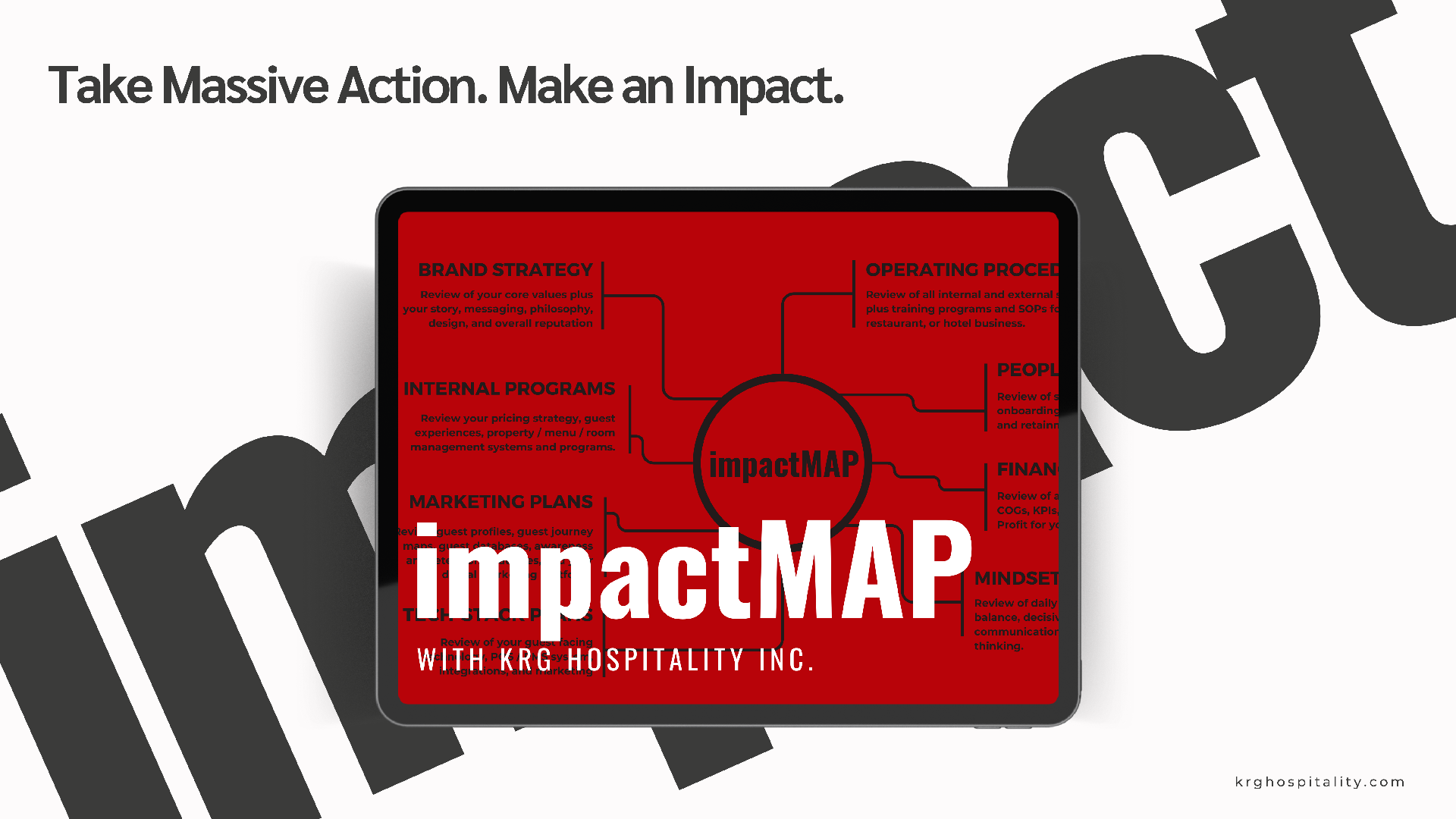
KRG Hospitality ImpactMAP, main image

Let’s be honest, the line between success and failure often hinges on the ability to act decisively and act with purpose.

In this article, we’re going to explore two areas of your hospitality business that are under your control: creating a plan, and taking action.

Understanding the Risk of Inaction

The concept surrounding the Risk of Inaction—arguably a new form of ROI—captures the potential losses businesses face when they fail to take strategic actions.

Inaction in the hospitality industry can manifest in various harmful ways. Inaction can also stem from multiple sources: fear of change, lack of resources, or simply underestimating the competition.

Regardless of the manifestation or cause, the consequences are usually the same: stagnation, decline, and, ultimately, a shuttered business.

Let’s put this into context by taking a look at a sample of both a restaurant and a hotel business.

Failure to Innovate

If a restaurant does not act to continuously re-engineer its menu, it risks diminishing profits, providing a low-level guest experience, and mismanaging inventory. Without regular strategic updates, the menu may fail to reflect current culinary trends and guest preferences, which can lead to a decrease in interest and satisfaction.

Additionally, sticking with a static menu can prevent the restaurant from optimizing ingredient use, productivity, and cost-efficiency.

At the end of the day, this lack of adaptation and innovation will result in diminishing sales and profitability, making it difficult for the restaurant to sustain its operations.

Failure to Update Systems

If a hotel on the other hand decides to not use a modern and fully integrated Property Management System (PMS), it risks operating inefficiently and falling behind in today’s technology-driven hospitality environment.

A non-existent, outdated, or fragmented PMS can lead to significant operational issues, such as slow check-in and check-out processes, errors in room availability and booking management, and ineffective communication between different departments. That’s just to name a few crucial issues.

This inefficiency can impact guest experiences negatively, leading to dissatisfaction and potentially harming the hotel’s reputation.

Furthermore, without a modern PMS, a hotel may struggle with data management, limiting its ability to effectively analyze performance metrics, forecast demand, and implement dynamic pricing strategies. These disadvantages will result in lost revenue and reduced competitiveness in a space where guest expectations and operational efficiency are increasingly driven by technological advancements.

In each example above, the risk of inaction leads to missed opportunities and underperformance.

The Power of an ImpactMAP™

To combat the risks associated with inaction, your hospitality business can benefit significantly from developing an ImpactMAP™.

This strategic tool can help you identify where you currently stand, define where you want to go, and outline the steps required to get there, thereby helping you create not only strategic clarity, but drive and accountability.

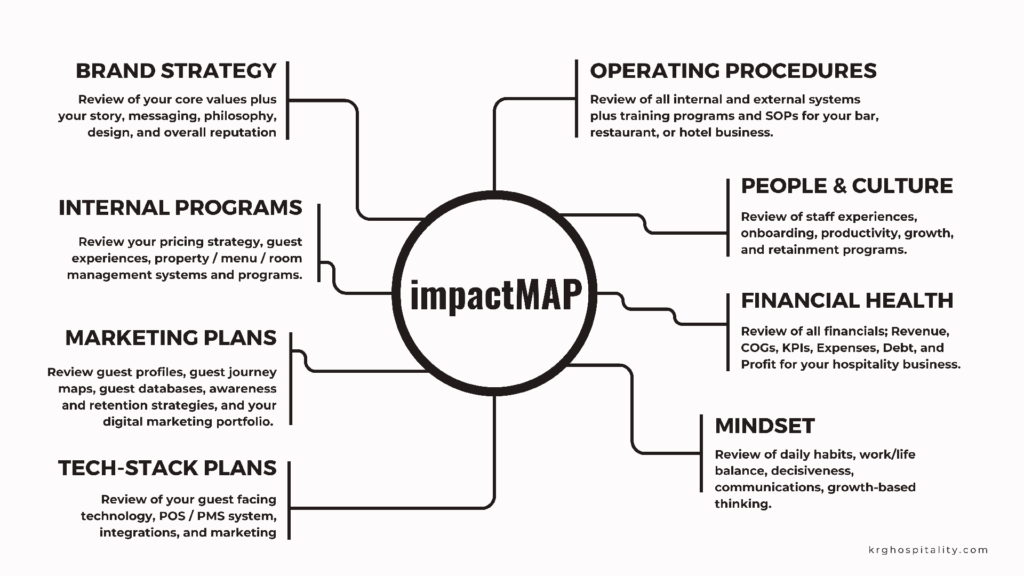
KRG Hospitality ImpactMAP, flowchart and map

The Assessment

To create an ImpactMAP™ and to take action immediately, you need to first assess your operations.

An assessment of your hospitality business is a comprehensive evaluation process aimed at analyzing various aspects of your business to identify strengths, weaknesses, and areas for improvement or opportunity. The goal is to gather actionable insights that can help optimize operations, enhance guest experiences, and massively improve your profitability.

The assessment should involve on-site observations, staff interviews, and a deep dive into the following eight categories, culminating in a detailed report that provides recommendations and a strategic plan for future growth and sustainability.

For each of the eight categories, consider a 3x matrix with three responses to the following questions:

  • Where are we now?
  • Where do we want to go?
  • What resources do we need?
  • What’s holding us back?

Then, create a SMART (Specific, Measurable, Achievable, Relevant, Timely) goal for each response in your “Where We Want to Go” list.

What are the eight assessment categories?

1. Brand Strategy

Assessment: Review your core values, story, messaging, philosophy, design, and reputation.

Opportunity: Enhance brand alignment across all touchpoints to ensure consistency while refining your brand messaging to better connect with targeted guest profiles.

2. Internal Programming

Assessment: Review your pricing strategy, guest experiences, property / menu / room management systems and programs.

Opportunity: Optimize your offerings based on guest preference data and a profitability analysis, along with potential upgrades to your amenities to enhance guest satisfaction and to compete with today’s market standards. In summary, implement efficiencies to improve guest experiences and operational workflow with a focus on your internal programming.

3. Marketing Plans

Assessment: Review guest profiles, guest journey maps, guest databases, awareness and retention strategies, and your digital marketing portfolio.

Opportunity: Integrate advanced digital marketing techniques to increase reach and engagement while developing targeted promotions and partnerships, and by leveraging data analytics to tailor marketing efforts more precisely to guest behaviors and trends.

4. Tech-Stack Plans

Assessment: Review guest facing technology, POS / PMS system, integrations, and marketing.

Opportunity: Identify current technology gaps and plan for a strategic integration of systems that enhance guest experiences while streamlining operations.

5. Standard Operating Procedures

Assessment: Review of all internal and external systems, plus training programs and SOPs.

Opportunity: Ensuring that all staff are clear on their roles and responsibilities, which enhances overall service quality through the development of standardized procedures that ensure consistency and efficiency across the business. Implement feedback systems to continually refine and improve SOPs based on real-time challenges and successes.

6. People and Culture

Assessment: Review of staff experiences, onboarding, productivity, growth, and retainment.

Opportunity: Strengthen employee engagement through improved communication and support systems. Foster a culture of innovation and openness in which employees feel valued and motivated. Develop leadership from within to enhance management effectiveness and succession planning.

7. Financial Health

Assessment: Review of all financials, including Revenue, COGs, KPIs, Expenses, Debt, and Profit.

Opportunity: Identify cost-saving opportunities without compromising service quality. Explore new revenue streams that align with your brand values and market opportunities. Implement more rigorous financial tracking and forecasting tools (such as technology) to better predict financial trends and react proactively.

8. Mindset

Assessment: Daily habits, work / life balance, decisiveness, communications, and growth-based thinking.

Opportunity: Develop a mindset of continuous improvement among all staff levels (starting with yourself) to foster an environment of excellence. Cultivate resilience by planning for crisis management and business continuity. Promote a guest-centric approach, aligning all business decisions with guest satisfaction and personal development outcomes.

Creating the ImpactMAP™

By following the above 3x strategy for each category, you will have created 24 SMART objectives that will be the foundation of your ImpactMAP™ to move your business forward over the next one to six to 12 months.

Importance of SMART Objectives

What does SMART mean and how does it work?

  • Specific, Clarity, and Focus: SMART objectives provide clear and concise goals that everyone in your business can understand and rally behind. This clarity helps to focus efforts and resources on what’s most important.
  • Measurability and Tracking: By setting measurable goals, your business can track progress and make data-driven decisions. This measurability allows for adjustments to be made in strategies or tactics to ensure the objectives are met.
  • Achievability: Goals that are achievable motivate staff. Setting impossible goals can lead to frustration and disengagement, whereas achievable objectives encourage team effort and commitment.
  • Relevance: Ensuring that each objective is relevant to the broader business goals ensures that every effort made contributes to the overall success of your brand.
  • Timeliness: Incorporating a timeframe provides urgency, a deadline, and accountability, which can help prioritize daily tasks and long-term plans.

However, you shouldn’t try to accomplish all 24 objectives at the same time. Once you’ve set your 24 impactful objectives, prioritizing them is crucial to stabilize your hospitality business and aim for scalable growth.

Best Practices for Prioritizing Objectives

  • Assess Business Needs: Start by conducting that thorough assessment of your business to identify key areas that need improvement.
  • Impact Analysis: Evaluate the potential impact of each objective. Prioritize objectives that offer the greatest benefits in terms of guest satisfaction, revenue growth, and operational efficiency.
  • Resource Availability: Consider the resources available, including budget, people, and technology. Prioritize objectives that align with current resources or where adjustments can be made to accommodate necessary changes.
  • Quick Wins: Identify objectives that can be achieved quickly and with minimal disruption to your ongoing operations. These quick wins can boost morale and provide visible improvements that justify further investments in other areas.
  • Strategic Importance: Some objectives, while not providing immediate benefits, are crucial for long-term success. Prioritize these based on their strategic importance to the business’s future.
  • Stakeholder Input: Engage with various stakeholders, including management, staff, and guests, to gain insights into which objectives they feel are most critical. This can help in aligning the goals with the needs and expectations of those most affected by the changes.
  • Balanced Scorecard: Use a balanced scorecard approach to ensure that objectives across different areas such as guest services, internal processes, financial performance, and learning and growth are all being addressed.
  • Iterative Review: Regularly review the priorities as situations and business dynamics evolve. What may be a priority today might change based on market conditions or internal business changes over the next three to six months.

Once you have your objectives prioritized, it’s time to assign or delegate them as needed and have those assignees (including yourself) take ownership of the objectives with their signature to add another level of accountability.

Implementing the ImpactMAP™

Before starting, ask yourself one final question: What will happen if we don’t take action?

Be detailed and mindful of what the short-term and long-term consequences might be if you don’t act.

Effective implementation of an ImpactMAP™ requires knowledge of these consequences, along with a commitment from all levels of your business. It starts with comprehensive training sessions followed by regular review meetings, which are both essential to assess progress, address challenges, and refine strategies as needed.

Take a SMART-ER approach, which is where you Evaluate and Re-adjust the SMART objectives halfway through the timeline you’ve set.

Conclusion

Risk of inaction is a silent threat that can undermine any business, particularly in this dynamic industry.

Adopting an ImpactMAP™ and making a commitment to take massive action allows you to manage your operations proactively, adapt to changing market conditions, and set a course for sustainable success.

This strategic approach not only mitigates risks but also empowers your hospitality business to thrive in a competitive landscape—but it starts with you and your mindset toward taking action.

Image: KRG Hospitality

KRG Hospitality. Restaurant Business Plan. Feasibility Study. Concept. Branding. Consultant. Start-Up.

Top