Finalizing Your Big Game Menu? Google is Here to Help
by David Klemt
Operators putting the final touches on their delivery, takeout, meal kit and Big Game menus for February 7 could probably use some help.
None of us have a crystal ball but we do all have access to Google Trends intel, which is often just as good.
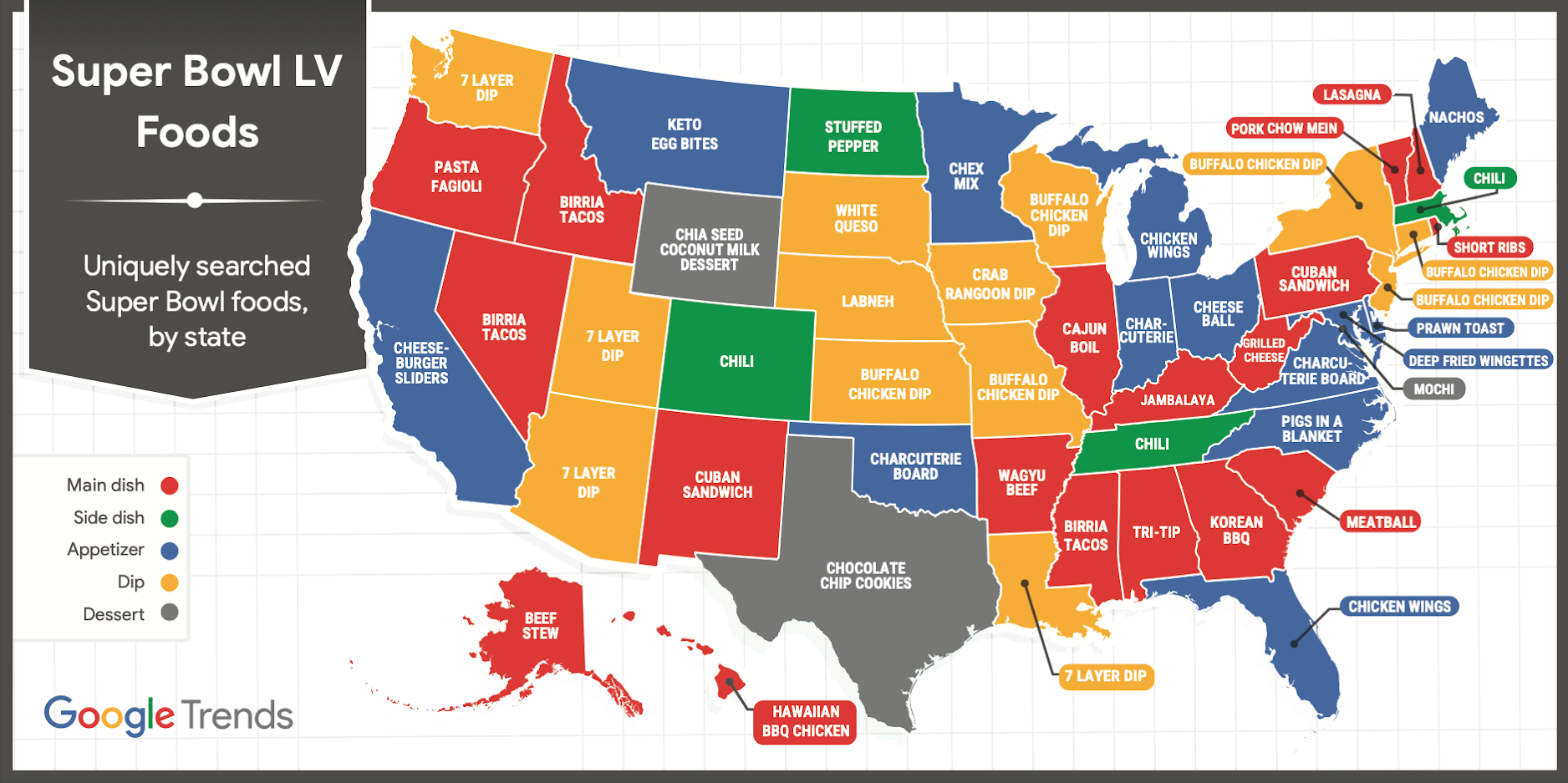
Google’s latest data-driven infographic is just in time for this coming weekend: Uniquely searched Super Bowl foods, by state.”
The information, neatly categorized by food item type, provides insight into what people in each state are interested in ordering from restaurants or featuring at their at-home gathering. Such data can help operators dial in their menus and create Big Game packages, offering customers a convenient way to enjoy their favorite foods while they watch the Big Game.
Unique Super Bowl Food Searches
Google color-coded their infographic. Red represents main dishes, green is for side dishes, appetizers are blue, dip is yellow, and grey denotes dessert. As the Google map shows, several states are more into snacks than entrees.
Eighteen states are red. Interestingly, a specific item is the top search in three states. Nevada, Idaho and Mississippi are dominated by birria tacos. Cuban sandwich was the top search in two states: New Mexico and Pennsylvania. The other 13 states each have top searches unique to them:
Oregon: Pasta fagioli
Alaska: Beef stew
Hawaii: Hawaiian BBQ chicken
Illinois: Cajun boil
Arkansas: Wagyu beef
Kentucky: Jambalaya
Alabama: Tri-tip
Georgia: Korean BBQ
South Carolina: Meatball
West Virginia: Grilled cheese
Rhode Island: Short ribs
Vermont: Pork chow mein
New Hampshire: Lasagna
Just four states are green, and chili is the top search in 75 percent of those: Colorado, Tennessee and Massachusetts. North Dakota is the outlier with stuffed peppers.
There are 13 states colored blue. The top football food search in three of those—Oklahoma, Virginia and Indiana—is charcuterie board. Surprisingly, chicken wings are the top search in just two states, and neither is their state of origin: Michigan and Florida. The most unique appetizer, at least in our view, is Montana’s interest in keto egg bites. Although, Maryland’s search for deep fried wingettes is very specific and Delaware’s search for prawn toast is rather distinct. What’s commonly assumed to be a sports bar and Super Bowl staple, nachos, was only the top search in one state: Maine. California searched for cheeseburger sliders, Minnesota looked up Chex Mix, Ohio is most interested in cheese ball, and North Carolina is all about pigs in a blanket.
Another 13 states are most interested, per Google data, in dip (yellow states). In particular, Buffalo chicken dip reigns supreme. It’s the top search in six states: Kansas, Missouri, Wisconsin, New Jersey, Connecticut and, somewhat predictably, New York. However, 7-layer dip is a close second, dominating four states: Washington, Arizona, Utah and Louisiana. Nebraska may lay claim to Most Unique Dip Search with labneh. South Dakota looked up white queso the most, and Iowa prefers crab rangoon dip.
Only two states and Washington, DC, searched for dessert items the most. Wyoming’s top search was incredibly specific: chia seed coconut milk dessert. Texas wants chocolate chip cookies, and our nation’s capital searched for mochi.
Unfortunately, this Google Trends data doesn’t include Puerto Rico. You can view the infographic by scrolling down.
Takeaways
Top main dish: Birria tacos
Top side dish: Chili
Top appetizer: Charcuterie board
Top dip: Buffalo chicken
Super Bowl LV: Uniquely searched Super Bowl Foods, by state. Google Trends.
The big third-party delivery services are facing pushback in the form of community-based competition.
We’ve kept our eye on this burgeoning trend and the push for operators to implement first-party delivery, also known as direct delivery.
It isn’t directly related to hospitality but the first of the “not” sites that grabbed our attention was Not Amazon. As the name suggests, Not Amazon is…well…not Amazon.
The founder highlights businesses owned and operated by women and BIPOC and LGBTQA+ people. However, Not Amazon goes even further, as illustrated in their mission statement:
“Providing the most we can, while taking as little as possible, in order to build a new kind of community.”
Community and neighborhood support is at the core of Not Amazon. The digital era has been marked by local, mom-and-pop brick-and-mortar businesses suffering in the wake of online shopping. Convenience has outweighed community. More often than not, women-, BIPOC- and LGBTQA+-owned businesses have been disproportionately affected by “convenience.”
Of course, it makes sense with a global pandemic to shop online. Not Amazon, which currently serves Calgary, Halifax, Toronto and Vancouver, provides a viable alternative to its behemoth of an online retail counterpart.
That brings us to two compelling hospitality industry-specific platforms.
It’s not a secret that KRG Hospitality supports first-party and last-mile delivery. In fact, we’ve very clearly explained that operators lose guest data and control over the guest journey when they sign with a third-party delivery company.
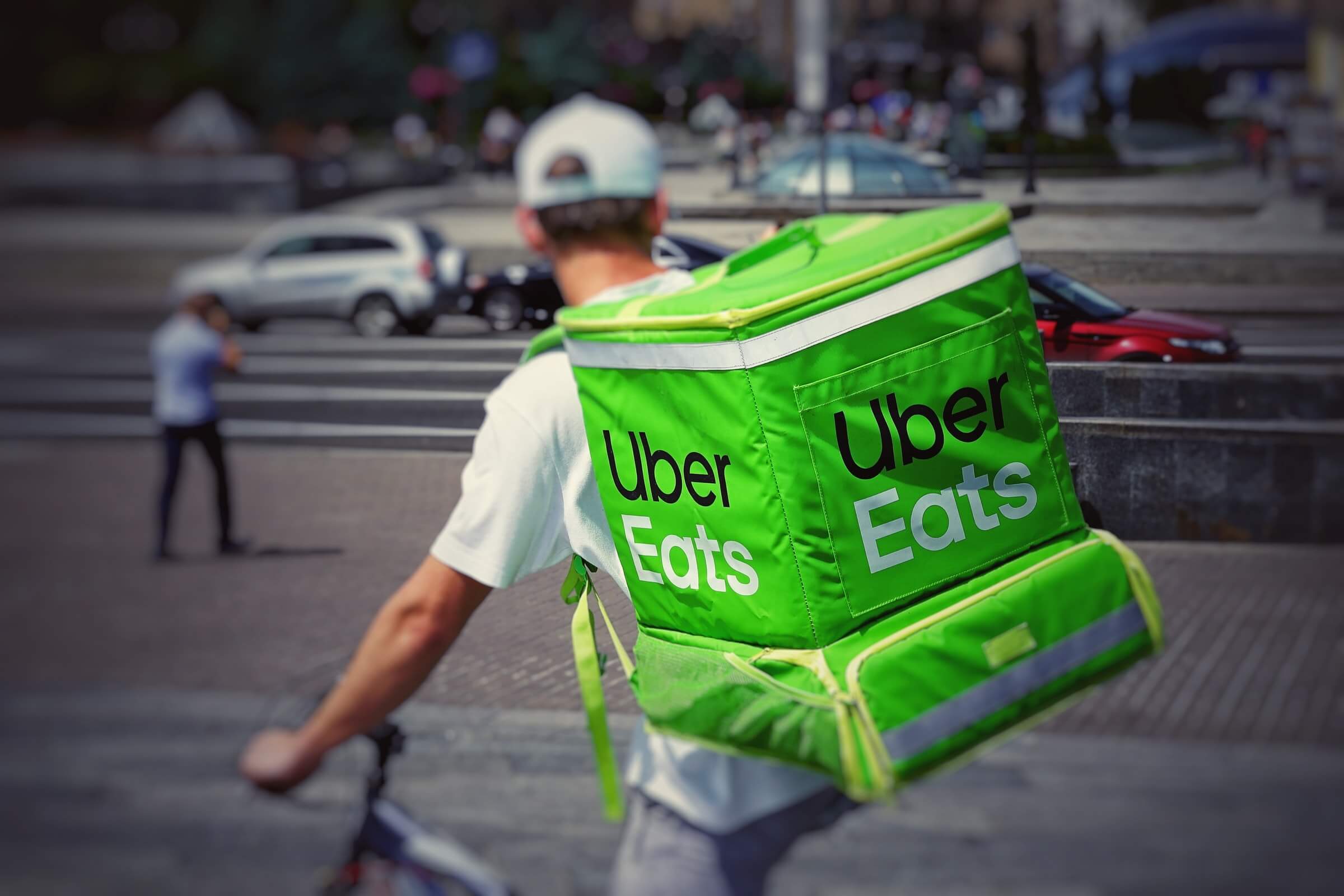
That’s to say nothing of the fees third-party services charge their F&B “partners.” Is it convenient that DoorDash, UberEats, Postmates and other companies provide a semblance of infrastructure, the lure of reaching a larger pool of customers, and drivers (including the associated liability)? Sure.
But are the costs associated with doing business with a third-party delivery company worth it? Most likely not.
Studies have also shown that when a delivery goes wrong on the third-party’s end–cold food, for instance–it’s the restaurant that tends to get the blame.
There are two websites that, like Not Amazon, have popped up to put supporting local restaurants front and center: Not UberEats and NotGrubhub.
The former serves Toronto and operates as a non-profit, according to their FAQ page. The latter is mainly focused on the United States, offers the option to purchase gift cards, and is powered by Lunchbox. NotGubhub also boasts more than 100,000 direct ordering links.
Both operate in similar fashion: Restaurants submit their information to be added to the respective platforms, provide an ordering link, and obtain a listing. From there, people can search by location for restaurants in their area to place a delivery order.
In the case of NotUberEats, deliveries are fulfilled by Ritual or DoorDash. As noted on their FAQ page, Ritual is offering Toronto restaurants free delivery through 2021. Restaurants can also DoorDash because, as NotUberEats explains in their FAQs, the service is charging a flat rate and not collecting any commissions.
People can also send restaurant information to NotUberEats to help grow their listings. Anyone who wishes to do so is asked to provide at least 50 businesses in their city and submit them here.
Operators ready to make the move to first-party/direct delivery and own their guest journey should consider the following platforms:
With delivery here to stay, the sooner operators transition to direct delivery, the better. There’s no longer a reason to lose control of guests, a profitable operational element, or costs.
Recently Awarded Michelin Star Shines Spotlight on Vegan Menus and Operations
by David Klemt
If there was any question that vegan restaurant concepts are viable, a recently awarded Michelin star has provided a firm and affirmative answer.
Michelin Guide France awarded ONA (Origine Non Animale or “Non-Animal Origin” in English) a Michelin star earlier this week. This marks the first time in the award’s history that a restaurant in France that uses no animal products received a star.
Chef and owner Claire Vallée opened ONA in the city of Arès in the southwest of France in 2016 leveraging a combination of crowdfunding a loan from La Nef, an ethical bank. It has been reported that volunteers helped to finish the project when funds ran out before construction had been completed.
The vegan diet has endured mockery for decades in the United States and Canada. It’s only in recent years that veganism has flourished, bolstered by a belief that the diet is healthier, more sustainable, and more ethical. Growing interest in plant-based diets have also no doubt boosted veganism.
In France, however, the vegan diet hasn’t been embraced as widely as it has throughout North America. Sifting through online searches, travel blogs and posts shows that, generally speaking, vegan options aren’t widely available throughout France’s rich and storied restaurant scene.
For ONA to win a Michelin star shows that attitudes toward the vegan diet in one of the gastronomy and culinary capitals of the world is undergoing a possibly seismic shift.
A number of chefs have returned their Michelin stars or requested their restaurants not be considered for the accolade. For now, however, Michelin stars still recognize outstanding food and operations.
The awarding of a star to ONA is a significant achievement for Chef Vallée and her team.
Delivery and Takeout Food Trends for 2021: United States
by David Klemt
Yesterday we reviewed food delivery data and 2021 food trend predictions for Canada. Now it’s the United States’ turn.
Before we jump into the data and predictions, a word on succeeding with delivery in 2021 and beyond.
As I pointed out yesterday, when an operator signs up with a third-party delivery service, their guest data becomes the delivery company’s data.
That means that company and not the restaurant or bar owns the guest journey and guest engagement, and therefore owns the guest for all intents and purposes.
When a restaurant, bar or other F&B business enters into a contract with a third-party delivery company—unless otherwise explicitly stated—they give up control of targeted marketing efforts. In other words, third-party delivery platforms disrupt the guest journey.
Delivery became a way for many businesses to generate revenue during 2020, for obvious reasons. Operators who can afford to implement first-part and last-mile delivery should do so to maximize their revenue and control the guest journey and marketing.
To help operators own delivery, we’ve reviewed end-of-year reports from three delivery titans—UberEats, Grubhub and DoorDash—to share their 2020 findings. When it comes to the most ordered items, cuisines and categories, some third-party platforms are willing to share data.
According to UberEats, comfort foods were the most popular category:
Burgers and fries
Burritos
Pad Thai
Mac and cheese
California rolls
Chicken Tikka Masala
Miso soup
Mozzarella sticks
Per the platform, the following cuisines proved most popular:
American
Italian
Mexican
Chinese
Japanese
Thai
Indian
French
Caribbean
Greek
As UberEats stated in their report, it appears that customers found a way to travel after all—they just did it through food.
Pizza, bagels, wings, tacos, burgers and dumplings led the way for Grubhub in 2020. The most popular pizza order was Hawaiian (because some people are monsters and put pineapple on their pies), while the most popular burger was garlic mushroom. Grubhub revealed that their top French fry was the loaded curly fry, and the most popular plant-based item was the eggplant burger.
In descending order, the top F&B Grubhub orders overall from 2020 were:
Spicy chicken sandwich
Chicken burrito bowl
Chicken wings
Waffle fries
Cold brew coffee
Steak quesadilla
Iced latte
Fish and chips
Strawberry shake
Roast beef sandwich
Per Grubhub, the top breakfast item was the acai bowl, the top side dish was French fries, the number-one late-night order was strawberry cheesecake, and the most ordered dessert was apple pie.
Moving on to DoorDash, the platform identified their top ten 2020 items back in November:
Chicken fingers and French fries
Fried chicken sandwich
Mac and cheese
Chips and guacamole
Apple pie
Pad Thai
Chicken quesadilla
Iced coffee
California roll
Chicken Tikka Masala
The UberEats, Grubhub and DoorDash revelations align with data collected by the National Restaurant Association between November and December of 2020. Per the NRA, the following were the top items sold by full-service casual, family and fine-dining restaurants:
Burgers
Seafood
Pizza
Steak
Chicken (excluding chicken wings)
Breakfast items
Pasta
Mexican food
Sandwiches, subs and wraps
Chicken wings
According to the NRA, the items below were the most popular for limited-service restaurants (fast casual, quick-service, coffee and snack):
Sandwiches, subs and wraps
Pizza
Burgers
Chicken (excluding chicken wings)
Ice cream, cookies and cakes
Baked goods
Breakfast items
Mexican food
BBQ items
Seafood
For 2021, DoorDash predicted the following items to see a lift:
Sausage, egg and cheese on a biscuit
Create your own omelettes
Carrot cake
Cinnamon roll
Caramel latte
Chocolate brownies
Black coffee
Donuts
Blueberry muffin
Biscuits
DoorDash revealed that Mexican, Chinese and Tex-Mex were the top cuisines ordered via the platform. The company also predicted five cuisines would be popular in 2021:
Taiwanese
French
Filipino
Australian
Moroccan
When it comes to 2021, multiple sources have named vegetarian, vegan, plant-based, and health and wellness items as the foods to watch. Even this early into the year it’s not exactly a controversial statement to say that all of those categories are going to perform well in 2021.
According to DoorDash, nearly half of Americans (47 percent) plan to consume more plant-based items. Whether it’s truly healthier than its traditional counterparts, plant-based is perceived that way. In total, per DoorDash, 72 percent of Americans plan to make a concerted effort to eat healthier in 2021. This is likely due to an increased interest in boosting immune systems due to Covid-19.
Put another way, operators will likely struggle if they don’t add vegan, vegetarian, and plant-based foods to their streamlined menus, another trend expected to continue through 2021.
Predictions from the Specialty Food Association in particular caught our attention. For 2021, the association has predicted spices and herbs native to West Africa (Senegal, for example) will be in demand. Scandinavian and Cambodian flavors are also expected to perform well, as are Latin American and Southeast Asian items.
Due to interest in tahini sauce and black sesame, the SFA expects halva, which is a Middle Eastern confection, to get plenty of attention. The SFA and Datassential both named fermented honey as an item to watch in 2021.
Along with vegan and plant-based items, creative meal kits are expected to perform well. Restaurants and bars will continue to face restrictions and indoor dining bans over the course of at least the next few months. Creative meal kits will get the attention of customers who have grown tired of preparing the same meals over and over.
Whether an operator chooses to stick with their current menu or embrace one or more food trends, they should look into first-party or last-mile delivery. It’s imperative that operators own their guest journey and marketing efforts.
For more information about first-party and last-mile delivery, please listen to Bar Hacks episode 13 with “Rev” Ciancio, an advocate of keeping delivery and data in-house.
Patrons, analysts and experts have spoken: delivery and takeout will remain standards in the new era of hospitality.
Analysts and experts have spoken with data, and consumers have spoken with their dollars.
But there’s another consequential voice that matters when it comes to delivery: that of the operator.
There’s no denying that the operator is shoved aside in the third-party delivery relationship. At the very least, that’s the overwhelming perception. Once an operator signs on with such a service, their guest data becomes the delivery company’s data.
Whatever company owns the data owns the guest, their journey and engagement, and the targeted marketing efforts. That means a restaurant or bar’s guests receive offers and promotions for their competitors.
In short, third-party delivery platforms disrupt the guest journey.
However, there are some data the third-party delivery services do share. As we saw midway through 2020, for example, Uber Eats and Grubhub released the top orders and other useful information in publicly available reports. Some of the services also release end-of-year or year-in-review reports, as SkipTheDishes did for Canada.
Most of these reports are laser-focused on the United States. That’s logical given the number of bars, restaurants and other hospitality businesses to which Grubhub, Uber Eats, Postmates, Instacart, Seamless and other services have access.
SkipTheDishes, for the Americans reading this, is the Grubhub of Canada. For the Canadians reading, below are SkipTheDishes’ data regarding top orders, cuisine, and demographics in 2020:
Top Cuisines: Chinese, Italian, American/Canadian
Top Orders (General): Asian dishes, pizza, burgers
Top Orders by Item: Chicken sandwiches (also the top item in 2020 in the US), burgers, and French fries (mid-year data)
Top Vegan Provinces: Manitoba, Saskatchewan, British Columbia
Top Organic Provinces: British Columbia, Ontario, Alberta
Top Gluten-free Provinces: Manitoba, Alberta, The Maritimes
Top Dairy-free Provinces: British Columbia, Alberta, The Maritimes
Top Kosher Provinces: Alberta, Ontario, Saskatchewan
Top Dayparts: 5:00 PM was the most popular order time, and late afternoon (3:00-4:00 PM) and weekdays saw lifts. Late-night ordering (9:00 PM and beyond) slowed. (Mid-year data.)
Top Pre-order Daypart: 5:00 PM. More Canadians got into the habit of pre-ordering their dinners. (Mid-year data.)
Fastest-growing Segment by Age Group: 65+
Most Revealing Datum: 81% of customers ordered from restaurants they’d never visited in person.
Plant-based items and foods recognized for boosting a person’s immune system are expected to be popular. The pandemic has given many consumers a reason to reevaluate what they’re putting into their bodies. All three sources predict people will be interested in and order plant-based foods and focus on health and wellness.
Both Food Network Canada and Chatelaine predicted chickpeas—an inexpensive, versatile and plant-based protein source—will be among the top food items sought out by restaurant guests (in-person) and customers (takeout, delivery). Most operators should be able to adapt and get creative to add chickpea-based items to their menus. The two sources also predicted that snacking will replace meals (at least occasionally), so snackable items and sides may take off this year.
Food Network Canada pointed to sauerkraut as an example of a health and wellness food item that may see a boost in popularity and demand due to its probiotic and gut health properties. The source also predicted that coffee and coffee-based F&B items will get a lift in 2021.
Restaurants Canada predicted that comfort food, popular throughout 2020, will remain in high demand. However, 2021 will bring in an interest in elevated riffs on comfort food classics. Citing specific examples, Restaurants Canada suggested Pad Thai French fries and Pulled Pork Mac and Cheese. The Canadian food industry association predicted that interest in and support of Black, Indigenous, and People of Color (BIPOC) cuisine, flavors and businesses will continue through 2021.
All three sources listed plant jerky as food item to watch in 2021.
What else should be in store for this year? Operators embracing first-party or so-called “last-mile” delivery to grab their share of the orders of this year’s trendy food items. Platforms such as Lunchbox, Olo, ChowNow can provide operators with the ability to own delivery and therefore the entire guest journey in the new era of hospitality. It’s likely an operator’s current POS can be updated to “unlock” in-house delivery, which would then need to be supported by a delivery menu, delivery supplies, and staff training.
For more information about first-party and last-mile delivery, please listen to Bar Hacks episode 13 with “Rev” Ciancio, an advocate of keeping delivery and data in-house.
Tobin Ellis and Barmagic’s Relief Dashboard Contains Hundreds of Restaurant and Bar Resources
by David Klemt
In keeping with this week’s focus on good news, KRG Hospitality would like to shine a light on Barmagic’s Bar & Restaurant Revival Guide.
First, some background.
Tobin Ellis founded Barmagic of Las Vegas in 1997. He’s done so much for the hospitality industry that it feels almost criminal to just attach a few labels to describe him, but here we are.
Ellis is a hospitality industry innovator, advocate, designer, marketer and consultant. Anyone who has ever attended an hospitality trade show and sat in on a presentation, panel or Q&A session featuring him knows he’s passionate, quick-witted, real-world solution-oriented, and doesn’t suffer pretenders lightly.
He’s also more than put in the work to for the recognition he deserves as an industry icon. Ellis has been in the trenches for decades, beginning his hospitality journey washing dishes in upstate New York. He has worked around the world in essentially every type of venue, from sleepy dives to hyperkinetic high-volume cocktail bars, and everything in between.
A few years back, Perlick partnered with Ellis to create the Tobin Ellis Signature Cocktail Station. This innovative hardware was designed with ergonomics in mind, focusing on improving bar team member’s physical comfort and safety.
Since restaurants and bars found themselves fully in the devastating and nearly inescapable grip of the pandemic, Ellis has focused on the health and longevity of the industry as a whole.
To help operators navigate the pandemic and the myriad challenges (again, a criminal label for what operators and workers have been facing for almost 12 months) it continues to present, Ellis added a Hospitality Relief dashboard to the Barmagic website.
Visitors will find hundreds of links for US- and Canada-based resources, including a relief map for those who need aid or who want to donate to relief efforts. There’s also a link to the Barmagic Bar & Restaurant Revival Guide, a 96-page download loaded with information and ideas that Ellis hopes “might just spark a thought or two” in the minds of restaurant and bar owners, operators, leaders and workers.
We’re not going to get through this if we don’t come together, save as many businesses as possible, and help new venues open and flourish. We applaud the Barmagic relief resources—more like this, please.
Athletic Brewing Co. Proves Viability of Alcohol-free Beer
by David Klemt
Doubters and detractors of non-alcoholic beer have only to look at Athletic Brewing Co. to understand the category has a long, bright future ahead of it.
Athletic Brewing opened its first taproom in Stratford, CT, back in May of 2018. A month later, the non-alcoholic brewer signed on with a distributor to launch two of their flagship beers statewide. Two years after that milestone was reached, Athletic took over a 100,000-barrel capacity facility in San Diego once owned by Ballast Point.
That would be impressive growth for any brewer, traditional or non-alcoholic. But there’s another element that really highlights the explosive growth and potential of Athletic: investment rounds.
In August of 2017, Athletic raised $250,000 in seed funding. One year later, in September, the brewer raised $500,000 in another seed funding round. A third funding round resulted in $3,122,221 in December 2019. And then came March 2020: Athletic raised $17,500,000 in Series B funding.
According to a report written by Kate Krader and published earlier this week by Bloomberg, some of Athletic’s investors are celebrities, something that had remained quiet for a few years now.
David Chang, the founder of Momofuku, NFL players Justin Tuck and JJ Watt, and Lance Armstrong are some of the celebrity backers identified by Krader as Athletic Brewing Co. backers. According to Crunchbase, Blake Mycoskie, founder of TOMS Shoes, participated in the 2020 Series B funding round.
That these investments remained under the radar shows that celebrities and other investors believe Athletic and the non-alcoholic beer category is here to stay.
We’ve grown accustomed to celebrity-backed spirits and wines. At least three celebs have scored massive paydays in spirits. George Clooney and Rande Gerber sold Casamigos to Diageo for $1 billion in 2017. Last year, Aviation Gin, owned by Ryan Reynolds, sold to Diageo for a deal worth up to $610 million.
Athletic is one of the brewers we showcased in our January 1 article “0.0 to 0.5 Beers to Know for Dry January and Beyond.” We shared some of Athletic’s story and how founder Bill Shufelt was motivated to fill a void in the market. Namely, refreshing and flavorful non-alcoholic craft beers.
Shufelt, like so many people who have chosen to live an alcohol-free lifestyle or reduce their alcohol intake, still enjoys going out to bars and restaurants to socialize. Athletic and other non-alcoholic brewers offer guests a drinking and dining experience without a sacrifice in quality.
I can clearly see an opportunity for people to invest in Athletic Brewing Co., Partake Brewing, WellBeing Brewing, Surreal Brewing Company, and others moving forward. It’s obvious that craft non-alcoholic beers have a future beyond Dry January, and it’s likely more talented brewers and celebrities will enter the category. In fact, 2021 may be the Year of NA Beer.
Have a Slice of Nostalgia: The Return of Viennetta
by David Klemt
A British confection launched in the ’80s is headed back to the United States.
Wall’s brought what’s considered by some the first-ever branded ice cream dessert—Viennetta—to the world almost 40 years ago. The British frozen dessert and ice cream producer, owned by Unilever, launched the legendary treat in 1982.
Viennetta is said to be based on a multi-layered pastry known as mille-feuille. The original Wall’s product consists of layers of vanilla ice cream and compound chocolate that create the dessert’s signature wavy top.
While Viennetta was a product of Wall’s in Europe, it came to America under Unilever’s Breyers label. At one point in the ’90s, the product disappeared from the United States, though it maintained a presence throughout Europe, Australia, New Zealand, and elsewhere.
As an ’80s kid, I remember seeing Viennetta commercials late in the decade, or perhaps I saw them in the early ’90s. Either way, the images of what passed for elegance and sophistication back then informed me that Viennetta must be a “fancy” dessert. I mean, c’mon—it was served on a silver platter!
Alas, I never had the opportunity to taste what I could only assume back then was an opulent dessert before it was so cruelly whisked out of the country. But that will change this year.
Unilever is bringing at least the original vanilla flavor back to the States in 2021 under their Good Humor brand. Back in the ’80s, Viennetta wasn’t available solely at supermarkets—it was also sold at KFCs and Pizza Huts. I’ve found no announcements from Unilever or Good Humor that Viennetta will be available through a partnership at any restaurants this year, but it would make sense.
Can you experience nostalgia if you’ve never actually owned, enjoyed or consumed a product in the past personally? Apparently the answer is yes, because when I saw Viennetta was returning to America my first thought was, “Finally—I’ll have my chance,” followed by a flood of images from my childhood and early teen years.
Should I be ashamed? Maybe. But I’m not. And I know I’m not alone. And I know something else: Operators looking to leverage nostalgia, particularly if they’re ’80s- or ’90s-themed or feature programming around those decades, should be excited about this news.
It was so much fun reviewing 2021 food trend predictions that we felt compelled to do the same for drinks.
We checked out Liquor.com, VinePair, Wine Enthusiast, SmartBrief and Forbes to see what they had to say about how and what people will be drinking in 2021. As we predicted, a number of the predictions were identical or at least similar, lending them even more weight.
Let’s get into the top trends for 2021!
To-Go Cocktails are Here to Stay
What was once a defining characteristic of partying in New Orleans and Las Vegas quickly became a necessity for operators throughout the United States. To-go drinks provided operators with a way to generate some revenue during the pandemic (to varying degrees of success, of course). VinePair and Wine Enthuisast have both predicted this trend will swing more toward a stand element of operations through at least 2021. Similarly, SmartBrief and VinePair predict that alcohol delivery also isn’t going anywhere anytime soon. Also here to stay? Contactless/touchless menus. Guests have gotten used to them, and that’s unlikely to change.
When building out their cocktails-to-go menu sections, operators should consider another Wine Enthusiast trend prediction: the growth of low- and no-alcohol drinks. This trend has been growing for at least the past two years, so it’s worth noting and leveraging.
Cans, Hard Seltzer & RTDs Continue Their Rise
Canned wines, canned cocktails, hard lemonades, hard seltzers growing in the on-premise space… VinePair, Forbes, SmartBrief, and Wine Enthusiast all made similar predictions. Wine Enthusiast went a step further and more specifically suggested that the popularity of canned cocktails may be strongest in the first half of 2021. It stands to reason that what consumers make popular off-premise will be in demand on-premise sooner or later. Operators should probably assume they’ll be selling buckets of hard seltzers, hard lemonades and canned cocktails once people can resume dining and drinking in person like they did pre-pandemic.
Responsible, Ethical & Transparent Businesses are the Future
And the near future, at that. This shouldn’t come as a surprise—people vote with their dollars and today’s consumer wants to know they’re supporting restaurants, bars, hotels, resorts, and other businesses that align with their values. Wine Enthusiast and Forbes predict that consumers will seek out businesses that operate ethically and that brands, cognizant of this expectation, will work harder to be more sustainable and responsible.
Connection Becomes Even More Important
The statement that humans are social creatures by nature isn’t exactly a hot take—we all know this. Having been largely deprived of the ability to socialize, people are starving for interaction. SmartBrief predicts that consumers will look to connect more with the brands they support. This is largely down to people becoming accustomed to engaging with brands and people via Zoom and other platforms—they’re going to want to continue this engagement in person. Bars, restaurants and brands that have hosted tasting, cooking, home bartending and other events online should capitalize by hosting them in person when it becomes safe to do so.
Wine Enthusiast, in a similar fashion, predicts that people will be seeking out unique cocktail experiences, as does SmartBrief. Whereas VinePair predicts a return to classic cocktails, Wine Enthusiast thinks guests will seek out opportunities to try complex and esoteric drinks. Savvy operators may be able to save time and headaches by batching complex cocktails (at least in part), a trend Liquor.com predicts for 2021.
Operators can leverage the Liquor.com prediction that pop-up bars will grow in popularity this year. These types of experiences became more common in 2020 and bar and restaurant guests have spoken: they love them. Bar takeovers, partnerships with restaurants and food trucks… Operators have the chance to get creative with these events and attract guests craving new experiences.
Speaking of the importance of connection, Liquor.com fears the nation may lose a significant number of local distillers. The pandemic took a serious toll on distillers as tasting rooms were ordered to shutter or suffered from slow to no traffic due to the pandemic. This is an opportunity for operators and distillers: As consumers seek to connect with brands, operators can leverage the drive toward supporting local by featuring local distillers on their menus and back bars. It’s win-win-win.
Tiki is Out
This prediction speaks to responsible and ethical business practices and connection. Wine Enthusiast and Liquor.com, pointing to the colonialist roots of tiki culture and the appropriation Indigenous cultures. Liquor.com goes so far as to say tiki bars “are fast on their way to extinction,” using the example of Lost Lake in Chicago removing the word “tiki” from the bar’s lexicon. Instead, the words “tropical” and “nautical” are in favor, and the designs of such bars are eschewing the use of Indigenous images, symbols, stereotypes and language.
Honorable Mentions
Other predictions made by the publications and websites we reviewed ranged from the standard to the esoteric. For instance, Wine Enthusiast predicts that Cognac, tequila, mezcal and whiskey will continue their notable growth through 2021, with Irish whiskey in particular performing well while blended Scotch whiskey will be an exception. The publication also predicted, as at least on source does each year, that rum may finally have its moment in the United States.
Forbes thinks we’ll see rosé expressions of Champagne and Prosecco will have “a moment,” as will orange wines. Liquor.com predicts spirits will embrace and promote their individual terroir, and that “sophisticated” Jell-O shots will rise in popularity. The site, pointing to consumer concerns about health and safety, will reject shared cocktails like Scorpion Bowls for obvious reasons.
Two of the most unique predictions come from VinePair and SmartBrief. The former predicts more alcohol producers will make suspect health benefit claims, while the latter says we may see a demand for drinks infused with cannabis or psychedelic properties.
0.0 to 0.5 Beers to Know for Dry January and Beyond
by David Klemt
As consumers become more conscious of their drinking habits, alcohol-free beer options are becoming more appealing.
Interest in NA beers grows during Dry January, but shifting consumer habits show that it’s wise to offer alcohol-free options year-round.
Putting both quality non-alcohol and true-zero beers on your menu as part of everyday operations is just good business. Doing so makes guests who have given up alcohol permanently or temporarily will feel included and they’ll remember that your business offered them a complete and enjoyable experience.
Below are several options that will help you develop the NA portion of your menu thoughtfully, split into two categories: 0.5 or lower and true zero.
0.5 or Lower Beers
Mikkeller: The world-famous, revered Danish brewer prepared for Dry January by curating a bundle of five 0.0 to 0.3 beers. Mikkeller Limbo Riesling and Drink’in the Sun are 0.3, and Kinder Series Xtra Grapefruit, Weird Weather and Limbo Raspberry complete the five-pack.
BrewDog: The manifesto for this awesome brewer states that BrewDog is “determined to make a stand for independence, a stand for quality and stand for craft.” This extends to their alcohol-free beers. There are six BrewDog alcohol-free beers, one of which, Ghost Walker, is a collaboration with metal band Lamb of God.
Partake Brewing: Founder and CEO Ted Fleming created Partake Brewing in response to the lack of quality, drinkable alcohol-free beers on the market. Fleming gave up alcohol more than ten years ago but missed drinking a good beer. The Canadian craft brewer has been making inroads into the United States, providing Americans with a high-quality NA beer choice. There are five styles in the Partake Brewing portfolio: Blonde, Pale, IPA, Red, and Stout.
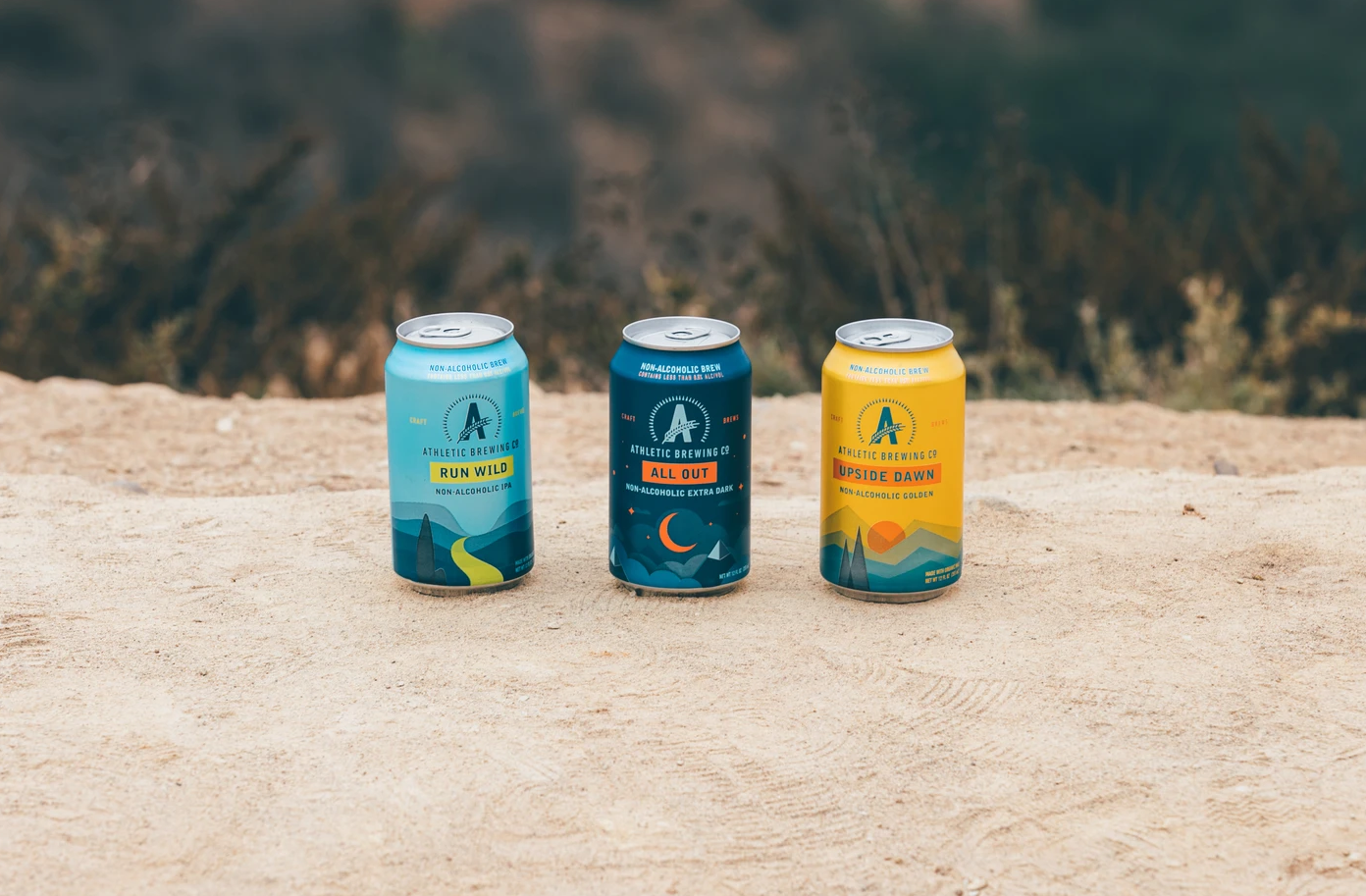
Athletic Brewing Co.: Bill Shufelt, the founder of Athletic Brewing, explains on the Connecticut company’s website that he chose to lead an alcohol-free lifestyle but still enjoyed going out to bars and restaurants. What he didn’t enjoy were the subpar alcohol-free beers that were the only options at most places he visited. So, he filled that void with Athletic Brewing, which currently offers six non-alcohol brews.
Surreal Brewing Company: Husband and wife team Tammer Zein-El-Abedein and Donna Hockey, who live an alcohol-free lifestyle, felt excluded by the lack of quality beer choices available. So, they did something about it: they created their own craft NA beer company operating in California. There are currently seven brews in the Surreal Brewing Company portfolio: Natural Bridges Kolsch, Creatives IPA, Juicy Mavs Hazy IPA, Milkshake IPA, Chandelier Red IPA, 17 Mile Porter, and Pastry Porter.
WellBeing Brewing: This Missouri-based brewer has a singular focus—brewing craft alcohol-free beer. Founder Jeff Stevens, similar to other founders and CEOs of brewers who gave up drinking alcohol, still liked going out to bars and live-music venues. He also ran into a similar problem: NA beers that didn’t offer an enjoyable experience. WellBeing Brewing currently offers five non-alcohol beers, three of which are vegan and therefore work for Veganuary: Heavenly Body Golden Wheat, Hellraiser Dark Amber, and WellBeing Victory Wheat Sports Brew (with electrolytes). Intentional IPA and Intrepid Traveler Coffee Cream Stout round out the portfolio.
Clausthaler: German brewer Clausthaler claims the title of most-awarded non-alcohol beer brewer. Clausthaler offers five alcohol-free options that taste, smell and look like beer: Original, Unfiltered, Dry Hopped, Lemon, and Grapefruit.
Lagunitas IPNA: A 0.5 beer, Lagunitas IPNA is brewed with Citra, Mosaic & CTZ (Columbus, Tomahawk, Zeus) hops so the alcohol-free offering is still as hoppy and full-bodied as its traditional counterparts.
Coors: Launched toward the end of 2019, Coors Edge replaced Coors Non-alcoholic and is intended to taste like Coors Banquet.
0.0 Beers
Budweiser 0.0: Brewed with two-row and six-row barley malt, Budweiser Zero achieves true zero-alcohol status and weighs in at just 50 calories and 11.5 grams of carbs.
Heineken 0.0: It took years, according to Heineken, to get the recipe for Heineken 0.0 just right, which uses the brewer’s famous A-Yeast.
Bitburger Drive: A completely alcohol-free brew from a brewer that adheres German Beer Purity Laws, Bitburger Drive is 0.0 pilsner.
Tomorrow marks the start of the first Dry January we’ve ever experienced under stay-at-home shutdowns and bar, restaurant and nightclub restrictions.
Like Veganuary—remember way back to yesterday when we wrote about it?—the movement as we’ve come to know can be traced back to the UK. People have chosen t abstain from alcohol in January for decades but Dry January really took off after the trademark was registered by a non-profit called Alcohol Change.
Understandably, many operators have taken issue with Dry January. Taking a hit to the bottom line for a month (or more) because of a reduction in alcohol sales isn’t an exciting proposition.
However, Dry January may be different this year. The convergence of a number of consumer behaviors driven by restricted access to restaurants and bars may present an opportunity.
Throughout most of 2020 we’ve been inundated with reports about unprecedented boosts in online alcohol sales. Premium and ultra-premium spirits grew at a faster rate than they had pre-pandemic. Operators have been forced to pivot, relying heavily on delivery, (somewhat) traditional takeout, and curbside pickup.
Put those all together but substitute premium spirits for premium alcohol-free options and there’s the potential for operators to generate revenue directly linked to zero-proof sales.
One of the keys to succeeding with zero-ABV drinks is presentation. Many alcohol-free brands are dedicated to elevating the category, meaning they can be treated the same as their low- and full-proof counterparts. Curated zero-proof drink kits that include quality modifiers, mixers, garnishes and drinkware can help generate sales. Post quick how-to videos to social media showing a member of the bar team building zero-proof cocktails to create interest.
Those are just two ideas. It shouldn’t be difficult for operators to pivot and offer alcohol-free options that are authentic to their brand and therefore resonate with their guests.
Operators that nail their Dry January menu programming lay the groundwork for succeeding with the alcohol-free category throughout the rest of the year. We finally live in an age where sober, sober-curious and intermittently abstinent consumers don’t feel uncomfortable visiting a bar. Make them feel welcome. Operators who alienate these guests will drive them straight to their competitors to ring their registers instead.
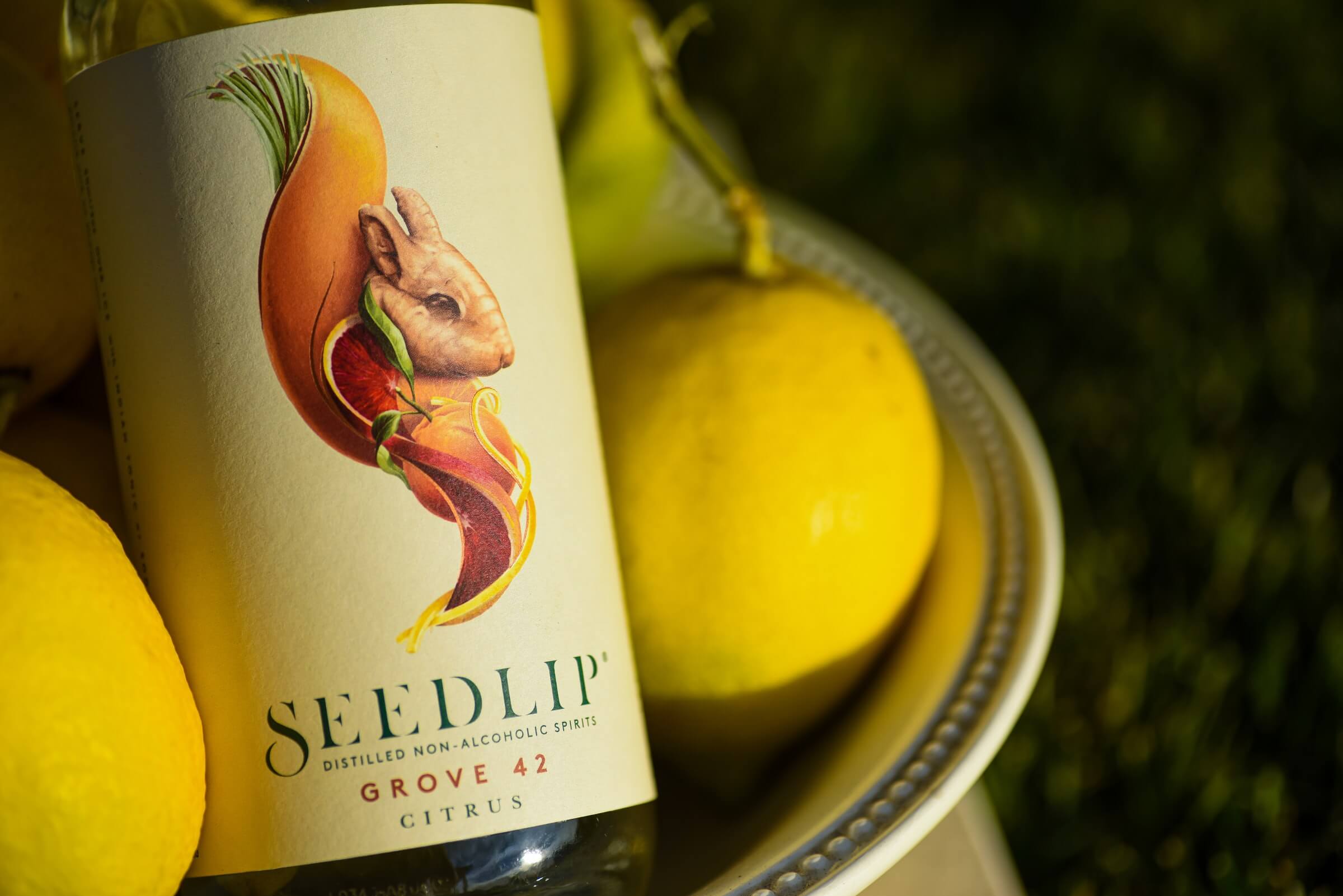
Seedlip is probably the best-known within the alcohol-free category but more premium brands are emerging. Operators should familiarize themselves with the following: Lyre’s (which crafts zero-proof spirits that taste like their traditional counterparts), Wilderton (which uses a distillation method that never introduces alcohol), and Shoki (which showcases African and Caribbean heritage and flavors). There are also brewers embracing the alcohol-free movement, such as Calgary’s Partake Brewing (which is beginning to cross into the US) and Lagunitas and their IPNA, an alcohol-free IPA.
Strange or even inappropriate as it may seem, it’s time to review food trend data and predictions because we’re hurtling toward 2021.
January also plays host to two monthlong traditions that impact F&B operations: Dry January and Veganuary. For this post, we’re focusing on the latter.
Veganuary may not have claimed “tradition” status just yet, to be honest, but it appears to be well on its way. The movement began in the United Kingdom in 2014 as a social and eco-friendly campaign intended to make the transition to adopting a vegan diet as easy as possible.
The movement has been growing each year with 2018 through 2020 seeing the biggest increases in participation. In 2017, a reported 50,000 people had signed up for Veganuary. That number jumped to a reported 170,000 in 2018; 250,000 in 2019; and 400,000 in 2020. According to the Veganuary campaign, 2020’s participation represented more than one million animal lives and the CO2 equivalent of 450,000 flights.
“Research shows that health is a significant driver for so many people going vegan, especially American consumers. But the reasons to test this lifestyle and decrease consumption of animal-based products are countless, from improving health, to reducing animal suffering, and helping to preserve the planet,” said Veganuary CEO Simon Winch in 2018. “Research shows that not only are there more people curious about going vegan, but more people are sticking with the lifestyle after taking part in Veganuary, which is great news! We are thrilled with the enthusiasm and growing response from Americans taking the pledge and will continue to do our part in making it as easy as possible to try vegan, for as many people as possible.”
Participants sign up for free and are challenged to stick to a vegan diet for the entirety of January. While Covid-19 vaccines have been approved, they’re not widely available to the general public. Many markets are still restricted to outdoor dining, delivery and pickup. It’s important that operators stay current with food and consumer behavior trends to remain top of mind and continue generating revenue.
We reviewed multiple sources to find common vegan-friendly food trends for operators to leverage when programming their 2021 menus.
Plant-based (Datassential, Delish)
One big difference between plant-based and vegan is that the latter’s focus on moral and ethical reasons for choosing the diet. Regardless, plant-based is expected to grow in popularity and therefore demand across the globe.
Tofu (Food & Wine, Whole Foods Market)
The great thing about tofu, a sentence I never thought I’d type, is that the back of house can get as creative as they want with it. Tofu “scrambles” (no eggs, just peppers, onions and sweet potato cubes), fishless tacos (breaded and brined tofu), and spaghetti with tofu riffs elevate this ingredient.
Mushrooms (Food & Wine, Whole Foods Market)
Portobello mushrooms, for example, are more than capable of starring in an array of dishes, replacing animal proteins rather easily. There’s also the fact that mushrooms are being used to make to-go packaging, giving eco-minded guests another reason to support a particular restaurant.
“You can chickpea anything,” says Whole Foods Market. In fact, they claim it’s the cauliflower, taking several forms, like pasta and flour.
Hyper-local (Food & Wine, MarthaStewart.com, The New York Times)
The push for restaurants to source ingredients locally and highlight them on their menus isn’t expected to slow. These publications and more are recognizing supporting local as a “trend” (it’s more a movement at this point) that will get stronger in 2021.
Meal kits (Food & Wine, Delish, MarthaStewart.com, The New York Times)
These, as several publications have stated, are here to stay. Consumers got used to these when subscription services exploded in popularity. Some restaurants offered them pre-pandemic as a response to the meal-kit subscription craze, and they’ve become more prevalent since Covid-19 ripped apart the world. They’re a hit with consumers, so operators should consider vegan-friendly meal kits during Veganuary.
Home cooking classes (Datassential, Whole Foods Market, Delish)
Many of us probably feel like our entire lives are one big Zoom meeting at this point. Well, that’s not expected to change any time soon. A great way to connect with guests staying at home is to host cooking classes—with a focus on vegan cooking in January—and follow up with curated meal kits.
Datassential also identified baby carrots and ramen among their 2021 food trend predictions (and both are vegan-friendly), and carob, chicory root, “future” produce (specialty produce varities), and honeysuckle as flavor trends to follow next year.
Two trends that are not considered vegan? Avocados and fermented honey because the reliance on bees to produce and cultivate both are considered “exploitation” by vegans. Remember the moral and ethical difference between vegan and plant-based from above? There you go.
How to Address Temporary Restaurant and Bar Closures: 5 Social Media Examples
by David Klemt – 12/1/2020
Repeated restaurant and bar closures have, tragically, become a hallmark of 2020.
Operators have had to learn how to communicate closures to potential indoor guests, as well as delivery and takeout guests.
For most operators, the possibility of closing their doors—temporarily or otherwise—has moved well past “if” territory. At this point, it’s not even a question of when a restaurant or bar will have to close, it’s a matter of when it will happen again.
There are a few reasons a F&B business will have to close due to the Covid-19 outbreak: official mandate, reduced indoor and outdoor dining capacities, and voluntary temporary closures.
Mandated closures are, on the surface, straightforward. Government officials decree that certain types of businesses must close their doors by a specific date and time, and owners are expected to comply.
Closures induced by capacity restrictions are less straightforward. It has become woefully apparent that most lawmakers don’t understand (or don’t care) that at a certain threshold, reducing indoor and outdoor dining capacities is as good as forcing a restaurant or bar to close; the value proposition of remaining open simply isn’t there.
A voluntary temporary closure can come about because of capacity limitations, but they can also be the result of other factors. A significant workforce reduction, lack of traffic, rising costs of goods, or an internal Covid infection.
The stark reality is that the likelihood today’s operators are going to have to craft social media posts and emails announcing temporary (and possibly extended) closures is anything but slim.
Below are four examples of effective closure announcements that bars across America have posted to Instagram recently.
Machine, an upscale cocktail bar and restaurant in Chicago, made the difficult decision to close their doors to in-person dining guests throughout the remainder of 2020. The post addressed the reason for the decision but made it clear that Machine would continue to operate for delivery and curbside pickup orders placed online. Community health and safety was held up as a priority, and though the news was disappointing and no doubt difficult to break, Machine’s post was positive.
Award-winning Chicago cocktail bar Lazy Bird, located in the basement of the Hoxton hotel, was forced to close due to indoor dining restrictions. The post image was short and to the point, with the caption explaining in detail why the bar was closing temporarily. Lazy Bird is part of the Boka Restaurant Group and their post included a call to action for people to support venues within the portfolio that would still be able to offer outdoor dining, delivery and takeout.
Three days ago, award-winning restaurant Compère Lapin announced a temporary closure due to a team member being exposed to Covid-19. Like the Machine post, Compère Lapin’s message explained their decision was based on safety. Similar to Lazy Bird, the restaurant urged guests to visit James Beard Award winner Chef Nina Compton’s other restaurant, Bywater American Bistro (BABs).
In Woburn, Massachusetts, just ten miles northwest of Boston, the Baldwin Bar alerted guests to their temporary closure because a staff member tested positive for Covid-19. The message, like that of Machine’s, was transparent, straightforward, reassuring, and positive overall. Not only did the Baldwin Bar share that the venue was undergoing a deep clean, they named the company tasked with providing the service.
The Baldwin Bar, thankfully, got to post the following message a little more than a day after posting their closure announcement:
Operators who find themselves in the terrible and frightening position of having to announce a temporary closure would do well to follow the examples above. While hope isn’t a viable business strategy, a hopeful tone can help garner support from the community.
Equally important are an emphasis on health, safety and cleanliness so guests feel comfortable placing orders for delivery and takeout, and returning when the doors open once again. As difficult as it may be when faced with closure, focusing on the well-being of the guests can help ensure there are guests lined up upon reopening.
Hotel Food & Beverage in a Post-Pandemic Landscape
By Doug Radkey – 07/22/2020
Nearly all of our favorite and most popular travel destinations around the world have been impacted by the Covid-19 pandemic, resulting in a horrendous financial loss for hotels, resorts, and the entire hospitality industry alike.
Research by the American Hotel & Lodging Institution suggests that hotel recovery to pre-COVID-19 levels could take until the year 2023—or perhaps even later with the expected ‘long-term’ loss of business travel and international leisure travellers.
Sadly, many properties have not survived and will not be opening their doors again. Some of those who rely on international travel see little benefit in resuming service while many borders remain closed. And those who are ready to reopen face a very different business environment to the one they were once accustomed to.
There are numerous strategies and alterations to consider moving forward for the operation of a hotel property post-pandemic; but one area that can help properties to regain their guests’ trust plus revenue and profits is that of the food & beverage program.
The Opportunity
For years, one could rely on a hotels restaurant and bar for a steady supply of traditional fare. Hotel food wasn’t necessarily an after-thought, but menus lacked (and in some cases continue to lack) inspiration.
However, in today’s global hotel market; both pre-covid and post-pandemic, a cities best and most innovative and creative food & beverage menu could be found in a hotels restaurant and bar.
But it is not longer just about the food. Hotels obviously have their chef(s) – but moving forward they must also consider a ‘director of mixology’ – even for smaller boutique properties.
Consider for a moment, instead of creating cocktails to match the food menu, doing it the other way around and starting with the beverages. You may be surprised by the results.
This is a secret to a successful, high-profit full-sensory on-premise (and off-premise) program.
While there is significant social and economic changes expected (post-pandemic), there will be a growing and potential multi-billion dollar opportunity for hotels to better cater to guests through their food & beverage options – if the venue can weather the current storm.
As the population regains their confidence to book a hotel stay, guests who visit for either business or leisure may be reluctant to travel to too many spots around town due an ongoing fear that it may not be 100% safe to do so.
Furthermore, many (potential) guests will find their finances dramatically affected by the economic downturn which is now inevitable throughout most of the world, and this will also lead to demand for more affordable cuisine and experiences.
Therefore, a food & beverage program with multiple revenue streams including a balance in pricing found within a trusted hotel that provides a consideration towards a full sensory experience for multiple day-parts is critically important.
Hyper-Local Programming
Hotels today must increasingly try to attract local residents partly because today’s visitors increasingly want to eat where the locals hang out and secondly – because that noted business & leisure travel is expected to be slow for the next 12-18 months.
The food & beverage programs and experiences must shape guests’ understanding of the hyper-local region by supporting local farms, vendors, & culture.
Hotels today and moving in a post-pandemic landscape must promote strong relationships & partnerships with local farmers and producers and introduce their products & flavors to guests in delicious and sometimes, surprising ways.
It is anticipated that hotel guests will expect venues to rely less on imported goods while using more locally-produced items within a 75 mile (100 km) radius due to support local initiatives, the need to embrace the local culture, current (and future) supply chain restrictions, and simply more robust, fresh flavors.
Buffet Pivots
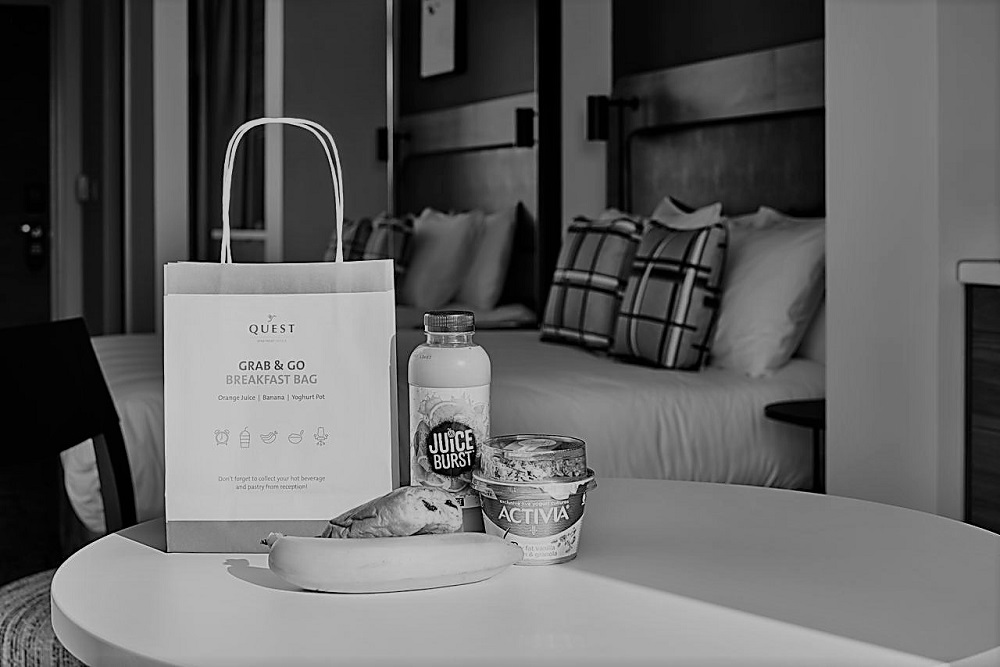
Remember waking up at a hotel and strolling down to the lobby for the breakfast buffet? Sadly, that will be just a memory for most moving forward. It’s likely no secret that it will be a long time before buffets come back. Even with sneeze guards, hotels must (temporarily) shift to à-la-carte menus, made-to-order options, and individually packaged grab-and-go items.
The buffet concept (for breakfast and other day-parts) could also opt to switch to cafeteria-style model instead of self-serve stations (with physical distancing measures in place). Even hotel restaurants with self-serve beverage stations, breakfast bars, salad bars, and a toppings bar will likely need to eliminate these self-serve stations in order to comply with guidelines from both a government point of view and guest sentiment point of view.
These “serving stations” could be individually prepared & plated in real-time by staff from behind the counter which likely means more labor – but providing a safe experience which will win guests over – providing opportunity for further awareness, revenue & profits.
Off-Premise Revenue
Many hoteliers and hotel brands around the world have begun to shift their food & beverage operations amid the pandemic, catering to locals by launching both takeout and curbside pickup options.
With the introduction of this new revenue channel, it is anticipated that it will stick around for quite some time.
Hotel F&B programs must also offer access to more premium grab & go options and also meal-kits. Whether for a day out exploring the city (remember they may be hesitant to stop in a restaurant they don’t know), or on the way to a business meeting, hotels are uniquely positioned to meet guest needs by leveraging their full-service kitchens to supply pre-made meals, snacks, and even F&B experience kits.
Micro-Experiences
From mid-scale to luxury, some hotel brands are taking the resurgence of “at-home” dining to the next level by creating unique F&B packages for micro-groups at the hotel itself.
As an add-on at booking, guests for example can upgrade to a private dining package that includes customized tastings, cooking tutorials, wine pairings, and cocktail making – all in a private space.
For some hotel & resort properties, the often abundance of outdoor space can also provide ample opportunity for seasonal or year-round food & beverage experiences. Picture open-fire kitchens, bar pavilions, and an atmosphere complete with comfortable seating, temperature control systems, and (hopefully) impeccable views for couples, families, and small group gatherings.
Technology Stack
There are a lot of ways technology will enhance hotel operations and experiences moving forward, both in and outside the food & beverage department.
Inside the kitchen, remodels are expected to happen over the next 1-3 years to adhere to the quick-service demand, the demand for the noted new experiences, and the potential lack of qualified staff. This means more self-cooking oven stations, simplified processes, smaller footprints, and smart kitchen technology.
A high level of convenience and contactless service will also be critical on the consumer side, when it comes to on-premise (F&B) room service.
One way to ensure a frictionless experience is through the use of technology.
Approximately one in four hotel guests surveyed by the American Hotel & Lodging Institute, think it’s important for hotels to have 24-hour room service. They want the option to have incredible food and beverage, no matter the time of day.
Post-pandemic, this will still hold true but the service sequence needs to change so that it includes the use of technology and contact-less service, both in the hotel restaurant(s) and in-room. The data shows that one in five guests also want the convenience of ordering with technology – via the hotels app on their phone or even through the TV in their room.
The order can then be packaged & delivered to the outside of the room, to their table in the restaurant, or by having a technology-driven “pick-up locker” in the lobby with mobile phone use to access the food delivered via the hotels kitchen or any third-party delivery partners.
And when it comes to customizing mini bars, 14 percent of guests would choose a hotel where the mini bar is personalized to snack and drink preferences based on the historic data from previous stays or allergies. While some argue the mini-bar is done due to the pandemic – we think hotels just need to personalize it and then make it a point of sanitation between stays.
—
Quick summary; hotel food & beverage programs must continuously react, adapt, and execute as consumer demand and sentiment fluctuates; both short-term and long-term while providing both unique one-of-a-kind experiences and brand activations.
Once your idea has been researched and the market, location, technical, business, and financial viability of the idea has passed a series of reviews throughout a feasibility study, a concept development plan can then be started.
Remember, outside of being scalable, you want to build a concept that is sustainable, profitable, memorable, and consistent.
Bar concepts over the years have gone from being tame (or lame) or overplayed, like tiki bars or sports bars, to concepts that push the boundaries of what a bar can be. One of the best ways to build a customer base is to go off the beaten path to create a bold and fresh new bar concept.
A concept plan will focus on ‘chapters’ and visual storyboards that include an overall:
Concept Summary (a one page summarization similar to that of an Executive Summary)
Owning a bar is a dream for most that must be met with the right research, planning, and mind-set.
One’s market will, and must, define the concept. To be successful, you must be open to building a venue the market both wants and needs.
Concept development is giving your ‘idea’, both soul and character. A bar’s concept is the lifeline of its brand and longevity in the market. It makes your venue stand apart from the competition, and it’s ultimately your bar’s unique selling proposition.
Have you ever walked into a bar and been confused about its identity? The interior doesn’t match the beverage offerings, the social media experience doesn’t reflect the actual experience, and even the music doesn’t seem to match the vibe of the bar.
This is what happens when there isn’t a clear and detailed concept development plan in place, and it is a sure fire way to be just average at best.
It’s More Than Just a Drink
Most conceptual ideas start at the food & beverage level. A bar however, needs to remember that they don’t just sell food & beverage; they sell experiences through the enhancement of guest emotions.
When planning a concept, it’s imperative to have a focus on the style of menu and niche of entertainment – but a winning concept will elevate a guest’s variety of senses. Here’s how:
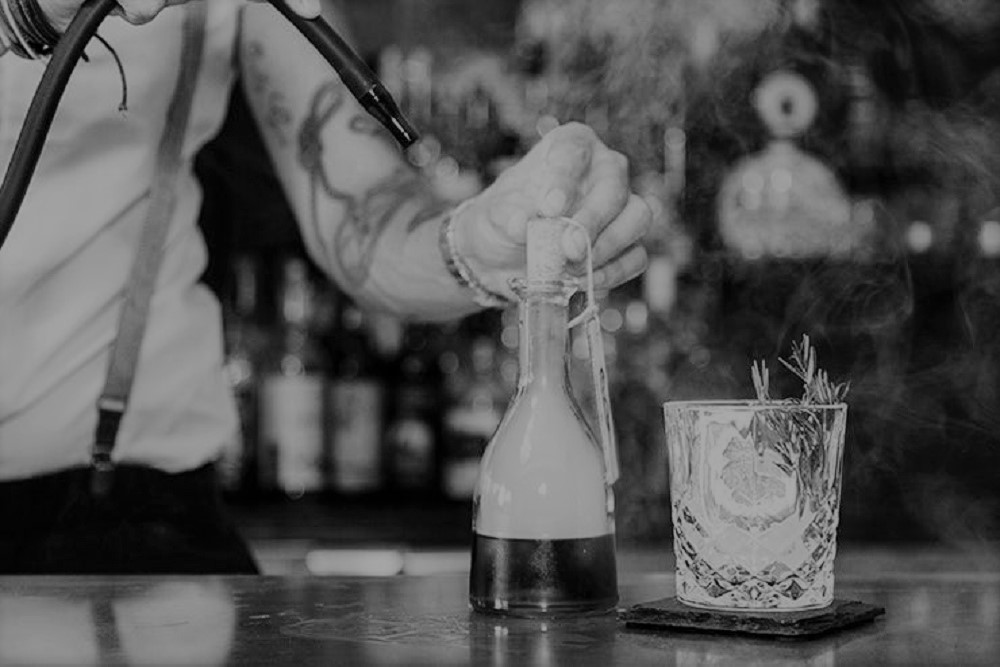
Visual: Use the mindset of a traditional bar meeting on-trend beverage effects. Consider the style of beverage vessels, the use of unique ice cubes or even dry ice, the garnishes used, and potentially a variety of ‘smoking’ techniques within a variety of your signature cocktails, providing a visual effect that grabs every guest’s attention.
Plus, it will be hard to find a guest who is not taking a photo and sharing it on social media – an easy promotional tool to make each of their individual networks feel as if they’re missing out (FOMO) on the best experience in town.
Auditory: Music, drinks, and food share an intimate connection. From the beginning, this should be a focus. Every day, every weeknight, and every weekend must be filled with strategic decisions around sound.
From your day-part strategies, to the sound of cocktail shakers, to live music calendars and even proper speaker placement – your venue must see why 76 percent of bar customers surveyed believe they stay longer due to the sound of the environment.
Olfactory (smell) System: Like sound, a pleasant and subtle fragrance can lead to an improved perceived quality of the environment and can enhance the mood of guests, causing them to stay longer. Our sense of smell is after all, directly linked to the part of the brain responsible for memory and emotion – two things bars need to strive for.
For example; consider a Smoked Cedar Plank Whiskey around the Christmas season. The scent of the smoked cedar will fill the bar area with a subtle Christmas tree aroma, prompting the guests attention and need to spend more money.
Gustatory (taste) System: Food & beverage pairings have never been more important, and it isn’t just for wine. Consider appetizers (snacks) within your food & beverage program that pair with miniature versions of your signature beverages (beers, wines, and even cocktails) that could be served on flight boards; elevating all flavor profiles.
Your remaining food & beverage menu should be small, balanced, and targeted around flavor profiles that your ideal guests desire.
Summary; When you combine these efforts, it’s easy to see how a successful brand can build a community around thousands of fans – within 30 days of opening.
This is something you can easily replicate if you focus your decisions on layout, design, food, beverage, training, and events around the above sensories.
Let’s be honest, the traditional bar setting serving cocktails is an environmental nightmare.
Let’s think about it; there is high use of energy within ice machines, refrigeration, and glass cleaning appliances. There is enormous waste in garnishes, straws, bottles, and napkins (to name a few). And finally, there are corporate wineries, distilleries, and breweries producing a large carbon footprint delivering spirits to the bar.
When it comes to bars; (or any other food & beverage service provider) the producers, manufacturers, delivery drivers, owners, managers, and servers ultimately share the responsibility to create an enjoyable guest experience within ones concept. As we have seen with restaurant kitchens over the past 3-5 years, there is now also a ‘movement’ towards eco-friendly and sustainable bars, something many guests are seeking as part of their desired experience.
On the surface, it may sound like an easy change, but creating cocktails in particular that are ‘sustainable’ (zero waste), is in-fact difficult to produce while maintaining the required quality, speed, and profit margins both operators and guests, look for.
So how can independent bars make a simple impact within this craft-cocktail ‘movement’? Let’s begin to have a look at some strategies (#barhacks) that one can implement starting today:
Re-Purposed Ingredients – How can you use 100% of an ingredient? Start by looking at the beverage menu. How large is it? Does it have focus? What ingredients are used in each and every drink that’s made? Which ones are used for infused flavour versus visual appeal? Which ingredients are only partially used with the remaining components discarded into compost, for example fruit scraps? Review each drink and look for ways to re-purpose ingredients and their counter-parts, within both the bar and/or kitchen.
Edible Garnishes – Obviously, cocktail garnishes are decorative ‘ornaments’ that often add character or style to a cocktail. They are often used to complement and enhance the flavours in a drink by stimulating the special nerve cells in our nose and mouth. The days of plastic straws, festive umbrellas, plastic skewers, and other non-edibles however, need to stop. Instead, use fresh fruits, flavour infused salts, edible stir sticks, edible flowers, house-made flavor-infused lollipops on candy sticks (yes), and steel skewers for olives and other edible garnishes, if so desired.
Energy Conservation – Take a close look at your glassware and how it is washed. Are you using over-sized glasses (ie. martini glasses) that are taking up too much space on the wash-rack, leading to unnecessary additional washes (which costs money and uses more detergents)? How many glasses could you fit if you changed glassware sizes?
How much ice are you using in each drink? Does the beverage really need ice or could the glass be simply pre-chilled? Take a look at your menu, glassware, fridge space, freezer space, and use of ice machine. Is there a way to reduce used energy within the bar itself to help create sustainable cocktails?
Supply Chain Management – Transparency, traceability, and accountability must be a top concern when deciding on vendors to ensure all products (both food and beverage) entering your bar or other food service business, are not only safe & sustainable for your customers, but for your community. Work with beer, wine, and spirit makers who are equally trying to make a difference. With the growth of local distilleries, breweries, wineries, and produce suppliers; supporting local and reducing the carbon footprint within a bar, is so much easier! Collaborate and work together to make a difference.
In summary, don’t start a goal of 100% zero waste or sustainability – it’s likely not going to happen overnight. Instead, set SMART realistic goals to reduce waste by 15 or 30% over the next 6 to 12 months to begin building a sustainable cocktail and/or bar venue. Once that goal is obtained – double down on that goal for the next 6 to 12 months. You and your customers will notice a positive difference!
Festive Season. These two words signal colder weather (in most areas), delicious comfort food, creative drinks, memorable parties, laughter with friends & family, and of course – gift giving.
These are also two words that nearly everyone seems to look forward to throughout the year, including that of restaurant owners. The reason is quite simple; consumers are often in a generous mood which equals longer stays and more spending dollars.
Restaurants, bars, and cafes have the opportunity to generate an abundance of awareness, an increase in revenue per guest, and even repeatable business in what can be defined as the often slower months following the Festive Season (yes it is possible).
Let’s jump right into some Festive strategies your concept or venue should consider this holiday season:
1. Cross-Promotions
Make sure that special events and other winter-related promotions are planned for well in advance, ideally 1-2 months prior. This season is such a large opportunity, that a true marketing plan should be developed just for the season. The festive cheer that starts the season, for example, can act as a forerunner to both Christmas and New Years Eve parties, packages, and other revenue generating opportunities such as gift card sales.
Speaking of gift cards – create a marketing program specifically around these money-makers. Restaurants are the most popular choice for consumers to purchase gift cards, with 41% of total gift card spend going to restaurants. But don’t just sell the one card. Create a promotion that includes spending an ‘x’ amount of dollars on a card before Christmas, and receive a second card with an amount of ‘x’ that can only be used in January or February. Add value, be aggressive, and get people through your doors over the next two months when sales are traditionally lagging.
2. Labor Management
Similar to that of the retail sector and depending on the size of the restaurant, additional staff may need to be hired to handle the extra covers that are waiting to come in. This is where planning ahead really comes into play. To be fair to yourself, your team, your new hires, and your guests, you need to ensure you leave yourself enough time for interviewing, talent selection, onboarding, and training before the peak of Christmas season truly hits.
Both front-of-house and back-of-house systems and their teams need to be reviewed to ensure your operations are prepared. Customer service and speed in the kitchen or bar should not be hindered by the fact it’s getting busier. You can ‘scale’ your business by being prepared; create mock schedules and see where there may be gaps to ensure a high standard of service is available when your restaurant needs to shine.
Speaking of staff, let’s not forget about their valuable time! Ensure they’re given time to spend with their friends and family too. Be flexible with your scheduling – and don’t forget to thank them for their loyalty and commitment!
3. Off-Premise Dining
With the increase in delivery and off-premise dining, the Festive Season may not show any signs of slowing that segment down this year. Is your restaurant prepared to market the catering and delivery of food and beverage to office parties and house parties?
This presents an opportunity to offer the catering of a traditional or concept-infused, Christmas focused meal or buffet style dinner — right to their door!
Create a variation of value-added packages for different sized parties and request 72 hours (or more) notice (with deposit) to have it prepped and delivered, right on time. Just don’t forget the high-quality take-out containers and plates for an easy clean-up afterward!
Pre-ordered packages such as this will generate cash-flow, control potential waste, and control staff costs.
4. Food Menu
Is your restaurant in a position to offer a traditionally plated meal or other harvest/winter flavors? How about a unique variation or infusion based on your restaurant’s concept and kitchen structure?
Don’t be afraid to think outside-the-box and get creative. For example, if you’re a Quick Service Restaurant (QSR) near a parade route, create an easy-to-eat holiday inspired option for ‘on-the-go’.
Develop a holiday-themed menu with your entire team (kitchen and bar team) with your target market and concept kept close in mind. Make it a fun exercise for everyone. As always, keep the specialized menu small and inviting to reduce inventory, prep-time, additional staff requirements, and potential waste.
You also want to keep in mind that a lot of the guests visiting may have never stepped foot in your establishment before because they’re just tagging along with a large party. Think of allergens and include dishes that vegans, vegetarians, and guests with other primary food sensitivities would still enjoy.
5. Beverage Menu
Having the right drinks on your menu is just as important as the food. The Christmas season is the best time of year to sell both pre-and-after-dinner drinks if you’re a dine-in restaurant.
You have to have the mindset that every drop counts!
While pre-and-after dinner drinks are big sellers, you can make a larger impact by offering ‘session drinks’ – drinks with a lower level of alcohol – or just zero-proof drinks all-together.
The drinking ‘culture’ associated with alcohol, in particular, has definitely changed over the past decade thanks to strict driving laws, the cost of ‘going out’, and the sophistication of consumers.
Show off your bar teams talent by creating ‘theatre’ in your beverages in addition to a balance in alcohol levels which should be promoted with the right mix of marketing.
When crafting your beverage menu, keep sustainability, speed, price, and perception of value in mind – for both non-alcohol and alcohol driven drinks.
6. Christmas & New Year’s Parties
You have the square footage, you have the approved capacity, and you have the kitchen/bar. These are the needed ingredients required to host an exclusive or intimate type event at any venue. Whether you have the capacity for 20 or 200 plus guests, there is an opportunity to generate awareness, revenue, and repeat customers by becoming known within your community for being the ‘best host in town’.
To make event management work for your restaurant, it must create a unique and memorable guest experience, which is no different than traditional dining strategies. Whether you’re hosting your own New Year’s Eve party or renting out your space before Christmas for a variety of private events – ensure there are defined (but value driven) food & beverage packages and a financial deposit made to protect your bottom line.
You also want to ensure there is a communication strategy in place to let other guests know if your venue is closed for a private event. Maximize each event by being organized, well staffed, and engaged. Take it a step further by providing guests at the event – an opportunity to revisit in January or February with a measurable gift (a coupon for a free appetizer or $10 gift card, for example).
By truly knowing and understanding your target market, your concept, and the neighboring business environment, the Festive Season is an excellent time to showcase your brand and your creativity – ultimately generating awareness, revenue, and repeat business opportunities, ultimately setting the tone for the following year!
Should restaurants ditch third party delivery apps and create their own in-house off-premise strategy? I recently took part in a few online conversations surrounding third party delivery apps – from both the consumer and the restaurant operator point-of-view.
If you follow along – I am not a fan of these services (at all). I’ve never used them nor suggested a brand to use them.
While I embrace technology in the restaurant space (and off-premise dining options) – I feel the business model surrounding these apps (in particular UberEats and Skip the Dishes during these most recent discussions) are lacking in both customer service and transparency while further killing overall restaurant profits (like operators today need anymore of that).
Let’s look at a recent transaction. I recently saw a screenshot from a consumer using a third party delivery application. After a delivery fee, a busy area fee, a peak delivery time fee, and the delivery fee taxes, a meal that was listed as $8.89 on the menu ended up costing them $30.36.
Of that, the restaurant earned a mediocre $6.67 of that order.
It’s not exactly a traditional breakdown of revenue that we see in restaurants, and operators today are struggling to adapt to this ever-changing restaurant landscape. I feel it came at them much too fast and many have jumped on board because they felt they had to.
But I have a question – why are we not doing a better job to get guests to spend that $30.36 they were willing to spend – in the restaurant or at least through our own off-premise dining program?
With a little effort – it can happen!
Here is what we know. Delivery and off-premise dining has disrupted the restaurant industry more in the last five years than anything else. Digital ordering paired with the outsourcing of delivery has impacted restaurant traffic, revenue, profit and overall restaurant operations like no other piece of industry-wide technology.
Based on the conversations this past weekend it seemed liked the only party benefiting from the use of these apps – was the third party. However, if you ask them, they’re apparently not making ‘huge profits’ either.
Here are a few notable quotes from the public chat that took place on Facebook – again from both consumer & operators:
“I’ve deleted the app – every time I’ve ordered, something goes wrong and a lot of times it’s the drivers fault not paying attention” – Consumer
—
“If you’re doing takeout, pick it up from your local business. Other than that you’re rolling the dice” – Operator
—
“Their chat-bot told me ‘we are deeply disappointed that we have failed to provide you with optimum service during your orders and for this reason we have decided that it is best to remove ourselves from this relationship’” – Consumer
—
“Best thing to do is get out and support your local restaurants, leave these rip off merchants congeal back in the gutter where they belong” – Operator
—
“I had no idea these apps take such a percentage from the restaurant on top of the delivery fee. I will no longer order through an app. I thought I was supporting my favorite restaurant, but apparently I wasn’t” – Consumer
—
Not much of anything positive.
Here’s the thing; recent stats are showing staggering numbers such as 60% of consumers ordering delivery in the past 30 days. Based on trend reports, this is ‘unfortunately’ only going to climb – even though I personally wish more people would visit restaurants, engage in the experience, get out of their home, and socialize with others away from their smart-phone.
But out of those that do order delivery through these third parties, 30% are experiencing poor customer experiences – with either the app or the restaurant – or both.
That is significantly higher than the number of complaints one would receive at the restaurant level without a third party being involved.
Here’s the next problem; according to a study by Steritech, consumers are placing over 80% of the problems on the restaurant through the use of these apps (even if most problems are not their fault).
Due to the third party app, a gap in communication immediately happens between the consumer and the restaurant. This leads to the restaurant not being able to often resolve the problem in a timely manner before that consumer blasts them for something on social media.
Not a pleasant situation.
This is because they’re sending their complaints directly to the third party app (the platform that ultimately placed the order for them) – which I suppose makes sense from a consumer point-of-view. This however leads to over 25% saying they would not order from the restaurant ever again – not entirely fair considering the restaurant may never have even known about this unhappy experience.
Furthermore:
14% say food quality was not as expected (likely due to travel time or packaging)
19% say the order took too long
19% say the food wasn’t the correct temperature when it arrived (timing or packaging issue)
29% say the order was incorrect or missing something
All of this could be avoided! When partnering with these mainstream third party apps – you’re also:
Losing a direct communication channel
Losing positive brand perception
Losing much needed profits to sustain yourself
Losing consumer data for future marketing
Losing foot traffic in your dine-in real estate
Most importantly – you’re losing control once that food leaves your four walls.
Why on earth are we doing this to ourselves for such limited margins?
If you are operating a restaurant and are currently using these apps – though you will never have full control of the situation, there are a number of options available to you to leverage more control.
That said I encourage you to consider your own in-house off-premise program. These options below should be considered whether you’re partnering with a third party or if you’re offering your own in-house platform:
Offering a limited delivery only menu option with higher margins (consumers are obviously willing to spend more)
Offering limited day-part delivery times (example; not at 6pm on a Saturday when the kitchen is slammed)
Using specialized take-out packaging for certain menu items to protect the quality of your unique food options
Using tamper-proof packaging so delivery drivers cannot alter the order (happens often)
Having a quality control program (or expeditor) reviewing meals before it leaves the restaurant
Sending printed customer care promises (how to reach the restaurant directly) delivered with the meal
There are much better options out there for digital take-out, delivery, catering, and off-premise dining that will allow you to keep control of all of the above while maximizing profits including the introduction of your own off-premise strategy – which will often keep costs to under 10% – no joke!
Then, use these ‘savings’ to increase your own marketing & advertising efforts. It surely won’t be 25-30% like what these third party delivery apps are currently taking from independent operators (which you were willing to give up anyway); keeping more money in your pocket.
This type of in-house strategy will also differentiate your brand from the competition that is also increasing each day on these main-stream app platforms.
How will you stand out and make your brand memorable? How will you position your brand for a sustainable future? How will you protect your brand, its profits, and utilize the available customer data?
Don’t partner with them just because it seems like the easy thing to do or ‘because everyone is using them.’
The notion that you must be on them to survive is 100% inaccurate. If you need to use them for ‘marketing’ – you need to learn more about marketing.
Take a stand and learn about your options first.
I am yet to hear a positive story on how these main-stream third party delivery apps have actually helped their business grow in the long-term. In my professional opinion, restaurants should ditch third party delivery apps.
Patio. Season. Two words nearly every Canadian seems to enjoy and two words nearly everyone looks forward to after a long cold winter, including that of local restaurant & bar owners.
If your property is lucky enough to have this additional space and seating, it’s critical to take advantage of this revenue generating opportunity.
But can having a patio be looked at as a double-edged sword? While it opens up more seats and potential revenue (during a time when many restaurateurs are seeking smaller foot prints), can a patio also cause labour, logistics, and other operational challenges?
The quick answer is absolutely!
With something as complex as a successful patio season however, there needs to be an action plan, first and foremost to combat those challenges. This is a plan that is developed prior to the nice weather arriving and a plan that is well organized with strategic goals and a series of risk assessments.
To execute a flawless patio program, it’s important to start planning as early as possible, preferably 2-3 months prior to the start of the warmer weather. Developing a program around your patio this early will allow your restaurant or bar to determine cash-flow needs, staffing requirements, inventory levels, marketing requirements, and any additional training requirements to ensure a smooth operating season.
As with any seasonal, strategic, or marketing related program, it’s crucial to use a SMART mindset towards your planning; one that is Specific, Measurable, Attainable, Realistic, and Timely.
Furthermore, the development of an action plan is a fantastic opportunity to utilize your staff to help brainstorm menu items, themes, and other special events to ensure your venue and patio becomes the desired destination that it deserves to be!
So how can owners, operators, and managers take advantage of this opportunity and maximize on its potential while limiting day-to-day challenges?
An epic patio program will highlight the following critical segments.
Labour Management
Let’s start with the biggest elephant in the room. Depending on the size of restaurant and patio, additional staff may be needed to handle the extra covers that are sitting outside.
The first question you need to honestly and realistically answer is, will your traffic increase or will it be merely the same traffic, just sitting outside versus inside?
In summary, will you be putting in the continuous efforts to increase traffic?
This is where planning ahead really comes into play. This is where strategic goals, historic data, an the understanding of your target market & hyper-local competition, and where knowing if your intended marketing plan will position you to have either a distressed or profitable patio program.
With an hourly breakdown of foot traffic (historic and potential) and an understanding of your day-parts, you can begin to determine your staff requirements.
To be fair to yourself, your team, your new hires, and your guests, you need to ensure you leave yourself enough time for interviewing, talent selection, on-boarding, and training before the peak of patio season truly hits.
Culture Reset
As you’re reading this, you may be saying phrases such as ‘good luck finding more staff’ or ‘I can’t even keep the staff I have now, how am I going to staff an increase in traffic this summer”?
Fair statements if you lack the elements of culture. I think we’ve all heard by now that there is a “shortage of qualified hospitality staff”. If you’re experiencing this first hand and had those phrases or ones similar go through your mind – it may be time to hit the reset button on the culture within your venue.
An entire article could be written on this subject alone, but in summary – let’s just put a stop to the excuses right now. You can overcome these challenges with the right mindset towards culture and towards providing an emphasis on your core values, team experiences, a positive work environment, employee engagement, hiring practices, and providing above average pay scales.
It can be that easy – or that hard. It depends on you and your leadership team. The way out of this ‘shortage’ starts with you and your brand.
Labour Systems
Getting back to the fundamentals of a winning patio program, both ‘front-of-house’ and ‘back-of-house’ systems and teams need to be reviewed to ensure your operations are prepared. Customer service and speed in the kitchen (and bar) should not be hindered by the fact additional seating is now offered.
Plan ahead, create mock schedules, and see where there may be gaps to ensure the high standards of service inside is going to be matched with high standards of service outside.
How will this affect your labour costs? Are you going to be able to control this additional cost versus the potential revenue opportunity? What happens if the weather doesn’t cooperate one day and you’re over staffed? What is your contingency plan?
Restaurants today have the ability to cross-train and create more of a ‘one-house’ approach versus one with varied departments which positions a concept to maximize their personnel while hiring based on values versus experience.
This mindset towards actual ‘labour systems’ will ensure not only staffing your patio becomes ‘easier’, but staffing your restaurant throughout the entire year becomes much less of a ‘headache’ – something most will agree is the biggest year-over-year challenge within the industry.
Seating and Tables
To effectively control your labour, you need to equally review your seating arrangement and overall patio capacity.
Outside of making it enticing, inviting, and clean with new patio furniture, there are numerous ways you can step up your patio game. There should be more to it than just wiping down the tables, setting up the chairs, and sweeping the ground of the past winter.
Similar to that of seating strategies inside your venue, ideally you want to have a strategic setup of tables and chairs outside. Consider a restaurant revenue management (RRM) approach, which can be defined simply as selling the right seat to the right customer at the right price and for the right duration of time. A strategic setup includes understanding your target market, their ideal length of stay, and average party size in addition to overall space for comfort and traffic flow for both guests and staff.
Again, this additional seating must also align with production levels in the kitchen and bar. What would happen if you were at full capacity, both inside and outside? Have a plan in place and analyze your revenue per available seat-hour (RevPASH) to maximize each moment throughout the day.
You also want to analyze the steps taken for staff from the pass and/or bar to the patio section. Many patios are designed in a way that it is a distant walk for staff. How many steps does each staff member take to serve a guest? What is the cost of this distance over the course of a day, a week, or a season?
Are there ways to reduce this burden on your labour? The answer may be hiding in the way your patio is setup for a successful season.
Patio Driven Menus
The answer to efficient labour and revenue management as it relates to your patio program – may just lie within your menu. If you have the space, consider taking the grill outside (or any equipment you can) to launch an exciting new outdoor experience. This will push your restaurant to create unique outdoor menus, redefine your guest experience and stay a step ahead of your competition.
This will not only improve on the guest experience, but reduce wear & tear on your staff – improving ticket times, walking distance, and staff morale.
Take the Production Outside
Equipment today is extremely versatile. You can now put together mobile kitchens & bars that are cost effective and perfect for the patio – especially in a climate that sees a variety of weather patterns. With minimal square feet and utility requirements, you can now grill, fry, and/or bake a targeted food menu right on the patio.
The fun doesn’t stop there, mobile bars can ensure the drinks continue to flow on the patio and that the cocktail shaking is both seen and heard, keeping the energy level high every day of the season.
Work towards elevating your guests visual, auditory, olfactory (smell), and gustatory (taste) senses right on the patio.
Creative Menus
Don’t be discouraged if you don’t have the space for any bar or kitchen equipment outside. Create a seasonal menu that’s inspired by an outdoor patio, anyway.
Develop a menu plan with your entire bar and culinary team with your venues target market and concept kept close in mind (and reward them for that creativity).
As always, keep this specialized menu small and inviting to reduce inventory, prep time, waste and any other staff requirements. Be creative this year and start thinking outside the box.
Support Local
Your guests today are likely looking for new flavours and innovation, as well as creative summer-like takes on traditional menu items. There is no better way to stay ahead of this need than by utilizing and building stronger relationships with your local farmers market. Provide your team with the means to develop unique, limited-time offers with not only seasonal produce, but a variety of barbecue-related flavours.
Innovation shouldn’t stop with just the food; beverages need to be included into the mix, too. (It is hot out, after all). The “garden-to-glass” trend continues to grow and new, refreshing spirits are becoming readily available to develop flavourful drinks with unique vessels and memorable presentations.
Lastly, beer and cocktails with low-levels of alcohol should also be featured, plus creative mocktails and house-made spritzers should highlight one’s patio menu.
Temperature Control
Unfortunately, we can’t dictate the weather. Throughout the patio months you’re going to see rain, wind, storms and even days where it may feel ‘too hot’, or evenings where it may feel ‘too cool’ to be out on a patio.
Restaurants and bars should consider these weather elements by offering more than just an umbrella or patio heaters. Look for other solutions to shade your patio, block wind and prevent heavy rain from ruining a potentially profitable day or night on the patio.
These investments will pay off by continuing the positive cash flow even when mother-nature tries to disappoint you.
Pest Control
Now that you have your labour, revenue, production, menu, and weather patterns considered, take the time to meet with your pest control vendor and discuss your plans for outside.
They can suggest safe bug repellents and means of keeping away other animals and critters like mice, squirrels, and even birds.
Sanitation is a critical component in any restaurant and the patio cannot be overlooked. Put a preventative action plan in place to deter any bugs or animals from potentially ruining a guest’s experience.
Noise Control
With outdoor seating, you’ll likely encounter noise issues that start beyond the boundaries of your patio, including vehicle traffic, construction and other neighbourhood noises.
To reduce this burden, consider noise reduction strategies such as walls, bushes or even your own sound strategy, like a catchy playlist through your sound engineering plan.
Music (whether live or through a playlist) can deliver the right, on-brand ambiance and attract your target demographic while increasing overall profits and drowning out other noise on the patio. No matter the concept, guests enjoy their food, drink, and company more when music is playing, which ultimately makes them stay longer and, of course, spend more of their hard earned dollars on your patio.
Driving Energy Levels
The warm weather typically attracts tourism and gets locals looking to re-explore their outside surroundings. The restaurants or bars that provide the right mix of marketing (online and offline) paired with energy are the ones that will attract a consistent level of guests throughout the patio season.
Look for ways to utilize live music, themed parties, and interactive games (inside or outside) on a daily or weekly basis throughout the patio months.
A fully pre-planned calendar of events will drive high level of positive energy while creating awareness, excitement and anticipation while developing repeat business opportunities.
Marketing Plan
Now it’s time to tie all of this together. Remember, if you build it they will not come.
An epic patio season could be destroyed if it’s not coupled with an epic marketing campaign.
It is vital to inform your guests of your patio and the plans you have for it throughout the season. Each week and month throughout the season should be properly planned for to ensure the said energy level, never cools down.
Create Buzz
To maximize your patio program or event’s reach, it’s best to use a three-tiered approach to creating buzz. Have a plan in place to promote your seasonal events including patio launch party, menu launch parties, live music, comedy night on the patio, and the many others you and your team come up with.
You’ll need to create buzz not only prior to the event, but during the event and also after the event.
Give guests (and potential guests) a means to engage with your brand. You’re also giving an opportunity for others to see what they may have missed out on, also known as FOMO (the fear of missing out) making them intrigued to not miss your next scheduled event!
Story-Telling
Venues must now make their story meaningful, personal, emotional, simple, and authentic. This story-telling should flow to your patio program as well.
Despite the word “story,” it isn’t even confined to the written word. Colours, decor, vendors, staff members, plating, and glassware — even the simplest visual segments within your brand and patio ‘messaging’ — can paint a picture worth a thousand words.
Within your marketing plan, ensure you’re capitalizing on this through all of your resources and media channels, including the use of social media.
Using Video
Story-telling and video elements are really required for any time of the year, but to promote your patio, your events, your limited-time offers and summer drink menu for example, there is no better way to amplify the message than through video.
Use this opportunity to showcase service staff planning an event, cooks building that signature summer burger, or bartenders pouring that refreshing beverage.
Hint; this will also improve your culture!
Remember, with today’s smart phones, you no longer need to break-the-bank on video production!
Tap Social Circles
A successful patio program also relies heavily on the opportunity to reach out to sporting teams, bike clubs, and other outdoor enthusiasts. Can your venue host after-parties? Can your venue host a social-media-only party or tasting event?
Don’t be afraid to reach out and partner with other local businesses and organizations. Every campaign should have a social media and/or community-driven strategy behind it.
Three Visits
Each seasonal program and its associated campaigns should have the goal of guests returning at least three times. Understanding your target market, is it realistic to see a guest return three times per week, three time per month, or once per month over the course of your patio season?
Once you truly understand their lifestyle and spending habits, you can develop events and campaigns to drive patio drive loyalty and a personalized experience.
Quality Designs
When a venue gives itself the opportune time to plan, a sense of higher quality often comes with it.
Budget for and take the time to create high-quality designs for posters, ads, video and social media posts. This will speak volumes to potential guests while providing a perception of value to not only your new patio menus, but also your events and overall venue.
The patio season provides an opportunity to think outside the box, but don’t go overboard with menu changes and special events. Know your target market, know your concept, and know your financial budgets.
Develop a program that is simple but memorable, profitable, and effective, and without placing additional stress on your kitchen, bar, or service staff.
In summary, concentrate your patio program on presentation, energy levels, story-telling, and developing a personalized guest experience. Doing so will develop a sense of community and culture, setting your venue up for success, even as the weather (and often sales) begin to cool down come the next fall and winter season.
How Restaurants Can Avoid the Dead Ends of Delivery
Originally Posted on RestoBiz – By Doug Radkey 07/09/2018
I recently saw a screenshot from a consumer using a third party delivery application. After a delivery fee, a busy area fee (what?) and delivery fee taxes, a meal that was listed as $8.89 on the menu ended up costing them $30.36. Of that, the restaurant earned a mediocre $6.67 of that order. It’s not exactly a traditional breakdown of revenue, and restaurant operators are struggling to adapt to the ever-changing restaurant landscape.
Delivery has disrupted the restaurant industry more in the last five years than anything else. Digital ordering paired with the outsourcing of delivery has impacted restaurant traffic, revenue, profit and overall restaurant operations like no other piece of industry-wide technology.
The Here and Now
No longer just for the pizza or Chinese food segments, consumers can now dine at home or work with the same quality food found at their local fine dining restaurants. With consumers so accustomed to shopping online, it was no surprise to see non-traditional restaurants take advantage of the opportunity when it presented itself. But while the numerous positives seemed self-evident — a new revenue stream, more access to customers, more seats available for visiting customers — the negatives quickly became apparent as deliveries got underway across the world.
Third-party applications like UberEats, DoorDash and Foodora, represented on the backs of the small army of cars or bicycle couriers that sport the companies’ large, cubic bags, have largely made the delivery revolution possible. That revolution is far from free; restaurant operators can typically expect to give away 25 to 30 percent of the revenue generated by delivery to the third-party services that enable it, a cost that often ends up eroding the restaurateur’s bottom line.
By the Numbers
Restaurants typically spend an average of 30 to 35 percent in food costs, 25 to 30 percent in labour costs, 10 to 12 percent for leasing, plus minimal space for numerous other ancillary costs. At the end of the day, it leaves an average profit margin of approximately four percent. It’s already cut-throat, but with the added 25 to 30 percent for delivery, it’s simply brutal.
Consumers are driving the shift to third-party delivery, demanding convenience and high-quality, atypically-delivered food. Restaurant operators are in a bind: sign up for a third-party delivery service and relinquish a quarter to a third of their delivery-derived revenue, or miss the boat entirely. It’s not an easy decision.
Best Practices
It seems like most opt to take the plunge, which opens the door for a host of new issues. At one step of remove, restaurants’ relationships with their customers change. Operational headaches that are otherwise immediately addressed in the dining room are left in wonder. Even if a dish is perfectly cooked, it might be delivered cold, or outside the estimated timeframe, or jostled around until it falls apart. If it persists, it’s only a matter of time before it affects the restaurant’s reputation.
Dine-in traffic is reduced, as well. Restaurants risk demolishing their more profitable dine-in revenue by encouraging customers to stay at home and order. This is where the high-levels of profit from beverages, upselling and overall menu engineering strategies are lost. Restaurants must focus on the guest experience more so now than ever before, to draw in guests and encourage the guest to spend that noted $30.36 in-house.
In-House Delivery Solutions
Many immediately throw this idea out the window. The first thing you should do is consider an in-house delivery platform, with the use of a cost-effective digital ordering platform that is tied into your point-of-sale system.
Consider completing a cost comparison analysis based on your projected delivery orders while also considering insurance, staffing, and other startup delivery platform costs.
You may be surprised by the outcome. Numerous studies have suggested that in-house delivery platforms will operate at over 50 percent less than that of employing the services of a third party. If you’re willing to put in the effort to develop and execute a winning strategy, you will undoubtedly keep your brand messaging consistent while producing higher profit margins, controlling the delivery costs, keeping consumer data in-house, and maintaining your quality control efforts.
Going Third Party
While 25 to 30 percent is the norm, negotiation is still on the table, and it may be easier than you think. What could a reduction of 3 to 5 percent of commissions for example, mean to your bottom line over the course of a year? If, let’s say, UberEats isn’t willing to negotiate with you, then consider speaking to Foodora, or vice versa. Take control of the conversation.
Your delivery window is your control, as well. Limit it to off-peak hours of operations only, and encourage dine-in or pick-up only traffic through the use of effective experiences plus marketing and advertising during your peak-times to control kitchen operations, overall quality and, most importantly, your profit margins.
Similarly, it’s vital you limit what you deliver. Some items command a solid price point and still look good upon delivery, despite the bumps in the road. That elaborately prepared entree that your kitchen puts together with tweezers? Probably not so much. If a dish can barely survive the trip from the pass to a table intact, best not ask someone on a bike to rush it across town.
The Road Ahead
Delivery is only going to keep growing, and operators have the opportunity to take advantage of the new trend. But done haphazardly, they risk losing their hard-earned dollars, delivery by delivery.
Restaurateurs need to understand the risks and options available to them, and integrate the radically different profit margins into their day-to-day business.
Do your research and understand your brand, know your target market, and put the effort into analyzing the variety of options that are available to you.
The long-term viability of your restaurant may just depend on it.
7 Strategies for Building a More Effective Beverage Program
Originally Posted on FoodableTV – By Doug Radkey 06/14/2018
Every drop counts! Beverages arguably play a larger role in the industry today than they ever did before!
You could try and make everyone happy by offering dozens of options at your restaurant, cafe, or bar, but we all know that’s likely not going to happen. An establishment needs to carefully consider their beverage menu, whether alcohol-focused or not, and offer one that is balanced, targeted, and one that fits their concept.
Many operators continue to face a challenge, however, when it comes to developing an effective beverage strategy. As with its food counter-part, consumers are more educated today about beer, cocktails, wine, coffees, sodas, and even a variety of waters. They understand retail prices and flavor profiles because they’ve become (or think they’ve become) a barista, mixologist, and/or wine & beer connoisseur at home. When they’re dining out or visiting a bar now, they crave something that’s ‘differentiated.’
How can restaurants, cafes, and bars take advantage of this segment and develop a memorable, consistent, and profitable beverage strategy that creates differentiation? Here are some tips to review when creating or re-engineering your next beverage menu.
1. Day-Part Strategy. First, let’s look at your hours of operation and overall concept. Taking advantage of different day-parts is critical to maximizing each delicate moment of the day. Look at your mornings, lunch periods, afternoons, dinner hours, and late night day-parts. One segment that is taking off, for example, is the hybrid of ‘coffee by day – cocktails by night’. Both of these beverage categories now require a high level of skill, if executed properly (we’re not talking basic drip coffee here). Can your restaurant, bar, or even cafe, introduce a beverage strategy that targets specific time-frames of the entire day?
2. Session Drinks. The drinking ‘culture’ associated with alcohol, in particular, has definitely changed over the past decade thanks to strict driving laws, the cost of ‘going out’, and the sophistication of consumers. Society today wants to maintain some measure of sobriety when they’re out in public. Therefore the days of ‘strong’ cocktails or binge drinking at the bar are diminishing. For your next menu, consider low-levels of alcohol in highly creative cocktail platforms in addition to flavourful beers that have less than 3% abv. In summary, a “session drink” is a beverage low in alcohol which can be consumed in ‘larger’ quantities without making someone excessively intoxicated.
3. Beverage Science. What are the age brackets, income levels, and the number of men vs. women you’re targeting at your establishment? How long are your guests intending to stay? This all plays a part in their choice of beverage offerings. Still focusing on alcohol, let’s have a quick lesson.
Alcohol is a depressant or a “sedative-hypnotic drug” because it depresses our central nervous system. Every organ in the human body can be affected by alcohol. In an average person, the liver breaks down roughly one standard drink of alcohol per hour. Excess alcohol then moves throughout the body making the body ‘impaired’. At low doses, however, alcohol can act as a simple stimulant, where people may feel happy, or become talkative.
This mindset and thought processes have to be considered in the development of a beverage strategy, especially one involving alcohol. Consider the volume of alcohol, the sugar levels in the mixers (juices and soda), the potential pairings with food (yes, even if you’re a sports bar concept) and how it will affect your target customers during their stay.
4. Perception of Value. Many restaurants & bars are still trying to ‘up-sell’ that extra ounce or two of spirits or upgrade to a glass of beer that’s larger than a traditional pint. Using the discussion points noted above, it may be wise to consider ‘down-selling’ to deliver that new perception of value. This is a reason why beer flights, for example, are effective (less beer, stronger profits, and visually impressive). All beverages must elevate the guests’ sense of smell, taste, and vision to create a positive emotion and perception of value. Consider this mindset first before trying to add that extra ounce of alcohol instead!
5. Reward Creativity. An effective beverage strategy, similar to that of food – also includes the development of limited time offers (LTO’s). Get your baristas and bartenders to create unique cocktails, iced teas, iced coffees, or craft sodas that are ‘Instagram Worthy’ – and then reward them for that creativity. This is also a great way to generate staff engagement, social media engagement, and to generate a new channel of potential revenue.
6. Sustainability. When developing your next beverage menu, consider sustainability. Let’s think about it; there is a high use of energy within ice machines, refrigeration, and glass cleaning appliances. There is an enormous amount of waste in garnishes, straws, bottles, and napkins (to name a few). How can your establishment re-purpose ingredients, use more edible garnishes, conserve energy, and work with beverage suppliers to make a difference by reducing waste by 25-50% over the next six months within your venue? Make it a team challenge!
7. Price and Speed. Lastly, you want to keep your beverage menu compact and balanced with the right mix of high-quality choices and price points your target market will resonate with. You also want to ensure beverages are produced at a cost-effective speed. High-quality coffee, sodas, and cocktails, in particular, still need to be quick. How many of one specific drink can your team produce per hour? Anything over 60-90 seconds becomes a problem for venues and consumers. This comes down to production strategies and service training techniques. Make sure this is reviewed before going to print!
By now, you should see that the beverage category is a brand differentiator. When you ‘humanize’ that beverage experience, it takes it out of the realm of being a ‘commodity’. No matter your concept, there are strategic ways to maximize your beverage potential.
Originally Posted on FoodableTV – By Doug Radkey 11/05/2017
Each individual has their own personal explanation of what Thanksgiving means to them. The general, modern celebration of Thanksgiving however, is characterized as an opportunity to enjoy quality time with friends, family, food, the occasional beverage, large parades, and yes, often the game of football.
It’s also a time to reflect, set aside political and corporate related agendas and turn a blind eye to the negative news surrounding us from around the world. Smiles, laughter, and memorable experiences are often shared over the course of the long weekend.
With so much focus around food, drink, and togetherness; what does all of this mean for restaurants on Thanksgiving?
Well, restaurants aim for a similar experience each and every day— offering food, beverage, smiles, laughter, and memorable moments with friends, co-workers, family, and loved ones.
Depending on the restaurant concept and its location, there likely lies a large opportunity to generate awareness, increase revenue, develop repeat customers, or hopefully, a combination of the three.
Here are six elements to consider for your restaurant around Thanksgiving:
1. Marketing 101
Solve a problem. For starters, a restaurant has an enormous opportunity to highlight consumer convenience by solving one of Thanksgiving’s largest ‘problems’.
What’s the one thing everyone enjoys at Thanksgiving? The answer (naturally) is eating the delicious Thanksgiving meal. What are the two things everyone dislikes at Thanksgiving? The answer is cooking the delicious meal (for many people) and of course cleaning up after the often large, messy meal.
With high quality design, consumer touch-points, and overall (pain-point) messaging, a marketing program can highlight convenience, more time for family, and yes, keeping a nice clean kitchen at home.
How can your restaurant leverage this solution?
2. Menu Development
The traditional Thanksgiving meal revolves around turkey, stuffing, yams, other vegetables, and of course, pumpkin pie. Is your restaurant in a position to offer this traditionally plated meal or other fall/harvest flavors? How about a unique variation or infusion based on your restaurant’s concept and kitchen structure?
Don’t be afraid to think outside-the-box and get creative. If you’re a sports bar, put together a football inspired Thanksgiving menu. If you’re a QSR near a parade route, create an easy-to-eat holiday inspired option for on-the-go.
Develop a menu plan with the entire kitchen team (and bar team) with the restaurant or bar’s target market and concept kept close in mind. As always, keep the specialized menu small and inviting to reduce inventory, prep-time, additional staff requirements, and potential waste.
3. Revenue Options
If you strongly believe the target market would prefer to dine at home for Thanksgiving, don’t look at it as a potential loss. This presents an opportunity to offer the catering of a traditional or concept-infused, Thanksgiving meal— right to their door!
Create a variation of value-added packages for different sized parties and request 72 hours (or more) notice to have it prepped and delivered, right on time. Just don’t forget the high quality take-out containers and plates for an easy clean-up afterwards! Pre-ordered packages such as this will generate cash-flow, control potential waste, and control staff costs.
4. Cross-Promotions
Make sure that special events and other winter related promotions are planned for well in advance. The Thanksgiving holiday weekend can act as a forerunner to both Christmas and New Years Eve parties, packages, and other revenue generating opportunities such as gift card sales.
With the right marketing and sales mix, a restaurant or bar can take advantage of pre-booking and pre-sale opportunities; keeping in mind many consumers are already in a money spending mindset, thanks to the likes of ‘Black Friday’ and ‘Cyber Monday’ which surrounds the holiday in the US.
Create a marketing plan that will drive sales now and over the next 1-2 months.
5. Giving Back
Based on your concept, target market, location, and/or size of establishment, maybe the above options aren’t right for you. This doesn’t mean that your restaurant cannot be involved in the festivities. Consider hosting a community benefit meal for less fortunate individuals or families, or hosting a meal for military personnel.
If that may not work, consider getting your team involved in the holiday by assisting at local food banks or shelters. This practice will not only increase employee engagement, but also develop a positive perception of your brand and increase the possibility of local media coverage. Make it a win-win for everyone involved!
6. Saying Thanks
It may sound obvious, but show what you’re thankful for. Give thanks to your customers with appropriate messaging on social media, your website, or within the specialized menu. You can step it up a notch and ask staff to provide a video snapshot on what Thanksgiving means to them and then create a video montage to share on Social Media.
Speaking of staff, let’s not forget about them! Ensure they’re given time to spend with their friends and family too. Be flexible with your scheduling and/or consider special operating hours over the course of the weekend – and don’t forget to thank them for their loyalty and commitment!
By truly knowing and understanding your target market, your concept, and the neighboring business environment, the Thanksgiving holiday weekend is an excellent time to showcase your brand and your creativity – ultimately generating awareness, revenue, and repeat business opportunities.
Originally Posted on FoodableTV by Doug Radkey – 09/15/2017
Nearly every household orders food to-go from a local restaurant at least once or twice per month (some per week) and the days of traditional ‘phone orders’ or simply waiting in line, are clearly coming to an end thanks to new and continuously improving technology.
Many independent restaurants have been sitting back, watching the development of online/mobile ordering, also known as digital ordering, wondering if they need to get into this space and/or how to even get started.
The question shouldn’t be ‘should we introduce digital ordering?’— the question should be ‘when will we introduce digital ordering?’
The answer to that question should be: As soon as possible, BUT only when your operations are ready for it and you won’t be undermining any restaurant fundamentals throughout the process.
If you haven’t implemented digital ordering yet, don’t freak out!
It’s obvious you didn’t open a restaurant because you love technology. You opened one because you love food, drink, and serving a community through the development of customer experiences.
There are numerous benefits, however, to offering digital ordering methods to your guests. The good thing is that technology (or apps) currently on the market (for example, Gloria Foods) have made it extremely simple and cost effective to introduce this new feature while improving on customer experiences.
To sum it up, independent restaurateurs no longer need an IT department or professional to get started— the hard work is already done for you!
If you’re on the fence about the how, why, and when of digital ordering for your establishment, consider the following tips to see if it’s the right fit for you.
Improves Efficiencies – Digital ordering will not tie-up phone lines or require staff to stand around taking manual orders. This will allow staff to be more productive in terms of food preparation and other customer service requirements, especially if the ordering method is tied right into the point-of-sale system. This will undoubtedly and effectively control labour costs while improving communication amongst your team and your customers. Speaking of preparation, digital ordering methods often allow customers to ‘pre-order’ hours ahead of time, allowing the kitchen more time to prep, just like traditional table reservations would for a full-service restaurant.
Improves Quality Control – Digital ordering will also reduce human error often associated with phone or counter orders (due to background noise, customer accents, or simple misunderstanding), resulting in higher customer satisfaction rates and often quicker customer return rates.
Improves Mobile Presence – With digital ordering, you instantly have a mobile app while improving your mobile and online presence, which then improves your SEO, marketing, and overall customer satisfaction. Use this updated technology to ensure your website, social media, and online efforts work FOR you, not against you.
Improves Competitive Advantage – You’re not alone when it comes to not having online ordering methods implemented. It is likely true, many of your hyper-local competitors are ‘behind,’ as well. This means that introducing this technology will give you an immediate advantage while also positioning you to compete at a higher level with the larger mainstream brands in your area.
Improves Overall Revenue – When customers are given more time to order and can view all of the different menu options available to them, they tend to spend more money. Digital ordering increases impulse purchases through effective up-selling. Imagine what adding even just $2-$4 could mean to your bottom line!
Improves Marketing Efforts – Lastly, digital ordering collects data that is highly beneficial. Many of the applications offer ways to track previous orders, create customized profiles to predict sales, and understand which neighbourhoods are buying and which ones are not. It also provides an avenue to improve social media efforts by driving sales directly through these platforms.
Introducing digital ordering methods can, however, come with their challenges for operators and these challenges are not necessarily technology driven. Here are some to consider.
Menu Setup – It must be easy for customers to navigate your menu. If there are customizable dishes (for example, a hamburger), it must be very easy for customers to decide which toppings they want and don’t want. In addition, typical food sensitivities or allergy alerts need to be clearly visible to the customer on your digital application. The solution is to keep your menu simple.
Delivery Options – With digital ordering as an option, the expectation of delivery often presents itself to your customer. It’s not mandatory, but something to consider as an operator. Delivery can create more immediate questions than answers, though, as one needs to decide on using either a delivery app company or hiring their own set of drivers. This, then, poses insurance questions and another potential increase in costs. Delivery can be expensive and difficult to ensure food is delivered as advertised— meaning your style of to-go packaging will need to also be reviewed for quality assurance.
Venue Layouts – With an increase in digital orders or to-go orders, in general, a restaurant’s layout may need to be adjusted. This could mean less tables and larger pick-up areas. It could also mean aligning kitchen equipment differently and even creating specified digital ordering pickup parking spaces to ensure these customers are in and out, as quickly as possible.
The entire premise of digital ordering is to simplify the ordering sequence, for both the restaurant and the customer. If you cannot promise a high level of customer satisfaction, then you’re not ready.
Don’t start to offer digital ordering just because others are offering it.
It needs to be thought through and planned for long before it’s launched. In summary, customers must enjoy the digital ordering experience just as much as the food they’re ordering.
Originally Posted on Typsy by Doug Radkey 08/31/2017
It doesn’t matter if you’re developing your very first restaurant menu or you’re planning to re-invent your current one – you need to have a strategy in place with both the food and beverages on offer.
If you’ve done a concept development plan, you’re already on the right path. Your restaurant menu is there to give meaning to the overall guest experience while also delivering emotions and brand personality.
These are the fundamentals of a restaurant’s concept.
To develop a memorable food and beverage menu, however, you must have a thorough understanding of your target customers. You should also undertake an advanced hyper-local analysis (competitive analysis) and aim to understand your local economic factors.
If you’re just starting out, developing a menu concept will assist both you and your architect in designing a kitchen and bar layout that is going to deliver effective productivity, storage, and preparation.
Here are a few tips to help you get started.
1. Develop Your Menu Concept
First and foremost, you should ask yourself what you want your restaurant to be known for. The best ‘what’ in your area? From here, you can begin to develop a flavor profile with supporting elements such as colors and textures that will deliver that promise.
The goal is to keep it simple and memorable. Try to keep your menu under 24 items for optimal productivity, and to minimize confusion and anxiety among your guests (and staff).
Remember, guests prefer to make a decision within 120 seconds.
Take this time to list out your desired menu and if it’s too large, begin to narrow it down.
2. Develop a List of Core Ingredients
Developing a menu and/or new and specific dishes and drinks can take a lot of trial and error. It’s important to understand your concept and target market while working with flavors that will make customers go ‘wow’!
Put together a list of the core ingredients that will deliver that wow factor within your desired menu. You’ll also want to consider how you can repurpose raw ingredients as much as possible to reduce food costs and potential waste.
Consider this; how can the kitchen & bar collaborate to maximize the yield on ingredients?
When considering ingredients, try using as much product from around you as possible – for example, produce that is in season, food artisans from your area, or meats from a local farm/butcher. Take this time to list out all the main ingredients you will require.
3. Investigate Your Supply Chain
Now that you know your concept and its core ingredients, where can you find them?
You want to reduce your risk (and often costs) by eliminating as many third parties as possible within the supply chain. When planning your menu(s), list out a limited number of targeted suppliers, including data on their company history, any past product recalls, their storage facilities, delivery logistics, and ethical working environment.
Build a list of two to three local butchers, seafood suppliers, dry goods, craft breweries, local wineries, and produce suppliers (etc.) needed for your concept.
4. Cost Out Your Menu Items
Using a recipe management program or simply inputting available data into a spreadsheet will allow you to begin analyzing your menu concept, its portions, and each associated item with its core list of ingredients.
Based on the concept, noted ingredients, and each supplier’s cost, can the menu items be priced accordingly for your target customers and local economy? Is there enough room for profit based on your location’s needs? Is there enough balance in the pricing? What is the goal for average revenue per customer?
This is where having a business plan in place will assist in understanding appropriate key performance indicators (KPIs) required to be a successful restaurant.
5. Visualize Plating and Glassware
Now that you have the concept and initial costs figured out, you can move along to the next step. Many aspiring restaurateurs forget about this one. It’s time to consider how your guests will eat and drink your menu offerings.
How will it look on the plate or in the glass? How will the colors contrast with one another? Is the dish or drink ‘Instagram’-worthy? Which elements should go on a fork or spoon together?
If it’s available for take-out, how will the menu item perform after being in a container for 10+ minutes on the drive home?
It’s ideal to plate it three different ways, test it, take photos, and also test its longevity if it is going to be available for take-out.
Again, trial and error makes perfect.
6. Run a Test Kitchen
This is arguably the most exciting aspect – testing the flavors! Do the menu items meet and exceed your expectations? Give each item a few different tweaks and decide which is best. Get others involved in the process and don’t be afraid to use a soft opening to gather further feedback.
You may want to take photos and put them on social media to see which ones gather the most engagement from a visual standpoint.
At the end of the day, the key to a profitable and memorable menu is to keep it small and focused with signature items that you want to be known for – while differentiating your concept from local competition and offering a balance in pricing.