Covid-19

by David Klemt David Klemt No Comments

Which States are Reopening this Summer?

Which States are Reopening this Summer?

by David Klemt

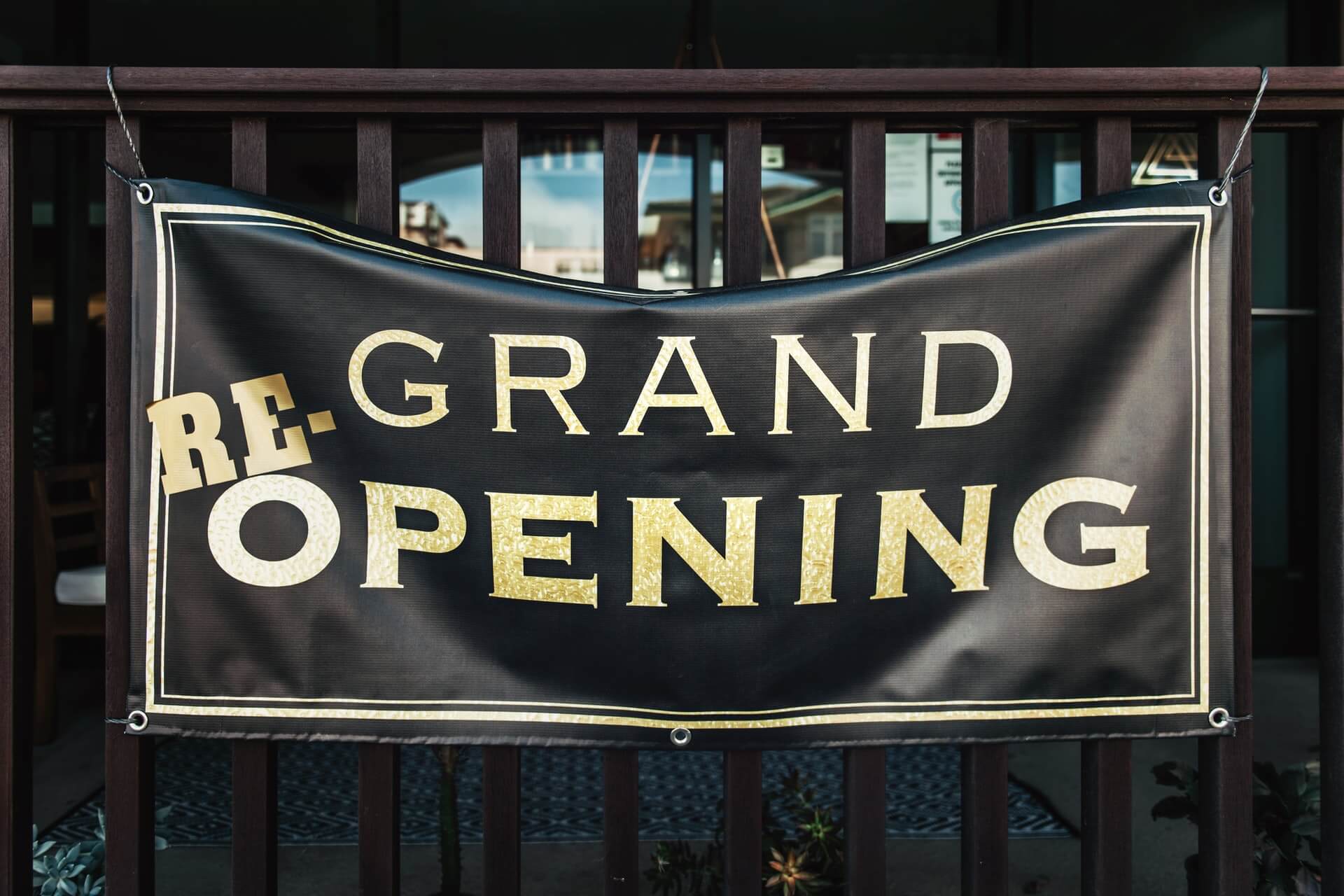
Grand re-opening sign

Around one-third of America’s population is vaccinated fully and some states are easing restrictions.

Per the CDC, not exactly America’s favorite agency, more than 40 percent of Americans have received one Covid-19 vaccine shot. Just over 30 percent have completed the vaccine process.

So, which states are planning to reopen fully for Summer 2021? We have a list of some of the states that have made their plans to reopen 100 percent known so far.

California

The Golden State plans to reopen fully on June 15. According to doctors at the University of California San Francisco, the state is nearing herd immunity. However, Governor Gavin Newsom’s target date relies on two criteria:

  • Vaccine supply must be sufficient enough “for Californians 16 years and older who wish to” receive inoculation.
  • Hospitalization rates must remain low and stable.

Illinois

Per Mayor Lori Lightfoot, the plan is for the city of Chicago to be open 100 percent by July 4. Of course, that means reopening fully right in time for one of the biggest celebratory holidays of the year. However, Governor J.B. Pritzker says Illinois could reopen in as early as the start or middle of June.

Nevada

Governor Steve Sisolak plans for Nevada to reopen fully on June 1. That said, casinos in the Silver State have a slightly different timeline. With the exception of nightclubs, dayclubs and live performances, casinos will open 100 percent June 4 if all requirements are met.

New York

According to Mayor Bill de Blasio, the plan is to reopen New York City on July 1. Governor Andrew Cuomo hopes to reopen New York State fully before that date.

Texas

Governor Greg Abbott opened the state 100 percent back in March. However, judges in the state’s 22 counties still have the authority to impose Covid-19 mitigation strategies. Hospitalization rates in a particular county rising above 15-percent hospital bed capacity for seven days would be a triggering event.

As the vaccine rollout continues, it’s likely we’ll see more states announce Summer 2021 reopening plans. Still, operators should proceed with caution and remain in compliance with state, county and local Covid-19 rules. This is, after all, a fluid situation.

There’s light at the end of the tunnel but now’s not the time to be complacent.

Image: Tim Mossholder on Unsplash

by David Klemt David Klemt No Comments

Summer Stimmy, Hot Vax Summer

Summer Stimmy, Hot Vax Summer

by David Klemt

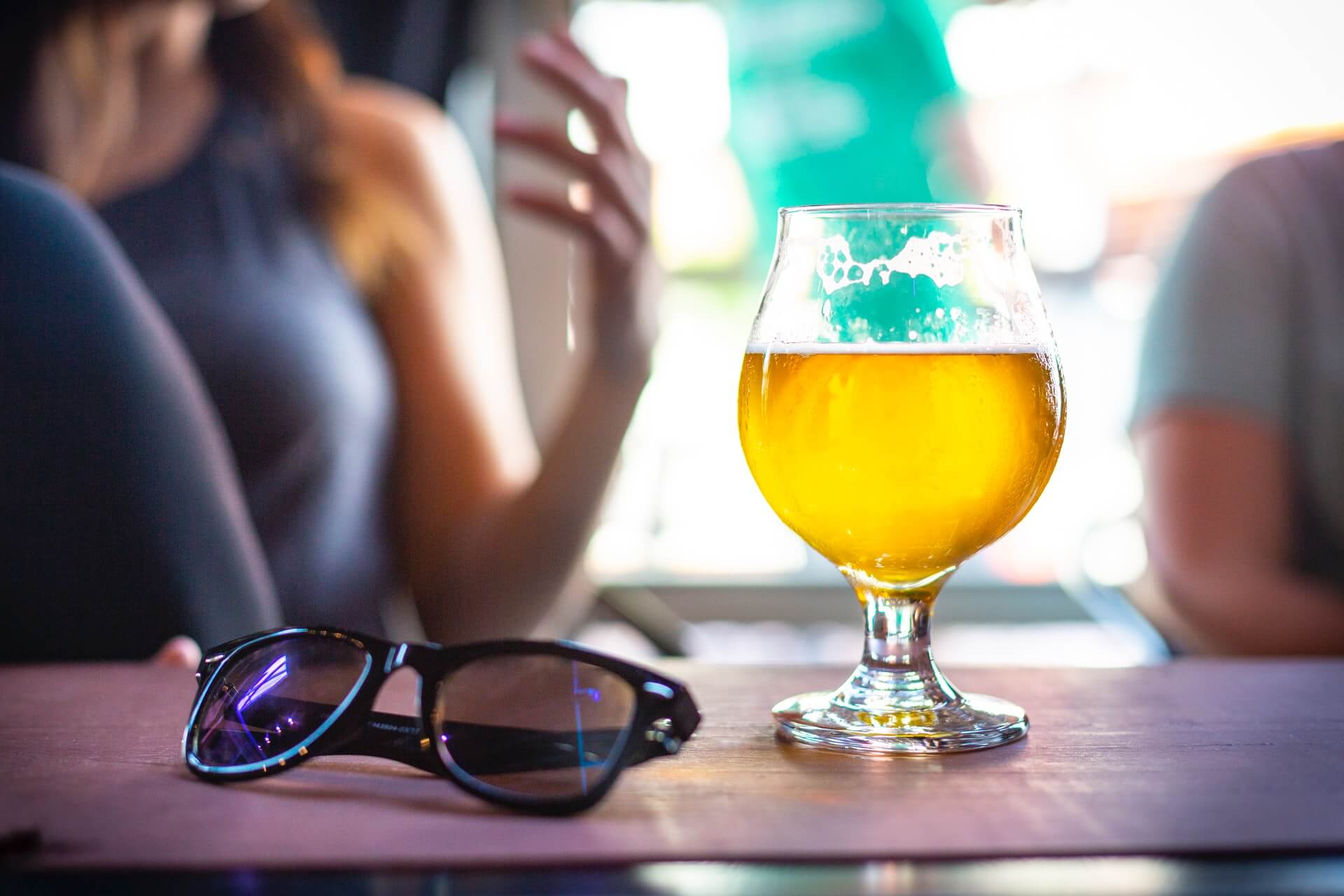
Sunglasses and beer on table at a bar

When considering event programming, operators should consider the zeitgeist of the current era in which we find ourselves.

Big brands monitor and leverage the cultural climate of a given time.

Operators can do the same, as long as they embrace authenticity, show a sense of humor, and avoid disrespect and appropriation.

Here are a couple examples operators can use for Summer 2021.

Summer Stimmy

Bud Light is tapping into America’s federal response to the pandemic—stimulus checks, to be exact—with creativity and a sense of humor.

Is it too soon? It doesn’t seem so—the levity is a welcome respite.

For all intents and purposes, it appears Bud Light is leaning heavier into the creative and promotional aspect than just humor.

Bud Light’s Summer Stimmy is a proposal to “make Summer 2021 even awesomer for people across America.”

The brand explains each “proposal” item as though they’re components of a bill up for consideration. For example, Part I, Section 1 of the Bud Light Summer Stimmy proposal carries the subtitle “Tons of Tix.” Bud Light proposes to give away 100,000 tickets for MLB, NBA, NFL, NHL, NWSL and WNBA events.

Part I, Section 2, More Awesomeness, proposes the nomination of Rob “Gronk” Gronkowski as Secretary of Summer. Additionally, the section proposes May 14 as National Gronk Day, his birthday.

Of course, Bud Light owns the term Summer Stimmy now. However, clever operators can get in on the fun (and profits) through their Bud Light rep. Or, they can get creative and come up with their own Summer 2021 promotions that leverage pent-up demand.

Hot Vax Summer

Even though it seems like forever ago, who can forget 2019 and Hot Girl Summer?

Megan Thee Stallion, one half of the infamous “WAP” duo, gets the credit for coining the phrase and creating the movement.

The “rules” for Hot Summer were simple: Women and men just needed to be “unapologetically them,” make having a good time a priority, and be free.

We all know what happened in 2020. There certainly wasn’t a Hot Girl Summer, Part Two.

Meeting new people, dating, hooking up… For the most part, none of that happened without Covid-19 tests and quarantining. That is, if those activities occurred at all.

But now we have multiple vaccines: Pfizer, Moderna, and Johnson & Johnson. AstraZeneca and Novavax have yet to be authorized by the FDA.

So, what are the Hot Vax Summer rules? Pretty simple: Get vaccinated (fully), get back out there to meet, interact and hook up.

And where do people tend to go to meet others? Restaurants, bars, nightclubs and dayclubs.

Whether to confidently and comfortably meet friends they haven’t seen for several months, make new friends, or kickstart dating, our businesses are where people want to be.

Operators need to ensure their venues are ready for the initial crush of guests clamoring to finally reclaim their social and romantic lives. So, prepare your outdoor areas; make sure indoor areas meet guest expectations for comfort so they can interact freely; and ensure your staff is ready for the welcome onslaught of eager guests.

Image: Photo by Drew Beamer on Unsplash

by David Klemt David Klemt No Comments

Canadian Hospitality Needs Real Help

Canadian Hospitality Needs Real Help

by David Klemt

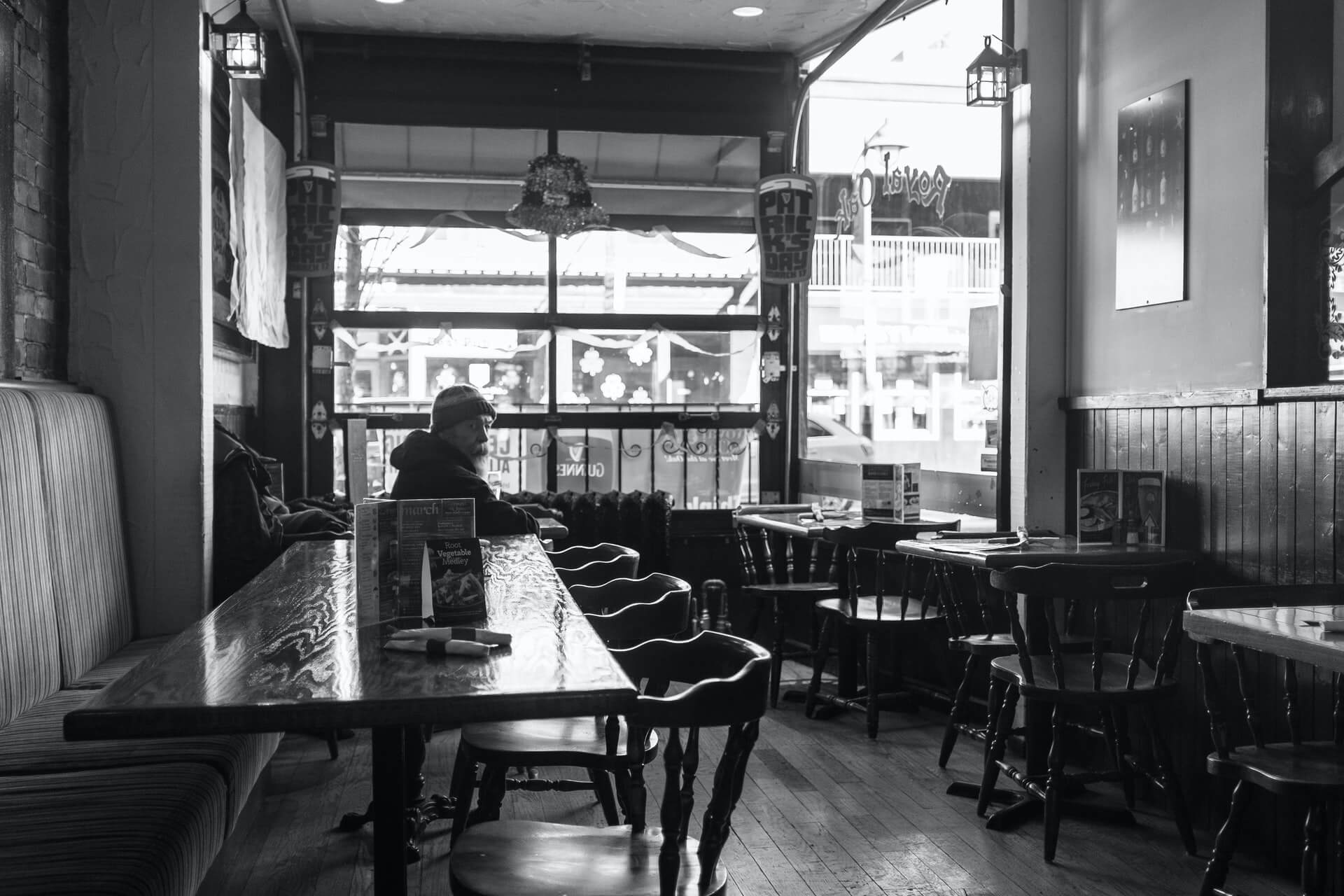
Man in empty restaurant and bar in Ottawa, Ontario, Canada

Restaurants, bars and other foodservice establishments throughout Canada need specific relief to survive, replace lost jobs, and return to profitability.

The seemingly endless and severe provincial restrictions is putting far too much strain on a struggling industry.

Yes, there are some federal provisions in place. No, they’re not enough.

Relief Efforts

Currently, the federal budget promises extensions for wage and rent subsidies. Those subsidies would extend to September 25, 2021.

However, most Canadians, per a Restaurants Canada survey, agree that the industry needs more help.

If additional industry-specific relief faces significant delays or doesn’t come at all, operators, employees, and their families will suffer.

No wonder, then, that 90 percent of Canadians (according to the Restaurants Canada survey) feel restaurants and bars need federal support to remain in business and continue paying staff.

Support Proposals

Of the approximately 98,000 foodservice establishments throughout Canada, about 10,000 are out of business. As of last month, 319,000 lost foodservice jobs had yet to be filled.

No other industry in Canada is facing such startling numbers. Add to that the fact that the industry contributes to four percent of Canada’s GDP, restaurants are the first employers for most Canadians, women comprise nearly 60 percent of the restaurant workforce, and visible minorities comprise over 30 percent of ownership and labor, and the situation grows even starker.

Clearly, industry-specific relief is necessary.

Restaurants Canada is campaigning for the following measures:

  • Extend the wage and rent subsidies through April 2022.
  • Develop subsidy requirements that more closely match the dire reality the industry continues to face.
  • Implement an employee retention and retraining credit to defray Covid-19 protocol costs.
  • Partial forgiveness for all government-backed loans.
  • Removal of merchant fees from the tax portion of restaurant bills.
  • Restore the meals and expenses to 100 percent on a temporary basis.
  • Develop and implement a culinary tourism incentive for the 2020 and 2021 tax years, using New Brunswick as a model.
  • Implement a rebate program that provides government reimbursement of $15 per person, per meal.
  • Freeze the Excise Act, including Excise Act 2021.

Act Now

It took more than a year but the industry and its supporters in America helped bring about meaningful change for restaurants, bars, and other hospitality venues.

The same can be done in Canada, and time is of the essence.

For example, the Restaurant Revival Working Group is a good start for effecting change. The group consists of government and industry representatives.

Click here to review the list of Restaurant Revival Working Group members, particularly those in government, so you can contact them.

Image: Tyler Farmer on Unsplash

by David Klemt David Klemt No Comments

Live Event Venues Can Apply for Relief

Live Event Venues Can Apply for Relief

by David Klemt

Bokeh photograph of condenser microphone

Live event venue and movie theater operators can once again apply for relief grants via a Small Business Administration portal today.

This is big and welcome news for businesses that are among the hardest-hit due to the pandemic. However, the portal has yet to open at the time of publication.

It remains to be seen if the issues plaguing the SBA’s portal are no more. It also casts some doubt on a glitch-free process for Restaurant Revitalization Fund applicants.

SVO Grant Portal Problems

Today’s reopening of the Shuttered Venue Operators Grant portal is nearly three weeks in the making. A message on the homepage states that the portal has undergone “rigorous testing” to prevent further issues.

On April 8, the day the website opened for applications, it was shut down due to a “technical glitch.” Applicants are now 18 days behind in terms of applying for and receiving relief.

Unfortunately, the delay is more bad news for live event and movie theater operators. The Economic Aid to Hard-Hit Small Businesses, Nonprofits, and Venues Act became law on December 27, 2020. That means more than 120 days will have passed just to open the application process today.

SVO Grant Details

The Shuttered Venue Operators Grant program contains more than $16 billion. There is a $10-million-dollar cap on single grants.

Importantly, eligible entities in operation on January 1, 2019, will receive grants equal to 45 percent of their 2019 gross earned revenue or $10 million. For eligible entities that began operation after January 1, 2019, grant amounts will be for the average monthly gross earned revenue for each full month of operation during 2019 multiplied by six or $10 million.

Eligible applicants include:

  • Live venue operators or promoters
  • Theatrical producers
  • Live performing arts organization operators
  • Museum operators
  • Motion picture theater operators, including owners
  • Talent representatives

Notable requirements include the following:

  • An eligible entity must have been in operation as of February 29, 2020; and
  • entities that received PPP loans on or after December 27, 2020, will have the SVO grant reduced by the PPP loan amount.

Be Ready

If you’re an operator applying for an SVO grant, be sure you’re ready to apply today.

There is a checklist for applicants on the SBA website. Click here to access and review it. There are several forms operators will need to fill out and include in their application, such as SBA Form 1623 and SBA Form 1711.

Necessary financial documents include 2019 tax returns for businesses in operation in 2019, 2020 tax returns for businesses that have filed 2020 taxes, and 2018 tax returns for non-profit applicants that have yet to end their 2020 fiscal year. Businesses that declared Chapter 11 or Chapter 13 bankruptcy must include pertinent documents.

Additionally, there are also business-specific documents required for live venue operators or promoters; theatrical producers; live performing arts organization operators; movie theater operators; and museum operators.

Image: israel palacio on Unsplash 

by David Klemt David Klemt No Comments

Ontario F&B Workers Petition for Phase 2

Ontario F&B Workers Petition for Phase 2

by David Klemt

Covid-19 vaccine ampoules

A petition on Change.org seeks to include F&B workers in Phase 2 of the Covid-19 vaccine rollout in Ontario, Canada.

The petition, which can be found here, is directed toward Ontario, Canada, Premier Doug Ford.

Currently, Ontario is in the midst of Phase 1 of Covid-19 vaccination.

Phase 1

Per the official Ontario Government website, Phase 1 aims to vaccinate around 1.8 million people.

The phase breakdown is as follows:

  • One: High-risk populations (December through March)
  • Two: Mass deliveries of vaccinations (April through July)
  • Three: Steady state (July onward)

Those eligible for Phase 1 inoculations are:

  • Health care workers
  • Adults in First Nations, Métis and Inuit populations
  • Adult chronic home care recipients
  • Congregate living for seniors
  • Adults over 80 years old

According to the Covid-19 Tracker Canada website, 1,116,496 vaccine doses have been administered throughout Ontario. In total, slightly more than six percent of the Canadian population has received at least one dose.

Phase 2

The second phase seeks to vaccinate approximately nine million people.

Eligible people are:

  • at-risk populations;
  • individuals with high-risk chronic conditions, and their caregivers;
  • high-risk congregate settings (such as shelters, community living, etc.);
  • adults aged 60 to 79, in 5-year increments; and
  • essential frontline workers who cannot work from home.

The requirement in bold should get the attention of all restaurant, bar and foodservice workers. Ontario identifies several “essential frontline workers” eligible for Phase 2. Among them are elementary and secondary school staff, police, firefighters, special constables, and social counselors.

However, high- and low-risk retail workers are on the list while restaurant and foodservice workers are not.

The Petition

Cassie MacKell is the person behind the petition to “Include Restaurant & Food Service Workers on Ontario’s Phase 2 Vaccination List.”

MacKell’s opening statement says, “I write this letter as a cry for help from the entire Food & Beverage industry of Ontario in regard to Ontario’s phase vaccine distribution plan.”

The petition’s creator goes on to say:

“As one of the hardest hit industries from Covid-19 why am I not seeing restaurants workers on this list? From the outset of the Covid-19 pandemic restaurants across Ontario have been heavily regulated and shut down by Premier Ford. Even after adhering to stringent restrictions and safety guidelines set forth by our government the framework continues to keep us closed, or only allows for limited seating capacity making it impossible for many businesses to survive.”

In closing, MacKell lays bare the situation for Ontario (and indeed all of Canada) foodservice professionals. Workers in this industry are exposed to people not wearing masks while they eat or drink; are unable to remain six feet from guests; and certainly can’t work from home.

Put bluntly, all those who work in foodservice are high-risk frontline professionals. If you agree and live in Ontario, Canada, please sign this petition.

Image: Alena Shekhovtcova from Pexels

by David Klemt David Klemt No Comments

Los Angeles Restaurants Face New Outdoor Dining Restrictions

After Weeks of Prohibition, This is What Los Angeles Restaurants are Facing

by David Klemt

Limited to delivery and takeout for several weeks, Los Angeles restaurants and breweries may now offer outdoor dining.

Of course, that easing of restrictions comes with a raft of new limitations.

The outdoor dining ban was lifted last Friday, January 29. Governor Gavin Newsom rescinded California’s statewide stay-at-home order four days prior, January 25.

Operators, still caught firmly in the vortex of opens, closures and ever-shifting restrictions, will have to weigh the potential to generate in-person dining revenue against limitations and costs.

Outdoor dining capacity of restaurants, breweries and wineries (able to open for outdoor tastings) is restricted to 50 percent. Even an operator with a significant outdoor footprint may find the revenue generated from in-person dining incapable of offsetting associated costs.

Speaking of footprint, operators must also contend with new distance requirements. Outdoor tables must now be spaced a minimum of eight feet apart to ensure guests aren’t seated back to back. This increase from six feet must be measured from the edges of each table.

Any employee who “may come in contact” with a guest is required to wear a face mask and a face shield for the duration of such an interaction, which can’t include tableside preparations.

No live entertainment is permitted, and televisions must remain turned off. Couple the television ban with a prohibition on “coordinated, organized or invited events or gatherings” and Super Bowl parties are clearly not permitted.

Additional limitations pertain to guests and group size. No more than six people may be seated at a table, and each guest must be a member of the same household. Signage informing guests of the household requirement must be posted, and guests must also be given this information verbally.

A “household” in Los Angeles County is defined as “persons living together as a single living unit.” Click here for the County of Los Angeles Department of Public Health’s “Protocol for Restaurants, Breweries and Wineries: Appendix I.”

According to Dr. Barbara Ferrer, Los Angeles County health director, operators can expect increased scrutiny and enforcement of Covid-19 protocols.

Evidence of enhanced enforcement efforts was seen last week. LA County filed two suits on January 27 against Cronies Sports Grill in Agoura Hills and Tinhorn Flats in Burbank for failing to adhere to health directives. Both suits label the establishments as “public nuisances.”

Some Los Angeles operators may find limited outdoor dining better than no in-person dining at all. However, others may conclude that labor and PPE costs alone aren’t worth restricted reopening, to say nothing of contending with increased governmental scrutiny.

Image: David Mark from Pixabay

by David Klemt David Klemt No Comments

Current Restaurant and Bar Restrictions: Las Vegas, Nashville, Philadelphia, Orlando

Current Restaurant and Bar Restrictions: Las Vegas, Nashville, Philadelphia, Orlando

by David Klemt

KRG Hospitality has turned hospitality industry visions into reality throughout the United States for several years.

Currently, we operate in Las Vegas, Nashville, Philadelphia and Orlando, along with the surrounding areas. Of course, we’re available to take projects from the idea phase to opening doors and beyond in other markets.

We’ve reviewed and gathered the current Covid-19-based restrictions for each of the four main US markets in which KRG operates to help current operators and those considering taking the next steps in their journey toward opening their own businesses.

To book a 15-minute introductory call to discuss your project and how we can help you realize your vision, click here.

Las Vegas

Set to expire on January 15, Nevada’s statewide “pause,” first implemented on November 24, was extended January 11 for a further 30 days. Guidance can be found here.

Requirements

  • Restaurants and bars must reduce capacity from 50 percent to 25 percent for both indoor and outdoor dining.
  • Bar seating must be social distanced.
  • Walk-ins are prohibited. Guests must make reservations.
  • Masks must be worn when a guest isn’t eating or drinking.
  • No more than four people may share the same table.
  • Nightclubs and dayclubs aren’t permitted to open.

Recommendations

  • Curbside, delivery, and/or takeout are encouraged.
  • Restaurants and bars should continue to make hand sanitizer available and conduct health screenings and/or temperature checks.
  • Limit personal gatherings to ten people from a maximum of two families.
  • Wear masks at indoor and outdoor gatherings.

Nashville

Among Nashville’s restaurant and bar guidance is the “No Seat, No Service” mantra. Additional requirements and recommendations are below, and detailed information can be found here.

Requirements

  • All residents and all visitors must wear face coverings when in public.
  • Restaurants and bars limited to 5o-percent capacity, with social distancing.
  • Tables must be socially distanced. Limited to eight people per table.
  • Surfaces must be cleaned after they’ve been used by patrons.
  • Standing at the bar is prohibited–bars are seated-service only.
  • Remember “No Shirt, No Service”? The new rule is “No Seat, No Service.”
  • Customers must wear a mask when standing up and walking through the restaurant or bar.
  • Entertainment is permitted but barriers must be in place between performers and customers. However, dance floors are prohibited.
  • Bar games and activities like darts, arcade games, etc., must be sanitized in between uses.
  • Last call for service is 10:00 PM, which is also the cutoff for entry.
  • No self-service food or condiments are permitted.

Recommendations

  • Governor Bill Lee urges Tennesseans to wear a mask, gather only with immediate household members.
  • Display this sign to show commitment to mandated and recommended health and safety rules and practices.
  • Use contactless, virtual or disposable menus.

Philadelphia

The current restrictions went into effect November 20. Click here for the full list of requirements and recommendations. You’ll find the city’s complete hotel guidance here.

Requirements

  • Required protections: Masks, Barriers, Staff education, Employee symptom screening and isolation of infected employees, Ensure employees can remain six feet away from one another; Handwashing on employee arrival and in accordance to established food safety precautions, Follow Department of Public Health Food Safety regulations.
  • 25-percent capacity of stated fire code occupancy.
  • Guests may not stand in the restaurant or sit at the bar.
  • Alcohol may only be served on-premises if it’s part of the same transaction as a meal.
  • Table capacity of four people of the same household or less.
  • Outdoor dining capacity limited to fewer than 50 people.
  • Operators must plan for inclement weather in regards to outdoor dining.
  • No entertainment permitted.
  • Indoor catered events prohibited.
  • Last call for orders must take place at 11:00. Business must be closed for service by midnight.

Recommendations

  • Servers should wear face shields and/or goggles along with a mask.
  • Temperature checks for employees and customers aren’t required but no-touch thermometer should be used by establishments that choose to conduct them. Anyone with a temperature of 100.4 degrees or higher should be turned away.
  • Consider using physical barriers in between tables.
  • Use contactless payment methods.
  • Promote online ordering, delivery, and curbside pickup options.

Hotel Requirements

  • Required protections: Provide masks to employees, Staff education, Employee symptom screening and isolation of infected employees, Ensure employees can remain six feet away from one another; Provide employees hourly handwashing breaks.
  • Separate staff from customers at ticket and information desks with plastic barriers.
  • Utilize contactless room service delivery.
  • Outdoor events and gatherings are prohibited from exceeding 10 percent of maximum occupancy (maximum of 2,000 persons), even with masks and social distancing. If no maximum occupancy is known, occupancy may not exceed more than 10 persons per 1,000 square feet.
  • Remove self-serve F&B stations from public areas.
  • Remove magazines, menus, and other reusable items that can’t be cleaned from guest rooms.
  • Indoor gatherings and events are prohibited.

Hotel Recommendations

  • Use contactless payment methods.
  • Increase building ventilation.

Orlando

Unlike Las Vegas, Nashville and Philadelphia, Orlando, because it’s located in Florida, has lifted restrictions on restaurants. Section 3: Restaurants of Executive Order 20-244 states:

“Pursuant to Chapter 252, including sections 252.36(5)(b ), (g) and (h), Florida Statutes, and in order to safeguard the economic vitality of this state, any restaurant may operate as set forth below.

“A. Restaurants, including any establishment with a food service license, may not be limited by a COVID-19 emergency order by any local government to less than fifty
percent (50%) of their indoor capacity. If a restaurant is limited to less than one hundred percent (100%) of its indoor capacity, such COVID-19 emergency order
must on its face satisfy the following:

“1. quantify the economic impact of each limitation or requirement on those restaurants; and 2. explain why each limitation or requirement is necessary for public health.

“B. Nothing in this order preempts or supersedes a non-COVID-19 municipal or county order.

“Section 4. Suspension of COVID-19-related Individual Fines and Penalties This order, consistent with Executive Order 20-92, suspends the collection of fines and
penalties associated with COVID-19 enforced upon individuals.”

The order that closed bars has also been rescinded: “Bars and other alcoholic beverage vendors may operate for consumption on premise effective Monday, Sept. 14th
under Phase 2… Adhere to social distancing rules, table seating [six feet] between tables. Alcohol allowed for take-out and delivery.”

However, Executive Order 20-192 is still in place and states:

“WHEREAS, on March 17, 2020, I issued Executive Order 20-68, as extended by Executive Order 20-112, which authorized the Department of Business and Professional
Regulation to ensure all restaurants implement employee screening and to prohibit any restaurant employee from entering the restaurant premises if he or she meets certain criteria indicative of concerns related to COVID-19.”

More details can be found here.

Last updated: January 27, 2021. Please note that Covid-19 guidance, restrictions and protocols are subject to swift change. One should monitor their state, county and city for the latest updates.

Image: Katy Anne on Unsplash

by David Klemt David Klemt No Comments

Current Restaurant and Bar Restrictions: Toronto, Calgary, Vancouver

Current Restaurant and Bar Restrictions: Toronto, Calgary, Vancouver

by David Klemt

For more than a decade, KRG Hospitality has turned hospitality industry visions into reality throughout Canada.

Currently, we operate in Toronto, Calgary and Vancouver and the surrounding areas.

We’ve reviewed and gathered the current Covid-19-based restrictions in Ontario, Alberta and British Columbia to help current operators and those considering taking the next steps in their journey toward opening their own businesses.

To book a 15-minute introductory call to discuss your project and how we can help you realize your vision, click here.

Toronto

On January 25, the province of Ontario officially extended the current state of emergency (which includes a stay-at-home order) by 14 days by Premier Doug Ford. Had Premier Ford not extended the emergency order, it would’ve expired Tuesday of this week. Unless extended again, it will expire February 11.

What this means for restaurants, bars and other types of F&B establishments is that indoor and outdoor dining are banned currently. Delivery, takeout and drive-through service are permitted.

Individuals face $750 fines (up to a maximum of $100,000) and corporations could be hit with $1,000 fines (up to a maximum of $500,000 for a director or officer) for a violation of emergency orders.

When the state of emergency expires or is otherwise rescinded, Ontario is expected to revert to the regulations found within the Reopening Ontario Act (currently suspended). Should Ontario find itself immediately colour-coded Grey, the current restrictions on restaurants and bars will remain identical: only delivery, takeout and drive-through service will be allowed.

Among other restrictions, a Red control level means restaurants are restricted to indoor dining capacity of ten people, outdoor dining is permitted, customers must be seated and two metres apart from one another, liquor may only be sold within a 9:00 AM to 9:00 PM window, face coverings must be worn except when eating or drinking, and nightclubs may only operate as a restaurant or bar.

Orange level restrictions include a 50-person capacity limit, a maximum of four people per table, customers must be screened before entry, liquor may only be sold between the hours of 9:00 AM and 9:00 PM, establishments must close by 10:00 PM, and gentlemen’s clubs must remain closed.

The Yellow control level is marked by the following restrictions: no more than six people may be seated at the same table, liquor may only be sold between 9:00 AM and 11:00 PM, establishments must close by midnight, music levels may not exceed that of a “normal conversation,” and all seated patrons must provide contact information.

Green control doesn’t mean everything is back to pre-pandemic “normalcy.” Tables must still be at least two metres apart, customers must be seated, face coverings must be worn except when eating or drinking, no buffet-style service is permitted, nightclubs may only operate as restaurants or bars, and contact information for at least one person per party must be collected. Restricted dancing, singing, performing and karaoke (no private rooms) are permitted.

Calgary

On December 13, 2020, indoor and outdoor dining was banned throughout Alberta. Current Covid-19-related public health measures and restrictions have been extended until further notice. The province’s restrictions affect restaurants, bars, cafes, pubs, and lounges (and other businesses, of course).

Only delivery, takeout and curbside pickup are permitted in Alberta. However, this is expected to change on February 8, 2021.

Hotels, motels and lodges are open but may not offer access to gyms, pools or spas. Indoor dining is banned but room service permitted. Casinos must remain closed.

Movie theatres, bowling alleys, pool halls and other entertainment businesses may not open for business.

If Alberta returns to the previous relaunch strategy, the province will be subject to a three-stage reopening. However, the document hasn’t been updated since June 2020.

Update: Alberta allowed restaurants and bars to reopen for in-person services yesterday, February 8. Indoor alcohol service must end by 10:00 PM, and indoor dining service must cease by 11:00 PM. Contact information from one person of the dining party must be collected, there’s a limit of six people maximum per table and each individual must be from the same household. Alternatively, the maximum per table for an individual living alone is there two close contacts. Tables must be spaced two metres apart and no entertainment is permitted.

Vancouver

British Columbia is far less restrictive than Ontario and Alberta, at least at the moment. The restrictions in place currently affect restaurants, bars, cafes, cafeterias, coffee shops, lounges, and tasting rooms. Nightclubs, however, must remain closed.

Requirements

  • Unless a physical barrier is in place, customers not in the same party must be at least two metres away from one another.
  • No more than six people may be seated at the same table or booth, even if they’re members of the same party.
  • If seated at a counter, customers must be two metres apart unless they’re in the same party or physical barriers are in place.
  • No more than six customers of the same party may be seated at a counter less than two metres from one another.
  • Businesses that offer self-serve food or non-alcohol drink stations must: ensure alcohol-based hand sanitizer or handwashing facilities are “within easy reach”; signage reminding customers to wash or sanitize their hands before touching anything on the stations and to maintain two metres from other customers must be present; utensils and high-touch surfaces at the stations must be cleaned and sanitized “frequently.”
  • Dance floors must be closed, and karaoke, singing, jam sessions, open mic sessions, and dancing are prohibited.
  • Background music or sounds may not be amplified or exceed the volume of a “normal” conversation.

Further details can be found here.

Last updated: February 9, 2021. Please note that Covid-19 guidance, restrictions and protocols are subject to swift change. One should monitor the country, provinces and cities for the latest updates.

Image: James Wheeler from Pexels

by David Klemt David Klemt No Comments

California’s Restrictive Regional Stay-at-Home Order Rescinded

California’s Restrictive Regional Stay-at-Home Order Rescinded

by David Klemt

Expectation became reality yesterday when Governor Gavin Newsom rescinded California’s highly restrictive regional stay-at-home order.

It had been reported for at least a day prior that Gov. Newsom was expected to do so on January 25.

The order, which choked the life out of restaurants, bars and other businesses, has been in place since the start of December 2020.

As we reported several weeks ago, a group of Orange County operators pushed back against the order shortly after it was imposed. The #OPENSAFE collective released a statement announcing their intention to protest Gov. Newsom’s stay-at-home order by remaining open for in-person dining.

Other states that imposed seemingly arbitrary and illogical orders that crushed restaurants and bars also experienced open defiance from operators. One of the highest-profile protests came from New York City restaurants.

Speaking for the first time in well over a week about California’s efforts to combat Covid-19, Gov. Newsom said, “Everything that should be up is up, everything that should be down is down.”

That’s an interesting claim given California experienced a record number of Covid-19-related deaths on January 21 with 761. During his press conference, the embattled governor claimed he lifted his stay-at-home order due to ICU numbers and not because of the multiple lawsuits filed against him or the current recall campaign.

Rather, Gov. Newsom said that he made his decision based on Covid-19 cases and hospitalizations decreasing while vaccination rates are reportedly trending upward. However, as one source cited, just 26 percent of California’s allotted vaccine doses had been administered as of last week.

The rescinding of the regional stay-at-home order doesn’t mean that businesses can reopen and resume operations as usual. Each of the state’s counties will be color-coded according to California’s “Blueprint for a Safer Economy.” Projections will be set aside for actual transmission rate data.

Tier 4 is color-coded yellow and its Covid-19 transmission risk is labeled “Minimal.” Tier 3 is orange and “Moderate,” where as Tier 2 is red and “Substantial.” Tier 1, which is purple, is labeled “Widespread.”

At the moment, most counties in California are purple.

Restaurants located in a Tier 1 county can offer only outdoor in-person dining. Those in Tier 2 can offer indoor dining but only at 25-percent capacity or 100-person maximum capacity (whichever is lower). Tier 3 bumps capacity to 50 percent or 200 people, and Tier 4 dictates a maximum of 50 percent capacity.

As expected, bars (along with breweries distilleries) that don’t serve food receive much harsher treatment than restaurants. Those located in a county designated purple or red must close. Bars in orange counties can open for outdoor service only, and those in yellow counties can offer indoor service at 50-percent maximum capacity. Bars “where [a] meal is provided” follow restaurant guidelines for the four applicable tiers.

Movie theaters, for context concerning how bars are being treated, are subject to the same guidance as restaurants in California’s blueprint. Such venues aren’t exactly known for providing meals.

Before operators who have chosen to work within California’s guidelines throw their doors open, they need to know two things. One, county officials are permitted to impose their own restrictions. If they choose to do so, those restrictions can be stricter than those that come down from state officials.

Two, for those operators in Los Angeles County, confusion remains regarding outdoor dining. Some interpret the rescinding of the state’s prohibition on outdoor dining as a lifting the ban. However, LA County implemented its own ban before the state did so. That county-issued ban expired on December 16 but outdoor dining was banned under the statewide stay-at-home order.

It may seem cut and dry that the expiration of the county order and the lifting of the state’s ban shifts LA County to Tier 1 restrictions. Operators should make sure they’re clear to resume outdoor service before incurring the costs associated with doing so.

How long California will revert back to the state’s Blueprint for a Safer Economy is anyone’s guess. Operators in several states have found themselves caught in a vicious open-close, open-close vortex. At any rate, 25-percent capacity restrictions will still more than likely make it more cost-effective for some operations to remain closed for indoor service.

Image: Paul Hanaoka on Unsplash

by David Klemt David Klemt No Comments

Dave Portnoy, Other Celebrities Provide Financial Support for Restaurants and Other Small Businesses

Dave Portnoy, Other Celebrities Provide Financial Support for Restaurants and Other Small Businesses

by David Klemt

Famous chefs and restaurateurs aren’t the only people lending their celebrity to raise money for struggling businesses and the workers they employ.

Well, notoriety may be a better descriptor for Dave Portnoy‘s influence than celebrity. He may not be an operator but he is one of the most prolific pizza reviewers and influencers on the planet. And there’s no denying he’s been in the corner of restaurants, criticizing how officials and their responses have dealt lethal blows to the industry.

The Barstool Sports founder was challenged to put his money where his mouth is by Marcus Lemonis after “ranting” about the plight of Covid-19-ravaged restaurants and bars. Rising to the challenge, Portnoy seeded the Barstool Fund with a personal donation of $500,000, which Lemonis matched.

That half-million dollars isn’t the only donation Lemonis has made to help small businesses. The entrepreneur, philanthropist and television show host launched the Nashville 30 Day Fund by putting in $500,000 of his own money just days after December 25, 2020. This particular fund provides small businesses and individuals that operate or reside within a half-mile radius of the Christmas Day bombing site in Nashville with forgivable loans up to $100,000

Back to the Barstool Fund. Bolstered by celebrity backing and support from more than 175,000 donors and counting, the fund has raised more than $22 million in less than a month and helped more than 100 businesses.

Guy Fieri, who helped grow the Restaurant Employee Relief Fund to well over $20 million, has donated money to the Barstool Fund. So have Aaron Rodgers (who reportedly pitched in $500,000), Tom Brady, Dana White, and Kid Rock.

One crucial element for small businesses applying to the Barstool Fund is that they must still be paying their employees. There are no regional restrictions, but applicants do need to explain the intended use for whatever funds they may receive. According to a Newsweek article, checks will be given to businesses selected for Barstool Fund support on a month-t0-month basis.

Below you’ll find the restaurants, bars, pubs, taverns and even a soda shop that have received Barstool Fund grants as of yesterday afternoon, January 11. To apply for funds, please click here. If you can afford to contribute, please follow this link and click “Contribute to the Fund.”

Northeast

Gaetano’s Tavern on Main (Wallingford, CT), Laskara (Wallingford, CT),  Piggy’s Cafe (Hartford, CT), Red Rock Tavern (Hartford, CT), Abbey Burger Bistro (Baltimore, MD), Claddagh Pub (Baltimore, MD), Don’t Know Tavern (Baltimore, MD), Dough Boy Fresh Pretzel Company (Dundalk, MD), Atlas Pub & Kitchen (Chicopee, MA), Casa Mia (Marblehead, MA), Jalapeno’s Mexican Grill (Walpole, MA), Jimmy’s Pub & Restaurant (Mansfield, MA), The Park Lunch (Newburyport, MA), The Village Trestle (Goffstown, NH), Hoboken Beer & Soda Outlet (Hoboken, NJ), Jack’s Cafe (Verona, NJ), Marandola’s (Bradley Beach, NJ), Mia Restaurant (Oceanport, NJ), Nanni Ristorante (Rochelle Park, NJ), Tim Kerwin’s Tavern (Middlesex, NJ), The Underdog Bar & Grill (Haledon, NJ), Acquista Trattoria (Fresh Meadows, NY), Bayview Tavern (Seaford, NY), Borrelli’s (East Meadow, NY), The Café (Long Beach, NY), Chadwick’s Restaurant (Brooklyn, NY), Durf’s Family Restaurant (Fairport, NY), The Eagle House (Williamsville, NY), Holbrooks Backporch (Holbrook, NY), Johny’s Luncheonette (New York, NY), Kabooz’s Bar and Grill (New York, NY), Kirvens (Bronx, NY),La Conca D’Oro (Catskill, NY), Mama Mia 44 SW (New York, NY), Mary Ann’s Mexican Restaurant (Port Chester, NY), Mulligan’s Fireside Pub (Bronx, NY), Portobello Restaurant (Staten Island, NY), Roomers Bar (Lake Placid, NY), San Martino Ristorante (Yonkers, NY), Squire’s Tap Room (Tonawanda, NY), Trattoria L’incontro (Queens, NY), Flanigan’s Boathouse (Conshohocken, PA), Jack’s Spot Tavern (Pitman, PA), Kelly’s Seafood (Philadelphia, PA), La Collina (Bala Cynwyd, PA)

Midwest

Manny’s Cafeteria & Delicatessen (Chicago, IL), Ken’s Diner (Skokie, IL), Que Rico (Chicago, IL), The Rathskeller (Indianapolis, IN), Special Dogs & More (Columbus, IN), The Bomber Restaurant (Ypsilanti, MI), Champ’s Pub (Brighton, MI), Kennedy’s Irish Pub (Waterford, MI), Mac’s Acadian Seafood Shack (Saline, MI), Water Street Tavern (Kent, OH), Dairy Land Family Restaurant (Madison, WI), Gray Brewing Company (Janesville, WI), J&B’s Bar & Blue Ribbon Tap Room (Milwaukee, WI)

Rocky Mountains

Durango Diner (Durango, CO)

Southeast

Play Louisville (Louisville, KY), Steak Street (High Point, NC), Freddie’s Beach Bar (Arlington, VA), Wonju Korean Restaurant (Roanoke, VA)

Southwest

Al J’s Tavern (Tucson, AZ), Coney Island Hot Weiners (Tulsa, OK), Mack’s Tenders (Houston, TX)

Pacific

Anaheim White House (Anaheim, CA), Cactus Cantina (Riverside, CA), Dessert’D Organic Bake Shop (Mammoth Lakes, CA), Locale Farm to Table Eatery (Bakersfield, CA), Mexican Riviera (Torrance, CA), Mitla Cafe (San Bernardino, CA), Rubi’s Frosty Freeze (Whittier, CA), Tadich Grill (San Francisco, CA), Vincenzo’s Terrazza (West Covina, CA), Banks Billiards (Banks, OR), Mayan Mexican Family Restaurants (Lacey, WA)

For the full list of Barstool Fund recipients, click here.

Image: Vladimir Solomyani on Unsplash

by David Klemt David Klemt No Comments

Operators Remain Caught in Vortex of Open-Close-Open Cycle

Operators Remain Caught in Vortex of Open-Close-Open Cycle

by David Klemt

Another week, another round of changes for restaurant and bar operators in different states.

It has become all too familiar for those in the hospitality industry: Orders governing capacities, party sizes, bar seating, capacities, and operating hours are issued, and within weeks or days, new orders are issued.

The result is a costly high-wire act forcing restaurant, bar and nightclub owners, operators, managers and workers to deal with an inordinate amount of stress. Every cost-incurring change threatens the longevity of each affected business and the livelihoods of those they employ.

That includes reopening. What officials likely view in a positive light isn’t that cut and dry for the business owners. Whether its ignorance or indifference, governors and other officials don’t seem to realize that permitting people to resume operation isn’t as simple as turning on lights and unlocking doors. Even a small bar is a machine with many moving parts.

As anyone who has been involved in mandated close-reopen cycles knows, there are myriad operational elements that must be aligned before throwing open the doors once again. Product must be secured, a workforce must be contacted and assembled, equipment must be checked, required health and safety protocols must be reviewed and shared with staff, the word must go out to potential guests… Those challenges and more must be overcome quickly while the threat of another closure or more restrictions loom not far in the distance.

Just a week ago, we shared the story of a Minnesota operator facing a five-year liquor license suspension for defying the order issued in November of last year that banned indoor dining. On Monday, January 11, Governor Tim Walz announced restaurants and bars will be able to open again—with restrictions, of course. Indoor event and entertainment venues will also be permitted to open.

Gov. Walz’s order allows restaurants and bars to resume indoor service at 50-percent capacity, with overall capacity maxed out at 150 people. Reservations will be required, parties may not exceed six guests and must be socially distanced six feet from other parties, bar seating will be restricted to parties of two, and dine-in service must cease at by 10:00 PM.

Indoor event venues such as bowling alleys are also limited to a maximum capacity of 150 people but are restricted to 25 percent capacity. Foodservice is required to stop by 10:00 PM if the venue serves food. Gov. Walz’s orders are, reportedly, a response to infection rates falling from 13 percent to six percent.

In another (partial) reversal, bars that don’t serve food have been ordered to close in some counties in Texas. The state’s 254 counties have been separated into 22 Trauma Service Areas (TSA). Per an order from Gov. Greg Abbott, if a TSA’s hospital capacity consists of 15 percent or more of Covid-19 patients for seven consecutive days, specific restrictions are triggered. Those restrictions are only lifted when the TSA falls beneath the 15-percent threshold for seven days straight.

TSA Q, which includes Houston, restaurants are now required to restrict capacity from 75 percent to 50 percent. Bars—businesses with gross sales of alcohol of 51 percent or greater—must close. A judge overseeing Coryell County has reportedly defended the three bars in his county, stating that he sees “no reason why our three establishments should be penalized.” Judge Roger Miller doesn’t think the bars have contributed significantly to increased infections in the county and is said to be asking for an exemption so they can remain open.

For bar owners unable or unwilling to make the transition to restaurant designation, the restriction is a lethal blow. Facing reduced traffic and rising costs, even a week-long closure can spell disaster. It’s no wonder more than 3,000 Texas bars have maneuvered to offer food and increase food sales in order to be categorized as restaurants—it’s a viable means of survival. At least restaurants in Texas are able to operate 50-percent capacity rather than the 25 percent other states have mandated should they operate in a TSA that triggers Gov. Abbott’s enhanced restrictions.

The ever-shifting rules and regulations operators face across the country make it more important than ever that they receive significant, targeted aid. Yes, vaccines have been approved. Yes, foodservice workers have been recommended for the third stage of vaccine rollout. That’s not enough. A new meeting of Congress was sworn in January 3 and the pressure campaign to demand the passage and signing into law of the RESTAURANTS Act or a similar bill must continue.

This is not meant in any way to diminish the appalling chaos and terroristic violence visited upon our Capitol Building two days ago. That reprehensible act of insurrection was an attack on us all and our elected officials must reckon with that appalling assault.

However, what occurred on January 6, a date that will certainly live on in infamy throughout our great nation’s history, does not absolve Congress from their duty to save our industry and the millions of workers it employs. If anything, it highlights their responsibility to help rather than harm all Americans.

Image: Nick Fewings on Unsplash

by David Klemt David Klemt No Comments

86 Restaurant Struggle Campaign a Quarter of the Way to Million-dollar Goal

86 Restaurant Struggle Campaign a Quarter of the Way to Million-dollar Goal

by David Klemt

It’s a new year and we could all use a lift and some great news.

I think a grassroots campaign to provide financial assistance to struggling restaurant workers should restore a bit of faith in humanity.

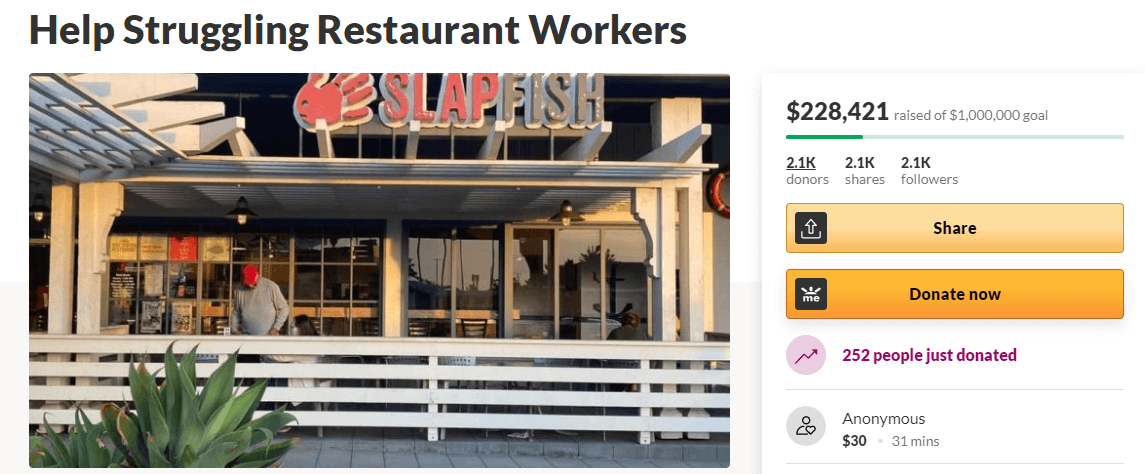
Chef Andrew Gruel, CEO and executive chef of the Slapfish chain of seafood restaurants, along with wife Lauren Gruel and Slapfish vice president of operations Brad Hall, launched the 86 Restaurant Struggle campaign on GoFundMe in December 2020. The goal is to raise $1 million for restaurant workers enduring hardship.

This news gets better and better:

  • 86 Restaurant Struggle has raised over $228,000 of the $1 million goal.
  • More than 2,100 people have donated to the GoFundMe campaign.
  • So far, half of the donations fall within the $5-100 range, meaning that even during these incredibly difficult times, people are coming together to give whatever they can afford to share.
  • The funds are being dispersed immediately to restaurant workers in need.
  • Turnaround time for 86 Restaurant Struggle fund applicants to be screened and receive their funds is, so far, less than two days.
  • As of two days ago, the campaign has managed to quickly disperse more than $100,000 of the funds raised.

The campaign is inspiring, even if the reason for its existence is the maddening failure of government to provide meaningful assistance to the hospitality industry and the millions of hard-working people it employs. This industry is made up of people who don’t leave others behind and who won’t wait for the government to decide anyone’s fate if they can help it.

Hey, we may not all like one another but we have each other’s backs. It’s important for our mental and emotional health to keep that in mind, as difficult as that may be sometimes.

To learn more about 86 Restaurant Struggle, please click here. To apply for assistance, click here. To follow Chef Gruel and track the progress of 86 Restaurant Struggle, click here.

by David Klemt David Klemt No Comments

Defiance of Sweeping Restaurant and Bar Restrictions is Growing

Defiance of Sweeping Restaurant and Bar Restrictions is Growing

by David Klemt

Defiance of Covid-19-related bar and restaurant restrictions is growing.

Operators across the United States are showing their willingness to refuse to comply with orders they feel are unjust. From being restricted to delivery and takeout only to crippling capacity limits, restaurant and bar owners are making it clear they have no intention to quietly let their employees and businesses suffer.

The pushback has taken various forms so far, from civil disobedience to organized, peaceful protests.

There’s the #OPENSAFE movement in Orange County, California, to which several dozen operators have committed. These business owners have pledged to operate safely and responsibly but have refused to comply with Governor Gavin Newsom’s orders that banned in-person dining.

86 Politicians, a grassroots movement coming out of Los Angeles County in California, was created as a response to the sweeping orders kneecapping the hospitality industry. If politicians are going to hurt rather than help operators and their employees, 86 Politicians supports recalling and removing them from office.

In New York City, the Latino Restaurant Bar and Lounge Association of New York State and New York City Hospitality Alliance organized a peaceful protest just over two weeks ago. Several hundred restaurant and bar owners, operators and workers gathered and marched against Governor Andrew Cuomo’s ban on indoor dining. Gov. Cuomo’s order was itself defiant: it defied logic and went against the state’s own contact-tracing data.

Now, an operator in Minnesota is facing a five-year suspension of her bar and bistro’s liquor license for defying orders. Lisa Hanson, owner of the Interchange Wine and Coffee Bistro in Albert Lea, roughly 90 minutes south of Minneapolis-Saint Paul, refuses to comply with Governor Tim Walz’s executive order banning indoor service. Hanson has been engaged in this fight since at least December of last year.

Hanson organized a protest—a reportedly peaceful one—of around 200 people yesterday. Protestors marched and chanted from city hall to the courthouse, walking past the Interchange at one point.

The bar and bistro, which has been hit with a temporary restraining order and had its license revoked by the Minnesota Department of Health, has a sign up declaring it a “Constitutionally Compliant Business.” That sign, which appeared in a WCCO 4 News clip and bears the logo, phone number and weblink for the Constitutional Law Group, states that the Interchange doesn’t follow any government official or agency’s “orders or suggestions” for face masks or social distancing.

According to a news report, the Minnesota Department of Public Safety is moving forward with a 60-day suspension of the Interchange’s liquor license. Hanson told reporter David Schuman that she had two choices: “Either I closed permanently or I opened fully.”

Hanson chose the latter. The Interchange’s owner is entitled to a court hearing before her suspension goes into effect. A tip jar at the bar and bistro has been transformed into a legal fund collection.

Whether one agrees with Hanson’s decision to make a stand and risk her liquor license and therefore business is somewhat beside the point. The #OPENSAFE and 86 Politicians movements, the protests in New York City, the story of the Interchange (which has yet to reach its conclusion), all point to increasing tensions.

Many restaurant and bar owners and operators don’t feel as though their voices are being heard. They feel like politicians at all levels of government are targeting them, using the businesses as scapegoats. More and more, the words “arbitrary” and “unfair” are coming up in conversations about rules that are crippling—if not outright killing—the hospitality industry.

Well over 100,000 restaurants and bars in the US have closed permanently since the start of the pandemic in March of last year. Unless officials listen to operators and at least gain a cursory understanding of their needs and challenges, more closures and job losses are imminent.

To be clear, we at KRG Hospitality aren’t against logical, common sense health and safety protocols aimed halting the spread of Covid-19. One of the cornerstones of hospitality is ensuring the safety of guests and employees. However, government officials and agencies are implementing and executing orders that are, quite clearly, uninformed and severely harmful. What works for retail and other industries doesn’t work for our industry.

It’s crucial that pressure be kept on Congress and Senate to vote on the RESTAURANTS Act and ensure it’s signed into law. The 117th Congress was sworn in yesterday and we must continue to demand they do their jobs and save our industry. We’ve been targeted as scapegoats—it’s beyond time we receive targeted relief.

Politicians can expect more protests and less faith in their abilities to govern if restaurant and bar owners and professionals continue to be harmed by their orders. Perhaps the only way to persuade them to help the industry and, in turn, keep their constituents employed, is to imperil their political influence and careers. Eighty-six ignorant and harmful politicians, indeed.

Image of Minnesota State Capitol: Bao Chau on Unsplash

by David Klemt David Klemt No Comments

You Need to Watch “Restaurant Hustle 2020: All on the Line” Now

You Need to Watch Restaurant Hustle 2020: All on the Line Now

by David Klemt

Whether you own, operate, manage, are employed by or have ever spent time at a restaurant as a guest, you need to watch Food Network’s Restaurant Hustle 2020: All on the Line.

Guy Fieri, who has helped raise $24 million (and counting) for restaurant industry workers, executive produced and co-directed the documentary, which aired last night. He tasked skeleton production crews (one would assume given the pandemic) with following four incredible chefs—Marcus Samuelsson, Maneet Chauhan (and her husband Vivek), Christian Petroni, and Antonia Lofaso—and said he wanted them to keep the cameras rolling to capture “the good, the bad and the ugly.”

When the scope of Covid-19 became clearer and the industry began to see how much devastating its impact would be on restaurants, bars and other hospitality venues, Fieri says in the documentary that he had two thoughts: “’No way can this happen,’ and, ‘Oh my god, this is gonna be worse than we ever imagined.’”

He’s angry about what’s happening to the industry and millions of people it employs and feeds.

“I was mad. I’m still mad,” says Fieri in Restaurant Hustle 2020. “Wrecked lives, wrecked families… Changed the history of the industry.”

Per the documentary, Fieri felt compelled to help his “millions of brothers and sisters” in whatever ways possible: “There was no words. It’s coming. Prepare. Stick together. What can we do?”

The documentary begins with three indisputable facts that speak volumes to the importance of the industry: The restaurant industry employs over 15 million people. That equals up to 20 percent of America’s workforce. The industry generates over $850 billion in sales.

From there, Restaurant Hustle 2020 introduces the four chefs, their restaurants, their challenges, and their collective hustle. Like so many in this industry, there’s no giving up in these people—there’s only fight.

Chef Marcus Samuelsson

Seeking community after 9/11, Chef Samuelsson opened the Harlem location of Red Rooster in 2010. That location employed 180 people—Chef Samuelsson had 30 venues located in eight countries when Covid-19 hit. Pre-pandemic, Red Rooster in Harlem would see around 1,100 guests on a Saturday night, and Chef Samuelson was just a week out from opening the doors of Red Rooster in Miami.

“It’s taken me 25 years to build this moment, but it took ten days to tear it all down. I don’t wish it on my worst enemy,” says Chef Samuelsson.

Chef Maneet Chauhan

Chef Chauhan and her husband Vivek operate four restaurants and three breweries within the Morph Hospitality Group portfolio in Nashville, Tennessee. At their peak, they served 2,500 guests over the course of a weekend. Morph employed nearly 300 people but by March they made the heart-wrenching decision to close their doors. Recalling the difficult choice, Chef Chauhan is brought to tears talking about how gracious her employees were about it.

However, Chef Chauhan and husband Vivek are willing to fight for their dreams and their employees: “The thing is, we are scrappy. We are immigrants,” she says.

Vivek focused on developing and strategizing reopening plans, and the duo fully embody the meaning of the Hindi word “jugaad,” or “a flexible approach to a problem.” While it only represented maybe a tenth of their regular sales, Morph implemented curbside pickup at three of their venues. They rotated availability offering curbside at a different location on Friday, Saturday and Sunday. This allowed them to bring back a handful of employees.

Chef Christian Petroni

There are five locations of Chef Petroni‘s Italian restaurant concept Fortina throughout New York’s tri-state area: Armonk, Brooklyn, Rye Brook, Stamford, and Yonkers. Heading into 2020, they were set to have another amazing year after doing very well in 2019.

“We were just gearing up to take over the world,” says Chef Petroni.

The first Covid-19 death in the United States was reported on February 28 in King County in Washington State. As we know, on March 16, 2020, NYC shut down around 27,000 restaurants, resulting in the loss of 225,000 jobs. Chef Petroni employed nearly 300 people but had to reduce his workforce to less than twenty. To help the communities they serve and generate some revenue, Chef Lofaso created Pies for the People so customers were able to buy pies for those in need or who needed a morale boost (such as hospital workers and EMTs).

Chef Antonia Lofaso

Over the course of a decade, Chef Lofaso has built and operated three restaurant concepts in Los Angeles, California. Her restaurants employed almost 500 people and back in February, serving 1,200 guests over the course of just two weekend evenings was common. Chef Lofaso’s biggest passion is the hospitality aspect of restaurant operation and being “the facilitator of the good time.” That good time came crashing down in March.

“It’s taken me ten years to build these three restaurants and it took a matter of a week for it all to be torn down,” says Chef Lofaso.

She admits to feeling sadness and anger, in large part because she had to lay off nearly 500 employees. Chef Lofaso says that she feels responsible to her team members because they help her build her dream. By March she was able to bring back roughly 20 workers, convert her locations into markets, and sell liquor, which allowed her to bring back 90 percent of her back-of-house employees for at least two days per week and double sales.

For the rest of the story, people will have to watch Restaurant Hustle 2020. The importance of Food Network, Guy Fieri and these chefs capturing this crucial moment in history cannot be overstated.

As Fieri says in the documentary, it’s “a historical moment in time in an industry that is so important to all of us in so many ways, shapes and forms, and these four very brave chef-restaurant owners captured it. Something you’ve never seen. Something you’ll probably never see again.”

As we move forward into 2021, it’s crucial we remember that this story is still unfolding—we don’t know what the new year holds for this or any industry. We know that without targeted aid, the lives of millions of Americans are in jeopardy. We know that even with vaccines available, we’re not out of harm’s way yet.

We don’t know what the industry will look like when the world returns to “normal,” whatever that may be. But we know this industry is made up of fighters and we look out for our own. We’ll get through this together.

Food Network is available via several streaming platforms, including Amazon Fire TV, Roku and Apple TV.

Photo by Shangyou Shi on Unsplash
by David Klemt David Klemt No Comments

75% of American Restaurant Operators Expect Decreased Sales Through Start of 2021

75% of American Restaurant Operators Expect Decreased Sales Through January

by David Klemt

The fifth National Restaurant Association COVID-19 Restaurant Impact Survey results have been released.

Unsurprisingly and unfortunately, the news is not good.

For their fifth installment, the NRA surveyed 6,000 restaurant operators and 250 supply chain businesses between November 17 and 30. Full-service and limited-service restaurant operators, independent and chain, reported their sales had slipped in October.

Only 12 percent of restaurant operators reported seeing sales growth. In comparison, 79 percent said sales were down.

Per the NRA survey, one reason for the decline in sales is outdoor dining season coming to a close. In New York City, per Governor Andrew Cuomo’s order banning indoor dining, outdoor dining is the only option beyond delivery and takeout. However, the weather is less than attractive for outdoor diners.

Costs are disproportionate to sales for most operators. Nearly 60 percent of survey participants reported increased labor costs when compared to the start of the Covid-19 pandemic in the United States.

Profit margins, historically thin even at the best of times, were reported by 86 percent of operators who partook in the survey to also be lower than the they were prior to the pandemic.

The NRA’s predicted outcome for the industry is that without targeted and significant federal relief specifically for restaurants and bars, more temporary and permanent closures are coming, as are further losses of jobs.

According to an estimate from the NRA, more than 110,000 restaurants and bars had closed by December 1. On average, these establishments employed 32 people, and 17 percent of the closed businesses employed a minimum of 50 people.

Close to 40 percent of survey participants indicated they were considering closing their restaurants or bars temporarily and waiting out the pandemic. That means layoffs that could affect dozens of employees per establishment. Almost 60 percent of survey participants expect a reduction in their workforces over the coming three months.

Sales are expected to lag through the start of next year. The majority of operators surveyed, 75 percent, expect sales to fall even further from their already lower levels through the start of next year.

If that logical assumption becomes reality, slowed sales may trigger a domino effect: reduced traffic, plummeting sales, and increased operational costs leading to layoffs, temporary closures, and ultimately permanent closures.

Restaurants and bars require targeted relief for the industry to survive. If that help doesn’t come soon, if the RESTAURANTS Act or similar legislation isn’t signed into law, the country will lose millions of jobs permanently. The economy will be dealt a lethal blow, losing out on tens of billions of dollars.

Now is not the time to back off the pressure being put on Congress and Senate to pass the RESTAURANTS Act. Click here to tell them time is up—they must return to Washington in January to save our restaurants and bars.

Image: Enrico Hänel from Pexels

by David Klemt David Klemt No Comments

New York City Restaurant Operators Rally Against Governor Cuomo’s Orders

New York Restaurant City Operators Rally Against Gov. Cuomo’s Orders

by David Klemt

Just one day after Governor Andrew Cuomo’s ban on indoor dining went into effect, New York City restaurant operators came together to protest.

Gov. Cuomo announced the ban on Friday, December 11. New Yorkers reportedly flocked to restaurants and bars that weekend for “last suppers.” The ban went into effect Monday, December 14.

New York City’s ban on indoor dining will last at least two weeks. It has been reported that state officials are considering a statewide ban on indoor dining, depending on Covid-19 trends.

Whereas New York City restaurants have been forced to operate at 25-percent capacity since the end of September, New York State restaurants have been operating at a 50-percent capacity limit.

Restaurants are permitted to offer delivery, takeout and outdoor dining. However, a massive nor’easter winter storm is blasting the east coast. Freezing weather is more than likely to keep New York City restaurants’ outdoor dining areas empty.

The Latino Restaurant Bar and Lounge Association of New York State is being credited with organizing Tuesday’s rally. The New York City Hospitality Alliance joined the protest against the indoor dining ban, as did hundreds of other restaurant and bar owners, operators and workers.

Protestors gathered at Times Square before marching from Duffy Square (the northern part of Times Square) to Midtown East where Gov. Cuomo’s office is located.

The order appears to prove the point Joe Rogan makes on the Joe Rogan Experience podcast episode with Richard Rawlings, released this week. During the episode, Rogan says the decisions politicians are making regarding restaurants and bars are arbitrary.

There’s no science, nothing. It’s arbitrary decisions that are made by politicians,” says Rogan. “And that’s the minimum: The outdoor dining thing is the most egregious because you have all these people that spent so much money to try to convert their restaurants and make these outdoor dining [spaces]—spent thousands of dollars that they didn’t even fucking have.”

According to current New York contact tracing data, Gov. Cuomo’s ban isn’t based on science. Their own data regarding Covid-19 shows that restaurants and bars account for just 1.43 percent of infections. In contrast, based on 46,000 Covid-19 cases from September to November, private household gatherings are responsible for 74 percent of exposures.

That data also makes clearer the disparity between restrictions imposed on New York City restaurants compared to the rest of the state. Long Island restaurants, for example, have not been ordered to close their indoor dining areas.

The governor’s statement that “restaurants have adapted and New Yorkers have really adapted” rings rather hollow when, per survey results released by the New York State Restaurant Association and National Restaurant Association, 54 percent of New York restaurants are expected to close within the next six month unless they receive meaningful, targeted relief.

An argument can be made that Gov. Cuomo is, as some New York operators have stated, scapegoating restaurants and bars during the pandemic. When announcing the indoor dining ban, the governor appeared to be following through with a threat rather than acting in the best interest of public safety and New York residents.

“We said that we would watch it, if the stabilization, if the hospital rate didn’t stabilize, we would close indoor dining,” he said. “It is now. We’re gonna close indoor dining in the city on Monday.”

The numbers simply don’t support that decision.

Yesterday, New York operators asked Gov. Cuomo to repeal the ban. At the time of publication, that request has been ignored.

The protestors also called for the governor to help the industry rather than hobble it, along with demanding the RESTAURANTS Act finally be voted into law at the federal level.

Every day that passes without the RESTAURANTS Act also passing thrusts the industry further into peril. More restaurants and bars close permanently each day while Congress prepares to leave for the remainder of 2020. If Congress fails to act before leaving, the industry will be without relief through at least February.

Cities across the country imposing crippling capacity limits and dining restrictions should prepare for future protests organized by restaurant and bar owners, operators, workers and supporters.

State representatives can be contacted about the RESTAURANTS Act via this link from the National Restaurant Association.

Image: Anthony Rosset on Unsplash
by David Klemt David Klemt No Comments

Is Texas the Model for Restaurant Operation During the Pandemic?

Is Texas the Model for Restaurant Operation During the Pandemic?

by David Klemt

The mass exodus to Texas has been all over the news lately.

Many new Texas residents moved to the Lone Star State moved from California. Some moved to escape exorbitant rent, home prices, and taxes. But others have left California due to what some deem over-reaching Covid-19 restrictions.

On December 5, a regional stay-at-home order took effect in five California regions. Included in that order was a restriction on “nonessential trips” between the hours of 10:00 P.M. and 5:00 A.M. Some California lawmakers disagreed with labeling the restriction a “curfew” but it certainly seemed like one to Californians.

Also included in the order was a full shutdown of businesses categorized as bars, while restaurants were restricted to delivery and takeout only. In response, a group of operators in Orange County formed the #OPENSAFE movement and made it known they intended to defy the order, which is expected to remain in place through at least Christmas.

It’s likely that some former Californians flocked to Texas due to Governor Gavin Newsom’s restrictive stay-at-home order and “Covid fatigue.”

But is Texas less restrictive than California?

Some counties in Texas did implement curfews. For example, a 10:00 P.M. to 5:00 A.M. curfew took effect in Bexar, El Paso and San Antonio Counties over the Thanksgiving holiday. However, they were short-lived and ended November 30.

According to reports, El Paso County Judge Ricardo Samaniego is mulling the idea of a “partial curfew” for the period between the Christmas holiday and New Year’s Eve.

One major difference between the orders implemented in California and those that were issued in Texas is that the latter weren’t blanket, statewide restrictions.

Another difference regards bars. Drinking establishments are closed throughout California. In Texas, according to this document located on the Texas Alcoholic Beverage Commission website, “[b]ars or similar establishments located in counties that have opted in may operate for in-person service up to 50% of the total listed occupancy inside the bar or similar establishment,” and guests must remained seated if they’re drinking or eating.

Interestingly, no occupancy limit exists for a bar’s (or “similar establishment’s”) outdoor area. Another interesting detail: “the County Judge of each county may choose to opt in with the Texas Alcoholic Beverage Commission (TABC) to allow bars or similar establishments to operate with in-person service.”

That statement relates to Texas’ GA-32 executive order. In counties where Covid-19-related hospitalization rates and case counts meet state requirements, county judges can opt-in to reopen bars. In fact, the TABC features a map—updated daily at 3:00 P.M. CST—that displays the counties in which bars are permitted to open their doors.

Bars are required to stop serving alcohol at 11:00 P.M. but don’t have to close for business or send guests away at that time.

Restrictions are different for Texas restaurants. According to the TABC’s website, “Restaurants may operate for dine-in service up to 75% of the total listed occupancy inside the restaurant; outdoor dining is not subject to an occupancy limit; and restaurant employees and contractors are not counted towards the occupancy limitation. This applies only to restaurants that have less than 51% of their gross sales from alcoholic beverages.”

Per news coverage, the cutoff rule Texas bars operate under doesn’t apply to restaurants, motivating the decision of thousands of bar owners to reopen their businesses as restaurants.

One of the highest-profile ex-Californians who made the move to Texas recently is Joe Rogan. Rogan speaks with Texas native and entrepreneur Richard Rawlings on the most recent episode of The Joe Rogan Experience podcast on Spotify. The subject of California comes up roughly 23 minutes into the discussion, with Rogan calling out California and saying that Californians “are recognizing” that “California itself doesn’t exist as everybody thought of it.”

Rogan goes on to say that California’s government is to blame for the exodus to Texas, saying, “Literally, it’s a case of now we know that if you have poor government, the government can ruin a state.”

He praises Texas Governor Greg Abbott and his approach to Covid-19. In particular, Rogan lauds Gov. Abbott for shutting down the state for a short period of time but allowing businesses to remain open. He mentions that while businesses are still struggling—capacity restrictions, social distancing protocols, mask requirements—at least they’re able to operate.

At around the 24-minute mark, the conversation shifts to restaurants in particular.

You can’t even go eat outside. There’s a 10:00 P.M. curfew in Los Angeles. It’s insane. There’s no science behind it, either. There’s no science that shows that if you get people to stay home after 10:00 P.M. that there’s less transmission,” says Rogan.” There’s no science, nothing. It’s arbitrary decisions that are made by politicians. And that’s the minimum: The outdoor dining thing is the most egregious because you have all these people that spent so much money to try to convert their restaurants and make these outdoor dining [spaces]—spent thousands of dollars that they didn’t even fucking have. They just wanted to stay open, and then they just get shut down.”

Rawlings then references the owner of Pineapple Hill Saloon & Grill, Angela Marsden, and the emotional, viral video she posted in response to Los Angeles restaurants being prohibited from offering outdoor dining.

Marsden claimed to have spent $80,000 to comply with L.A. County health requirements and create an outdoor dining area before the restriction was put in place. In the video, she shows a television production crew dining under tents set up next to her outdoor dining area. Ultimately, Marsden had to shut down after running out of funds.

I was pretty pissed off at that one because, you know, we shut down Gas Monkey Bar & Grill for the winter,” says Rawlings. “We’re just hanging out, see what happens.”

Texas hasn’t fully reopened and some may still view some of the state’s Covid-19 rules as arbitrary. However, capacity limitations for bars (up to 50 percent) and restaurants (up to 75 percent) are much more viable for operators.

There are other questions to consider regarding Covid-19 protocols and restrictions. If state lawmakers implement rules that ultimately encourage their residents to flee to other states, does that increase the risk of infection rates, hospitalizations and deaths rising in those states? Is America capable of setting aside our divisions and pulling in the same direction to flatten curves nationwide? Are our lawmakers capable of abandoning the arbitrary for the targeted and logical to provide relief and increase the survivability rates of restaurants, bars and other small businesses?

Covid-19 protocols can change in any state at any time, but for now, Texas may serve as the best model for restricted restaurant and bar operations in the United States.

Image: Thomas Park on Unsplash
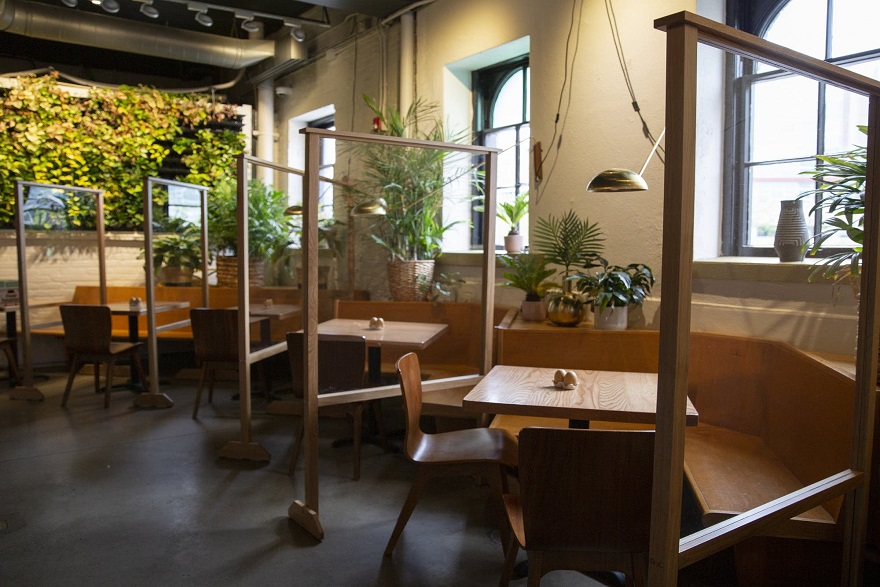
by David Klemt David Klemt No Comments

One Fair Wage Survey Results: Foodservice Professionals on Front Lines of Infection Risk and Hostility

One Fair Wage Survey Results: Foodservice Professionals on Front Lines of Infection Risk and Hostility

by David Klemt

Over a three-week period, One Fair Wage (OFW) surveyed 1,675 foodservice workers in five states and Washington, D.C.

The survey was initially sent to more than 61,000 applicants to the One Fair Wage Emergency Fund in Illinois, Massachusetts, New Jersey, New York, Pennsylvania and D.C. By November 9, 2,621 respondents had completed the OFW survey online. A total of 1,575 indicated they were currently employed and an additional 100 surveys were completed by phone.

One of the key takeaways of the survey is at once disturbing and unacceptable but not, infuriatingly, shocking. Not only did significant percentages of respondents report lax Covid-19 protocol training and enforcement along with increasingly hostile guests, close to half revealed “a dramatic increase in sexual harassment” since the pandemic struck.

Increased Sexual Harassment

Forty-one percent of survey respondents noted a marked shift in the frequency that guests are subjecting foodservice workers to unwanted sexualized comments. A quarter said they had personally experienced or witnessed “a significant” change in this manifestation of sexual harassment.

An analysis by OFW of the comments shared by respondents reveals the impact that this increase in sexual harassment has on the recipients. The comments have a negative effect on workers’ sense of safety in the workplace, financial security, physical health, and emotional and psychological health.

Of the 25 percent of the female respondents who had personally experienced or witnessed sexual harassment, 43 percent reported that comments were directly tied to social distancing and wearing masks, two pillars of Covid-19 health and safety protocols.

Identified by OFW as a “mild example” of the unwanted comments being made, “Take your mask off I want to see what’s underneath,” provides insight into the overall “theme” of the harassment being made. Many guests engaging in harassment appear to be sexualizing covered noses and mouths. Indeed, other comments support this analysis:

  • “Come on, sweetie. Lemme see that pretty face under there. Take it off for me, will you? Just a quick flash.”
  • “Please take the mask off, I want to see your lips.”
  • “Take off your mask so I know how much to tip you.”

When foodservice pros rebuff these unwanted advances, the responses tend toward hostility and smaller—or no—tips. In short order, these types of aggressors have found a way to weaponize the guest-server power dynamic and seemingly fetishize required Covid-19 protocols.

Increased Hostility

Whereas close to half of OFW survey respondents reported increased sexual harassment, more than three-quarters reported increased hostility from guests.

A staggering 78 percent of respondents said they had experienced or witnessed increased hostility as a response to following and enforcing Covid-19 protocols. Almost 60 percent said these incidents were occurring on a weekly basis.

Again, the power dynamic comes into play. Nearly 60 percent of respondents reported hesitation in enforcing Covid-19 protocols for fear doing so would affect their tips negatively. That concern is rooted in reality: 65 percent of respondents said they were tipped less on a weekly basis after enforcing health and safety protocols.

More than 80 percent said tips have decreased since the pandemic took hold, with 65 percent reporting that decrease to be 50 percent or more.

Impact of Subminimum Wage

One Fair Wage, as their name suggests and their mission clearly states, advocates and campaigns for all employers in America to pay full minimum wage. The organization also calls for tipped workers to receive full minimum wage plus their tips.

Per OFW, service workers—including people who work in salons and airports—are twice as likely to require food stamps to get by when compared to the rest of the workforce in the United States. Foodservice workers, however, are subjected to more sexual harassment than those workers in any other industry. The U.S. Equal Employment Opportunity Commission (EEOC), a federal agency, has identified the restaurant industry as the sector with the most sexual harassment charges filed by women.

This isn’t a digression. The OFW’s mission for a full minimum plus tips for tipped workers would have a direct impact on community health and safety. Infectious disease experts have warned that Covid-19 will not be the last pandemic with which we’ll have to contend. According to a report released by the CDC in September, the risk of contracting Covid-19 doubles for adults after dining inside a restaurant.

Were all service workers working for a full, living minimum wage, they’d likely be less concerned with incurring a guest’s wrath in the form of a reduced tip or no tip at all. The OFW survey findings that foodservice pros are being harassed to remove their masks or not socially distance—risking the health and safety of themselves and guests, then of family and friends, and therefore the community—and that 58 percent are reluctant to enforce Covid-19 protocols out of concern for their tips illustrates, in part, how subminimum wage for tipped workers can impact the health and safety of communities overall.

The pandemic has made foodservice workers and others who work with the public, by default, Covid-19 protocol enforcers. Clearly, significant swaths of the public feel zero compunction when it comes to responding with hostility, threats, harassment, and refusal to comply.

It’s also clear that guests who react with hostility and intimidation when employees are enforcing officially mandated health and safety requirements lest their employer face fines, the suspension of their business and/or liquor license, or any other form of punishment that puts their employment at risk won’t hesitate to wield the guest-server power dynamic as a weapon. That weapon can ultimately endanger an entire community.

The Good News

A mere ten percent of survey respondents reported their employers instruct employees to follow all Covid-19 health and safety protocols on a consistent basis, and just 31 percent of respondents said their employer follows all such protocols.

Those are startling numbers since ten percent of respondents said they had contracted Covid-19, 88 percent said they knew someone had contracted the infection, 44 percent reported that at least one coworker had contracted Covid-19, and a depressing 42 percent of those who reported knowing someone who had contracted the illness had died from it.

However, there were some positive pieces of data shared by survey respondents:

  • 92 percent reported their employers require all workers to wear masks.
  • 86 percent reported their employers require all workers to wash hands frequently.
  • 86 percent reported their employers require tables and chairs be wiped down and sanitized between uses.
  • 78 percent reported their employers provide employees with personal protective equipment (PPE).
  • 75 percent reported that a supervisor has told them they will have their back if they tell a guest or coworker to put on their mask whenever they’re within six feet of them.

In a perfect world, those percentages would all be one hundred. This isn’t a perfect world and there’s obviously major room for improvement. Management must step up in this time of crisis and uncertainty and embrace true leadership:

  • Respect the fact that employees are putting themselves at risk every shift. Put people first.
  • Avoid putting the bottom line ahead of health and safety.
  • Create and enforce a zero-tolerance sexual harassment policy—for employees and guests. Support employees when they report sexual harassment.
  • Communicate clearly and consistently. Transparency and targeted training must be priorities.
  • Display integrity when making decisions and enforcing rules.

Foodservice and hospitality industry professionals are on the front lines, sacrificing their own health and safety—and that of the people inside their bubble—to keep the industry afloat. Ownership and management need to protect them.

Read the entire OFW report here.

Image: engin akyurt on Unsplash

by David Klemt David Klemt No Comments

Significant, Permanent Restaurant Closures Expected to Rock Canada Unless Situation Improves

Significant, Permanent Restaurant Closures Expected to Rock Canada Unless Situation Improves

by David Klemt

Industry surveys continue to reveal how dire the situation is for operators.

On December 8, Restaurants Canada, a non-profit that represents and advocates for the Great White North’s restaurant industry, shared the results of a survey they had conducted between November 26 and December 4. A total of 511 surveys representing 3,000 restaurants were completed.

According to Restaurants Canada, the nation’s foodservice industry consists of 97,500 establishments ranging from QSRs to bars and full-service venues.

More than eight out of ten survey respondents answered that they are either barely staying afloat or are operating at a loss. Drilling deeper, significantly more restaurants are operating at a loss—65 percent of survey respondents fall into this category. Just 19 percent of restaurants represented by survey respondents are able to break even.

That’s 2,400 restaurants of 3,000 struggling to survive, and 78,000 restaurants out of 97,500, assuming the survey sample size accurately represents the overall industry in Canada.

To understand the long-term effects of government-mandated restrictions and shutdowns, one has only to digest another startling statistic: Restaurants operating in the red aren’t expecting to return to profitability for a minimum of 12 months.

Under optimal conditions, the average Canadian restaurant operates on razor-thin margins. Per Restaurants Canada, restaurants keep just five percent of every $10 in sales on average, or 50 cents. The industry is Canada’s fourth-largest employer (it’s number five in the United States, for comparison), accounting for 1.2 million jobs, 58 percent of which are held by women. Over thirty percent of owners, operators and staff belong to a visible minority, further illustrating how important restaurants are to diversity and the economy; half of all restaurants in Canada are operated by immigrants. Just like in the America, restaurants are the first employer for most Canadians.

The industry is crucial to Canada, but this vital resource is under serious threat. One of those threats comes from lawmakers whose restrictions are making it much more difficult for operators to wring any profits out already miniscule margins. Much like the situation afflicting the industry in the United States, the situation is going to get worse in short order without government relief.

Restrictions are simply nails in coffins unless they’re accompanied by relief.

“Our members are seeking a new year’s resolution from government, not only to support their survival but our industry’s vital role building back a stronger, more resilient Canada,” said  Todd Barclay, president and CEO of Restaurants Canada. “Restaurants Canada is calling for a national working group to pave the way for the foodservice sector’s revival, building on the commitment in the federal government’s 2020 Fall Economic Statement to provide targeted, sector-specific support to restaurants and other hardest hit businesses.”

That national working group, according to Restaurants Canada, should focus on providing businesses being affected by government-mandated restrictions with “sufficient, efficient and effective aid”; developing campaigns that make it clear to Canadians that restaurants are capable of safely and reliably providing safe meals; promoting delivery and takeout as a viable way for the public to support restaurants; connecting with operators to understand the industry’s needs and pain points to ensure they’re in as strong a position as possible when entering the post-pandemic economy.

The next six months are crucial to the survival of Canadian restaurants. If things don’t improve, should the government not address the industry’s situation and provide relief, 48 percent of single-unit operators surveyed by Restaurants Canada indicated they expect to close within six months. That number jumps to 56 percent for multi-unit operators, who expect to close at least one of their locations (also within six months).

Restaurants Canada is asking for anyone who supports the formation of a dedicated national working group to contact their Member of Parliament via this link.

Photo by Marcus Urbenz on Unsplash

by David Klemt David Klemt No Comments

National Restaurant Association Shares Startling Statistics

National Restaurant Association Shares Startling Statistics

by David Klemt

An email sent out by the National Restaurant Association yesterday included statistics about the state of restaurants in the United States.

The revelations are breathtakingly disturbing.

While Congress “has been trapped in a political tug-of-war,” the reality for restaurants has only gotten bleaker.

According to the NRA, their most recent survey found that 110,000 restaurants have closed since Covid-19 first dug its infected claws into the United States. That’s an increase of 10,000 closures since the NRA’s last survey, the results of which were released back in September.

Many people outside of the industry are likely under the impression these closures are the result of inexperienced owners failing to adapt. A second NRA statistic dispels that misconception.

Sadly, the average age of the restaurants that have been closing is 16 years old. Sixteen percent had been open for more than three decades.

These closures aren’t the result of inexperience, they’re largely the byproduct of mandated shutdowns—repeated, in some markets—and restrictions handed down by officials who don’t understand the business.

Unfortunately, there’s not much reason to be optimistic that these closures are temporary. The majority of survey respondents who have closed their restaurants, 52 percent, said they won’t return.

The NRA is strongly encouraging everyone to let Congress know that enough is enough—they must make real progress to help the industry.

Please visit RestaurantsAct.com, click the button to email your lawmakers, and share that link with family, friends and industry peers. Don’t let Congress leave for the year without making your voice heard and telling them to pass relief for restaurants and bars.

If our elected officials don’t act fast, things will only get worse.

Image by Wokandapix from Pixabay

by David Klemt David Klemt No Comments

LCBO and SkipTheDishes Hit Pause on Partnership After Public Lashing

LCBO and SkipTheDishes Hit Pause on Partnership After Public Lashing

by David Klemt

The Liquor Control Board of Ontario (LCBO) faced outrage over the weekend, ultimately deciding to “pause” a controversial partnership after receiving a public lashing.

In case you missed it, the LCBO and SkipTheDishes announced on December 4 that they had partnered to offer home deliveries of beer, wine and spirits in Toronto. For those who are unfamiliar, SkipTheDishes is a food delivery service similiar to Grubhub that serves Canada. In fact, SkipTheDishes pulled out of the United States in 2020 and their services were handed over to Grubhub.

Just two days after the partnership was made public, it was announced by the LCBO that, due to “direction from the Ontario Government,” the deal had been suspended.

Restaurants and bars in Ontario have been allowed to offer alcohol for delivery and takeout since March via an emergency order due to the Covid-19 pandemic, shutdowns, and utter carnage that has befallen the industry. Many would like for the emergency order to be made permanent.

To understand the outrage, one must realize that restaurants and bars in Ontario have been operating under forced lockdowns. Premier Doug Ford announced the lockdown—which affected Toronto and Peel Region—on November 20. It went into effect a minute past midnight on November 23. No end date accompanied the mandate.

When the LCBO—which is able to make purchases and sales of beverage alcohol at lower wholesale prices than restaurant and bar owners and operators—arranged the deal with SkipTheDishes, those who operate in Toronto and Peel interpreted the move as undercutting their struggling businesses. Alcohol delivery and takeout is one of the only ways operators in those areas can generate any revenue and give themselves a fighting chance to keep from closing their doors permanently.

In terms of optics, the situation did anything but paint the LCBO and SkipTheDishes in a positive light. The LCBO, for those outside Canada, is what’s known as a Crown Corporation. That is, it’s entirely owned by the Sovereign of Canada—a state-owned enterprise. One could argue that it appeared the government in Ontario hobbled the LCBO’s competition—restaurants and bars—in an effort to boost their revenue and profits.

A tweet by operator and author Jen Agg regarding the timing of the partnership read, in part, “It is timed to UNDERCUT restaurants that are already bleeding out. It is timed to benefit companies that DONT NEED ANY HELP! It is timed to devastate restaurants and they damn well knew all of this.” (Emphasis Jen Agg’s.)

While the “pause” of the LCBO-SkipTheDishes partnership is a victory of sorts, countless operators—and likely customers and other small business supporters—would like to see this arrangement permanently dissolved. Several tweets have mentioned that the LCBO has increased profits during the pandemic, while others have pointed out that the Crown Corporation could help restaurants and bars by offering them wholesale pricing to reduce costs.

For now, operators in Ontario will need to keep their eyes and ears open, remaining vigilant should the LCBO and SkipTheDishes press play on their deal again.

Photo by Talha Atif on Unsplash

by David Klemt David Klemt No Comments

Competing Stimulus Plans Fail to Include RESTAURANTS Act

Competing Stimulus Plans Fail to Include RESTAURANTS Act

by David Klemt – 12/3/2020

Talk out of Washington, D.C., about yet more stimulus relief package negotiations is making one thing starkly clear: We’re on our own.

There’s no help coming, not from the federal government.

Unfortunately—but perhaps unsurprisingly—it appears the bipartisan support the RESTAURANTS Act received in Congress was an exercise in optics. The result? Fleeting hope.

Without a signature from the president, it doesn’t matter that Congress voted to pass a revised HEROES Act two months ago. Lest anyone forget, the last time a meaningful Covid-19 relief package was signed by the current president on March 27 of this year.

Another way to put that is that our elected officials haven’t managed to pass a stimulus package signed into law for 251 days. They did, however, find the time for a week-long recess for Thanksgiving.

It was announced just two days ago that a bipartisan group of congresspeople and senators had negotiated a $908 billion stimulus package. The intention was to strike a middle ground between Majority Leader Mitch McConnell’s (R-KY) desire for a $500 billion package and House Speaker Nancy Pelosi’s (D-CA) proposed $2 trillion-plus bill.

Yesterday, multiple sources reported that the $908 billion—which apparently didn’t include the RESTAURANTS Act—was dead on arrival.

Of note, at least to me, is that Senator Mark Warner (D-VA) is reported to have mentioned that this week’s touted bipartisan package had been negotiated “over pizza or pasta at people’s houses.” I have to wonder if the pizza or pasta was prepared, provided and delivered by restaurants that are among the hundreds of thousands facing permanent closure if the government doesn’t actually act in a meaningful way.

Treasury Secretary Steven Mnuchin, on his way to a House committee meeting, reportedly said, “The president will sign the McConnell proposal that he put forward yesterday, and we look forward to making progress on that.”

From what I was able to glean, the RESTAURANTS Act isn’t included in McConnell’s bill either. Neither are stimulus checks nor a federal boost to unemployment insurance payments. Supposedly it does include an extension of the problematic Paycheck Protection Program (PPP); liability protection for schools and businesses; and a $332 million grant for theaters and live venues.

If the tone of this article comes across as angry, I freely admit that’s an accurate assessment. The RESTAURANTS Act was first introduced to Congress on June 15. Elected officials have had 171 days to help the hospitality industry.

The industry that employs more than 16 million people—11 million of which are employed by independent restaurants. The industry that generates well over $760 billion in annual sales. The industry that accounts for 3.5 percent of America’s GDP. The industry that has for years provided venues, food and drinks for elected officials’ countless re-election campaign fundraisers.

The industry that, should tens or hundreds of thousands of restaurants close their doors permanently, will shed millions of jobs that will not return.

And that’s just what’s happening to the industry in the United States. The industry is similarly at extremely high risk for irreversible devastation in Canada and throughout the world.

So, yes—I’m angry. I’m angry that the millions of jobs and hundreds of billions of dollars this industry contributes just to America apparently don’t mean much to government officials.

I suppose I can only blame myself for holding out hope that the RESTAURANTS Act would be signed into law. After all, the president, speaking about restaurants back in March, said, “they’ll all come back in one form or another,” adding, “It may not be the same restaurant, it may not be the same ownership, but they’ll be back.”

They won’t be back. We’ve already suffered permanent closures. There was no prescience—or empathy—in the president’s statement. Let me make this clear: I’m not laying all of this solely at his feet. America’s politicians on all sides have failed the hospitality industry and therefore millions of Americans.

Restaurants, bars, lounges, nightclubs, hotels… This is an industry that consists of incredibly resilient people. There comes a point, however, that even the most resilient need help.

As hospitality professionals fight to return to their feet, bloodied and battered from countless blows, it doesn’t seem that the government is in their corner. Nothing would make me happier than to be proven wrong, but we’ve been at this crossroads for months now.

Image: Caleb Perez on Unsplash

by krghospitality krghospitality No Comments

Hotel F&B in a Post-Pandemic Landscape

Hotel Food & Beverage in a Post-Pandemic Landscape

By Doug Radkey – 07/22/2020

Nearly all of our favorite and most popular travel destinations around the world have been impacted by the Covid-19 pandemic, resulting in a horrendous financial loss for hotels, resorts, and the entire hospitality industry alike.

Research by the American Hotel & Lodging Institution suggests that hotel recovery to pre-COVID-19 levels could take until the year 2023—or perhaps even later with the expected ‘long-term’ loss of business travel and international leisure travellers.

Sadly, many properties have not survived and will not be opening their doors again. Some of those who rely on international travel see little benefit in resuming service while many borders remain closed. And those who are ready to reopen face a very different business environment to the one they were once accustomed to.

There are numerous strategies and alterations to consider moving forward for the operation of a hotel property post-pandemic; but one area that can help properties to regain their guests’ trust plus revenue and profits is that of the food & beverage program.

The Opportunity

For years, one could rely on a hotels restaurant and bar for a steady supply of traditional fare. Hotel food wasn’t necessarily an after-thought, but menus lacked (and in some cases continue to lack) inspiration.

However, in today’s global hotel market; both pre-covid and post-pandemic, a cities best and most innovative and creative food & beverage menu could be found in a hotels restaurant and bar.

But it is not longer just about the food. Hotels obviously have their chef(s) – but moving forward they must also consider a ‘director of mixology’ – even for smaller boutique properties.

Consider for a moment, instead of creating cocktails to match the food menu, doing it the other way around and starting with the beverages. You may be surprised by the results.

This is a secret to a successful, high-profit full-sensory on-premise (and off-premise) program.

While there is significant social and economic changes expected (post-pandemic), there will be a growing and potential multi-billion dollar opportunity for hotels to better cater to guests through their food & beverage options – if the venue can weather the current storm.

As the population regains their confidence to book a hotel stay, guests who visit for either business or leisure may be reluctant to travel to too many spots around town due an ongoing fear that it may not be 100% safe to do so.

Furthermore, many (potential) guests will find their finances dramatically affected by the economic downturn which is now inevitable throughout most of the world, and this will also lead to demand for more affordable cuisine and experiences.

Therefore, a food & beverage program with multiple revenue streams including a balance in pricing found within a trusted hotel that provides a consideration towards a full sensory experience for multiple day-parts is critically important.

Hyper-Local Programming

Hotels today must increasingly try to attract local residents partly because today’s visitors increasingly want to eat where the locals hang out and secondly – because that noted business & leisure travel is expected to be slow for the next 12-18 months.

The food & beverage programs and experiences must shape guests’ understanding of the hyper-local region by supporting local farms, vendors, & culture.

Hotels today and moving in a post-pandemic landscape must promote strong relationships & partnerships with local farmers and producers and introduce their products & flavors to guests in delicious and sometimes, surprising ways.

It is anticipated that hotel guests will expect venues to rely less on imported goods while using more locally-produced items within a 75 mile (100 km) radius due to support local initiatives, the need to embrace the local culture, current (and future) supply chain restrictions, and simply more robust, fresh flavors.

Buffet Pivots

Remember waking up at a hotel and strolling down to the lobby for the breakfast buffet? Sadly, that will be just a memory for most moving forward. It’s likely no secret that it will be a long time before buffets come back. Even with sneeze guards, hotels must (temporarily) shift to à-la-carte menus, made-to-order options, and individually packaged grab-and-go items.

The buffet concept (for breakfast and other day-parts) could also opt to switch to cafeteria-style model instead of self-serve stations (with physical distancing measures in place). Even hotel restaurants with self-serve beverage stations, breakfast bars, salad bars, and a toppings bar will likely need to eliminate these self-serve stations in order to comply with guidelines from both a government point of view and guest sentiment point of view.

These “serving stations” could be individually prepared & plated in real-time by staff from behind the counter which likely means more labor – but providing a safe experience which will win guests over – providing opportunity for further awareness, revenue & profits.

Off-Premise Revenue

Many hoteliers and hotel brands around the world have begun to shift their food & beverage operations amid the pandemic, catering to locals by launching both takeout and curbside pickup options.

With the introduction of this new revenue channel, it is anticipated that it will stick around for quite some time.

Hotel F&B programs must also offer access to more premium grab & go options and also meal-kits. Whether for a day out exploring the city (remember they may be hesitant to stop in a restaurant they don’t know), or on the way to a business meeting, hotels are uniquely positioned to meet guest needs by leveraging their full-service kitchens to supply pre-made meals, snacks, and even F&B experience kits.

Micro-Experiences

From mid-scale to luxury, some hotel brands are taking the resurgence of “at-home” dining to the next level by creating unique F&B packages for micro-groups at the hotel itself.

As an add-on at booking, guests for example can upgrade to a private dining package that includes customized tastings, cooking tutorials, wine pairings, and cocktail making – all in a private space.

For some hotel & resort properties, the often abundance of outdoor space can also provide ample opportunity for seasonal or year-round food & beverage experiences. Picture open-fire kitchens, bar pavilions, and an atmosphere complete with comfortable seating, temperature control systems, and (hopefully) impeccable views for couples, families, and small group gatherings.

Technology Stack

There are a lot of ways technology will enhance hotel operations and experiences moving forward, both in and outside the food & beverage department.

Inside the kitchen, remodels are expected to happen over the next 1-3 years to adhere to the quick-service demand, the demand for the noted new experiences, and the potential lack of qualified staff. This means more self-cooking oven stations, simplified processes, smaller footprints, and smart kitchen technology.

A high level of convenience and contactless service will also be critical on the consumer side, when it comes to on-premise (F&B) room service.

One way to ensure a frictionless experience is through the use of technology.

Approximately one in four hotel guests surveyed by the American Hotel & Lodging Institute, think it’s important for hotels to have 24-hour room service. They want the option to have incredible food and beverage, no matter the time of day.

Post-pandemic, this will still hold true but the service sequence needs to change so that it includes the use of technology and contact-less service, both in the hotel restaurant(s) and in-room. The data shows that one in five guests also want the convenience of ordering with technology – via the hotels app on their phone or even through the TV in their room.

The order can then be packaged & delivered to the outside of the room, to their table in the restaurant, or by having a technology-driven “pick-up locker” in the lobby with mobile phone use to access the food delivered via the hotels kitchen or any third-party delivery partners.

And when it comes to customizing mini bars, 14 percent of guests would choose a hotel where the mini bar is personalized to snack and drink preferences based on the historic data from previous stays or allergies. While some argue the mini-bar is done due to the pandemic – we think hotels just need to personalize it and then make it a point of sanitation between stays.

Quick summary; hotel food & beverage programs must continuously react, adapt, and execute as consumer demand and sentiment fluctuates; both short-term and long-term while providing both unique one-of-a-kind experiences and brand activations.

by krghospitality krghospitality No Comments

Turning Crisis into Confidence

Articles Submitted To Media Partners During Covid-19 Pandemic

By Doug Radkey (March 2020-July 2020)

Take Time to Recharge: Self-Care During a Crisis

During times of crisis, everyone feels something: sadness, confusion, fear, anxiety, or anger.

It can be easy for many within the industry to become overwhelmed with the amount of decisions that need to be made not only for their business, but for their family, staff, and community.

One area that often gets overlooked, particularly among business and community leaders, is their own self care.

From watching the news every hour to making tough decisions, to hours of volunteering, to scrolling through your social media a little too much, it’s easy to get lost in the noise of what’s going on around us in the time of crisis.

And you’re not alone in this……Continue Reading Here on Nightclub & Bar

Every Red Light Eventually Turns Green

When faced with a lengthy business shutdown, it can be a roller coaster of emotions when you learn it’s time to re-open. While it is understandable that you want to open your doors as quickly as possible, you also want to ensure you’re doing it correctly and in a way that will not cause further damage to your brand, bottom line, staff, or guests.

The truth is, as a variety of government bodies have indicated; you’re likely going to have to open your venue in a series of phases. Are you financially & mindfully prepared for that?

You are also going to have to pivot (are you tired of that word yet?) if you haven’t already in addition to diversifying your menu and offerings.

You are going to have to build a high level of trust with guests like never before….Continue Reading on Nightclub & Bar

Adapting to Change; Seating (Part 1)

Understanding flexibility and a willingness to embrace change will make you a valuable leader — one who can reliably deal with many different opportunities and scenarios. You will then find change is not something to fear, but something to welcome and turn into an advantage. For restaurants with a large on-premise business model, change is happening and you need to prepare – now!

The biggest fear factors for many with a significant dining room are the new seating recommendations and capacity levels for dine-in restaurants. Everyone reading this will be in a slightly different scenario, pending the size of venue, location, and style of concept, so it is hard to create a cookie-cutter solution.

However, there are some new strategies and standards to consider that will help you adapt, pivot, and embrace these changes. Continue Reading on Resto Biz

Adapting to Change; Seating (Part 2)

To maximize your seating, encourage guests to make reservations, preferably online. Your guests will want to pick their spots, their proximity to others, and their proximity to high-traffic areas. Your new seating arrangement should ideally be online to review and should also be flexible.

Having a reservation system will also allow your staff the appropriate time to fully sanitize and prepare each area for the next number of guests in a reserved party.

With reservations, it may be wise to also consider time restrictions; guests who are used to travelling to tourism hot spots will be accustomed to these types of rules. Don’t be scared to put a 60- or 90-minute timestamp on reservations to encourage more table flips, which you’ll want to do as many times as possible within safety guidelines. Continue Reading on Resto Biz

Maintaining Financial Health During Pandemic

You already know the majority of restaurants run their business on extremely thin margins, and in the the time of COVID-19, the financial health of the industry has become all the more precarious. In fact, a recent (U.S.) National Bureau of Economic Research paper gave restaurants a 30 per cent chance of reopening if the pandemic lasts four months; this estimate drops to 15 per cent if it lasts six months.

The average restaurant, it found, had enough cash on hand to last approximately two weeks. Why such little time? Because the 3- to 5-per cent profit margin of the average restaurant or bar simply can’t cut it in this environment.

Here’s the thing – we can’t continue down this doom and gloom route. The industry will prevail, and some will come out even stronger – if they push forward now. Restaurants must operate with the mindset of achieving 12- to 15-per cent profit margins – and the secret is, it is possible. Continue Reading on Resto Biz

Hotel F&B in a Post-Pandemic Landscape

early all of our favorite and most popular travel destinations around the world have been impacted by the Covid-19 pandemic, resulting in a horrendous financial loss for hotels, resorts, and the entire hospitality industry alike.

Research by the American Hotel & Lodging Institution suggests that hotel recovery to pre-COVID-19 levels could take until the year 2023—or perhaps even later with the expected ‘long-term’ loss of business travel and international leisure travellers.

There are numerous strategies and alterations to consider moving forward for the operation of a hotel property post-pandemic; but one area that can help properties regain their guests’ trust plus revenue and profits is that of the food & beverage program. Continue Reading on KRG Hospitality

Top