How to open a hotel

by krghospitality krghospitality No Comments

The Risk of Waiting Until the New Year

The Risk of Waiting Until the New Year

by Doug Radkey

Four neon signs that each say "waiting" in various stages of being lit up

Sometimes “waiting” means “waiting.” Too often, “waiting” means “…until it’s too late,” or “never”

It’s that time of year again.

The leaves are turning. The holidays are approaching. And everywhere you look, people are starting to say the same thing: “I’ll wait until the new year.”

They’ll wait to start the new habit.
To launch the business.
To fix the broken system that’s draining their energy.

But here’s the uncomfortable truth: waiting is one of the most expensive decisions you’ll ever make.

The Myth of January

It seems that January has become society’s magical “reset” button.

This is when people start going to the gym more (or at all). It’s when aspiring entrepreneurs tell themselves they’ll be ready to start. When current operators say the holiday season is too busy.

It’s funny that somehow the turn of a calendar gives them permission to begin.

But in business—and in hospitality in particular—the market doesn’t wait. The competition doesn’t wait. Staff and guests don’t wait.

And the risk of waiting isn’t just lost time, it’s lost opportunity and lost momentum.

The Numbers Don’t Lie

Let’s look at some numbers.

On October 1st, you still have 25.21% of the year left.
By November 1st, you still have 16.71% left.
And on December 1st, you still have 8.49% left.

That’s not scraps. That’s a quarter, a sixth, or even a full month of your calendar. This is time you’ll never get back once it is gone.

So ask yourself this question: Do you really want to burn that much equity of time waiting for a date on the calendar that somehow gives you permission to move forward?

A Familiar Story

Each year, between October and January, I take calls from operators or aspiring entrepreneurs who tell me the same things.

The aspiring entrepreneur wants to open a new concept.
A year or two after first opening, an operator wants to stabilize their operations.
The veteran operator wants to get their brand’s finances under control.

But here’s the thing: approximately 80% of them admit they already decided to “wait until after the holidays.”

By the time they wait it out until the new year, the real estate they were eyeing is gone. The investor they were courting has moved on and is backing a different concept. Or worse, a new or scaling competitor has beaten them to the punch.

The cost of inaction always shows up, 100% of the time.

The Illusion of Busy

I get it. Society and this industry seem to thrive on being busy. The closer we get to the holidays, the easier it is to convince ourselves there’s no time to think about strategy.

Well, here’s the problem: that “too busy” mindset is often just a shield. It’s easier to stay stuck in the chaos than to step back and do the real work of building clarity.

And yet, that’s exactly what separates operators who crush it from those who drift away toward mediocrity or closure.

The ones who wait? They start the new year months behind or in survival mode.

The ones who act now? They start the new year in control.

That’s why this is called “separation season.”

Momentum Beats Motivation

Motivation is fickle. It spikes in January when gyms are full and the journals or planners are fresh.

By February, it all begins to fade.

Momentum, however, is different. Momentum compounds over time.

When you take action in October, November, or December, you’re not just getting ahead. You’re strategizing and developing the foundations. Or you’re training your systems, your people, and yourself to move forward when the calendar flips.

By the time many are just warming up, you’re already moving at full speed. Think about those positive results.

The Risk of Inaction

Let’s talk about what waiting actually costs you.

  • Prime Real Estate: The space you’ve been watching doesn’t wait for January. It will be leased by the operator who had the courage to strategize and take action.
  • Capital: Investors are looking for leaders with confidence and momentum. If you show hesitation, they’ll invest their money elsewhere.
  • People: Your best staff won’t stick around forever waiting for change. If you don’t build clarity and systems, they’ll leave for a team that already has them in place.

The longer you wait, the steeper the climb is going to be in the new year.

The Power of Now

So, what happens when you act now?

  • You gain clarity. Strategic playbooks create focus for your concept, your brand, your financials, and your guest experience.
  • You create momentum. Your systems start running, your people align, and your execution gains speed.
  • You build confidence. Investors, staff, and even guests can feel when an operator is in control.

Taking action now separates yourself from the 99% who sit back and wait.

From Survival to Legacy

Let’s be clear: This isn’t about working more hours. It isn’t about grinding yourself into burnout before the holidays.

It’s about mindset. Ask yourself:

  • Do you believe long hours equal nobility or inefficiency?
  • Do you believe success is about hustle or about alignment?
  • Do you want to survive another year or build a business that outlasts you?

The entrepreneurs and operators who crush it don’t wait for January.

They strategize now. Build now. Lead now.

Why? Because survival is built on reaction. Legacy is built on clarity.

A Challenge for You

Take a hard look at your calendar.

If you start today, you still have weeks (if not months) to set the stage for the business you want to run next year, and the many years thereafter.

Lay the foundation now. Create your strategies now. Get your systems ready now.

Do it now so that when the new year arrives you’re not scrambling to catch up—you’re already miles ahead.

The Final Word

Hospitality doesn’t wait. Guests don’t wait. The market doesn’t wait.

So why are you waiting?

The real flex is proving that October, November, and December are still full of opportunity.

Because when clarity meets courage and strategy meets execution, you don’t just start the new year strong, you start it by separating yourself from others, and leading the way.

Now is the time. Take action. Build momentum. Create your legacy in hospitality.

Image: Levi Meir Clancy via Unsplash
Client Intake Form - KRG Hospitality

by David Klemt David Klemt No Comments

Cheers to the Flyover Conference!

Cheers to the Flyover Conference and Cincy!

by David Klemt

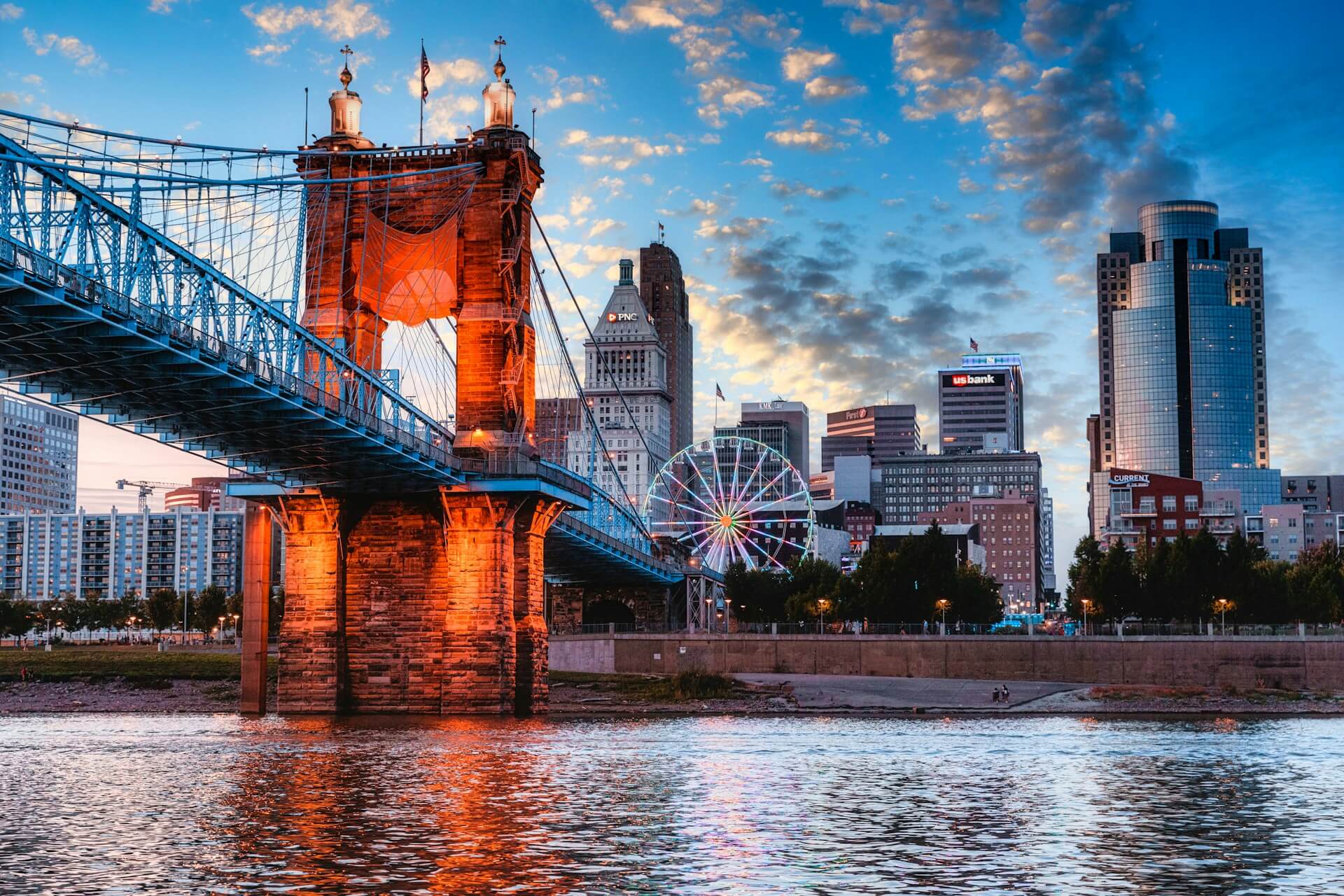
The John A. Roebling Suspension Bridge over the Ohio River, heading toward Over-the-Rhine in Cincinnati, Ohio

Just pretend the temporary SkyStar Wheel isn’t in this picture.

The successful and exciting launch of the Flyover Conference makes it clear that co-founders Sarah Engstrand and Greg Newman are onto something big.

Big, yet intimate. There’s a real feeling of community when a small-but-driven group gathers with purpose. That’s exactly what Flyover embodies.

Now, I know some people who live between the east and west coasts in the US find the term “flyover” irritating, if not outright offensive. As someone born and raised in the Midwest, I understand the frustration. However, I can assure anyone raising a skeptical eyebrow or frowning at the name of the conference that it isn’t meant as a pejorative.

Rather, Engstrand and Newman are giving a cheeky middle finger (likely two, really) to those who dismiss “secondary” and “tertiary” markets. In fact, their intention is to shine a spotlight onand servecities that don’t receive the same attention as “primary” markets.

By primary, I think you know main culprits: New York, Los Angeles, Chicago, Boston, and Miami. In contrast, Las Vegas, Phoenix, Cincinnati, and Detroit carry the “secondary” label (as do many other cities).

So, a core element of the conference is featuring speakers who have, up until now, mostly spoken at highly visible trade shows that take place in major host cities. For example, the National Restaurant Association in Chicago.

For the inaugural Flyover, the co-founders put in the work to provide Cincinnati with a powerhouse lineup of hospitality industry speakers. Additionally, this year’s F&B sponsors delivered an awesome array of sips and bites.

Killer Kickoff Keynote

Truly, Flyover’s mission is to deliver maximum impact over the course of just two days. The 2024 speaker lineup serves as a testament to their dedication.

So, too, is how the 2024 show utilized the two speaker stages, provided by Rhinegeist Brewery. Flyover attendees and speakers were close to one another, not separated by the vast expanse of a ballroom or elevation of a platform.

David Kaplan, CEO of Gin & Luck, the parent company of the world’s first cocktail bar chain (for lack of a better term, really) kicked off the event. Perhaps multi-location craft concept is a better phrase to explain Death & Co. in five words or less.

During his informative and inspiring keynote, he detailed he and his team’s approach to entrepreneurship. As Kaplan explains, when someone understands their purpose (why), they come to an understanding that helps develop their process (how). In turn, that gives an entrepreneur an understanding of the outcome they’re working toward, or their “what.”

I’ll dive much deeper into his keynote in a future article, because Kaplan’s approach goes much further than why, how, and what. In fact, in keeping with his status as one of the most transparent people in hospitality, Kaplan shares his personal core values, along with those of Death & Co.

Engaging Education

Bartender-cum-licensed psychotherapist (and soon-to-be organizational psychologist) Laura Louise Green took on a topic afflicting all of hospitality: burnout. The founder of Healthy Pour, Green explained that burnout is not only different than stress, it’s certainly not a sign of weakness to take the time to address it.

One of my favorites, Chef Brian Duffy, took a different approach to the topic of menus. Instead of reviewing a handful of submissions, Duffy took questions and addressed issues with food purveyors directly in a frank and open discussion.

Encouraging operators to take greater risks, Michael Tipps, co-founder of Maverick Theory, drove home a compelling point. Oftentimes, operators are fearless when developing their concepts. However, something curious often happens when it’s time to welcome the public into the space: second guessing, and blunting the sharpness of the original vision.

Oh, and I shared the KRG Hospitality approach to systems, starting, stabilizing, and scaling, my second time every presenting at a conference. Most people assume that because I host a podcast I’m comfortable talking to anyone, anywhere. That’s mostly true. However, I, like millions of other people, find public speaking anxiety-inducing. So, a huge thanks to the Flyover team, fellow speakers, and mostly the attendees for setting me at ease.

The above are but a handful of the education sessions that Flyover provided for attendees. Other topics ranged from the need for fully realized non-alcohol bar programs, building events in house, and operators handling their own PR campaigns, to leadership skills and leveraging the power of an effective door team.

Bang for Buck

Anyone who has attended one of the big hospitality industry conferences has probably been subjected to the experience below.

You file into a session featuring a topic of particular interest to you and your business. Even better, the speaker is someone you’re excited to see and hear. The presentation ends and…awkward silence. Almost everyone is too afraid to ask a question that they feel may make them look “stupid,” or like they’re not a good operator. Finally, someone asks a question, and that leads to a few more questions.

Unfortunately, the presentation was 45 to 50 minutes long, and with the awkward pause after its conclusion, there are barely ten minutes left for the speaker to answer questions. When they’re shooed off the stage, they’re swarmed in the hallway. You think they may be overwhelmed, you don’t want to add to that or inconvenience someone you admire, and you never get to meet them, ask them an important question, and exchange business cards.

That’s not an indictment of the large, more mainstream conferences. It’s just how it is when you pack dozens upon dozens of speakers, and thousands of attendees, into a conference hall. Further, schedules tend to be so loaded in order to attract attendees and boost ticket sales that people are forced to make difficult choices and miss out on some awesome sessions.

In contrast, Flyover intends to limit their ticket sales. And while there will always be a choice to make at a conference, they seek to mitigate that prevalent issue. Was this year’s show perfect? No, there were growing pains, as expected. Will this team learn and improve the show to maximize the impact for attendees? I have every confidence that the answer is a resounding “yes.”

Future Flyovers

I have to say, I’m deeply interested in the future of Flyover Conference. In fact, schedule permitting, I would attend even if I weren’t asked to speak at future shows.

It was an honor to be part of something of so impactful.

The entire point of this industryhospitalitycan sometimes fall to the wayside at conferences, trade shows, and expos. Another way of saying that is that while we all speak the same language, we often forget to take the time to connect with one another.

While there’s work to do, Flyover addresses this issue. The show is set up so that attendees, speakers, and sponsors are sharing the same spaces; there’s an actual sense of community. When it comes the host city, there’s a real sense of place, and that’s important.

Speaking of the host city…the next Flyover will take place in a city I mentioned at the top of this article. The most populous city in Michigan, DetroitMotor City itself—will host the second Flyover Conference. Looking forward to it, Hockeytown.

Be sure to connect with Flyover for updates and announcements.

Cheers!

Image: Jake Blucker on Unsplash

KRG Hospitality Start-Up Restaurant Bar Hotel Consulting Consultant Solutions Plans Services

Top