Staff

by krghospitality krghospitality No Comments

The Power of an ImpactMAP™

The Power of an ImpactMAP™

by Doug Radkey
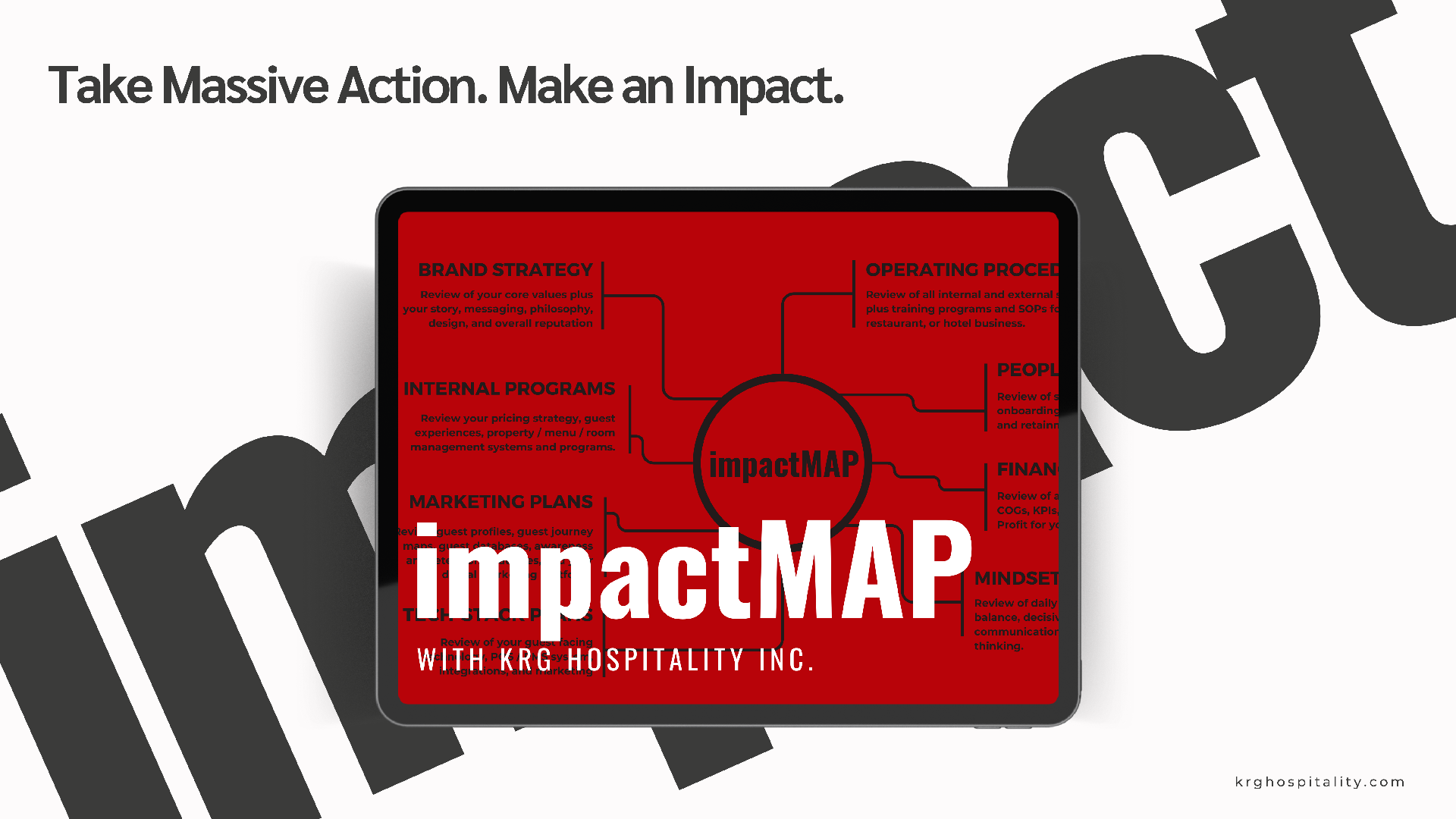
KRG Hospitality ImpactMAP, main image

Let’s be honest, the line between success and failure often hinges on the ability to act decisively and act with purpose.

In this article, we’re going to explore two areas of your hospitality business that are under your control: creating a plan, and taking action.

Understanding the Risk of Inaction

The concept surrounding the Risk of Inaction—arguably a new form of ROI—captures the potential losses businesses face when they fail to take strategic actions.

Inaction in the hospitality industry can manifest in various harmful ways. Inaction can also stem from multiple sources: fear of change, lack of resources, or simply underestimating the competition.

Regardless of the manifestation or cause, the consequences are usually the same: stagnation, decline, and, ultimately, a shuttered business.

Let’s put this into context by taking a look at a sample of both a restaurant and a hotel business.

Failure to Innovate

If a restaurant does not act to continuously re-engineer its menu, it risks diminishing profits, providing a low-level guest experience, and mismanaging inventory. Without regular strategic updates, the menu may fail to reflect current culinary trends and guest preferences, which can lead to a decrease in interest and satisfaction.

Additionally, sticking with a static menu can prevent the restaurant from optimizing ingredient use, productivity, and cost-efficiency.

At the end of the day, this lack of adaptation and innovation will result in diminishing sales and profitability, making it difficult for the restaurant to sustain its operations.

Failure to Update Systems

If a hotel on the other hand decides to not use a modern and fully integrated Property Management System (PMS), it risks operating inefficiently and falling behind in today’s technology-driven hospitality environment.

A non-existent, outdated, or fragmented PMS can lead to significant operational issues, such as slow check-in and check-out processes, errors in room availability and booking management, and ineffective communication between different departments. That’s just to name a few crucial issues.

This inefficiency can impact guest experiences negatively, leading to dissatisfaction and potentially harming the hotel’s reputation.

Furthermore, without a modern PMS, a hotel may struggle with data management, limiting its ability to effectively analyze performance metrics, forecast demand, and implement dynamic pricing strategies. These disadvantages will result in lost revenue and reduced competitiveness in a space where guest expectations and operational efficiency are increasingly driven by technological advancements.

In each example above, the risk of inaction leads to missed opportunities and underperformance.

The Power of an ImpactMAP™

To combat the risks associated with inaction, your hospitality business can benefit significantly from developing an ImpactMAP™.

This strategic tool can help you identify where you currently stand, define where you want to go, and outline the steps required to get there, thereby helping you create not only strategic clarity, but drive and accountability.
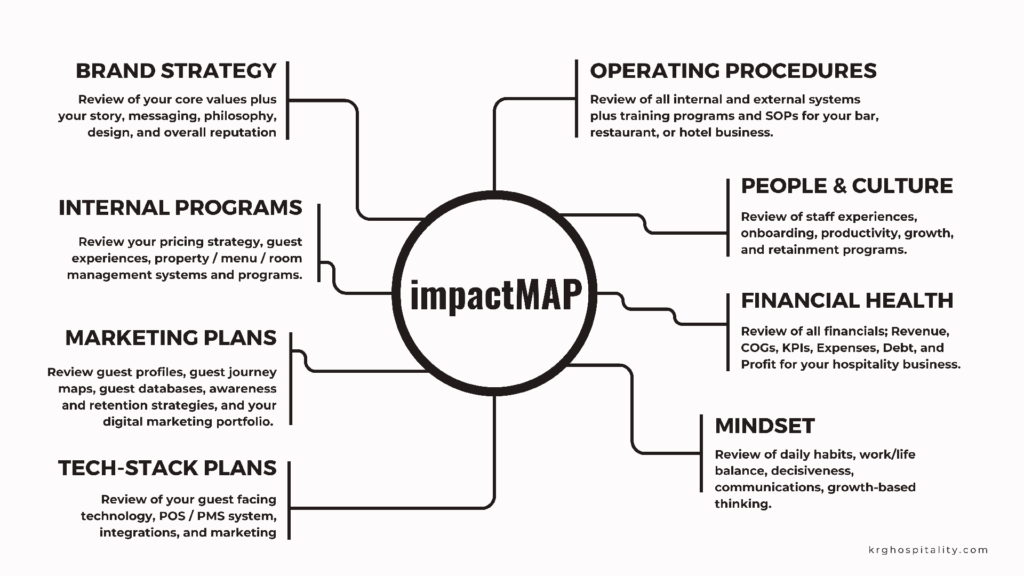
KRG Hospitality ImpactMAP, flowchart and map

The Assessment

To create an ImpactMAP™ and to take action immediately, you need to first assess your operations.

An assessment of your hospitality business is a comprehensive evaluation process aimed at analyzing various aspects of your business to identify strengths, weaknesses, and areas for improvement or opportunity. The goal is to gather actionable insights that can help optimize operations, enhance guest experiences, and massively improve your profitability.

The assessment should involve on-site observations, staff interviews, and a deep dive into the following eight categories, culminating in a detailed report that provides recommendations and a strategic plan for future growth and sustainability.

For each of the eight categories, consider a 3x matrix with three responses to the following questions:

  • Where are we now?
  • Where do we want to go?
  • What resources do we need?
  • What’s holding us back?

Then, create a SMART (Specific, Measurable, Achievable, Relevant, Timely) goal for each response in your “Where We Want to Go” list.

What are the eight assessment categories?

1. Brand Strategy

Assessment: Review your core values, story, messaging, philosophy, design, and reputation.

Opportunity: Enhance brand alignment across all touchpoints to ensure consistency while refining your brand messaging to better connect with targeted guest profiles.

2. Internal Programming

Assessment: Review your pricing strategy, guest experiences, property / menu / room management systems and programs.

Opportunity: Optimize your offerings based on guest preference data and a profitability analysis, along with potential upgrades to your amenities to enhance guest satisfaction and to compete with today’s market standards. In summary, implement efficiencies to improve guest experiences and operational workflow with a focus on your internal programming.

3. Marketing Plans

Assessment: Review guest profiles, guest journey maps, guest databases, awareness and retention strategies, and your digital marketing portfolio.

Opportunity: Integrate advanced digital marketing techniques to increase reach and engagement while developing targeted promotions and partnerships, and by leveraging data analytics to tailor marketing efforts more precisely to guest behaviors and trends.

4. Tech-Stack Plans

Assessment: Review guest facing technology, POS / PMS system, integrations, and marketing.

Opportunity: Identify current technology gaps and plan for a strategic integration of systems that enhance guest experiences while streamlining operations.

5. Standard Operating Procedures

Assessment: Review of all internal and external systems, plus training programs and SOPs.

Opportunity: Ensuring that all staff are clear on their roles and responsibilities, which enhances overall service quality through the development of standardized procedures that ensure consistency and efficiency across the business. Implement feedback systems to continually refine and improve SOPs based on real-time challenges and successes.

6. People and Culture

Assessment: Review of staff experiences, onboarding, productivity, growth, and retainment.

Opportunity: Strengthen employee engagement through improved communication and support systems. Foster a culture of innovation and openness in which employees feel valued and motivated. Develop leadership from within to enhance management effectiveness and succession planning.

7. Financial Health

Assessment: Review of all financials, including Revenue, COGs, KPIs, Expenses, Debt, and Profit.

Opportunity: Identify cost-saving opportunities without compromising service quality. Explore new revenue streams that align with your brand values and market opportunities. Implement more rigorous financial tracking and forecasting tools (such as technology) to better predict financial trends and react proactively.

8. Mindset

Assessment: Daily habits, work / life balance, decisiveness, communications, and growth-based thinking.

Opportunity: Develop a mindset of continuous improvement among all staff levels (starting with yourself) to foster an environment of excellence. Cultivate resilience by planning for crisis management and business continuity. Promote a guest-centric approach, aligning all business decisions with guest satisfaction and personal development outcomes.

Creating the ImpactMAP™

By following the above 3x strategy for each category, you will have created 24 SMART objectives that will be the foundation of your ImpactMAP™ to move your business forward over the next one to six to 12 months.

Importance of SMART Objectives

What does SMART mean and how does it work?

  • Specific, Clarity, and Focus: SMART objectives provide clear and concise goals that everyone in your business can understand and rally behind. This clarity helps to focus efforts and resources on what’s most important.
  • Measurability and Tracking: By setting measurable goals, your business can track progress and make data-driven decisions. This measurability allows for adjustments to be made in strategies or tactics to ensure the objectives are met.
  • Achievability: Goals that are achievable motivate staff. Setting impossible goals can lead to frustration and disengagement, whereas achievable objectives encourage team effort and commitment.
  • Relevance: Ensuring that each objective is relevant to the broader business goals ensures that every effort made contributes to the overall success of your brand.
  • Timeliness: Incorporating a timeframe provides urgency, a deadline, and accountability, which can help prioritize daily tasks and long-term plans.

However, you shouldn’t try to accomplish all 24 objectives at the same time. Once you’ve set your 24 impactful objectives, prioritizing them is crucial to stabilize your hospitality business and aim for scalable growth.

Best Practices for Prioritizing Objectives

  • Assess Business Needs: Start by conducting that thorough assessment of your business to identify key areas that need improvement.
  • Impact Analysis: Evaluate the potential impact of each objective. Prioritize objectives that offer the greatest benefits in terms of guest satisfaction, revenue growth, and operational efficiency.
  • Resource Availability: Consider the resources available, including budget, people, and technology. Prioritize objectives that align with current resources or where adjustments can be made to accommodate necessary changes.
  • Quick Wins: Identify objectives that can be achieved quickly and with minimal disruption to your ongoing operations. These quick wins can boost morale and provide visible improvements that justify further investments in other areas.
  • Strategic Importance: Some objectives, while not providing immediate benefits, are crucial for long-term success. Prioritize these based on their strategic importance to the business’s future.
  • Stakeholder Input: Engage with various stakeholders, including management, staff, and guests, to gain insights into which objectives they feel are most critical. This can help in aligning the goals with the needs and expectations of those most affected by the changes.
  • Balanced Scorecard: Use a balanced scorecard approach to ensure that objectives across different areas such as guest services, internal processes, financial performance, and learning and growth are all being addressed.
  • Iterative Review: Regularly review the priorities as situations and business dynamics evolve. What may be a priority today might change based on market conditions or internal business changes over the next three to six months.

Once you have your objectives prioritized, it’s time to assign or delegate them as needed and have those assignees (including yourself) take ownership of the objectives with their signature to add another level of accountability.

Implementing the ImpactMAP™

Before starting, ask yourself one final question: What will happen if we don’t take action?

Be detailed and mindful of what the short-term and long-term consequences might be if you don’t act.

Effective implementation of an ImpactMAP™ requires knowledge of these consequences, along with a commitment from all levels of your business. It starts with comprehensive training sessions followed by regular review meetings, which are both essential to assess progress, address challenges, and refine strategies as needed.

Take a SMART-ER approach, which is where you Evaluate and Re-adjust the SMART objectives halfway through the timeline you’ve set.

Conclusion

Risk of inaction is a silent threat that can undermine any business, particularly in this dynamic industry.

Adopting an ImpactMAP™ and making a commitment to take massive action allows you to manage your operations proactively, adapt to changing market conditions, and set a course for sustainable success.

This strategic approach not only mitigates risks but also empowers your hospitality business to thrive in a competitive landscape—but it starts with you and your mindset toward taking action.

Image: KRG Hospitality
KRG Hospitality. Restaurant Business Plan. Feasibility Study. Concept. Branding. Consultant. Start-Up.

by David Klemt David Klemt No Comments

TOTCF Unveils National Policy Initiative

TOTCF Unveils National Policy Initiative

by David Klemt

Tales of the Cocktail 2023 Singapore x Tales Residency

Yesterday, the Tales of the Cocktail Foundation announced the launch of their Policy Initiative, intended to update outdated labor standards and pay.

Along with advocating for both bartenders and servers, the initiative seeks to raise the subminimum wage to $2.13.

This news comes on the heels of the completion of an in-depth survey. The TOTCF surveyed more than 510 bartenders and other hospitality industry professionals about pay and other compensation.

In particular, more than half of bar workers want employers to provide health insurance. On the restaurant side, servers want to say increases in pay.

There’s much more, of course. Please visit this link to discover the finer details of the TOTCF Policy Initiative. Additionally, you’ll find TOTCF’s press release in its entirety below.

INTRODUCING THE TALES OF THE COCKTAIL FOUNDATION® POLICY INITIATIVE

TOTCF introduces a national initiative aimed at policy change in support of the hospitality community with first priority centered on improving labor standards for bar professionals

NEW ORLEANS, LA (February 13, 2024) — Tales of the Cocktail Foundation® (TOTCF) is pleased to announce the launch of the Tales of the Cocktail Foundation Policy Initiative, a multi-faceted effort designed to amplify and advocate for improved benefits and resources for hospitality professionals in the United States. The TOTCF Policy Initiative – which includes a robust nationwide survey and research project, coupled with support from the initiative’s advocacy committee members and partners – will catalyze an extensive campaign to create policy reform and positive change within the food and beverage community.

“Supporting an industry that has been historically underserved – from lack of industry research, common resources to educate and inform, and funding for coalitions – is crucial in breaking the cycles that have made it difficult to build a lifelong career in hospitality,” said Tales of the Cocktail Foundation CEO Eileen Wayner.

Intended to shift antiquated and subpar labor standards through industry support of positive policy action, the TOTCF Policy Initiative’s objectives include providing resources for employees and employers on labor standards and protections, conducting research and supporting efforts toward effective policy changes, information on healthcare access and benefits, sexual harassment training, and youth worker engagement – all with an emphasis on diversity and inclusion. The TOTCF Policy Initiative, along with its Bar Professional Policy Network Hub, will assist with the organization of grassroots development and advocacy efforts in industry professionals’ local communities, providing opportunities for advocates to be directly involved in policy and reform in their own communities.

“Given our unique position within the industry, we want to offer platforms and resources for productive conversations between policymakers, industry executives, bar owners and operators, and bar professionals, to ensure existing and future policy changes are reflective and inclusive,” said Tammera Catchings, Government Affairs Manager for Tales of the Cocktail Foundation. “For TOTCF, the process begins with supportive research data and intricate data analysis of bar industry professionals and their work.”

The Policy Initiative is centered around improving labor standards for hospitality professionals around the country and supporting increased protections that will help ensure bartending and serving are viable, long-term careers. One of the first priorities of the TOTCF Policy Initiative is to support efforts to increase the subminimum wage of $2.13 for bartenders and servers. Since 1990, employment in the hospitality industry has grown over 85%, while overall private-sector employment grew by only 24%. With more than one in ten U.S. workers employed in the hospitality industry, increasing the wage floor and improving labor standards would significantly improve the well-being of millions of Americans and their families and help reduce long-standing race and gender-based wage inequities.

Launched in spring 2022, Phase One of the Policy Initiative consisted of a robust research project, which culminated with an industry-specific data collection completed by more than 500 bartenders and servers nationwide, targeting topics such as job quality, compensation, tip culture, health benefits, and more. This research, which was analyzed by Dynata, the nation’s largest first-party data company, resulted in a compilation of data that highlights key trends in the hospitality community. By effectively utilizing the survey data to start a progressive dialog amongst hospitality executives, politicians, and advocates, the TOTCF Policy Initiative will encourage significant changes in the economic and labor standards for all bartenders and servers in the country. Research results will be published as analyzed on the Tales of the Cocktail Foundation Policy website in April 2024. In Phase Two of the initiative to support positive policy reform, TOTCF is partnering with Florida International University Chaplin School of Hospitality and Tourism Management to conduct further research and analysis into industry labor standards, culminating in research publication at the end of 2024.

TOTCF Policy Initiative Committee Members

TOTCF is pleased to share the collective of industry professionals who are dedicated to advancing and overseeing the Policy Initiative: 
  • Zen Castro: New Orleans, LA – Espiritu Mezcaleria Restaurant, Bartender; BeachBum Berry’s Latitude 29, Bar Back
  • Jayanthi Daniel: Los Angeles, CA – Restaurant Workers Community Foundation, Executive Director 
  • Lauren Darnell: New Orleans, LA – Made IN New Orleans, Executive Director
  • Amanda Gunderson: Los Angeles, CA – Another Round Another Rally, Co-Founder
  • Kaiden Hope: New York, NY – Beam Suntory, Multicultural Portfolio Associate
  • Alex Jump: Denver, CO – Focus on Health, Co-Founder and Director of Operations
  • Jesse Maguire: New York, NY – Beam Suntory, U.S. Trade Engagement Manager 
  • Lynnette Marrero: New York, NY – American Bartender, Mixologist, and Philanthropist 
  • Robin Nance: Albany, IN – Strategic Branding Expert
  • John Reyna: Dallas, TX – Texas Hospitality and Non-profit Law Center, Managing Attorney

Government Affairs Manager

  • Tammera Catchings, J.D., M.S.: Ridgeland, MS – Tales of the Cocktail Foundation
To learn more about the Tales of the Cocktail Foundation Policy Initiative and get involved, join the Bar Professional Policy Network. You can learn more about The Foundation via the Tales of the Cocktail Foundation website, Instagram, Twitter, and Facebook.

About Tales of the Cocktail Foundation

Tales of the Cocktail Foundation is a non-profit organization that educates, advances, and supports the global hospitality industry and creates lasting impact in our host communities. Tales of the Cocktail Foundation is the global leader in spirits education and a platform to tackle issues facing the industry. The pillars of the Foundation are to Educate, Advance, and Support the hospitality industry through programs that benefit individuals and organizations in the community and to make a lasting impact in communities that host our events. This year, TOTCF hosts its 22nd Tales of the Cocktail® (TOTC) conference in New Orleans from July 21-26, 2024, and celebrates the theme Inspire.

Image: Cory Fontenot

Bar Pub Brewery Nightclub Club Nightlife Business Plan

by David Klemt David Klemt No Comments

The Sixth: Art of ITALICUS Returns

The Sixth: Art of ITALICUS Returns for 2024

by David Klemt

ITALICUS bottle surrounded by citrus fruits

Your bar team members have the opportunity to participate in the sixth-annual Art of ITALICUS Aperitivo Challenge and win an invaluable prize.

There are multiple prizes, really. For example, national finals winners take the title of ITALICUS Bar Artist for their country, for 2024. They also walk away with a ticket to the global finals, which take place in Rome.

After the global finals, one winner will earn the title ITALICUS Bar Artist of the Year 2024. However, taking nothing away from this title, there’s another prize that I feel should drive every competitor to truly outshine their competition.

The ITALICUS Bar Artist of the Year will head to the incredible Cafe La Trova in Miami to participate in a mentorship program. Given that Julio Cabrera is such an influential member of the hospitality world, this prize represents a once-in-a-lifetime opportunity.

Now, as an operator or leadership team member, you may wonder what this news has to do with you. It’s simple: Encouraging your bartenders to participate in this competition and others like it shows you care about their career progression.

Bar team members who want to take part in competitions get to show off their creativity to a wider audience, become known to brands, and network with peers outside of their local communities. They can also discover and bring back tips, techniques, and lessons to your bar, restaurant, nightclub, or hotel.

In this case, one bartender will return to their bar or restaurant with lessons from the Cafe La Trova team. That’s priceless insight that will benefit their entire team.

For crucial competition details, please read the Art of the ITALICUS Aperitivo Challenge press release below.

Good luck to all of the participants!

ART OF ITALICUS APERITIVO CHALLENGE RETURNS FOR 2024 IN PURSUIT OF THE BEST ART-INSPIRED APERITIVO COCKTAIL

New York, NY (January 9, 2024) – Today, The Art of ITALICUS Aperitivo Challenge returns for its sixth edition, inviting bartenders from around the world to create an original and unique aperitivo cocktail inspired by any form of art and crafted using ITALICUS Rosolio di Bergamotto.

The Winner of the renowned industry challenge will be crowned ITALICUS Bar Artist of the Year 2024 and win a trip to Miami for a once in a lifetime mentorship program with Cafe La Trova by Julio Cabrera. Nominated in 2023 as one of the World’s 50 Best Bars, Cafe La Trova is the true embodiment of hospitality, welcoming guests with impeccable warmth, attention to detail and service, crafting a truly memorable experience for anyone who visits. The “cantinero culture,” which is synonymous with the venue, embraces the most important values of the cocktail industry, making it the perfect inspiration for the new Art of Italicus participants. As part of the prize, the 2024 ITALICUS Bar Artist will have the opportunity to experience what makes this bar truly special and discover one of the most vibrant art cultures in Miami’s iconic surroundings.

Reflecting the brand’s passion for Italian art and design, The Art of ITALICUS Aperitivo Challenge is built on the belief that bartenders are artists and offers them the opportunity to expand their creativity whilst experimenting with new ingredients, techniques and glassware to showcase the versatility of ITALICUS. Each recipe must be in an aperitivo style and can be inspired by any form of art such as sculpture, painting, fashion, music, architecture and much more.

The competition will welcome entrants from 13 countries including Croatia/Slovenia, France, Greece, Hong Kong, Hungary, Italy, Norway, Portugal, Spain, Sweden, Swiss, United Kingdom and the United States. Bartenders from other countries will be able to apply through a Wild Card entry, offering them the opportunity to win a spot at the global final in May in Rome.

Giuseppe Gallo, founder and CEO of ITALICUS, comments:

“Now in its sixth year, The Art of ITALICUS Aperitivo Challenge celebrates aperitivo culture while encouraging bartenders to express their creativity, looking to art in its various forms as way of inspiration. Meeting with the industry’s emerging talent through this program gives me a great deal of pride and is something I hope continues for many years as a way of keeping our community connected, working together and empowering one another.”

The 2024 Competition

Competitors are tasked with creating an original aperitivo cocktail using a minimum of 40ml (1.5oz in US) of ITALICUS Rosolio di Bergamotto and a maximum of five ingredients. Participating bartenders must upload their unique recipe alongside an image of their creation including measurements, garnishes and glassware recommendations to the competition website before February 20, 2024 in order to be in with a chance of winning. Competitors are also required to share their inspiration and the story behind their aperitivo cocktail and encouraged to suggest food pairings for their recipe.

Applications for The Art of ITALICUS Aperitivo Challenge 2024 will be open from January 9 through February 20. Recipes can be submitted via the website: https://imbibemagazine.com/art-of-italicus/.

Entrants are also encouraged to share their creations on social media ahead of the competition, using the following hashtags: #ITALICUS #ROSOLIODIBERGAMOTTO #ARTOFITALICUS #AOI24

National Finals

The national finals will take place throughout March and April (March 4 – April 12) where the eight shortlisted bartenders will present their cocktail creation to the judging panel across eight minutes and including at least three serves. The winner of the national final will receive the title of ITALICUS Bar Artist of their country 2024 along with a ticket to participate in the global final which will be held in Rome.

Global Finals

On May 12, the national finalists will compete against one another in Rome in a bid to earn the coveted title of ITALICUS Bar Artist of the Year 2024 as well as a once in a lifetime opportunity and mentorship with one of the world’s most influential bars, Cafe La Trova by Julio Cabrera. During the trip to Miami, the winning bartender will be accompanied by a film crew who will document their experience and create a documentary video which will later be released on social media.

For further information on The Art of ITALICUS Aperitivo Challenge, please visit www.artofitalicus.com.

Image: ITALICUS

Bar Nightclub Pub Brewery Menu Development Drinks Food

by David Klemt David Klemt No Comments

US Restaurant Employment Still Short

US Restaurant Employment Creeping Toward February 2020 Levels

by David Klemt

Restaurant door handle that says "push"

Keep pushing. We have work to do to reach February 2020 employment levels.

After what appeared to be a strong September 2023, restaurants and bars saw a decline of 7,500 jobs in the month of October.

In fact, the strong numbers from September were notably weaker once revised. After revisions, eating and drinking businesses added 48,300 jobs, not the nearly 61,000 from preliminary reports.

Importantly, a correction in employment numbers for August 2023 has revealed further declines. Initially, reports stated that restaurants had added 14,400 jobs. Unfortunately, the corrected number showed that restaurants shed 9,300 positions.

However, context is important. Notably, the unemployment rate in the US has remained under four percent for nearly 24 months. As of the latest reporting by the US Bureau of Labor Statistics, unemployment is at 3.9 percent.

Numbers by Restaurant Category

The data in this subsection comes from the National Restaurant Association. As the NRA notes, this information is based on data from September 2023.

These numbers should provide further context for restaurant and bar’s current situation. Some restaurant categories are struggling more than others to reach or surpass pre-pandemic levels of employment.

Below, employments numbers for September 2023 in comparison to February 2020.

  • Full-service: -214,000 jobs
  • Quick-service and Fast Casual: +128,000 jobs
  • Bars and Taverns: +50,000 jobs
  • Cafeterias and Buffets: -36,600 jobs
  • Catering and Mobile Food Service: +14,900
  • Snack and Non-alcohol Beverage Bars: +107,000 jobs
  • Foodservice Contractors: +15,100 jobs

As you can see, full-service restaurants are struggling the most to reach pre-pandemic employment numbers. However, QSRs and bars have surpassed that milestone.

By the Numbers

Below, the change in employment in each state and Washington, DC. The time period the data span runs from September 2019 to September 2023*.

  • Alabama: -5,700 (-3.4%)
  • Alaska: +100 (+0.4%)
  • Arizona: +18,200 (+7.6%)
  • Arkansas: +7,900 (+8.1%)
  • California: +32,700 (+2.2%)
  • Colorado: +9,100 (+3.8%)
  • Connecticut: -1,200 (-1.0%)
  • Delaware: +2,500 (+6.4%)
  • District of Columbia: -2,500 (-4.5%)
  • Florida: +35,200 (+4.4%)
  • Georgia: +21,800 (+5.5%)
  • Hawaii: -4,900 (-6.9%)
  • Idaho: +7,000 (+11.5%)
  • Illinois: -11,000 (-2.3%)
  • Indiana: +7,900 (+3.2%)
  • Iowa: -200 (-0.2%)
  • Kansas: +4,800 (+4.7%)
  • Kentucky: -400 (-0.2%)
  • Louisiana: -9,000 (-5.2%)
  • Maine: -4,000 (-7.9%)
  • Maryland: -16,700 (-8.0%)
  • Massachusetts: -15,600 (-5.6%)
  • Michigan: -21,400 (-6.3%)
  • Minnesota: -9,000 (-5.2%)
  • Mississippi: -1,700 (-1.7%)
  • Missouri: -3,500 (-1.5%)
  • Montana: +4,500 (+10.7%)
  • Nebraska: +600 (+0.8%)
  • Nevada: +22,300 (+16.7%)
  • New Hampshire: -1,500 (-2.9%)
  • New Jersey: +7,400 (+2.7%)
  • New Mexico: +3,100 (+4.2%)
  • New York: -10,000 (-1.4%)
  • North Carolina: +12,900 (+3.3%)
  • North Dakota: -100 (-0.3%)
  • Ohio: -6,300 (-1.4%)
  • Oklahoma: +3,600 (+2.5%)
  • Oregon: -2,000 (-1.2%)
  • Pennsylvania: -5,600 (-1.3%)
  • Rhode Island: -2,000 (-4.3%)
  • South Carolina: +1,000 (+0.5%)
  • South Dakota: +3,100 (+9.4%)
  • Tennessee: +8,000 (+3.0%)
  • Texas: +74,200 (+6.6%)
  • Utah: +12,900 (+12.0%)
  • Vermont: -1,000 (-4.7%)
  • Virginia: -100 (-0.0%)
  • Washington: +3,900 (+1.5%)
  • West Virginia: -2,600 (-4.6%)
  • Wisconsin: -8,100 (-3.8%)
  • Wyoming: -100 (-0.5%)

Ups and Downs

First, the less-positive news: restaurant employment is below pre-pandemic levels in more than half of the country. Including Washington, DC, 27 states are still lagging behind September 2019.

However, in some cases the change is negligible.

For example, Wyoming is down just 0.5 percent, and Virginia is down just 100 jobs or 0.00033 percent. Of the 27 states seeing declines, 20 are down less than five percent in comparison to September 2019.

Of course, it’s important to note that Hawaii, Michigan, and Massachusetts are down more than five percent.

So, to the good news. Two dozen states are enjoying restaurant and bar employment above September 2019 levels.

Four states are up more than ten percent. Nevada is leading the way, up 16.7 percent. Next is Utah, up 12 percent. Following in third is Idaho, up 11.5 percent.

Takeaways

Restaurant employment’s pre-pandemic peak was in February 2020. As of the most-current data, we’re down 14,000 jobs.

According to the most recent data, restaurants and bars employ 12.32 million people in the US. While we have yet to reach the 12.34 million that were employed in February 2020, we’re not far off. We still have reason to be positive about recovery.

The larger threat looming over operators is rising costs. Additionally, depending on the source, a recession is either a possible or current threat.

Of course, there’s still increasing demand from consumers to gather at restaurants and bars. So, again, there’s reason to remain positive.

This is all to say that numbers without deeper understanding and nuance only provide surface context. They can make us panic or breathe a sigh of relief, seemingly at the drop of a hat. We can either worry that we haven’t reached the pre-pandemic milestone, be positive that we’ll reach that number in the near future, or decide that perhaps that metric shouldn’t be the primary one by which we measure recovery.

In short, operators positioning themselves for long-term success understand their market, their teams, and their guests; focus on staff and guest retention; develop community engagement and support; and have strategic clarity.

*Sources: US Bureau of Labor Statistics, National Restaurant Association

Image: Tim Mossholder on Unsplash

Bar Nightclub Pub Brewery Winery Staff Talent Consulting

by David Klemt David Klemt No Comments

FAST Act Fight Appears to be Over

FAST Act Fight Appears to be Over

by David Klemt

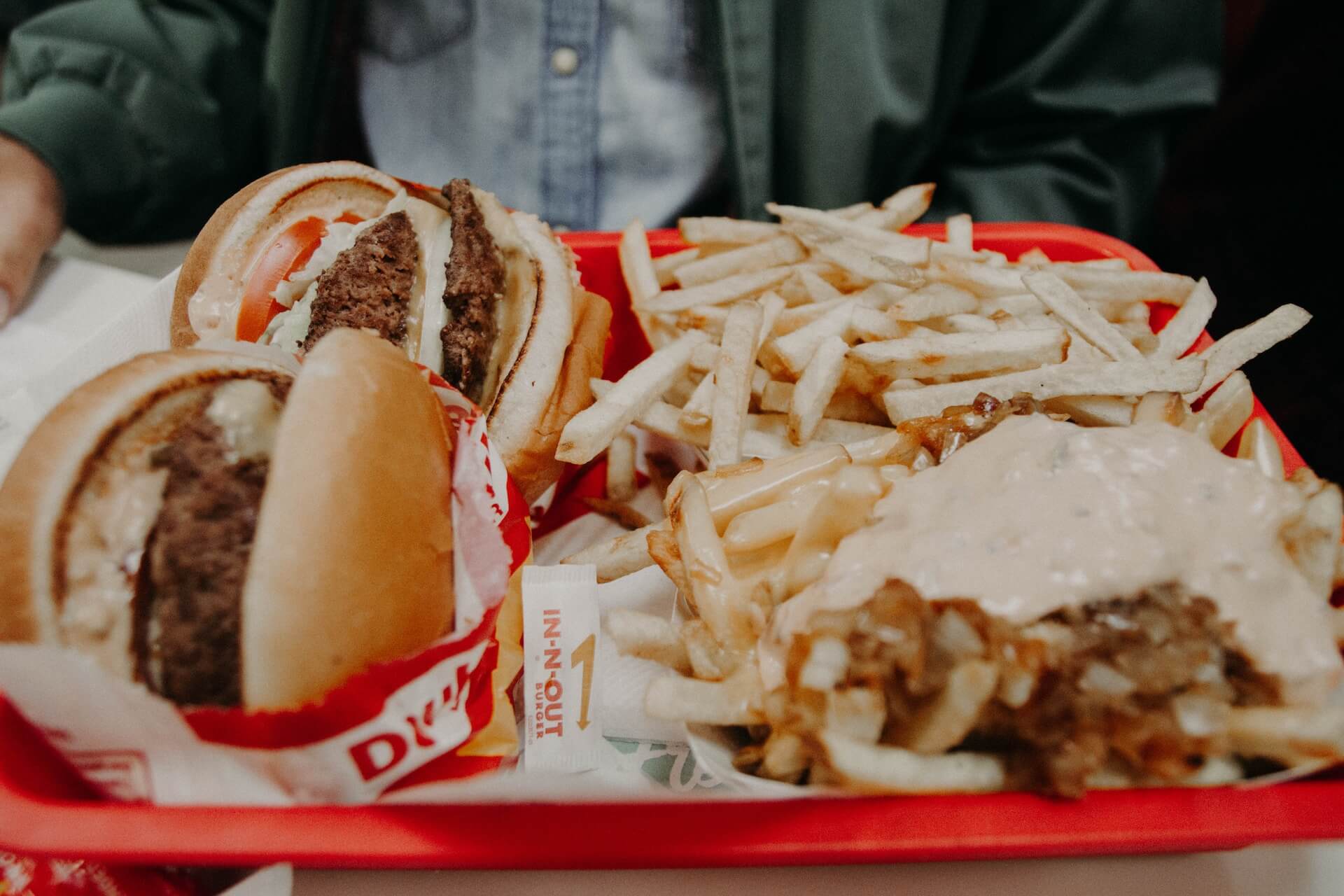
Tray with In N Out burgers and French fries

Well, that was fast: If recent reports are accurate—and it appears they are—the battle over the FAST Act has come to a close.

Rather than fight on the ballot, fast-food chain operators and labor groups have struck a deal. Per some reports, this puts a halt to a referendum battle that could have cost more than $100 million in campaign funds.

On its face, the deal is quite simple. AB 257, known as the Fast Food Accountability and Standards Recovery—or FAST Act—is dead. That is, dead save for one provision: the creation of the Fast Food Council will move forward.

The council will have a total of eleven members. Nine will have the power to vote, two will be non-voting members. The breakdown will be as follows:

  • two representatives of the fast-food restaurant industry (2);
  • two franchisees or restaurant owners (2);
  • two restaurant employees (2);
  • two advocates for fast-food restaurant employees (2);
  • member of the public who is not affiliated with either side (1, will serve as chair); and
  • members from the Department of Industrial Relations and the Governor’s Office of Business and Economic Development (2, non-voting)

Their first meeting is on the schedule for March 15.

In exchange, fast-food workers will see the minimum wage bump up to $20 per hour should they be in the employ of a fast-food chain with more than 60 locations throughout the US. That pay rise will come in April 2024.

When it comes to further pay rises, the council has two options:

  • An annual wage increase of 3.5 percent; or
  • An increase based on average changes to the consumer price index each year.

As one might expect, the rise will be whichever number is lower.

What was AB 257?

To summarize, FAST would’ve done the following:

  • Establishes the Fast Food Council, ten members appointed by the Governor, the Speaker of the Assembly, and the Senate Rules Committee. The council will operate until January 1, 2029.
  • Defines “the characteristics of a fast food restaurant.”
  • Gives the Fast Food Council the authority to set “minimum fast food restaurant employment standards, including standards on wages, working conditions, and training.”
  • Provides the council the power to “issue, amend, and repeal any other rules and regulations, as necessary.”
  • Allows the formation of a Local Fast Food Council by a county, or a city that has a population of more than 200,000.

Click here to review the bill’s text in its entirety.

Why is this Important?

It’s entirely possible that similar bills will pop up in other states in the coming years.

If this result is anything go by, such bills may be used by QSR operators and labor groups as negotiating tactics. The most recent news regarding the FAST Act should have the attention of both operators and hospitality workers. In California alone, the pay rise is expected to affect at least 500,000 workers.

However, there is one provision of the FAST Act that workers may find less than encouraging. The deal that has been struck kills a notable provision: fast-food operators, at least in California, won’t be held legally responsible for labor violations that occur in franchise locations.

Operators in other states should keep an eye out for similar bills, as should all hospitality professionals.

Image: Kenny Eliason on Unsplash

by David Klemt David Klemt No Comments

Hospitality Mindset: Restaurant Edition

Hospitality Mindset: Restaurant Edition

by Jennifer Radkey

Chef in commercial kitchen handling a pan on fire

Have you ever wondered why you just can’t seem to get ahead regardless of what you do, or why you appear to be developing a negative team culture?

Maybe you wake up with a sense of dread or anxiety about what lies ahead of you each day, or maybe no matter how hard you try and how much money you pour into your restaurant it never seems to be enough to get you where you want to be.

The cause of these problems may stem from your—and your team’s—mindset.

But what is mindset exactly?

Simply stated, mindset is an individual’s usual attitude or mental state. It reflects someone’s way of thinking and motivates their actions. So, why is it important to be aware of your mindset?

Well, if your mindset dictates how you show up in your life each and every day, then it will influence all parts of your life. Your thoughts about yourself, others, your business, your opportunities, and your challenges are all influenced by your mindset.

Your mindset can either hinder or promote your overall well-being and success in life.

The good news about mindset is that you can change it – if you want to. It can also be contagious—in a positive way.

These facts led me to question if the different sectors of the hospitality industry face unique mindset challenges and what can be done to overcome them.

To find answers and gain further insight I decided to turn to our team at KRG Hospitality for their thoughts. In turn, I’ve written a series of hospitality mindset articles, including one for bar operators and one for hotel operators.

In this article I’ll explore the restaurant industry, with thoughts from chef consultant Nathen Dubé.

Let’s dive in!

The Restaurant Industry

The restaurant industry is massive, employing 12.5 million in the US and 1.2 million in Canada.

Ranging from quick service to fine dining and offering every type of cuisine imaginable, the industry is a staple in any community. And while many enjoy being guests at these establishments, the same can’t always be said for working in them.

The restaurant industry faces constant challenges, ranging from mental health issues to labor shortages and rising costs.

So, what makes a restaurant succeed despite these challenges? While there are many ingredients involved in running a successful restaurant, arguably one of the most important is a strong operator.

Successful Operators

Operating a successful restaurant takes a certain mindset. You need to be organized, open-minded to growth strategies, resilient, and responsive to the needs of your team.

Interested in what makes a restaurant operator stand out, I asked Nathen what contributes to operator success:

“The key strength for a restaurant owner, first and foremost, is resiliency. You need to stay even keeled during the good and bad times. Things will fluctuate between busy and slow. You will experience great staff, not-so-great staff, shortages, bad reviews, good reviews, equipment breaking, orders delivered late, plumbing issues, electrical issues… The list goes on and on.

“But at the end of the day, when you say you’re open at noon or 5:00 PM or whichever, you better be ready on time, every time. That can give the strongest characters stress and anxiety over the long term. I think being resilient and able to do what is in your control and let go of the rest will help an owner maintain one’s sanity.

“The second strength needed is empathy. Without empathy for your staff, your customers, the many other people in the food and alcohol chain, the risk of becoming a tyrant no one wants to work for or associate with is real, and I’ve seen it happen. Your staff are people too, who have doctor’s appointments, family gatherings, and trouble at home. Some may suffer from addiction and mental illness, and some live in borderline poverty, which is a truly sad reality for many hospitality workers.

“The third characteristic is good business sense. As much as restaurants and bars are about hospitality, engaging customers, and providing great service, if you can’t run a business properly, that is all for naught. Money management, accounting, marketing, the whole lot is important to your success and longevity.”

Operator Challenges

Operators need a positive, strategic, growth mindset to be successful in the restaurant industry. Maintaining this kind of mindset takes self-awareness and consistent cultivating. There will be challenges every day that will test you and if you aren’t checking in with your thought patterns, it can be easy to fall into a negative mindset.

When asked what specific challenges hotel operators face that may affect their mindset, Nathen shared some insights.

Financial Risk

Opening and operating a restaurant comes with inherent financial risks. Sometimes it may feel as if more money is going out than coming in.

“When dealing with perishable food items in a time-sensitive environment, there will be plenty of challenges,” says Nathen. “Some are temporary, some are constant, and some are one-offs, but they all need careful attention. There is obvious financial risk and stress that comes with that. Labor costs, food, and alcohol are the main culprits of financial strain for the back of house. The kitchen setup costs (equipment, construction, etc.) are also in this category. Money can be a great source of stress for anyone, and more so for those who are risk averse.”

The Human Element: Guests

As a restaurant operator you rely on guests. Your efforts are almost always focused on how you can get more guests through the door and how you can get them to return.

Besides the stress of keeping them happy, sharing, and returning, guests can create another level of stress.

“Dealing with customer feedback can affect well-being,” Nathen says. “Not everyone who comes into your establishment will love everything. There will be complaints, there will be disagreements, poor online reviews, and there will be outright rude guests. This causes stress to staff, as well as the owner’s state of mind. Keeping staff motivated, calm, and on the same page when dealing with these guests and reviews is a lot of emotional work. It takes a strong-willed individual to let it roll off their back while still learning from it.”

The Human Element: Staff

Without your team there would be no restaurant. Your team is key to your success and can also be a cause of stress to your overall well-being.

“Issues can and will arise in dealing with the human element of labor,” explains Nathen. “Concern and care for staff is a full-time job in itself, and that’s in a best-case scenario. In a worst-case scenario you can experience shortages, theft, drama, and the like that will need to be dealt with or it can drag down a good establishment and create an exodus of good staff. Not to create a bleak picture, but management can take a toll.”

Employee Challenges

Your team experiences their own unique set of challenges that can affect their well-being and mindset as well. Being aware of these challenges is important if you are hoping to create a culture of respect, collaboration, and trust.

When asked what specific challenges restaurant staff face, Nathen had some insights:

“It’s well documented that working in a professional kitchen is difficult work when things go perfectly well. Long hours standing, hot kitchens, short time constraints, and difficult customers can be draining on a person. Mix in stress, poor health habits, and skipped meals, you get the perfect recipe for very hard work. Managing stress and employee wellness within the kitchen team is important to an overall successful business. Not paying attention or implementing ways to help will lead to a difficulty hiring and retaining staff.”

A Living Wage and Safe Environment

The restaurant industry has faced criticism for low pay, unsafe working environments, and an unsupportive culture.

While this is not the case in all establishments, it occurs enough in the industry to make potential employees wary.

“Pay in the industry is notoriously low for entry level positions,” Nathen says. “There is typically limited room to grow on the pay grade, and a lack of insurance, health, and dental care can compound the issues.

“Workplace standards including safety and culture are another common pain point for restaurants. Dirty, unsafe conditions create a dangerous work environment. It will also make it difficult to pass health inspections. Allowing a toxic culture to develop creates an environment that no good staff wants to work at. All of these issues can drain the pride from a good, well run, happy environment that employees want to stay and thrive at.”

Harmful Beliefs in the Restaurant Industry

Your belief system directly impacts your mindset. If you have negative beliefs regarding your team, your guests, or your community, it’s time to sit down and recognize where those beliefs are coming from and how to change them.

The restaurant industry has a few specific common, harmful beliefs that are prevalent in many establishments. Being aware and knowing how to acknowledge and combat these beliefs is crucial to creating a more positive work environment.

Stigma

When I asked Nathen what one of the most prevalent harmful beliefs operators have about their team, he discussed the stigma restaurant employees often face:

“Unfortunately, there is still a stigma around restaurant staff being uneducated, working in this industry only because they can’t do anything else in society. Often, they are seen as doing this job until something better comes along. Why should they invest in their staff’s well-being if they will vanish in a moment’s notice?

“The next stigma is that all workers are just lazy drunks, addicts, and thieves out for a paycheque to drink away at the bar. While there is a prevalent issue of substance abuse in the industry, it can be a tough challenge to address, and unfair if everyone is painted with the same brush.”

Selfish/Uncaring

Operators are not the only people in the industry who harbor negative or false beliefs.

Staff can do so as well. One primary negative belief is that management and/or ownership doesn’t care about them.

“In terms of ownership, kitchen staff can feel ripped off, or that they are doing all the work while the owner gets rich,” explains Nathen. “Staff will make accusations behind closed doors that they do all the work while the owner does nothing.”

To overcome negative beliefs, says Nathen, “[a]n engaged owner can eliminate the walls between staff, customers, community, and themselves. Talking to those in your business circle and including everyone squashes resentment, misunderstandings, and most complaints will be solved immediately, eliminating potentially bad situations.”

Toxic Culture

The last thing that any hospitality business needs is a toxic culture. A toxic workplace culture encourages and breeds negative mindsets on all levels.

I asked Nathen what creates toxic culture in a restaurant and he shared his thoughts and experiences:

“It starts with ownership. Defining a clear set of core values and standards in the workplace—and adhering to them from the hiring process all the way to daily operations—will dictate the type of people you hire and attract. Toxic environments can be created by just one employee. My experience with toxic kitchens was based on there being no consequences; there wasn’t even a lack of standards enforcement because there were no standards to begin with.

“Things like bullying, harassment, poor attitudes, low morale, lack of leadership, and poor working conditions—whether physical, emotional or both—are the typical causes of toxic culture. To blame is also the negative actions of others, and equally the lack of action from management. Bad eggs are left to rot and quickly poison the whole omelet, so to speak.

“Define a concept clearly, every step of the way, and then find the people to fit that vision. But also deal with problem employees immediately; there is nothing worse than losing good employees to bad ones.”

Moving Forward

Understanding the challenges that operators and staff are currently facing, and acknowledging the importance of growth mindset and the need for change, I asked Nathen what positive changes have been occurring in the industry as a whole?

“Restaurant work environments have improved over the last few decades but still have a long way to go. When I started in the mid ‘90s, belittling, yelling, and screaming—general abusive treatment of anyone and everyone—was commonplace. There was no compassion for the environment that staff worked in. The culture, the workload, pay… Literally everything was just ‘take it or leave it.’ ‘If you don’t like it, leave,’ was repeated everywhere to any staff who raised concerns.

“Over time, a stand has been made in response to a mass exodus, tales of burnout, and at the worst end of the spectrum, severe addiction, and even suicide. It was time to look from within at where the actual problems were, and what could be changed. The veil of toughness finally came down, and an honest conversation has led to slow changes.

“One of the more prevalent changes is an overall less-abusive environment. No longer is it tolerated to show anything less than human decency to staff and guests. Genuine care for staff well-being is starting to be seen almost everywhere. It’s leading to a new excitement among hospitality professionals and can hopefully attract new individuals to the field.”

Room for Improvement

Although awareness of the well-being of those working in this industry is increasing, there are still changes that need to happen.

Nathen believes that improvement lies in focusing on balance and respect:

“There is no way around the fact that cooking and serving is hard, long work, regardless of concept. This is unfortunately the entry point for all those who claim to want to change the industry or make it better. In my opinion, this is the wrong approach. Enhancing the whole experience of the employee, leadership team, and guest will make everyone happier and, hopefully, healthier.

“Balancing the workload for everyone, finding creative ways to increase pay, and offering benefits leads to a strong sense of job safety. Rotating schedules, for example: four nine-hour days; or two on, three off; or something away from the traditional 10-, 12-, or 14-hour days and five- to six-day work weeks, reduces burnout, gives employees a chance at a social and family life, and still allows everyone to earn enough income to live. Throw in benefits and some sort of bonus pay, and you will have a brand everyone wants to work for.

“Another big contributor to improving the industry—and we have made big strides already—is the respect for people and creating an environment or culture void of bullying, harassment, intimidation, and general mistreatment of the people who make this the best industry to work in.”

Final Thoughts

In a highly competitive industry facing consistent challenges and harmful beliefs, it will come down to developing and maintaining the right mindset to truly succeed both professionally and personally. It starts from the top with a positive, resilient, growth mindset.

I’ll leave you with a few last words of wisdom from Nathen:

“Hopefully, there is a sense of urgency in the fight to change the industry for the better. It’s important to recognize and praise positive contributions and not just positive people because everyone needs encouragement. It’s equally important to handle negative contributions quickly and correctly.

“A positive attitude can go a long way toward creating a strong team player who can make the best of stressful times and have a coachable attitude. A positive person can help change the culture of a workplace and pick up other teammates who may need a boost. They share their optimism and passion for the job and can make management’s life easier.

“A negative person will contribute to a toxic environment. Resentment begins to build on both sides as a negative person sees things not being done their way, contributes less to the success of the kitchen, and spreads their toxic beliefs to other employees who may start to feel similarly.

“I recently heard a saying, and I don’t recall by who so I can’t quote it, but it goes, ‘It’s important to get the right people on the bus, but it’s just as important to get them in the right seats.’”

Cheers to personal and professional well-being!

Image: Helmy Zairy on Pexels

KRG Hospitality. Restaurant Business Plan. Feasibility Study. Concept. Branding. Consultant. Start-Up.

by David Klemt David Klemt No Comments

American Trends 2023: Technomic

American Trends 2023: Technomic

by David Klemt

Pink pineapple against pink background

Foodservice research firm Technomic has some interesting predictions for the hospitality industry in the United States of America this year.

On the topic of operations, Technomic foresees more negotiating power among workers. Additionally, the firm looks at both the economy and pent-up guest demand.

When it comes to food, the US and Canada have a trend prediction in common. And as the image atop this article signifies, a particular color may be a hit on menus in 2023.

Before we jump in, Technomic’s 2023 Canadian trend predictions are here. Last year’s Technomic predictions for America are here. Curious readers can review the firm’s 2023 predictions in their entirety here.

Okay, let’s go!

Think Pink

I want to address this prediction first. According to Technomic, pink is going to be the F&B color of 2023.

As they explain, the color is fun, nostalgic, and photogenic. Yes, operators must still consider the Instagram-worthiness of their menu items. That may change one day, but it’s not today.

Per Technomic, pink also signals that a food or drink may have antioxidants.

Some of the items the research firm names specifically: pink pineapple, pink salt, pink celery, cara cara oranges, and schisandra berries.

Pickle It

This is the culinary trend that, per Technomic, Canada and America will share in 2023.

Along with fermenting, pickling gives the kitchen and bar teams a unique experimentation method to explore. So, encourage these teams to get creative and add pickling and fermentation to your next menu update.

Of course, that’s not the only reason to consider putting pickling front and center. For many, these preparations indicate a healthy F&B choice. Think kombucha, as an example.

As we know, healthy choices continue to be top of mind for many guests.

One more note: Technomic suggests being transparent and identifying the pickling and fermenting processes your team leverages to produce each menu item.

Economics

For those looking for a bit of optimism in these trying times, Technomic may have what you’re looking for. This year’s report, What We Foresee for 2023, says the following about the possibility of a recession:

“There is reason for optimism in the coming year, however, as any recession is expected to be relatively mild.”

Yes, that’s just one source’s opinion. However, Technomic is known for their voraciousness when it comes to data. So, if this firm is optimistic it could be a solid sign that things are looking up in 2023.

“Pent-up consumer demand” and variations thereof have been making the rounds since 2o21. However, it’s still a relevant phrase.

As it pertains to 2023, Technomic believes on-premise dining may “bounce back” this year. In fact, the firm suggests that people want to socialize and dine in person now more than ever.

Also, delivery and pickup times appear to be growing. So, plenty of people will see in-person dining as the more appealing option in 2023.

Operations

In part due to legislation addressing minimum wage and workplace conditions, employees may have the upper hand this year.

Add the fact that many people seeking work know many operators are dealing with a labor shortage and their negotiating position looks even stronger.

So, we could finally be in for a significant change when it comes to how the industry looks at compensation. More and more workers—and the guests they serve—are taking issue with tipping. Instead, many people outside and inside of the industry want to see operators pay staff a competitive, living wage.

Of course, there are also the hospitality professionals who prefer tips to minimum wage. In 2023, the industry could experience the start of a sea change. Time will tell.

For more predictions and this Technomic report in its entirety, please click here.

Image: Alex Gruber on Unsplash

by David Klemt David Klemt No Comments

We Ask ChatGPT About Robots and AI

We Ask ChatGPT About Robots and AI in Restaurants

by David Klemt

Vintage toy robot face and torso

Earlier this week we had “a conversation” with ChatGPT, the now (in)famous chatbot from artificial intelligence research and development company OpenAI.

For my first time interacting with this type of tool, I keep things simple. I attempt to phrase my questions correctly, focusing on the topic of AI and robots in hospitality.

Initially, I receive a response that probably isn’t much of a surprise. But as you’ll see, the chatbot highlights an item or two that aren’t always top of mind with this topic.

Below you’ll find ChatGPT’s responses to one request and two questions.

Please write 400 to 500 words about robots and artificial intelligence working in restaurants, from the perspective of robots and AI.

“Robots and artificial intelligence (AI) are becoming increasingly prevalent in the restaurant industry. This is in part due to the many benefits that these technologies can offer, such as increased efficiency, improved safety, and reduced labor costs. However, it is also important to consider the perspective of the robots and AI systems themselves, and how they are integrated into the restaurant workforce.

One of the main ways that robots and AI are used in restaurants is through automation of tasks that would otherwise be performed by human workers. For example, robots can be programmed to cook food, mix drinks, and serve customers. This can help to improve the efficiency of the restaurant, as robots are able to work faster and more accurately than humans. Additionally, robots can be designed to perform tasks that are dangerous or difficult for humans, such as handling hot oil or sharp knives. This can help to improve safety in the kitchen and other areas of the restaurant.

However, the use of robots and AI in restaurants also raises some important ethical and social issues. Some people may worry that robots will take jobs away from human workers, especially in an industry that already has high turnover rates. Additionally, there may be concerns about the social and emotional impact of having robots as a major presence in the workplace. For example, some people may find it uncomfortable or strange to interact with robots in a social setting, such as a restaurant.

The robots and AI perspective, they are programed to perform their task efficiently without any error. They don’t have any emotions or preferences hence they are not impacted by the same issues that human employees may face like fatigue, stress or burnout. They can work in any environment without needing breaks or vacation days, this can help reduce labor costs, as restaurants can operate with fewer employees. However, it also means that human workers may need to be trained in new skills that allow them to work alongside robots and AI systems.

In conclusion, the integration of robots and AI in the restaurant industry can provide many benefits, including increased efficiency and improved safety. However, it is important to consider the ethical and social implications of these technologies, and to ensure that they are implemented in a way that benefits both the restaurant and its employees. With proper planning and training, robots and AI can be an [sic] valuable asset to restaurant workforce.”

Can you explain to me, in 300 to 400 words, what the ethical implications are for restaurant, bar, and hotel operators using artificial intelligence and robots to complete tasks?

For the most part, ChatGPT repeats talking points from our first interaction. This is likely due to the phrasing of my question. Also, this chatbot is still in its “infancy.”

However, ChatGPT brings up a few new points, and expands on others.

“The use of artificial intelligence (AI) and robots in restaurants, bars, and hotels raises a number of ethical implications that should be considered by operators. One of the main concerns is the potential for these technologies to displace human workers. In an industry that already has high turnover rates and relatively low wages, the use of robots and AI could make it even more difficult for human workers to find and keep jobs. This could lead to increased unemployment, reduced income and work-life imbalance among the impacted employees.

Another ethical concern is the impact that these technologies may have on the customer experience. For example, some customers may find it unsettling or uncomfortable to interact with robots in a social setting, such as a restaurant or hotel. Additionally, customers may feel that the use of robots and AI detracts from the human element of the service experience, and could harm the overall reputation of the business. There may also be concerns about how the data collected by these systems is used and protected, raising question about data privacy and security.

Additionally, some concerns about the way these AI and robots are designed and how they make their decisions, there could be potential for bias, especially when the systems are provided with data that is not representative of the whole population. This could lead to unfair treatment of customers, employees and other stakeholders.

There are also concerns about how the maintenance and repair of these technologies are managed and who is responsible for any accidents or malfunctions that may occur. This is particularly important for safety critical tasks, such as cooking or cleaning. Operators need to ensure that the AI and robots are designed and maintained to the highest standards to prevent any harm to employees or customers.”

Are there risks that human designers and engineers will introduce bias to customer-facing artificial intelligence and robots?

Since ChatGPT mentions bias in response to my first question, I run with that train of thought.

Below is what the chatbot has to say about that topic as it relates to AI and robots.

“Yes, there is a risk that human designers and engineers may introduce bias into customer-facing artificial intelligence (AI) and robots. This can happen in a number of ways, including:

  1. Data bias: If the AI system is trained on a dataset that is not representative of the population it will be serving, it may make decisions or predictions that are biased towards certain groups of people. For example, if an AI system used in a hotel is trained on data from primarily white and wealthy guests, it may have difficulty understanding and serving guests from other backgrounds.
  2. Algorithm bias: The way an AI system is designed and the algorithms it uses can also introduce bias. For example, if an algorithm is designed to prioritize certain inputs over others, it may make decisions that are biased towards certain groups of people.
  3. Human bias: Human bias can be introduced into AI systems through the decisions made by designers and engineers about what the system should do, how it should work and how it should interact with people. For example, if a designer and engineers decide that the robot should be more polite to older customers, it may be less polite to younger customers, or if the system is designed to recognize only certain languages, it may not be able to understand and serve customers who speak other languages.

It is important for human designers and engineers to be aware of the potential for bias in AI systems, and to take steps to minimize it. This can be done by using diverse and representative data when training the AI system, being mindful of the potential for bias in the algorithms used, and involving stakeholders from diverse backgrounds in the design and testing process. Additionally, monitoring and audit the system performance regularly, and providing ways for users to provide feedback on the performance and make adjustments accordingly.

It is important to remember that this is an ongoing process and it requires continuous monitoring and adjustment as the data and environment changes. There is also a need for more research in the field of explainable AI, which would allow human designers and engineers to understand why the AI system is making certain decisions, which can help to identify and mitigate any biases that may have been introduced.”

Takeaways

Obviously, I don’t think ChatGPT “speaks” for the machines. And I don’t think the chatbot was attempting to convince me of anything. There’s nothing overtly nefarious afoot here—this was mainly an entertaining exercise with a newsworthy tool.

That said, I’m not entirely certain how I feel about my interaction with ChatGPT. On one hand, the answers in favor of AI and robots are what one expects: efficiency, speed, consistency, cost reductions, improvements to safety.

But what about what ChatGPT says about biases, programming, representation, and human interactions with tech? To alter a phrase, “Who watches the programmers?”

Hospitality is about the human element. It’s about service and the guest experience. Personally, I don’t think the world will be in a better place if we reduce human interaction.

Dropping baskets into hot oil? Slicing and dicing? Sure, send in the robots…maybe. Reducing the human element in the name of efficiency and profits? I don’t see a benefit worth the risks.

Image: Rock’n Roll Monkey on Unsplash

by David Klemt David Klemt No Comments

Minimum Wage Rises for Most of USA

Minimum Wage Rises for Most of USA

by David Klemt

Closeup of Ben Franklin on $100 bill

More than half of the states across America are either now seeing a boost to minimum wage or plan to increase the hourly minimum by the middle of this year.

In total, minimum wage is up in 27 states. However, the rise isn’t yet in place in a handful of states, including Nevada.

Now, the federal minimum wage still has yet to go up. That rate remains at $7.25 per hour, where it has been since 2009. For the curious, if a person works 40 hours per week and is compensated at the federal minimum rate, that’s just over $15,000 per year—before taxes.

Per Motley Fool: “If we factor in inflation, [federal minimum wage] would have had to grow to $10.20 to let people buy the same amount of goods and services today [as in 2009]. In real terms, the current minimum wage has shrunk by almost 30% since it was set.”

You’ll see below that I didn’t list the increases for tipped workers. As an operator, you should already be well aware of the minimum rate your tipped workers must be paid. In all likelihood, your suite of software is already updated to the current requirements (but check yourself to be certain).

The list will provide an idea of what you’re up against. It’s difficult to recruit rock stars if you’re unable to offer wages above minimum wage, never mind at minimum wage.

Today, for most workers, the minimum isn’t going to cut it. So, when you’re looking at what you can offer, keep in mind the minimum wage for both tipped and un-tipped workers in your area.

Also, know what other operators are paying. To remain competitive, consider what else you can offer, including your values and culture.

States Increasing Minimum Wage

Below, the states with an increase to the minimum wage. Rather than organize the list by hourly rate or rate of increase, I set it up alphabetically.

  1. Alaska: $10.85 per hour
  2. Arizona: $13.85 per hour
  3. California: $15.50 per hour
  4. Colorado: $13.65 per hour
  5. Connecticut: $15 per hour (June 1)
  6. Delaware: $11.75 per hour
  7. Florida: $11 per hour (September 30)
  8. Hawaii: $12 per hour
  9. Illinois: $13 per hour
  10. Maine: $13.80 per hour
  11. Maryland: $13.25 per hour
  12. Massachusetts: $15 per hour
  13. Michigan: $10.10 per hour (could rise further; lawsuit pending)
  14. Minnesota: $8.63 per hour (small employer); $10.59 per hour (large employer)
  15. Missouri: $12 per hour
  16. Montana: $9.95 per hour
  17. Nebraska: $10.50 per hour
  18. Nevada: $11.25 per hour (July 1)
  19. New Jersey: $14.13 per hour
  20. New Mexico: $12 per hour
  21. New York: $14.20 per hour (excluding some areas); $15 per hour for fast food workers
  22. Ohio: $10.10 per hour
  23. Rhode Island: $13 per hour
  24. South Dakota: $10.80 per hour
  25. Vermont: $13.18 per hour
  26. Virginia: $12 per hour
  27. Washington: $15.74 per hour

Among the states on the list above, four are lifting minimum wage to at least $15. Those states are Connecticut, Massachusetts, California, and Washington. Additionally, the minimum wage is $15 per hour in parts of New York.

Interestingly, employers in Nevada can reduce the minimum wage by one dollar if they pay qualifying health insurance. In such a case, the hourly minimum will be $10.25.

Only one of these states, Montana, will remain under $10.

Cities, Counties, Districts

As stated above, some parts of New York have a minimum wage higher than $14.20.

There are also cities, counties, and districts boosting the minimum wage.

  • Denver, Colorado: $17.29 per hour
  • Long Island, New York: $15 per hour
  • New York City, New York: $15 per hour
  • Washington, DC: $16.50 per hour
  • Westchester County, New York: $15 per hour

Overall, more than half the country either already increased the minimum wage or will do so later this year.

Image: Adam Nir on Unsplash

by David Klemt David Klemt No Comments

Leadership Facepalm, Part Three

Leadership Facepalm, Part Three

by David Klemt

Frustrated man sitting on couch

We almost got to next year without another viral leadership facepalm moment but then an Olive Garden manager sent a memo.

In case you’re unaware of the now-infamous Olive Garden memo, here’s a recap:

  • Zero tolerance for calling off.
  • Sick team members must come in and prove they’re ill.
  • If someone’s dog dies, they must bring the dead animal in to prove its death.
  • Family emergencies are not private and must come with an explanation.

The manager who authored the memo also takes time to boast about their perfect attendance record.

For the curious, the first entry in our leadership facepalms is here. Part two is here.

The Letter

Below you’ll find the letter, addressed to “ALL Team Members.” To read it in its entirety, click here.

“Our call offs are occurring at a staggering rate. From now on, if you call off, you might as well go out and look for another job. We are no longer tolerating ANY excuse for calling off. If you’re sick, you need to come prove it to us. If your dog died, you need to bring him in and prove it to us.”

I highly doubt that’s Olive Garden or Darden policy.

“If its a ‘family emergency’ and you can’t say, too bad. Go work somewhere else. If you only want morning shifts, too bad go work at a bank. If anyone from here on out calls out more than ONCE in the next 30 days you will not have a job.”

It doesn’t get any better when the manager brings up their own track record:

“Do you know in my 11.5 years at Darden how many days I called off? Zero. I came in sick. I got in a wreck literally on my to work one time, airbags went off and my car was totaled, but you know what, I made it to work, ON TIME! There are no more excuses.”

Interestingly, the manager implies they’re speaking for all the leaders:

“Us, collectively as a management team have had enough.”

A Breaking Point

First, I’m not pretending a staggering amount of operators, leadership teams, and team members aren’t at their breaking points. The labor shortage and staffing struggles are a real crisis in our industry (and others, of course).

Second, I’m not suggesting that operators and their teams aren’t justified in their frustration and anger.

If we’re to accept just this year’s reporting alone, it appears many people are comfortable being rude to service workers. It’s a disturbing trend, and it’s motivating people to leave public-facing roles. As they’re leaving, many are swearing off the hospitality industry entirely.

Third, I think the memo above highlights our need to address mental health in this industry. Sure, it’s easy to write this manager off as a jerk and terrible leader. But what if we look at this through the lens of stress?

The memo could easily be the manifestation of a breaking point. It’s also possible the entire management team was behind this email.

Damage Done

Let’s look at this situation solely as an example of poor judgment and leadership. Imagine the damage it could do to any restaurant or bar, chain or independent.

What do you think a memo like this does to the ability to recruit? To retain? How does such an email do anything but exacerbate labor problems?

Darden, Olive Garden’s parent, went into crisis management mode when this memo went viral. It appeared on Reddit, was picked up by news outlets and other websites, and exploded.

Ultimately, Darden terminated the manager to whom the memo is attributed: “We strive to provide a caring and respectful work environment for our team members. This message is not aligned with our company’s values. We can confirm we have parted ways with this manager.”

The Olive Garden location in Kansas where this situation took place may recover. They’re a large chain, people tend to have short memories for news, and regulars will likely stay loyal.

But what if this occurred at an independent restaurant? The damage could be irreparable.

Work Culture

Now, it should be obvious that from a simply operational standpoint, this situation highlights an unhealthy work environment and culture. That should go without saying.

So, instead I want to say something else.

Operators need to check in with their team members. Leaders, front of house, back of house—everyone. Stress levels are reaching breaking points and every one of your team members needs to know they matter, they’re safe, and they’re supported.

Check in. Survey your team. Be empathetic. And if you’re an operator, you need a support system of your own.

Being a leader doesn’t mean being infallible. It’s not poor leadership or weakness to admit you need help.

Image: Nik Shuliahin 💛💙 on Unsplash

by David Klemt David Klemt No Comments

Tipping is on the Ballot in Washington, DC

Tipping is on the Ballot in Washington, DC

by David Klemt

Folded dollar bills

Out of concern that people who work for tips aren’t making minimum wage in Washington, DC, Initiative 82 is on the ballot.

This is interesting for several reasons. One of which is the fact this isn’t the first time this issue has been voted on in DC.

Back in 2018, Initiative 77 was presented to Washington, DC, voters. The initiative took the $3.33 per hour minimum wage for tipped workers up to $15 per hour, the full minimum wage.

In June 2018, the measure was approved by voters. However, the Washington, DC, Council held a vote and repealed Initiative 77 after if had been passed.

Phil Mendelson (D-Chairman) of the Washington, DC, Council, introduced the bill that ultimately repealed Initiative 77 in October 2018.

“The Council amends laws all the time. And if a law is a bad law it should be amended or repealed,” said Mendelson at the time. “It doesn’t matter if the law was adopted by Congress, the voters, or ourselves.”

Further, Mendelson claimed that tipped workers themselves—bartenders, servers, valets, manicurists, and more—didn’t hold a favorable view of the passing of the initiative.

“77 may be well-intentioned, but the very people the Initiative is intended to help are overwhelmingly opposed. If we want to help workers – protect them from harassment and exploitation – there are better ways than Initiative 77,” Mendelson said.

One council member, Mary Cheh (D-Ward 3), opposed repealing Initiative 77 and addressed claims that it was harmful to tipped workers.

“Although I take these claims seriously, in my view they are speculative and not borne out by the experience of the other jurisdictions that have one wage,” said Cheh.

Support

Whenever increasing tipped worker wages to full minimum wage comes up, we tend to encounter the same arguments for and against.

Currently, the tipped hourly wage in DC is $5.35 per hour. In comparison, full minimum wage in DC is $16.10 per hour.

Now, as the law reads, if a tipped worker’s wages don’t equate to full minimum wage, their employer is expected to bridge the gap.

The key argument for the passing of Initiative 82 is simple: tipped workers should make at least minimum wage. These workers deserve the stability of knowing how much they’ll make each shift and earning a living wage (consistently, hopefully).

Those who support Initiative 82 also say that since the measure doesn’t outlaw tipping, tipped workers would earn more than minimum wage.

Opposition

Opponents, however, argue that the initiative will harm tipped workers. Some say that operators will cut shifts and increase prices in response to Initiative 82 passing. This will, of course, lead to servers, bartenders, and other tipped workers making much less than they did in the past.

Traffic may also decrease because it’s assumed that operators will increase costs significantly.

There’s also the argument that’s often (if not always) made when this topic comes up: Tipped workers themselves don’t support these initiatives.

“I have not met a single server who wants this,” Washington, DC, bar owner David Perruzza told the Washington Blade. Perruzza added, “The people who support this don’t know anything about the service industry.”

A Few Questions…

I’ve made no secret of my cynicism when it comes to politicians and their relationships with our industry.

My main argument was made for me: the Restaurant Revitalization Fund saga. We watched for months as Congress failed to replenish the RRF, leaving more than 177,000 operators and their staffs to fend for themselves. This, after months of dangling replenishment in front of all of us. Ultimately, they abandoned us.

Tellingly, Senator Rand Paul (R-KY) referred to RRF replenishment as a “bailout.” And apparently he doesn’t think much of the challenges operators have faced since the start of the pandemic, asking, “Where’s the emergency?” The closures of tens of thousands of restaurants and bars, often the cornerstones of communities across the country, doesn’t rank as an emergency, apparently.

So, Initiative 77, Initiative 82, and similar measures beg a few questions:

  • Do politicians actually ask their tipped-wage constituents their thoughts on this topic before introducing these ballot measures?
  • When these initiatives are being considered, do people just ask a few operator friends their opinions?
  • Do local, state, and federal politicians really have a grasp of our industry?

One thing is certain: Industry eyes across the country are on Initiative 82. If it passes, we can likely expect similar measures to be introduced in cities and states. Should it fail, it may be a while before another jurisdiction sees this type of initiative again.

Image: Annie Spratt on Unsplash

by David Klemt David Klemt No Comments

How a Chain Lost My Business Forever

How the Staff at a National Chain Lost My Business Forever

by David Klemt

Chocolate cookie and cookie crumbles

An unfortunate and entirely avoidable guest experience debacle guarantees that I’ll never spend another dollar at a particular national American chain.

What was supposed to be a small treat and excuse to get outside for a bit went downhill quickly.

Now, before I begin, I tend to shrug at poor service. Truly, a front-of-house team member has to go pretty far for me to do more than raise an eyebrow.

Given how the past two years-plus have gone, my tolerance has only grown. Everyone has bad days, including restaurant, bar, and hotel staff. In fact, I tend to assume that someone is simply having an off day due to an array of reasons: working several days in a row, opening and closing multiple times a week; having more responsibilities heaped on them due to being short staffed; a seeming increase in abuse from guests; stress spilling over onto the job; etc.

However, that doesn’t mean I’ll always return to be subjected to poor service in the future. What I experienced yesterday falls into this category: I won’t spend my money with this chain ever again.

Third-party Issues

As stated above, my visit to this national chain (600-plus locations) was intended to be a small treat. It was Halloween, they specialize in a particular type of confection, so why not?

Also, the temperatures have been in the 70s and lower in Las Vegas—perfect for a trip on my motorcycle. So, two treats in one, really.

Okay, so I’m going to do something I don’t like doing here: making an assumption or two. I think, however, I’m basing them on sound reasoning.

Additionally, I don’t like to use third-party delivery. In this case, the order was placed via Uber Eats for pickup using a monthly credit. Zero offense to third-party delivery drivers—it’s the corporations behind the services and the fees they charge operators I don’t support.

So, my assumption is that because the order came in via Uber Eats the staff figured I was “just” a delivery driver.

Downhill Fast

I’ll concede that this visit didn’t start off on the wrong foot: I received a decent welcome. Since I was picking up the order, I stood at the pickup counter, and confirmation came in before I arrived that the order was ready.

There were three guests waiting when I walked in, and one by one they got their orders and left. I didn’t think anything was going wrong until people walked in after me and received their orders. In terms of this chain, my order was on the smaller side.

After several minutes of being ignored, I was asked if I was picking up for Uber Eats. I clarified that no, I’m not an Uber Eats driver, I was picking up my order placed via Uber Eats.

Another several minutes went by as I watched larger orders get fulfilled ahead of mine. And then I was asked again—by the same staff member—who I was picking up for. Again, not an Uber Eats driver—my order.

At this point, I had been waiting more than 10 minutes. When I was finally given my order, I noticed another difference. Staff members showed guests their orders to confirm the contents before handing them over. My order, however, was taped closed behind the counter and handed to me.

It didn’t strike me that this is how this staff treats Uber Eats driver until I was on my bike. And that’s the problem.

Standards of Service

If this is how staff treats third-party delivery drivers, it’s appalling. There’s no excuse for treating drivers differently just because they aren’t the guest themselves or fellow employees.

Let’s be clear: anyone walking through a restaurant, bar or hotel’s doors deserves at least decent service. There are several reasons for this, and I shouldn’t have to address them. But, hey, we’re already here, so why not address a couple?

First, standards. If your staff is purposely treating a group of people poorly because they think they can do so without ramifications, your standards have slipped or there simply aren’t any. That’s a problem.

Are team members going to get to know regulars? Absolutely. Are they going to have favorites. Of course! And there’s nothing wrong with that. In fact, that’s what should happen—every front-of-house team member should cultivate their own regulars.

So, yes, some guests will treated differently. There’s a huge difference, however, between subjecting some guests to poor service intentionally and delivering outstanding service to favorites.

Quite simply, the minimum standard of service should be great service. “Decent” sucks; great should be the baseline.

Regulars and guests who staff have rapport with should receive service that’s above and beyond the standard level. Rock star servers and bartenders deliver outstanding service to everyone, regular or first-timer, gracious guest or grump.

Different Treatment?

Second, your staff shouldn’t be treating third-party delivery workers like they don’t matter. There’s zero room in hospitality for treating people poorly—doing so is in direct opposition to the spirit of this profession.

In fact, they shouldn’t treat difficult guests with anything but your expected standards. Leadership team members should be confronting rude or difficult guests, protecting the rest of the team.

I’ve read and heard about restaurant staff treating third-party delivery drivers poorly. Always, of course, with justifications thrown in: retaliation toward rude drivers, drivers not tipping…pick a reason. Again, if there’s a rude driver, staff should alert leadership and they should handle it.

Look, I’ve made no secret of my view on third-party delivery apps. Their fees and taking advantage of operators, particularly during the pandemic, infuriate me. And it’s easy to point at me and say I’m part of the problem, using a credit to place a third-party delivery. I’ll accept that criticism.

What I won’t do is return to a business with staff who think it’s acceptable to allow standards to slip and treat delivery drivers poorly. Most people seem to take delivery jobs to make ends meet. Hell, some of them are likely service industry professionals themselves working another job or jobs.

The labor shortage isn’t a valid justification for slipping standards or poor service. Dislike of third-party delivery services is no justification, either.

In fact, this chain obviously sees these delivery services as a viable income stream. The fact their staff doesn’t is a problem. If there’s a standard of service for this chain, it certainly wasn’t met when I was there. And if there’s a standard that I didn’t receive, there are several other problems.

Either way, the damage is done.

Image: Andre Moura via Pexels

by David Klemt David Klemt No Comments

Viral Post Highlights Real Leadership

What a Viral Reddit Post Reveals About Leadership in Hospitality

by David Klemt

Reddit app icon on smartphone

A text exchange between a restaurant manager and delivery driver posted to Reddit went viral last month.

Refreshingly, it didn’t make the rounds on news sites for the wrong reasons. Rather, the text conversation is a succinct example of emotional intelligence, empathy, and leadership.

Those interested in reading the text exchange in its entirety can follow this link. However, I’ll sum it up here.

Posted to the subreddit Kitchen Confidential, the conversation begins with the manager checking in on the driver, asking, “You doing OK?”

The driver says they’re “doing better but” is still dealing with a lot. After the manager asks if they should cover their shift that night, the driver reveals they may need to quit the job.

Instead of blowing up at the driver, trying to talk them out of their decision, or cutting the exchange short, they say, “It’s alright [sic].”

Going further, the manager says, “You’re [sic] happiness is more important.” They add that the business hopes the driver will return to the job when they’re ready.

Shall I Cover You Tonight?

Now, I tend to believe that most members of restaurant, bar, and hotel leadership teams are empathetic. I also lean toward believing that most are competent problem solvers.

However, we’ve all come across people who don’t belong in a leadership role. In some cases, a person’s lack of leadership qualifications doesn’t manifest until they’ve been in the role for some time.

My business partner Doug Radkey and I have had conversations about leaders who don’t seem to lead. At best, they’re examples of what not to do. At worst, they’re chasing away a business owner’s staff and guests.

Most recently, these conversations have centered around managers insisting that staff solve scheduling problems themselves.

Before I proceed, I acknowledge fully that we’re facing an unprecedented labor shortage. That’s no excuse for poor leadership.

What, exactly, is the leadership team doing that they can’t manage the schedule? Further, with today’s modern scheduling platforms, why is filling available roles difficult for leaders? Several scheduling apps make it a painless, automated process.

The manager in this Reddit text exchange doesn’t demand the driver find someone to cover their shift. Instead, they behave like a manager and handle it themselves.

Don’t Ever Discount Yourself

If you’re active on LinkedIn and have a sizeable hospitality-centric network, you’ve likely seen posts about how the industry needs to be more people-focused. Not in terms of guests—that’s obvious.

Rather, the consensus is that we’re not going to solve the labor problem if we don’t treat staff as well as we treat guests. Some of these posts may be a bit saccharine, but they’re not incorrect.

Let’s review the texts from this manager:

  • “You doing OK?”
  • Your “happiness is more important.”
  • “We love having you here.”
  • “You’re an awesome person.”
  • “Don’t ever discount yourself.”

When’s the last time you and other members of the leadership team asked a staff member if they’re okay? And if you’ve asked recently, did you get an honest answer? Did you want an honest answer?

A restaurant or bar team that doesn’t trust leadership isn’t going to bother providing an honest answer to that question—they feel like the leaders don’t care about them.

Looking at the rest of the texts above, do you and your leaders take the time to recognize and thank staff? Even the shyest team member wants recognition for a job well done.

Those in leadership roles need to develop their skills constantly. Contrary to some in those positions, leaders aren’t there simply to lord their authority over others and dish out punishments.

So, before your next team meeting, gather the leaders. Find out if every member of the team is checking on staff, valuing their health and wellness, and tackling the mundane tasks that are inherent to their roles.

The maxim is true: People don’t quit jobs, they quit people. If your leadership team isn’t leading with empathy, you can expect your labor issues to compound. No amount of excuses will turn that around.

This article by KRG Hospitality director of business development David Klemt was first published by Bar Business and can be read in its entirety by following this link.

Image: Brett Jordan on Unsplash

by David Klemt David Klemt No Comments

Back of House Report: The Labor Challenge

Back of House Report: The Labor Challenge

by David Klemt

Employees wearing black staff T-shirts

A recent report from Back of House reveals opportunities for operators amidst the current staffing challenge.

In their report, the restaurant technology platform suggests effective hiring and retention solutions. For example, helping staff find meaning in their work.

To download and access the report in its entirety, please visit BackOfHouse.io.

For some of the platform’s insights into staffing, keep reading.

Why People Leave the Industry

Obviously, people take jobs for a variety of reasons. Often, a person’s first job has one or two motivations: money and/or experience.

Some estimates put a gig in the restaurant industry as the first job for a third of Americans. In Canada, restaurants are the top employers for those under 25 years of age.

However, Back of House sees value in looking at a different metric: Why people leave the industry.

As Back of House states, knowing why someone would leave their job helps an operator determine what benefits to offer to retain talent.

Now, it may be tempting to assume pay is the top reason people leave jobs. Per Back of House, however that’s not the case. Broken down by age group, below you’ll find the reasons people are leaving hospitality:

  • Pay: 26 to 35
  • Schedule: 46 to 55
  • Lack of opportunities: 26 to 35
  • Lack of benefits: 26 to 35
  • Work environment: 18 to 25

Look at these issues through the lens of someone moving through life. When first entering the workforce, more people want to find the right employer and workplace. From their twenties to thirties, more concern is placed on moving up, making more money, and receiving benefits. And, per Back of House’s findings, time becomes more of a consideration as people age.

Meaning and Value

Per Back of House, there are two important elements of employment that keep people engaged.

One, meaning in the work they do. In other words, feeling that their work has value. Two, staff want to feel that they’re employers value them.

Of course, both make sense, no? If a person doesn’t see their role in the industry as valuable, they’ll always be looking for the escape hatch. And if they feel that they’re employer doesn’t value them, why would they continue working for them? People, as they say, quit bosses, not jobs.

So, Back of House recommends that operators demonstrate they value their team members by:

  • investing in their staff;
  • supporting their staff; and
  • respecting their staff.

Now, good leaders should already do all of the above. It should go without saying but if someone feels a lack of respect, support, and interest from their employer, they’re not going to remain in their role for long.

And who could blame them? That seems like a terrible workplace and a waste of a hospitality professional’s valuable time. Time, of course, that can be better spent finding a good leader to work for who will help them progress in their career.

There are further insights one can glean from Back of House’s report. To download “Understanding the Staffing Challenge,” please click here.

Disclaimer: Neither KRG Hospitality nor its representatives received compensation to promote this report. The team at KRG simply feels all operators will find value in downloading and reading it, and considering the information contained therein.

Image: Joao Viegas on Unsplash

by David Klemt David Klemt No Comments

Hiring Struggles? Engage These Age Groups

Hiring Struggles? Engage These Age Groups

by David Klemt

Chef plating greens on plates

Staff turnover rates are still above pre-pandemic levels and there’s no silver bullet solution. However, two companies have some helpful advice.

Both Service Management Group and Technomic shared their tips during Restaurant Leadership Conference. Interestingly, each company has a different approach to the current hospitality industry labor problem.

In short, both SMG and Technomic advise operators to engage with vastly different age groups. However, they each have information that supports their recommendations.

Service Management Group

Jennifer Grimes, senior vice president of client services for Service Management Group, co-presented a session with Jim Thompson, COO of Chicken Salad Chick.

SMG is a software-with-a-service platform that seeks to the employee, customer, and brand experience. One crucial element of the company’s mission is the reduction of staff turnover.

During the RLC session, Grimes shared several years of hospitality turnover rates:

  • 2017: 72%
  • 2018: 75%
  • 2019: 79%
  • 2020: 130%
  • 2021: 86%

First, some context. The general consensus is that the industry’s average turnover rate has been between 70 and 80 percent for close to a decade. However, in comparison to other industries—10 to 15 percent—that’s stratospherically high.

Secondly, the turnover rate has been on rise since before the pandemic. Per some sources, the rate jumped from 66 percent in 2014 to 72 percent in 2015, a trend that continues to this day.

For SMG, the age group operators should seek to engage—generally speaking, of course—is 25 to 34 years old. Per the SWaS platform, this group was the most engaged pre-pandemic.

One reason for SMG’s suggestion is that Boomers appear to opting out of the workforce.

During the presentation by Grimes and Thompson, the latter shared that Chicken Salad Chick predicts the 2022 turnover rate to be just slightly above the 2019 rate.

Technomic

Unsurprisingly, Technomic had some numbers to share during RLC 2022 in Scottsdale, Arizona.

Per data provided by Joe Pawlak and Richard Shank, 70 percent of operators are still struggling with labor. Recruiting, hiring, and retaining staff doesn’t appear to be getting any easier four months into 2022.

Technomic also pointed out that the US saw the lowest population growth in its history last year: 0.1 percent.

Additionally, almost 17 percent of the country’s population is now at least 65 years old. In 2019, 48 percent of people 55 or older retired. That number is now just over 50 percent for the same age group.

Nearly seven million American consumers turn 60 each year, while four million turn 70 or older.

Logically, one may assume that Technomic is saying a significant portion of the US population is leaving the workforce. So, it’s best to focus on the same age group as SMG recommends.

However, Technomic is recommending a different strategy. Per Pawlak and Shank, retirees (mostly ages 55 and up) tend to have valuable managerial skills and experience.

Obviously, those skills and all that experience can be of great benefit to operators and our industry.

Certainly, all groups should be engaged by operators seeking to recruit, hire, and develop their teams. So, as KRG Hospitality sees recruitment, operators should craft targeted, authentic messaging that appeals to each age group.

Image: Sebastian Coman Photography from Pexels

by David Klemt David Klemt No Comments

This Simple Test Reveals Process Problems

This Simple Test Reveals Process Problems

by David Klemt

Server helping guest in restaurant

There’s an easy way to identify whether there are changes that need to be made to processes and practices that only requires observation and time.

Luckily, it doesn’t take much time, either. In less than a week, an operator can determine if there are issues relating to onboarding new hires.

This simple test was shared during the 2022 Restaurant Leadership Conference in Scottsdale.

Interviews are Just the Start

It should go without saying but here we go: The hiring process doesn’t end with the interview.

An operator or their leadership team found an amazing job candidate? Awesome! That’s no small feat these days.

However, that’s just the first step in hiring and building a rock star restaurant, bar or hotel team.

Step two is onboarding, step three is training, and step four is advancement.

For KRG Hospitality, onboarding goes far beyond filling out federal and state paperwork. There’s more to it than setting up direct deposit and getting a new hire on the schedule.

Rather, operators need to implement a fully developed onboarding process. The key word there is “process.”

True onboarding includes the review of an employee handbook and an introduction to the business. During this process new hires should become familiar with the brand’s history, vision, culture, mission, and core values.

By the end of this process, a new team member should understand what’s expected of them, both in their individual role and behaviorally. Additionally, they should be introduced to the entire team.

In reality, the onboarding process is the development of a professional relationship.

The Test

Technically, the actual test for operators is for them to have in-depth hiring, onboarding and training processes in place.

So, operators should take a moment to review whether they have those processes.

However, the test I’m talking about here relates to onboarding directly. It’s simple and it was shared during RLC 2022 by Jim Thompson, COO of Chicken Salad Chick.

The only requirement is a few days’ time and an observant operator and/or leadership team.

Let’s say a candidate nails the interview. In particular, their personality is perfect for the available role. As the the hospitality industry maxim goes, hire for personality, train for skills.

The new hire works their first shift but their personality doesn’t shine through. However, that could be first-day jitters. Unfortunately, that personality the leadership team hired for is nowhere to be seen during their next few shifts.

According to Thompson, if a new hire’s personality doesn’t shine through within four shifts, there’s likely a process and practices issue. The lack of personality is an indicator that the new team member doesn’t feel confident in their role.

The onboarding process—either too shallow or nonexistent—is a likely culprit. Operators can use this test, a simple four-shift observation of a new hire, to determine if there’s a problem.

Once identified, the operator and their leaders can put their heads together, review the issue, and implement effective, positive change.

Image: Caroline Attwood on Unsplash

by David Klemt David Klemt No Comments

Leadership Facepalm: Don’t Do This

Leadership Facepalm: Don’t Do This

by David Klemt

Close-up shot of person texting on phone in a restaurant

Here’s a hot take on the employer-employee dynamic: Don’t text staff at 3:00 in the morning demanding they come in on their day off.

In fact, let’s compress this piece of advice. Don’t text staff at 3:00 in the morning.

Really, I shouldn’t have to explain the myriad reasons that doing so isn’t acceptable. However, a post on Reddit shows that this topic needs addressing.

Are You Serious?

Yes, I’m using a Reddit post as an example of what not to do. And yes, I’m going to assume the post is legitimate for the purposes of education.

Owners, operators, and members of leadership teams need to lead. Micromanaging, assuming staff is at their beck and call, and domineering behavior only lead to high turnover.

A high staff churn rate is costly, and not just financially. Yes, it costs thousands of dollars to replace a single member of staff. However, immediate financial costs shouldn’t be the only concern.

Churning through staff also damages a restaurant, bar, hotel, or owner’s reputation. Should they become known as a bad employer—word gets around quickly in this industry—and eventually an operator won’t be able to hire rock star talent.

Over time, they’ll only draw in workers that chase away their guests. After that, the operator will be closing the doors.

“You Need to Be a Team Player”

Interestingly, the Reddit post that’s inspiring this article isn’t brand new. The post in question is about six months old.

But these days, with the shift in the employee-employer dynamic that’s taking place, stories of “epic” or “savage” quitting garner attention.

Again, there are myriad reasons people are drawn to these stories. Rather than read through those, let’s take a look at this quitting story.

A bartender took to Reddit (again, I’m assuming this is a fact) to share texts from his (former) manager. The timestamp on the first text? 2:59 in the morning.

“I need you to come in from 11a-10p today,” starts the text. The reason? Only one bartender is on the schedule for an event that day.

In response, the bartender says, “No thank you,” stating it’s their day off. And then the manager makes a demand using a term that gets thrown around far too much when some people in a position of authority don’t get the response they want (in my opinion).

The bartender is told they need to be a “team player,” and that “it isn’t all about you.” On a positive note, the manager does then say “please” and asks the bartender to come in.

Putting their cards on the table, the bartender says they’ve had a few drinks and don’t want to work an eleven-hour shift with a hangover. Personally, I don’t think the manager was due that explanation but okay.

This doesn’t sit well with the manager, who now attempts to police the bartender’s personal time. According to the texts, the bartender needs “to stay ready for work.” This is apparently because “getting too drunk is not a good look if you can’t stay prepared.”

“Fed Up with You”

After a few more texts back and forth, the manager fast-tracks this situation’s escalation. The bartender is told that they’re going to talk about the bartender’s “attitude” when they “come in Sunday.”

Well, it’s highly unlikely that conversation ever took place. According to screengrabs of the texts, the bartender replies, “No we’re not.” They then proceed to remind the manager that “dozens” of places are hiring bartenders. They’re happy to go work for one of those businesses.

Unsurprisingly, the manager attempts to backpedal. They say that the bartender is making a rash decision “because you’re drunk” and will regret it the next day. That approach doesn’t work.

Now, there’s one sentence that suggests to me, if this situation is real, that the owner needs to address this manager. Or, if this manager is the owner of the business, that they need to work on developing leadership skills.

That line? “I’m fed up with you.”

Sure, they could mean they’re fed up with them in this instance. However, the line follows the bartender saying that their are several other places they can find work instead.

My interpretation is that at a minimum, these two have a problem with one another. Worst case, this manager isn’t doing the owner (or themselves) any favors with their “leadership” style.

Just…Don’t Do This

Please, please, please, don’t text or call staff at 3:00 in the morning. There are perhaps a tiny handful of reasons to ignore this advice. As I see it, those reasons all involve emergencies.

And no, being short-staffed for an event the following morning is not an emergency worthy of texting or calling an employee to cover a shift so late at night/early in the morning.

There are several leadership and scheduling solutions that can prevent this type of situation. In this particular instance, since the bartender was “fed up with” this manager, they were going to quit sooner or later.

Which brings me to my first point: Operators need to know what their leaders are doing. How are they treating staff? How does the staff perceive the leadership teams?

Secondly, how do the operator and other leaders perceive one another? Is everything running smoothly or is one “leader” not really leading?

And finally, scheduling technology. These days, there’s really no excuse for many kinds of scheduling problems. Several scheduling apps integrate well with popular restaurant, bar, and hotel POS systems.

For example, HotSchedules gives staff the ability to give away, swap, and pick up shifts. Another example is OpenSimSim, which provides an open shift invite feature. Staff can also set their profiles to auto-accept shifts as they become available.

7shifts and Schedulefly can also help fill shifts. And like HotSchedules and OpenSimSim, leaders can message groups and individuals, and vice versa.

Perhaps the biggest takeaway here is this: The maxim, “People don’t leave jobs, they leave managers,” is accurate. Leaders need to respect their team members and their personal time.

Image: Alex Ware on Unsplash

by David Klemt David Klemt No Comments

Prepare for the New Rules of Hospitality

Prepare for the New Rules of Hospitality

by David Klemt

People toasting with a variety of cocktails

Guests are returning to bars, restaurants, and hotels, so you need to prepare now for the new rules of hospitality.

If you’re wondering what those rules are, wonder no more. We have a number of articles addressing them, some of which are here, here, and here.

Phil Wills, owner and partner of the Spirits in Motion and Bar Rescue alum, also has some thoughts. In fact, Wills shared his approach to what he identifies as the new rules of hospitality last week.


View this post on Instagram


A post shared by Phil Wills (@phil_i_am11)

During Bar & Restaurant Expo 2022, Wills presented “The New Rules of Hospitality: What a Post-pandemic Consumer Wants.”

Below, you’ll find what Wills has to say about hospitality in 2022 and beyond in three categories.

Hospitality

Wills kicked off his session with a simple question: How do you define “hospitality”? And yes, he put attendees on the spot, asking them for their answers.

It’s always at least a bit amusing that even the most outgoing operator gets shy in a conference setting. I’ve never seen so many people suddenly need to check their phones, shoes, or the ceiling tiles as when they’re asked to participate in a class or education session.

For Wills, the definition is “making a guest feel welcome, as though they’re in your home.”

Obviously, the answer is different for everyone. As Wills says, the key is considering how you and your brand define hospitality. If that seems easier said than done, Wills has some tips, presented in the context of a guest visit.

First, guests take in the sights, sounds, and smells of your space. They also consume your menu items, and converse with your staff, their party, and other guests.

Look at your business through the eyes of your guests. Now, this can be a difficult exercise, particularly if you spend a lot of time in your restaurant, bar or hotel.

So, ask team members to do the same and provide feedback. We take for granted what our spaces, food, and drinks look like.

To improve the guest experience, pay attention to ticket times and F&B consistency. This will reduce recovery incidents and phrases.

Finally, Wills recommends engaging with guests (if that’s what they want). However, he also suggests facilitating connections between guests.

Interestingly, Wills also says, “Regulars are old money. You want to get that new money.” Then, you want to convert that new money into old money. Rinse, repeat.

Training

As relates to training, Wills categorizes new hires in two ways: toll takers and moneymakers.

Toll takers take a toll on your business. They cost you money, and if they don’t receive the proper training they can chase guests away.

So, you’ll need to spend time and money to convert toll takers into moneymakers.

Speaking strictly in a technical sense, training needs to provide team members with the knowledge and tools to become moneymakers. To accomplish this, Wills has three keys to making training stick:

  1. Don’t make training too easy. If training is easy, team members won’t retain what they’re taught. Challenge your staff.
  2. Vary your training. There are a number of training methods at your disposal. Use multiple methods to engage your staff. Wills suggests combining shift work, book work, and tests, at a minimum.
  3. Turn training into a competition. At this point, we’re gamifying just about anything. So, Wills recommends the platform 1Huddle to gamify your training.

Labor

Simply put, Wills says we need to find new ways to make this industry exciting to new hires.

According to the National Restaurant Association, we’re still seeing significant job losses in hospitality, foodservice, and lodging and accommodation.

In fact, we’re down 14 percent when it comes to full-service restaurant jobs. For bars and taverns, the number is 25 percent.

For Wills, offering incentives, mental health breaks, and even cash bonuses for staying in role for a number of months can draw the attention of new workers.

However, he also has another interesting idea: making people smile. On average, according to Will’s research, people smile 20 times each day. He wants to find ways to make people smile 20 times during a single visit to a restaurant or bar.

Now, Wills admits he’s still working on how to accomplish this lofty goal. I believe a key component is creating a working environment that inspires team members to smile 20 times per shift.

Image: Kelly Sikkema on Unsplash

by David Klemt David Klemt No Comments

Adding Veterans to Your Team

Adding Veterans to Your Restaurant, Bar or Hotel Team

by David Klemt

Military combat helmet in digital camouflage

Do more this Veterans Day by encouraging those who have served to apply and interview for available positions on your team.

There are several benefits to providing job opportunities to veterans, regardless of the country (or countries) in which you operate.

Of course, there are dos and don’ts that come along with recruiting, hiring and working with veterans.

Benefits to Hiring Veterans

Before we begin, a caveat: Remember that veterans are individuals. “Veteran” is a label, a designation, a descriptor. In no way is one person who is a veteran interchangeable with another.

That said, there are some elements of military service that are similar to those of successful hospitality operations.

Teamwork, a strong work ethic, leadership skills, precision in tasks, achieving goals, consistency in results… When a restaurant, bar or hotel team is operating at its best, it can be said they work with military precision.

Generally speaking, veteran job candidates bring experience to the table that can benefit an operator greatly.

Additionally, it’s commonly said that hospitality leadership should hire for personality because they can train requisite skills. Speaking generally again, many veterans are so used to receiving specialized training that they’ll likely appreciate and respond quickly to yours.

If you want your business to operate with military precision, why wouldn’t you hire military personnel who fit well within your team?

Questions to Ask During Interviews

Obviously, there are definite dos and don’ts when it comes to discussing a veteran’s military experience.

As curious as you may be about some aspects of a veteran’s experience, questions shouldn’t be invasive or offensive.

Some examples of questions you should ask are:

  • “What did you do (in the Air Force, Army, Coast Guard, Marines, Navy, National Guard or Reserves)?”
  • “Why did you choose that branch of the military?”
  • “How long did you serve?”
  • “Do you come from a military family?”
  • “Where were you stationed during your career in the military? Did you visit any other countries?”
  • “Where was your favorite place you visited or lived?”
  • “How do you think your experience in the military will benefit you here?”

As you can see, nothing in those questions should make a veteran applicant uncomfortable.

Questions and Behaviors to Avoid

Speaking of discomfort, there are many questions that you should never ask a veteran. Not just during the interview process, but ever.

Also, if a veteran informs you they’re uncomfortable answering a question about their service, that should be respected.

Examples of questions and topics you should avoid are:

  • “Do you have PTSD (Posttraumatic Stress Disorder)?”
  • “Do you find it hard to get back to ‘real/regular’ life after being in the military?”
  • “Did you ever get shot/stabbed/bombed?”
  • “Did you ever kill anyone?”
  • “What’s the worst thing that ever happened to you while you served?”
  • Current military conflicts, particularly if you haven’t served in the military.
  • Referring to elements of work through military analogies.
  • Insulting branches of the military if you never served.

In short, treat veterans with the respect their deserve, as you should any other member of your staff. Veterans aren’t novelties or curiosities—they’re people.

For too long, veterans have faced undue scrutiny and undeserved stigmatization. It shouldn’t be difficult to turn that around when the solution is simple: Give veterans respect; treat them like  people since that’s precisely what they are; and provide equal opportunity.

Image: israel palacio on Unsplash

by David Klemt David Klemt No Comments

You’re Competing Against Chains for Labor

You’re Competing Against Chains for Labor

by David Klemt

Help sign outside business

Independent operators and local chains aren’t just competing with one another for staff, they’re up against global brands.

Unfortunately, that means competing against massive corporations that can offer higher wages and all manner of benefits.

However, smaller operations can still take steps to lure workers and fill open positions.

The Threat

In response to the labor shortage, many national and global chains are increasing hourly wages.

For example, Chipotle boosted wages for hourly workers to $15 per hour a few months back. Along with this boost in wages came a hike in menu prices: four percent across the board.

Earlier this year, McDonald’s also announced they would boost hourly pay. Hourly workers saw a boost of about ten percent. Of course, this chain also found itself dealing with increased supply costs. To offset a rise in costs of at least four percent, McDonald’s also boosted menu prices.

The latest to enter the labor fray is Starbucks. And like other chains, the corporation addressed the issue of hourly wages publicly.

Indeed, Starbucks’ announcement shares several details. First, staff who have worked for the company for a minimum of five years could see a pay raise of ten percent. Those who have been with the company for at least two years (but less than ten) could get a raise of five percent.

However, it doesn’t end there. Starbucks workers in the United States can take advantage of $200 referral bonuses. On average, Starbucks says hourly wages will range from $15 to $23 per hour, with an average of $17 per hour. The company expects these wage changes to be in place by Summer 2022.

Solutions

Of course, one doesn’t have to need revenue in the tens of millions or billions of dollars to compete for staff.

We’ve addressed this topic several times on the KRG Hospitality site. In particular, we’ve brought up increasing menu prices to support wage hikes. Specifically, we recommend borrowing from Chipotle and McDonald’s: Be transparent and explain why menu prices are going up.

Additionally, Bar Hacks guests like Chef Brian Duffy and Lynnette Marrero have spoken about this topic.

As Chef Duffy says during his second appearance, treating staff better is a big step toward reducing turnover. Word spreads among hospitality workers, and improved employer-employee relations is an excellent recruitment tool.

Another effective benefit? Flexible and improved scheduling which, of course, can be implemented easily via scheduling apps.

Mentorship is a powerful recruiting and retention tool. Both Chef Duffy and Marrero believe in the power of this benefit. They have decades of experience to pass on to staff that can help their careers.

Marrero also suggests implementing labor structures that corporations don’t offer. For instance, she suggests new operators are well positioned to offer earned equity, profit sharing, and co-op ownership structures.

Existing operators can also leverage Marrero’s ideas. However, they’ll need agreement from their investors if they have any.

Now that you know where labor threats are coming from, you can strategize and fight back. You may not have billions of dollars in the bank, but you’re nimble and can implement changes much more quickly. Listen to your staff and be open to making meaningful but reasonable concessions.

Image: Fernando Venzano on Unsplash

by David Klemt David Klemt No Comments

Incentive Economy: What are You Offering?

The Incentive Economy: What are You Offering?

by David Klemt

Chef's knife and honing rod crossed on cutting board

You know about the gig economy but are you familiar with the incentive economy?

It’s quite simple, and there are myriad ways for operators to engage with it. In fact, you likely already participate in the incentive economy in some way.

To put it succinctly, the incentive economy is all about the perks of a job beyond a paycheck.

The Old Ways are Out

On episode 53 of our Bar Hacks podcast, Chef Brian Duffy addresses the need for changes in our industry directly.

First, he tackles the lack of transparency in leadership by some operators. As Chef Duffy says, “That’s an old school way of doing it. That was an old school way, that was the Eighties.”

According to the chef, and we wholeheartedly agree, we now find ourselves in a “different phase” in the industry.

Then, Chef Duffy takes on how leadership in the industry treats staff.

One effective recruiting and hiring incentive Chef Duffy offers on the podcast deals with scheduling. None of his cooks close both nights of a weekend. He also posts schedules two weeks in advance so there are, A) no surprises, and B) if staff need to swap or drop, they have time to do so without impacting the business.

This simple scheduling incentive is attractive to new hires and existing staff. Why? Because working unpredictable, erratic hours is stressful.

“That ruins your life,” explains Chef Duffy.

If operators want to attract new hires, keep their team together, and reduce turnover, listening to staff about scheduling is crucial.

Things Need to Change

Chef Duffy shares a story on the podcast about his daughter and her experience working at a restaurant operated by a hospitality group.

No, he doesn’t name the group or the concept. The who isn’t the point here, it’s the what.

That what is how leadership bungled not only a scheduling issue but also how they botched Chef Duffy’s daughter’s two-week notice, her final shifts, and her final pay.

For more context, his daughter wasn’t a new hire who bailed after perceiving she had been treated poorly. She had worked at that restaurant for a year, there were ongoing issues, and she finally left.

As we all know, we’re down about a million jobs in this industry. That loss isn’t simply because of the pandemic. Our industry is undergoing a seismic cultural shift and we’re losing people who won’t return to hospitality.

Things need to change if we’re going to reverse this trend and strengthen the industry. KRG Hospitality president Doug Radkey addresses the change we need in his latest book, Hacking the New Normal. Chef Duffy addresses some of the necessary changes on our podcast as well.

“We can complain as much as we want, but we created it,” Chef Duffy says. “We as owners and operators and managers, we created what’s happening right now.”

Get Creative

The only limits to incentivizing your staff are your imagination, staying consistent with policies and procedures, being respectful of your staff and guests, and the law. Remain in those confines and get creative.

An incentive doesn’t need to be a grand gesture or prize. In many instances, something that makes a shift more fun and breaks up the monotony is enough to energize the staff.

“I want my staff, I want my front-of-house staff, to know what my sales goal is for the day,” says Chef Duffy. “And then I want to run a contest with that.”

One of the chef’s favorite contests is simple and highly motivating: Follow the Twenty.

Chef Duffy puts a twenty-dollar bill into play against a particular item or menu category. For example, either a specific dessert or any dessert.

Whenever a team member sells a dessert, they get the $20 that’s in play. If a different person sells another dessert, they get the twenty. Follow the Twenty incentivizes the first person to sell more of an item to hang onto the money, and the game motivates the rest of the staff to outperform their coworker to get the prize.

The last member of staff to sell a dessert that shift or day keeps the money.

Offering another creative incentive he’s seen, Chef Duffy shares that there’s a restaurant out there offering a free tattoo to kitchen staff that stays for at least 30 days. Will some staff leave after they get their tattoo? Possibly. Hiring wisely, implementing training policies and procedures, treating staff with respect, making scheduling easier and more flexible, ensuring clear communication is embedded in the fabric of your brand’s culture, and offering further incentives can prevent that turnover.

Offer Ongoing Education

“We live in an incentive world now,” says Chef Duffy. Explaining that he doesn’t operate large kitchens, large bars, or employ large teams, he admits he can only do so much in terms of incentives.

However, his approach to incentivizing staff to stay starts with this example of true leadership: “The one thing I can do is treat my employees well.”

With decades of experience in the industry, Chef Duffy’s knowledge is something he can offer his staff. A big believer in education, passing down information that can enrich team members’ careers and lives is an incredibly valuable incentive.

During a recent training session with a very young kitchen staff, the chef started with the very basics of education.

“Hey, guys, here’s a knife. This is a knife,” he said to the kitchen staff. “There’s seven different parts to a knife. Here’s the most powerful part, here’s the most precise part. This is how you hold it, this is what we do…”

Just reading that, it may seem like Chef Duffy was being condescending. That’s not the case. He wants to share as much of what he’s learned over the years to pass on his collected knowledge.

“I want people to feel as if they’re gaining something from me and the knowledge that I have rather than, ‘Go cut those onions and I’m gonna yell at you if you do it the wrong way,'” says Chef Duff.

Make Meaningful Change Today

Making impactful change can feel overwhelming. Let’s face it, it’s easier to just stay the course. But these days, staying the course can cost you your staff, then your guests, and then your business.

One way to start making change is to look inward at yourself, and at your leadership team.

Are your staff gaining anything from you beyond a job and paycheck? Is your leadership team mentoring and incentivizing staff? Are you, your leaders, and your team happy at work?

If the answer to those questions is “no,” do what’s reasonable to improve your brand’s work culture.

As Chef Duffy says, “The whole dynamic of it has to change and we have to take better care of our employees.”

Image: Steve Raubenstine from Pixabay

by David Klemt David Klemt No Comments

What’s a Marketing Fund?

What’s a Marketing Fund?

by David Klemt

Vintage cash register in black and white

Do you know what a “marketing fund” is?

Moreover, if you know what I’m talking about, do your managers and staff have access to it?

A marketing fund—not your marketing budget—is a useful tool that can solve guest experience issues quickly.

What it Is

Both Doug Radkey and I mentioned marketing funds last week.

First, I brought it up in my article about communication and staff empowerment. Next, Doug included the marketing fund on last week’s Bar Hacks bonus episode, titled “Empowerment.” There, he shared the story that inspired my article.

Simply put, a marketing fund is a bit of cash kept on hand for use in a variety of situations.

Some people call it petty cash. Others refer to it as an “emergency” fund. We call it a marketing fund.

Whatever you choose to call it, it’s a small amount of cash most accessible by a manager or, often times, a bartender.

How to Use It

Operators will have to decide on the amount set aside; how often to replenish it; and who has access to the marketing fund.

For some, $40 may be feasible. Others may find that setting aside $200 for the week may work best.

In most cases, a register behind the bar serves as the marketing fund’s home. A manager or bartender knows where it is and can find it quickly.

Now, you’re likely noticing the word “quickly” is coming up a lot in reference to the marketing fund. That’s the point—quick, smooth problem solving.

So, come up with your rules and expectations regarding the marketing fund. Communicate those expectations. Then empower specific team members each shift to access it.

Of course, this requires trust in the team, their integrity, and their sense of what is and isn’t reasonable.

When to Use It

Again, this is about what’s reasonable and acceptable to an individual operation.

Will buying a round ease tensions and put a guest’s experience back on a positive track? Use the marketing fund.

Is there a promo that’s going wrong for a guest that a manager can solve with cash (a gift card problem, for example)? Access the marketing fund.

Will running across the street to grab an item solve a guest problem? The marketing fund can help.

This works for several reasons:

  • Staff can solve a guest’s issue quickly. This eases tensions and improves the guest experience.
  • Guest-facing or other issues can be solved smoothly. In some instances, the guest won’t even catch on that there’s really a problem.
  • Marketing fund transactions are traceable.
  • The marketing fund holds the operator and staff accountable. Are issues consistently arising during certain shifts or with specific team members? Something needs addressing.

The marketing fund is a practical, useful tool. Its use is trackable and ensures accountability. Consider implementing this fund today.

Image: Evergreens and Dandelions on Unsplash

by David Klemt David Klemt No Comments

10 Words that Exemplify Leadership

10 Words that Exemplify Leadership

by David Klemt

Level Up neon sign in white and yellow

During episode 50 of the Bar Hacks podcast, Travis Tober sums up restaurant and bar leadership in just ten words.

In fact, this seemingly “small” sentence explains leadership and buy-in for essentially every type of business.

Let’s take a look at what Tober, co-owner of Nickel City and owner Old Pal, says that resonates with me.

10 Important Words

So, what does Tober say during his first appearance on Bar Hacks that embodies leadership?

The following, about his general manager:

“He knows the brand just as good as I do.”

How do those words exemplify leadership and buy-in? For several reasons:

  • They illustrate transparency from the owners.
  • Those words show trust.
  • The ten words put buy-in and mentorship on display.
  • They show that the GM possesses a sense of ownership of the brand.
  • The brand is obviously defined clearly.

Buy-in is Crucial

As an entrepreneur, consider what you’re asking of the people who work for you. You’re expecting others to help you achieve your dream.

So, why would they take their role in your business seriously rather than only seeing it as a paycheck? The answer is simple: buy-in.

Staff want to feel as though they’re a part of something—they don’t want to work just to pay bills.

As difficult as it may be, an operator needs to trust the people they hire.

Why would you want them on your team—and you need to build a team, not just have employees—if you don’t trust them? Filling roles just to have bodies in the building is a losing strategy, labor shortage or not.

In addition to trust, there needs to be brand indoctrination. Every employee should be a brand evangelist for you and your business.

One of the most powerful recruiting and marketing resources at your disposal is your team. People they encounter should want to spend time and money at your business because of your team. They should want to work for you after observing your team at work and out and about.

If that’s not happening, something is wrong. Your team doesn’t trust you; doesn’t feel as though you trust them; doesn’t feel empowered; or doesn’t believe they’re really a part of your brand and business.

So, ask yourself a simple question: Can my GM, management team, and staff say they know my brand as well as I do?

Listen to episode 50 of Bar Hacks with Travis Tober on Spotify, Apple Podcasts, or wherever you listen to podcasts.

Image: Damir Kopezhanov on Unsplash

Top