Neighborhood bar

by David Klemt David Klemt No Comments

The Most-stressed Cities in the US

These are the Most-stressed Cities in the US

by David Klemt

Deflated smiley face balloon in street

There’s a simple argument to be made that one characteristic the happiest cities share is being among the least stressful to live.

Yesterday we took a look at the happiest cities in the US, according to WalletHub analysis. Click here in case you haven’t yet read that article.

Today, let’s check out the most- and least-stressed cities in America. As with their happiest and least-happy cities list, WalletHub ranks 182 cities based on stress levels.

Of course, “least stressed” doesn’t mean “stress-free.” Nor should it—some stress is good for us. After all, stress can push us to perform our best, bring out our problem-solving creativity, and even energize us.

The rankings below may surprise you. Like me, you may even find yourself raising an eyebrow and disagreeing with some of them.

However, it’s a compelling list worth reviewing if you’re an operator, leadership team member, hospitality professional, or in the site-selection portion of opening a restaurant or bar.

The Top 25 Cities of Stress

When determining their results, WalletHub ranked 182 cities according to four main categories. Those categories are: work stress; financial stress; family stress; and health and safety stress. The categories consist of 40 key metrics in total.

I think it’s safe to assume that no city wants to be in the top 25 of this list, or even the top 50. Neither, I’m certain, does any city want to wear the crown of “Most Stressed US City.”

Unfortunately, someone must be number one. Below, the top 25 “Cities of Stress,” per WalletHub:

  1. Cleveland, Ohio
  2. Detroit, Michigan
  3. Gulfport, Mississippi
  4. Baltimore, Maryland
  5. Philadelphia, Pennsylvania
  6. Memphis, Tennessee
  7. New Orleans, Louisiana
  8. Birmingham, Alabama
  9. Louis, Missouri
  10. Toledo, Ohio
  11. Augusta, Georgia
  12. Jackson, Mississippi
  13. North Las Vegas, Nevada
  14. San Bernadino, California
  15. Fayetteville, North Carolina
  16. Akron, Ohio
  17. Wilmington, Delaware
  18. Houston, Texas
  19. Montgomery, Alabama
  20. Shreveport, Louisiana
  21. Cincinnati, Ohio
  22. Newark, New Jersey
  23. Mobile, Alabama
  24. Columbus, Georgia
  25. Indianapolis, Indiana

Alas (I don’t get to use this word much), Ohio has four cities on this list. In fact, the Buckeye State has two cities in the top ten.

Of course, Ohio isn’t the only state with multiple cities in the top 25 stressed cities. Alabama has three cities among the top 25. Also, Mississippi and Louisiana each have two cities on this part of the list, unfortunately.

Cities 26 Through 91

As you’ll see below, Ohio shows up a couple of times in this portion of the list. However, so do a handful of other states.

For example, ten Texas cities land on this part of the list. That means Texas has 11 cities among the “top” half of the most-stressed US cities.

  1. Baton Rouge, Louisiana
  2. Las Vegas, Nevada
  3. Huntington, West Virginia
  4. Springfield, Missouri
  5. Dover, Delaware
  6. Norfolk, Virginia
  7. Milwaukee, Wisconsin
  8. Chicago, IL
  9. Newport News, Virginia
  10. Washington, DC
  11. Dallas, Texas
  12. Richmond, Virginia
  13. Tulsa, Oklahoma
  14. Chattanooga, Tennessee
  15. Bridgeport, Connecticut
  16. San Antonia, Texas
  17. Atlanta, Georgia
  18. Glendale, Arizona
  19. New York, New York
  20. Tucson, Arizona
  21. Columbia, South Carolina
  22. Columbus, Ohio
  23. Knoxville, Tennessee
  24. New Haven, Connecticut
  25. Brownsville, Texas
  26. Rochester, New York
  27. Casper, Wyoming
  28. Vancouver, Washington
  29. Oklahoma City, Oklahoma
  30. Jacksonville, Florida
  31. Corpus Christi, Texas
  32. Charleston, West Virginia
  33. Henderson, Nevada
  34. Phoenix, Arizona
  35. Modesto, California
  36. Wichita, Kansas
  37. Winston-Salem, North Carolina
  38. Little Rock, Arkansas
  39. Moreno Valley, California
  40. Louisville, Kentucky
  41. Stockton, California
  42. Spokane, Washington
  43. Fresno, California
  44. Miami, Florida
  45. Kansas City, Missouri
  46. El Paso, Texas
  47. Salem, Oregon
  48. Hialeah, Hawaii
  49. Los Angeles, California
  50. Fort Smith, Arizona
  51. Fort Worth, Texas
  52. Denver, Colorado
  53. Arlington, Texas
  54. Buffalo, New York
  55. Greensboro, North Carolina
  56. Bakersfield, California
  57. Fort Wayne, Indiana
  58. Providence, Rhode Island
  59. Tacoma, Washington
  60. Port St. Lucie, Florida
  61. Lewiston, Maine
  62. Laredo, Texas
  63. Cape Coral, Florida
  64. Grand Prairie, Texas
  65. Garland, Texas
  66. Aurora, Colorado

Cities 92 Through 137

This is where things begin to turn around, at least mathematically. This is the “bottom” half of the list.

Or, to phrase it another way, this section starts identifying the least-stressed cities in America.

  1. Portland, Oregon
  2. Ontario, California
  3. Lubbock, Texas
  4. Reno, Nevada
  5. Huntsville, Alabama
  6. Sacramento, California
  7. Amarillo, Texas
  8. Albuquerque, New Mexico
  9. Tampa, Florida
  10. Long Beach, California
  11. Colorado Springs, Colorado
  12. Fontana, California
  13. Tallahassee, Florida
  14. Las Cruces, New Mexico
  15. Worchester, Massachusetts
  16. Orlando, Florida
  17. West Valley City, Utah
  18. Fort Lauderdale, Florida
  19. Peoria, Arizona
  20. Riverside, California
  21. Mesa, Arizona
  22. Nashville, Tennessee
  23. Des Moines, Iowa
  24. Nampa, Idaho
  25. Tempe, Arizona
  26. Irving, Texas
  27. Oakland, California
  28. Grand Rapids, Michigan
  29. Charlotte, North Carolina
  30. Rancho Cucamonga, California
  31. Boston, Massachusetts
  32. Pittsburgh, Pennsylvania
  33. Honolulu, Hawaii
  34. Oceanside, California
  35. Pearl City, Hawaii
  36. Anchorage, Alaska
  37. Warwick, Rhode Island
  38. Virginia Beach, Virginia
  39. Cheyenne, Wyoming
  40. Petersburg, Florida
  41. Chesapeake, Virginia
  42. Billings, Montana
  43. Lexington-Fayette, Kentucky
  44. Durham, North Carolina
  45. Santa Ana, California
  46. Jersey City, New Jersey

Cities 138 through 182

Finally, we reach what cities, according to WalletHub analysis, experience the least amount of stress.

  1. Salt Lake City, Utah
  2. Aurora, Illinois
  3. Santa Clarita, California
  4. Glendale, California
  5. Manchester, New Hampshire
  6. Paul, Minnesota
  7. Garden Grove, California
  8. Pembroke Pines, Florida
  9. Yonkers, New York
  10. Chandler, Arizona
  11. Oxnard, California
  12. Juneau, Alaska
  13. Anaheim, California
  14. Santa Rosa, California
  15. Chula Vista, California
  16. Charleston, South Carolina
  17. Raleigh, North Carolina
  18. San Francisco, California
  19. Huntington Beach, California
  20. Omaha, Nebraska
  21. San Diego, California
  22. Gilbert, Arizona
  23. Scottsdale, Arizona
  24. Rapid City, South Dakota
  25. Austin, Texas
  26. Seattle, Washington
  27. Minneapolis, Minnesota
  28. Missoula, Montana
  29. Boise, Idaho
  30. Nashua, New Hampshire
  31. Plano, Texas
  32. Cedar Rapids, Iowa
  33. Lincoln, Nebraska
  34. Portland, Maine
  35. Irvine, California
  36. Burlington, Vermont
  37. Sioux Falls, South Dakota
  38. Bismarck, North Dakota
  39. San Jose, California
  40. Columbia, Maryland
  41. Fargo, North Dakota
  42. Overland Park, Kansas
  43. Madison, Wisconsin
  44. South Burlington, Vermont
  45. Fremont, California

Twelve of the cities on this part of the list are in California. Further, the least-stressed city in California: Fremont. If you read yesterday’s article, you know that WalletHub ranked Fremont, California, the happiest city in the US.

Image: Nathan Dumlao on Unsplash

by David Klemt David Klemt No Comments

Which Cities and States are the Happiest?

Which US Cities and States are the Happiest?

by David Klemt

Yellow smiley face ball

As an entrepreneur and operator evaluating a market for a first location or expansion, it can help to know where people are happiest.

Equally as helpful: Knowing the cities and states that are the least happy. Not, necessarily, so an operator can avoid these markets.

Rather, one’s concept may be a ray of stress-free sunshine for a given community. Providing a great workplace with a positive culture can work wonders for both the happiest and least-happy places. And as the cornerstones of the communities they serve, restaurants and bars can improve their guests’ quality of life.

We’ve looked at the US cities with the greatest inflow and outflow (which can reveal happiness levels), as identified by Redfin. And we’ve checked out the best US retirement cities, researched by Clever.

Now, we’re taking a look at which US cities and states are the happiest and least happy, according to WalletHub. In case you’re unaware, personal finance site WalletHub researches a vast array of topics. You can browse them here.

Happiest Cities

While determining which are happiest, WalletHub identified the happiest 182 cities. Obviously, that’s a far cry from how many cities are in the US.

According to one source, there 19,495 cities, towns, and villages across the country (per data from 2018). Of those, 4,727 cities have populations of 5,000 or more. A total of 310 cities have populations of at least 100,000, and only ten are home to one million people or more.

So, living in any of the 182 cities WalletHub suggests one is pretty happy. However, these are the ten happiest cities, in descending order:

  1. Fremont, California
  2. Columbia, Maryland
  3. San Francisco, California
  4. San Jose, California
  5. Irvine, California
  6. Madison, Wisconsin
  7. Seattle, Washington
  8. Overland Park, Kansas
  9. Huntington Beach, California
  10. San Diego, California

As you can see, six of the 10 cities are in California. In fact, 29 of the 182 cities on this list are located in the Golden State.

To create their list, WalletHub analyzed several metrics that make up three main categories: emotional and physical well-being; work environment; and community and environment.

Fremont, CA, is number one for emotional and physical well-being. The top spot for work environment goes to San Francisco, CA. And the number-one city for community and environment is Casper, Wyoming, which is number 79 on the list overall.

Least-happy Cities

Again, understanding that there are more than 19,400 cities, towns, and villages in the US alters the context of this list a bit.

Living and operating in one of these 182 cities indicates a person is living in a happy city. Basically, it isn’t the worst place to live if it’s on this list.

At any rate, let’s look at the 10 cities that make up the bottom of WalletHub’s list. Or, the “least-happy” cities, at least as far as these rankings are concerned.

  1. Detroit, Michigan
  2. Gulfport, Mississippi
  3. Memphis, Tennessee
  4. Huntington, West Virginia
  5. Montgomery, Alabama
  6. Cleveland, Ohio
  7. Augusta, Georgia
  8. Fort Smith, Arizona
  9. Mobile, Alabama
  10. Shreveport, Louisiana

Happiest States

WalletHub also ranked 50 states to determine the happiest and least happy. I checked, and, yep, that’s all of ’em! I will say it’s a bit disappointing they didn’t include Puerto Rico, but it isn’t the 51st state (yet).

WalletHub focused on 30 metrics to rank the states, which make up three main categories: emotional and physical well-being; work environment; and community and environment.

In descending order, the happiest states in America are:

  1. Hawaii
  2. Maryland
  3. Minnesota
  4. Utah
  5. New Jersey
  6. Idaho
  7. California
  8. Illinois
  9. Nebraska
  10. Connecticut

Hawaii doesn’t just take the top spot overall, it also claims number one for emotional and physical well-being. Utah takes first for work environment, and community and environment.

Rounding out the “happiest half” of the US are:

  1. Virginia
  2. South Dakota
  3. North Dakota
  4. Massachusetts
  5. New Hampshire
  6. Iowa
  7. Delaware
  8. Florida
  9. Georgia
  10. North Carolina
  11. Wisconsin
  12. Washington
  13. New York
  14. Maine
  15. Wyoming

Least-happy States

Conversely, the following are the least-happy states, starting with the unhappiest:

  1. West Virginia
  2. Louisiana
  3. Arkansas
  4. Kentucky
  5. Alabama
  6. Mississippi
  7. Oklahoma
  8. Tennessee
  9. New Mexico
  10. Missouri

Filling out the least-happy half of the country are:

  1. Alaska
  2. Michigan
  3. Ohio
  4. Indiana
  5. Texas
  6. Nevada
  7. Vermont
  8. South Carolina
  9. Kansas
  10. Arizona
  11. Colorado
  12. Montana
  13. Rhode Island
  14. Pennsylvania
  15. Oregon

In terms of the three metrics WalletHub analyzed, West Virginia is ranked last for emotional and physical well-being. Unfortunately, Mississippi is last for work environment. And Texas comes in last for community and environment.

Image: chaitanya pillala on Unsplash

by krghospitality krghospitality No Comments

2023: Year of the POS Systems?

2023: Year of the POS Systems?

by David Klemt

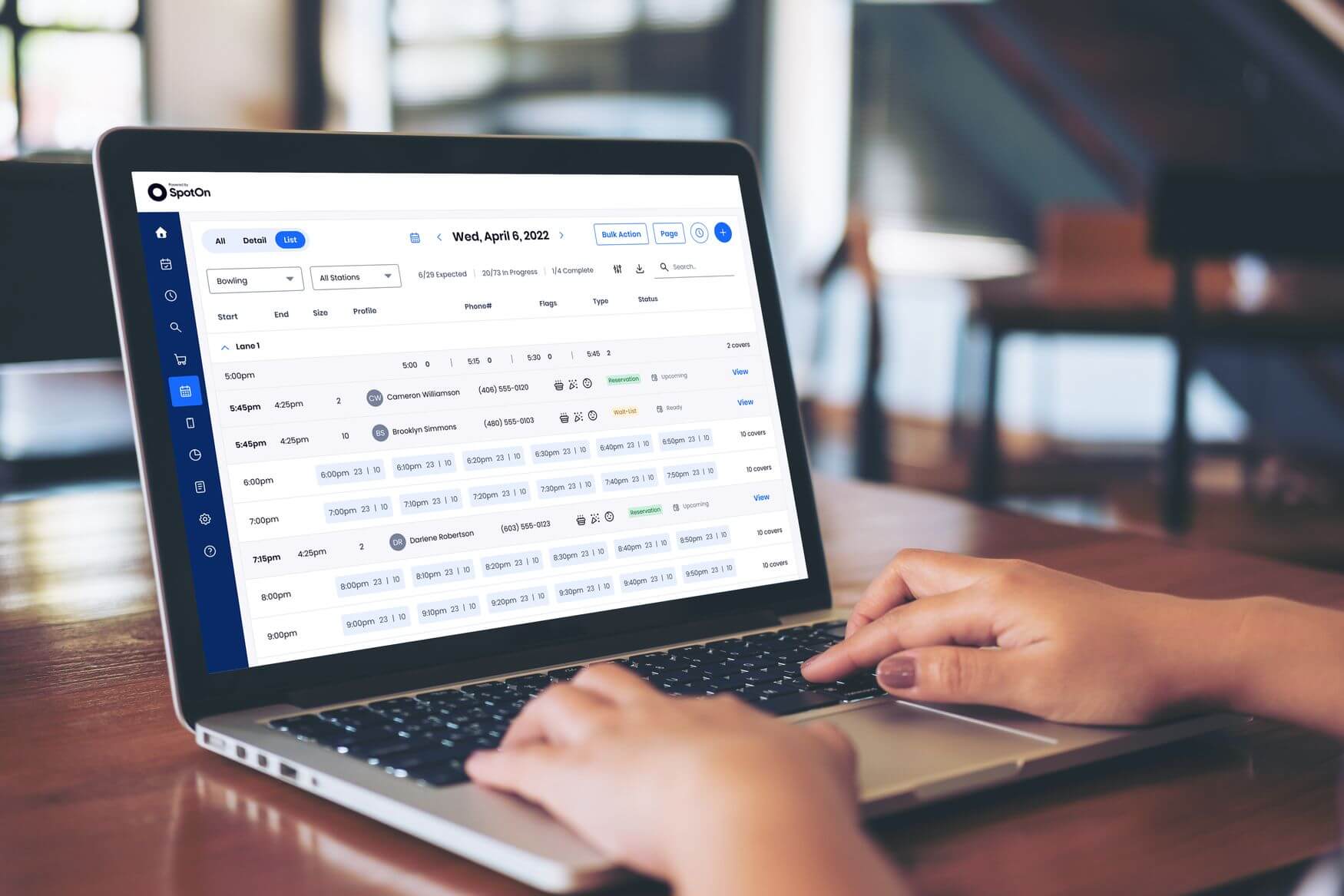
SpotOn POS system on laptop

Image from SpotOn press release

According to SpotOn, the industry could be in for a tech revolution next year as independent operators pursue more powerful POS solutions.

The results of a survey conducted by the cloud-based POS platform are rather revealing. In an effort to better understand where the industry is heading, SpotOn surveyed 300 independent and small-chain restaurant operators.

Both full-service and limited-service (LSR) concept operators participated in this SpotOn survey. Intended to identify the challenges operators face currently, the results reveal much more.

Below, the picture these survey results paint for the industry.

Legacy vs. Innovation

This isn’t the first time I’ve stated the following: Our industry hasn’t been the fastest to implement new technology.

However, we did appear to turn that around in 2021. Now, heading into 2023, our industry may be pursuing cutting-edge tech solutions even more fervently. Today’s guest expects more tech, and your team likely wants access to more modern tech that makes their jobs easier.

Per SpotOn’s survey, 81 percent of independent operators still use so-called “legacy” POS systems. These are “traditional” systems from companies that have been around for quite some time.

It’s not difficult to understand why the vast majority of independent operators continue using legacy systems:

  • Investing in a new platform requires expenditures of money and time.
  • Introducing a new POS platform requires staff training.
  • Staff need to grow adept at using the new system.
  • It can be daunting to research the available platforms and implementing change.

So, independent and small-chain operators have a choice to make: Stick with the familiar or invest in the future. Change can not only be intimidating, it can be expensive.

However, it seems that most operators are ready to throw comfort to the wayside and embrace innovation.

State-of-the-art Benefits

Should the SpotOn survey prove to be accurate snapshot of the industry, 75 percent of operators will implement new tech next year. According to SpotOn, this is largely in response to growing labor challenges, such as scheduling and retention.

The restaurant, bar, nightclub, and food truck platform found that operators are spending as much as 20 hours per week on administrative tasks. State-of-the-art POS systems can slash those hours by:

  • streamlining operations;
  • making scheduling simpler;
  • calculating tips and payout for payroll; and
  • managing overtime, an increasingly common task.

More modern POS platforms can automate labor management tasks, saving operators time, money, and frustration. Automation and streamlining give operators something invaluable: time.

In particular, innovative and helpful tech solutions provide an operator with time to focus on growing their business. When weighing whether to keep a familiar but less feature-rich POS system or invest in a modern platform that seamlessly integrates many solutions, ask yourself a couple important questions:

  • What’s my time worth?
  • What am I focusing on every day?
  • Am I growing my business or stagnating?
  • Is my current POS system helping or hindering my team?
  • Does my POS system streamline and automate any tasks?

Image: SpotOn

by David Klemt David Klemt No Comments

Are You Rewarding Voters Today?

Are You Rewarding Voters Today?

by David Klemt

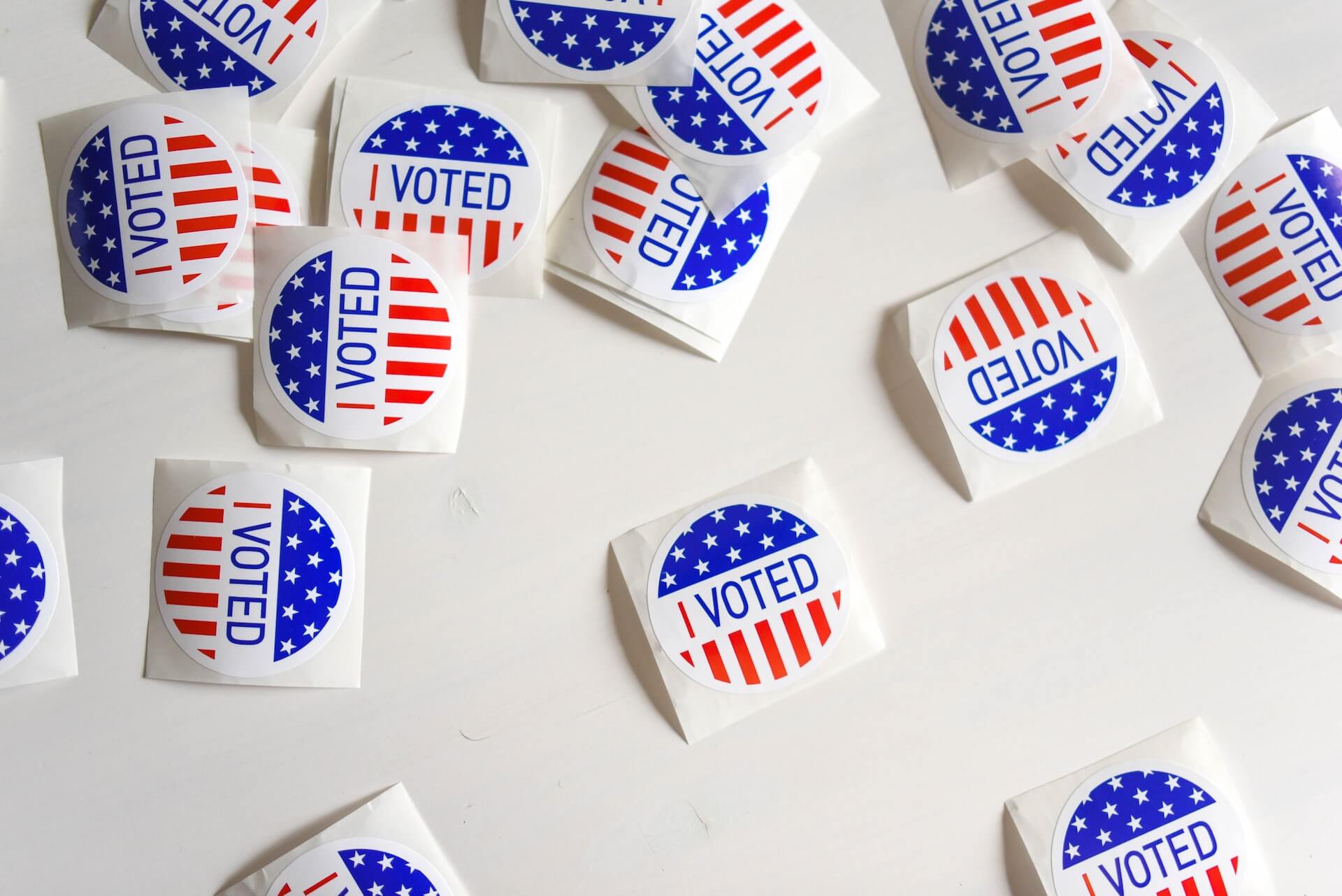
"I Voted" stickers on a white background

Voting is one of the hallmarks of democracy, a right and privilege so crucial that one can’t overstate or exaggerate the value and importance.

It is, therefore, supremely unfortunate that access to this right has become so acrimoniously political. Of course voting relates to politics—that’s a given. That doesn’t mean the act itself should be disingenuously politicized for twisted means.

For example, far too many people have grown convinced that their vote means nothing. Further, it’s an outrage that voting is made so difficult for so many who know voting matters.

So important is this fundamental right, there are three amendments to the US Constitution protecting it specifically: the Fifteenth, Nineteenth, and Twenty-sixth.

Before going further, I’m not this passionate in support of only those who vote “my way.” I want every American of voting age to have easy access to cast their ballot. Equally as important to me, I want every American to feel like their vote means something.

Of course, that also means accepting results we don’t like. We don’t always get our way in a democracy, after all.

This is all to say the following: Operators can play a role in elections. A simple-yet-important role.

Encourage Voters

I’m not the first to say it: Restaurants and bars are the cornerstones of their communities.

Back in June, I expressed the role our industry plays across the country and globe: “Restaurants and bars are pillars, cornerstones of the communities they serve. These are businesses that welcome people in, treat them like family. They’re there for them as they move through their lives. People who were seemingly at odds with another routinely found common ground over a bite and a sip. More often than not, that’s still the case.”

I still believe this, and that’s why I believe operators can play a role on this Election Day, and those in the future. The role is simple but powerful: Encourage your community to get out there and vote.

Now, one clear way to motivate your community to get out there today is to reward those wearing “I Voted” stickers when they visit your restaurant or bar. It’s commonplace now for operators to offer voters food and drink discounts, free menu items, or other perks on Election Day.

Restaurants and bars around the country routinely execute this type of promotion. From free sides and snacks to discounts on entrees and drinks, operators throughout the US find ways to encourage voting.

Proceed with Caution

Just keep something in mind: Legal scholars say that when federal candidates are on the ballot, such promotions are illegal.

The interpretation of a particular federal statute makes it illegal to pay people to vote. “Paying” includes providing something of value in exchange for voting, such as food or a drink.

One workaround is to ensure anyone who enters your business can participate in your promotion. No “I Voted” sticker? No problem. A guest says they haven’t voted? Not a disqualification.

Another solution is to simply encourage your social media followers to vote and come by for a visit. No reward, necessarily, just encouragement to exercise their right.

In other words, be the supporter and motivator your community needs. And be careful about any promotions you may be offering today.

Image: Element5 Digital on Unsplash

by David Klemt David Klemt No Comments

5 Books to Read this Month: November 2022

5 Books to Read this Month: November 2022

by David Klemt

Flipping through an open book

This month’s engaging and informative book selections will help you hone your culinary, cocktail, and leadership skills to dial in your menus and operations.

To review October’s book recommendations, click here.

Let’s jump in!

Shaya: An Odyssey of Food, My Journey Back to Israel: A Cookbook

The next time you visit New Orleans, plan to dine at least once at the James Beard Award-winning Shaya. I’ve had the opportunity to do so and the experience was stunning. Of course, you’ll also want to check out Domenica and Pizza Domenica while in NOLA. To give you an idea of what to expect, pick up the Shaya cookbook.

Chef Alon Shaya’s personal journey through cooking is truly unique, embracing Israeli, Italian, and American Southern cuisines. Shaya tells Chef-operator Shaya’s moving story and more than 100 incredible recipes. Pick it up at Amazon.

Turkey and the Wolf: Flavor Trippin’ in New Orleans

After moving to New Orleans and working in fine dining, Chef Mason Hereford opened his own restaurant and put his stamp on the scene: Turkey and the Wolf. Both the restaurant and this cookbook focus on creative and enticing takes on Southern cooking.

Fancy deviled-egg tostadas? Fried bologna sandwiches absolutely heaving with potato chips? How about purposely burnt tomato casserole? Well, you’ll find these recipes and 92 others in this book, along with photographs and illustrations. This is sure to get you salivating and get your creative wheels turning. Grab Turkey and the Wolf here on Amazon.

Last Call at Coogan’s: The Life and Death of a Neighborhood Bar

As those of us in the industry know, restaurants and bars are the cornerstones of the communities they serve. Last Call at Coogan’s is the true tale of a neighborhood bar that, unfortunately, closed its doors for good during the pandemic after more than 30 years in operation.

From Amazon: “This book touches on many serious issues facing the country today: race relations, policing, gentrification, and the COVID-19 pandemic. Along the way, readers will meet the bar’s owners and an array of its most colorful regulars.” Purchase here via Amazon.

Spiritual Coffee

Bar co-founder, bartender, brand ambassador, and author Martin Hudak’s informative and exciting cocktail book is available now for purchase. Hudak is one of the brilliant minds behind Sydney destinations Maybe Sammy and Sammy Junior. Also, he’s a brand ambassador for Mr. Black, the ridiculously tasty coffee liqueur.

Spiritual Coffee focuses on coffee cocktails, a passion of Hudak’s. However, you’ll get more than recipes when you purchase this entertaining book. In these pages you’ll also find a wealth of coffee history, knowledge, and stories. Buy here!

The Future Is Analog: How to Create a More Human World

This book, from award-winning author David Sax, asks poignant culture questions about our rush toward a digital world, an undertaking that was supercharged during the pandemic.

“Is our future inevitably digital? Can we reject the downsides of digital technology without rejecting change?” Sax asks. “Can we innovate not for the sake of productivity but for the good of our social and cultural lives? Can we build a future that serves us as humans, first and foremost?” Purchase here via Amazon.

Image: Mikołaj on Unsplash

by David Klemt David Klemt No Comments

Stand Out with Weird Holidays: Nov. 2022

Stand Out with Weird Holidays: November 2022

by David Klemt

Stay Weird neon sign with purple background

Want to stand out from from other restaurants and bars in your area? Then commit to keeping it weird.

Several “holidays” are set against every date on the calendar, and November is no exception. These holidays range from mainstream (Thanksgiving, anyone?) to “weird.”

Pay attention to the latter to raise eyebrows, carve out a niche for your restaurant or bar, and attract more guests. Why do what everyone else is already doing?

Of course, you shouldn’t try to celebrate every holiday, weird or otherwise. And this month’s list in no way includes every odd holiday.

Focus on the days that are authentic to your brand; resonate with your guests; and help you grab attention on social media.

For October’s list, click here.

November 4: National Candy Day

So, you would think we’d celebrate National Candy Day on Halloween, what with all the trick or treating. But no, we celebrate candy the first week of November.

This could be an excellent day to move any candy-themed menu items that may have somehow survived your Halloween programming. Or, hey, lean into it and garnish a number of cocktails with candy.

November 6: National Nachos Day

I know, I know—nachos aren’t weird. No, they’re one of the most fantastic foods on the planet. In fact, one could argue they’re among the culinary pinnacles of human achievement.

However, that doesn’t mean we can’t get a little weird and creative with nachos. Think outside the box (or platter), get with your back-of-house team, and come up with a unique nacho plating or two.

November 8: National Tongue Twister Day

There are a few ways to approach this holiday: create an LTO menu with tongue-twister descriptions; give menu items tongue-twister names; theme some drinks to well-known tongue twisters; or hold a tongue twister contest. Here’s one to get you started:

“Betty Botter bought some butter / But she said the butter’s bitter / If I put it in my batter, it will make my batter bitter / But a bit of better butter will make my batter better / So ‘twas better Betty Botter bought a bit of better butter.” Good luck.

November 12: National Pizza with the Works Except Anchovies Day

I’m including this because I like how oddly specific this holiday is. No thanks to the humble anchovy, apparently!

November 15: National Clean Out Your Refrigerator Day

Okay, so I’m not sure I’d actually call this holiday Clean Out Your Fridge Day. Instead, consider creating and adding a specific promotion to your programming repertoire.

For example, if you’re a wine bar, consider using this day to move open but unfinished bottles of still and sparkling wine before they oxidize or go flat. I’m not a fan of operators discounting menu items but in this case, doing so is better than the alternative. This can be done once per week, twice per month, once per month, etc.

November 17: Use Less Stuff Day

This is an excellent holiday to commit to a couple different operational changes. One, do whatever is practical to reduce the waste your restaurant, bar, nightclub, or hotel generates. Two, consider reviewing your menu and simplifying where you can.

November 20: National Absurdity Day

I mean…does any day scream “WEIRD HOLIDAY!” more than National Absurdity Day? The sky’s the limit here: get as weird, wacky, and creative as you can in a way that’s authentic to your brand and market.

November 24: Celebrate Your Unique Talent Day

Have a talented team? Boast a group of talented regulars? Encourage them to show off their unique skills talent show style, offering prizes and capturing your event via social media.

November 25: Blasé Day

The holiday season is stressful. It’s go, go, go, family, family, family, friends friends, friends, for several weeks. So, create a “lazy” promotion that provides your guests with a calm escape from their holiday stress. Be the oasis they need as the year closes out.

November 30: National Mason Jar Day

Ah, the mason jar. Its wide mouth and fit in most people’s hands is both rustic and comforting. They’re also perfect for a wide array of garnishes. In fact, consider serving over-the-top Bloody Maries in your mason jars…or moonshine cocktails…or beer cocktails… just great cocktails.

Image: Dan Parlante on Unsplash

by David Klemt David Klemt No Comments

How a Chain Lost My Business Forever

How the Staff at a National Chain Lost My Business Forever

by David Klemt

Chocolate cookie and cookie crumbles

An unfortunate and entirely avoidable guest experience debacle guarantees that I’ll never spend another dollar at a particular national American chain.

What was supposed to be a small treat and excuse to get outside for a bit went downhill quickly.

Now, before I begin, I tend to shrug at poor service. Truly, a front-of-house team member has to go pretty far for me to do more than raise an eyebrow.

Given how the past two years-plus have gone, my tolerance has only grown. Everyone has bad days, including restaurant, bar, and hotel staff. In fact, I tend to assume that someone is simply having an off day due to an array of reasons: working several days in a row, opening and closing multiple times a week; having more responsibilities heaped on them due to being short staffed; a seeming increase in abuse from guests; stress spilling over onto the job; etc.

However, that doesn’t mean I’ll always return to be subjected to poor service in the future. What I experienced yesterday falls into this category: I won’t spend my money with this chain ever again.

Third-party Issues

As stated above, my visit to this national chain (600-plus locations) was intended to be a small treat. It was Halloween, they specialize in a particular type of confection, so why not?

Also, the temperatures have been in the 70s and lower in Las Vegas—perfect for a trip on my motorcycle. So, two treats in one, really.

Okay, so I’m going to do something I don’t like doing here: making an assumption or two. I think, however, I’m basing them on sound reasoning.

Additionally, I don’t like to use third-party delivery. In this case, the order was placed via Uber Eats for pickup using a monthly credit. Zero offense to third-party delivery drivers—it’s the corporations behind the services and the fees they charge operators I don’t support.

So, my assumption is that because the order came in via Uber Eats the staff figured I was “just” a delivery driver.

Downhill Fast

I’ll concede that this visit didn’t start off on the wrong foot: I received a decent welcome. Since I was picking up the order, I stood at the pickup counter, and confirmation came in before I arrived that the order was ready.

There were three guests waiting when I walked in, and one by one they got their orders and left. I didn’t think anything was going wrong until people walked in after me and received their orders. In terms of this chain, my order was on the smaller side.

After several minutes of being ignored, I was asked if I was picking up for Uber Eats. I clarified that no, I’m not an Uber Eats driver, I was picking up my order placed via Uber Eats.

Another several minutes went by as I watched larger orders get fulfilled ahead of mine. And then I was asked again—by the same staff member—who I was picking up for. Again, not an Uber Eats driver—my order.

At this point, I had been waiting more than 10 minutes. When I was finally given my order, I noticed another difference. Staff members showed guests their orders to confirm the contents before handing them over. My order, however, was taped closed behind the counter and handed to me.

It didn’t strike me that this is how this staff treats Uber Eats driver until I was on my bike. And that’s the problem.

Standards of Service

If this is how staff treats third-party delivery drivers, it’s appalling. There’s no excuse for treating drivers differently just because they aren’t the guest themselves or fellow employees.

Let’s be clear: anyone walking through a restaurant, bar or hotel’s doors deserves at least decent service. There are several reasons for this, and I shouldn’t have to address them. But, hey, we’re already here, so why not address a couple?

First, standards. If your staff is purposely treating a group of people poorly because they think they can do so without ramifications, your standards have slipped or there simply aren’t any. That’s a problem.

Are team members going to get to know regulars? Absolutely. Are they going to have favorites. Of course! And there’s nothing wrong with that. In fact, that’s what should happen—every front-of-house team member should cultivate their own regulars.

So, yes, some guests will treated differently. There’s a huge difference, however, between subjecting some guests to poor service intentionally and delivering outstanding service to favorites.

Quite simply, the minimum standard of service should be great service. “Decent” sucks; great should be the baseline.

Regulars and guests who staff have rapport with should receive service that’s above and beyond the standard level. Rock star servers and bartenders deliver outstanding service to everyone, regular or first-timer, gracious guest or grump.

Different Treatment?

Second, your staff shouldn’t be treating third-party delivery workers like they don’t matter. There’s zero room in hospitality for treating people poorly—doing so is in direct opposition to the spirit of this profession.

In fact, they shouldn’t treat difficult guests with anything but your expected standards. Leadership team members should be confronting rude or difficult guests, protecting the rest of the team.

I’ve read and heard about restaurant staff treating third-party delivery drivers poorly. Always, of course, with justifications thrown in: retaliation toward rude drivers, drivers not tipping…pick a reason. Again, if there’s a rude driver, staff should alert leadership and they should handle it.

Look, I’ve made no secret of my view on third-party delivery apps. Their fees and taking advantage of operators, particularly during the pandemic, infuriate me. And it’s easy to point at me and say I’m part of the problem, using a credit to place a third-party delivery. I’ll accept that criticism.

What I won’t do is return to a business with staff who think it’s acceptable to allow standards to slip and treat delivery drivers poorly. Most people seem to take delivery jobs to make ends meet. Hell, some of them are likely service industry professionals themselves working another job or jobs.

The labor shortage isn’t a valid justification for slipping standards or poor service. Dislike of third-party delivery services is no justification, either.

In fact, this chain obviously sees these delivery services as a viable income stream. The fact their staff doesn’t is a problem. If there’s a standard of service for this chain, it certainly wasn’t met when I was there. And if there’s a standard that I didn’t receive, there are several other problems.

Either way, the damage is done.

Image: Andre Moura via Pexels

by David Klemt David Klemt No Comments

Menus in Canada: Who Wants What Items?

Menus in Canada: Who Wants What Items?

by David Klemt

Bar and restaurant food and drink menus

Nobody has a crystal ball telling them what they should put on their menus to boost traffic and revenue, but we do have data.

In this instance, we have useful data regarding Canadian consumers specifically. Not only do we have helpful information from Restaurants Canada, David Henkes from Technomic has also weighed in. For those who are unfamiliar, Technomic is one of the best foodservice research and consulting firms.

Before we dive into Restaurant Canada’s menu trend information, this is not a review of the top menu item orders in Canada. For a deep dive into that topic in particular, please read our article “F&B in Canada: Top Menu Items.”

Instead, in this article we’re reviewing broader menu categories and interest in them among Canadian consumers. For your own copy of the 2022 Foodservice Facts report, click here.

Word of Warning

Now, it’s important to bear in mind that the data below is a snapshot. It’s important, informative data but it shouldn’t influence your menu completely.

In other words, when considering revising your menu in any way, make sure you’re staying true to your brand and the community you serve. If your data differs from Restaurants Canada and Technomic data, that’s okay.

Not only are there always outliers, not all data applies to every concept. So, don’t take drastic action on your menus based solely on the data below.

For this particular topic, Restaurants Canada asked three age groups about their interest in eight menu categories.

The groups are: 18 to 34, 35 to 54, and 55-plus. The industry advocacy group then reviewed the numbers for those who indicated they’re “very interested” or “somewhat interested” for each category or item.

Who Wants What?

The menu category generating the most interest from Canadian consumers, according to Restaurants Canada data, is food sourced from local farmers. Overall, 93 percent of survey respondents very or somewhat interested. Those in the 55-plus age group are the most interested.

More than 80 percent are interested in comfort foods, or creative riffs on comfort foods. Age groups 18 to 34 and 35 to 54 have the most interest. Precisely 80 percent are interested in trying globally inspired foods and flavors, led by the 18 to 34 age group.

Foods that promote health and wellness come next, with 79 percent of Canadian consumers showing interest. The 55-plus age group is particularly interested. However, dishes that utilize ingredients that boost one’s immune system are only popular among 53 percent of survey respondents. Interestingly, it’s the 18 to 34 age group with the most interest in this category.

In what’s possibly a contrast from American consumers, the final three categories have no more than 41 percent of survey respondents’ interest. Forty-one percent have interest in meatless and vegetarian items. Next, just 38 percent show interest in alcohol-free cocktails. Finally, just 33 percent are interested in plant-based burgers and sausages.

For each of those categories, the greatest interest comes from the 18 to 34 age group, and the 55-plus group shows the least amount of interest.

Recommended Reading

We’ve been reviewing the 2022 Foodservice Facts report from Restaurants Canada in depth for several weeks. To learn more about this important report, please read the following:

Image: Samuel Regan-Asante on Unsplash

by David Klemt David Klemt No Comments

Raise a 7&7 to National Dive Bar Day

Raise a 7&7 to National Dive Bar Day

by David Klemt

Dive bar or neighborhood bar

We celebrate one of the most hallowed of drinking establishments on July 7, also known as National Dive Bar Day.

Look, we love a visit to a high-end, luxurious cocktail bar. But there’s nothing quite like discovering a casual, comfortable, unpretentious bar that feels like home.

Often times, the local watering hole is a cornerstone of a given community. So, we’re looking forward to the fifth annual National Dive Bar Day in just over two weeks.

You should have plenty of time if you’re a dive or neighborhood bar owner to create your National Dive Bar Day promotion.

A Little History

It’s hard to believe that National Dive Bar Day is a mere five years old. In fact, Seagram’s 7 Crown launched the first annual celebration in 2018.

Not only does this holiday honor a true institution, Seagram’s donated $25,000 to the National Trust for Historic Preservation on its inception. (This year, Seagram’s 7 Crown is supporting Main Street Alliance.)

This makes a lot sense when you think about it. After all, dive bars are often located in a historic building or are landmarks themselves.

Some people may not like it, but drinking culture is an integral part of many a community across not just America, not just North America, but the world.

Not so long ago a bartender could set beers and shots in front of two people with opposing views and they’d find common ground to bond over. The optimist in me hopes we can return to those days, visiting our local neighborhood bars and focusing on what we all have in common rather than letting ourselves grow further divided.

Where some people see a “just” a dive bar, those of us in the know see social and cultural centers that support neighborhoods and communities.

Given their commitment to unpretentious and welcoming service, we need to support and protect our local dives.

What Makes a Dive Bar?

There are some key elements that set dive bars apart from other drinking establishments.

Characters on both sides of the bar, inexpensive drinks, familiar bar food, and an approachable feel are, I would say, the hallmarks.

Now, there are those who think a dive bar also includes an “earthy” smell, to be generous. They may also feel that they call dirty buildings with questionable structural integrity home.

However, “dive” doesn’t have to mean filthy. First and foremost, a dive bar needs to be comfortable and welcoming. Filth tends to give off an unwelcoming, dangerous vibe. That’s not exactly the spirit of hospitality.

Just as a great dive bar should be clean, it should also have a solid F&B program. Inexpensive doesn’t have to mean cheap. Oh, and no, the staff doesn’t have to be surly and untrained.

Dives are Neighborhood Bars

When I first learned about Nickel City, as an example, I saw what a dive bar should be. Both locations, Austin and Fort Worth, are described by co-owner Travis Tober as “anytime bars.”

Nickel City commits to serving the community, and they’re open when people need them. In fact, as you’ll learn during episode 50 of the Bar Hacks podcast, Tober made sure they were open to serve people during the infamous winter storm of 2021 that shut down much of Texas.

In speaking with Tober and reading other interviews with him, I learned that he prefers the term “neighborhood” to “dive.” Due in part to the negative perception some have of dive bars, I can understand his preference.

In my opinion, the difference lies in subtle but important nuances. However, I’ll probably still refer to neighborhood bars as dive bars.

Either way, Nickel City is a dive bar done right and a concept that other operators should certainly study. Nickel City is exemplary, a standard that dive/neighborhood bars should aspire to reach.

The 7&7

As far as Seagram’s is concerned, the 7&7 is “the quintessential Dive Bar drink.” It’s difficult to argue: it’s a highball, it’s fast and simple to make, it’s refreshing, and it shouldn’t be pricey.

But, hey, if you’ve never made or ordered one, here’s the recipe:

Simply prepare a highball glass with ice, add Seagram’s 7 Crown and 7UP, and stir. Then just stir, garnish, and serve.

Cheers!

Image: Florencia Viadana on Unsplash

by David Klemt David Klemt No Comments

8 Glendalough Cocktail Recipes for St. Patrick’s Day and Beyond

Offer your guests something different for your St. Patrick’s Day promotion with Glendalough Distillery cocktail recipes.

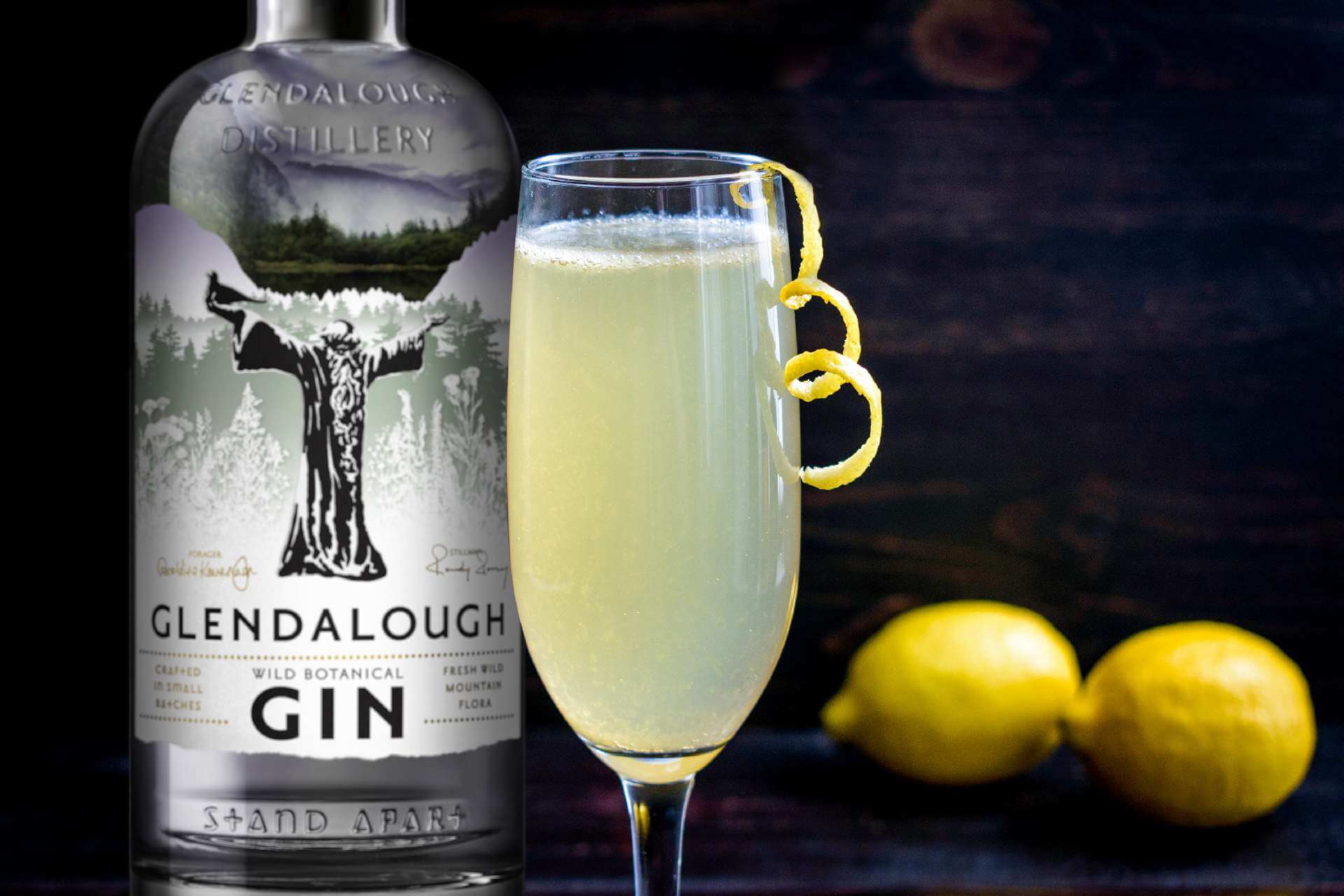
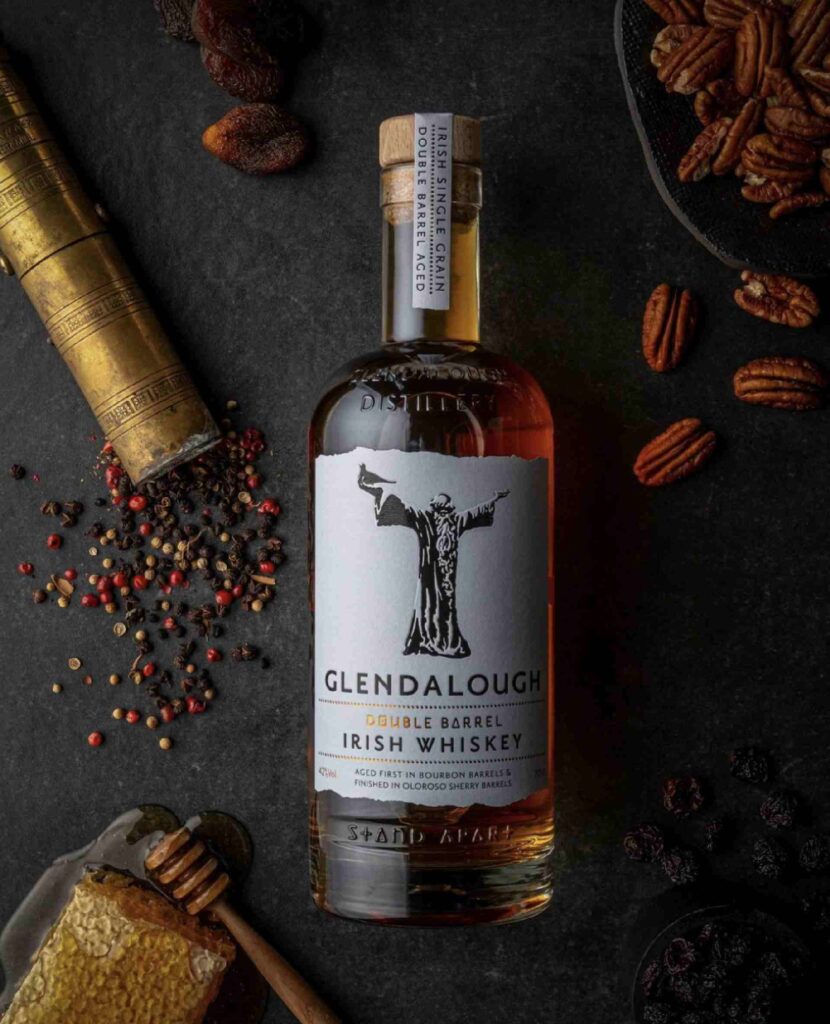
Without a doubt, you should have plenty of the expected Irish whiskeys on hand. However, Glendalough Distillery Double Barrel, Pot Still, Wild Gin, and Rose Gin are extraordinary Irish whiskeys and gins.

Each spirit the distillery crafts honors the art of Irish distillation, a craft that stretches back centuries. What’s more, each whiskey Glendalough crafts is single malt—there are no light-bodied blends in their lineup.

To learn more, check out episode 71 of the Bar Hacks podcast with Glendalough Distillery co-founder and national brand ambassador Donal O’Gallachoir.

by David Klemt

Glendalough Distillery Wild Gin Irish gin

8 Amazing Irish Whiskey and Gin Cocktails

Below, eight refreshing and sophisticated drink recipes made with Glendalough whiskeys and gins. Sláinte!

Glendalough Distillery Double Barrel Single Malt Irish Whiskey

The Lough Inn

This highball is made with Glendalough Double Barrel, a single-grain Irish whiskey aged in ex-bourbon barrels before being finished in Oloroso sherry casks.

  • 2 oz. Glendalough Double Barrel Single Grain Irish Whiskey
  • 1 oz. Spiced honey syrup (see note)
  • 1 oz. Fresh lemon juice
  • Soda to top
  • Lemon wheel or slice to garnish
  • Mint leaf to garnish
  • 1 cup Honey for spiced honey syrup
  • 0.5 cup Water for spiced honey syrup
  • 4 Cinnamon sticks for spiced honey syrup
  • 1 pod Star anise for spiced honey syrup

Add ice to a highball glass, then add first three ingredients. Top with soda water. Garnish with lemon wheel or slice and freshly torn mint leaf.

For spiced honey syrup: Add honey, water, cinnamon sticks, and star anise to pot. Bring to a boil, then stir. Strain into container.

Glendalough Distillery Pot Still single malt Irish whiskey

Pot Still Highball

Deceptively simple to build, this cocktail highlights the terroir of the land surrounding Glendalough Distillery.

  • 1.5 oz. Glendalough Pot Still
  • Soda to top
  • Grapefruit peel to garnish
  • Mint leaf to garnish (freshly torn and slapped, of course)

Prepare a highball glass with an ice shard, spear or cylinder. Pour in Glendalough Pot Still whiskey, then top with soda. Glendalough Distillery recommends a 1:2 ratio, Pot Still to soda. Garnish with mint leaf.

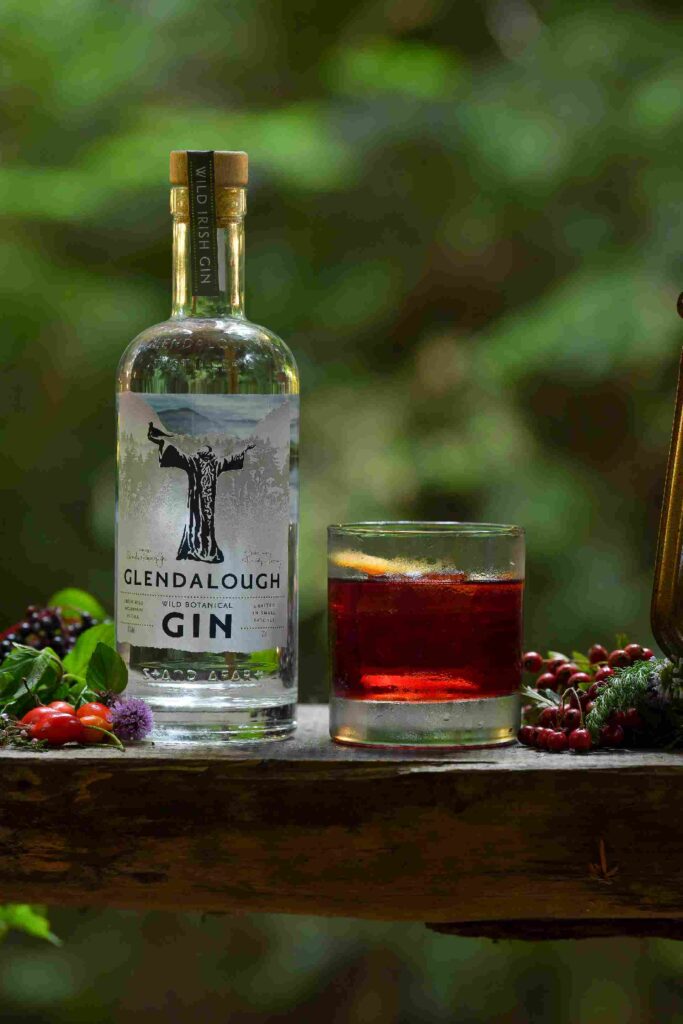
Glendalough Distillery Wild Gin Negroni cocktail

Glendalough Negroni

The foraged botanicals in Glendalough Wild Gin add even more complexity and depth to the classic Negroni. In fact, the flavors work so well this recipe maintains the Negroni’s crucial 1:1:1 ratio.

Prepare an Old Fashioned with ice. Add first three ingredients to glass in the above order. Add more ice if necessary. Stir, express orange peel, and place as garnish.

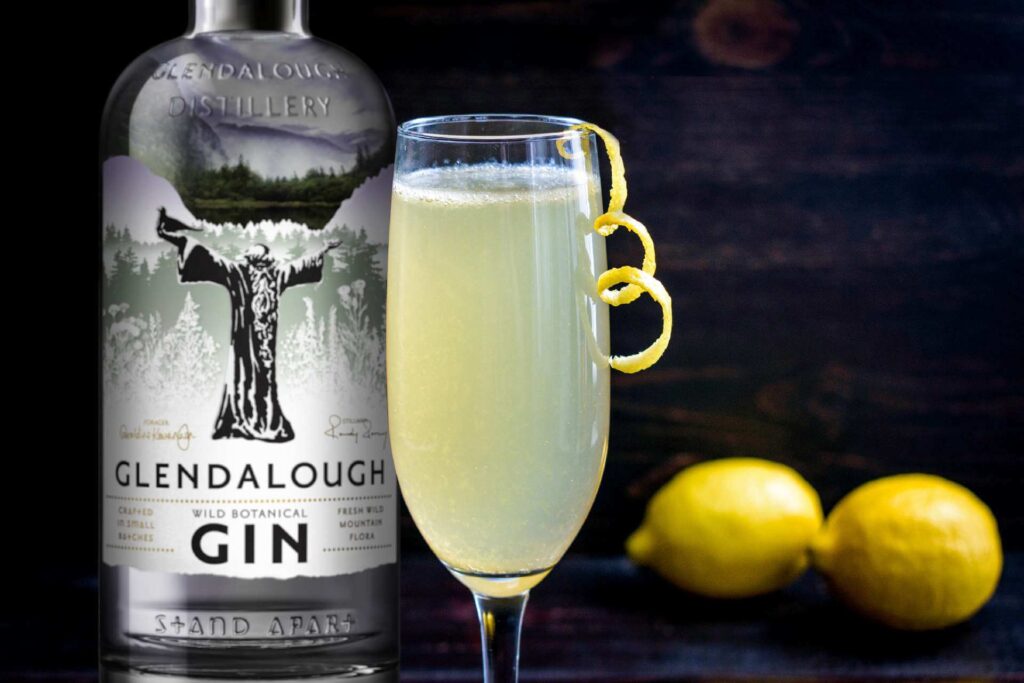
Glendalough Distillery Wild Gin Irish gin

Glendalough Wicklow 75

Bubbles make everything better and everyone happier.

Add all ingredients to shaker. Add ice and shake until well chilled. Strain into Champagne flute, top with Prosecco, and garnish with lemon twist.

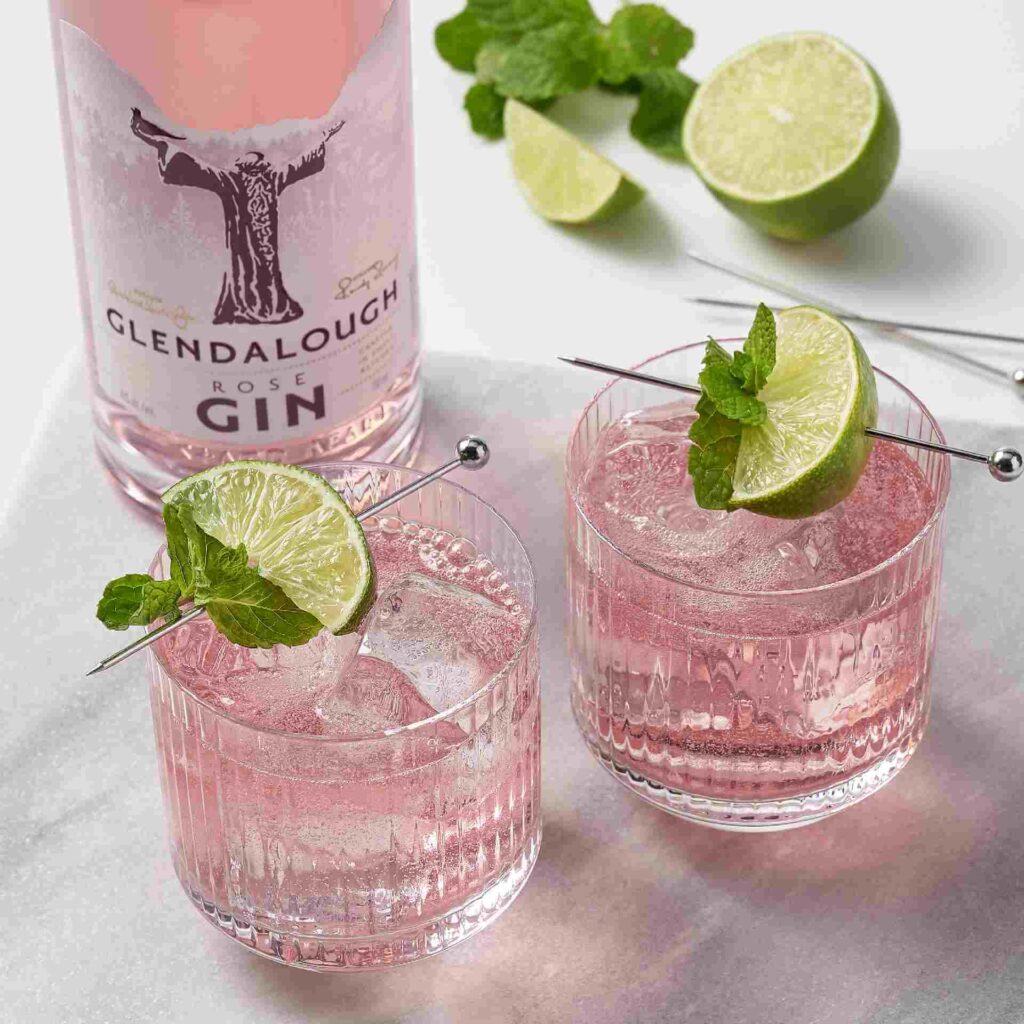
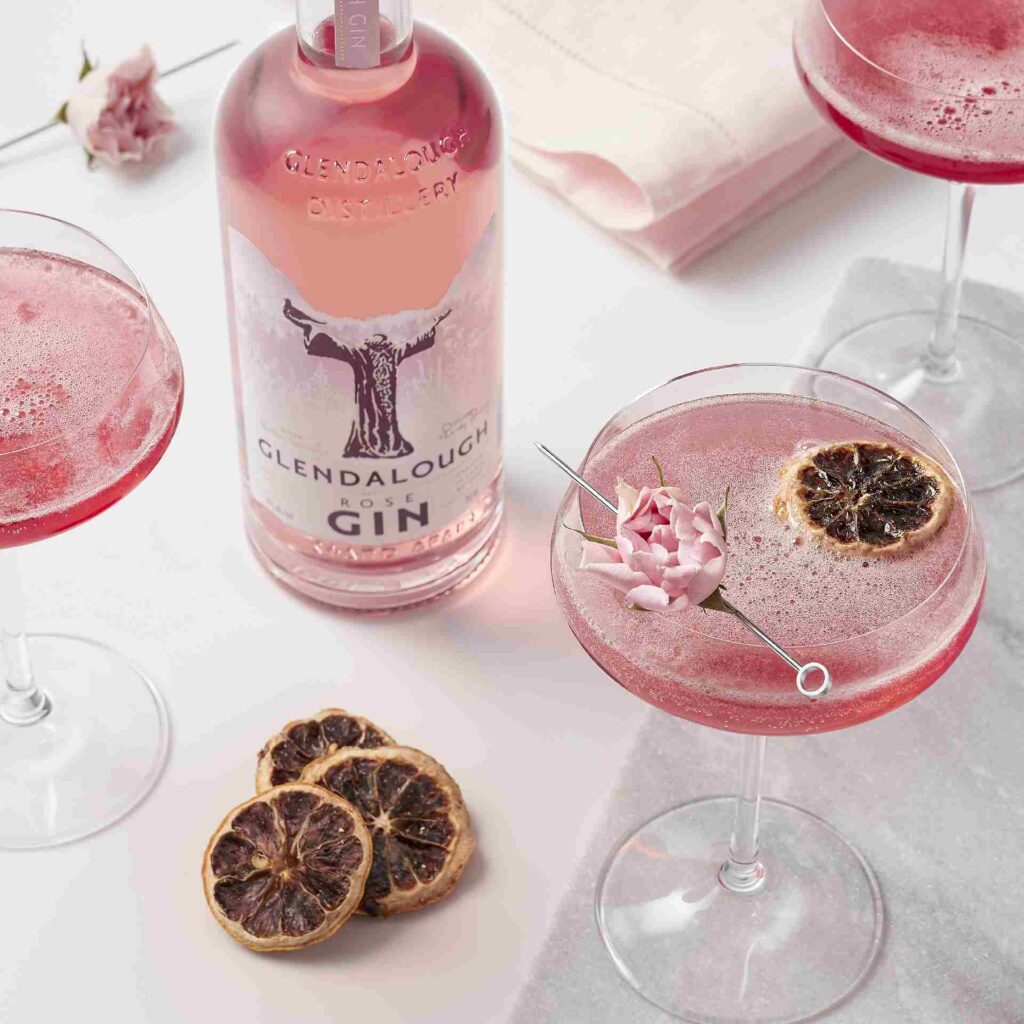
Glendalough Distillery Rose Gin Irish gin and cocktails

Glendalough Rose G&T

This simple classic receives a huge visual and aromatic boost from Glendalough Rose Gin.

  • 2 oz. Glendalough Rose Gin
  • Tonic to top (the higher the quality, the better)
  • Lime slice
  • Mint leaves

Add ice to glass, then add Rose Gin. Top with tonic, and garnish with lime slice and mint leaves.

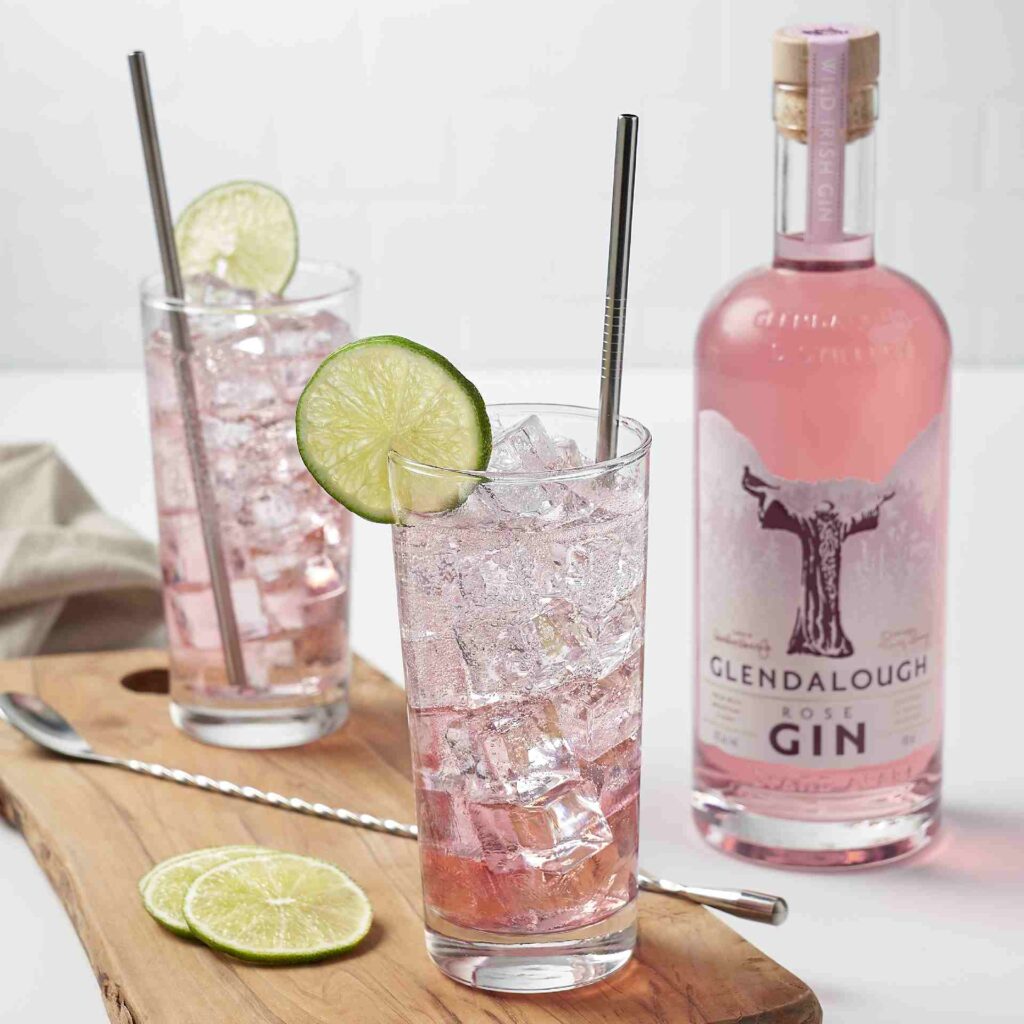
Glendalough Distillery Rose Gin Fizz

Glendalough Rose Gin Fizz

One way to elevate the highball is to use a striking pink-hued Irish gin.

  • 1.5 oz. Glendalough Rose Gin
  • 0.5 oz. Elderflower liqueur
  • Raspberry & Lime sparkling water to top
  • Lime wheel to garnish

Add ice (spear, shard or cylinder for impact), Rose Gin, and liqueur to highball glass. Stir, then add sparkling water to top. Garnish with lime wheel.


View this post on Instagram


A post shared by Glendalough US (@glendaloughus)

Glendalough Rose Collins

Boost the classic Collins with Glendalough’s striking rose-petal gin.

  • 1.5 oz. of Glendalough Rose Gin
  • 1 oz. of Lemon juice (freshly squeezed)
  • 0.5 oz. of Sugar syrup (1:1 ratio, hot water to sugar)
  • Soda to top
  • Lemon peel to garnish
  • Cherry to garnish

Combine first three ingredients in a shaker with a cup of ice. Place an ice shard, spear or cylinder to a highball glass. Shake until well chilled, then strain into glass. Top with soda, and garnish with lemon peel and cherry.

Glendalough Distillery Rose Gin Hibiscus Rose

Glendalough Hibiscus Rose

Refreshing and flavorful, the hibiscus tea syrup plays incredibly well with Glendalough Rose Gin.

  • 1.5 oz. Glendalough Rose Gin
  • 0.5 oz. Hibiscus tea syrup (see note)
  • 0.5 oz. Lemon juice (fresh squeezed)
  • Prosecco to top
  • Dehydrated lemon wheel to garnish
  • Rose petals to garnish
  • 33 oz. Water for hibiscus tea syrup
  • 16 oz. Sugar for hibiscus tea syrup

Add first three ingredients and ice to a shaker. Shake until well chilled and double strain into a coupe.  Top with Prosecco, and garnish with dehydrated lemon wheel and rose petals.

For the hibiscus tea syrup: Steep seven hibiscus tea bags in 33 ounces of water for 15 minutes. Add 16 ounces of sugar.

Images & Recipes: Glendalough Distillery

Related Reading

Work with Us

Click the image below to partner with us on your project.

Client Intake Form - KRG Hospitality

by David Klemt David Klemt No Comments

Some Texas Operators Keep Masks in Place

Some Texas Operators Keep Masks in Place

by David Klemt

Face mask Covid-19 graffiti

Texas is less than a week away from opening “100 percent” according to Governor Greg Abbott.

Three things in life are certain: death, taxes, and Texans aren’t fans of being told what to do.

Data shows an increase in coronavirus cases in Texas but that isn’t stopping Gov. Abbott from announcing all businesses can open at 100-percent capacity and the state’s mask mandate is no more as of March 10.

Political, Practical or Perilous?

Per Gov. Abbott, Texas have “mastered the daily habits to avoid getting Covid,” so it’s “now time to open Texas 100 percent.”

One of those habits, one would assume, is wearing a mask or other face covering to “avoid getting Covid,”

Doctors and health experts have been warning against complacency fueled by vaccines and cases dropping in some states. Another surge may be around the corner if people drop covid-19 safety measures in favor of a return to “normal” life.

Gov. Abbott’s announcement, therefore, calls into question his motivations: political, practical or perilous?

Some Operators Pushing Back

If we accept that one can’t tell a Texan what to do, we must apply that to restaurant and bar operators in the state.

Some Texas operators disagree with Gov. Abbott lifting of the mask mandate and are “100 percent” still requiring masks in their establishments post-March 10.

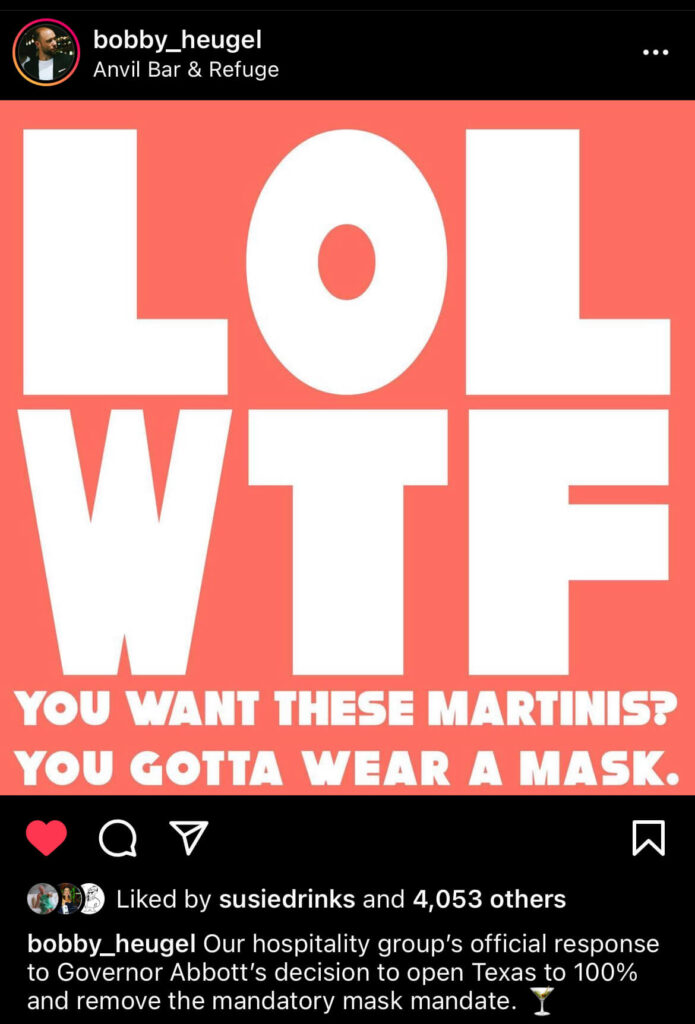
This message from Bobby Heugel, the operator behind Anvil Bar & Refuge, Tongue-Cut Sparrow, Better Luck Tomorrow and Squable in Houston, is straightforward. It’s also garnering plenty of support, with people thanking Heugel and pledging to spend their money at his businesses.

In response to a question by one commenter on the post, Heugel explains that the hospitality group is maintaining 50-percent capacity, socially distanced seating, and other CDC guidelines “until vaccination rates improve.”

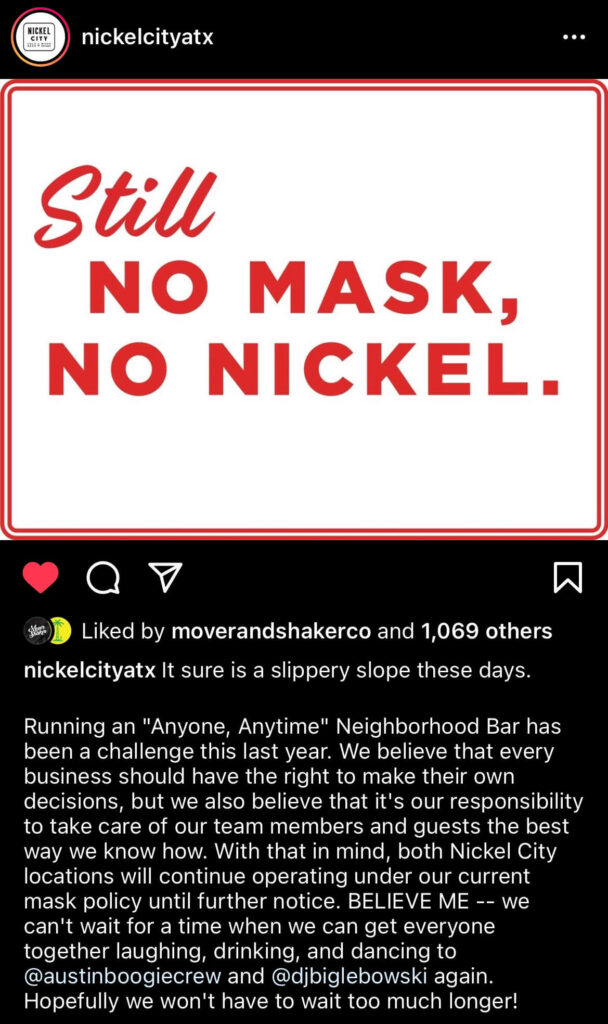
Nickel City operations locations in Austin and Forth Worth. As the above statement makes clear, guests must wear masks inside their venues regardless of what Gov. Abbott says. Like Heugel’s, Nickel City’s statement is garnering support.

Whether the governor’s move proves wise or foolish will bear out in the coming weeks. However, the decision will likely once again put front-of-house workers at risk of hostile confrontations with guests who take wearing a mask as a personal attack on their liberty.

Still Struggling

To be fair, Gov. Abbott isn’t going it alone in terms of rolling back a mask mandate. Mississippi, Alabama, Iowa and Montana have made similar choices.

Going a further step toward fairness, a total of 16 states don’t have mask mandates in place. In fact, some never did. What has drawn attention is that Texas is the largest state to do away with its mask mandate (and the second largest state in the US in terms of population and area).

What grabbed my attention are the responses from well-known and respected operators who have chosen to still require masks and other Covid-19-related health and safety guidelines, along with the support they’re receiving from the public for doing so.

Multiple vaccines, a seemingly downward trend in infection rates, and the lifting of restrictions don’t magically solve operators’ problems—they’re struggling, as are their employees.

Follow this link to tell your representatives to pass the American Rescue Plan Act of 2021 and Restaurant Revitalization Fund now.

Image: Adam Nieścioruk on Unsplash

Top