Revenue

by David Klemt David Klemt No Comments

Understanding TAM, SAM, and SOM to Start, Stabilize or Scale Your Business

After working through this with a client the other day, we thought it would be a good opportunity to explain the acronyms of TAM, SAM, and SOM.

These concepts can help your business start, stabilize, or scale.

Let’s be real: in the hospitality industry, understanding your market and its potential is paramount for sustainable growth and profitability. This is where the concepts of TAM (Total Addressable Market), SAM (Serviceable Addressable Market), and SOM (Serviceable Obtainable Market) come into play.

For bars, restaurants, and hotels, these metrics aren’t just marketing or financial jargon. Each provides critical insights that inform feasibility studies, shape marketing strategies, and guide business decisions.

Below, we’ll break down each of these concepts, illustrate how to calculate them, and explain their role in building effective strategies for your hospitality business.

by Doug Radkey

Image of a person in a suit superimposed over a chart and city skyline

The Definitions

TAM (Total Addressable Market)

TAM represents the overall revenue opportunity available if your business held 100 percent of the market share. It is the entire potential market size without any constraints like geography, budget, sociographics, or operational limits.

Example: For a new bar, the TAM would represent the total annual spend of all consumers in your market who drink out, regardless of their preferences, location within a region, or budget.

SAM (Serviceable Addressable Market)

SAM is the portion of TAM that your business can reach realistically, given practical limitations like geographic location, regulatory constraints, more targeted sociographics, and operational scope. Going further, SAM also considers factors that make a portion of the TAM unfeasible for your business to serve.

Example: Using the same bar concept, SAM would represent all the people within a certain radius who are willing to visit a bar with a similar concept, who can afford your menu, and who are within your reach given your physical location.

SOM (Serviceable Obtainable Market)

SOM is the segment of the SAM that your business can capture. This metric accounts for your competitors, market share estimates, and your unique ability to attract your ideal guests within your SAM.

Example: For the bar, SOM would be the percentage of patrons within your SAM that you expect, realistically, to convert into regular guests, taking into account competition, unique value proposition, and brand positioning.

Why These Metrics Matter

Each of these metrics provides a progressively more realistic picture of your business’ revenue potential.

Your business plan cannot be “targeting males and females between 25 to 45 years old.” You have to go much deeper than that to be successful.

TAM shows you the broadest possible opportunity, but SAM narrows it down based on serviceable factors. SOM gives you a realistic goal to aim for based on your most targeted factors.

Their Role in Feasibility Studies and Marketing Plans

In hospitality, feasibility studies are essential for understanding whether a business idea is viable.

When you’re assessing the potential of a new bar, restaurant, or hotel, the TAM, SAM, and SOM calculations give you quantitative data that can help you avoid common mistakes such as overestimating your market potential, or failing to identify target demographics accurately.

Feasibility Studies

  • TAM Analysis: Helps validate whether there’s a broad demand for your concept.
  • SAM Analysis: Identifies a focused portion of the market that fits within your operational range.
  • SOM Analysis: Helps set realistic revenue goals by factoring in competition and market positioning.

When preparing a feasibility study, using TAM, SAM, and SOM ensures that your projections are grounded in reality, giving potential investors or stakeholders confidence in your plan.

Marketing Plans

Once you’ve established a feasible market, TAM, SAM, and SOM inform your marketing strategies.

  • TAM helps you understand the entire universe of potential guests, useful for broader brand awareness campaigns.
  • SAM directs you to specific geographic or demographic segments for targeted campaigns.
  • SOM guides the creation of highly focused, competitive strategies to capture and retain market share in a specific segment.

By utilizing TAM, SAM, and SOM, your marketing plan becomes tailored, efficient, and likely to generate a higher return on investment.

How to Calculate TAM, SAM, and SOM for Your Hospitality Business

Step 1: Define Your Target Market

Before calculating TAM, SAM, and SOM, it’s essential to understand and define your target market. This includes analyzing demographics (age, income, education) and psychographics or sociographics (lifestyle, preferences, values).

For a local bar, restaurant, or hotel, understanding these details about your audience is crucial because your business’ reach will likely be local or regional.

If, for example, you’re opening an elevated cocktail bar, you might define your target market as:

  • Travelers aged 30 to 50 with disposable income between $70,000 and $90,000 per year.
  • Downtown business professionals who are interested in after-office food and beverages.
  • Individuals and tourists seeking upscale F&B and unique guest experiences.

Did you know? In Canada and the US specifically, there are over 65 sociographic or “tapestry” profiles that make up the fabric of our neighborhoods.

Step 2: Calculate TAM

To calculate TAM, consider the total market demand for your type of service.

  • Formula: TAM = (Total number of potential customers) × (Average annual spend per customer)
  • Example for a Bar: If the estimated number of people in your city who visit bars is 200,000, and the average spend per person is $500 annually ($41.67 per month), the TAM would be 200,000 × $500 = $100 million.

Step 3: Calculate SAM

To calculate SAM, refine TAM by narrowing down to the guests you could reach realistically based on your location, budget, and other factors. Use your sociographic/tapestry profiles to help.

  • Formula: SAM = (Total number of reachable guests within your service area) × (Average spend)
  • Example for a Bar: Out of 200,000 potential guests, suppose only 50,000 are within a 10-mile radius who are between 25 and 45 years old, who drink, and who make between $50,000 and $70,000 per year. SAM would be 50,000 × $500 = $25 million.

Step 4: Calculate SOM

Finally, to determine SOM, evaluate how much of the SAM you believe you can capture realistically. This often depends on your competitive positioning, your marketing effectiveness, and operational capacity.

  • Formula: SOM = (Total number of targeted guests you can convert realistically) × (Average spend)
  • Example for a Bar: If you believe you can capture 10 percent of your SAM, SOM would be 5,000 guests × $500 = $2.5 million.
  • Now, compare that to your daily, weekly, and monthly traffic projections and your daily, weekly, and monthly revenue projections. How close are you?

Sample Calculations for a Boutique Hotel Business

To illustrate these calculations, let’s imagine a boutique hotel in a medium-sized city:

  1. TAM Calculation:
    • Target market: All tourists visiting the city annually.
    • Estimated annual visitors: One million.
    • Average annual spend per tourist on accommodations: $1,000.
    • TAM = 1 million × $1,000 = $1 billion.
  2. SAM Calculation:
    • Focused market: Visitors who prefer boutique hotels versus chain flags who are between 22 and 42 years old.
    • Estimated visitors who prefer boutique hotels: 20 percent of TAM (200,000).
    • SAM = 200,000 × $1,000 = $200 million.
  3. SOM Calculation:
    • Realistically, the hotel expects to capture five percent of SAM based on its operations, the number of rooms, its daily rates, and expected occupancy rates.
    • SOM = 10,000 guests × $1,000 = $10 million.

Why Defining Your Target Market is Crucial

All that said, calculating TAM, SAM, and SOM is only effective if you have a clearly defined target market. Hospitality businesses must understand their audience’s demographic and sociographic details, which is why initial market research is so essential.

For instance, if a new restaurant targets health-conscious millennials, knowing their spending patterns, dining preferences, and local competition will make the calculations more accurate.

With detailed sociodemographic insights, you can more precisely estimate TAM, SAM, and SOM, creating a feasibility study that reflects realistic market conditions.

The Benefits of Using TAM, SAM, and SOM in Your Business Planning

By incorporating TAM, SAM, and SOM into your feasibility studies and marketing plans, you can make data-driven decisions that increase your business’ chances of success.

Here’s how each metric adds value for you and your business:

  • Informed Decision-Making: These metrics offer clarity for market potential, helping you avoid costly mistakes.
  • Financial Confidence: TAM, SAM, and SOM provide stakeholders with measurable data, increasing confidence among investors or lenders.
  • Efficient Marketing: Focusing on SOM in marketing efforts allows you to deploy resources effectively, targeting guests you are most likely to convert.
  • Adaptability: These metrics aren’t static; you can adjust TAM, SAM, and SOM as market dynamics change, ensuring your business stays relevant.

Why Now is the Time to Embrace TAM, SAM, and SOM

In a competitive hospitality landscape, using TAM, SAM, and SOM can provide a strategic advantage. By understanding your true market potential, you can design a feasibility study and marketing plan that align with realistic growth goals.

While TAM shows you the big picture, SAM and SOM bring clarity to your specific opportunities, helping you prioritize resources and strategies that will yield the best return.

As you move forward with planning, remember: calculating TAM, SAM, and SOM is not a one-time task. Updating these metrics regularly as your business and the market evolve can provide insights that will keep your brand relevant and profitable.

My final thoughts: Before you dive into launching a new bar, restaurant, or hotel, take the time to do a deep dive into TAM, SAM, and SOM. It’s not just about understanding your market; it’s about maximizing your opportunity to stabilize and then scale within it.

By leveraging TAM, SAM, and SOM, you’ll be equipped to create a hospitality concept that doesn’t just survive but sets a new standard for success.

Image: Canva

Related Reading

Work with Us

Click the image below to learn more about working with us, and how TAM, SAM, and SOM applies to your concept.

Client Intake Form - KRG Hospitality

by David Klemt David Klemt No Comments

Modern Day Revenue Management for Hotels

Modern Day Revenue Management for Hotels

by Doug Radkey

An AI-generated hotel bar area with seating next to large windows, with numbers superimposed over the image

Note: Image generated by artificial intelligence.

The landscape of hotel revenue management has evolved significantly in recent years, driven by both tech advancements and changing consumer behaviors.

With this in mind, I think now would be a good time to explore these current trends, tools, and strategies in hotel revenue management.

Below, I outline the importance of data analytics, dynamic pricing, and AI in maximizing revenue today, and as we move forward in this industry.

The Evolution of Revenue Management

In the early days of the hotel industry, revenue management was a relatively straightforward affair.

While the overall concept of revenue management originated in the airline industry in the 1980s, it was later adapted by hotels. Traditional practices relied primarily on static pricing models, where room rates were set based on the season, room type, and booking lead time. Rates were adjusted infrequently (often just a few times per year), and they were influenced mainly by historical data documented internally, and the intuition of revenue managers.

Hotels used simple tools such as spreadsheets and reservation logs to track bookings and manage their inventory. The focus was on achieving high occupancy rates rather than maximizing revenue per available room (RevPAR) and the other key metrics that we follow today.

Discounts and promotions were applied sporadically, without a deep understanding of market segments or consumer behavior, to help drive revenue during off-season periods. Group rates and corporate contracts were negotiated based on fixed rates, with little consideration for fluctuating market conditions.

From Static Pricing to Dynamic, Data-Driven Strategies

The transition from those early days to modern revenue management practices began in the late 1990s and early 2000s, driven by tech advancements and increased competition in the accommodation space.

The advent of online travel agencies (OTAs), real-time booking systems, and sophisticated data analytic tools transformed how hotels approached their pricing and inventory management.

So, what’s the modern approach?

  • Data-Driven Decision Making: The incorporation of advanced data analytics revolutionized revenue management. Hotels began leveraging large datasets from various sources, such as reservation systems, customer relationship management (CRM) software, and market intelligence platforms. This data-driven approach enabled more accurate forecasting, segmentation, and pricing strategies. Revenue managers could now analyze booking patterns, guest preferences, and demand fluctuations to make informed decisions.
  • Dynamic Pricing Models: Dynamic pricing involves adjusting room rates continuously based on real-time market demand, competitor pricing, and other external factors. This approach allows hotels to maximize revenue by selling the right room to the right guest at the right time and price. Dynamic pricing models consider various data points, including booking pace, market trends, weather, and special events, to optimize their recommended rates.
  • Automation and Real-Time Adjustments: Modern revenue management systems (RMS) introduced automation, allowing hotels to implement real-time rate adjustments. These systems use algorithms and machine learning to analyze data and update rates across all distribution channels automatically. This automation minimizes manual errors, and ensures consistent pricing across platforms, enhancing the hotel’s ability to respond to market changes quickly.
  • Focus on Total Revenue Management: While traditional revenue management focused primarily on room revenue, modern practices embrace a more holistic view known as total revenue management. This approach considers all revenue streams, including food and beverage, spa services, and other on-property offerings. By optimizing pricing and promotions across all areas, hotels can now maximize total revenue and profitability.

The Importance of Data Analytics

Data analytics involves the systematic analysis of data to uncover patterns, correlations, and trends that inform strategic decisions.

Sounds fairly important, right? In the hospitality industry, data analytics helps you understand market dynamics, predict demand, and tailor your hotel’s offering to meet guest needs. This level of analysis is paramount for developing effective revenue management strategies that maximize profitability.

One of the primary functions of data analytics in hotel revenue management is demand forecasting. By analyzing historical booking data, seasonal trends, and external factors such as local events, weather, or economic conditions, hotels can predict future demand accurately. This forecasting through data analytics enables hotels to adjust room rates more dynamically, optimize inventory allocation more efficiently, and implement targeted marketing campaigns that drive results.

Modern analytics platforms have revolutionized hotel revenue management by providing sophisticated tools for data analysis, strategic planning, and dynamic pricing. Atomize RMS stands out as a prime example of an advanced analytics tool that leverages data-driven decision-making to optimize hotel performance through dynamic pricing. This cloud-based revenue management system (RMS) uses sophisticated algorithms and machine learning to provide real-time pricing recommendations, as well as market insights.

Atomize enables hotels to make informed decisions based on real-time market conditions and predictive analytics by leveraging machine learning and big data. This data-driven approach leads to more precise pricing strategies, optimized inventory management, and improved profitability.

Moreover, the system’s ability to automate and streamline revenue management processes reduces the risk of human error, and frees up time for hotel staff to focus on other critical aspects of operations, such as providing a memorable guest experience, and elevating service quality.

The Role of Artificial Intelligence (AI)

Artificial Intelligence (AI) has further revolutionized the field of revenue management in the hotel industry, offering advanced capabilities that enhance both efficiency and profitability. Another AI-powered RMS provider is Duetto Cloud’s Game Changer, designed to analyze large datasets, identify patterns, and make real-time decisions.

One of the key capabilities of an AI-powered RMS is the automated pricing optimization. The system monitors market conditions continuously and adjusts room rates based on real-time data, with limited rules in the back-end. This dynamic pricing approach allows hotels to capitalize on fluctuations in demand, ensuring that they are charging the optimal rate at any given time.

These accurate forecasts can enable hotels to plan more effectively, manage inventory, and allocate resources more efficiently.

For example, AI can help predict when a hotel is likely to experience high demand and adjust staffing levels accordingly, ensuring optimal service quality. Additionally, accurate forecasting helps in identifying potential periods of low occupancy, allowing hotels to implement targeted marketing campaigns and promotional offers to boost bookings.

Beyond pricing and forecasting, AI-powered RMS can also enhance the guest experience through personalization. By analyzing guest data such as booking history, preferences, and feedback, AI systems can tailor offers and recommendations to individual guests.

For instance, an advanced RMS can identify a guest’s preference for specific room types, amenities, or dining options and use this information to provide personalized packages or upsell relevant services.

As AI technology continues to evolve, its role in revenue management is expected to grow, offering even more sophisticated capabilities and insights for hotels. Embracing AI-powered RMS now is going to be essential for hotel operators who are looking to compete and win in today’s fast-paced and data-driven market.

Integrating Revenue Management with Other Hotel Operations

As mentioned above, modern hotel revenue management is moving away from the siloed approach of focusing solely on room-based revenue. Increasingly, that outdated method is being replaced by a more holistic perspective that encompasses the entire guest experience.

This shift necessitates cross-department collaboration, aligning revenue management with sales, marketing, and operations to create cohesive strategies that optimize total revenue. Integrating efforts across departments means hotels can enhance their revenue streams and also provide a seamless and enriching experience for their guests.

To maximize total revenue, hotels must look beyond room revenue to optimize ancillary revenue streams, such as food and beverage (F&B), spa services, events, and so much more. This approach, known as total revenue management (TRM), involves a comprehensive strategy that considers all aspects of the guest experience.

For example, coordinating F&B with revenue management ensures that the on-property restaurant reservations and event bookings align with the hotel’s overall occupancy and pricing strategies.

The obvious and ultimate goal of cross-department collaboration is to enhance the guest journey and experience. Aligning efforts across revenue management, sales, marketing, and operations ensures hotels can create a seamless and personalized experience for their guests.

This can include personalized room amenities, customized dining options, and exclusive access to hotel facilities. Engaging with guests before, during, and after their stay through targeted communications and personalized offers can further enhance their experience and encourage repeat visits.

Looking Ahead

As you can see, modern hotel revenue management has become an intelligent discipline driven by data analytics, dynamic pricing, and artificial intelligence (AI). These elements are really becoming a non-negotiable for optimizing revenue, enhancing guest experiences, and maintaining a competitive edge.

Data analytics provides deep insights into market trends, guest behaviors, and demand patterns, enabling more accurate forecasting and strategic decision-making. Dynamic pricing, powered by real-time data and AI, allows hotel operators to adjust room rates fluidly, maximizing revenue by responding to market conditions.

AI further enhances revenue management through advanced capabilities such as predictive analytics and personalized guest services, all of which streamline operations and improve efficiency when integrated with other departments within your hotel.

Looking ahead, the future of hotel revenue management promises exciting innovations and trends. As AI and machine learning technologies continue to advance, we can expect even more precise forecasting models, and highly personalized guest experiences. The integration of big data from diverse sources, including social media, online reviews, and IoT devices, will provide richer datasets for analysis, leading to more nuanced insights and strategic opportunities.

Additionally, the increasing importance of TRM and revenue per available guest (RevPAG) will encourage hotels to optimize not just room revenue but also ancillary streams such as dining, spa services, events, and more.

Move Forward Today

For hotel operators like yourself, you must embrace and invest in advanced analytics tools, AI-powered RMS, and dynamic pricing strategies.

Adopting a data-driven approach will position you to better understand your hotel’s market, anticipate demand fluctuations, and tailor your offering to meet guest expectations.

This proactive stance will not only drive revenue growth but also enhance your brand equity.

Stay ahead of the curve and adopt cutting-edge technologies and strategies to navigate the complexities of the modern market and ensure long-term success. Now is the time to invest in the future, leverage the power of data and AI, and lead your hotel to new heights of profitability and excellence.

Image: DALL-E

KRG Hospitality Contact 60-Minute Impact Session

Looking to Start, Stabilize, or Scale? Book Below to Setup a 60-Minute Result-Driven Impact Session.


by David Klemt David Klemt No Comments

Taco Bell Racking Up Rewards Program Wins

Taco Bell Racking Up Rewards Program Wins

by David Klemt

"Say yes to tacos" graffiti

Taco Bell, masters of the limited-time offer and loyalty program, continue to rack up wins with the return of a fan-favorite promotion, and more.

The fast-food giant operates more than 7,800 restaurants in the US alone. However, the company understands that sheer numbers aren’t enough to turn a profit.

Rather, Taco Bell continually proves they understand the power of promotions, loyalty, and LTOs.

The QSR routinely releases specialty items, then packs them away to generate buzz and traffic by making them available once again—for a limited time. Compellingly, Taco Bell also ties their LTOs to their loyalty program. Often times, the only way for guests to enjoy special perks and items is to be a Taco Bell Rewards member.

Not only does this help to engage existing members, this approach drives new program signups.

Case in point: the Taco Lover’s Pass.

National Taco Day Promotion

If you’re industry or a fan of Taco Bell, you should be aware of the Taco Lover’s Pass by now.

Tracing its genesis to 2021 in Arizona, the LTO pops up every now and then. In exchange for $10, those who grab a pass can get one free taco each day for 30 consecutive days.

Oh, and the pass is now only available via the Taco Bell app, and to members of the Taco Bell Rewards program. Again, this is an excellent way to boost engagement. Do guests want to take advantage of this LTO? Great—they’ll need to exchange their info and provide access to themselves to do so.

Normally, the Taco Lover’s Pass is available for purchase for just one day. However, this time around Taco Bell gave rewards members two days to snag one. This is likely due to a new menu item drop coming tomorrow.

For quite some time now, Taco Bell has been hinting that they’ll be making breakfast easier and better. And now we know how they plan to accomplish that goal.

Joining the Seasoned Beef Crunchy Taco, Seasoned Beef Crunchy Taco Supreme, Seasoned Beef Soft Taco, Seasoned Beef Soft Taco Supreme, Spicy Potato Soft Taco, Seasoned Beef Doritos® Locos Tacos, and Seasoned Beef Doritos® Locos Tacos Supreme on the Taco Lover’s Pass is the new Toasted Breakfast Taco.

Today, October 12 (a Taco Tuesday!), Taco Bell drops the Toasted Breakfast Taco, and holders of their coveted pass can grab one for free.

Clearly, Tuesdays are important to Taco Bell. Let’s not forget that they very publicly challenged the “Taco Tuesday” trademark, and very publicly celebrated its cancellation. So, launching an all-new item that will drive traffic to Taco Bell during the breakfast daypart makes perfect sense. The drop also further solidifies their branding and marketing.

Steal a Base…

…Steal a Taco. Not only is the Taco Lover’s Pass back, so is Taco Bell’s Major League Baseball promotion.

And, once again, it’s available only via the Taco Bell app, and only to Taco Bell Rewards members.

Focusing on the Fall Classic, “Steal a Base, Steal a Taco” is a collaboration between Taco Bell, the MLB, and Topps.

Starting October 27 (not a Tuesday), the first player to steal a base will earn the title Taco Hero. That player will also earn free Nacho Cheese Doritos® Locos Tacos for Taco Bell Rewards members.

Taking things further, however, is Topps. The iconic trading card brand has put a limited run of Topps TacoFractor cards into circulation. People who hold the card of the first player to steal a base during the 2023 World Series could win Taco Bell for life. For this promotion, that comes in the form of a digital $15,000 Taco Bell gift card.

Alternatively, the holders of Topps TacoFractor Wild Cards could win the big prize.

On October 10 (a Tuesday!), Taco Bell Rewards members will have the chance to score free Topps Chrome or Cosmic Chrome packs. This limited Tuesday Drop could lead to a Taco Hero card, which in turn can lead to winning Taco Bell for life.

Takeaway

Unquestionably, Taco Bell understands the power of marketing messaging, branding, promotions, and the LTO.

However, they also understand the need for loyalty and rewards programs to do more than just offer discounts and free menu items. A great loyalty program needs to be big, bold, and encourage constant engagement.

With that in mind, it’s more than likely time for most operators, regardless of size, to review and rethink their programs.

Image: Chad Stembridge on Unsplash

Bar Nightclub Pub Brewery Marketing Agency Team

by David Klemt David Klemt No Comments

SevenRooms Reveals Revenue Management Tool

SevenRooms Reveals Revenue Management Tool

by David Klemt

Closeup view of buttons on vintage, antique cash register

Just when you think SevenRooms is done launching new solutions for the year they announce a new tool that will excite operators.

That new tool is Revenue Management. Much more than “just another” plugin, SevenRooms Revenue Management is an engine.

This new engine is feature-rich and automates a number important tasks. In fact, one feature in particular has our attention: the “do-it-for-me” function.

What does that feature give operators the power to accomplish while saving time and labor costs? Below are just a handful of benefits:

  • party size recommendations
  • dining duration configurations
  • decrease last-minute cancellations via cancellation policy implementation
  • floor plan configuration recommendations

Should this automation feature prove easy to understand and use, we can see that this latest tool may become the most popular among SevenRooms users.

To learn more about Revenue Management, scroll down to the latest SevenRooms press release.

Growth Recap

Let’s take a look at just some of the growth SevenRooms has achieved over the course of just the past few years.

  • March 2021: SevenRooms appoints Pamela Martinez as the company’s chief financial officer.
  • September 2021: SevenRooms announces a multi-year partnership with TheFork. The partnership is big news for operators throughout Europe and Australia. Further, the partnership illustrates how the company is pursuing global growth.
  • October of 2021: The company forms a partnership with Olo. This ensures clients who also use Olo are able to capture data from a key group: off-premise customers. That data creates profiles for such customers automatically. That means operators can learn more about—and effectively market to—customers who engage with them via online orders.
  • December 2021: SevenRooms and ThinkFoodGroup—the hospitality company behind Chef José Andrés’ portfolio of restaurants—make their partnership public. Interestingly, this partnership also includes ThinkFoodGroup joining SevenRooms in an advisory role.
  • January 2022: The platform announces the hiring of a chief revenue officer, Brent-Stig Kraus.
  • December 2022: SevenRooms enters into a partnership with Competitive Social Ventures.
  • January 2023: The company announces the appointment of their first-ever chief marketing officer.
  • March 2023: SevenRooms announces that Danny Meyer and EHI are investors in the platform. Following that announcement, SevenRooms launches Email Marketing Integration less than two weeks later.
  • May 2023: The company drops their Pre-Shift tool. Two weeks after that launch, SevenRooms announces a new global partnership with Marriott.

Most platforms launch a new solution or announce new partnerships once or twice per year. Not SevenRooms. And it’s this constant growth that encourages us to recommend the platform to our clients.

SEVENROOMS LAUNCHES REVENUE MANAGEMENT TO HELP OPERATORS INCREASE SALES & PROFITABILITY

Automated revenue management solution will provide restaurants with the tools they need to optimize their operations and fill more seats, more often

NEW YORK (September 28, 2023) – SevenRooms, a guest experience and retention platform for the hospitality industry, today announced the launch of a new solution for restaurants: Revenue Management. The product serves as an engine for operators to generate more sales and profitability from the same seats, using data science to recommend how to optimize availability and increase table utilization.

To survive current economic conditions, restaurants need solutions that can save them time, reduce their labor costs and increase their sales and profits. Inspired by effective revenue management strategies long-used by the travel industry, Revenue Management extends this practice to the restaurant industry. The product automates these processes without the need for analysts, additional staff or high-priced consultants to manage changes, helping to:

  • Fill more seats, more often to increase sales by reducing the time seats sit empty
  • Save time and reduce burdensome labor costs by automating in-depth analysis, quickly making changes with a ‘do-it-for-me’ option
  • Provide operators with easy-to-digest insights along with ready-to-use actions that demystify proven steps taken by revenue leaders

Other systems on the market today may offer reporting on a handful of insights, but none help operators immediately action revenue-focused suggestions with a ‘do-it-for-me’ option that has an instant impact on their operations. Sample actions include recommendations on party size or dining duration configurations, when to institute cancellation policies to decrease last-minute cancellations, floor plan configuration recommendations and more. Diners also benefit, with more available reservations, a better dining experience (e.g. being sat on time and not being rushed out the door) and more unique experiences and offerings to choose from when dining out as operators have more time to focus on the guest experience.

Notably, Revenue Management also gives operators insights into how much demand was missed across booking channels by summarizing data on recent reservation attempts. This helps operators better manage these channels and optimize their books to offer more reservations across their most profitable channels.

“With Revenue Management, we are delivering on our promise to help operators make more money, providing a product that automatically executes on strategies used by the most successful hospitality brands throughout the world – without having to add team members or search out implementation experts,” said Angela DeFranco, VP of Product at SevenRooms. “This tool is both proactive and reactive, helping operators uncover untapped opportunities while simultaneously working to identify potentially harmful configuration issues that may restrict venues from maximizing sales and profitability. Today’s operators are busier than ever, and we are excited to bring Revenue Management to hospitality operators, helping them automatically fill more seats, more often while continuing to elevate their guest experiences.”

For more details on SevenRooms’ newest innovations, please visit sevenrooms.com/new.

About SevenRooms

SevenRooms is a guest experience and retention platform that helps hospitality operators create exceptional experiences that drive revenue and repeat business. Trusted by thousands of hospitality operators around the world, SevenRooms powers tens of millions of guest experiences each month across both on- and off-premises. From neighborhood restaurants and bars to international, multi-concept hospitality groups, SevenRooms is transforming the industry by empowering operators to take back control of their businesses to build direct guest relationships, deliver exceptional experiences and drive more visits and orders, more often. The full suite of products includes reservation, waitlist and table management, online ordering, mobile order & pay, review aggregation, email marketing and marketing automation. Founded in 2011 and venture-backed by Amazon, Comcast Ventures, PSG and Highgate Ventures, SevenRooms has dining, hotel F&B, nightlife and entertainment clients globally, including: Marriott International, MGM Resorts International, Mandarin Oriental Hotel Group, Wynn Resorts, Jumeirah Group, Hard Rock Hotels & Resorts, Wolfgang Puck, Michael Mina, Bloomin’ Brands, José Andrés Group, Union Square Hospitality Group, Australian Venue Company, Altamarea Group, AELTC, The Wolseley Hospitality Group, Dishoom, Live Nation and Topgolf. www.sevenrooms.com

Image: Erik Mclean via Pexels

Bar Pub Brewery Nightclub Club Nightlife Technology Plan Tech Stack

by David Klemt David Klemt No Comments

3 Ways to Build Revenue on Mother’s Day

3 Ways Restaurants Can Build Revenue This Mother’s Day

by Austen Asadorian

Tattoo-style rose with "Mom" ribbon

With Mother’s Day quickly approaching, there’s no doubt that operators across the country are preparing for the celebratory—yet extremely busy—day.

During their preparations, it’s important that operators find and incorporate new tools and innovative marketing tactics. Doing so will not only fill seats, it will ensure they capitalize on a key opportunity to drive incredible revenue.

Below are three simple but powerful ways operators can generate revenue and loyalty on—and beyond—this Mother’s Day.

Encourage Reservations & Offer Upgrades

An easy way to make this busy day seamless for guests—and, ultimately, staff—is to encourage and allow guests to make a reservation before they arrive. Reservations give operators insight into who will be dining with them, help optimize seatings and covers, and provide a idea of how much to order to eliminate food waste if a special menu is being offered.

Using a reservation system also provides operators with the opportunity to offer diners upgrades during the booking process, even including prepayment should they want to go that route. This not only allows operators to earn additional revenue before a guest even visits, but also a convenient way to offer guests peace of mind knowing they’ve handled that “something special” for Mom way before the big day.

These upgrades don’t have to be anything crazy or extreme (although that’s always an option). In fact, according to the National Restaurant Association, consumers want special touches and discounts over everything else. So, an upgrade can be something as simple as a beautiful flower arrangement waiting on the table to a special off-menu dessert brought out at the end of the meal.

Use Email & Social Media to Your Advantage

Properly promoting Mother’s Day offerings to guests is extremely important because if no one knows about it, who will come?

Operators should utilize tools like email marketing to send personalized communications to their guest database promoting the venue’s Mother’s Day reservation availability or special offerings. Better yet, these tools can be used to offer loyal guests reservations before they open to the general public, further creating a special experience for those faithful diners.

In the same vein, operators should harness the power of social media, too. Operators can target paid marketing efforts on social channels like Facebook and Instagram to drive even more awareness and revenue for their restaurant by creating an event, including the details of the activities, specials, or Mother’s Day promotions, and exporting the names of top guests and email data.

Surprise Them with a Second Visit

While Mother’s Day is the focus right now, it doesn’t stop there for operators. To drive the revenue they need, it’s important to turn these celebratory diners into repeat guests.

To do so, operators should consider offering Mother’s Day diners complimentary gift cards or discounts (even via email post-visit) to bring them back. This could be for an upcoming graduation, Father’s Day (so Dad can also get the love), or even for a future birthday.

This “surprise and delight” factor is one of the easiest strategies to capitalize on holiday traffic and get diners to return to a restaurant once again as a loyal guests.

Here’s to You, Mom

Moms should be celebrated every day, but especially on Mother’s Day, and it’s important to make sure they have the best experience when dining out.

By incorporating simple tactics like offering reservations and custom upgrades or even a special surprise at the end of the meal, operators not only succeed in making the day memorable, but create a guest who will return over and over again.

About Austen Asadorian

Austen Asadorian is the Vice President of Sales at SevenRooms, where he is tasked with supporting SevenRooms’ global expansion efforts and accelerating the company’s goal of being the best-in-class solution for hospitality operators globally. Prior to joining SevenRooms, Austen was Peloton’s Director of Sales, leading the company’s go-to-market strategy for retail growth and expansion. He started his career at Hillstone Restaurant Group where he cut his teeth learning how to run efficient and profitable restaurants at scale. Austen was ultimately promoted into an executive role where he oversaw the company’s Manager in Training Program and Back of House Operations. Austen graduated from the Culinary Institute of America (CIA).

Image: grumpymonstergroup via Vecteezy.com

KRG Hospitality marketing plan. Restaurant. Bar. Cafe. Lounge. Hotel. Resort.

by David Klemt David Klemt No Comments

Spring Clean Your Business!

7 Ways to Give Your Business a Spring Cleaning!

by Kim Richardson & David Klemt

White mops against red and white wall

In case you’re so busy you didn’t catch it, we’re officially—finally—in spring, and that means it’s time to spring clean your business.

Below you’ll find a spring cleaning slideshow with helpful advice from KRG Hospitality consultant Kim Richardson.

Each slide contains her best advice for reviewing, refreshing, and improving your business. For your convenience, Kim organizes her spring cleaning advice in just seven slides.

It’s time to look at your business through fresh, energized eyes! Your team, guests, and bottom line will thank you.

[metaslider id=78443]

Note: Unable to view the slides above? Each slide is transcribed below.

1 Re-plant Your Core Values

  • Review your core values with your team.
  • Post them where everyone can see them daily.
  • Foster core values through consistent training.
  • What kind of experiences are you offering your team?
  • Hire a coach to help you discover your core values.

2 Tidy up Your Guest Journey Map

  • Walk through your business from the guest perspective.
  • Review your website for content, ease of use, current info.
  • Review your technology and potential pain-points.
  • Touch up items that may have become run down: paint, signage, furniture, equipment, etc.
  • Review your flow of service and communication.

3 Spruce up Your SOP & Training Programs

  • Evaluate how well current SOPs are being followed.
  • Evaluate how well you continuously train your team.
  • Make updates as needed and add any new procedures.
  • Ensure SOPs are easily accessible by your team.
  • Discuss your standards during pre-shift meetings.

4 Deep Clean Your Financial Books

  • Review your budgets and projections for the year ahead.
  • Review and organize the financials tracking processes; receipts, invoices, files, etc. and digitize what you can.
  • Consider updating your financial tracking technology or bringing in a third party to assist.

5 Dust off Your Business Plan

  • Evaluate the progress of your business plan.
  • Acknowledge what you have accomplished.
  • Are you on track to achieve your goals this year?
  • Do all of your goals still make sense?
  • Make any necessary updates and create a game plan to stay on track; review every 30 days.

6 Freshen up Your Marketing Plan

  • Budget time and money to dedicate towards marketing for the next 90 days.
  • Create strategic campaigns that will create awareness, build a database, and retain your targeted customers.
  • Consider working with a third party or having someone dedicated to this role internally.

7 Declutter Your Mind

  • Perform a calendar audit.
  • Review goals and formulate action plans.
  • Practice mindfulness through journaling or meditation.
  • Consider hiring a mindset coach to help you organize your life and your business.

Image: PAN XIAOZHEN on Unsplash / Slideshow Images: Kim Richardson / KRG Hospitality

KRG Hospitality. Business Coach. Restaurant Coach. Hotel Coach. Hospitality Coach. Mindset Coach.

by David Klemt David Klemt No Comments

IRS Proposes New Tip Reporting Program

IRS Proposes New Tip Reporting Program

by David Klemt

"Tax Man" graffiti on red brick wall

The Internal Revenue Service is proposing a voluntary tip reporting program which they’re calling the Service Industry Tip Compliance Agreement (SITCA).

Making the announcement via Notice 2023-13 back in February, the IRS is giving people the chance to comment on the SITCA proposal.

Per the IRS, their intention is to “take advantage of advancements” in POS, scheduling, and e-payment technology. How do they intend to leverage all this tech? In short, the IRS is proposing that POS systems will have to process payments and tips in the same way.

To clarify further, if someone pays by credit card, they’ll have to tip via credit card. If a guest pays in cash, they’ll have to tip in cash. So, should SITCA become the industry standard, the days of paying with a credit card but leaving a cash tip will be over.

However, in my eyes, this isn’t a simple “modernization” of IRS processes.

If the IRS is proposing a new for businesses to process tips, they’re looking to catch non-compliant businesses and tipped workers. A likely culprit or contributing factor to this IRS scrutiny? The retail venues now asking for or suggesting tips when customers check out.

So, it would be wise to reiterate to your team the need to report tips accurately. And remember, business owners need to ensure they’re complying with tip reporting as well. Getting flagged for inaccurate reporting is a great way to catch an audit, penalties, and a huge bill.

Nuts and Bolts

According to the IRS, SITCA will reduce taxpayer burdens. And, of course, the service claims the program will also reduce their own administrative costs.

Additional “features,” per the IRS website, are as follows:

  • The monitoring of employer compliance based on actual annual tip revenue and charge tip data from their point-of-sale system. There will be allowance for adjustments in tipping practices from year to year.
  • Participating employers demonstrate compliance with the program requirements by submitting an annual report after the close of the calendar year. This reduces the need for compliance reviews by the IRS.
  • Employers participating in SITCA will receive protection from liability under the rules that define tips as part of an employee’s pay for calendar years in which they remain compliant with program requirements.
  • Participating employers have flexibility to implement employee tip reporting policies best suited for their employees and business model. Policies must be in accordance with the section of the tax law that requires employees to report tips to their employers.

Requests for Comment

Interestingly, Notice 2023-13 contains a request for comments in four specific areas:

  • By what means a technology-based time and attendance system may be used by tipped employees to report tips. This includes tips in cash and other forms of tipping made through electronic payments methods (other than a credit card), regardless of whether the tips are received directly from customers or through tip sharing arrangements.
  • How tip sharing practices vary across service industries and how the SITCA program can support employer participation while accommodating potential differences in Federal, state, and local labor and employment law requirements.
  • By what methods employers of large food or beverage establishments participating in the SITCA program may meet their filing and reporting obligations under section 6053(c) and also satisfy the SITCA program requirements for compliance, while minimizing the administrative burdens on taxpayers and the IRS.

Those interested in providing such feedback have until May 7, 2023 to do so. The IRS has set up two ways to provide comments on Notice 2023-13:

  • Mail: CC:PA:LPD:PR (Notice 2023-13), Room 5203, Internal Revenue Service, P.O. Box 7604, Ben Franklin Station, Washington, D.C. 20044; or
  • Electronic: Visit the Federal eRulemaking Portal at www.regulations.gov (indicate IRS and Notice 2023-13) and follow the instructions for comment submission.

Personally, I have more questions than comments. Bear in mind, the IRS will stop accepting comments, feedback, and questions on May 7, 2023.

Image: Jon Tyson on Unsplash

KRG Hospitality. Restaurant. Bar. Hotel. Feasibility Study. Business Plan.

by David Klemt David Klemt No Comments

Reduce Discounts, Increase Profits

Reduce Discounts, Increase Profits

by David Klemt

Scientific calculator on top of cash

There’s reason to be optimistic about generating revenue this year but operators must also be savvy if they want to boost their bottom lines.

Put another way, the growth some industry organizations and experts are predicting isn’t just going to occur. We’re optimistic about 2023 as well, but it’s going to take hard work and shrewdness.

As we know now, the National Restaurant Association is forecasting massive sales this year. In fact, the NRA projects the foodservice industry will generate $997 billion in sales. That’s nearly a trillion dollars just from the foodservice space.

Clearly, that’s a big number. It’s also $60 billion more in sales than the industry generated in 2022. That’s impressive in and of itself, surpassing the 2022 sales forecast by almost $40 billion.

Okay, so those are a lot of big numbers. Should foodservice outperform the forecast again, the industry will pass the trillion-dollar mark. And I know every owner and operator, be they independent, chain or franchisee, wants a healthy share.

However, impressive as those numbers are, they’re just that: numbers. Operators will still have to do the work to increase traffic; convert first-timers to repeat guests; and increase revenue. Fail in those tasks and there’s no reason to expect profits to rise.

It’s math, after all, not magic.

One way operators can increase revenue and profits is to offer fewer discounts. Really, this isn’t an incredible concept: If more guests pay full price, operators see more profits.

Real-world Example

Costs are up nearly across the board, and it can be tempting to offer discounts in an attempt to increase traffic. However, one group has shown over the past couple of years that discounts don’t need to be an operator’s go-to traffic- and sales-boosting tactic.

Carrols Restaurant Group is a Burger King franchisee. According to Restaurant Business, the group operates more than 1,000 Burger King restaurants. So, they operate approximately one out of every seven Burger Kings in the US.

Last quarter, Carrols managed to generate more than $14 million in free-flow cash. That’s higher performance than the group has seen in the past couple of years.

A significant factor for Carrols and Burger King is backing off of discounting. Again, this isn’t groundbreaking but it’s still noteworthy. A brand that once was reliant on discounting is now backing off that model and seeing dividends.

Of course, guest perception, the guest experience, and marketing play a role. Guests must still feel they’re getting value for the dollars they spend. They must also feel that their experience, from QSR to full-service, shows that they’re valued by the restaurant. And the marketing messaging must truly speak to a brand’s guest base and bring them through the doors to spend their money.

Premiumization over Discounts

The bottom line for an operator’s bottom line is this: If prices are continually discounted, that lower price is now the actual price. At least, a discounted price is now the normal price in the eyes of guests.

In other words, an operator who discounts all the time is training their guests to only visit and buy items when prices are lower than usual.

The superior option? Offering premium LTOs that speak to a brand’s base and tempt them to spend more. LTOs don’t need to come with discounted prices. In fact, they should be treated as premium promotions and command premium prices.

Create seasonal LTOs (in one concept’s case, inventing a fifth season), as an example, to generate buzz and increase traffic. Offer premium items at premium—but fair—prices to leverage the traffic, increase sales, and boost profits.

Another strategy that’s more effective than discounts? Building a brand with which guests resonate. Guests who relate to a brand tend to visit more often and support it with their dollars.

It’s tempting to discount. Don’t give in to temptation.

Image: Karolina Grabowska on Pexels

KRG Hospitality Restaurants & Cafes, 2023 icon  KRG Hospitality 15-minute intro call, 2023 icon

by David Klemt David Klemt No Comments

Do Super Bowl Ads Work on Consumers?

Do Super Bowl Ads Work on Consumers?

by David Klemt

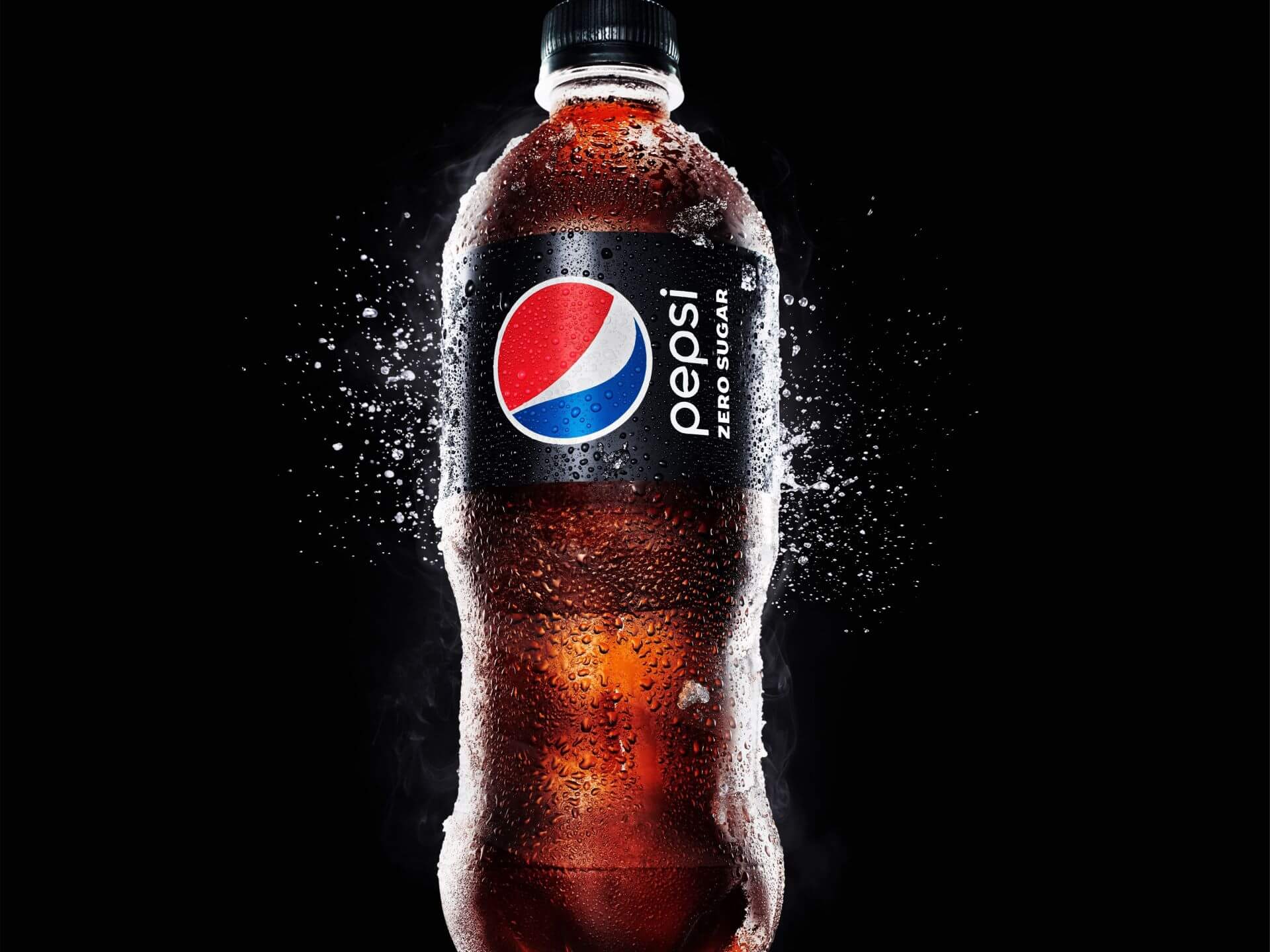
Pepsi Zero Sugar bottle

One of the biggest Super Bowl ad winners is Pepsi Zero Sugar.

Brands spent hundreds of millions of dollars to advertise during Super Bowl LVII, but do their ads actually translate to demand for their products?

A week ago we shared our ten favorite beverage-focused Big Game ads. Along with those ads we shared some numbers.

One of those numbers was $7 million, the cost of a 30-second Super Bowl ad on Fox. Other numbers? $500 million and $700 million, the range of revenue it’s estimated that Fox generated this year from Super Bowl ads.

At this point, these ads and the Halftime Show have essentially become their own entities. Some people watch the Big Game for the ads, some for the show halfway through. It stands to reason that brands are well aware of this development. So, they try to create the most impactful ad possible in the hopes of generating consumer demand.

In other words, these brands aren’t spending all this money just so they’re commercial can be deemed cool. Sure, brands want that buzz. But they also want an ROI on the millions they spend.

The big question is, then, are they seeing a return? Well, it just so happens that behavioral insight platform Veylinx has a data-driven answer to that question.

In short, the answer is yes. Of course, it’s a nuanced yes. For example, it appears Gen Z doesn’t care much about Super Bowl ads, as you’ll see below. Also, non-advertisers in the same categories as Super Bowl advertisers appear to see a benefit from the ads.

You’ll learn more from the Veylinx press release below. It’s an interesting read with valuable data for restaurant, bar, and hotel operators.

NEW YORK, Feb. 22, 2023 — A new study from behavioral research company Veylinx determined whether or not Super Bowl commercials boost consumer demand for the products advertised. The results show that 2023 Super Bowl advertising fueled a 6.4% increase in demand among viewers.

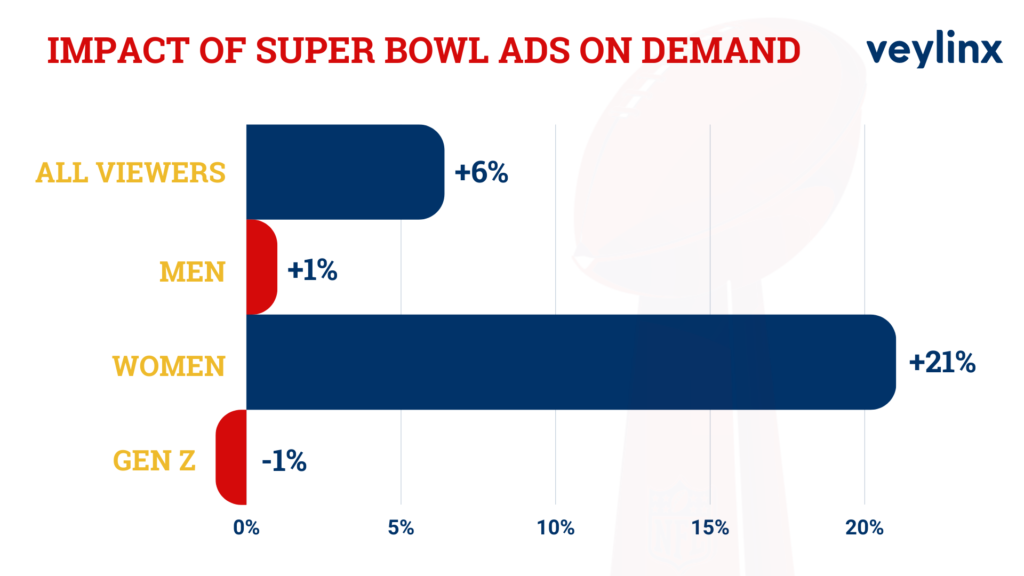
The overall increase in consumer demand was driven by women, who accounted for a 21% increase in demand growth. The commercials had minimal impact on men, yielding just 1% demand growth for the brands tested. Gen Z viewers were largely unimpressed by the Super Bowl ads, with demand among 18 to 25 year olds actually shrinking by 1%.

2023 Veylinx impact of Super Bowl ads on consumers chart

“It’s not really a surprise to see that Super Bowl ads improve sales, but the short term bump alone may not be enough to justify the $7 million price tag,” said Veylinx founder and CEO Anouar El Haji. 

Using Veylinx’s proprietary methodology—which measures actual demand rather than intent—the study tested purchase behavior during the week before the Super Bowl and again the week after. The research focused on measuring the change in consumer demand for eight brands with Super Bowl ads: Michelob Ultra, Heineken 0.0%, Hellmann’s Mayo, Downy Unstopables, Crown Royal Whisky, Frito-Lay PopCorners, Pringles and Pepsi Zero Sugar. 

Super Bowl Advertising Winners Overall

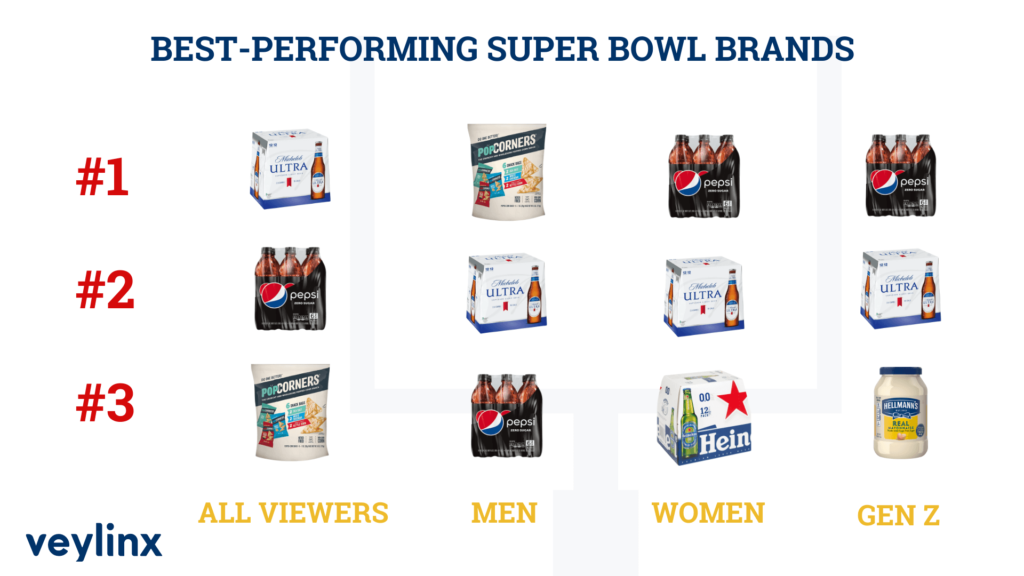
Michelob Ultra – 19% increase in demand

Pepsi Zero Sugar – 18% increase in demand

Frito-Lay PopCorners – 12% increase in demand

Heineken 0.0% – 11% increase in demand

Super Bowl Advertising Winners Among Women

Pepsi Zero Sugar – 45% increase in demand

Michelob Ultra – 40% increase in demand

Heineken 0.0% – 40% increase in demand

Crown Royal Whisky – 26% increase in demand

Veylinx, top performing brands during 2023 Super Bowl

Halo Effect for Non-Advertisers

The biggest winners were arguably brands in the same product categories as Super Bowl advertisers. Non-advertisers in those categories appeared to benefit nearly as much as the advertisers: demand grew by 4.2% percent for the study’s control group of non-advertising competitors. Corona Extra, Kraft Mayo and Lay’s STAX were the greatest beneficiaries in a control group that also included Budweiser Zero, Arm & Hammer Clean Scentsations, Canadian Club Whisky, Popchips, and Coke Zero Sugar. Notably, every non-advertiser saw at least a slight increase in post-Super Bowl demand.

“The goal of our study was to look specifically at how consumer demand is affected by running a commercial during the Super Bowl,” El Haji said. “It’s possible that the non-advertisers deployed other marketing efforts to offset or take advantage of the Super Bowl advertising—or they simply benefited from increased exposure for their categories.” 

Additional Findings

Study participants also answered a series of follow-up questions about their preferences, perceptions and how they watched the Super Bowl. More than three-quarters watched at home through various platforms, the most popular being the live cable/satellite broadcast (38%), followed by YouTube TV (15%) and Hulu (10%). When asked why they watched, it’s no surprise that participants were all about the game (64%)—but the commercials were the next most popular reason for watching (39%), followed by halftime (35%), the social aspect (26%) and fear of missing out (13%). 

About the Research

Veylinx studied the behavior of 1,610 U.S. consumers pre- and post- Super Bowl LVII. Unlike typical surveys where consumers are simply asked about their purchase intent, Veylinx measures whether consumers will pay for a product through a real bidding process. Consumers reveal their true willingness to pay by placing sealed bids on products and then answering follow-up questions.

For more information about the study and the Veylinx methodology, visit info.veylinx.com/super-bowl

About Veylinx

Veylinx is the most realistic behavioral insights platform for confidently answering critical business questions during all stages of product innovation. To reliably predict demand, Veylinx captures insights through a Nobel Prize-winning approach in which consumers have real skin in the game. This is a major advance from traditional market research practices that rely on what consumers say they would hypothetically buy. Veylinx’s unique research methodology is trusted by the world’s largest and most innovative consumer goods companies.

Main article image: PepsiCo / Article body images: Veylinx

KRG Hospitality Bars & Lounges, 2023 icon

by David Klemt David Klemt No Comments

Traffic Up but Margins Thinner

Traffic Up but Margins Thinner

by David Klemt

Chef checking tickets

The One Table 2022 report from Datassential focuses on the state of the operator and what the industry can expect moving forward.

This informative report shares survey results from 801 operators across America. While some of the findings are positive, it’s clear many operators are enduring significant challenges.

For some, traffic and sales are up. However, that’s not the situation others find themselves in.

To download and review the Datassential One Table 2022, please click here.

The Respondents

For this report, Datassential shares the survey answers from 801 respondents.

Most survey respondents are independent operators. In fact, they account for 71 percent of the participants. Making up the rest of the field are chain operators (15 percent) and franchise operators (14 percent).

As far as segment types, the majority of survey participants operate in the fast-casual space (18 percent). Unsurprisingly, fine dining is the smallest group of respondents at six percent. Thirteen percent operate midscale restaurants, and 12 percent are at the helm of casual-dining concepts. Somewhat surprisingly, just ten percent of participants operate QSRs.

Interestingly, the service format is fairly even among survey participants. Fifty-three percent of operators are full-service and 47 percent are limited-service.

Similarly, survey respondents represent the country’s regions pretty evenly:

  • South: 30 percent
  • Midwest: 29 percent
  • Northeast: 21 percent
  • West: 20 percent

In terms of market type, most respondents operate in the suburbs (49 percent). Following somewhat closely are urban-market operators, at 31 percent. Just 20 percent of survey participants operate in rural markets.

Traffic, Sales and Margins

At first glance, Datassential’s survey reveals positive news.

Now, I’m sure people find the terms “pandemic, “pre-pandemic,” and “post-pandemic” exhausting at this point. However, there’s no denying we continue to feel the aftershocks sent through the industry by the pandemic.

So, how do things look now in comparison to pre-pandemic traffic and sales levels?

First, the positives. Nearly half of survey respondents—47 percent—say their traffic is up in comparison to where it was pre-pandemic. Add to that the 14 percent who say their traffic is the same and 61 percent of operators appear to be in good shape.

In terms of sales, 51 percent of survey participants have good news. That news is that their sales are higher in comparison to pre-pandemic levels. Again, add the 14 percent who don’t see any change. So, that’s 65 percent of operators who appear to be performing well.

But with the good there’s bad. Unfortunately, 39 percent of respondents report lower traffic than pre-pandemic levels. And sales are lower than they were before the pandemic for 35 percent of survey participants.

Operator margins are lower for all respondents. Generally speaking, the profit margin for operators before the pandemic sat at 21 percent. Now, the average is 13 percent. QSRs and fast-casual restaurants are a bit higher among survey respondents: 17 percent and 15 percent, respectively.

On paper things do look up for many operators. However, the industry is still suffering, with a third struggling to rise to even pre-pandemic levels of traffic and sales.

Image: Daniel Bradley on Unsplash

by David Klemt David Klemt No Comments

Operators & Guests Respond to Rising Costs

Operators & Guests Respond to Rising Costs

by David Klemt

Canadian dollar bills

Everything is more expensive these days and both operators and consumers have their own ideas for addressing rising costs.

To gather and share insight into people’s mindsets, Restaurants Canada conducted and commissioned two surveys.

For one, the industry research and advocacy organization surveyed operators. The focus was on how much operators anticipated increasing their prices.

On the other side, Restaurants Canada commissioned Angus Reid for a survey focusing on consumers. This survey revealed potential traffic slowdowns and perceived value for money.

For your own copy of Restaurant Canada’s 2022 Foodservice Facts report, click here.

QSR vs. FSR: Consumers

As an operator, converting first-time visitors into repeat guests is paramount. Equally as important: increasing visit frequency per guest.

Of course, an immediate byproduct of rising costs is consumers pulling back and reevaluating their spending. Oftentimes, dining out is one of the first costs consumers slash in order to save money.

Therefore, operators always face the risk of reduced traffic and even losing some guests permanently when they raise prices. However, this is often a necessary risk to take to combat rising costs.

So, how dire is the situation among Canadian consumers currently? Or at least, how did they feel in Q2 of this year? Angus Reid conducted a survey of consumers to find out, and the results can be found within the 2022 Foodservice Facts report.

First, let’s look at visit frequency for QSRs and FSRs. Before we begin, 12 percent of survey respondents answer that they “don’t know for sure” if rising prices will affect their visit frequency for either QSRs or FSRs. Not helpful.

For QSRs, 19 percent of respondents say an increase in prices won’t impact their visit frequency. Thirty-six percent anticipate visiting “a little less often,” while 32 percent will visit much frequently.

As for FSRs, 16 percent of survey respondents won’t change their visit frequency. However, 37 percent anticipate visiting FSRs much less often. Nearly as many, 36 percent, will visit a bit less frequently.

Interestingly, however, is perceived value. More FSR guests believe they receive excellent or good value for their money than they do from QSRs. More QSR guests believe they receive fair, poor, or very poor value for their money.

Overall, though, 90 percent of Canadian consumers feel positive toward the value they receive from QSRs and FSRs.

QSR vs. FSR: Operators

Clearly, it’s good news that the vast majority of Canadians believe they receive good value for their money when dining out.

Nobody enjoys paying more but it appears that both QSRs and FSRs in Canada can increase their prices. At least, they can do so for now while consumers are mostly understanding about inflation.

Restaurants Canada asked QSR and FSR operators a simple but revealing question for their 2022 Foodservice Facts report. The question? How much higher do operators expect to increase their prices by the end of Q4 of this year in comparison to last year?

The majority of operators in both categories anticipate they’ll increase menu prices by more than seven percent. Twenty-seven percent of QSR operators have that expectation. That number rises to 35 percent for FSR operators.

Twenty-two percent of QSR operators anticipate raising prices five to seven percent before the end of 2022. In comparison, 32 percent of FSR operators expect to raise prices in the same range.

At the moment, Canadian consumers appear to be willing to endure these increases. However, it’s likely they expect prices to drop back to “normal” (pre-pandemic prices) or close to it sometime in 2023. That is, unless Canada slides into recession.

Image: PiggyBank on Unsplash

by David Klemt David Klemt No Comments

Canada’s Restaurant Labor by the Numbers

Canada’s Restaurant Labor by the Numbers

by David Klemt

Chef inside commercial kitchen

While there are positive signs for Canada’s foodservice industry, recruiting and retaining labor continues to be a challenge.

Unfortunately, this isn’t a challenge unique to Canada. Operators throughout North America and indeed across the globe are facing labor shortages.

Restaurants Canada addresses this topic in their 2022 Foodservice Facts report. The non-profit research and advocacy group predicts sales will reach pre-pandemic levels by Q4 of this year.

However, restaurants, bars, and nightclubs may have to achieve traffic and revenue growth despite a significant labor deficit.

Please click here to access the 2022 Foodservice Facts report yourself.

Labor Shortage by Category

In their latest report, Restaurants Canada crunches the numbers for three distinct venue categories. These are quick-serve restaurants, full-service restaurants, and bars and nightclubs.

The organization finds that QSRs and FSRs are facing the greatest shortages. In fact, in response to a survey from May of this year, at least half of QSRs and FSRs aren’t operating with fulls staffs.

For QSRs, 52 percent of respondents say they perceive restaurants and bars they’ve visited to be understaffed. A bit over a third (36 percent) think staffing is “about right.” Unhelpfully, 12 percent “don’t know” if restaurants and bars have enough staff.

So, let’s switch gears to FSRs. Precisely half of survey respondends say restaurants and bars don’t have enough staff. Just like their QSR counterparts, 36 percent say that staffing seems to be at the ideal level. Fourteen percent respond that they “don’t know,” which doesn’t tell us much.

Per Canadians who responded to Restaurants Canada’s survey, bars and nightclubs are fairing better…at first. Frustratingly, a staggering 37 percent of respondents “don’t know” if bars or nightclubs have appropriate levels of staffing. Thirty-two percent think they’re understaffed, 31 percent think staffing levels are “about right.”

Industry professionals are probably already putting two and two together here. As long as guests receive the level of service they expect, from greeting to speed of service, to closing out their check, they think things are fine. If they’re made to wait longer than they want, they’ll likely say a restaurant, bar or nightclub doesn’t have enough people on shift.

Labor Shortage by Role

Okay, so the May 2022 Restaurants Canada wasn’t entirely helpful. It still provides interesting insight. That is, we know how guests perceive staffing in at least most instances.

So, let’s get down to hard numbers: shortages in specific roles throughout the industry.

Here, Restaurants Canada provides compelling information, even if it’s not what we want to see. In comparison to 2019, every role is down by thousands of people. In some cases, tens of thousands.

Below you’ll find the deficits by role:

  • Foodservice supervisors: -3,100
  • Chefs: -10,900
  • Bartenders: -17,600
  • Maîtres d’hôtel and hosts/hostesses: -21,100
  • Restaurant and foodservice managers: -22,400
  • Food counter attendants, kitchen helpers, and related support occupations: -43,200
  • Cooks: -44,400
  • F&B servers: -89,500
  • Other: -18,800

Add that up and that’s a shortage of 271,000 people throughout Canada’s foodservice industry. For further context, the industry boasted 1,265,700 workers. In 2021, the industry was down to 994,700.

Unfortunately, from 2020 to 2021, just 4,100 jobs were recovered, according to Restaurants Canada. This situation clearly shows that operators need to change their approach to staffing.

Now, more than ever, operators must focus on effective recruitment, onboarding, and retention. For tips on making improvements, click here. To learn how to implement employee surveys to boost retention and avoid costly turnover, click here.

Image: Brian Tromp on Unsplash

by David Klemt David Klemt No Comments

Datassential’s State of the Operator 2022

Datassential’s State of the Operator 2022

by David Klemt

Guests sitting at the bar inside a restaurant

The latest addition to the Datassential FoodBytes research series shares insights into the top three challenges most—if not all—operators are facing.

Now, some of what the report reveals paints a bleak picture. Inflation, the labor shortage, and supply chain issues persist even past the midway point of 2022.

However, operators are a tenacious and innovative group of business owners. Of course, that tenacity seems to manifest in people thinking this industry can weather any storm. That perception can come at operators’ detriment. Exhibit A: The Inflation Reduction Act of 2022 not including replenishing of the RRF. But, I digress.

“The State of the Operator & the Road Ahead,” which you can download here, is helpful and informative. As you may be aware, we’re fans of Datassential and their FoodBytes reports. In fact, you can find our synopses of FoodBytes reports here and here.

Below are some key points that operators should be aware for consideration. I strongly urge you to download this free report today.

Operator Outlook

First, let’s take a look at traffic. As Datassential points out, some hospitality business segments are performing better than others currently.

In large part, this is due to two factors: People working from home, and people returning to travel. So, operators who rely heavily on commuters and in-person workers are struggling. On the other hand, operators inside or around hotels are, per Datassential, performing the strongest at the moment.

Interestingly, though, nearly half of operators (47 percent) are seeing an increase in traffic in comparison to pre-Covid levels. Fourteen percent of operators are reporting no change in traffic. Unfortunately, traffic is lower for 39 percent of operators.

Next, sales. In comparison to pre-Covid times, more than half (51 percent) of operators report an increase. Again, 14 percent of operators are experiencing no change. But 35 percent of operators are experiencing a decrease in sales.

Finally, profit margins. Half of operators may be seeing increases in traffic in sales, but profit margins are taking a hit. On average, the industry’s profit margin is now hovering at 13 percent. That’s an eight-percent drop in comparison to pre-Covid levels.

Segment Performance

The findings regarding profit margins are likely to be the most alarming to operators. Historically, our industry has operated on razor-thin margins for decades. Dropping from an average of 21 percent to 13 is concerning.

However, context is important. The segments seeing the lowest profit margins in 2022 are: Business & Industry (B&I), Healthcare, and Colleges & Universities (C&U). Again, remote work (and learning) are largely responsible for those particular segments watching their profit margins tumble.

The strongest performers are: Quick-Service Restaurants (QSR) at 17 percent; Fast Casual at 15 percent); and Midscale, Casual Dining, and Fine Dining, each at 13 percent. Lodging is just below the current average at 12 percent.

Operator Adaptation

Inflation, rising food costs, supply chain issues, labor shortages… Operators are finding ways to cope, and in some situation, thrive.

Unsurprisingly, the vast majority of operators are increasing menu prices. In the past 12 months, 77 percent of operators have raised menu prices at least once.

These increases range from one percent a staggering 30 percent. However, the majority have kept these increases to one to ten percent. Most (31 percent) have implemented increases of no more than five percent. Just one percent of operators boosted prices between 25 to 30 percent.

Of course, raising prices isn’t the only strategy operators have at their disposal. Forty percent of operators are streamlining their menu, reducing the sizes of their menus. However, it’s wise for operators to review their menus at least every three months to eliminate poor performers.

Other strategies include focusing on value for guests (27 percent); utilizing LTOs and launching new menu items (26 percent); eliminating a specific daypart or portion of the menu (25 percent); and making portion sizes small, or “shrinkflation” (18 percent).

There’s much more revealed in Datassential’s latest FoodBytes report. Download your copy today.

Image: Luca Bravo on Unsplash

by David Klemt David Klemt No Comments

Top 10 States Attracting High Earners

Top 10 States Attracting High Earners

by David Klemt

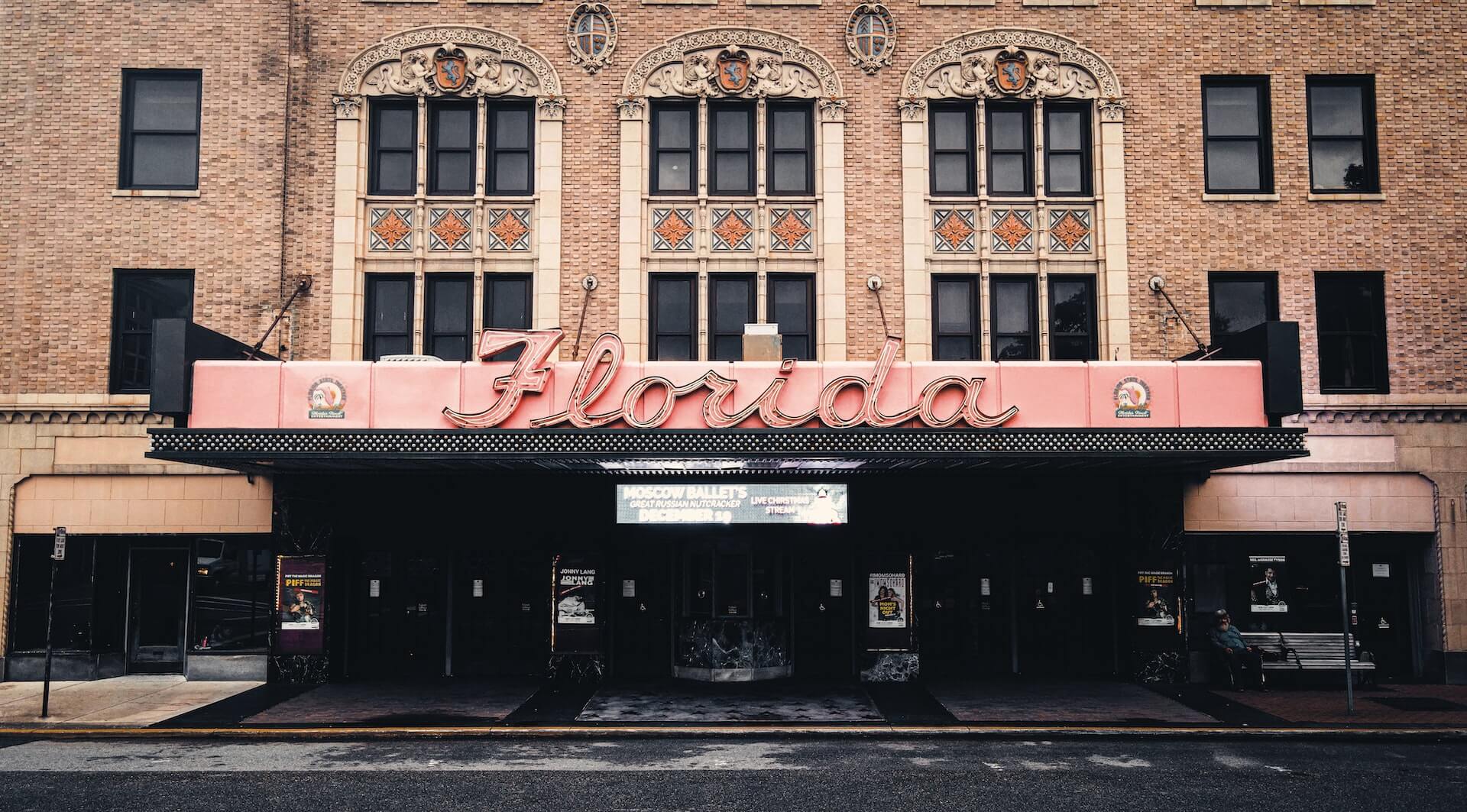
The Florida Theater in Jacksonville, Florida

Using the inflow and outflow data of tax filers earning $200,000 or more, SmartAsset identifies the top ten states attracting high earners.

When it comes to the number-one state, “it’s not even close,” says SmartAsset Advisors. Not surprisingly, several top inflow cities (according to Redfin data) line up with SmartAsset’s top inflow state list.

So, why should this information matter to operators? Plainly, it’s important market information. Population, household income, and age information are crucial considerations when opening any business.

In fact, KRG Hospitality includes such data (and much, much more) when conducting research for our proprietary feasibility, business, and concept plans. Among many elements of opening a restaurant, bar, hotel, or entertainment venue, the income of one’s target audience is crucial.

Knowing where high-income households are leaving and moving to can inform many operator decisions. Where should one open their first concept? Which markets should one consider for expansion? What type of concept will work in a market? What are the threshold price points for menu items? How will this information help inform design choices?

Operators need to recoup their outlay. The income of a concept’s ideal guest should be as important to an operator as knowing their costs.

Top Ten Inflow States

Interestingly, the top state on this list did experience significant outflow in 2020. In fact, the state lost 11,756 high-earning households in 2020.

However, the state also added 32,019 such households, netting 20,263 high earners.

  1. Utah
  2. Idaho
  3. Nevada
  4. Colorado
  5. Tennessee
  6. South Carolina
  7. North Carolina
  8. Arizona
  9. Texas
  10. Florida

Another compelling detail of the states on this list pertains to income tax. In short, three of the states don’t levy personal income tax.

Above, they’re the states in bold: Florida, Nevada, and Texas.

Top 10 Outflow States

So, above are the ten states are seeing the greatest an inflow of high-earning households. Which means, of course, there’s an inverse.

Below, the ten states experiencing the greatest outflow of high earners. Unsurprisingly, SmartAsset deems several entries on the list high-tax states. Also, Washington, DC, is a high-tax area.

Moreover, the list below includes five of the top ten high personal income tax jurisdictions (in bold).

  1. Ohio
  2. Minnesota
  3. Washington, DC
  4. Maryland
  5. New Jersey
  6. Virigina
  7. Massachusetts
  8. Illinois
  9. California
  10. New York

However, it’s not as though these states are seeing a massive exodus of high-earning households. In fact, per SmartAsset, these states have more high-income households than the national average.

Nationally, high-earning households account for less than seven percent of all tax filers. According to SmartAsset, nearly nine percent of tax filers are high-income households in the top ten outflow states.

Image: Trevor Neely on Unsplash

by David Klemt David Klemt No Comments

What Does Omni-channel Mean?

What Does Omni-channel Mean in Hospitality?

by David Klemt

Restaurant diners eating burgers, fries and roasted vegetables

Buzzword or professional jargon, the term “omni-channel” seems to come up more often as our industry embraces more innovations.

As more social and digital platforms (channels) pop up, your job as marketer becomes more complex.

For a pessimistic take, your marketing efforts are like a ship. Every new marketing channel that gains traction is like a hole you have to plug. Fail to do so and you risk your marketing ship sinking.

Now for an optimistic take. Every channel you can add to your marketing is an opportunity to grow your reach. Increasing the amount of people who become familiar with your brand represents the potential to grow loyalty and sales.

If you want to meet your guests where they are—and you should—you need to have a presence where they are to engage with them.

And that’s just marketing. There are also omni-channel operational tactics you can implement. Unsurprisingly, you’ll likely realize many of those solutions are also digital.

So, what does “omni-channel” mean for operators? It means offering seamless guest experiences pre-, per- and post-visit.

Staying top of mind is also an element of an omni-channel strategy.

Traditional Channels

In terms of marketing, let’s break down the different types of channels available to operators.

A simple way to look at “traditional” marketing channels is that they don’t leverage digital mediums:

  • Newspaper and magazine ads
  • Radio and television ads
  • Direct mail
  • Billboards
  • Vehicle wraps
  • Flyers

Now, some of the above may seem outdated. However, those channels still have reach.

The key is knowing your brand and audience to know if a traditional channel will deliver an ROI. You also need to take the time to figure out where your dollars and time are best spent.

Digital Channels

So, there’s a reason I put the word traditional in quotation marks in the previous section.

There may be a time when digital channels become so ubiquitous that they’re considered traditional.

Just look at the digital channels below and consider how commonplace they’ve become:

  • Social media
  • Email marketing
  • Company websites
  • Search engine marketing
  • Newsletters
  • Text messages

It’s easy to see how one day the channels above will overtake their non-digital counterparts and become the traditional way we market.

The reasons for this are obvious. Digital campaigns are easily measurable, they allow for incredibly specific targeting, and they tend to be more engaging.

Really, the biggest cons that pertain to digital marketing channels are: being viewed as annoying/intrusive; being lost in the sea of ads people encounter every day.

On the execution side, it can still be overwhelming to engage just in social media marketing. However, there are platforms that can help make this task less daunting.

Other Channels

Like I wrote earlier, omni-channel doesn’t only pertain to marketing.

Of course, the term and practice are most often associated with marketing. However, operators have more to think about to truly become omni-channel.

The way your guests interact with your restaurant are also channels. Your front-of-house staff is a channel, technically speaking.

Now, we all know that the pandemic forced operational changes. Many of those changes are here to stay.

So, let’s look at a potential guest journey:

  • The potential guest receives a promotional offer via email.
  • They follow the link to an online reservation platform.
  • After arriving at the restaurant with their party, they check in with the host in person.
  • The server greets the party, some of whom request a physical menu. Others in the party pull out their phones and access the menu via QR code.
  • Throughout the meal, the server touches the table to ensure the visit is going well, refill drinks, take additional drink orders, etc.
  • When it’s time to pay, the party quietly does so via a touchless option and leaves.
  • A follow-up email is sent for feedback.
  • After a number of days, a text message is sent out to encourage another visit.

The marketing channels are just one element that makes the hypothetical restaurant an omni-channel operation. Providing digital, touchless menu access and payment are also omni-channel elements.

Those are just a few examples. If you take the time to review your operations; where you can reach new and repeat guests; threats such as third-party delivery; and innovations you can implement, you’ll see where you can make changes to become an omni-channel restaurant.

Image: Dan Gold on Unsplash

by David Klemt David Klemt No Comments

Canadian Trends 2022: Technomic

Canadian Trends 2022: Technomic

by David Klemt

Yellow neon "butter" sign and scaffolding

Curious about what to expect in 2022 as a Canadian restaurant, bar or hotel operator?

Technomic has some predictions for next year.

Reviewing their “Canadian Trends: Looking Ahead to 2022” report, creativity and streamlining will be keys to success.

Let’s jump in!

Butter

Yes, this is why I chose the image above. Technomic is very specifically identifying butter as an important 2022 F&B trend.

And no, they don’t appear to be predicting the popularity a particularly rare or esoteric butter. The industry intelligence firm means butter will prove important in 2022.

In large part, Technomic is pointing to comfort food as a driver for butter.

Generally, the firm points to how versatile butter is in the kitchen. Browned and herb-infused butters, says Technomic, will find its way into cocktails.

Flavor and texture will play an important role, extending the butter prediction into buttery foods territory. For example, Technomic predicts butterscotch, buttermilk and ghee will see a boost in usage and demand.

Additionally, the plant-based movement will help nut butters grow more popular. In fact, Technomic says nut butters will find their ways onto burgers and into cocktails.

Interestingly, the firm’s butter prediction gives operators two larger trends to watch: comfort food and plant-based.

Cross-utilization

You don’t need me to tell you that North America—and the rest of the world—is facing supply chain issues.

I know you’re exhausted from just the past nearly two years of constant adaptation and pivoting. In 2022, you’ll have to continue with your creative problem solving.

The supply chain challenge (there’s an understatement) requires creativity in several areas. This includes the kitchen and menu.

Technomic suggests that one path forward through supply chain problems involves ingredient preparations:

  • Pickling
  • Candying
  • Salt-baking

The firm says these creative takes on ingredients operators already have will extend product life; add new flavors to dishes; and deliver new textures. Those last two offer guests new experiences.

In addition, getting creative with the ingredients you may be able to get more readily will help streamline and update 2022 menus. However, revising your menu will require careful consideration of your supply chain and cross-utilization, with a heavy helping of creative prep.

Running Lean

Smaller footprints. Shrunken staff. Streamlined menus. Smaller, shrunken, streamlined, optimized, leaner…

Call the process whatever you want, Technomic is predicting that operators will need to “optimize” (read: make smaller) their businesses.

Of course, there isn’t a one-size-fits-all solution. We’ve read and heard predictions since last year about what will need to shrink moving forward.

While some recent news reports say that ghost kitchens are out, Technomic seems to think that’s not the case. Technomic suggests ghost kitchens will remain viable for operators who want to expand without investing in real estate.

Additionally, Technomic’s report suggests something that should come as no surprise. In short, if it works for a brand or location, smaller may be better and here to stay.

Growth

Now, this is the most promising of Technomic’s predictions: Growth.

Per the firm, the foodservice industry in Canada was down 29 percent in Q1 of 2021. Pre-pandemic, sales reached $95 billion. That represents a loss of nearly $30 billion.

However, there’s reason to be optimistic in 2022, according to Technomic.

The firm expects growth of 21 percent in 2022 over 2021, or sales of $74.8 billion. Should this prediction prove accurate, 2022 would close just three percent under pre-pandemic sales.

Technomic identifies full-service as the foodservice segment to experience the most growth next year at 26.2 percent. In comparison, the firm predicts limited-service to grow 7.3 percent.

Next year won’t be easy. 2022 won’t be a magical return to normalcy. But there is room for optimism if Technomic’s predictions are correct.

Image: Jon Tyson on Unsplash

by David Klemt David Klemt No Comments

How and Why to Edit Your Menu

How and Why to Edit Your Menu

by Nathen Dube

Restaurant tables with place settings and menus

When thinking about opening a restaurant an important question to answer is, “What am I going to serve?”

There is one answer that tempts too many restauranteurs: “I’ll offer something for everyone!” The thinking is that doing so translates into everyone coming to their restaurant or bar.

The truth is, everyone isn’t coming. Sadly, many of these places don’t survive long, and 60 percent of restaurants don’t make it past their first year. Having an overwhelming menu is one of the key contributors to that statistic.

Massive menus are stressful for guests, making it difficult for them to decide. At a certain point, too many items create what’s called the Paradox of Choice. Overwhelm guests with possibilities and they’ll just choose something simple and familiar rather than exploring the entire menu, impacting the guest experience negatively.

Too many options also lend to the perception of low-quality food. How can a kitchen staff possibly excel at so many dishes? How can the ingredients be fresh and not frozen? What is the quality of dishes if people only order them once or twice a week?

Those reasons and more are why it’s important to have a laser-focused menu from the onset.

Inventory Challenges

If a large portion of your menu isn’t moving out of the kitchen to hungry diners, guess where that food is going. A large menu creates tracking issues, a high percentage of ingredient spoilage, and opens the door to theft from staff. The best establishments do just a handful of things well, with a select few complementary items to round out the menu.

Having a kitchen full of product for dishes on the menu that might get ordered can quickly turn into dead stock. If there are boxes sitting in dry storage shelves collecting dust, it’s a good time to consider removing any dishes that require them from the menu.

Setting a scheduled review of inventory and menu sales breakdowns can be a great way to avoid dead stock eating into your food budget for any significant length of time. Not all dishes end up being winners—ignoring the losers will limit profitability significantly. A massive, unchecked menu just compounds the issue.

Another profit-eater is food waste. Ordering usually means receiving product in bulk and breaking it down. It’s near impossible, as an example, to order just two or four of something like cabbage for a dish that doesn’t move. The cabbage sits, and half a case gets thrown out for every dish sold. Having a focused menu will help quickly highlight items that need to be removed from a menu.

Tracking Issues

Then there’s the issue of theft. Unfortunately, theft happens. Having some deterrents in place can help mitigate opportunities for those who seek to steal in this industry.

If there aren’t robust tracking systems in place along with an honest team who uses them correctly, things can (and will) disappear. A much harder time will be had spotting losses and what’s causing them when it takes a long time to track inventory. Again, this leads to compounded profit losses on dead stock and product spoilage. We haven’t even begun to prepare any food yet and already our food cost is trending in a bad direction.

A restaurant budget needs to be established before opening and needs to be adhered to strictly. That can quickly go out the window when it comes to ordering food to stock your kitchen. A massive addition to your operating costs can set you back a few months, particularly when you’re not seeing a return on purchases for the reasons stated above.

With the current climate of the restaurant industry and a post-Covid dining scene, avoiding these pitfalls is crucial to success. Rising food and labour costs, recovering from months of closures, and a shortened patio season (if you’re lucky enough to have one), have made strict cost controls more important than ever going forward.

Keep in mind, if your seating capacity matches or is less than the amount of menu items you’re serving, that equates to minimal product turnover, which translates to minimal profits. That number is multiplied by product loss of any kind.

Training & Retention

When an owner can’t match their concept to food and drink offerings, it leads to poorly trained staff and frustration during service. There will be plenty of room for error (more loss!) and, unsurprisingly, low staff retention. That all keeps this never-ending cycle in motion.

If you can’t clarify your vision, how can you expect staff to showcase it to guests with any confidence?

At every “big menu” restaurant I’ve worked in, the owners were always in the building or kitchen. This wasn’t because they were driven to be hands on. It was because they couldn’t train staff properly to run the whole menu reliably, things would go “missing,” or staff simply couldn’t accomplish daily tasks consistently.

Interestingly, the opposite was true at establishments with small, focused menus. Staff were confident and knowledgeable, problems with food and service didn’t spiral out of control, and food moved out the door to some degree of consistency. The owners were freed up to run their business rather than micromanage everyone.

With all the issues currently hampering the food industry, the last thing you want right now is another level of frustration among your staff. Retention rates are at an all-time low. The struggle to fill job openings industry-wide are at all-time high, as are reported cases of staff walking out mid-service. A properly structured menu can keep your business on track and make the lives of your employees much more simplified.

Editing Your Menu

Focusing on cohesion between menu and concept doesn’t require offering all the dishes under the sun. Avoiding the “something for everyone” approach leads to improved guest experiences and employee confidence. Streamlining your menu simplifies inventory and sales tracking; differentiates high-profitability items from the rest; and makes identifying items that don’t sell easier.

Paring down your menu into a tight, focused version allows you to quickly retool it every few months. Just try tracking and editing a large four-page menu as frequently. It’s costly to reprint and you have better things to do with your time.

Keeping things tight also creates space to take advantage of seasonal offerings, local specialties, or customer favorites. You can also offer specials throughout the week that can drive traffic and give your talented cooks a chance to show off!

I would suggest looking over your sales data to identify your highest-selling dishes and the slow movers every one to two months. If you have a seasonal menu, this can be done at the midpoint of a seasonal change.

Think about what items are being purchased and only used in one dish. They can start to pile up in your stockroom and lead to dead stock. Consider the versatility of ingredients when planning a menu change—cross-utilize everything you can.

Fluctuating Costs

Another important point that can get forgotten is that the prices of food items fluctuate constantly. Maintaining a large menu, therefore, can become a nightmare cost scenario quickly. Limes, beef, avocados—even celery—are experiencing tremendous jumps in price. A small menu allows for damage control when prices jump, giving your room to make quick, lower-cost moves.

Of course, the alternative is to have your staff rattle off everything the kitchen is out of to your guests. Not cool.

The underlying theme here is to avoid tying up your finances in product that is sitting, turning to waste instead of profit, or not moving at all. Your mission is to have product moving out of the kitchen constantly and consistently.

It might seem like a wise decision to offer a large menu that’s all over the place. Maybe you’re making that choice for fear of alienating guests or reducing your traffic. However, the points made in this article should illustrate why a cohesive link between concept and menu is crucial, and how a smaller, more focused menu can deliver more for you than a large, out-of-touch menu.

Image: Karolina Grabowska from Pixabay

Top