News

by David Klemt David Klemt No Comments

CDC Updates Mask, Gathering Guidance

CDC Updates Mask, Gathering Guidance

by David Klemt

Vials of Covid-19 vaccine

On the heels of some states rescinding mask mandates, the Centers for Disease Control updates safety guidelines.

The CDC’s guidance focuses on vaccinated people.

Key Changes

Per the CDC, people who are vaccinated can meet indoors with one another. These indoor meetings can take place without masks.

Of particular note, the CDC says these people can meet up indoors with one unvaccinated household as long as they’re at “low risk” of serious illness.

Equally interesting, the latest guidance claims that if a fully vaccinated person is exposed to someone with Covid-19, they don’t need to quarantine if they’re not showing symptoms.

Importantly, these guidelines address fully vaccinated people, not those awaiting their second shot.

Masks & Public Gatherings

The CDC still recommends masks, social distancing, avoiding crowds, and staying away from spaces with poor ventilation.

Those who are fully vaccinated should exercise those recommendations whenever they’re in public; gathering with people are unvaccinated from more than a single household; meeting with anyone with increased risk of severe illness or death should they be infected with Covid-19.

Vaccinated or not, the CDC recommends people avoid medium- or large-sized gatherings and domestic and international travel.

Workplaces should still follow CDC guidance for employees not working exclusively from home.

Important Details

The CDC says a person is “fully vaccinated” if they meet one of two criteria:

  • It has been two weeks since they’ve received their second dose of a two-dose Covid-19 vaccination (Moderna, Pfizer, for example).
  • It has been two weeks since they’ve received a single-dose vaccine (example: Johnson & Johnson).

Anyone who needs to receive a second shot isn’t fully vaccinated. The same holds true if it has been less than two weeks since being vaccinated.

Per the CDC webpage: Everyone, “even people who’ve had their vaccines—should continue taking basic prevention steps when recommended.”

Click here to review the CDC’s new guidance. Remember that health and safety  protect yourself, your staff, your guests and your community.

Image: torstensimon from Pixabay

by David Klemt David Klemt No Comments

Senate Boosts RRF to $28.6 Billion

Senate Boosts RRF to $28.6 Billion

by David Klemt

Lower-case neon open sign

On Saturday, the Senate approved their version of the $1.9 trillion Covid-19 relief bill along party lines.

Next, the bill will go back to the House and could receive a vote as early as tomorrow.

Boost to RRF?

According to several sources, the Senate’s version of the American Restaurant Plan Act (ARPA) includes a $3.6 billion boost to the $25 billionRestaurant Revitalization Fund (RRF).

If that’s accurate and the House passes this version of the ARPA, the RRF has $28.6 billion to disburse.

Five billion dollars will be set aside specifically for businesses that grossed less than $500,000 in receipts in 2019.

Mostly a Good Start?

The RRF is modeled on the RESTAURANTS Act.

Unfortunately, it isn’t funded like the RESTAURANTS Act. The industry has been campaigning for nearly a year for a $120 billion fund.

More than 110,000 restaurants and bars have been lost throughout the United States permanently. In addition, the industry has lost around $220 billion in sales.

The RRF isn’t even a quarter of what the industry was asking for in terms of help from elected officials.

Still, if managed properly, the RRF is much-appreciated and much-needed relief for small and mid-sized operators.

The Details (So Far)

The Small Business Association (SBA) will manage the RRF. For the first 21 days, businesses owned or controlled by women or veterans—or that are economically and socially disadvantaged—will be prioritized for grants.

Maximum amounts for grants are $5 million per individual restaurant or $10 million per restaurant group.

Established restaurants can calculate their grants thusly: 2019 revenue minus 2020 revenue minus PPP loans. For restaurants that were opened in 2019, the calculation is the average of 2019 monthly revenues times 12 minus 2020 revenues. Restaurants opened in 2020 are eligible to receive funding equal to eligible expenses incurred.

Grants can be spent on eligible expenses from February 15, 2020 through December 31, 2021. However, the SBA may extend that period through two years from enactment.

Eligible expenses include but are not limited to:

  • payroll and benefits;
  • mortgage (no prepayment);
  • rent (no prepayment);
  • utilities, maintenance;
  • supplies (including PPE and cleaning materials);
  • food;
  • operational expenses;
  • covered supplier costs (as defined by the SBA under the PPP program); and
  • sick leave.

The fight for relief isn’t over. Please click here to tell your representatives to pass ARPA and the RRF immediately.

Image: Finn Hackshaw on Unsplash

by David Klemt David Klemt No Comments

Some Texas Operators Keep Masks in Place

Some Texas Operators Keep Masks in Place

by David Klemt

Face mask Covid-19 graffiti

Texas is less than a week away from opening “100 percent” according to Governor Greg Abbott.

Three things in life are certain: death, taxes, and Texans aren’t fans of being told what to do.

Data shows an increase in coronavirus cases in Texas but that isn’t stopping Gov. Abbott from announcing all businesses can open at 100-percent capacity and the state’s mask mandate is no more as of March 10.

Political, Practical or Perilous?

Per Gov. Abbott, Texas have “mastered the daily habits to avoid getting Covid,” so it’s “now time to open Texas 100 percent.”

One of those habits, one would assume, is wearing a mask or other face covering to “avoid getting Covid,”

Doctors and health experts have been warning against complacency fueled by vaccines and cases dropping in some states. Another surge may be around the corner if people drop covid-19 safety measures in favor of a return to “normal” life.

Gov. Abbott’s announcement, therefore, calls into question his motivations: political, practical or perilous?

Some Operators Pushing Back

If we accept that one can’t tell a Texan what to do, we must apply that to restaurant and bar operators in the state.

Some Texas operators disagree with Gov. Abbott lifting of the mask mandate and are “100 percent” still requiring masks in their establishments post-March 10.

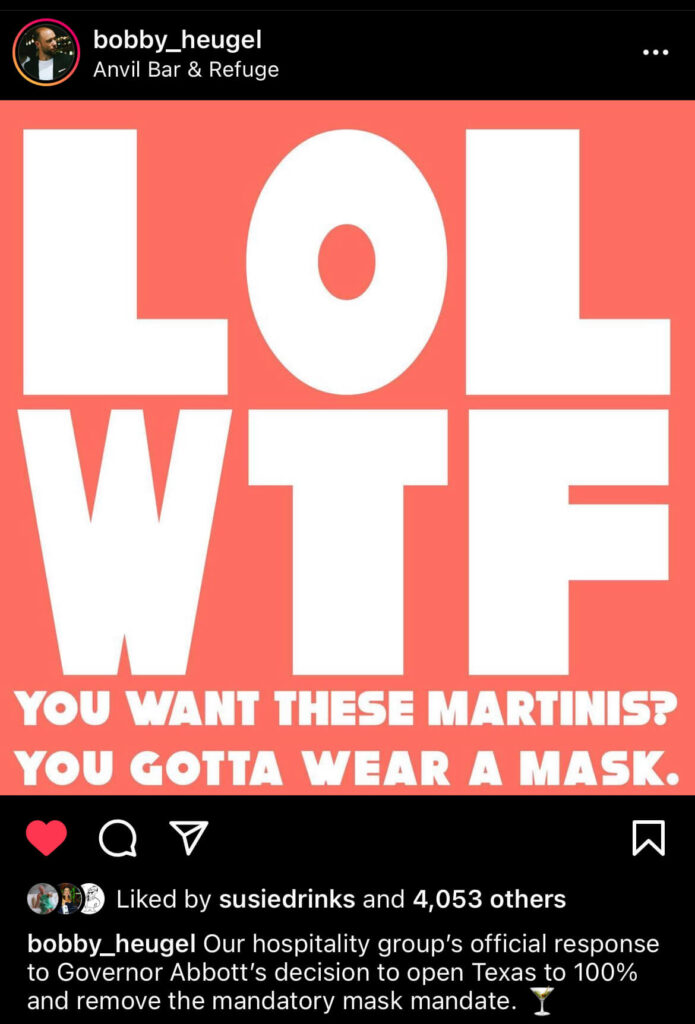
This message from Bobby Heugel, the operator behind Anvil Bar & Refuge, Tongue-Cut Sparrow, Better Luck Tomorrow and Squable in Houston, is straightforward. It’s also garnering plenty of support, with people thanking Heugel and pledging to spend their money at his businesses.

In response to a question by one commenter on the post, Heugel explains that the hospitality group is maintaining 50-percent capacity, socially distanced seating, and other CDC guidelines “until vaccination rates improve.”

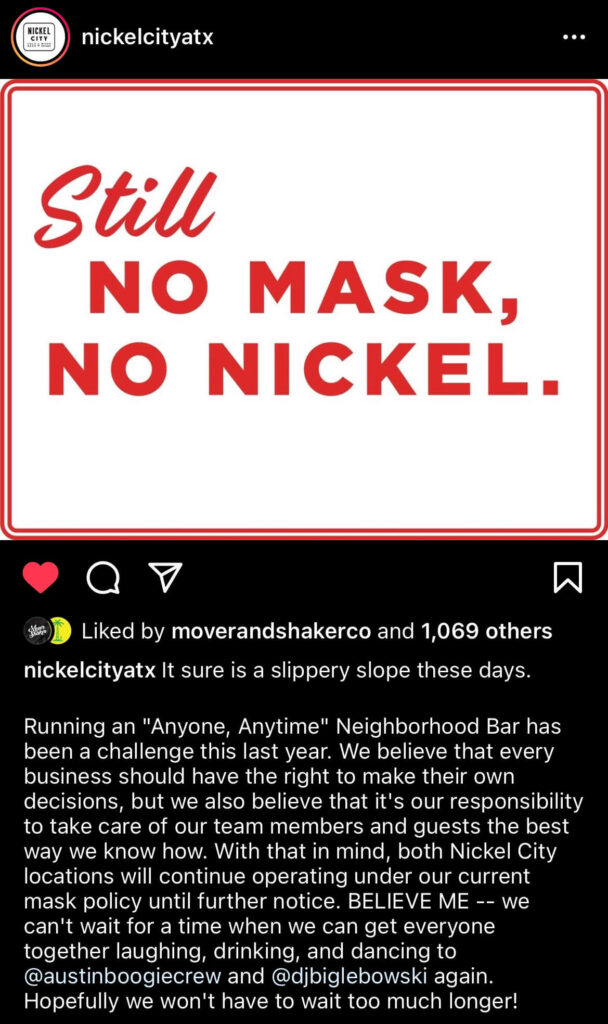
Nickel City operations locations in Austin and Forth Worth. As the above statement makes clear, guests must wear masks inside their venues regardless of what Gov. Abbott says. Like Heugel’s, Nickel City’s statement is garnering support.

Whether the governor’s move proves wise or foolish will bear out in the coming weeks. However, the decision will likely once again put front-of-house workers at risk of hostile confrontations with guests who take wearing a mask as a personal attack on their liberty.

Still Struggling

To be fair, Gov. Abbott isn’t going it alone in terms of rolling back a mask mandate. Mississippi, Alabama, Iowa and Montana have made similar choices.

Going a further step toward fairness, a total of 16 states don’t have mask mandates in place. In fact, some never did. What has drawn attention is that Texas is the largest state to do away with its mask mandate (and the second largest state in the US in terms of population and area).

What grabbed my attention are the responses from well-known and respected operators who have chosen to still require masks and other Covid-19-related health and safety guidelines, along with the support they’re receiving from the public for doing so.

Multiple vaccines, a seemingly downward trend in infection rates, and the lifting of restrictions don’t magically solve operators’ problems—they’re struggling, as are their employees.

Follow this link to tell your representatives to pass the American Rescue Plan Act of 2021 and Restaurant Revitalization Fund now.

Image: Adam Nieścioruk on Unsplash

by David Klemt David Klemt No Comments

What’s in the Senate Relief Package?

What’s in the Senate Relief Package?

by David Klemt

United States Capitol Building rotunda ceiling painting

As expected, the Senate version of the latest Covid-19 relief bill is different from the one passed by the House.

The changes will require the bill to be kicked back to the House, adding to the pressure to get relief to Americans before March 14.

Things may change but below are some of the differences between the two versions.

$15/hour Minimum Wage

This provision is dead in both houses of Congress.

That should come as no surprise as the boost to federal minimum wage was declared dead in the water by Senate Parliamentarian Elizabeth MacDonough even before the House voted on the American Rescue Plan Act.

According to reports, removing any and all language that raises federal minimum wage to $15 an hour is the biggest change between the House and Senate versions of ARPA.

Direct Payments to Americans

Chatter online indicates that Senate Democrats are in favor of a drastically lower threshold for $1,400 direct stimulus payments.

The House version of the American Rescue Plan Act of 2021 calls for $1,400 economic impact payments with the following parameters:

  • Individuals earning an adjusted gross income (AGI) up to $75,000.
  • Married couples earning an AGI up to $150,000.
  • Payments phase out, reaching $0 for individuals earning AGI over $100,000 and married couples earning AGI over $200,000.

The Senate version calls for $1,400 payments to phase out entirely for individuals earning an AGI of $80,000 and married couples with an AGI of $160,000.

Restaurant Revitalization Fund

Let’s be honest, this is why you’re here. Is the RRF safe?

There’s nothing that shows the $25 billion fund is in danger from the Senate. That said, there’s one threat to ARPA in general, “minor” as it may be: game-playing politicians.

Unsurprisingly, Republicans view ARPA as too expensive, too favorable of Democrat’s priorities, and insufficient for addressing the reopening of businesses, schools, and fighting Covid-19.

Those concerns in and of themselves aren’t akin to playing games, nor are they invalid. Vote-a-rama, however, is a time-wasting stalling tactic that allows senators to propose literally hundreds of amendments to a bill. The time limit for vote-a-rama? There isn’t one—it lasts until senators get tired or bored.

Speaking about a coordinated plan to engage in vote-a-rama, Senator Rand Paul (R-KY), said he’s “hoping for infinity. There are people talking about trying to set up a schedule and having it go on and on.”

Take Action

Americans simply do not have time for politicians on any side of the aisle to play games. Good-faith negotiations are one thing, delay tactics that last for “infinity” are another.

We’re still in the midst of a pandemic, people are unable to pay their bills, they’re going hungry, and business owners and their employees are suffering.

It seems some politicians have made up their minds and are committed to dragging out the process of passing ARPA and the RRF contained within but we still have our voices. Follow this link to tell your representatives to pass ARPA and RRF now.

Enough games, enough delays, more action.

Image: GO Educational Tours from Pixabay 

by David Klemt David Klemt No Comments

Meet Customers Where They Are

Meet Customers Where They Are

by David Klemt

Suburban community

If news stories are to be believed, Americans are fleeing big, expensive cities en masse.

Are those stories accurate or examples of sensationalism?

Mass Exodus?

The pandemic is, without any doubt, reshaping the United States. It is, in fact, transforming any nation on which it has gained a significant foothold.

Several sources claim that a mass exodus to the suburbs and rural towns is taking shape across America.

The authors of these stories often cite survey results, housing and rental price fluctuations, financial struggles and the cost of living in many cities, and anecdotal “evidence” to make their points.

On its face, just the argument that cities like Los Angeles and New York City are too expensive to live in with so many people struggling financially makes sense. And stories about astronomically high rent compared to square footage and median income in dense, expensive cities are commonplace.

Haute Exodus?

Still other stories tell tales of the wealthy migrating from major cities to “wait out” the pandemic.

Since wealthy people have the means, they’re able to leave densely populated areas for destinations with smaller populations. The logic being, the less people in an area, the lower risk of infection.

There are reports referring to NYC as a “ghost town” and describing San Francisco as a shell of its former densely-populated, well-heeled self.

Again, much of the reporting is supported by anecdotal and social media “evidence.”

Half-thruths

Forbes, which has published articles supporting mass exodus claims and also disputing them, has made the argument that the situation is nuanced.

Eric Martel, a Forbes Councils Member, analyzed U-Haul Migration Index (UMI) and uncovered some interesting data. Martel finds that net migration in San Francisco and Los Angeles is lower—significantly so in LA—than it was in 2018. In NYC, net migration looks higher.

More reasonable conclusions regarding Americans and the pandemic seem to be:

  • Large numbers of people have moved out of some major cities. NYC seems to be a good example.
  • Some of the wealthy have temporarily left highly-populated cities, choosing to stay in places normally considered vacation destinations for longer periods of time.
  • People appear to be moving toward the outskirts of larger cities where rent and prices tend to be lower than that of city centers.
  • Suburbs near the outskirts of major cities appear to be popular migration targets.
  • Some of this “migration” is temporary, driven by the ability to work remotely. It’s likely that some people who have moved out of cities will return when they perceive things have returned to “normal.”

Adapt

Jack Li, co-founder and CEO of Datassential, suggests operators check out so-called second-tier cities—Austin, Nashville and Charlotte, for example—and the areas where cities meet suburbs. The reasons are simple:

  • Innovation and food trends tend to start cities, reaching rural areas last. That means second-tier cities, city outskirts, and suburbs are quicker to embrace trends and innovations. (Location.)
  • Less-expensive commercial real estate prices. (Cost.)
  • Potential increase in the number of families. (Customer density.)
  • Potential increase in the number of seniors with financial means. (Customer density.)

The impact the pandemic has had makes informed decisions that much more critical to success in this industry. Demographic and feasibility studies are more important now than ever.

Both are cornerstones of the KRG Hospitality approach, whether an operator has several years’ experience or is a neophyte. Click here to learn more about how KRG Hospitality can help you and your concept, click here to learn about KRG Mindset Coaching, and click here to download the KRG 2021 Start-up Cost Guide & Checklist.

Image: The Lazy Artist Gallery from Pexels

by David Klemt David Klemt No Comments

Restaurant Revitalization Fund Passes

Restaurant Revitalization Fund Passes

by David Klemt

United States Capitol Building

Congress has once again voted to pass targeted relief for restaurants and bars.

The American Rescue Plan Act of 2021, which includes the Restaurant Revitalization Fund Passes, made it through Congress by a vote of 219 to 212.

All Republicans and two Democrats voted against the $1.9 billion bill, which now goes to the Senate.

Now What?

After a year of being mostly left to fend for ourselves—save for the flawed Paycheck Protection Program—operators may finally receive some relief.

The $300-per-week federal boost to unemployment, which the American Rescue Plan Act increases to $400 per week, expires on March 14. There’s some pressure on the Senate to pass the bill so it can be signed into law before or by that date.

However, we’ve been down this road before: Congress has voted in favor of a bill that contains relief for restaurants, bars and other foodservice and drinking establishments, the Senate goes a different direction, and the Congressional victory turns to ashes in our hands rather than becoming law.

Democrats control the House. A Democrat sits at the Resolute Desk. And while the 50-50 Senate is “controlled” by Democrats since Vice President Kamala Harris can break tie votes, the party can’t afford any defections if they hope to pass the American Rescue Plan.

Once again, targeted relief isn’t a certainty.

What’s in the Plan?

In short, not the RESTAURANTS Act. The American Rescue Plan provides a fraction of the $120 billion for which the industry has been campaigning for a year now.

Instead, a $25 billion grant program called the Restaurant Revitalization Fund (RRF) has been carved out for restaurants, bars and other eligible providers of food and drink.

There’s another $15 billion allocated for targeted Economic Injury Disaster Loan (EIDL) advance payments, and $1.25 billion for shuttered venue operators.

Just $7.25 billion would be pumped into the PPP and the application deadline wouldn’t be extended beyond March 31. This is likely because the PPP has disbursed over $662 billion in just under a year, and there’s still roughly $140 billion available.

In addition, the current bill includes $1,400 direct stimulus payments for individuals earning up to $75,000 or $2,800 for married couples earning up to $150,000. Payments would phase out completely for individuals earning $100,000 or married couples earning $200,000.

What’s the Restaurant Revitalization Fund?

The RRF carves out $25 billion for restaurants, bars, saloons, inns, taverns, lounges, tasting rooms, brewpubs, taprooms, food trucks, food carts, food stands, caterers, and eligible providers of food and/or drink.

Grants, should the bill pass the Senate and be signed into law, will be equal to pandemic-related revenue loss as calculated by subtracting 2020 revenue from 2019 revenue. Eligible entities could receive of up to $10 million, or a physical location could receive a maximum grant of $5 million.

RRF grants are required to be used for:

  • payroll costs;
  • principal and interest payments on a mortgage, excluding prepayments on the principal;
  • rent payments, excluding prepayments;
  • utilities;
  • supplies, including personal protective equipment (PPE) and cleaning materials;
  • F&B expenses within the eligible entity’s scope of “normal business practice” before the covered period: February 15, 2020, through December 31, 2021 (or another date as determined by the Small Business Administration);
  • maintenance expenses, including construction accommodating outdoor seating and walls, floods, deck surfaces, furniture, fixtures, and equipment;
  • covered supplier costs;
  • operational expenses;
  • paid sick leave; and
  • any other expenses the SBA determines to be essential to maintaining the eligible entity.

The SBA would be responsible for awarding $20 billion of the $25 billion fund in “an equitable manner to eligible entities of different sizes based on annual gross receipts.” The remaining $5 billion would be set aside, per the bill in its current form, for eligible applicants with 2019 gross receipts of $500,000 or less.

Click here to find your senators and urge them to pass the Restaurant Revitalization Fund.

Image: Jens Junge from Pixabay 

by David Klemt David Klemt No Comments

Hakkasan Group Announces Reopenings

Hakkasan Group Announces Reopenings

by David Klemt

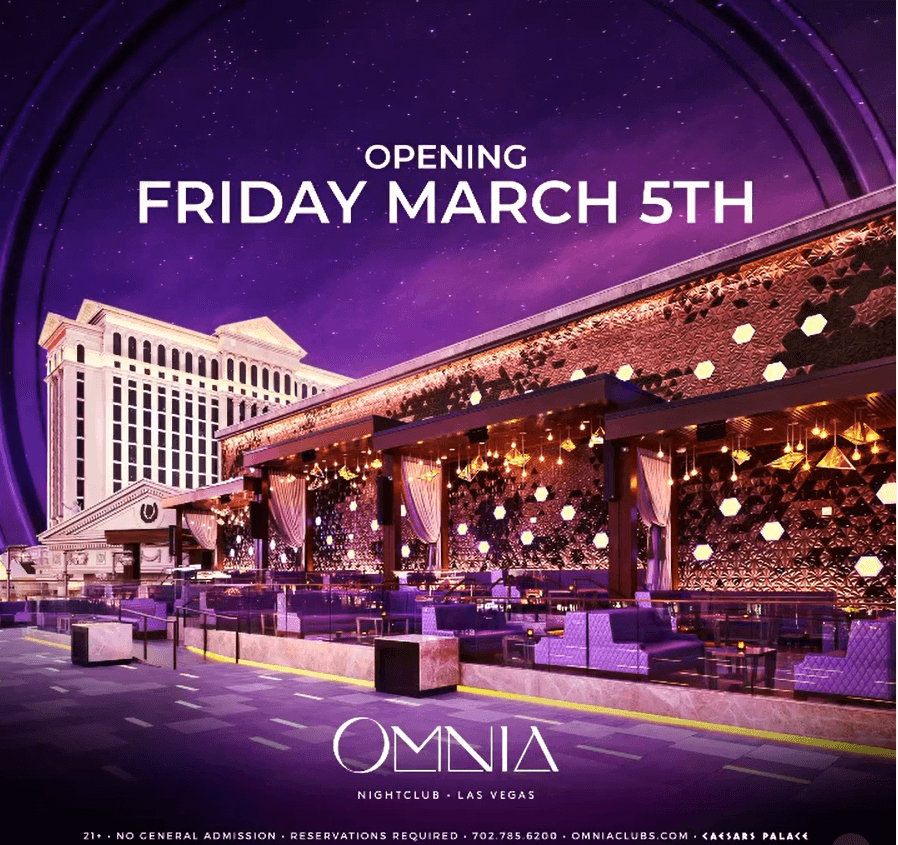
OMNIA Nightclub Las Vegas Terrace

In a positive sign for Las Vegas nightlife, daylife and tourism, Hakkasan Group has set dates against the reopening of three major venues in its portfolio.

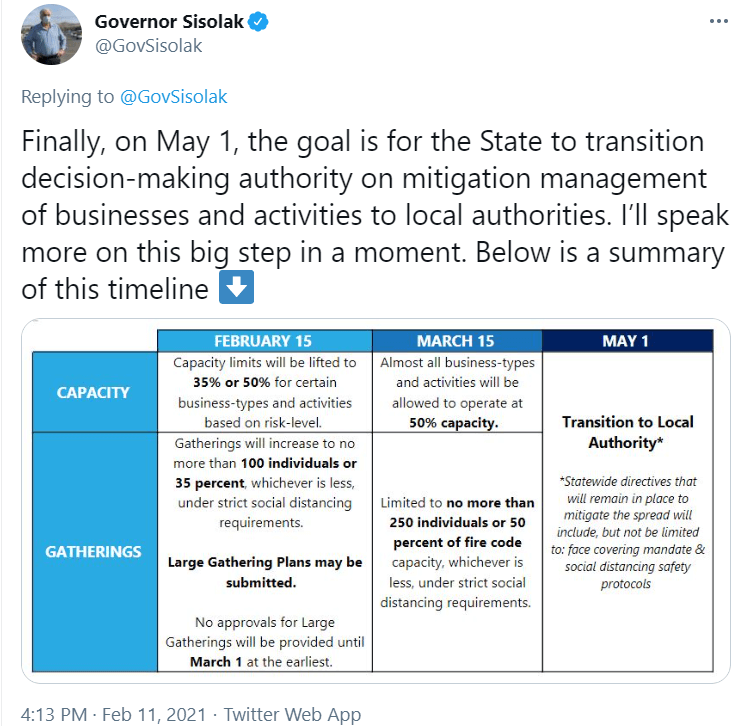
The announcement came less than a week after Governor Steve Sisolak unveiled Nevada’s Roadmap to Recovery Safe Reopening Plan.

Two Hakkasan Group properties will reopen on March 5. A third will resume business a week later on March 12.

OMNIA

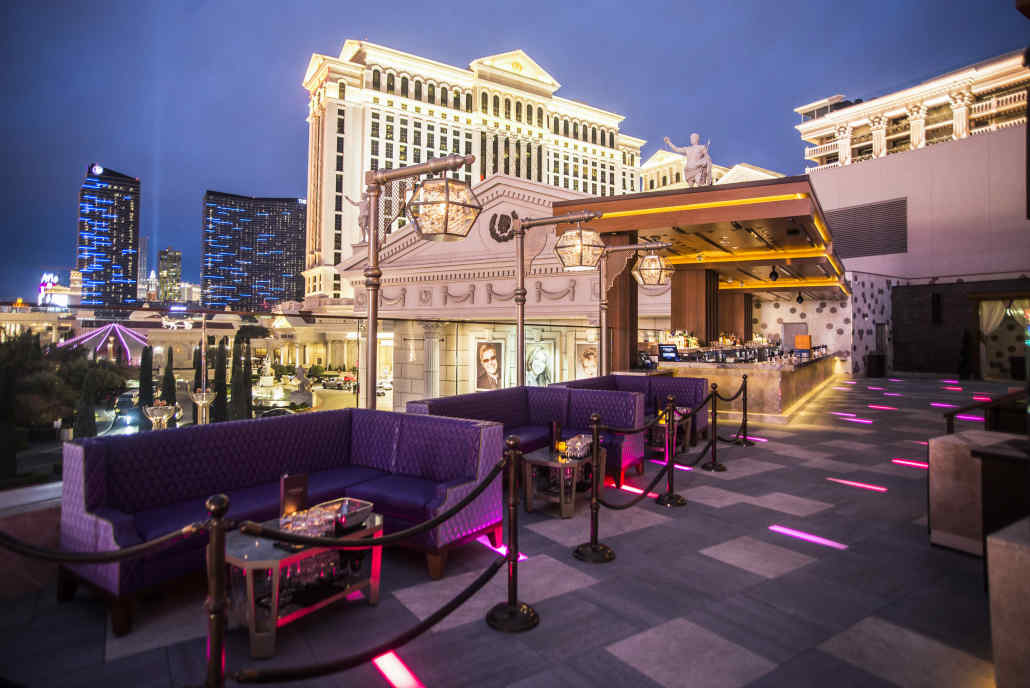
Two years after Hakkasan ushered in a new era of nightlife in 2013, OMNIA opened its doors inside Caesars Palace. Known for its “dancing” chandelier (click here for images) and opulence, OMNIA quickly established itself as a nightlife bucket list destination, attracting guests from all over the globe. The nightclub gives Hakkasan’s namesake venue a run for the title of portfolio flagship.

OMNIA is scheduled to reopen the property’s terrace area as a lounge on Friday, March 5. Restrictions mandated by the State of Nevada include reservations for nightclubs and dayclubs. In terms of health and safety protocols, a statement on the OMNIA website reads: “With health and safety protocols at the forefront: the venue has moved to touchless menu system via a scannable QR code from cell phones; VIP sections will be separated to allow for physical distancing; and rigorous cleaning plans will also be implemented.

Wet Republic

The dayclub that redefined the category, Wet Republic opened in 2008. If Rehab at the Hard Rock was the pioneer in the dayclub space, ultra-pool Wet Republic is the undisputed heir to the throne. There are no plans to relinquish that crown any time soon, either.

Just before the pandemic forced Las Vegas nightclubs to close, Wet Republic unveiled renovations made to the 54,000-square-foot property. The venue was able to operate in a limited capacity midway through 2020 but it wasn’t quite the same.

On Friday, March 5, more guests will finally be able to see the refreshed dayclub, located at MGM Grand. General admission is prohibited; reservations are required and the venue is following the same health and safety protocols as OMNIA.

Liquid Pool

Located at Aria Las Vegas, Liquid Pool is an upscale adults-only venue designed to pamper guests and provide a luxe pool experience. At 16,000 square feet, Liquid is less than a third the size of Wet Republic, delivering a more relaxed and intimate vibe than its larger sibling.

There are eight cabanas, several daybeds, multiple dipping pools, and upscale F&B programming at Liquid Pool. On Friday, March 12, Liquid Pool will welcome the start of Las Vegas pool season in reserved-but-elevated style. Like OMNIA and Wet Republic, Liquid Pool requires reservations.

Image: Hakkasan Group

by David Klemt David Klemt No Comments

Datassential Finds Operators Optimistic

Datassential Finds Operators Optimistic

by David Klemt

Restaurant open sign hanging in window

The latest report from Datassential finds that the vast majority of operators are optimistic or at least confident their businesses will survive the pandemic.

Per Datassential, operator outlook appears to be more positive than it was in December.

That’s largely due to the distribution of the Covid-19 vaccine.

Datassential Covid-19 Resources & Reports

Datassential has been releasing informative Covid-19 reports throughout the pandemic to provide helpful industry, consumer and operator data.

Trending Upward” is Datassential’s 46th installment, and the research firm provides their Covid-19 resources at no charge.

For this report, Datassential surveyed 400 “decision makers for restaurants and on-site foodservice locations.”

Operator Outlook

Most of the operators surveyed, 220 or 55 percent, are still concerned about the challenges facing them and the industry. However, they’re “fairly confident” that their businesses will make it through.

That 55 percent represents no change from December of last year, when Datassential last gauged operator outlook.

The next two survey respondent segments tell the tale of optimism.

Of the 400 operators surveyed, 148 or 37 percent are “cautiously optimistic.” In fact, they expect to be even stronger post-pandemic.

Compared to December, that’s a seven-percent increase in operators who feel optimistic. That seven percent shifted from the “very nervous” segment,

Just 32 of survey respondents (eight percent) reported that they don’t think they’ll survive the pandemic. Losing any businesses to the pandemic and its terrible impact on the industry is beyond horrific, and the results of this Datassential report in no way minimize that awful truth. However, the percentage of operators who feel “very nervous” or otherwise pessimistic reducing by nearly half provides at least a semblance of hope for the future of the industry.

Staff Cuts

According to Datassential, more than 80 percent of operators who were forced to cut staff at some point during the pandemic have been able to bring back some of their workers.

Of the 400 respondents surveyed by Datassential, 21 percent of operators reported they hadn’t laid off any of their employees

Another 20 percent had to cut staff but were able to rehire all of them.

Nearly half (48 percent) have only been able to hire some of the staff they laid off back. Twelve percent have been unable to rehire any of the staff they had to let go.

Takeaway

Optimism is great for emotional and mental health. So is targeted relief. Operators and employees will likely feel far more confident and relieved if the industry receives actual targeted relief. This Datassential report’s findings are positive but we need Congress to act.

Click here to tell your representatives to pass the RESTAURANTS Act now.

Image: Artem Beliaikin from Pexels

by krghospitality krghospitality No Comments

I Tried the Mask Made for & by Hospitality

I Tried the Mask Made for & by Hospitality

by David Klemt


DCBL X-1 Mask, made by hospitality professionals for the hospitality industry

Wearing a mask is part of everyday life, particularly for hospitality industry professionals.

DCBL Masks was designed by hospitality professionals for the hospitality industry, born out of their reverence for the workers putting themselves at risk so the communities they serve can retain a semblance of their normal lives.

Their first mask, the X-1, is intended to provide solutions to the problems presented by other face coverings.

Thoughtful Design

One problem with the standard masks and face coverings we’ve grown accustomed to is their tendency to muffle voices. One of the driving design elements behind the DCBL X-1 is the projection of the wearer’s voice.

The X-1 is a three-piece mask and its second layer is what sets it apart from others. The middle layer is sound-enhancing, sculpted foam that allows the wearer’s voice to carry. No more going hoarse from yelling, no more (or less, at least) repeating oneself, no more guests leaning in or stepping closer to hear what’s being said (hopefully).

That second layer is also intended to improve breathability. The inside layer’s design provides an air pocket for similar breathing functionality. It’s also made of natural bamboo so it’s soft, moisture-wicking and cooling, and it receives an antimicrobial treatment.

The X-1’s outer layer is polyester and resists dust and moisture while also protecting against UV rays. There are two flexible “suspension” systems, one for the nose and one to seal the bottom of the mask. Straps are Spandex, ear loops are adjustable, and there’s a clasp system so the wearer can choose how to secure the mask to their head.

Designed by Industry Pros

DCBL is the brainchild of industry veterans Michael Tipps and Homan Taghdiri. Tipps and Taghdiri are the co-founders of both DCBL Masks and Invictus Hospitality, a consulting agency headquartered in Los Angeles.

Tipps boasts over two decades’ experience in hospitality. He got his start in South Florida and has worked every front-of-house position. His journey through hospitality helped him gain perspective regarding the challenges inherent to the industry, and he eventually co-founded Invictus.

Taghdiri worked in hospitaity for 13 years before becoming a licensed attorney in California. He has worked every position in the industry. While he no longer studies law, when he did, he specialized in real estate, business and the hospitality industry.

DCBL’s Mission

There are three main goals DCBL seeks to achieve: Protection, projection, and connection. I’ve explained how they achieve the first two goals.

If the first goal isn’t realized, goals two and three don’t matter. If DCBL whiffs on the second goal, the third is unachievable. The X-1 seeks to make conversation easier when wearing masks so people can feel more connected. Being separated by masks, distance, barriers, and staying at home is detrimental to us all. The DCBL X-1 addresses that issue.

As the DCBL website says, “Staying safe and making a living shouldn’t be as challenging as it has been.” I feel the brand accomplishes their deceptively simple goals.

Impressions

First things first, I didn’t receive my X-1 in exchange for this post or any monetary compensation. I was genuinely curious about the mask and placed an order for two.

My masks arrived in a black bubble mailer, making them seem a little cooler from the start. They were each sealed in their own packet with an insert that explained the three layers, different methods for securing the X-1, machine washing instructions, and more.

DCBL X-1 mask packaging

In my experience, the mask felt soft and comfortable before even putting it on. The X-1 feels like a well-constructed, high-quality mask.

DCBL X-1 Mask

I have to say, I dig the interior layer. Not only is it soft and comfortable, the design detail is a nice departure from the white, black or pale blue to which we’ve all become accustomed:

Inside layer of DCBL X-1 face mask

It’s comfortable on my face and it allows me to speak comfortably, clearly and loudly no extra effort. I wore mine around my place and while writing this article. The ear loops are comfortable for me but the X-1 can be worn easily with an ear loop extension or toward the top of the head with the clasp system.

My glasses did fog slightly at first, but that became a non-issue after I adjusted the nose bridge suspension area.

Other people’s mileage may very, of course, but I feel that the mask delivers on DCBL’s mission statement: Be Heard.

To learn more and order the X-1, click here. connect with DCBL on Instagram and Facebook. Contact hello@dcblmasks.com for wholesale orders.

Disclaimer: The DCBL X-1 is not a medical-grade mask and is not intended as a replacement for medical-grade equipment or other recommended measures to stop the community spread of any viruses.

Images taken by author.

by David Klemt David Klemt No Comments

Infographic: NRA Raise the Wage Survey

Infographic: NRA Raise the Wage Survey

by David Klemt

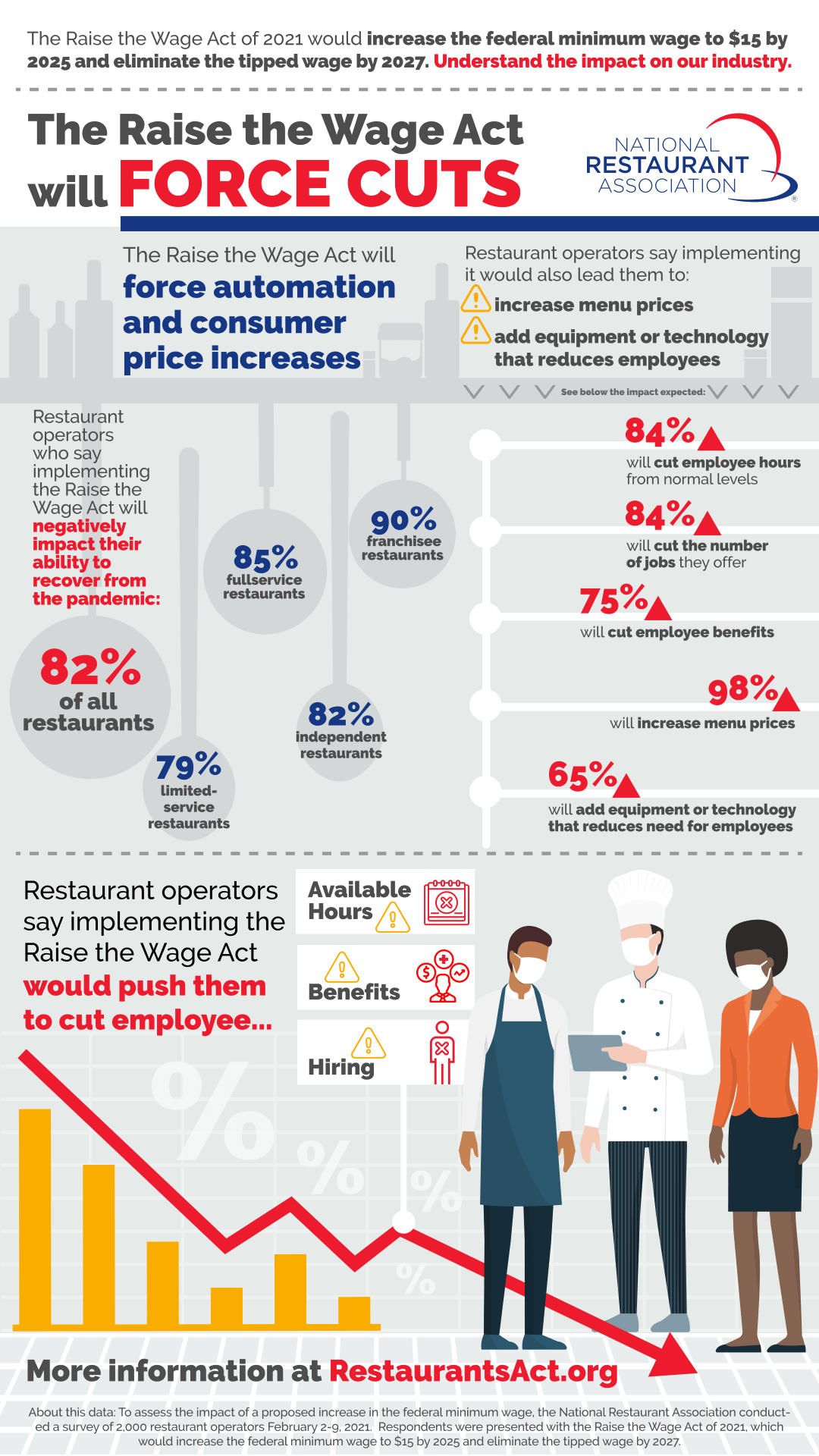
The results of a survey conducted by the National Restaurant Association to gauge operator reaction to the Raise the Wage Act are in.

Per the NRA’s infographic detailing the participant responses, there’s not much support for increasing the federal minimum wage and eliminating the tip credit.

What’s in the Raise the Wage Act?

If signed into law, the Raise the Wage Act will represent significant change for employers and employees.

The federal minimum wage will be raised incrementally to $15 by 2025. Two years later, in 2027, the tipped wage will be eliminated.

Survey Results

The NRA surveyed 2,000 restaurant operators between February 2 and 9. Respondents are clearly opposed to the Raise the Wage Act.

National Restaurant Association Raise the Wage infographic

What Does This Mean?

A vast majority of survey respondents—along with the NRA—definitely view the bill as a threat to the industry. An email sent by the NRA’s executive vice president of public affairs, Sean Kennedy, includes this succinct statement:

“These results make one point crystal clear—after seeing over 110,000 restaurants close and over 2.5 million jobs lost, increasing labor costs is going to make it more likely that more operators close their doors and lay off their staff. Tipped servers will lose with the end of a system that allows them to make $19-$25 an hour in tips under the current tip credit system.”

To the best of my knowledge, the NRA has not yet conducted a targeted survey of restaurant workers for their opinions of a $15 federal minimum wage and the elimination of the tax credit.

However, fast-food workers from McDonald’s and other chains have gone on strike in at least 15 cities in the United States to demand a raise to $15 per hour. That speaks volumes for how foodservice workers who aren’t typically tipped feel about the Raise the Wage Act.

What’s Next?

According to the NRA, the bill is slated to be fast-tracked and voted on in just a few weeks.

Agree that the Raise the Wage Act is going to hurt operators, workers and the industry? Click here to let Congress know.

Want Congress to pass the bill? Click here to find your representatives and let them know.

Infographic: National Restaurant Association

Image: lucas Favre on Unsplash

by David Klemt David Klemt No Comments

Mardi Gras Transforms Into Yardi Gras

Mardi Gras Transforms Into Yardi Gras

by David Klemt

In a glaring, neon sign of the times, Mardi Gras is built for socially distanced enjoyment this year.

This year, the parade “floats” will be stationary and the revelers will come to them.

Initially created as a grassroots campaign to raise money for artists who craft Mardi Gras parade floats, “Yardi” Gras just may become an annual tradition. In fact, it has been reported that artists have already been commissioned for Yardi Gras in 2022.

What is Yardi Gras??

It’s simple. Well, it’s simple to understand—designing and constructing a Mardi Gras float is a complex undertaking that takes about a year.

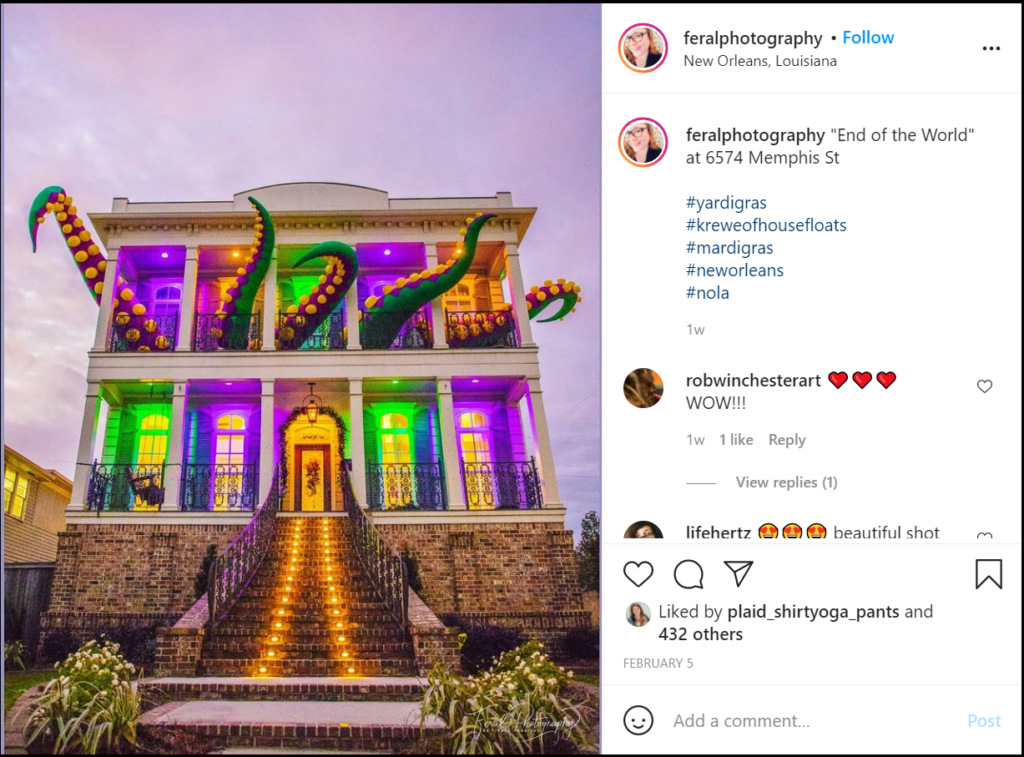
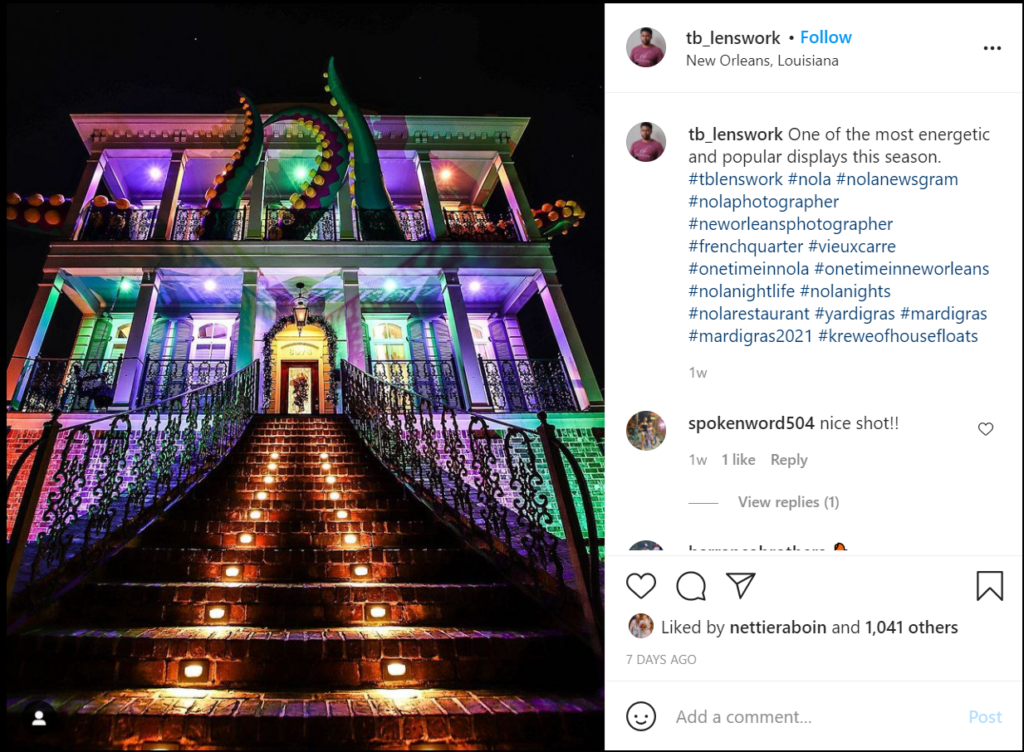
Anyway, Yardi Gras celebrates Mardi Gras by transforming buildings into stand-ins for their float counterparts. As you read this, there are hundreds of homes and businesses decorated to celebrate Carnival.

Given that the most common way to enjoy Yardi Gras is via driving tours, I can see this taking off in cities across the world…in conjunction with traditional Mardi Gras parades, of course.

Via @nolashirtclub on Instagram

Alright, Who Did This?

The Krewe of Red Beans has been credited with kicking off what I hope becomes a tradition in NOLA (along with the return of floats, of course) and other cities. To raise funds for Mardi Gras artists and float builders who found themselves out of work when the city canceled parades.

A krewe, by the way, is a social group that organizes Carnival parades or balls.

Announced via press release another krewe, the Krewe of House Floats, also supported artists and the community: The Krewe of House Floats (KoHF) today announced a giving campaign to raise $100,000 for those affected by COVID-19 restrictions and Mardi Gras event cancellations, with Culture Aid NOLA and Grace at the Greenlight as the first partners for the initiative. The magic of Carnival, while often billed as the ‘Greatest Free Show on Earth,’ isn’t possible without float artisans, service industry workers, musicians, Mardi Gras Indians and other culture bearers.”

Click here to donate via the Krewe of Red Beans, and click here to give to the Krewe of House Floats. The latter has created a map of Yardi Gras participants.

Via @tb_lenswork on Instagram

Why Am I So into this Idea?

In its 164-year history, Mardi Gras has only been canceled 14 times. Mardi Gras is most closely associated with New Orleans, a city that should hold a place a reverence in the hearts of all hospitality workers.

Las Vegas, New York City, Chicago, San Francisco, and Orlando come to most people’s minds when they think of US cities known for hospitality. However, New Orleans deserves a top ranking on any hospitality list.

New Orleans has nurtured the careers of several notable chefs, bartenders and operators:

  • Chef Leah Chase, who passed in 2019, was anointed the Queen of Creole Cuisine. Dooky Chase, her NOLA restaurant, has been recognized as one of the most important restaurants and was an important gathering spot for the Civil Rights Movement.
  • Emeril “So Famous You Don’t Need to Hear His Last Name to Know Who I’m Talking About” Lagasse helmed the storied Commander’s Palace in NOLA.
  • The Brennan family took ownership of Commander’s Palace in 1969 and has succeeded in building a family-owned restaurant empire.
  • Chef Nina Compton is a James Beard Award winner who worked in NYC and Miami. Before opening the award-winning Compère Lapin in 2015 and Bywater American Bistro in 2018 in NOLA, Chef Compton competed on season 11 of Top Chef.
  • Chris Hannah worked at the world-famous Arnaud’s 75 for close to 15 years before opening Manolito and Jewel of the South with Nick Dietrich.
  • Jeff “Beachbum” Berry cemented his legacy as one of the most influential people in the bar world long before he opened Latitude 29 in the French Quarter. He has written seven books focused on cocktail and culinary history, “lost” recipes, and culture.

That’s just a tiny handful of culinary and cocktail influencers with ties to New Orleans.

Cocktails Created in New Orleans

NOLA is the home of several classic cocktails, including:

  • Sazerac. Antoine Peychaud, the inventor of Peychaud’s Bitters, is credited as the creator of the Sazerac.
  • Vieux Carré. It means “Old Quarter” in French and references what we now know as the French Quarter.
  • Brandy Crusta. Created by Joseph Santini in the 1850s at the “original” Jewel of the South bar.
  • Ramos Gin Fizz. Originally called the New Orleans Gin Fizz but eventually changed to honor its creator, Henry Ramos.
  • Hurricane. Invented at Pat O’Brien’s Bar, which is still in operation and has been serving Hurricanes since the 1940s.

Next time you serve or enjoy one of these classics, toast New Orleans.

We hope you have a great Mardi Gras or Yardi Gras!

Image: beebutter from Pixabay

by David Klemt David Klemt No Comments

This Generation is Most Likely to Dine In

This Generation is Most Likely to Dine In

by David Klemt

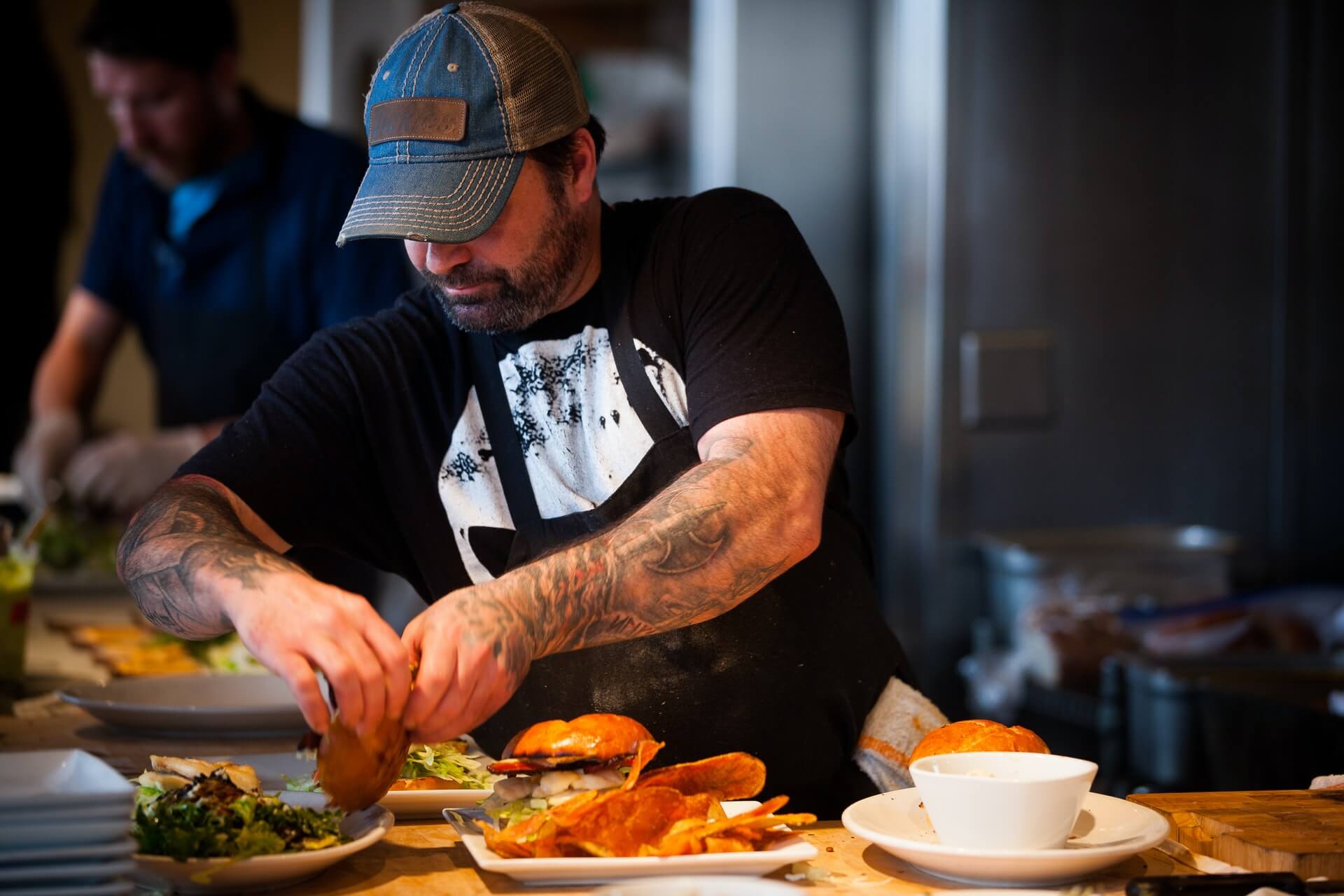
Chef preparing burgers inside restaurant

The National Restaurant Association’s 2021 State of the Restaurant Industry report revealed the generation most likely to dine in-person at a restaurant.

That is, of course, if such restaurant service—from quick-service to fine dining—is permitted where they’re located.

So, do you have a guess? Because we have the answer.

Most Likely to Dine In

Per an NRA survey, Gen Z is most eager to return to in-person restaurant dining.

However, it’s more of a simple majority that’s after a restaurant experience beyond delivery, takeout and curbside pickup than an overwhelming one.

Just 53 percent of adult members of Gen Z surveyed by the NRA are willing to dine inside restaurants over the course of the next few months.

Overall, 67 percent of Gen Z, Millennial, Gen X and Baby Boomer adults would like to engage with restaurants like they did before the pandemic. That’s not a huge stretch, of course; we all want to return to normal and put Covid-19 behind us.

Still, the survey results make it clear there’s demand for in-person dining. The convenience of interacting with and ordering from restaurants is here to stay. However, that convenience hasn’t replaced the desire to dine (and socialize) out.

So, Who’s Most Likely to Order In?

You’d be forgiven for assuming the answer to this question is also Gen Z. After all, just about every development regarding technology and how people engage with the world has been laid at their feet.

When Gen Z isn’t being accused of “killing” a tradition, sense of normalcy or an entire industry, the finger is pointed at Millennials.

Well, it turns out the usual finger-pointing suspects are the consumers most likely to order from restaurants.

According to the NRA’s report, 81 percent of Boomers and 80 percent of Gen X will continue to order from restaurants, at least for the next few months.

Put it All Together

At least for the next several months, the industry’s recovery will hinge on the full-strength return of in-person service and the convenience of delivery and takeout.

In other words, some consumers are champing at the bit to once again make restaurant visits a regular part of their lives while others plan to proceed with caution. Successful restaurant operations will maintain a mixture of traditional and digitally-driven services.

Nearly 90 percent of adults surveyed by the NRA say they enjoy going out to restaurants and that doing so with family and friends is a better way to spend leisure time than cooking at home.

“Restaurants are the cornerstone of our communities, and our research shows a clear consumer desire to enjoy restaurants on-premises more than they have been able to during the pandemic. We’ve also found that even as the vaccine becomes more available and more social occasions return to restaurants, consumers will continue to desire expanded off-premises options going forward. Both will continue to be key for industry growth,” said Hudson Riehle, senior vice president, Research and Knowledge Group, NRA, in a press release announcing the Association’s 2021 State of the Restaurant Industry. “With more than half of adults saying that restaurants are an essential part of their lifestyle, we are confident that, with time, the industry is positioned for successful recovery.”

The NRA predicts foodservice sales to reach $731 billion in 2021, an 11 percent increase over 2020. Unfortunately, that estimate is about 15 percent lower than sales generated in 2019.

Still, that’s a reason to be optimistic. Consumers are pent-up and eager to make restaurants a significant part of their lives once again.

Nobody is more eager, evidently, than Gen Z.

Image: Jesson Mata on Unsplash

by krghospitality krghospitality No Comments

On the Menu for 2021: The RESTAURANTS Act

On the Menu for 2021: The RESTAURANTS Act

by David Klemt

Much like restaurants themselves, the RESTAURANTS Act has faced multiple starts and stops.

The bill received huge bipartisan support in 2020, landing dozens upon dozens of co-sponsors.

However, that widespread support didn’t materialize into any actual progress—the bill was never signed into law. That must change now.

A Long Road

It’s February 2021. The House and Senate must work together to provide the targeted relief of the Real Economic Support That Acknowledges Unique Restaurant Assistance Needed to Survive (RESTAURANTS) Act.

The RESTAURANTS Act was first introduced to the House of Representatives on June 15, 2020. The bill was eventually included in the revised Heroes Act, which was passed by the House on October 1, 2020 on a vote of 214 to 207.

Unfortunately, that bill was “dead on arrival” and didn’t receive a vote on the Senate floor. A $900 billion stimulus package was negotiated in December of 2020 but the RESTAURANTS Act wasn’t included in it.

It has been more than long enough—it’s beyond time for action.

Where are We Now?

Throughout all of this, from inception to current status, the Independent Restaurant Coalition (IRC) has never faltered in their campaign to ensure this industry receives the targeted relief it so desperately needs.

It’s wise given how the number of times we’ve been let down by our elected officials to be guarded and cautiously optimistic about the RESTAURANTS Act finally being signed into law this month.

On February 5, Senators Roger Wicker (R-MS) and Kyrsten Sinema (D-AZ), and Representatives Earl Blumenauer (D-OR) and Brian Fitzpatrick (R-PA) formally (re)introduced the RESTAURANTS Act to the 117th Congress.

What’s in the Bill?

In its current form, the RESTAURANTS Act:

  • establishes a $120 billion relief fund for foodservice and drinking establishments;
  • makes groups that operate up to 20 units eligible for relief from that fund;
  • provides operators access to grants of up to $10 million for eligible expenses; and
  • makes the grants retroactive to February 15, 2020 and ends them eight months after the legislation is signed into law.

New provisions in the February 2021 RESTAURANTS Act include:

  • updates to the award calculation based on annual loss from calendar year 2020 instead of quarterly;
  • grant eligibility for new restaurants that opened after January 1, 2020;
  • paid sick leave as an eligible expense for employees, with a bonus amount to cover the cost of voluntarily providing ten days of sick leave to employees;
  • providing the Department of the Treasury the discretion to help reduce waste, fraud, and abuse;
  • imposing reporting obligations on the Department of the Treasury to share who gets loans and demographic information about recipients; and
  • ensuring that restaurants can use both the Employee Retention Tax Credit and the RESTAURANTS Act grant program, provided they are not used for the same expenses.

What’s Next?

We must all act to give the RESTAURANTS Act the best chance of becoming law. We have been patient for long enough.

We must let our representatives know we expect them to pledge their support for this bill formally.

The IRC provides several methods for ensuring our representatives understand they need to co-sponsor and pass the RESTAURANTS Act:

  1. Email your representatives and ask them for their co-sponsorship.
  2. Call your representatives directly and tell them why restaurants and bars need the RESTAURANTS Act to be voted on, passed, and signed into law. This is the number to dial: (202) 224-3121. The IRC has provided talking points here.
  3. Share the graphic below on your social channels and encourage your followers to also contact their representatives and ask them to co-sponsor the RESTAURANTS Act. Use the following caption when posting: It’s official: the RESTAURANTS Act of 2021 is on the menu in both chambers of Congress. Call your representatives today and tell them that independent restaurants, bars, and workers can’t wait any longer for direct relief: 202-224-3121 #SaveRestaurants

All of that will take less than 20 minutes. That’s not a lot of time to help finally get this industry the support and relief it needs.

The RESTAURANTS Act is needed to prevent more permanent restaurant and bar closures, and to revitalize the industry. The road to recovery is a long one and getting this bill signed into law is a major step forward.

Please email and call your representatives. Please share the post and caption above on your social media. Please help save the restaurants, bars, and millions of people they employ.

Image:

by David Klemt David Klemt No Comments

2021 Technomic Outlook: United States

2021 Technomic Outlook: United States

by David Klemt

Technomic has been providing the foodservice industry with valuable insights on a global level for 50 years.

The research and consulting firm has been one of my go-to information sources for at least a decade.

A few weeks ago, I reviewed American food delivery trends from multiple sources. This week, I’m taking a look at Technomic’s foodservice predictions for the US.

Unprecedented and Unpredictable

Before we proceed, keep this in mind: predictions are best guesses. Technomic’s approach is scientific and data-driven but it’s important to approach any prediction with caution.

As the firm itself points out in their 2021 foodservice report, the global pandemic has plunged the industry deep into unprecedented territory.

It seems the only thing predictable about Covid-19 in relation to restaurants, bars and other hospitality businesses is that this industry will continue to bear the brunt of closures and restrictions.

That said, I trust Technomic to lead the industry through unprecedented and unpredictable moments in time.

7 Key Trends

Technomic has made seven predictions for foodservice in the US.

  1. Streamlined menus. Technomic expects the trend toward reducing SKUs to continue. However, that may lead to innovative and healthy items replaced removed items. Leafy greens, environmentally-friendly, and health-conscience items such as immune boosters are expected to be menued.
  2. Tech is the future. This prediction can be summed up quickly: If it’s a tech-based, can improve operations and help a brand differentiate itself from others, the industry is going to implement it.
  3. Top three cuisines. Chinese, Italian and Mexican food and drink are expected by Technomic to perform the best in 2021, particularly if operators move beyond the classics and incorporate lesser-known ingredients. However, Technomic expects more interest in West African and Caribbean cuisine.
  4. Social justice. Operators will have to be transparent about their stances on social justice issues and make meaningful statements—hashtags won’t cut it with younger consumers.
  5. Umami will reign supreme. Technomic uses the phrase “new-mami” to describe “intense, mouthwatering fare.” Think fruit vinegars beyond apple, candy cap mushrooms, seafood meatballs, and so much more.
  6. Communal concepts must adapt. Food halls, eatertainment concepts, and venues with communal seating will have to reimagine their spaces and how guests use them during an era characterized by social distancing, constant sanitizing, and off-premise business models. Traditional guest experiences may return but there’s no telling when that will happen.
  7. Revenue recovery. Technomic expects the industry to start recovering in 2021. However, sales levels are unlikely to reach those of 2019.

Bring it all Together

Chasing trends can be a fool’s errand. Not every prediction made by Technomic will work for every restaurant or bar in Canada.

Just like Technomic collects and analyzes industry data, operators must review their guest, sales and operations data to make informed decisions. This is another reason it’s crucial to own the guest journey in its entirety.

Click here to view Technomic’s “2021 U.S. Trend Outlook” webinar.

Image: Justin Cron on Unsplash
by David Klemt David Klemt No Comments

2021 Technomic Outlook: Canada

2021 Technomic Outlook: Canada

by David Klemt

Technomic has been providing the foodservice industry with valuable insights on a global level for five decades.

The research and consulting firm has been one of my go-to information sources for at least ten years.

A few weeks ago, I reviewed Canadian food delivery trends from multiple sources. This week, I’m taking a look at Technomic’s foodservice predictions for Canada.

Unprecedented and Unpredictable

First things first: predictions are best guesses. Technomic’s approach is scientific and data-driven but it’s important to approach any prediction with caution.

As the firm itself points out in their 2021 foodservice report, the global pandemic has thrown the industry into unprecedented territory.

It seems the only predictable element related to Covid-19 is that restaurants, bars and other hospitality businesses will bear the brunt of closures and restrictions.

That said, I trust Technomic to lead the industry through unpredictable, unprecedented moments in time.

5 Key Trends

Technomic has made five predictions for foodservice in Canada.

  1. 2021 will represent the start of financial recovery for foodservice. Technomic predicts moderate sales growth this year, below levels of 2019. However, limited-service restaurants are expected to perform better than their counterparts and return to 2019 revenue levels. Not surprisingly, Technomic expects full-service restaurants to be the most challenged.
  2. Operators will make their stances on social issues known. Multiple sources say today’s consumers want transparency from the brands they support. They want to know what company’s believe about climate change, food insecurity, social inequalities, diversity and hiring practices, fair pay for employees, and other issues. Technomic expects more operators to “double down” on transparency.
  3. On-premise operations will invest in off-premise business models. Again, multiple sources have reported that significant percentages of consumers are uncertain or uncomfortable about returning to restaurants and bars for in-person dining and drinking. Technomic expects operators to invest in smaller dining rooms so they can offer more limited-contact and contactless options to guests: walk-up ordering windows, multiple drive-thru lanes, designated curbside pickup locations, and in-store pickup and grab-and-go stations. The firm also expects more operators to embrace first-party/direct delivery, along with technologies like mobile ordering and geofencing.
  4. Comfort, quirkiness and indulgence. Technomic expects comfort foods to continue to perform well and encourages operators to get creative—even quirky—with this category. They caution that health will still be a focus of many guests and suggest that some operators will “disguise better-for-you meals as indulgent.”
  5. Our home and native land. Hyperlocality will play a crucial role in driving traffic given the travel restrictions imposed throughout Canada. Operators will likely forge relationships with local farms to attract local visitors to their venues. Technomic expects to see grassroots movements promoting support for small regional chains and local independent operations to gain traction.

Bring it all Together

Chasing trends can be a fool’s errand. Not every prediction made by Technomic will work for every restaurant or bar in Canada.

Just like Technomic collects and analyzes industry data, operators must review their guest, sales and operations data to make informed decisions. This is another reason it’s crucial to own the guest journey in its entirety.

Click here to view Technomic’s “2021 Canadian Trends Outlook” webinar.

Image: Hermes Rivera on Unsplash

by David Klemt David Klemt No Comments

E-Commerce Alters Drinking Occasion

E-Commerce Alters Drinking Occasion

by David Klemt

According to estimates, beverage alcohol e-commerce grew by 40 percent in 2020.

Per data from the IWSR, ten “core countries” are driving that growth: Australia, Brazil, China, France, Germany, Italy, Japan, Spain, United Kingdom, and the United States. China, the reigning campion of beverage alcohol e-commerce, is expected to be toppled by the US by the end of this year.

Of particular note: growth in the above markets more than doubled from 2019, when online alcohol retail grew by 11 percent.

What this Means for Brick-and-Mortar Operations

We all know what drove the growth in online alcohol sales.

In their quest to find comfort in the midst of the global 2020 pandemic, they became comfortable with purchasing alcohol online as a long-term behavior. Alcohol brands were forced to pivot to online sales channels due to restaurants, bars, lounges, nightclubs and other brick-and-mortar F&B operations facing constantly shifting restrictions and closures. (See also: Los Angeles County restaurant restrictions.)

To compete, operators must continue to do what they’ve had to even before a pandemic absolutely ravaged the hospitality industry and millions of people’s livelihoods: adapt.

For at least several more months, drinking at home will be its own occasion, for obvious reasons. The IWSR expects brands to invest more into online alcohol retail. If that proves to be the case, operators can expect–as a worst-case scenario–fewer dollars spent on their brick-and-mortar operations.

Getting creative with alcohol delivery, takeout and pickup is crucial to give operators the best chance to be included in the at-home drinking occasion.

The Trends to Watch

In terms of delivery trends, you can click here for food trends so you can consider complimentary beverages. Click here for 2021 drink trends, which certainly include alcohol-free beer.

Athletic Brewing Co. alcohol-free craft beers.

Athletic Brewing Co. alcohol-free craft beers. Image: Athletic Brewing Co.

Speaking of delivery, the growth in alcohol e-commerce makes owning the guest journey by offering direct delivery even more important.

The IWSR has identified their own set of trends tied to the growth of alcohol e-commerce:

  1. As touched on above, at-home drinking becoming its own occasion outright.
  2. Premiumization will change. Some consumers will experiment less and focus on their favorite brands, and others will turn to brick-and-mortar channels for premium experiences.
  3. Politics will play a noticeable role on beverage alcohol, not just in the US but across the globe. Tariffs could change and strict e-commerce regulations could loosen.
  4. RTDs will remain strong or get stronger. Per the IWSR, “innovation in alcohol bases, exploration of new and increasingly local flavors, and premium product offerings” will ensure RTDs remain a crucial beverage category in 2021.
  5. Low- and zero-alcohol drink options will continue their evolution. Once stigmatized, these drinks exploded in popularity in 2020. For 2021, the IWSR expects them to become aspirational.

Last year changed the industry. Comfort, convenience, and a heightened awareness of health and wellness are altering how people consume and engage with brands, restaurants and bars. Operators, already facing challenges from all sides, must take the time to develop strategies to compete for e-commerce dollars.

Image: mentatdgt from Pexels

by David Klemt David Klemt No Comments

What You Need to Know About SBA Form 3508S

What You Need to Know About SBA Form 3508S

by David Klemt

Midway through last month, the Small Business Administration maneuvered to make the PPP loan forgiveness process simpler for loans up to $150,000.

In December of 2020, Congress passed a Covid-19 relief bill that pumped $284 billion into the Paycheck Protection Program.

Twelve billion dollars were made available to minority-owned and “very small” businesses, and $15 billion were made available to independent movie theaters, live music venues, and cultural institutions.

What is SBA Form 3508S?

Simply put, 3508S is a simplified, one-page PPP loan forgiveness form.

When Congress passed December’s relief bill, they included a requirement for the SBA to offer streamlined loan forgiveness forms.

To that end, 3508S is for businesses that received loans of $150K or less. Again, it’s a single page. As you’ll see when you check out SBA Form 3508S, the form comes with instructions.

What information do you need to provide?

With Form 3508S, you’re not even filling out an entire page. And the first roughly third is simple. Assuming you’re the person filling out, certifying and signing the form:

  • Business legal name (“Borrower”)
  • If applicable, the DBA or Tradename
  • Business address
  • North American Industry Classification System (NAICS) code (Accommodation and Food Services is 72; Arts, Entertainment and Recreation is 71, for reference)
  • Business Taxpayer Identification Number (TIN), Employer Identification Number (EIN), or Social Security Number (SSN)
  • Primary contact
  • Email address

After filling out that section and ticking the box for first-draw PPP loans or second draw, you’ll need the following info:

  • SBA PPP loan number
  • Lender PPP loan number
  • PPP loan amount
  • PPP loan disbursement date
  • The number of employees at the time of the loan application
  • Number of employees at time of loan forgiveness application
  • Covered period of PPP loan. Per the form instructions, “The Covered Period begins on the date the loan was originally disbursed. It ends on a date selected by the
    Borrower that is at least 8 weeks following the date of loan disbursement and not more than 24 weeks after the date of loan disbursement.”
  • Total amount of loan spent on payroll costs
  • Requested amount of loan forgiveness

From there, you initial two boxes–if you can do so accurately and honestly–next to certification statements. Then you sign, print and the date form and include your title.

There’s an optional demographic information section at the top of page two of Form 3508S.

SBA Form 3508A. Sample only.

What additional documentation must you provide?

None, which is what makes this form so simple. In fact, you’re not even required to show any of your calculations corresponding form sections. However, we strongly suggest you run those calculations as you’ll need to certify that you did so and you’ll need them if the SBA audits the loan.

And while you don’t have to submit additional documents, it’s likewise required and smart that you retain required documentation for a number of years. The SBA may ask for certain documents when your application comes up for review, so you’ll want to know where they are to make the process as smooth as possible.

What’s the loan forgiveness deadline?

There’s no specific date in terms of an SBA PPP loan deadline. However, the SBA’s PPP loan forgiveness FAQ states the following:

  • “Borrowers may submit a loan forgiveness application any time before the maturity date of the loan, which is either two or five years from loan origination.”
  • “[I]f a borrower does not apply for loan forgiveness within 10 months after the last day of the borrower’s loan forgiveness covered period, loan payments are no longer deferred and the borrower must begin making payments on the loan.

You may notice that Form 3508S has an expiration date of July 31, 2021 in the upper right-hand corner. This simply indicates the SBA’s compliance with the Paperwork
Reduction Act.

There are other SBA PPP loan forgiveness applications as well. SBA Form 3508-EZ is for borrowers who meet specific conditions, and Form 3508D is for borrowers to disclose controlling interests in the business by other companies, along with government officials involved in the business.

If none of those forms are right for you, you’ll have to fill out the standard, five-page Form 3508.

Image: Cytonn Photography from Pexels

by David Klemt David Klemt No Comments

Los Angeles Restaurants Face New Outdoor Dining Restrictions

After Weeks of Prohibition, This is What Los Angeles Restaurants are Facing

by David Klemt

Limited to delivery and takeout for several weeks, Los Angeles restaurants and breweries may now offer outdoor dining.

Of course, that easing of restrictions comes with a raft of new limitations.

The outdoor dining ban was lifted last Friday, January 29. Governor Gavin Newsom rescinded California’s statewide stay-at-home order four days prior, January 25.

Operators, still caught firmly in the vortex of opens, closures and ever-shifting restrictions, will have to weigh the potential to generate in-person dining revenue against limitations and costs.

Outdoor dining capacity of restaurants, breweries and wineries (able to open for outdoor tastings) is restricted to 50 percent. Even an operator with a significant outdoor footprint may find the revenue generated from in-person dining incapable of offsetting associated costs.

Speaking of footprint, operators must also contend with new distance requirements. Outdoor tables must now be spaced a minimum of eight feet apart to ensure guests aren’t seated back to back. This increase from six feet must be measured from the edges of each table.

Any employee who “may come in contact” with a guest is required to wear a face mask and a face shield for the duration of such an interaction, which can’t include tableside preparations.

No live entertainment is permitted, and televisions must remain turned off. Couple the television ban with a prohibition on “coordinated, organized or invited events or gatherings” and Super Bowl parties are clearly not permitted.

Additional limitations pertain to guests and group size. No more than six people may be seated at a table, and each guest must be a member of the same household. Signage informing guests of the household requirement must be posted, and guests must also be given this information verbally.

A “household” in Los Angeles County is defined as “persons living together as a single living unit.” Click here for the County of Los Angeles Department of Public Health’s “Protocol for Restaurants, Breweries and Wineries: Appendix I.”

According to Dr. Barbara Ferrer, Los Angeles County health director, operators can expect increased scrutiny and enforcement of Covid-19 protocols.

Evidence of enhanced enforcement efforts was seen last week. LA County filed two suits on January 27 against Cronies Sports Grill in Agoura Hills and Tinhorn Flats in Burbank for failing to adhere to health directives. Both suits label the establishments as “public nuisances.”

Some Los Angeles operators may find limited outdoor dining better than no in-person dining at all. However, others may conclude that labor and PPE costs alone aren’t worth restricted reopening, to say nothing of contending with increased governmental scrutiny.

Image: David Mark from Pixabay

by krghospitality krghospitality No Comments

National Restaurant Association Opposes Elimination of Tip Credit

National Restaurant Association Opposes Elimination of Tip Credit

by David Klemt

Citing a 600-percent increase in labor costs, the National Restaurant Association opposes the elimination of the tip credit.

An email sent out yesterday by NRA executive vice president of public affairs, Sean Kennedy, stated that doing away with the credit would present “an impossible challenge to restaurant owners” to remain open.

The email also opposes boosting the national minimum wage to $15 per hour.

Not every operation would see labor costs potentially skyrocket to untenable levels but wage changes could see restaurants, bars and other businesses in some states hit the cited 600-percent increase. If the majority of restaurant operators saw sales decline last month, as a previous NRA report said operators predicted, and that trend continues, the association’s standpoint could be proven right.

While the NRA continues its support for making the RESTAURANTS Act part of any new stimulus relief bill, the association has made their positions on the matter of a minimum wage hike and elimination of the tip credit clear:

“But now is not the time to insert wage changes–a hike in the minimum wage and elimination of the tip credit–to a stimulus bill. Tipped servers generally earn between $19-$25 dollars per hour, and this plan would punish these workers who use restaurant jobs to make a better life for themselves.”

The NRA appears concerned that the Biden administration’s efforts to quickly get Congress to pass a Covid-19 relief bill are short-sighted and will end up hurting tipped workers and the hospitality industry overall.

According to the message sent out yesterday, the majority of tipped workers across the country have, historically, opposed efforts to eliminate the tip credit. Per the NRA, tipped workers earn between $19 to $25 per hour when the tip credit remains intact.

Instead, the NRA prefers the next stimulus relief bill–there are currently two competing bills, one for $1.9 trillion plan and a GOP counterplan with a price tag of around $600 billion–to go with the Senate version of the RESTAURANTS Act.

If you agree with the NRA’s concerns, click here to take action.

Image: Mathieu Turle on Unsplash
by David Klemt David Klemt No Comments

Rise of the ‘Not’ Delivery Platforms

Rise of the ‘Not’ Delivery Platforms

by David Klemt

The big third-party delivery services are facing pushback in the form of community-based competition.

We’ve kept our eye on this burgeoning trend and the push for operators to implement first-party delivery, also known as direct delivery.

It isn’t directly related to hospitality but the first of the “not” sites that grabbed our attention was Not Amazon. As the name suggests, Not Amazon is…well…not Amazon.

The founder highlights businesses owned and operated by women and BIPOC and LGBTQA+ people. However, Not Amazon goes even further, as illustrated in their mission statement:

“Providing the most we can, while taking as little as possible, in order to build a new kind of community.”

Community and neighborhood support is at the core of Not Amazon. The digital era has been marked by local, mom-and-pop brick-and-mortar businesses suffering in the wake of online shopping. Convenience has outweighed community. More often than not, women-, BIPOC- and LGBTQA+-owned businesses have been disproportionately affected by “convenience.”

Of course, it makes sense with a global pandemic to shop online. Not Amazon, which currently serves Calgary, Halifax, Toronto and Vancouver, provides a viable alternative to its behemoth of an online retail counterpart.

That brings us to two compelling hospitality industry-specific platforms.

It’s not a secret that KRG Hospitality supports first-party and last-mile delivery. In fact, we’ve very clearly explained that operators lose guest data and control over the guest journey when they sign with a third-party delivery company.

That’s to say nothing of the fees third-party services charge their F&B “partners.” Is it convenient that DoorDash, UberEats, Postmates and other companies provide a semblance of infrastructure, the lure of reaching a larger pool of customers, and drivers (including the associated liability)? Sure.

But are the costs associated with doing business with a third-party delivery company worth it? Most likely not.

Studies have also shown that when a delivery goes wrong on the third-party’s end–cold food, for instance–it’s the restaurant that tends to get the blame.

There are two websites that, like Not Amazon, have popped up to put supporting local restaurants front and center: Not UberEats and NotGrubhub.

The former serves Toronto and operates as a non-profit, according to their FAQ page. The latter is mainly focused on the United States, offers the option to purchase gift cards, and is powered by Lunchbox. NotGubhub also boasts more than 100,000 direct ordering links.

Both operate in similar fashion: Restaurants submit their information to be added to the respective platforms, provide an ordering link, and obtain a listing. From there, people can search by location for restaurants in their area to place a delivery order.

In the case of NotUberEats, deliveries are fulfilled by Ritual or DoorDash. As noted on their FAQ page, Ritual is offering Toronto restaurants free delivery through 2021. Restaurants can also DoorDash because, as NotUberEats explains in their FAQs, the service is charging a flat rate and not collecting any commissions.

People can also send restaurant information to NotUberEats to help grow their listings. Anyone who wishes to do so is asked to provide at least 50 businesses in their city and submit them here.

Operators ready to make the move to first-party/direct delivery and own their guest journey should consider the following platforms:

With delivery here to stay, the sooner operators transition to direct delivery, the better. There’s no longer a reason to lose control of guests, a profitable operational element, or costs.

Image: Nathan Dumlao on Unsplash
by David Klemt David Klemt No Comments

California’s Restrictive Regional Stay-at-Home Order Rescinded

California’s Restrictive Regional Stay-at-Home Order Rescinded

by David Klemt

Expectation became reality yesterday when Governor Gavin Newsom rescinded California’s highly restrictive regional stay-at-home order.

It had been reported for at least a day prior that Gov. Newsom was expected to do so on January 25.

The order, which choked the life out of restaurants, bars and other businesses, has been in place since the start of December 2020.

As we reported several weeks ago, a group of Orange County operators pushed back against the order shortly after it was imposed. The #OPENSAFE collective released a statement announcing their intention to protest Gov. Newsom’s stay-at-home order by remaining open for in-person dining.

Other states that imposed seemingly arbitrary and illogical orders that crushed restaurants and bars also experienced open defiance from operators. One of the highest-profile protests came from New York City restaurants.

Speaking for the first time in well over a week about California’s efforts to combat Covid-19, Gov. Newsom said, “Everything that should be up is up, everything that should be down is down.”

That’s an interesting claim given California experienced a record number of Covid-19-related deaths on January 21 with 761. During his press conference, the embattled governor claimed he lifted his stay-at-home order due to ICU numbers and not because of the multiple lawsuits filed against him or the current recall campaign.

Rather, Gov. Newsom said that he made his decision based on Covid-19 cases and hospitalizations decreasing while vaccination rates are reportedly trending upward. However, as one source cited, just 26 percent of California’s allotted vaccine doses had been administered as of last week.

The rescinding of the regional stay-at-home order doesn’t mean that businesses can reopen and resume operations as usual. Each of the state’s counties will be color-coded according to California’s “Blueprint for a Safer Economy.” Projections will be set aside for actual transmission rate data.

Tier 4 is color-coded yellow and its Covid-19 transmission risk is labeled “Minimal.” Tier 3 is orange and “Moderate,” where as Tier 2 is red and “Substantial.” Tier 1, which is purple, is labeled “Widespread.”

At the moment, most counties in California are purple.

Restaurants located in a Tier 1 county can offer only outdoor in-person dining. Those in Tier 2 can offer indoor dining but only at 25-percent capacity or 100-person maximum capacity (whichever is lower). Tier 3 bumps capacity to 50 percent or 200 people, and Tier 4 dictates a maximum of 50 percent capacity.

As expected, bars (along with breweries distilleries) that don’t serve food receive much harsher treatment than restaurants. Those located in a county designated purple or red must close. Bars in orange counties can open for outdoor service only, and those in yellow counties can offer indoor service at 50-percent maximum capacity. Bars “where [a] meal is provided” follow restaurant guidelines for the four applicable tiers.

Movie theaters, for context concerning how bars are being treated, are subject to the same guidance as restaurants in California’s blueprint. Such venues aren’t exactly known for providing meals.

Before operators who have chosen to work within California’s guidelines throw their doors open, they need to know two things. One, county officials are permitted to impose their own restrictions. If they choose to do so, those restrictions can be stricter than those that come down from state officials.

Two, for those operators in Los Angeles County, confusion remains regarding outdoor dining. Some interpret the rescinding of the state’s prohibition on outdoor dining as a lifting the ban. However, LA County implemented its own ban before the state did so. That county-issued ban expired on December 16 but outdoor dining was banned under the statewide stay-at-home order.

It may seem cut and dry that the expiration of the county order and the lifting of the state’s ban shifts LA County to Tier 1 restrictions. Operators should make sure they’re clear to resume outdoor service before incurring the costs associated with doing so.

How long California will revert back to the state’s Blueprint for a Safer Economy is anyone’s guess. Operators in several states have found themselves caught in a vicious open-close, open-close vortex. At any rate, 25-percent capacity restrictions will still more than likely make it more cost-effective for some operations to remain closed for indoor service.

Image: Paul Hanaoka on Unsplash
by David Klemt David Klemt No Comments

February’s Big Game Presents an Opportunity for Operators

February’s Big Game Presents an Opportunity for Operators

by David Klemt

The most American of sporting events goes down on February 7.

This season’s Super Bowl match-up was decided yesterday.

In the NFC Championship game, the 14-5 Tampa Bay Buccaneers, led by Tom Brady, defeated Aaron Rodgers and the 14-4 Green Bay Packers. The game was close, with the Bucs winning 31 to 26.

Later in the day, Patrick Mahomes and the 16-2 Kansas City Chiefs, led by Josh Allen, knocked the 15-4 Buffalo Bills out of the championship game yesterday, beating them 38-24. That 14-point win clinched the AFC Championship for the Chiefs.

The final contest of the season will take place on February 7 at Raymond James Stadium in Tampa, Florida. Kickoff is scheduled for 6:30 PM EST.

2020 marked an unusual 101st season for the NFL. Making it even more unique is the fact that the 2021 Super Bowl marks the first time in history that a team competing in the big game will play at their own stadium.

Super Bowl LV is the third NFL Championship game to be played at Raymond James Stadium and the fifth to take place in Tampa. The Weeknd will headline the halftime show.

Another unique development concerns Super Bowl advertising. Reportedly, Budweiser, Pepsi, Coca-Cola, Little Caesars, Ford, Hyundai, Avocados From Mexico, and Olay won’t be running ads during this year’s game.

The pandemic, unemployment, and political division have been cited as reasons some corporations have decided to pass on Super Bowl LV. Several companies don’t believe it’s possible to produce and air a commercial that won’t offend and be met with backlash.

Operators who have yet to finalize their Super Bowl promotions need to jump on that now. Of course, state Covid-19 protocols will play a major role in big game planning.

For example, Governor Gavin Newsom is expected to “relax” California’s stay-at-home restrictions later today. It has been reported that restaurants will be permitted to offer outdoor dining. Of course, local officials could impose limits on businesses, so California operators must monitor the situation closely.

Football fans and people who are simply eager to get out of their homes will likely flock to any restaurant, bar, brewery or distillery able to host an in-person Super Bowl event.

While that represents opportunities to generate revenue—and possibly turn a much-needed profit—it’s important that operators work within their mandated pandemic guidelines. Businesses hosting Super Bowl parties should expect to face increased scrutiny and must be as prepared as possible to avoid fines, shutdowns or suspended licenses.

That said, delivery and takeout packages programmed around the Super Bowl will likely be attractive to customers. Pizza, chicken wings, chicken sandwiches, burgers, snacks and other popular items should be considered for packages. Click here for our coverage of the top delivery items for 2020 and 2021 predictions.

One other word of caution: The NFL is notoriously protective—and litigious—when it comes to their branding. Operators must keep that in mind when promoting Super Bowl events and specials.

Avoid mentioning the NFL, both teams, and the term Super Bowl when marketing February 7’s event. For years, “the big game” has been the go-to to avoid legal trouble. (We’re not attorneys, so proceed with caution when advertising the Super Bowl as this warning doesn’t constitute legal advice.)

Operators have a real opportunity to ring their registers in two weeks. Be informed, be creative, be fun, and be cautious but optimistic.

Image: 3D Animation Production Company from Pixabay

by David Klemt David Klemt No Comments

Las Vegas Vegan Culinary School Slated for April Opening

Las Vegas Vegan Culinary School Slated for April Opening

by David Klemt

This has been a big year for veganism already.

Multiple sources have named vegan food as a hot (and therefore lucrative) “trend” to watch this year.

The Michelin Guide France awarded a star to an entirely vegan restaurant in France for the first time in history.

And now, news out of Las Vegas is further making this Veganuary one for the books.

Global destination that it is, Las Vegas does its best to appeal to the greatest number of people possible. There are close to two dozen restaurants considered wholly vegan, and hundreds of other venues have vegan-friendly options. For several years now, every restaurant at Wynn Las Vegas has had vegan options on their menus.

The fact that Las Vegas is picking up steam as a vegan-friendly hotspot can be attributed to a few factors.

One, destination cities are about delivering on top-notch experiences. Vegas is no exception—amazing experiences keep people coming back. Two, if it’s trending, it’s very likely available somewhere in Vegas. The more popular it becomes, the more widely available it is throughout the city. And three, Las Vegas operators aren’t in the habit of letting a lucrative opportunity slide by them. People are willing to pay money for vegan food? Then vegan food they shall have!

Vegas Vegan Culinary School & Eatery is slated to open in April 2021. Located in the Arts District of Downtown Las Vegas, the venue will operate as a vegan deli, coffee shop, weekly meal delivery service, space for events and fundraisers, and brick-and-mortar and online culinary school.

According to Vegas Vegan’s Instagram page, demo at their location began around the middle of this month. A post from two days ago shows buildout progress.

This type of project moving from concept to buildout is a big deal for the city, culinary students, vegans, and those curious about the vegan diet. It’s also a big development for vegan food in general.

It’s certainly too early to declare 2021 food trend predictions accurate, of course. However, the opening of a dedicated vegan culinary school and restaurant certainly hints at vegan food ramping up in popularity this year. The same can be said for vegetarian and plant-based diets as well.

Moving forward, it’s going to be important and profitable for operators to have at least a few vegan-friendly F&B menu options. To fail to do so is to alienate vegans, and in this industry alienation equals lost revenue, something no operator can afford.

For those uncertain about what food items to add to their main, delivery and takeout menus, Grubhub listed the below as their top five vegan orders of 2020:

  1. Tofu spring rolls (263 percent more popular in 2020 than 2019)
  2. Plant based burger (251 percent more popular in 2020 than 2019)
  3. Black bean taco (242 percent more popular in 2020 than 2019)
  4. Vegan chocolate cake (211 percent more popular in 2020 than 2019)
  5. Vegan ramen (183 percent more popular in 2020 than 2019)

Succeeding with vegan or other diet-specific items comes down to thoughtful consideration of what will be authentic to a particular restaurant or bar. Just slapping anything vegan on the menu is simply not good enough.

Image: Free To Use Sounds on Unsplash

by David Klemt David Klemt No Comments

Recently Awarded Michelin Star Shines Spotlight on Vegan Menus and Operations

Recently Awarded Michelin Star Shines Spotlight on Vegan Menus and Operations

by David Klemt

If there was any question that vegan restaurant concepts are viable, a recently awarded Michelin star has provided a firm and affirmative answer.

Michelin Guide France awarded ONA (Origine Non Animale or “Non-Animal Origin” in English) a Michelin star earlier this week. This marks the first time in the award’s history that a restaurant in France that uses no animal products received a star.

Chef and owner Claire Vallée opened ONA in the city of Arès in the southwest of France in 2016 leveraging a combination of crowdfunding a loan from La Nef, an ethical bank. It has been reported that volunteers helped to finish the project when funds ran out before construction had been completed.

The vegan diet has endured mockery for decades in the United States and Canada. It’s only in recent years that veganism has flourished, bolstered by a belief that the diet is healthier, more sustainable, and more ethical. Growing interest in plant-based diets have also no doubt boosted veganism.

In France, however, the vegan diet hasn’t been embraced as widely as it has throughout North America. Sifting through online searches, travel blogs and posts shows that, generally speaking, vegan options aren’t widely available throughout France’s rich and storied restaurant scene.

For ONA to win a Michelin star shows that attitudes toward the vegan diet in one of the gastronomy and culinary capitals of the world is undergoing a possibly seismic shift.

A number of chefs have returned their Michelin stars or requested their restaurants not be considered for the accolade. For now, however, Michelin stars still recognize outstanding food and operations.

The awarding of a star to ONA is a significant achievement for Chef Vallée and her team.

Image: Jo Sonn on Unsplash

Top