
Eatertainment

by David Klemt David Klemt No Comments

Spectacle ROI vs Scene Retention: The Two Financial Logics of Nightlife

One of the biggest misunderstandings in modern nightlife is assuming the business runs on a single economic system. It doesn’t.

A sold-out Saturday doesn’t mean your model works, it just means your event worked.

What looks like one category from the outside is actually operating on two fundamentally different financial logics. Some venues run on Spectacle ROI, monetizing attention in spikes through high-impact nights. Others run on Scene Retention, monetizing repeat behavior through habit, identity, and belonging.

Both models can succeed. However, they require different strategies, risk tolerance, and expectations.

Nightlife hasn’t just split culturally, it has split economically.

by David Klemt

A DJ performing from an elevated both, with lights and fog going off over the crowd

Spectacle ROI: The Event Model

Spectacle-driven venues operate like live events.

Revenue is concentrated into big nights, big bookings, and big production. Talent becomes a headliner rather than background. Lighting, visuals, and room energy are core parts of the product. VIP sales function as a structured access economy.

The goal isn’t consistency, it’s impact.

Spectacle venues are built to answer one question: How big can this night be?

When this model hits, it hits hard; a single night can outperform several average weeks. The upside per activation is significant.

The trade-off is structural. Spectacle relies on novelty, meaning programming must refresh constantly, and attention fades faster than loyalty. Without momentum, gravity weakens quickly.

Scene Retention: The Habit Model

Scene-driven venues operate more like cultural infrastructure.

Revenue comes from repeat behavior, not single-night spikes. Guests return because the space feels familiar, aligned, and socially meaningful. Programming cadence matters more than headliner scale, and identity and community replace spectacle as the primary draw.

The question here isn’t how big the night can be, it’s how often the same guests return.

The Scene model builds more slowly than its Spectacle counterpart. This model rarely produces explosive revenue peaks. The retention that the Scene model generates compounds: loyalty stabilizes revenue, and acquisition pressure drops. The venue becomes part of a guest’s social routine, not just an occasional destination.

Scene doesn’t monetize moments, it monetizes habits.

The Revenue Split in Plain View

Spectacle operates on ROE, return-on-event; Scene operates on retention.

One monetizes attention in spikes; the other builds gravity that compounds over time.

That difference shows up everywhere operationally.

The Nightlife Revenue Split

Dimension Spectacle ROI Model Scene Retention Model
Core Goal Maximize revenue per night Maximize guest lifetime value
Economic Engine Event spikes Habit formation
Revenue Pattern Volatile, high peaks Stable, compounding
Guest Motivation Occasion, visibility Belonging, familiarity
Programming Strategy Big moments Consistent rhythm
Marketing Focus Reach, hype Relationship, trust
Risk Profile High Moderate to low
Talent Dependency High Moderate
Growth Style Fast, unstable Slow, durable
Gravity Source Novelty Habit

Neither model is “better” than the other. They’re built for different environments, capital structures, and operator skill sets.

Where Operators Get Into Trouble

Most struggling venues aren’t failing nightlife, they’re failing model and strategic clarity.

Examples show up everywhere:

  • Spectacle-scale buildout with mid-tier programming.

  • Big DJ nights layered onto a space that lacks identity.

  • Strong community concept buried under overhead designed for event economics.

These are structural mismatches.

You can’t run event economics on retention demand. You can’t expect habit behavior in a room designed for episodic spectacle. And you can’t out-market a model mismatch forever.

Diagnostic: Which Business Are You Actually Running?

Operators often think they’re running as one model while their numbers say they’re operating under another. The checklist below is a reality check.

Spectacle ROI Signals

  • ☐ Our biggest nights drive a disproportionate share of revenue

  • ☐ Talent bookings influence weekly performance heavily

  • ☐ Marketing cycles revolve around specific dates or headliners

  • ☐ Guest traffic varies dramatically week to week

  • ☐ VIP/Table sales are a primary profit engine

  • ☐ Production value is central to guest expectations

  • ☐ Without programming refresh, attendance drops fast

  • ☐ We rely heavily on new guest acquisition

  • ☐ Guests talk about specific nights more than our actual venue/brand

  • ☐ Our revenue model depends on scale and volume

If you’ve checked six or more boxes, you’re operating a Spectacle ROI model.

Scene Retention Signals

  • ☐ Regular guests attend multiple times per month

  • ☐ Staff recognize frequent guests

  • ☐ Programming cadence matters more than individual bookings

  • ☐ Week-to-week revenue is relatively stable

  • ☐ Word-of-mouth outperforms paid promotion

  • ☐ Guests describe our venue as their “spot”

  • ☐ Community identity matters (music, culture, subculture)

  • ☐ Nights feel familiar but still engaging

  • ☐ Loyalty drives traffic more than hype

  • ☐ The business could survive a week without headline talent

You’re operating a Scene Retention model if you’ve checked six or more boxes.

The Red Zone

If both sections score high, you may be trying to operate two incompatible economic systems in one space. That’s where identity confusion, overhead mismatches, programming inconsistency, and marketing inefficiency tend to show up.

This is a red flag, and your reality check, particularly if you feel like you’re working hard but not gaining traction. The issue likely isn’t effort, it’s alignment.

Where Gravity Lives

Spectacle captures attention, Scene builds gravity.

Gravity reduces acquisition pressure. It stabilizes revenue and increases guest lifetime value. Without it, venues remain stuck in perpetual re-acquisition mode, always chasing the next spike and new, first-time guests.

That doesn’t make Spectacle wrong or a “bad” model; it means Spectacle is a different business.

The Decision That Shapes Everything

Before programming calendars, deciding on talent budgets, or developing marketing plans, operators need to answer one question: Are we built to maximize nights or years?

The answer shapes staffing structure, pricing strategy, programming cadence, capital planning, and growth expectations.

Clarity here doesn’t limit a concept, it lays it a stable operating foundation on which a successful legacy brand can be built.

Nightlife hasn’t just fragmented socially; it has separated into two financial logics. Operators who understand which model they’re actually running and stop trying to be both are the leaders positioned to build nightlife brands with real staying power.

Related Reading

Image: Matty Adame via Unsplash

Work with Us

Click the image below to partner with KRG Hospitality on your nightlife project.

Client Intake Form - KRG Hospitality

by David Klemt David Klemt No Comments

When Nightlife Becomes an Industry: Spectacle Economics in the U.S.

The U.S. shows what happens when Spectacle Nightlife reaches full maturity: the category shifts from subculture to structured entertainment economy.

Over the past several years, nightlife hasn’t just gotten bigger in the U.S., it has become an industry all its own.

In cities like Las Vegas, a club night can carry the economics of a touring concert, the sales structure of luxury hospitality, and the marketing engine of a major event.

This isn’t nightlife as Scene, it’s nightlife as Spectacle infrastructure. DJ bookings become headline acts, VIP ecosystems become core revenue engines, and venues function less like local scenes and more like recurring live-event platforms.

Understanding this shift isn’t about monitoring trends, it’s recognizing how scale changes the economics, risks, and operating realities of going out.

by David Klemt

Female DJ on the decks, overlooking a nightclub crowd bathed in red light

There was a time when nightlife was primarily a cultural business with entertainment layered into operations and programming.

In the U.S., that equation has flipped.

Today, top-tier Spectacle Nightlife operates at the intersection of three systems:

  • Live-event economics: headliner-style bookings, one-night performance stakes

  • Luxury hospitality mechanics: tiered access, service levels, status signaling

  • Entertainment production logic: lighting, staging, sound, and visuals as core product

This reality goes beyond just running a “busy club.” These venues are now functioning as recurring event platforms.

The DJ is no longer in the background, they’re the headliner. Production is no longer atmosphere, it’s the expectation. VIP is no longer a side offering, it’s the revenue engine.

That is industrialization.

Las Vegas: The Fully Realized Spectacle Model

If you want to see the Spectacle model built out fully, you look to Las Vegas.

Vegas has proven something the rest of the industry now studies and tries to emulate at varying scales: nightlife can be engineered like a large-scale entertainment product when tourism volume, capital investment, and talent pipelines align.

Here, a single night can resemble a festival set compressed into a room (or pool deck, or rooftop, or…):

  • internationally known DJs

  • large-format LED installations

  • choreographed lighting and visual sequences

  • host-driven VIP ecosystems functioning like parallel sales forces

Guest segmentation isn’t incidental, it’s strategic. General admission, elevated GA, table service, VVIP… Each tier represents a different product, not just a different price.

Vegas didn’t simply grow its clubs, it has built a repeatable Spectacle machine.

Spectacle Beyond Vegas: Markets Scaling the Model Differently

While Las Vegas is the clearest example of industrialized Spectacle Nightlife, it isn’t alone.

Other U.S. cities have developed variations of the model. Some may operate at a slightly reduced scale but they’re still built around visibility, production, and high-value guest segmentation.

Miami: Spectacle as Lifestyle Infrastructure

In Miami, nightlife merges with tourism, luxury culture, and 24-hour energy.

Venues like E11EVEN Miami demonstrate how Spectacle logic travels outside Vegas: performance-driven environments, celebrity DJs, VIP ecosystems, and branding that positions the club as a destination in itself. The club even has its own lifestyle clothing brand, with its own dedicated website.

Miami’s version of Spectacle is less about mega-scale venues and more about allure, visibility, and proximity. That said, the economics still revolve around tiered access, production value, and guest perception of status.

Lesson: Spectacle doesn’t need Vegas volume if the city already functions as a global playground.

New York: Spectacle Under Density Pressure

New York City supports both Scene ecosystems and Spectacle venues, but its Spectacle model operates under different constraints: real estate costs, licensing limits, and neighborhood density.

Large-format nights still exist, but the economics require sharper programming, faster turnover of what’s “hot,” and stronger marketing engines. In NYC, Spectacle must fight harder for attention because the city’s overall entertainment field is so crowded.

Lesson: Spectacle in dense urban markets becomes a momentum business: constant refresh, constant visibility.

San Francisco: Spectacle Facing Structural Headwinds

San Francisco shows what happens when Spectacle-style nightlife meets demographic and economic pressure.

Large, generalized club formats have struggled as population patterns and social habits shift. The result isn’t the disappearance of nightlife, but a reduction in the viability of broad, mainstream Spectacle venues.

Markets like this expose a key truth: Spectacle requires the right ecosystem (population flow, tourism, and nightlife culture density) to remain sustainable.

Lesson: Without structural support, Spectacle struggles to maintain gravity.

What Scale Changes

When Spectacle scales to this level, the rules of nightlife shift.

1. Programming Becomes High Stakes

In smaller scenes, a soft lineup might dent a week. At industrial Spectacle scale, one weak booking can impact staffing efficiency, beverage forecasts, and margin performance in a single night.

Talent becomes a cost center that must perform like an asset.

2. Operating Costs Reshape Risk

Between talent fees, production crews, technical systems, security, and host teams, the cost structure resembles event production more than traditional bar operations.

Profitability depends on volume, pricing power, and consistent demand. This model rewards scale, and punishes inconsistency.

3. Marketing Becomes Infrastructure

Promotion is no longer a tactic, it’s a crucial system.

Hosts, promoters, influencer networks, partnerships, and digital campaigns function as a distributed sales and awareness engine. Without it, the machine stalls.

4. The Middle Gets Squeezed

At this scale, the market tends to split into true Spectacle venues, and everything else.

Mid-sized concepts that borrow the look without the engine and gravity often struggle to justify their position.

The Trade-Off of Spectacle at Scale

Industrial Spectacle Nightlife delivers destination pull, global brand visibility, massive revenue potential, and talent relationships that feed future programming.

However, this scale also compresses cultural cycles.

When production value rises everywhere, differentiation must move faster. Trend lifespans shorten, talent dependence deepens, and fatigue sets in more quickly if the experience feels interchangeable.

The more nightlife behaves like industry, the less room there is for cultural ecosystems that are slower to grow to define the mainstream.

The Counterweight: Scene Nightlife in the U.S.

Even in the U.S., Spectacle isn’t the whole story. If Spectacle represents nightlife as industry, Scene represents nightlife as cultural infrastructure.

Further, Scene nightlife isn’t limited to “small” or “secondary” markets, it’s simply the counterweight.

In places like Brooklyn, Chicago, and Detroit, Scene Nightlife operates on a different economic model. The model is defined by lower production arms races, deeper musical or cultural identity, and repeat behavior driven by belonging rather than visibility.

However, these spaces aren’t anti-Spectacle. Instead, they simply monetize a different currency: loyalty rather than volume.

This is the same structural split visible in Canada (and elsewhere), just with greater economic extremes on the Spectacle side in the U.S.

Chicago: Scene as Heritage and Habit

Chicago operates on deep musical lineage and neighborhood ecosystems. House music culture, live music venues, and genre-driven nights create repeat behavior grounded in identity, not production scale.

Chicago’s nightlife isn’t built around Spectacle-motivated spikes, it’s built around weekly rhythms that feel owned by the community.

This is where I first experienced nightlife, from the city’s biggest and most (in)famous nightclubs to goth and industrial bars, and everything in between. Chicago’s Scene Nightlife shaped a significant portion of who I am today.

Detroit: Culture Over Flash

Detroit remains one of the clearest examples of Scene logic. Techno heritage, intimate venues, and music-first environments make nightlife feel participatory rather than performative.

The value isn’t in flashy visual production. In Detroit, the value is in credibility.

Brooklyn: Scene at Urban Scale

Brooklyn demonstrates how Scene can operate at significant size without losing identity. Music-driven venues, warehouse-style events, and culturally specific nights build followings based on trust and consistency.

Brooklyn shows Scene doesn’t mean small. The reality is that Scene Nightlife in Brooklyn is anchored in culture first, scale second.

Portland: Micro-Scene Density

Portland thrives on personality-driven nightlife: themed venues, alternative events, and subculture-specific programming. These rooms rarely compete on spectacle; they compete on character.

This is nightlife designed for people who already know why they’re there, who want to be present, and who value experience over exposure.

Denver: Experience Reframed

Denver shows how Scene evolves with guest behavior. Social events, live music, and alternative nightlife formats emphasize connection, pacing, and community over traditional late-night spectacle.

Here, nightlife behaves less like a production and more like shared experience infrastructure.

What This Means for Operators

When considering starting a nightlife venue, the most important decision by operators isn’t design style, it’s business model identity.

The Spectacle Nightlife model operates on ROE: return on event. Scene Nightlife operates on retention. One monetizes attention in spikes, the other builds gravity that compounds over time.

Dimension Spectacle Nightlife Scene Nightlife
Economic Driver Event revenue spikes Repeat visit frequency
Financial Logic Return on event Retention/Lifetime value
Guest Motivation Visibility, energy, occasion Belonging, familiarity, identity
Programming Model Big nights, headline draws Consistent cadence, trusted rhythm
Risk Profile High volatility Lower volatility, slower growth
Marketing Focus Momentum and reach Community and trust
Gravity Source Hype cycles Habit formation

If You’re Playing Spectacle at Scale:

You are in several businesses at once: the event business, the talent business, and the luxury access business.

To ensure you succeed in Spectacle Nightlife, you need capital depth, programming pipelines, partnerships, and risk tolerance.

This is a high-reward, high-volatility model.

If You’re Not:

Attempting to replicate Spectacle aesthetics without Spectacle economics is incredibly dangerous.

Most markets can’t support industrial-scale nightlife infrastructure. Therefore, following the logic, many are better suited to Scene logic: identity, community, programming cadence, and repeat behavior.

Clarity on how to execute the Scene Nightlife model will help an operator create gravity (the invisible force that pulls the right guests back, again and again).

The Bigger Picture

The U.S. demonstrates what happens when Spectacle Nightlife reaches full economic maturity.

It’s impressive, there’s no doubt it. I’ve witnessed the evolution and industrialization of nightlife in Las Vegas firsthand for nearly two decades.

It’s engineered. Successful Spectacle Nightlife venues are systemized fully, with ruthless precision; nothing is left to chance.

Importantly, it’s also profitable. There are venues that boast nine-figure revenue generation annually.

However, it also makes the defining divide clearer than ever: nightlife today is built either for scale and visibility or depth and belonging.

Operators who understand which business they’re really in—and stop pretending they’re in both—are the industry leaders positioned for longevity as the economics of going out continue to evolve.

Related Reading

Image: Kemal Can via Pexels

Work with Us

Click the image below to partner with KRG Hospitality on your nightlife project.

Client Intake Form - KRG Hospitality

by David Klemt David Klemt No Comments

Canada’s Nightlife Split: Spectacle vs. Scene, and What it Means for Operators

Closures don’t kill nightlife, sameness does. Across Canada’s major cities, nightlife isn’t disappearing, it’s sorting itself.

What used to be a broad middle ground of bars and clubs for everyone is fragmenting into two distinct operating models.

A recent cultural critique described nightlife as splitting between highly visible, algorithm-feeding spectacle and darker, more immersive underground spaces built for experience over exposure. (Indeed, a number of nightclubs and nightlife venues have dance floor phone bans in place to protect at least one element of the guest experience, and keep people present.) It’s a sharp observation.

For operators, this isn’t about aesthetics or vibes. Nightlife operators need to understand how attention works now, how guests behave inside venues, and what really drives repeat behavior. What we’re seeing is a structural divide: Spectacle Nightlife vs. Scene Nightlife.

This split isn’t uniquely Canadian. It’s visible in major nightlife markets across the U.S. and globally. However, Canada’s cities offer a particularly clear view of how the two models compete and coexist.

Canada’s nightlife markets are a live case study on how these two models, Spectacle and Scene, compete, coexist, and succeed differently.

by David Klemt

DJs performing in tandem or back-to-back inside dark a nightclub.

The Structural Split: Spectacle vs Scene

Spectacle Nightlife

Spectacle nightlife is built for visibility.

These are high-energy, high-production environments designed to deliver moments, visually, socially, and culturally. They thrive on:

  • scale

  • lighting and production

  • social media momentum

  • “who’s hot tonight?” dynamics

Guests don’t just attend these venues and curated events. They perform in their own right, for friends, strangers, and, undeniably and increasingly, for the feed. The room is part dance floor, part stage.

From an operator standpoint, Spectacle Nightlife typically means:

  • higher buildout and operating costs

  • constant programming refresh to avoid fatigue

  • strong marketing engines

  • volatile relevance curves (big spikes, fast drop-offs)

When it works, it prints. When it fades, it fades fast.

Scene Nightlife

Scene nightlife is built for immersion.

These spaces are less about being seen and more about being there, and being present in the moment. The focus is on:

  • music or cultural identity

  • community and familiarity

  • programming depth over production scale

  • nights that feel specific rather than interchangeable

The goal isn’t to create a moment for a camera, it’s to create a night people remember. Importantly, they remember the night (or day; I haven’t forgotten about you, daylife operators and programmers) because they were present in it, not documenting it.

Operationally, Scene Nightlife tends to mean:

  • programming-driven differentiation

  • slower growth but deeper loyalty

  • lower hype volatility

  • stronger long-term cultural positioning

The energy isn’t just explosive, it’s sticky.

Why This Split is Happening: Sameness Fatigue

Guests aren’t just more price-sensitive, they’ve become experience-sensitive.

This has been true for several years now. A significant percentage of consumers make it clear they’re more interested in paying for experience than just buying things.

When nightlife starts to feel like the same playlist in the same room with the same crowd posting the same photos and videos, people pull back. They’re not rejecting nightlife entirely but they see no value in buying into interchangeable nights.

Spectacle formats that don’t evolve quickly enough collapse into noise. Scene formats, when done well, stand out because they feel specific to a sound, a community, a neighborhood, a subculture.

This is the backdrop against which Canada’s nightlife markets are operating.

How Canada’s Markets Reflect the Split

Vancouver: The Rise of the Intentional Night

Vancouver behaves increasingly like a Scene-leaning market.

Instead of broad, mainstream club ecosystems, the traction is in curated parties, themed nights, listening-bar energy, and ticketed or semi-ticketed events.

Discovery often happens through community networks, not just mass promotion. Nights with a clear identity (sonic, cultural, or thematic) outperform generic formats.

Operator lesson: Vancouver rewards clarity over scale. Being for someone beats trying to be for everyone.

Toronto: Big Enough for Both, Brutal to the Weak

Toronto can support Spectacle Nightlife. It has the population, tourism flow, and density to sustain high-visibility formats.

However, Toronto also punishes mediocrity, and it does so quickly.

At the same time, Toronto’s neighborhood ecosystems and niche venues show strong Scene dynamics. There are music-first rooms, culturally anchored spaces, and smaller venues with loyal followings.

Operator lesson: Toronto isn’t anti-spectacle, it’s anti-average. If you’re running Spectacle logic, it has to be sharp. On the other hand, if you’re Scene-driven, it has to be real.

Calgary: Social Infrastructure Over Spectacle

Calgary leans naturally toward Scene Nightlife.

The strength of its after-dark culture often lives in live music, approachable social bars, neighborhood movement, and nights built around connection, not performance.

This is nightlife as habit, not event. The room is a place to gather, not a place to stage a moment.

Operator lesson: Not every market wants a stage; some just want a room. Concepts that feel like community infrastructure rather than Spectacle venues hold traction.

Montreal: Culture as Competitive Advantage

Montreal’s nightlife behaves most like culture, not just entertainment.

Its advantage isn’t just venue count, it’s in neighborhood identity, programming depth, and scenes with history and credibility.

Even when venues scale, they often retain a Scene backbone: a sense that guests are stepping into a space that has context and character.

Operator lesson: You can’t manufacture Montreal-style nightlife with capital alone. Culture compounds, but only if it’s protected.

What This Means for Operators

The biggest mistake right now is trying to sit in the middle. Borrowing the look of Spectacle Nightlife without the engine or trying to co-opt the vibe of Scene Nightlife without the depth are failing “strategies.”

Positioning Question: Which model are you building?

This choice shapes a number of crucial operating elements, such as:

  • marketing strategy

  • staffing profile

  • programming cadence

  • revenue rhythm

  • risk tolerance

If You’re Spectacle-Leaning:

You need a strong visual and production identity, constant programming evolution, social momentum, and a content strategy.

Further, you’ll need to maintain operational precision under pressure.

If you choose to operate in the space of Spectacle Nightlife, you’re in the attention business; stagnation is your enemy.

If You’re Scene-Leaning:

You need consistent, credible programming. You’ll also need to build a team who understands culture, not just service.

Scene Nightlife operators must commit to community integration. Community in the sense of the immediate neighborhood, the town or city, and the subcultures targeted in the programming.

Crucially, if you’re a Scene Nightlife operator, you’ll need patience. Your brand will build more slowly but will also last longer.

You’re in the belonging business, and authenticity is your currency.

The New Competitive Advantage

Neither Spectacle nor Scene Nightlife concepts can rely on buildout alone for an advantage. Similarly, they can’t rely on table and bottle sales, nor will they succeed simply because of their talent bookings.

The new, clear competitive advantage in nightlife, regardless of how the concept leans, is clarity of experience design. Clarity is what creates gravity, the invisible force that pulls the right guests back, again and again.

Nightlife operators need to ask key questions about their experience design and programming:

  • What kind of night is this?

  • Who is this night for?

  • Why should a guest return after this night, not just once but habitually?

The markets that will thrive aren’t the ones with “more nightlife.” They’re the markets with clearer nightlife: concepts that understand whether they’re building spectacle or building scene, and align every decision accordingly.

It’s important to understand that nightlife hasn’t split because guests have stopped going out. The reality is that nightlife has split because because guest attention has changed.

Operators who understand this shift aren’t just surviving this era, they’re the leaders who will define what going out looks like next.

Related Reading

Image: Phat Doan via Pexels

Work with Us

Click the image below to work with KRG Hospitality on your nightlife concept. Cheers!

Client Intake Form - KRG Hospitality

by David Klemt David Klemt No Comments

Canada’s Emerging Culinary Hubs and Why Strong Ecosystems Matter Now

Canada’s culinary identity isn’t defined by a handful of famous restaurant cities, but by a nationwide shift toward chef-driven regional expression.

These are culinary hubs where local ingredients, immigrant influence, and cultural revival are turning entire neighborhoods and secondary markets into the country’s next great dining destinations.

For years, conversations about Canadian dining have centered on a few obvious cities. However, that myopic view misses the real story unfolding across the country.

What’s happening now isn’t just growth, it’s decentralization. Chefs are leaning into regional identity, immigrant culinary traditions are shaping modern menus, Indigenous and heritage cuisines are experiencing a resurgence, and smaller markets are building serious food credibility.

The result? Canada’s culinary gravity is spreading outward, neighborhood by neighborhood, province by province. It’s creating a network of emerging hubs that operators, investors, and food travelers alike should be watching closely. Established culinary hubs are positioned for even more growth, and new, exciting destinations are poised for their time to shine.

Canada’s most exciting food scenes are no longer limited to major cities. Chef-driven regional cuisine and culturally rooted neighborhoods across every province are creating the country’s next wave of culinary destinations.

While this is exciting, it reveals a stark truth: closures will also reshape Canada’s culinary markets. Survival won’t be random.

The areas most likely to endure are those with strong culinary identity, independent operator density, regional ingredient stories, and genuine destination pull. These are ecosystems that tend to consolidate rather than collapse. This makes them particularly valuable ground for operators selecting a location to start their first concept, those working to stabilize operations, and for brands preparing to scale, offering a more resilient foundation than generic commercial strips.

by David Klemt

A close-up view of the gourmet plating of proteins, taken in Toronto, Canada

Ontario

How best to boil down Ontario’s rich culinary scene? If I had to pick just a few accurate descriptors, I’d say it’s chef-driven, globally-inspired, and diverse, and that last one may be an understatement.

It’s also undeniable that the farm-to-table movement has taken hold throughout the province.

Watch Riverside/Leslieville in Toronto, where independent, chef-driven concepts continue to cluster east of the core, and Prince Edward County, which is evolving from wine-country getaway into a year-round culinary destination. Also, monitor Ottawa’s Wellington West corridor, where neighborhood-scale dining energy keeps building beyond ByWard’s traditional gravity.

Toronto

Top Culinary Hubs

  • Chinatown
  • The Danforth
  • Gerrard East
  • Kensington Market
  • Koreatown
  • Queen West

Ottawa

Top Culinary Hubs

  • ByWard Market
  • Elgin Street
  • The Glebe
  • Little Italy
  • Wellington West

Québec

Anyone looking for rich and indulgent dining experiences will be rewarded in Québec. Smoked meats, duck, pork, wild game, incredible cheese production, a focus on charcuterie and pâtisserie, and a vibrant maple syrup culture all define the province’s approach to cuisine.

Rather than focusing on broad, already-established neighborhoods, watch micro-corridors within Montréal’s Mile End and Plateau. These areas are where new independent kitchens are pushing modern Québécois and immigrant-influenced cuisine forward.

In Québec City, Saint-Sauveur and the expanding Saint-Roch fringe show the strongest signs of becoming the city’s next chef-driven growth zones.

Québec City

Top Culinary Hubs

  • Grande-Allée
  • The Island of Orléans
  • Limoilou
  • The Old Port
  • The Petit Champlain District
  • Saint-Roch

Montréal

Top Culinary Hubs

  • Atwater Market
  • Chinatown
  • Downtown
  • Le Central
  • Little Italy
  • Mile End
  • Old Montreal
  • Plateau
  • Time Out Market

British Columbia

Anyone who has spent time diving into BC’s culinary scene knows a few things to be true: the food is clean and captures the Pacific’s terroir, the province’s chefs are masters of seasonal fare, several Asian cuisines are well represented, and seafood and wine are shine.

Kelowna is solidifying itself as BC’s most complete emerging culinary city, where wine, agriculture, and chef ambition intersect. Kamloops is building quiet momentum through event-driven food culture and local-forward dining. Within Vancouver, watch continued restaurant density growth in Mount Pleasant and the Commercial Drive area, where neighborhood dining culture is deepening.

Vancouver

Top Culinary Hubs

  • Chinatown
  • Gastown
  • Granville Island
  • Kitsilano
  • Richmond
  • The West End

Victoria

Top Culinary Hubs

  • Downtown
  • Chinatown
  • Fisherman’s Wharf
  • Inner Harbour
  • James Bay
  • Old Town

Alberta

Where’s the beef? It’s in the finest restaurants across the world, as Alberta’s known for its ranches and super-premium beef. Of course, there’s also elk, bison, and incredible wild game.

The province is largely renowned for its rustic cooking, bold flavors, and growing craft beer and spirits scenes.

In Edmonton, keep an eye on the Jasper Avenue corridor and adjacent downtown-adjacent districts, where revitalization and restaurant clustering are aligning. In the Rockies, Canmore is steadily transitioning from tourist stop to serious dining town, with chef-led concepts raising the ceiling on expectations.

Calgary

Top Culinary Hubs

  • 17th Avenue SW
  • Downtown
  • Eau Claire
  • Inglewood
  • Kensington

Edmonton

Top Culinary Hubs

  • 104th Street
  • 124th Street
  • Brewery District
  • Downtown
  • Garneau
  • Glenora
  • Mill Creek
  • Old Strathcona
  • Ritchie
  • Wîhkwêntôwin (formerly Oliver)

Manitoba

The province is known for freshwater treasures like Lake Winnipeg pickerel, along with cuisine influenced by immigrant comfort foods. Of note, Ukrainian, Mennonite, and Eastern European dishes.

Manitoba is also making a name for itself through foraged foods and wild rice.

Beyond Winnipeg’s established districts, Corydon Village continues to evolve into a more chef-driven dining strip, while Wolseley shows signs of strengthening as a neighborhood-scale food destination built around independent operators rather than chains.

Winnipeg

Top Culinary Hubs

  • Downtown
  • Exchange District
  • The Forks
  • Red River
  • Sports, Hospitality and Entertainment District (SHED)
  • Waterfront

Brandon

Top Culinary Hubs

  • Downtown
  • 18th Street Corridor
  • West End

Saskatchewan

New Prairie cuisine is a chef-driven movement putting modern spins on traditional dishes. In Saskatchewan, the province’s status as an agricultural powerhouse helps this movement shine. Saskatchewan is also experiencing an indigenous culinary revival.

Riversdale in Saskatoon is evolving from up-and-coming to culinary identity district, driven by independent restaurants and walkable density. In Regina, the Warehouse District continues to position itself as the city’s most concentrated food-and-nightlife corridor.

Saskatoon

Top Culinary Hubs

  • Briarwood
  • City Park
  • Downtown
  • Nutana
  • Stonebridge

Regina

Top Culinary Hubs

  • Albert Street
  • Cathedral Village
  • Downtown

Nova Scotia

Given its status as “the Seafood Capital of Canada,” driven in part by the billions in seafood the province exports to dozens of countries, it’s tough to beat Nova Scotia’s maritime-focused food scene. While there are rustic bites, there’s pride in Nova Scotia in producing elegant and refined dishes.

The Annapolis Valley (in particular, Wolfville) is becoming a true food-and-wine ecosystem rather than just a scenic stop, with agriculture, vineyards, and ambitious chefs converging into destination dining appeal.

Halifax

Top Culinary Hubs

  • Agricola Street
  • Argyle Street
  • Downtown
  • Halifax Seaport Farmer’s Market
  • The Halifax Waterfront

New Brunswick

A coastal powerhouse, New Brunswick will give any coastal location a run for its culinary money. Just consider that Shediac is referred to as “the Lobster Capital of the World,” and Cap-Pelé is considered by many to be “the Smoked Herring Capital of the World.”

And those are but two examples of New Brunswick’s incredible seafood. It’s undeniable that the province’s vibrant Acadian culture has influenced New Brunswick’s maritime mastery and rich food scene.

In Moncton, watch downtown-adjacent corridors near the core rather than any single street; restaurant growth is spreading outward. Coastal communities like Cap-Pelé and Shediac will continue gaining attention as regional seafood identity centers rather than purely seasonal stops.

Fredericton

Top Culinary Hubs

  • Downtown
  • Historic Garriston District
  • Northside

Moncton

Top Culinary Hubs

  • Downtown
  • St. George Street
  • West End

Newfoundland & Labrador

If rustic, heritage-driven cuisine is what someone craves, this province’s chefs deliver. Newfoundland & Labrador’s culinary scenes are rich with both traditional and modern takes on comforting, nostalgic dishes, and chef-driven concepts are modernizing dining options throughout the province.

The Bonavista Peninsula (including Bonavista and nearby coastal communities) is developing into a recognized culinary subregion, where chef-driven coastal gastronomy and heritage cooking are drawing national attention.

St. John’s

Top Culinary Hubs

  • Downtown
  • Duckworth Street
  • Quidi Vidi Village
  • Pleasantville
  • St. John’s Farmer’s Market
  • Water Street

Prince Edward Island

It may be the smallest province but Prince Edward Island boasts super-clean ingredients, be they in the form of seafood or its agricultural bounty. PEI delivers huge flavor and pristine bites.

Beyond Charlottetown, Rustico and Brackley Beach show the strongest signs of developing into seasonal micro-hubs built around seafood, agriculture, and destination-focused dining. These may be smaller in scale, but they’re high in culinary quality.

Charlottetown

Top Culinary Hubs

  • Downtown
  • Richmond Street
  • Victoria Row
  • Waterfront
  • West Royalty

Outside of Charlottetown

  • New Glasgow
  • New London
  • Summerside
  • Victoria-by-the-Sea

Image: Javon Swaby via Pexels

Along with other sources, the author reviewed the Destination Canada website for information.

Related Reading

Work with Us

Click the image below to work with us on starting, stabilizing, or scaling your hospitality concept.

Client Intake Form - KRG Hospitality

by David Klemt David Klemt No Comments

WalletHub Ranks the Best Foodie Cities in the US for 2026

Personal finance and financial education company WalletHub has ranked the top 182 foodie cities in the USA for the year 2026.

Several metrics were considered, scored under two primary dimensions, Affordability, and Diversity, Accessibility & Quality. These include:

  • Accessibility & Affordability of High-Quality Restaurants
  • Restaurant Meal Cost
  • Average Beer & Wine Price
  • Restaurants per Capita
  • Ratio of Full-Service Restaurants to Fast-Food Establishments
  • Growth in Number of Full Service Restaurants

The company has been releasing this list since 2014, and released their latest ranking at the end of September of last year. Their rankings give operators several considerations for starting, stabilizing, or scaling their concepts in 2026 (and beyond).

For example, will their concept face stiff competition in a particular city due to market saturation, or will it stand out because it fills a gap? Will a market’s economics, demographics, and pyschographics support an operator’s expansion, or would it perform far better elsewhere? Just these two questions highlight the importance of a feasibility study, among other fact-based approaches and considerations.

When they first started, WalletHub ranked 150 cities. That expanded to more than 180 quite quickly.

This year’s number-one city also earned the top spot on the 2024 list. Scroll down to check out the latest ranking of American foodie cities. Cheers!

by David Klemt

Ocean Drive in South Beach, Miami, Florida, during the daytime

Hint for the city that earned the top spot.

America’s Top Foodie Cities

The Top 25

  1. Miami, Florida
  2. Portland, Oregon
  3. San Francisco, California
  4. Seattle, Washington
  5. Orlando, Florida (#1: Most Ice Cream & Frozen Yogurt Shops per Capita)
  6. Austin, Texas
  7. Tampa, Florida
  8. Las Vegas, Nevada (#1: Most Restaurants per Capita)
  9. Sacramento, California
  10. San Diego, California
  11. Atlanta, Georgia
  12. Denver, Colorado
  13. Pittsburgh, Pennsylvania
  14. St. Louis, Missouri (#1: Most Gourmet Specialty-Food Stores per Capita)
  15. Houston, Texas
  16. Los Angeles, California
  17. Milwaukee, Wisconsin
  18. Richmond, Virginia
  19. Cincinnati, Ohio
  20. Washington, DC
  21. Fort Lauderdale, Florida
  22. San Antonio, Texas
  23. Chicago, Illinois
  24. Grand Rapids, Michigan
  25. Dallas, Texas

26 to 50

  1. New York, New York
  2. Wilmington, Delaware
  3. Oakland, California
  4. Louisville, Kentucky
  5. Phoenix, Arizona
  6. Scottsdale, Arizona
  7. Philadelphia, Pennsylvania
  8. Salt Lake City, Utah (#1: Most Coffee Shops per Capita)
  9. Buffalo, New York
  10. Portland, Maine
  11. Long Beach, California
  12. Omaha, Nebraska
  13. Anaheim, California
  14. San Jose, California
  15. Minneapolis, Minnesota
  16. Nashville, Tennessee
  17. Vancouver, Washington
  18. Raleigh, North Carolina
  19. Rochester, New York
  20. Charlotte, North Carolina (tie)
  21. Cleveland, Ohio (tie)
  22. Madison, Wisconsin
  23. Aurora, Colorado
  24. Indianapolis, Indiana
  25. Baltimore, Maryland

51 to 75

  1. Fresno, California
  2. Boston, Massachusetts
  3. Providence, Rhode Island
  4. Tucson, Arizona
  5. Tulsa, Oklahoma
  6. El Paso, Texas
  7. Honolulu, Hawaii
  8. Bakersfield, California
  9. Reno, Nevada (#1: Lowest Average Beer & Wine Price)
  10. Albuquerque, New Mexico
  11. Springfield, Missouri
  12. Stockton, California
  13. Virginia Beach, Virginia
  14. Santa Ana, California
  15. Charleston, South California
  16. Santa Rosa, California (#1: Most Craft Breweries & Wineries per Capita)
  17. Colorado Springs, Colorado
  18. Spokane, Washington
  19. Jersey City, New Jersey
  20. Columbia, South Carolina
  21. Greensboro, North Carolina
  22. St. Petersburg, Florida
  23. Dover, Delaware
  24. Columbus, Ohio
  25. Newark, New Jersey

76 to 100

  1. Tempe, Arizona
  2. Jacksonville, Florida
  3. New Orleans, Louisiana
  4. Tacoma, Washington
  5. Modesto, California
  6. Detroit, Michigan
  7. Oklahoma City, Oklahoma
  8. Salem, Oregon
  9. Knoxville, Tennessee
  10. St. Paul, Minneapolis
  11. Billings, Montana
  12. Amarillo, Texas
  13. Plano, Texas
  14. Fort Worth, Texas
  15. Tallahassee, Florida
  16. Manchester, New Hampshire
  17. Warwick, Rhode Island
  18. Missoula, Montana
  19. Wichita, Kansas
  20. Sioux Falls, South Dakota
  21. Burlington, Vermont
  22. Cedar Rapids, Iowa
  23. Lincoln, Nebraska
  24. Durham, North Carolina
  25. Des Moines, Iowa

To check out cities 101 through 180 and learn more about WalletHub’s methodology, click here.

173 to 182

The following cities complete the list, earning the final ten slots on the list.

  1. Columbus, Ohio
  2. Yonkers, New York
  3. Rancho Cucamonga, California
  4. Shreveport, Louisiana
  5. West Valley City, Utah
  6. Jackson, Mississippi
  7. Montgomery, Alabama
  8. Moreno Valley, California
  9. Lewiston, Maine
  10. Pearl City, Hawaii

Top 10 Foodie Cities in the US (2024)

The top ten foodie cities heading into last year are listed below.

  1. Miami, Florida
  2. San Francisco, California
  3. Orlando, Florida
  4. Portland, Oregon
  5. Tampa, Florida
  6. Sacramento, California
  7. Las Vegas, Nevada
  8. Seattle, Washington
  9. Denver, Colorado
  10. San Diego, California

Top 10 Foodie Cities in the US (2014)

For those who are curious, WalletHub’s first list, published in 2014, is below. For their inaugural list, the company ranked 150 cities.

Things have certainly shifted over the course of more than a decade.

  1. Orlando, Florida
  2. Grand Rapids, Michigan
  3. Madison, Wisconsin
  4. Boise, Idaho
  5. Cincinnati, Ohio
  6. Reno, Nevada
  7. New Orleans, Louisiana
  8. Austin, Texas
  9. Lexington, Kentucky
  10. Pittsburgh, Pennsylvania

Henderson, Nevada, was ranked 150.

Image: Luise and Nic on Unsplash

Related Reading

Work with Us

Click the image below to work with us on starting, stabilizing, or scaling your F&B or hospitality concept.

Client Intake Form - KRG Hospitality

by David Klemt David Klemt No Comments

The Public Has Spoken: How Guests View Bars and Restaurants

A few weeks ago, a popular bar and restaurant in Toronto closed its doors after more than 25 years in business.

Not quietly. Not without attention from local PR. And not without commentary from the public online.

What followed wasn’t just nostalgia or sadness. It was a wave of blunt, uncomfortable public opinion, with comments that should stop every operator in their tracks. Comments such as:

“Bars and restaurants are a cultural wasteland.”
“Not surprised. Kids don’t drink anymore.”
“Why pay $25 for a burger and fries?”
“I can’t afford to go out anymore anyway.”
“Going out is a waste of money. I can cook better at home.”
“Charge less and you’d still be open.”

These weren’t trolls. These were guests (or potential guests). This is a trend we are seeing on many other closure announcements.

Every day, consumers are starting to react honestly to what dining out now feels like to them.

Whether operators like it or not, there is a perception problem that the hospitality industry must confront head-on.

by Doug Radkey

A bar and restaurant with very few guests but many empty tables, chairs, and barstools.

Image: Canva

Operators Must Reinvent the Hospitality Industry

This isn’t just Toronto. It’s everywhere.

Across Canada, the United States, the UK, Western Europe, Australia, and even parts of Mexico, the same themes are emerging: demand still exists, but tolerance is shrinking. Guests are no longer willing to blindly accept higher prices, inconsistent experiences, or unclear value.

Recent data paint a sobering picture:

  • Canada is projected to see roughly 4,000 net restaurant closures in 2026, following a “bloodbath” of approximately 7,000 closures in 2025 (Dalhousie University’s Agri-Food Analytics Lab)
  • Over 86 percent of consumers say they plan to cut back on dining out due to high costs.
  • Input costs for food, labor, rent, and supplies have increased 20 to 30 percent year over year.
  • Many small independent operators, already running on razor-thin margins, are the most vulnerable.

In the UK, net closures continue, though the pace has slowed.

In Europe, bankruptcies in accommodation and foodservice jumped more than 20 percent in 2025.

Australia has seen one of the highest closure rates in hospitality relative to other sectors.

The US looks more stable on paper, but that stability masks aggressive adjustments in casual dining and a widening gap between winners and everyone else.

Mexico remains growth-oriented, but performance is uneven and increasingly value-sensitive.

This is not a localized issue. This is a structural issue, and requires a reset for the industry as a whole.

The Calm Before the Storm

Here’s the part that confuses people.

Just months ago, many headlines talked about recovery, stabilization, and momentum. Many articles boasted about new records in revenue. But as we always say, revenue is a vanity metric.

So what happened? Well, while the perception was about recovery, the fact is, it was just the calm before the storm.

Many operators were surviving on deferred debt, temporary relief programs, optimism, and sheer willpower. Balance sheets were stretched. Lease terms were aggressive. Margins were compressed but ignored. Now, reality is catching up to many operators.

Our working theory is this: This era may become the largest period of restaurant closures in modern history. Not because people stopped eating out, but because years of inflated optimism, weak unit economics, and bad financial discipline finally collide.

The market isn’t cruel, it’s just indifferent.

How the Public Actually Sees the Industry Right Now

This is where operators need to listen more than they talk.

From the guest’s perspective, dining out is judged through a simple lens for most:

“Is it worth it?”

That’s it.

Guests are not anti-bar or anti-restaurant; they are anti-disappointment.

They still want experiences. They still want social connection. They still want great food and drink (and yes, even alcohol). And, of course, they want hospitality.

But what is happening is they are rationing their frequency and raising their expectations.

Across markets, several narratives dominate:

  1. “Dining out costs too much for what you get.”

Affordability is the loudest theme. Inflation, tariffs, and prices rose fast, portions are often viewed as shrinking, and consistency in service has slipped. Guests don’t just feel sticker shock; what they are feeling is uncertainty. They don’t trust that the experience will justify the bill.

  1. “Tipping and surprise charges are out of control.”

Tip fatigue is now mainstream. It’s in the media. Guests are sharing screenshots of their bills on social. People are frustrated by auto-gratuities, hidden service charges, and unclear checkout moments. The final bill often feels disconnected from the experience they just had.

  1. “I’m cutting back, but I still want real nights out.”

This is critical. Again, guests aren’t quitting bars and restaurants; they are choosing moments. Routine dining is being replaced by occasional, intentional experiences. When they do go out, they want it to feel special, even if it is not a typical special occasion. Operators need to fight for that earned dollar more than ever before.

  1. “Value wins. Convenience gets questioned.”

Convenience still matters, but tolerance for fees is collapsing. Delivery, once a savior (particularly during the pandemic), now carries a perception problem. Guests are questioning all-in costs and choosing where value feels honest, even when it comes to convenience.

  1. “I feel bad for operators—but I won’t overpay forever.”

There is an element of sympathy, but not blind loyalty. Understanding cost pressures does not equal unlimited patience. However, the public still doesn’t understand the economics of the industry. Of course, that begs the question: Should they have to?

In short, the public still wants bars and restaurants, but they want proof. They want proof of value, proof of consistency, and proof that the cost makes sense for them.

Where Operators Went Wrong

This is the hard part.

Many closures were not food or beverage problems. They were not service problems or not demand problems. What were they? Strategy problems, or what we refer to as strategic clarity problems.

Too many operators:

  • built concepts without clear strategy and value ladders;
  • raised prices without visibly improving the experience;
  • allowed menus to sprawl, increasing labor and waste;
  • operated with thin or negative margins and called it “temporary”; and
  • treated leases and debt as fixed realities instead of negotiable strategy.

The middle of the market, particularly casual dining, has been hollowed out. Legacy QSRs are fighting traffic declines and digital fatigue. Only a handful of unicorn brands are truly winning at scale.

Being busy is no longer enough. Neither is just being liked. Being open for 10 or 15 or more years is no longer a shield for your brand, as we saw at the start of this article.

Consumer Education Starts with Operator Discipline

As I alluded to a moment ago, guests don’t understand restaurant economics—and they shouldn’t have to. It’s not their job to subsidize inefficiency or poor planning.

Consumer education will not come from lectures or defensiveness. It will come from intentional design. When the word “value” is used, the industry must remember that it does not mean “cheap.” “Value,” to most guests, means “I understand what I paid for, and it was worth it.”

Winning operators are doing a few things differently:

  • Creating clear value ladders on the menu. Entry items that feel generous. Mid-tier bestsellers that anchor frequency. Premium items that sell identity and margin.
  • Engineering portions and prep so guests feel abundance in the right places while margins are protected behind the scenes, which takes planning and strategy.
  • Pairing price increases with visible improvements in speed, cleanliness, hospitality, or consistency. Being intentional with onboarding, training, and culture.
  • Eliminating billing friction. Fewer surprise fees. Clear compensation models. Simple, human scripts at checkout while still providing frictionless payment methods.

The goal is not to race to the bottom, it’s to rebuild trust for the consumer’s earned dollar.

The Real Estate and Balance Sheet Reckoning

Many recent closures weren’t hospitality failures. They were financial failures. It was the period of rent structures, debt servicing, and cash flow timing.

Operators must treat the lease and balance sheet as core strategy, not background admin. That means you should become disciplined about the following:

  • Negotiate harder than you are comfortable with. Rent structure and tenant improvements can make or break the business before the first guest arrives.
  • Build a real cash flow plan: 90-day cash runway targets, weekly dashboards, and a contingency action plan for slower weeks.
  • Price for reality. If your model only works at “perfect” sales, it is not a model, it is hope.

Realistic Opportunities Still Exist

Despite some of the negatives, there is plenty of room to win. The opportunities are just more specific.

  • Focused fast-casual restaurants and QSRs with a strong value story continue to shine. Simple menus, fast throughput, and a reason to believe.
  • Small-footprint, high-productivity concepts. A footprint of 1,200 to 2,500 square feet with disciplined labor, high sales per square foot, and lower build-out costs can outperform larger venues.
  • Occasion-based concepts. Places built for specific moments like brunch culture, late-night, celebrations, and business lunch, where the guest is not comparing you to cooking at home.
  • Hybrid revenue models. A restaurant that also has a catering engine, packaged goods, a market component, a chef’s counter, or private events that deliver add-on experiences.
  • Operational turnarounds and acquisitions. In a churn cycle, buying a distressed asset with good bones can beat building from scratch, if you know how to fix the model.
  • Neighborhood loyalty plays. The public is cautious; become the trusted local go-to and you can win with frequency and reputation, even without hype.

This is not about creativity dying. In reality, it’s about creativity being protected by fundamental discipline.

Design Hospitality for a More Skeptical Guest

So, where do we start? Let’s look at the guest journey first. The first five minutes matter more than ever.

  • Improve the arrival sequence: greeting time, seating clarity, and “what happens next” cues.
  • Upgrade service pacing and check-back timing so guests feel cared for without being interrupted.
  • Ruthlessly remove the things people complain about online: noise management, restroom cleanliness, waitlist confusion, cold food, and delayed drinks.

Look for patterns during the entire guest journey: from awareness to bookings/ordering, from arrival to experience, from payment to post-visit experience.

Shift from Marketing to Conversion Systems

With consumer pullback, attention is not the problem. It’s conversion and frequency that are the culprits.

  • Own your best channels: Provide search and AI-focused profiles, reviews, email and SMS, and a simple loyalty or bounce-back offer that drives the much-needed second visit.
  • Sell occasions, not just items. Give people reasons to choose you this week, such as date night sets, lunch bundles, and fixed-price midweek menus. Curate a memorable experience that has a trackable ROI with guest data capture.
  • Build two off-premise lanes that make money (revenue and profit), such as catering for offices and small events, and pickup bundles that do not collapse food quality.

The New Definition of Winning

Moving forward from here, winners will not be the loudest or trendiest. The winners will be the operators who:

  • deliver a clean, honest value promise;
  • eliminate friction at all guest touch points;
  • run tight systems with both people and technology;
  • build consumer trust through service consistency;
  • know their numbers better than their accountant; and
  • create experiences that guests feel are worthy of leaving home to try.

This is why strategic playbooks and guidance matter more than ever. Not templates, not blind optimism, but real playbooks and guidance. Frameworks that integrate market validation, financial stress-testing, operational discipline, brand positioning, and leadership execution.

What New Entrants Must be Prepared For

This is still a great industry to enter, but the bar is higher. You need more money, more discipline, and more clarity on your lane within the industry. Building a legacy in this industry is still possible.

You must be prepared to navigate the following:

  • Slower ramps: Assume early on that it may take longer to stabilize sales and team performance, and fund that slower ramp up accordingly.
  • Higher operating precision: Guests notice inconsistency faster, and they do not give many second chances. Therefore, building intentional systems early in the process is a non-negotiable.
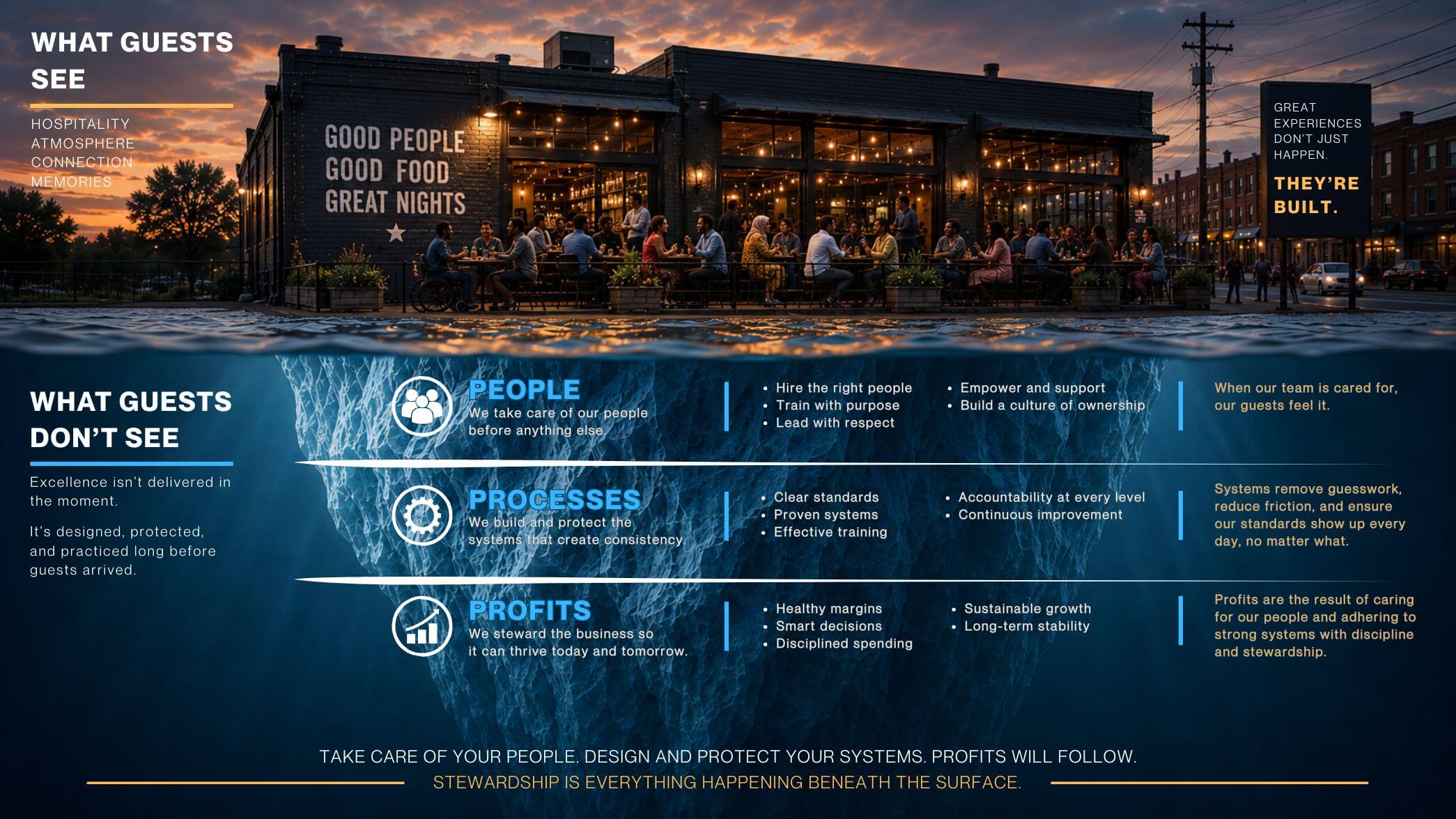
  • A tougher labor environment: Hiring is not the hard part; retention, training, and performance management are the real challenges. Build your brand on people, processes, and profit.
  • Vendor volatility and margin compression: Your best protection is menu engineering, purchasing discipline, and systems that control costs and reduce waste.
  • Real estate risk: A “great location” can still fail if the lease structure is wrong or the space forces too much labor.

That is exactly why the KRG Roadmap exists.

Most hospitality failures don’t happen after opening, they happen when clarity is skipped. The KRG Roadmap helps you validate readiness, numbers, and sequencing before the pressure begins.

The KRG Roadmap gives you an experienced strategic partner early, helping you think clearly, validate assumptions, and move forward without second-guessing every decision.

The KRG Roadmap clarifies if you are truly ready: financially, operationally, and personally. It defines what your project will actually cost in today’s market. It outlines what comes first, what comes next, and what can wait. And it answers what life looks like before and after opening.

Most importantly, the KRG Roadmap is designed to create a predictable outcome for you as a new or seasoned operator looking to start, stabilize, and scale in this ever-changing industry.

The Final Thoughts

This is still a great industry but the bar is higher than ever.

The good news is this: there is enormous opportunity for those willing to reinvent. Not by guessing better, but by planning better. Stress-testing faster. Executing with both intention and discipline.

The public hasn’t abandoned hospitality, they’ve just raised the standard of what they expect.

The question for operators is simple: Are you listening?

Related Reading

Work with Us

Learn more about working with KRG Hospitality. Click the link below.

Client Intake Form - KRG Hospitality

by David Klemt David Klemt No Comments

2026: Animals vs. Plants?

2026: Animals vs. Plants?

by David Klemt

Fine-dining plating of beef at a gourmet dining experience in Alberta, Canada

Gourmet dining experience featuring Canadian beef.

According to Datassential, plant-based meat and seafood alternatives have reached a plateau, meaning that animal meats should go hard in 2026.

Last September, the F&B intelligence platform surveyed 993 consumers who eat both animal and plant-based meats. Most indicated that they were more interested in the former than the latter.

There are three primary factors driving this sentiment, per Datassential. The top factor is how natural one category is in comparison to the other. Second is versatility. And third, which is perhaps the most important to operators with food programs, is craveability.

More Natural

Of the 993 survey respondents, 65 percent indicated that animal meat is more natural to consume than its plant-based counterparts. This appears to be the top concern or motivating factor, as it represents the greatest sentiment per respondents.

This does make some sense, at least to me. Over the past several years I’ve heard variations of this point of view at restaurants, inside kitchens, in discussions with F&B peers, while speaking with clients, and at trade shows. A common misgiving can be summed up thusly: “We don’t know exactly what they’re putting in these products.”

That doesn’t bode well for overall consumer perception.

More Versatile

Survey respondents also expressed that they feel animal meats are more versatile than plant-based alternatives. In fact, 61 percent shared that opinion.

Again, I’ve heard variations of this statement several times, and I’m sure I’m not the only one. You’ll hear “But what do I do with it?” at trade shows where there are plant-based brands exhibiting at booths and doing demos.

More Craveable

Finally, craveability. This is an interesting one. Nearly 60 percent of respondents (59%) stated that they crave animal meat on a regular basis. On its own, that’s not an incredible stat. However, that majority opinion consists of people who don’t follow through on that craving.

In other words, even people who don’t eat animal meat regularly feel its pull. That doesn’t necessarily include people who adhere to vegetarian or vegan diets, but it’s possible.

More Meat

Along with this comes some insight into consumption habits. Per the Datassential survey, 37 percent of respondents increased their consumption of animal meat more than they boosted their intake of plant-based counterparts.

This is logical when we take the three sentiments above into account as a whole. If something is more natural, more versatile, and more craveable, it stands to reason consumers are going to choose to consume it, and even consume more of it more often.

It’s also possible this increase relates to consumer interest in proteinmaxxing.

More Choices

So, where does this leave operators and their food programs?

Well, it leaves them needing to make programming, menu, and inventory choices.

Datassential suggests that plant-based meats have plateaued in the retail space. It certainly seems that consumer sentiment toward plant-based meats has also plateaued among consumers, based on their survey results.

However, that doesn’t mean operators should abandon plant-based meats and altogether. The better, more intentional approach is to run reports, analyze the data, and make choices with surgical, informed precision.

What do the numbers indicate? Are plant-based meats lagging, and are they taking up valuable inventory space? If orders for plant-based meats are declining, what do sales for “center-of-plate” vegetables look like? What can be leaned into harder, what can be adjusted, and what should be removed?

And, crucially: Are the choices for moving forward being made in a well-considered, intentional manner, or are they just knee-jerk reactions and guesses?

It’s worth noting that Datassential’s consumer sentiment survey focuses on plant-based meats, not just plants. The survey respondents didn’t indicate a decline in interest for items like cauliflower or portobello steaks.

Whatever choices are made, operators need to leverage data and facts, and follow the Three Ps: People, Processes, and Profits.

Image: Deane Bayas via Pexels

Client Intake Form - KRG Hospitality

by David Klemt David Klemt No Comments

Tequila may Drive These 2026 Trends

Tequila may Drive These 2026 Trends

by David Klemt

Clear glasses filled with tea, served from a silver teapot at a restaurant

Is there alcohol in that teapot? Maybe.

While some of us continue to cross our fingers that tequila will have their year as the top spirit, other similar sips may rise up in 2026.

One can argue that tequila finally clinched the Top Spirit crown in the US and made 2025 its year. After all, it showed the fastest growth of any spirit last year.

Further, some sources report that tequila generated more revenue than any other major category in the US. Per reporting, premiumization is believed to be a major driver of tequila’s 2025 success.

However, other sources report that vodka still holds the throne due to volume sales. It probably won’t shock a single person that Tito’s holds the number one spot as 2025’s top-selling brand.

In Canada, beer earned the top spot by overall market share. However, Canadian whisky led in 2025 as the top spirit, though tequila garnered notable interest.

Meanwhile, two spirits similar to tequila may finally have meaningful moments in 2026 as vodka and the world’s most-famous agave spirit battle for the title. If Datassential and Nation’s Restaurant News are accurate in their predictions, raicilla and sotol may finally become even more well known to consumers this year.

What is Raicilla?

This agave spirit has been produced in Jalisco, Mexico (for the most part), for at least three centuries. And yet, it wasn’t granted its own Denominación de Origen (Designation of Origin, or DO) until 2019.

Authentic raicilla can only be produced in 16 municipalities throughout Jalisco, and, for some reason, one municipality in Nyarit, called Bahía de Banderas.

There are essentially two regional types of raicilla, de la costa and de la sierra. As the names imply, the former are coastal raicillas, and the latter are from mountainous areas.

Some varieties of raicilla will be familiar to tequila drinkers: joven, reposado, and añejo. There are also varieties that have been aged or matured in glass, abocado (infused raicilla), and artisanal double-distilled raicilla.

Unlike tequila, which can only be made from Blue Weber agave, raicilla is made from several different types of agave. Intriguingly, most raicilla is made with wild agave. The reason is simple: raicilla production is nowhere near the scale of tequila, so for the most part, producers don’t need to cultivate huge fields of agave.

Generally speaking, there are two primary approaches to cooking agave for raicilla, resulting in different flavor profiles. De la sierra producers tend to cook the agave above ground. Conversely, de la costa producers mainly utilize underground or pit ovens.

So, de la sierra raicilla usually doesn’t have smoky notes like mezcal, whereas de la costa raicilla is more likely to share that profile. Generalizing again, raicilla is characterized most often as being more floral and vegetal than tequila and mezcal. Really, a raicilla’s flavors and aromas are highly dependent on terroir.

What is Sotol?

Contrary to a common misunderstanding, sotol isn’t derived from agave. One common thread connecting tequila and sotol is the fact that they’re both traditional Mexican distilled spirits.

Another similarity is the production method: piñas are harvested and cooked, then fermented and distilled.

However, it’s a plant known as Dasylirion that’s used to produce sotol. Commonly known as “desert spoon,” this plant is a member of the asparagus family, as is agave. This may be what leads some to believe that sotol and tequila are both agave-based spirits.

Like tequila and raicilla, sotol is protected by a DO. This means true sotol can be produced exclusively in the Mexican states of Chihuahua, Coahuila, and Durango. It must be noted, though, that there are producers in Texas “don’t recognize” the DO and bottle what they call sotol.

A detail that may appeal to more sustainability-minded guests: sotol production is considered more eco-friendly in comparison to tequila and raicilla. When harvesting desert spoon for sotol, the roots aren’t dug up, meaning a single plant is capable of producing several bottles of sotol over its lifetime.

Desert spoon piñas are cooked in an earthen pit, and terroir is a factor. Depending on the regiondesert, forest, or prairiea sotol will have different flavor and aroma profiles.

For example, a forest sotol may have notes of pine, eucalyptus, and mushroom. In contrast, a desert sotol may be characterized by leather and pepper. Sotol is complex and will keep the adventurous engaged for quite some time.

How can Operators Capitalize?

One of the most effective ways to introduce guests to raicilla and sotol is to leverage the undeniable and seemingly unstoppable popularity of tequila.

And while it’s fun to nerd out over production, it’s likely a better idea, initially, to taste guests on tequila, raicilla, and sotol. While you’re there, you can also include mezcal.

Particularly notable is NRN itself predicting sotol as a trend of its own this year. Further, Datassential has identified raicilla as a trend in their own report.

Of course, there are also some compelling 2026 trend predictions you can leverage with these two traditional Mexican spirits.

Both raicilla and sotol are more than capable of standing in for tequila and mezcal in cocktails. However, raicilla can also tag in for gin, and sotol can act as substitute for gin and vodka.

Off the top of my head, raicilla or sotol Margaritas and Negronis should appeal to a wide range of guests.

This brings me to a simple trend that NRN predicts may take off in 2026: smaller cocktails.

Think (and Price) Small

That’s it; it’s that simple. People seem to be drinking less, not just in frequency but in ABV.

So, it may behoove operators to offer smaller cocktails, accompanied by appropriately reduced prices. This means the drinks are priced appropriately rather than offering discounts in the hopes of driving traffic.

Not only does this move, when intentional, speak to a current shift in guest imbibing behavior, and appeals to those who want to go out to bars and restaurants but don’t want to spend much.

The New Happy Hour

This is where a few trends converge. According to Datassential, “teatime is the new happy hour.”

And per The IWSR, playfulness may also take hold in 2026. I’m sure you can see where this is going.

In Datassential’s view, teatime rather than traditional happy hour gives operators more leeway in terms of dayparts. Noon, early afternoon, early evening, brunch… It’s all on the table, and there isn’t confusion around start and stop because it’s not referred to as a happy hour.

It also allows operators to offer tea-based cocktails made with raicilla and sotol (or any other spirit), and low- and no-ABV tea drinks. Again, this speaks to a range of consumer behaviors and expectations.

The Three Ps

Whatever trends operators choose to pursue this year, their decisions must be intentional.

That means viewing them through the lenses of People, Processes, and Profits.

People: Do we have the right people in place in the right roles? Are we serving our guests to the best of our abilities? Team member or guest, are we truly treating everyone with respect and gratitude?

Processes: How often are we reviewing each operational element? Are we reviewing our menus at regular intervals over the course of 12 months, or are we doing this annually (or not at all)? How are we approaching our pricing? When was the last time we reviewed and tested each and every one of our systems?

Profits: Total sales are great, but are we making money? As Doug Radkey, president and principal consultant of KRG Hospitality says, “Sales are a vanity metric. Profits tell the real story.” Do we know our numbers? Are we controlling costs? Do we make pricing and labor decisions proactively and strategically, or are we panicking and reacting without careful consideration?

Those are by no means all of the questions we need to ask on a regular basis, but they’ll give operators a solid baseline.

Image: Davey Gravy via Unsplash

Client Intake Form - KRG Hospitality

by David Klemt David Klemt No Comments

Is 2026 the Year of ‘Maxxing?

Is 2026 the Year of ‘Maxxing?

by David Klemt

Stark image of a speed limit sign that reads "MAXIMUM 30"

If we pretend this is referring to grams of fiber, that’s excellent fibermaxxing.

If recent reports and consumer behaviors are any indication, and I think they are, health-conscious “maxxing” trends are on the menu in 2026.

Currently, proteinmaxxing appears to be king of Diet Trend Hill.

In 2026, though, protein may face a realistic contender for the crown: fiber.

Look it up and you’ll see it’s not an entirely new trend, and has been on the upswing since at least the middle of 2025.

For operators, this is yet another consumer signal. The interest (some would say obsession) in high-protein diets has inspired menu changes across categories. Whether a QSR with global reach, a regional chain, or a local independent, restaurants have been responding to their guests’ desire to consume more protein.

Now, it’s possible an interest in a high-fiber diet may inspire more menu changes and additions.

What is GLP-1?

Would you like a healthy dose of pedantry? Fantastic.

“GLP-1” stands for “glucagon-like peptide 1,” which is a hormone found in our bodies. When we eat something, GLP-1 stimulates insulin secretion.

A GLP-1 drug is an “agonist.” That is, it mimics, in this case, a hormone to cause a response.

So, when we talk about GLP-1, it’s a hormone; when we talk about the drug, it’s a substance humans take predominantly via injection. Pedantry: complete.

It may seem as though these drugs came onto the market just before Covid ravaged the world. However, the hormone was discovered around 50 years ago, and the first GLP-1 medication was approved by the FDA just over 20 years back to treat type 2 diabetes. From 2018 to 2023, according to multiple analytics sources, interest in, and use of, GLP-1 drugs for weight loss exploded.

GLP-1 medications cause the body to delay emptying the stomach. Further, the drugs tell the brain to reduce the desire to eat. Both actions curb appetite, and tend to result in significant weight loss.

Of course, side effects have been reported widely. Those who experience rapid weight loss may experience “Ozempic face.” According to Harvard Health Publishing (2004), this appearance is characterized by:

  • a hollowed look to the face
  • changes in the size of the lips, cheeks, and chin
  • wrinkles on the face
  • sunken eyes
  • sagging jowls around the jaw and neck.

There are also several gastrointestinal side effects one can experience, but I’ll let you use your imagination rather than list them.

What is Proteinmaxxing?

This one is quite a bit simpler to understand: It’s focusing on the consumption of protein, and “maxxing” it out. I assume there are two Xs to really drive home the point that something is being maximized.

Taken to the max (or “maxx,” I guess), there are proteinmaxxers who aim to consume 200 grams of protein per day. According to Cargill, a company that distributes high-protein products, there are “entire ‘social subcultures'” built around the consumption of high-protein diets. Essentially, for some proteinmaxxers, the diet is more like an ideology.

However, some doctors believe consuming that much protein can be harmful, not healthy.

Recognizing that there’s a range when it comes to protein consumption (age, activity level, etc.), there are some general guidelines one can follow.

Using the standard 2,000-calorie-per-day diet, common guidance is that 10 to 35 percent of calories should come from protein. For an “average” person, daily protein consumption can be calculated at 0.8 grams per kilogram of body weight. So, someone who weighs 150 pounds (68 kilograms) should consume 54 grams of protein per day.

People tend to face muscle loss in their 40s or 50s, and therefore should aim for 1.0 to 1.2 grams of protein per kilogram of body weight. On the high end, for that hypothetical person weighing 150 pounds, that’s an increase to 82 grams of protein.

Those who exercise regularly should increase protein consumption to 1.1 to 1.5 grams; that rises to 1.2 to 1.7 grams for people who lift weights or do other strenuous exercise on a regular basis. Using the high end, that’s 102 grams of protein per day for the former, and 115 to 116 grams for the latter.

Consuming 2.0 grams of protein per kilogram of body weight is considered “excessive” by some.

What is Fibermaxxing?

If you’re guessing that fibermaxxing is similar to proteinmaxxing, you’ve nailed it.

That said, the numbers are absolutely not the same in comparison to proteinmaxxing.

Unless something changes, the current definition of fibermaxxing appears to fall in line with current dietary recommendations: 25 to 38 grams of fiber per day.

Going deeper, nutrition guidelines state that the source of fiber should be food rather than supplements.

However, most Americans and Canadians consume just 14 to 15 grams of fiber per day. That’s a shortfall of 10 to 11 grams, every day.

It must be noted, however, that some people need to adhere to low-fiber diets for medical reasons. Further, while there’s some debate, some believe 50 grams of fiber is excessive; others feel that too much fiber is closer to 70 grams per day.

How does excessive fiber intake manifest? Again, that’s largely gastrointestinal, and, again, I’ll leave that to your imagination.

That’s all to say this: proceed with caution when trying out any diet, and try to find what’s best for you and your body.

Like protein, fiber can aid in weight loss. So, with the rise of GLP-1 medications, it’s unsurprising that some people trying to lose weight are focused on fiber while some have lasered in on protein.

What is the Point?

“David… Seriously, what the hell? Thanks for the dietary info, but what are we doing here?” I can hear some of you asking.

Simply put, operators need to be aware of large-scale consumer trends. They must consider how it can affect their people, processes, and profits.

Per Datassential, just 13 percent of operators are aware of fibermaxxing.

Borrowing from Datassential’s trend ranking system (Inception, Adoption, Proliferation, and Ubiquity), it’s fair to say fibermaxxing consumers are either on the cusp of moving on from inception to adoption or are already there.

As far as proteinmaxxing, that’s definitely in proliferation territory. What’s my evidence? A QSR, Arby’s, to be precise, introduced Steak Nuggets in Q4 of 2025. That’s an entirely different spin on nuggets in fast food, and even if it’s not stated explicitly, that certainly appears to be an appeal to proteinmaxxers looking for a snack.

There’s also the seeming addition or infusion of protein to all manner of food and drink items on menus across all categories of restaurants.

Protein-infused coffee drinks, protein-enhanced pastries, QSR meal combos for people leading a high-protein lifestyle… There are lists online of the top orders at various chains for consumers seeking protein. Of course, there are also lists online identifying high-fiber items offered by various well-known restaurants.

Then we can look to retail labeling. Unsurprisingly, food brands want to leverage increased consumer interest in protein, fiber, and other nutritional values. These companies are calling out their protein and fiber values to encourage purchases and brand loyalty.

Restaurants and bars can do the same. In some cases (more than you many think), a given menu already has high-protein and high-fiber options; it’s just not called out directly.

What is the Takeaway?

As we kick off 2026, let’s change the approach. If you want to appeal to health-conscious guests, tell them exactly what they want to know.

Review your menu, identify what falls in line with various diets, and call out those values or qualities in the descriptions.

Some consumers are proteinmaxxing. Others are fibermaxxing. Somehow, I expect balancemaxxing (maximizing the focus on a balanced diet; did I just coin a phrase?) to take hold in 2026 or 2027.

Similarly, operators need to focus on profitmaxxing for the financial health of their business, the financial stability of their hardworking teams, and longevity in serving their communities.

It all comes down to the Three Ps: People, Processes, and Profits. Serve the people (including your team members) and perfect your processes, thereby maxxing your profits.

Image: Erik Mclean via Pexels

Client Intake Form - KRG Hospitality

by David Klemt David Klemt No Comments

Bar Hacks 2025: Top Episodes

Bar Hacks 2025: Top Episodes

by David Klemt

Bar Hacks Spotify for Creators Wrapped 2025 cover

Thank you to every one of our incredible guests and our amazing audience for listening to Bar Hacks and Bar Hacks: ReFire this year!

Season six, which spanned 2025, was another fantastic year for insightful and fun conversations.

Among our informative and engaging guests were Hayden Lambert, who shared his “simplexity” philosophy. Michael Suomi, the creative mind behind several award-winning designs, dropped by for a great chat.

Matty Rangel popped in to chat tending bar, dive and neighborhood bars, crafting engaging content, and more. KRG Hospitality design partner Nancy Kuemper of Mabel Design Co. shared her journey in hospitality design, and her tips for maximizing the client-designer relationship.

Bar Hacks host David Klemt addressed real-world hospitality business situations with Bradley Knebel over the course of several Bar Hacks: ReFire episodes.

Of course, that’s just a handful of the guests and topics from 2025. We’re grateful for everyone who takes the time to stop by and chat with us, and for everyone who listens, subscribes, likes, and shares.

Thank you all so much!

Below, the top episodes of 2025. We’ll see you in 2026! Cheers!

Episode 136 with Hayden Lambert

Our number one episode of 2025! Hayden Lambert, co-founder of the unique and award-winning Above Board bar in Melbourne, Australia, pops by for an incredible chat.

When Lambert would explain the reductionist philosophy behind the concept for Above Board to others in the industry, he was told it wouldn’t work. Well, nearly ten years of operation, a few appearances on the World’s 50 Best Bars list, and other accolades later, Above Board continues to prove that its unique approach works.

On this episode of the Bar Hacks podcast, Lamber discusses his journey through hospitality, traveling the world, still being tested as a bartender, “simplexity,” how brands can succeed in a bar without a back bar, the magic that is making guests feel like their experience was easy, and much, much more.

Lambert drops a ton of useful information and experience in this episode that veteran, new, and hopeful bar owners need to hear and consider.

Spotify

Apple Podcasts

Episode 141: Brand Authenticity: Robert Minucci of Talkhouse Encore

On this episode of Bar Hacks, host David Klemt sits down with Rob Minucci, CEO and co-founder of Talkhouse Encore, a premium RTD brand inspired by the legendary dive bar Stephen Talkhouse in the Hamptons. Together, they delve into the story behind the brand’s inception during the pandemic, discussing how Rob’s business partner Ruby Honerkamp (whose family owns the iconic bar), sought to bring the spirit of the Talkhouse to the masses through gluten-free vodka and tequila seltzers. Or, as Rob explains, dive bar classics in RTD form.

Rob shares insights into the challenges of launching a new beverage brand, from navigating distributor relationships to the importance of creating a standout product that resonates with consumers. He emphasizes the significance of authenticity and flavor, particularly for the Gen Z demographic, who are looking for more than just a drink;they want a story and a connection to the brand.

You’ll learn about the strategic decisions that shaped Talkhouse Encore, including its unique approach to market research and branding. Rob explains how they focused on building a strong local presence before considering expansion, ensuring that they meet consumer demands with quality ingredients and an engaging brand narrative.

Spotify

Apple Podcasts

Episode 134 with William Brooks

On this episode, host David Klemt sits down with William Brooks, the Global Brand Ambassador for Tequila Herradura. With a background from Johnson & Wales University and extensive experience in the spirits industry, William shares his fascinating journey from whiskey to agave.

Discover the unique qualities of tequila, as William dispels common myths and misconceptions. He dives into the importance of terroir, the differences between lowland and highland agave, and how these factors influence flavor profiles. The conversation also covers the innovative practices at Tequila Herradura, including sustainability efforts, and the creation of the reposado category.

Plus, William shares his favorite tequila cocktails, perfect food pairings, and tips on how to properly taste tequila (hint: replace the lime). Whether you’re a seasoned agave enthusiast or just starting to explore, this episode is packed with valuable insights and delicious ideas.

Spotify

Apple Podcasts

ReFire: Brilliant Burgers, Sloppy Service & Persnickety Perception

Guest experience drives perception, and perception shapes value. As you may have already learned, perception can be impacted on what may feel trivial to operators and their teams but is incredibly important from guest to guest.

On this episode of Bar Hacks: Refire, David Klemt, partner at KRG Hospitality, and co-host Bradley Knebel of Empowered Hospitality break down a real-world story of two restaurants offering the same menu and pricing, but with vastly different outcomes. One felt like a letdown because of disorganization and sloppy service; the other delivered a memorable experience simply by getting the fundamentals right.

The duo dig into why poor guest experience makes food and drinks taste worse; why discounting without strategy sends the wrong message; and why every detail—from lighting and music volume to greetings and check drop—matters. If your guests don’t feel good about the experience, they won’t feel good about the value. And if they don’t see value, they won’t see a point in returning for more visits.

Tune in to rethink what you’re really selling.

Spotify

Apple Podcasts

Episode 133 with Michael Suomi

Suomi Design Works is an award-winning hotel design studio dedicated to approaching every hospitality project with an exceptional level of creativity. In fact, Michael Suomi, president of the studio, actively seeks out unique, challenging projects.

On this episode of the Bar Hacks podcast, host David Klemt chats with Michael about a number of these extraordinary projects. Further, Michael shares his approach to onboarding clients, building unique teams for exceptional projects, trends he thinks may stand out in 2025 (and which he’d like to see disappear), and more.

Spotify

Apple Podcasts

Episode 139 with Matthew Rangel

We sit down with real-life bartender, actor, and social media creator Matthew Rangel (@therealmattyrangel) an hour before he needed to open one of the three bars at which he works in Wisconsin to talk neighborhood bars, dive bars, mental health, social media, and the Midwest.

For those who haven’t yet come across Matty’s bartending videos, they’re quick, funny, and relatable to anyone who has worked behind the stick, or worked at a bar or restaurant. Matty breaks down his approach to creating his videos, which is a quicker process than most would likely expect. He also explains that people don’t need to buy the most expensive recording gear or spend hours editing to make impactful videos.

Matty also discusses mental health and the hospitality space, in particular bartending. He hosts Mental Health Mondays each week, hoping for people to reach out, share, connect, and work through their struggles.

Spotify

Apple Podcasts

Episode 140 with Finian Sedgwick

Long-time listeners know we love it when previous guests return! On this episode, Finian Sedgwick, chief growth officer at BAXUS, comes back onto the podcast.

Finian and David chat about the growth of BAXUS and the BoozApp, including new features for the peer-to-peer marketplace, popular bottles and spirits categories, and the rabbit hole members can go down when searching for items to purchase and trade. They also talk about bottles that have grabbed Finian’s attention, why he’s bullish on wine, and how alcohol-free cocktail menus are more important than some operators may think.

Speaking of operators, the two also discuss the doom-and-gloom articles blaming Millennials and Gen Z for “killing” or otherwise “ruining” alcohol consumption and sales. Is that really the state of booze, or are people rage-baiting for clicks, and are some operators failing to meet their guests where they are?

Spotify

Apple Podcasts

Episode 130 with Giuseppe Gallo

Giuseppe Gallo has accomplished a lot in his two decades-plus in the hospitality and beverage spaces: he’s a respected vermouth and amaro expert, the winner of the 2014 Spirited Award for Best International Brand Ambassador, an educator and drinks historian, and a bartender’s bartender.

Among other topics, this episode explores the creation of SAVOIA Americano (and ITALICUS). Giuseppe introduces SAVOIA Orancio, an innovative new aperitivo made with natural orange wine. Throughout the conversation, Gallo
emphasizes the importance of bartender insights in shaping successful beverage brands, and the guest experience.

Spotify

Apple Podcasts

ReFire: Bad Behavior & Ridiculous Regulars

Hosts David Klemt and Bradley Knebel tackle two real-life restaurant and bar situations in the first ReFire of 2025.

The two tackle the topic of an operator who’s hesitant to believe it when multiple employees claim a culinary team member is rude, hostile, and abusive…but believes that team member when they make the same accusation against a quiet but hard-working back-of-house peer. Don’t worry – it gets worse!

Then, David and Bradley take a look at a stunning, on-the-spot termination of a bartender who had been in role since day one. The restaurant was busy, the bar was slammed, and the word of a regular got the bartender of five years fired instantly. Something doesn’t add up!

Look, firing someone is never pleasant. However, it’s going to happen. Operators and leadership team members need to have standards in place and communicated clearly, a process for terminations, and the understanding that how they fire people speaks to their credibility and reputation.

Spotify

Apple Podcasts

ReFire: “We’re Having DinnerYou’re Not”

We managed to squeeze three real-world hospitality situations into episode five of ReFire!

On the last episode, David and Bradley talked about guest perception, and how the “little” things can have a big impact. This time, they discuss brand perception, and how quickly a misstep can turn into a catastrophe.

Then, they talk about “skunking,” and how it impacts your team.

Finally, David and Bradley take a look at a restaurant’s new SOPs shared by a team member, and why they’re a problem.

Spotify

Apple Podcasts

Image: Spotify

Client Intake Form - KRG Hospitality

Top