Industry news

by David Klemt David Klemt No Comments

After RRF Failure, What’s Next for Us?

After RRF Failure, What’s Next for Us?

by David Klemt

Super Mario Bros. game booth

After the US Senate failed to even debate the Restaurant Revitalization Fund, instead opting to let it die, what’s next?

Obviously, trusting our elected officials to do the right thing isn’t a viable option. After all, the Senate slow-walked the RRF’s death march. It took six weeks after the House voted “yes” on RRF for senators to filibuster the bill to death.

Last Thursday, the National Restaurant Association addressed moving forward. Sean Kennedy, executive vice president of public affairs, released a 90-second video in which he spoke about the RRF and where we are now.

Reconciliation?

One of the first options Kennedy proposes in his video is a reconciliation bill. That, however, is highly unlikely to come to fruition.

So, what’s a reconciliation bill? Simply put, it has to do with the Senate’s supermajority requirement.

In order for a bill to advance to a vote, 60 percent of the Senate must support ending a filibuster. On that topic, a filibuster is a procedural tool that prolongs a debate. The filibuster is used to delay or prevent a vote on a bill, resolution, etc.

Now, a budget reconciliation bill circumvents the supermajority requirement. A simple majority—51 senators for the US Senate—is all it takes to override a filibuster in this instance.

Technically, from what I’ve come to understand, the Senate can pass a maximum of three budget reconciliation bills in a year. Most often, it passes a single such bill per year.

Obviously, Kennedy feels that this would be a longshot to cross our fingers and hope the RRF is funded via these means.

Staying Ready

As they say—yes, “they”—if you stay ready, you don’t have to get ready. According to Kennedy, the NRA is prepared to act in any way they can should replenishing the RRF or similar aide once again become an option.

“We’re gonna continue to closely monitor the situation and we certainly can activate if there any signs of movement,” he says. “We’re not seeing them yet.”

The “yet” there is perhaps a bit hopeful. And as we like to say, hope isn’t a strategy. However, optimism is far healthier than pessimism and hopelessness.

Additionally, Kennedy and the NRA are grateful to the bipartisan group of representatives and senators who have shown their support for our industry and replenishing the RRF.

“We’re incredibly appreciative of the works of our champions in Congress,” says Kennedy.

In particular, he acknowledges Senate Majority Leader Chuck Schumer (D-NY), and senators Ben Carden (D-MD), Roger Wicker (R-MS), Kyrsten Sinema (D-AZ). In the House, Kennedy thanks Speaker of the House Nancy Pelosi (D-CA), and representatives Earl Blumenauer (D-OR), Dean Phillips (D-MN), Brian Fitzpatrick (R-PA).

What’s Next?

As Kennedy says, much of what he discussed with people at the 2022 NRA Show centered around this very topic. Just what are we supposed to do moving forward?

Unfortunately, there’s no clear answer, no simple solution we can point to and implement.

Instead, we have several issues we must navigate to keep restaurant and bar doors open:

  • What can we do to more effectively recruit and retain staff?
  • How can we best address increases in food costs and problems with availability?
  • Is there a way to address rising credit card transaction fees?

Of course, that’s but a handful of what we must address and solve. And at least when it comes to the first question, we know some of the elements for the solution:

  • Treat staff with respect.
  • Value diversity, equity, and inclusion.
  • Improve pay and offer benefits.
  • Develop a healthy company culture and workplace.

On the topic of state and local policymakers, expecting help is a dicey proposition.

Unless they engage with the owners, operators, and industry professionals in their states, counties, cites, and towns, they’ll hurt these businesses. The only effective and helpful way forward is for them to engage with us and not simply introduce and pass legislation that hurts. Possible, of course, but a big ask as we’ve seen proven time and time again.

Image: Minator Yang on Unsplash

by David Klemt David Klemt No Comments

2022 50 Best Bars: North America

2022 50 Best Bars: North America

by David Klemt

Door with number 50 address

Probably a speakeasy.

The World’s 50 Best Bars ranking for North America is official and the bars are, of course, extraordinary.

Unsurprisingly, much of the list consists of “household” names in our industry. Now, where some people may see a list of the “cool kids,” I see something different.

In a word, consistency. Sure, the more cynical among us roll their eyes at rankings and awards.

However, I see approaches to operations, service, menu and design innovation, and guest experiences to learn from and emulate.

Would I like to see bars in markets outside of the usual suspects on these lists? Absolutely. As so-called secondary and tertiary markets develop their scenes that may start to happen more often.

So, congratulations to this year’s 50 Best Bars in North America! Cheers!

Canada

This year, the second-largest country in the world claims eight of North America’s 50 best bars. One bar is in the top ten.

As Ontario’s capital and Canada’s most-populous city, it should come as no surprise that Toronto takes four spots. Bar Mordecai is number 47, Bar Raval is 41, number 38 is Mother, and Civil Liberties is tenth.

It’s a bit surprising to see just one bar from Vancouver—number 25, The Keefer Bar—but Montréal has two venues on the list. The Cloakroom Bar is number 45 and 29 is El Pequeño Bar.

Bar Kismet, in Halifax, Nova Scotia, is sitting in the 49th spot on the 2022 North American list.

America

Impressively, the US boasts 30 of North America’s 50 Best Bars, six of which are in the top ten. Intriguingly, ten of the bars on this list were ranked on the World’s 50 Best Bars last year.

As one would assume, New York City dominates the 2022 rankings. Eleven bars are on the list, with the number one spot going to Attaboy. Congratulations to Michael McIlroy and Sam Ross, their teams, and their partners. Katana Kitten is number four, and Dante earns the eighth spot on the list.

Moving to the south, two bars on the list are in Miami: Broken Shaker (32) and Sweet Liberty (14). Heading northwest, Kumiko in Chicago is in the top ten at number five.

On the other side of the country, Los Angeles claims three spots, one in the top ten. Genever holds number 50, Death & Co. is 34, and Thunderbolt is ninth. The Bay Area has two bars on the list. ABV in San Francisco is number 39 and Oakland’s Friends and Family is in the 33 spot.

Somewhat surprisingly, Las Vegas and New Orleans each have just one bar in the rankings. One of my personal favorites, Herbs & Rye, is number 28 on the list. Jewel of the South in NOLA is in the top half of the list, holding number 24.

In San Juan, Puerto Rico, the beloved La Factoría is twelfth on the list.

Mexico

Achieving 11 spots—three in the top ten—Mexico is crushing it this year. Remarkably but not surprisingly, the three bars in the top ten are all in Mexico City.

Baltra Bar earns number nine, and Handshake Speakeasy and Licorería Limantour are second and third, respectively. Overall, Mexico City boasts six bars on this list.

Two spots are in Oaxaca: Selva, which is number 22, and Sabina Sabe, number twenty.

Arca, number 37, is in Tulum. Number 21, El Gallo Altanero, is in Guadalajara. And Zapote Bar in Playa del Carmen almost breaks the top 10, coming in eleventh.

Cuba

The legendary El Floridita grabs Cuba’s only entry on the 2022 list.

Impressively, El Floridita can trace its opening to the early 1800s. Originally, the space was La Piña de Plata. About a century later, a bartender, Constantino “Constante” Ribalaigua Vert, became the owner and changed the name.

Oh, and he just so happens to be the inventor of the frozen Daiquiri. Along with its impressive history, El Floridita also has an awesome statue with its own seat at the bar. Ernest Hemingway is immortalized in bronze.

50 Best Bars: North America

Below, the full list in ascending order.

  1. Genever (Los Angeles, CA)
  2. Bar Kismet (Halifax, Nova Scotia)
  3. Teardrop Lounge (Portland, OR)
  4. Bar Mordecai (Toronto, Ontario)
  5. Julep (Houston, TX)
  6. Cloakroom Bar (Montréal, Québec)
  7. Bitter & Twisted (Phoenix, AZ)
  8. Clover Club in (New York, NY)
  9. Bar Leather Apron (Honolulu, HI)
  10. Bar Raval (Toronto, Ontario)
  11. El Floridita (Havana)
  12. ABV (San Francisco, CA)
  13. Mother (Toronto, Ontario)
  14. Arca (Tulum, Quintana Roo)
  15. Death & Co (Denver, CO)
  16. Mace (New York, NY)
  17. Death & Co (Los Angeles, CA)
  18. Friends and Family (Oakland, CA)
  19. Broken Shaker (Miami, FL)
  20. The Dead Rabbit (New York, NY)
  21. Employees Only (New York, NY)
  22. El Pequeño Bar (Montréal, Québec)
  23. Herbs & Rye (Las Vegas, NV)
  24. Overstory (New York, NY)
  25. Dear Irving (New York, NY)
  26. The Keefer Bar (Vancouver, British Columbia)
  27. Jewel of the South (New Orleans, LA)
  28. Amor y Amargo (New York, NY)
  29. Selva (Oaxaca de Juárez, Oaxaca)
  30. El Gallo Altanero (Guadalajara, Jalisco)
  31. Sabina Sabe (Oaxaca de Juárez, Oaxaca)
  32. Raised by Wolves (San Diego, CA)
  33. Service Bar (Washington, DC)
  34. Double Chicken Please (New York, NY)
  35. Hanky Panky (Ciudad de México)
  36. Café de Nadie (Ciudad de México)
  37. Sweet Liberty (Miami, FL)
  38. Kaito del Valle (Ciudad de México)
  39. La Factoría (San Juan)
  40. Zapote Bar (Playa del Carmen, Quintana Roo)
  41. Civil Liberties (Toronto, Ontario)
  42. Thunderbolt (Los Angeles, CA)
  43. Dante (New York, NY)
  44. Baltra Bar (Ciudad de México)
  45. Café La Trova (Miami, FL)
  46. Kumiko (Chicago, IL)
  47. Katana Kitten (New York, NY)
  48. Licorería Limantour (Ciudad de México)
  49. Handshake Speakeasy (Ciudad de México)
  50. Attaboy (New York, NY)

Image: Hello I’m Nik on Unsplash

by David Klemt David Klemt No Comments

Here Come the NFT Restaurants…

Here Come the NFT Restaurants…

by David Klemt

Blue and white NFT concept

It was inevitable, really, that after seeing cryptocurrency nightclubs we’d eventually see non-fungible-token-focused venues.

Not too long, in fact, a crypto nightclub set up shot in an ultra-lounge inside a Las Vegas casino. Members had access to a VIP section inside the venue provided they had minimum amounts of certain coins.

Bottles were popped, Instagram models made appearances, and the crypto contingent were given the VIP treatment.

Other such venues are in operation. However, the “new thing” leveraging the proliferation of the blockchain is the NFT restaurant.

Interestingly, two such restaurants are set to open in the US in two major markets. One is New York City, the other Los Angeles.

What’s an NFT?

Okay, bear with me here. I’m not an NFT expert, nor do I own an NFT. So, I’ll do my best to make this as simple as possible.

First off, the acronym NFT stands for “non-fungible token.”

Second, an NFT is a digital asset—quite often artwork—bought and sold online. Quite commonly, these assets are purchased with cryptocurrency. In fact, many sellers won’t accept any other form of payment for an NFT.

Their ownership is recorded, just like cryptocurrency, on the blockchain. It’s important to know that the purchase of an NFT doesn’t necessarily come with licensing rights, but that’s another issue entirely. So, yes, there are people who “own” an NFT but don’t actually own the rights to do much with it.

For now, what’s important to know is that NFTs are exclusive, unique digital assets. Oh, and the market (industry?), as of 2021, was worth a reported $41 billion. Not entirely surprising when one considers that a single NFT once sold for almost $92 million.

What’s an NFT Restaurant?

It is, perhaps, more accurate to refer to these hospitality venues as NFT clubs. Yes, there’s a restaurant component, but the main draw is a membership.

In New York City, for one example, the NFT is the membership. The planned venue is Flyfish Club by VCR Group, and it’s billed as “the world’s first member’s only private dining club.”

What does a Flyfish NFT membership get you? Well, the space isn’t open yet. However, the following benefits are expected:

  • Unlimited access to a 10,000-square-foot dining room.
  • Exclusive culinary, social, and cultural experiences.
  • An “iconic, New York City location” for the dining room, cocktail lounge, omakase room, and outdoor area.

It’s rumored that—dependent on crypto exchange rates, of course—the Flyfish membership will cost around $13,000.

On the other side of the country is another NFT membership. This concept comes from SHŌ Group and is slated to debut in 2023 on top of the Salesforce Transit Center.

Unfortunately, there isn’t any pricing information available (publicly) just yet for SHŌ Club. However, three tiers of membership have been revealed:

  • Earth: The lowest tier.
  • Water: The “core” membership.
  • Fire: Offers “ownership-like benefits.”

Per SHŌ, these memberships are not only verifiable via the blockchain, members will be able to sell or transfer their ownership of a membership.

If you’re curious about costs and a full breakdown of SHŌ Club benefits, you can sign up for notifications here.

Niche Concepts

Honestly, what else can we categorize these venues as besides “niche”? While both venues’ operations would likely be familiar to any hospitality professional, the NFT element certainly designates them as highly specialized.

Now, that’s not necessarily a bad thing. “Niche” isn’t inherently negative. In fact, identifying and servicing an underserved niche can be incredibly lucrative for any entrepreneur.

Indeed, the locations of Flyfish and SHŌ Club are telling. NYC is often labeled the finance capital of the world. And, of course, San Francisco is home to Silicon Valley, the tech capital of the world.

Obviously, many who work in finance and tech live in NYC and San Francisco. So, it makes sense that they’d be interested in these memberships and, as importantly, can afford them.

Clearly, VCR and SHŌ are targeting a group with a shared niche interest, and they’re doing so with upscale venues and experiences. Should these concepts come to life and their experiences live up to member expectations, they’ll have hit a homerun.

As an operator, you may not be interested in targeting the cryptocurrency or NFT crowd. However, the ubiquity of subscriptions in our lives may motivate you to consider a membership program.

If so, remember to offer value, avoid alienating non-members, and offer benefits authentic to the business.

Image: Riki32 from Pixabay

by David Klemt David Klemt No Comments

8 Bottles for National Bourbon Day

8 Bottles for Bourbon Day

by David Klemt

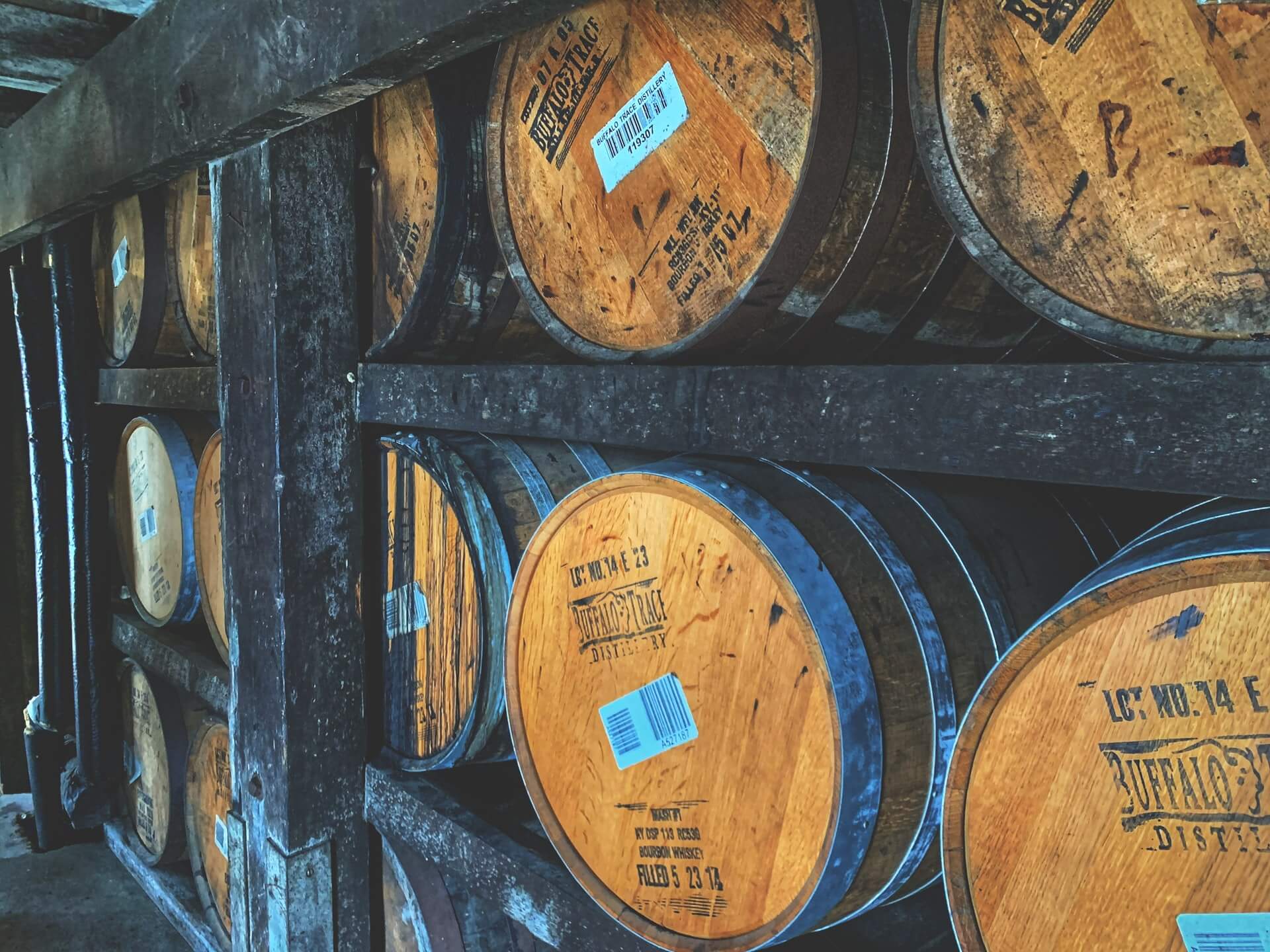
Buffalo Trace Distillery bourbon barrels

Next week, June 14, is National Bourbon Day, the day America celebrates the country’s “native” spirit.

Clearly, that means one thing: Make sure your promotion catches the eye of the whiskey aficionados, bourbon lovers, and bourbon curious among your guests.

One of the most effective ways to boost traffic on National Bourbon Day is deceptively simple. Simply put, add new bourbon releases to your inventory.

Of course, you should also ensure you have enough of what your regulars normally drink on hand. And let’s not neglect your bourbon cocktails.

First Things First

When deciding what to feature on your promotional or LTO menus, there’s a smart and simple first step to take.

You probably already know what I’m going to suggest: Run reports.

What are your top-selling bourbons? Which are more burden than bourbon, collecting dust in your inventory?

Introduce new bourbons recently? How are they selling?

Then there’s the cocktail menu. Do you know which cocktails are your guest favorites and which they’re not ordering? Are any of these bourbon cocktails?

So, don’t just jump into National Bourbon Day by guessing or assuming what bottles and cocktails to promote. Instead, leverage the power of your POS and run reports. Put hard data behind your promotions, always.

Of course, that’s not your only resource. Curious about what your guests would like to see on the menu and back bar? Ask your bar team.

New Releases

Now, this may come as a shocker: People want to try what’s new. Yeah, I know—hot take.

So, if people want the new thing, give ’em what they want. Below you’ll find some bottles worth asking your reps about for National Bourbon Day.

Obviously, you should ensure you have plenty of the standards on hand. And be cautious about just how much new bourbon you bring in. After all, you don’t have data on how they’ll perform yet.

That said, here are some bottles worth considering.

Basil Hayden Subtle Smoke

Far too often, “smoky” on a label means “tastes like you’re drinking a campfire.” Of course, some of us are into that, depending on our mood or personal tastes.

However, some guests aren’t into smoke bombs. Basil Hayden Subtle Smoke delivers what’s on the label: their high-rye Kentucky bourbon with smoke notes that aren’t overwhelming.

Ben Holladay

Don’t freak out after you read the following sentence. Not all bourbon comes from Kentucky.

Of course, you and your team probably know that. And I’m sure we all think that by now, people know a whiskey doesn’t need to come from Kentucky to be bourbon. However, there are still people who think otherwise.

Educate them with bottled-in-bond Ben Holladay, crafted in Missouri. It’s an interesting bottle labeled Real Missouri Bourbon. According to laws enacted in 2019 and 2020, for a whiskey to earn that designation the producer must:

  • mash, ferment, distill, age, and bottle in Missouri;
  • age in oak barrels made in Missouri; and
  • be made with corn grown in Missouri.

Bottled-in-bond and Real Missouri Bourbon. This bottle should get your guests’ attention.

Blood Oath Pact No. 8

When it comes to bourbon releases, Blood Oath Pacts are always big news. Blood Oath Pact No. 8 should be a welcome addition by the bourbon lovers among your guests.

For this release, Lux Row Distillers combined a a 14-year ryed bourbon, an 11-year ryed bourbon, and an 8-year ryed bourbon finished in Calvados casks.

OKI Reserve

The OKI story goes that two entrepreneurs in Ohio, Chad Brizendine and Jake Warm, bought the brand from New Riff Distilling two years ago.

For those wondering, OKI stands for “Ohio, Kentucky, Indiana,” the tri-state area responsible for most of the world’s bourbon. According to OKI, 99 percent of OKI Reserve is more than eight years old.

Thomas S. Moore

Alright, I’ll admit it—I count this section as four bourbons. But I have a good reason for doing so.

Thomas S. Moore is crafted by Barton 1792 and consists of four expressions: Cognac, Madeira, sherry and Merlot. Any one of these alone is worth the time and effort for a bourbon or whiskey lover to track down. However, think of the potential having two or more expressions available to taste against one another offers you and your guests.

Each Thomas S. Moore expression starts with five- or six-year-old Barton 1792 high-rye bourbon. Depending on the cask used for finishing, the bourbon is aged for another one to four years.

Image: Josh Collesano on Unsplash

by David Klemt David Klemt No Comments

Back of House Report: The Labor Challenge

Back of House Report: The Labor Challenge

by David Klemt

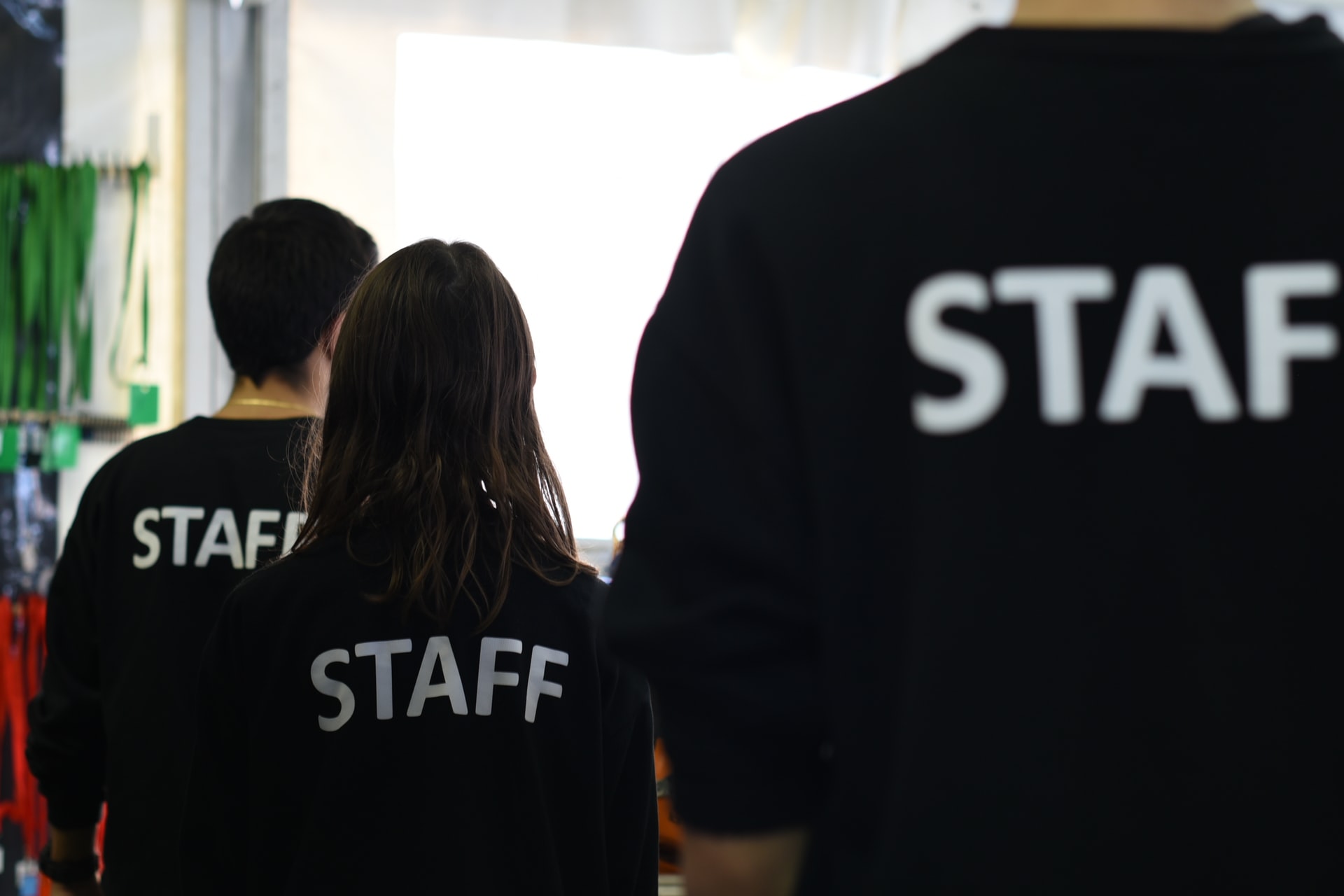
Employees wearing black staff T-shirts

A recent report from Back of House reveals opportunities for operators amidst the current staffing challenge.

In their report, the restaurant technology platform suggests effective hiring and retention solutions. For example, helping staff find meaning in their work.

To download and access the report in its entirety, please visit BackOfHouse.io.

For some of the platform’s insights into staffing, keep reading.

Why People Leave the Industry

Obviously, people take jobs for a variety of reasons. Often, a person’s first job has one or two motivations: money and/or experience.

Some estimates put a gig in the restaurant industry as the first job for a third of Americans. In Canada, restaurants are the top employers for those under 25 years of age.

However, Back of House sees value in looking at a different metric: Why people leave the industry.

As Back of House states, knowing why someone would leave their job helps an operator determine what benefits to offer to retain talent.

Now, it may be tempting to assume pay is the top reason people leave jobs. Per Back of House, however that’s not the case. Broken down by age group, below you’ll find the reasons people are leaving hospitality:

  • Pay: 26 to 35
  • Schedule: 46 to 55
  • Lack of opportunities: 26 to 35
  • Lack of benefits: 26 to 35
  • Work environment: 18 to 25

Look at these issues through the lens of someone moving through life. When first entering the workforce, more people want to find the right employer and workplace. From their twenties to thirties, more concern is placed on moving up, making more money, and receiving benefits. And, per Back of House’s findings, time becomes more of a consideration as people age.

Meaning and Value

Per Back of House, there are two important elements of employment that keep people engaged.

One, meaning in the work they do. In other words, feeling that their work has value. Two, staff want to feel that they’re employers value them.

Of course, both make sense, no? If a person doesn’t see their role in the industry as valuable, they’ll always be looking for the escape hatch. And if they feel that they’re employer doesn’t value them, why would they continue working for them? People, as they say, quit bosses, not jobs.

So, Back of House recommends that operators demonstrate they value their team members by:

  • investing in their staff;
  • supporting their staff; and
  • respecting their staff.

Now, good leaders should already do all of the above. It should go without saying but if someone feels a lack of respect, support, and interest from their employer, they’re not going to remain in their role for long.

And who could blame them? That seems like a terrible workplace and a waste of a hospitality professional’s valuable time. Time, of course, that can be better spent finding a good leader to work for who will help them progress in their career.

There are further insights one can glean from Back of House’s report. To download “Understanding the Staffing Challenge,” please click here.

Disclaimer: Neither KRG Hospitality nor its representatives received compensation to promote this report. The team at KRG simply feels all operators will find value in downloading and reading it, and considering the information contained therein.

Image: Joao Viegas on Unsplash

by David Klemt David Klemt No Comments

Plants Dominate 2022 NRA Show

Plants Dominate 2022 National Restaurant Association Show

by David Klemt

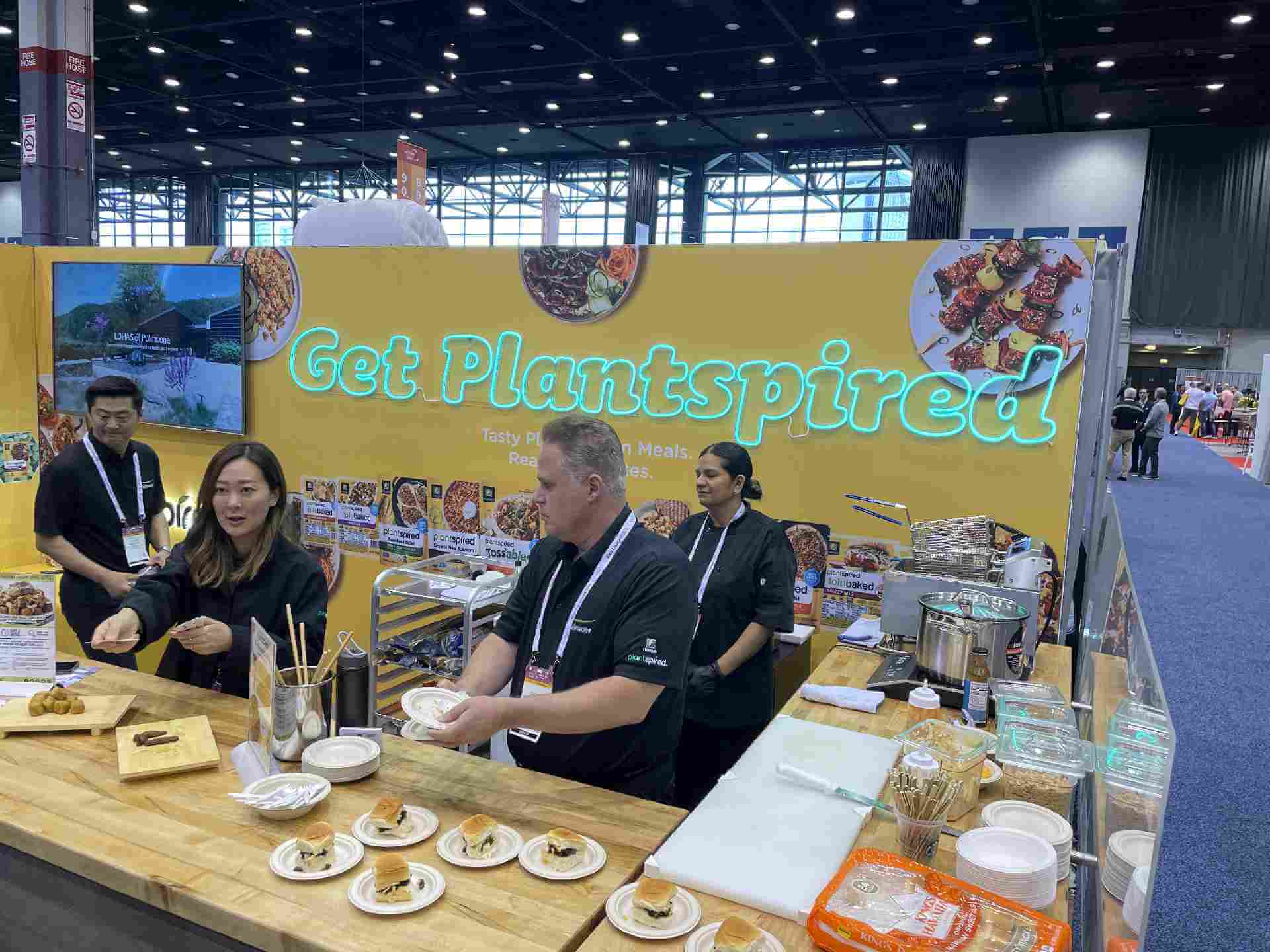
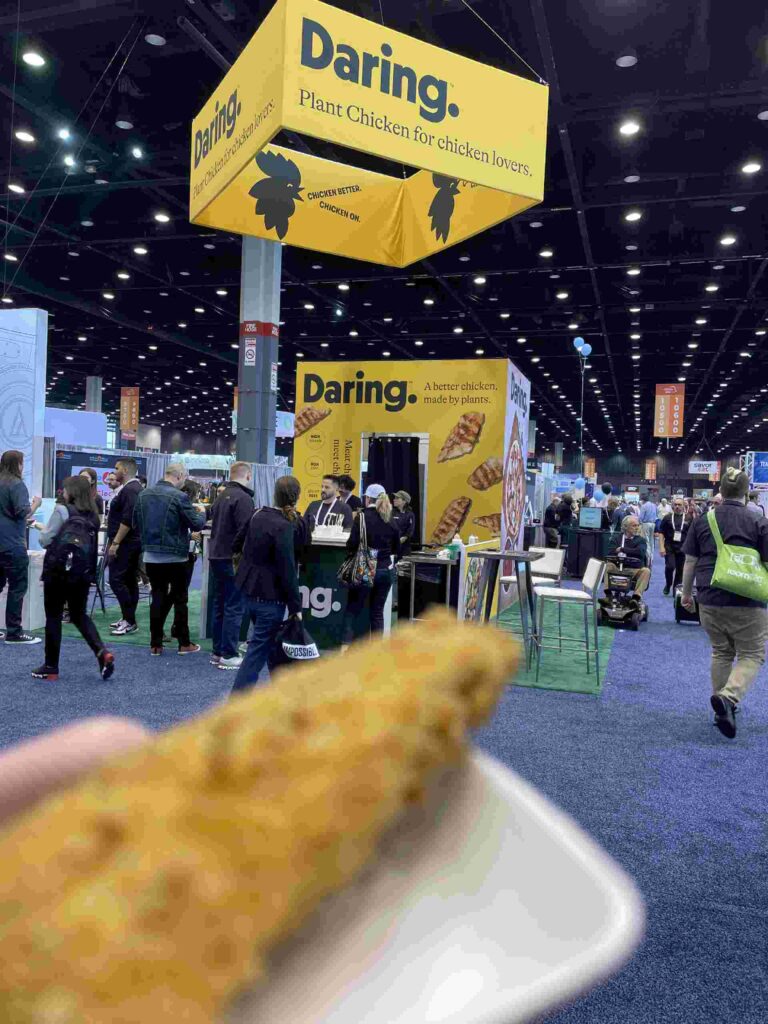
Plantspired plant-based foods

The National Restaurant Association Show is back in a big way, and meat alternative brands are establishing themselves as much more than a trend.

In particular, plant-based brands made their presence known in the Lakeside Center.

However, some big companies also showcased their animal alternatives in the South Building. Among them, Beyond and Daiya.

Notably, Daiya brought with them their freshly reformulated cream cheese alternative. They also had a creamy, flavorful queso at their booth.

Chik’n

Unsurprisingly, meatless chicken—often stylized as “chik’n”—dominated the NRA Show floor.

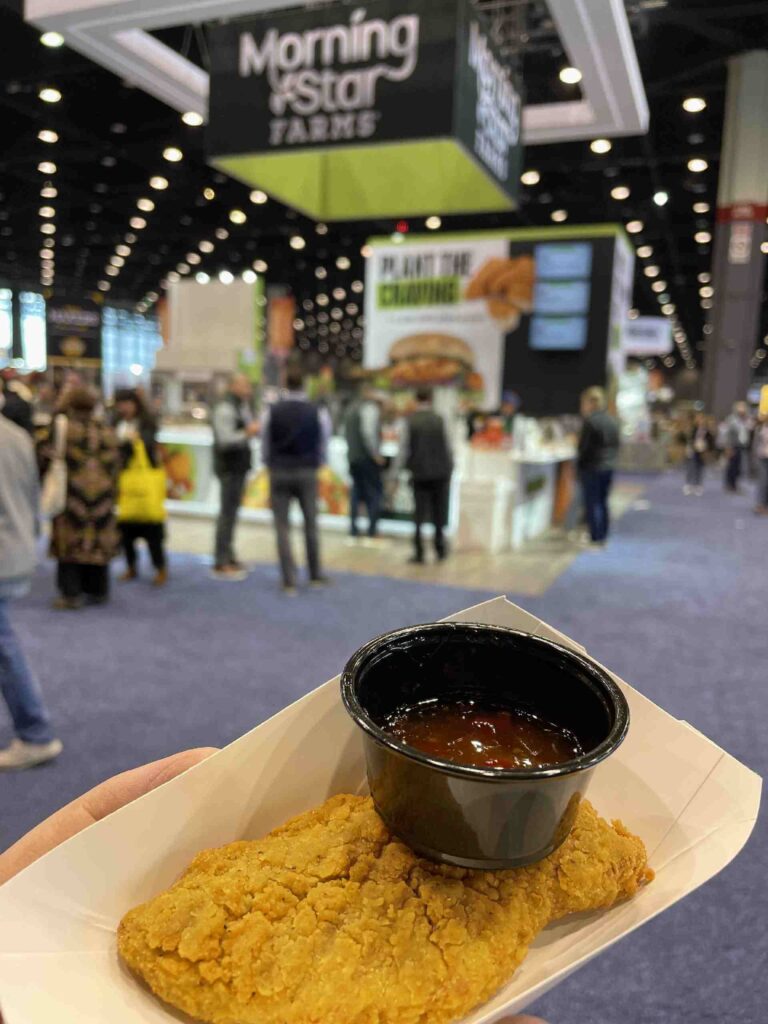
Morning Star Farms chicken

However, exhibitors showed off more than just nuggets and fingers. This year was more about innovation.

For example, more than one company is rolling out chik’n wings. Of course, there are no bones, so they’re more akin to nuggets.

Essentially, these chicken alternatives are boneless “wings.” And as we all know, boneless chicken wings are just chicken chunks with better marketing.

Really, it’s the seasoning, heat, and shape that define the chik’n wing. At least, that’s what they are for now. I expect further innovation and refinement for these wings.

Daring plant-based chicken

Interestingly, some brands appear to be taking on the chicken breast. Now, there weren’t many meatless companies featuring these on the NRA Show floor. Still, there were a couple and their products looked the part.

The textures are also quite close to their meaty counterparts. But I think there’s still work to do.

Plant-based Seafood

Of all the plant-based alternatives, seafood was the star. The CEOs of big brands have been working on these products for several years.

Well, we certainly saw the fruits of their investments at this year’s NRA Show.

Fish fillets, crab cakes, fish patties (including salmon), fish sticks, tuna flakes, shrimp… All were available to sample at exhibitor booths.

Crucially, the flavors and textures were close to the real thing. However, the shrimp mostly relied on being coated in seasoning to mimic their animal-based counterpart.

That said, seeing so many brands committed to bringing plant-based seafood to market was impressive.

Further, the seafood-focused companies are touting the eco-friendliness of their products. Plant-based seafood, they say, can help stop overfishing and stop the reduction of biodiversity in our oceans.

If they appeal to consumers and reduce harm to the planet, these products could perform well in foodservice. Good for the planet and good for the bottom line seems like a win-win to me.

Takeaway

As the 2022 NRA Show showed, plant-based is no longer a trend. These products ceased being a fad long ago.

Now, it’s clear the category is here to stay. The products categories like chik’n are seeing more innovation. Seafood will improve. Other meat alternatives are also improving.

Of course, whether they’re healthy, well, that’s another story. However, consumers seem to want these items regardless.

One thing is obvious, though: The plant-based category is proliferating and will soon reach ubiquity.

Images taken by author

by David Klemt David Klemt No Comments

2022 Cocktail Apprentice Program Class

TOTC Announces 2022 Cocktail Apprentice Program Class

by David Klemt


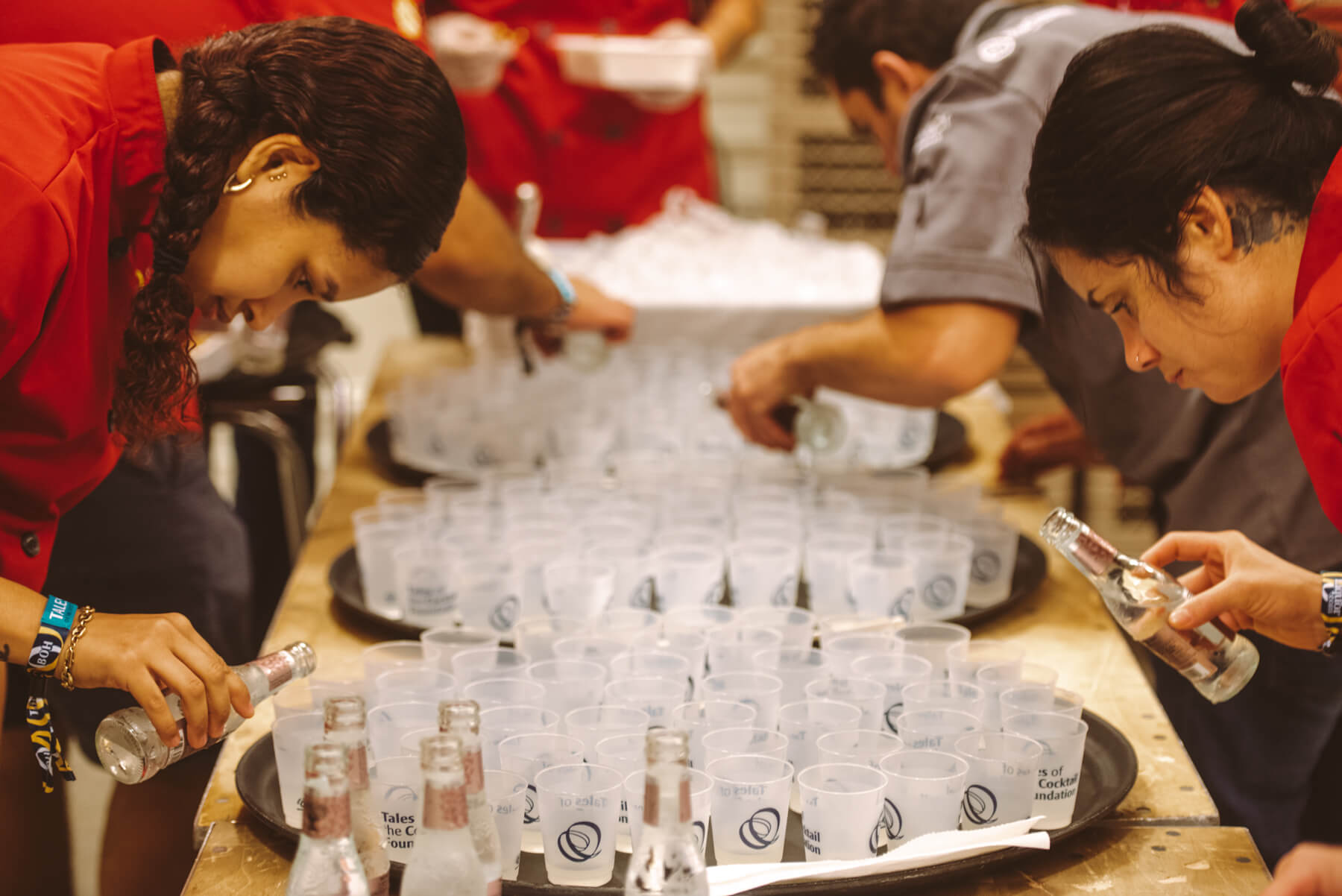
Tales of the Cocktail Red Coat apprentices

The Tales of the Cocktail Foundation has announced the 32 members of this year’s Cocktail Apprentice Program, also known as CAP.

For 2022, the CAP apprentices come from seven countries, Washington, D.C., fourteen American states, and Puerto Rico. First launched in 2008, CAP has played host to over 400 apprentices.

These bar professionals are thrown into the organized chaos that is Tales of the Cocktail each year. Well, to be fair, the event likely only feels like chaos to Tales attendees. This gathering of hospitality pros is a precision machine behind the scenes.

Of course, CAP apprentices and veterans are one of the keys to Tales’ success. These bar pros work together to prepare cocktails for for Tales seminars. They also make the many tastings possible. CAP Red and Grey Coats also batch the Dame Hall of Fame and Spirited Awards drinks.

As you’ll see while reviewing the lists below, CAP Red Coats work at some of the world’s premier bars, restaurants, hotels, distilleries, portfolios and brands, and hospitality groups. Moreover, they gain an incredible amount of experience and mentorship from industry veteran Grey, Black, and White Coats.

Valuable Experience

This is, of course, great news for attendees. Many will recognize the names and venues below. And, hey, these apprentices keep the good times flowing at Tales.

But there’s another reason this news is important.

Operators should encourage their bar team stars to apply to be TOTC CAP apprentices each year. The program is open to bartenders, barbacks, and bar managers.

Considering who they’ll meet, work with, and learn from, operators can think of CAP as an investment in their bar team.

In addition to returning to work with a wealth of knowledge and new industry contacts, they’ll be eligible to apply for the Cocktail Apprentice Scholarship Program. Since 2022 CAP Red Coats can apply when applications open next year, it’s reasonable to assume that 2023 Red Coats will be eligible to apply in 2024 for the TOTCF Cocktail Apprentice Scholarship Program.

So, operators who are serious about furthering their bar team’s careers and helping to mentor them should help them apply for the 2023 Cocktail Apprentice Program.

2022 Red Coats

Below are this year’s 32 CAP Red Coat apprentices. You’ll also find their place of work.

  • Patience AdjeiTwist Night Club and Level Up Lounge (Accra, Ghana, West Africa)
  • Gerald AkinsHamlet and Ghost (Saratoga Springs, NY)
  • Israel Baròn, Casa Prunes (Mexico City, Mexico)
  • Tammy Bouma, Bluebird Cocktail Room (Baltimore, MD)
  • Dylan BrentwoodBar Kismet (Halifax, Nova Scotia, Canada)
  • Napier Bulanan, Viridian (Oakland, CA)
  • Yosue Cordero BadilloFairmont El San Juan Hotel (Carolina, Puerto Rico)
  • Chelsea DeMarkThompson Hotel Savannah (Savannah, GA)
  • Milton DeyaMelinda’s Alley (Phoenix, AZ)
  • Linda DouglasCurly Bartender (Los Angeles, CA)
  • Kai DuartePacifico on the Beach and Down The Hatch (Wailuku, HI)
  • Cody DunavanBreakthru Beverage Virginia (Richmond, VA)
  • Glenn EldridgeROKA (Dubai, United Arab Emirates)
  • Tim FrandsenJane Jane (Washington, D.C.)
  • John FryRumba / Inside Passage (Seattle, WA)
  • Delena Humble-FischerGolden Pineapple Craft Lounge (Tempe, AZ)
  • Princess JohnsonAllegory (Washington, D.C.)
  • Maria KimSouthside Parlor (Seoul, South Korea)
  • Sungjoo KooMidnight Rambler (Dallas, TX)
  • Rylen KomeijiHere Kitty Kitty / Zouk Group (Las Vegas, NV)
  • Lars LunstrumThe Black Cypress (Pullman, WA)
  • Jacob MentelPolite Provisions (San Diego, CA)
  • Brian “Vito” MoralesSaso Bistro (Pasadena, CA)
  • Julian Bella RobinsPursuing MS in Hospitality Management at FIU (Tel Aviv, Israel)
  • Jomar SantosThe Peacock Lounge Savannah (Savannah, GA)
  • Jeremiah SimmonsSeven Three Distillery (New Orleans, LA)
  • Colin SimpsonThe Aviary (Chicago, IL)
  • Taylor SweeneyBar Shiru (Oakland, CA)
  • Vivi SzalavariUptown Cafe (Bloomington, IN)
  • Irlanda VargasBacal (Mexico City, Mexico)
  • Noor WafaiThe Eddy & Durk’s Bar-B-Q (Providence, RI)
  • Tim WeigelVegas Vickie’s (Las Vegas, NV)

2022 Grey Coats

Identifiable by their grey chef coats, Grey Coats are CAP leaders.

  • Hagay I. AbramovitzImperial Craft Cocktail Bar (Tel Aviv, Israel)
  • Justine BockGin & Juice (Bristol, UK)
  • Patrick BragaHappy Accidents (Albuquerque, NM)
  • Fifi BruceBarrel Brothers (Berlin, Germany)
  • Richie DelahoydeLyre’s Non Alcoholic Spirits (Dublin, Ireland) 
  • Amy DunkiBarr Hill and Caledonia Spirits (Los Angeles, CA)
  • Arianna Hone, High West Saloon, Post Office Place (Park City, UT)
  • Renson Malesi, House of Sage Cocktails (Nairobi, Kenya) 
  • Nicholas McCaslin, The Ritz-Carlton Nomad (New York City, NY)
  • Allie Phifer, Cayo Coco Rum Bar and Restaurante (Birmingham, AL)
  • Jessi Pollak, Spoon and Stable (Minneapolis, MN)
  • Eric Scott, Thyme X Table (Bay Village, OH) 
  • Britt Simons, The Eddy (Providence, RI)
  • Joey Smith, Chez Zou (New York City, NY)
  • Sarah Syman, The Dandy Crown (Chicago, IL)
  • Nigal Vann, The Berkshire Room (Chicago, IL)

2022 Black Coats

CAP assistant managers can be identified by their black chef coats.

  • Cam BrownSelf-employed (Vancouver, British Columbia, Canada)
  • Kaleena Goldsworthy-WarnockThe Bitter Bottle and Proof Bar and Incubator (Chattanooga, TN)
  • Alex LermanPearl Street Hospitality (Denver, CO)
  • Samm McCullochRed Wall Distillery (Sedona, AZ)

2022 White Coats

The industry veterans are CAP managers and wear white chef coats.
  • Alexis Belton-TinocoJohnnie Walker/Proof Media Mix (Chicago, IL)
  • Cris DehlaviDiageo Hospitality Partnership (Columbus, OH)
  • John DeragonResy (Brooklyn, NY)
  • Trevor KalliesFreehouse Collective (Vancouver, British Columbia, Canada)
  • Juyoung KangZouk Group at Resorts World Las Vegas (Las Vegas, NV)

Whenever you come across a Red, Grey, Black or White Coat at Tales, be sure to thank them for all their work. Well, if they don’t have their hands incredibly full. In that case, please get out of their way—they’ve got our drinks!

Image: M.S. Meeuwesen on Unsplash

by David Klemt David Klemt No Comments

Alright, Seriously—WTF, Grubhub?

Alright, Seriously—WTF, Grubhub?

by David Klemt

Or, more to the point, stop working with “partners” who exploit our industry rather than support it.

In spectacular and entirely predictable fashion, Grubhub’s “free lunch” further reveals that third-party delivery platforms don’t care about restaurants.

Of course, they all say they support restaurant owners and operators. And, of course, they’re quick to pat themselves on their backs for being a pandemic lifeline.

But…no. Time and time again, mainly through their exorbitant and exploitative fees, they prove the opposite is true.

Restaurants and bars aren’t third-party delivery partners. Rather, these relationships are adversarial and detrimental. So much so, in fact, that some states passed laws to limit third-party delivery fees.

In Nevada, for example, Clark County Commissioners passed an emergency ordinance in August 2020 capping those fees at 15 percent. Clearly, we need to stop enriching companies that prove they don’t support the hospitality industry but cause it significant harm.

Free Lunch?

They say there’s no such thing as a free lunch. Apparently, Grubhub really wants to prove that maxim true.

That’s one of the takeaways from their disastrous promotion. Last Tuesday, in what’s being reported as an attempt to claim the delivery throne in New York City, Grubhub offered “free” lunch to anyone who placed an order for delivery.

The requirements for this promotion? Place an order for delivery through Grubhub on May 17 between 11:00 AM and 2:00 PM and use the code “freelunch.”

Of course, customer orders weren’t entirely free. Rather, the code was good for a $15 discount. Still, a wildly attractive offer as the ensuing debacle reveals.

Unsurprisingly, the promotion made for some eye-grabbing and eye-rolling headlines. Buzzfeed News published the most attention-grabbing one: “GrubHub Was Getting 6000 Orders A Minute During Its Promo Today That Left Restaurant Workers Stressed And Customers Hangry.”

Six thousand orders per minute during a promotion with a three-hour window in a single market.

In addition, the outlet reported that one unsatisfied customer was number 3,630 in the Grubhub customer service queue. Apparently—and who can blame him—he hung up before he could speak with a Grubhub rep about his missing order.

Duh

Who could’ve seen this coming? Any of the restaurant owners, operators, or team members Grubhub “serves,” that’s who.

In fact, anyone who works in this industry with on-premise experience knew this was going to happen. So, too, any journalist who specializes in hospitality.

The fact that whoever came up with this promotion didn’t see this coming is revealing. Unless the creators of these apps and services have real-world restaurant experience, they don’t understand the business.

How can one effectively and properly serve an industry without an understanding of how it operates? Hospitality is about service. Shouldn’t the companies attempting to work within our industry work hard to serve alongside us?

Let’s be clear—this promotion was in no way designed to help struggling restaurants. It wasn’t intended to boost their traffic and revenue. Rather, it was solely created to serve Grubhub’s desire to be number one.

As we all know, we’re experiencing major staff shortages. There are also supply shortages making it difficult for operators to obtain product reliably. Grubhub made those problems exponentially worse.

Some restaurants stopped taking delivery orders. Others canceled orders. There were operators who closed in an effort to catch up with orders and prevent the situation from worsening.

According to news stories, some social media users posted that they planned to stop ordering through third-party platforms.

Negative Impact

If you’re new to KRG Hospitality, welcome. You’re likely realizing that we’re not fans of third-party delivery.

Those of you who are familiar with us have known for quite some time that we support direct delivery. That is, delivery controlled and executed by the restaurant itself.

It’s not that we’re against innovation. Rather, our dislike of these platforms, generally speaking, comes from our perception of their behavior.

In our opinion, they take control away from operators and cost them money. Again, speaking generally, they collect customer data that operators should control. Their fees are ridiculous in most cases. And when it comes to the customer experience, their inconsistencies and shortcomings reflect poorly on the operators far too often.

Studies show that customers who have issues with third-party deliveries often place the blame on the restaurant. Food the wrong temperature? Order arrive late? Packages in less-than-ideal condition? While those issues and others can be the fault of the driver, the restaurant often takes the brunt of a customer’s dissatisfaction.

Of course, there’s also the financial impact of third-party delivery on restaurants. A SevenRooms report from last year reveals how these platforms harm operators and their bottom lines.

The Solution

Look, we know operators have a ton on their plates. But protecting and boosting the bottom line is a non-negotiable element of this business.

Yes, it’ll take some time, effort, and money to set up direct delivery. However, it’s the best solution.

Direct delivery means the operator collects and control valuable data. Likewise, the operator can ensure consistency. Through direct delivery, the operator shapes and controls the experience.

Control. Inherently, third-party delivery takes some control away from operators. That’s not a good thing, and neither is their financial impact.

Look into setting up direct delivery, take control, and protect your revenue ASAP. Friend of KRG “Rev” Ciancio and SevenRooms CEO Joel Montaniel each address delivery on the Bar Hacks podcast. Listen to episode 13 with Rev and episode 24 with Joel to learn more about delivery.

We need to stop rewarding companies that exploit our industry and take advantage of our owners, operators, and hard-working staff members.

Direct delivery is the answer. Take steps to implement it today.

Image: Rosie Kerr on Unsplash

by David Klemt David Klemt No Comments

Breakdown: How Senators Voted on RRF

Breakdown: How Senators Voted on RRF

by David Klemt

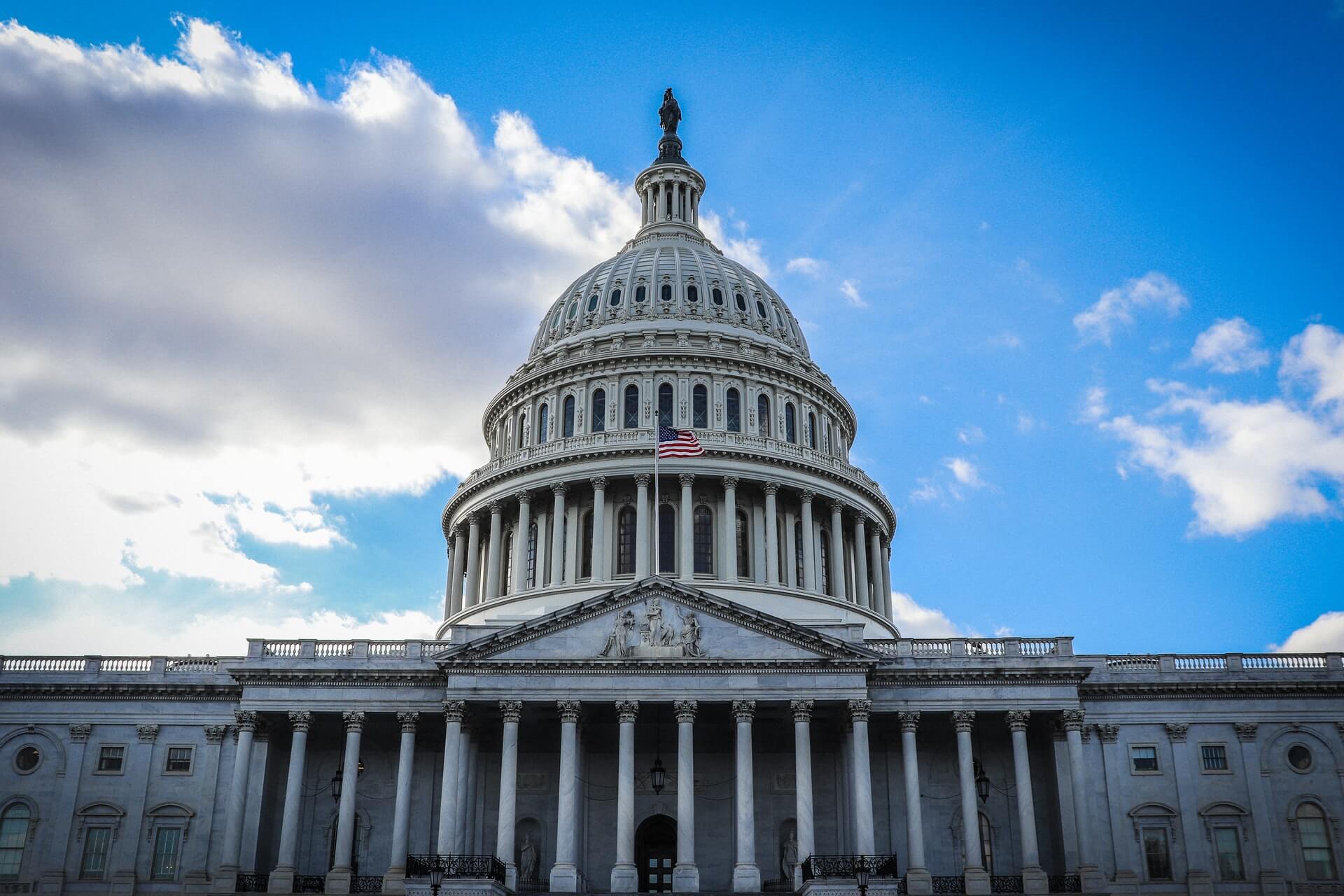
U.S. Capitol Building exterior, cloudy blue skies

After a year of waiting, we now know the fate of the Restaurant Revitalization Fund: a 52 to 43 vote that saw RRF replenishment fail on the Senate floor.

Last Thursday, the US Senate voted to debate the Small Business COVID Relief Act of 2022 (S.4008). A filibuster put an end to this effort to replenish the RRF.

To be blunt, this is a disgrace. Eligible RRF applicants have been awaiting needed and deserved grants for a year. We were left out of Build Back Better, we were left out of the $1.5 trillion omnibus spending bill passed in March.

A contributing factor to why this is so disappointing is the passing of S.3811. Of particular note, 32 of the senators who voted against $40 billion for American restaurants and bars voted in favor of $40 billion for supplemental aid for Ukraine.

Now, I’m not saying that Ukraine doesn’t deserve our support. Likewise, I’m not saying that we shouldn’t have voted to provide the war-torn country $40 billion in aid.

However, I am saying that I find it indefensible that dozens of our senators would send that kind of money overseas, then turn around and deny relief for American businesses.

In one moment we have senators saying America needs to come first. They then proceed to turn their backs on hard-working Americans.

Nay Votes

Unfortunately, 43 senators—all Republican—voted against the Small Business COVID Relief Act of 2022. Therefore, they voted against replenishing the RRF.

However, that doesn’t mean all Republican senators voted against the bill. Indeed, four Republicans voted with their Democrat and Independent peers.

  • Barrasso (R-WY)
  • Blackburn (R-TN)
  • Boozman (R-AR)
  • Braun (R-IN)
  • Burr (R-NC)
  • Capito (R-WV)
  • Cornyn (R-TX)
  • Cotton (R-AR)
  • Cramer (R-ND)
  • Crapo (R-ID)
  • Cruz (R-TX)
  • Daines (R-MT)
  • Fischer (R-NE)
  • Graham (R-SC)
  • Grassley (R-IA)
  • Hagerty (R-TN)
  • Hawley (R-MO)
  • Hoeven (R-ND)
  • Hyde-Smith (R-MS)
  • Inhofe (R-OK)
  • Johnson (R-WI)
  • Kennedy (R-LA)
  • Lankford (R-OK)
  • Lee (R-UT)
  • Lummis (R-WY)
  • McConnell (R-KY)
  • Moran (R-KS)
  • Paul (R-KY)
  • Portman (R-OH)
  • Risch (R-ID)
  • Romney (R-UT)
  • Rounds (R-SD)
  • Rubio (R-FL)
  • Sasse (R-NE)
  • Scott (R-FL)
  • Scott (R-SC)
  • Shelby (R-AL)
  • Sullivan (R-AK)
  • Thune (R-SD)
  • Tillis (R-NC)
  • Toomey (R-PA)
  • Tuberville (R-AL)
  • Young (R-IN)

Yea Votes

It’s important to remember that the Small Business COVID Relief Act of 2022 was a bipartisan effort. Sens. Ben Cardin (D-MD) and Roger Wicker (R-MS) introduced the bill, which included $40 billion for the RRF and $8 billion for other businesses.

Four Republican senators and two Independents voted in the affirmative with all Democrats.

  • Baldwin (D-WI)
  • Bennet (D-CO)
  • Blumenthal (D-CT)
  • Blunt (R-MO)
  • Booker (D-NJ)
  • Cantwell (D-WA)
  • Cardin (D-MD)
  • Carper (D-DE)
  • Casey (D-PA)
  • Cassidy (R-LA)
  • Collins (R-ME)
  • Coons (D-DE)
  • Cortez Masto (D-NV)
  • Duckworth (D-IL)
  • Durbin (D-IL)
  • Feinstein (D-CA)
  • Gillibrand (D-NY)
  • Hassan (D-NH)
  • Heinrich (D-NM)
  • Hickenlooper (D-CO)
  • Hirono (D-HI)
  • Kaine (D-VA)
  • Kelly (D-AZ)
  • King (I-ME)
  • Klobuchar (D-MN)
  • Leahy (D-VT)
  • Lujan (D-NM)
  • Manchin (D-WV)
  • Markey (D-MA)
  • Menendez (D-NJ)
  • Merkley (D-OR)
  • Murkowski (R-AK)
  • Murphy (D-CT)
  • Murray (D-WA)
  • Ossoff (D-GA)
  • Padilla (D-CA)
  • Peters (D-MI)
  • Reed (D-RI)
  • Sanders (I-VT)
  • Schatz (D-HI)
  • Schumer (D-NY)
  • Shaheen (D-NH)
  • Sinema (D-AZ)
  • Smith (D-MN)
  • Stabenow (D-MI)
  • Tester (D-MT)
  • Warner (D-VA)
  • Warnock (D-GA)
  • Warren (D-MA)
  • Whitehouse (D-RI)
  • Wicker (R-MS)
  • Wyden (D-OR)

Not Voting

Three Democrat and two Republican senators didn’t vote on S.4008.

  • Brown (D-OH)
  • Ernst (R-IA)
  • Marshall (R-KS)
  • Rosen (D-NV)
  • Van Hollen (D-MD)

Yay Votes for Ukraine, Nay Votes for RRF

The following senators, all Republican, voted to send $40 billion in aid to Ukraine.

The same day, they voted against $40 billion to replenish the RRF, voting against American restaurants and bars.

  • Barrasso (R-WY)
  • Burr (R-NC)
  • Capito (R-WV)
  • Cornyn (R-TX)
  • Cotton (R-AR)
  • Cramer (R-ND)
  • Cruz (R-TX)
  • Daines (R-MT)
  • Fischer (R-NE)
  • Graham (R-SC)
  • Grassley (R-IA)
  • Hoeven (R-ND)
  • Hyde-Smith (R-MS)
  • Inhofe (R-OK)
  • Johnson (R-WI)
  • Kennedy (R-LA)
  • Lankford (R-OK)
  • McConnell (R-KY)
  • Moran (R-KS)
  • Portman (R-OH)
  • Risch (R-ID)
  • Romney (R-UT)
  • Rounds (R-SD)
  • Rubio (R-FL)
  • Sasse (R-NE)
  • Scott (R-FL)
  • Scott (R-SC)
  • Shelby (R-AL)
  • Sullivan (R-AK)
  • Thune (R-SD)
  • Tillis (R-NC)
  • Toomey (R-PA)
  • Young (R-IN)

Image: PartTime Portraits on Unsplash

by David Klemt David Klemt No Comments

US Senate Fails to Replenish the RRF

US Senate Fails to Replenish the RRF

by David Klemt

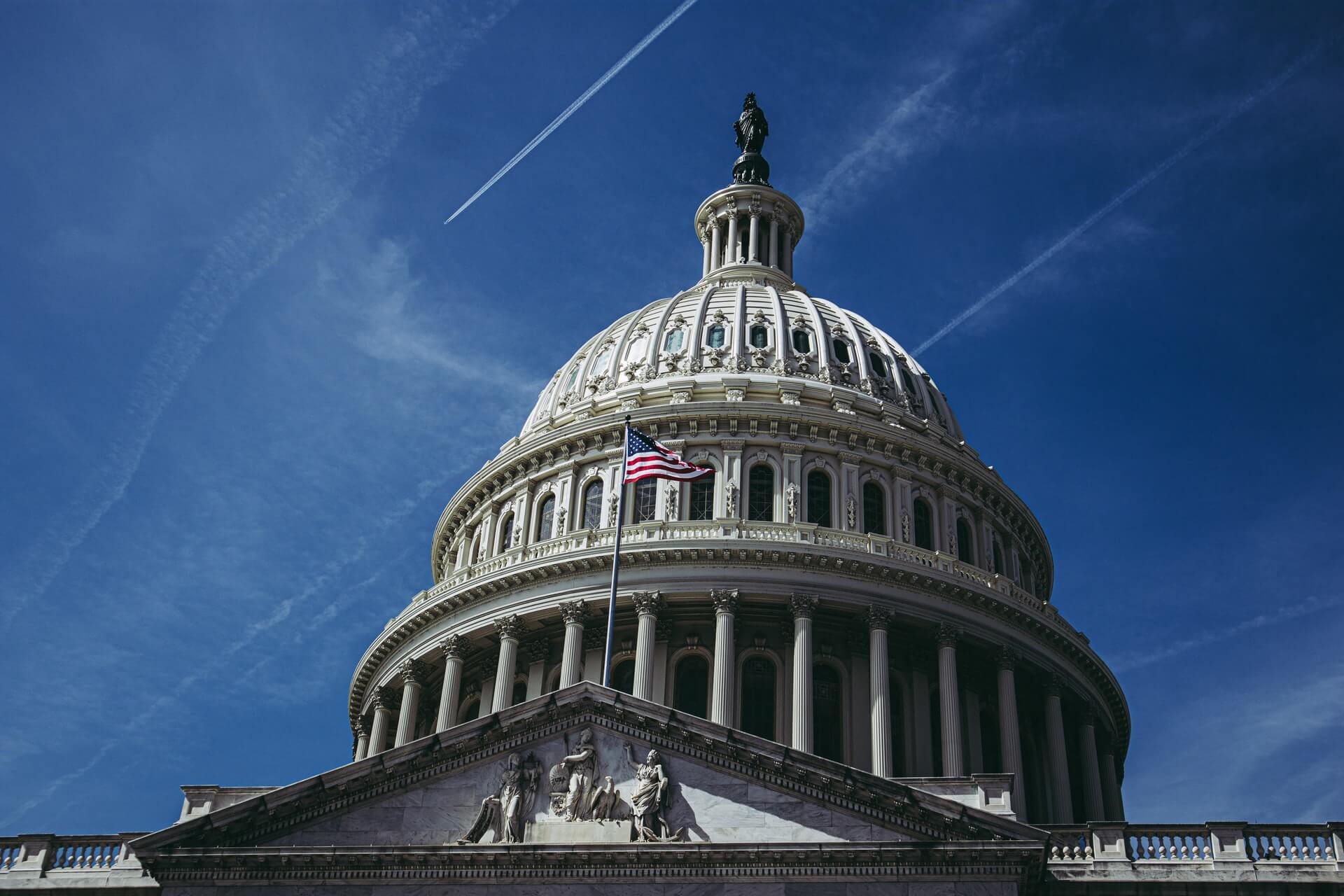
United States Capitol Building exterior and blue sky

After conflicting reports and speculation, the US Senate has finally voted this week on replenishing the Restaurant Revitalization Fund.

Last week, multiple sources reported that the Senate would hold their RRF vote this week. Just days ago, several outlets sounded the alarm, reporting that the vote would be pushed to next week. The reason, these sources provided, was the Senate’s scramble to repackage and hold another vote on aid for Ukraine.

Senator Rand Paul (R-KY) blocked the bill that would provide $40 billion in defense and humanitarian aid. Unsurprisingly, it was also Sen. Paul who objected to $43 billion in emergency funding last August, killing that RRF replenishment effort.

Today, on the Senate floor, Sen. Paul repeatedly derided the replenishment of the RRF as a “bailout.” Additionally, he asked, “Where’s the emergency?”

So, one can infer that the impending closure of an estimated 50 percent of RRF applicants—88,500—isn’t an emergency to the Kentucky senator. Simple math shows that if each of those applicants has just ten employees, that’s a loss of 885,000 jobs.

Rightfully so, people throughout the industry have been more than a little concerned that the bill would receive at least 60 “yea” votes today.

At issue is where the funds would come from. While Democrats view replenishing the RRF as emergency funding, Republicans prefer to reallocate existing funds.

Senate Fails to Replenish RRF

Today’s vote was a long time coming. In fact, it’s just days shy of one year since the RRF application portal closed.

Now, after a 223 to 203 vote in the House to replenish RRF, our senators have failed us. The resulting vote was 52 to 43, falling short of the 60 “yeas” necessary

I’m not despondent over this news. Honestly, I think I’ve made it rather clear that our politicians failing us wouldn’t at all surprise me. Yet I still find myself incredibly disappointed.

Disappointed in how the RRF was handled, disappointed in the grant approval process, disappointed in how emergency funding was blocked, and disappointed in how we were left out of the Biden administration’s Build Back Better and March omnibus bills.

And gravely disillusioned now that I’ve finally learned how little many of our senators care about us. Hospitality is an industry that employed nearly 17 million people in 2019. In terms of revenue, we’re projected by the National Restaurant Association to generate almost $900 billion in sales.

Not enough, it’s clear, for a majority of senators to vote to replenish the RRF.

However, I’m mostly dismayed for the owners and operators who have waited a year just to have this lifeline yanked from their fingertips. Today’s failure in the Senate puts millions of jobs at risk.

Underfunded from the Start

For those who found themselves in RRF limbo, the wait for this vote has been agonizing.

The RRF application portal opened May 3, 2021. Initially, the process looked promising. For the first 21 days, the Small Business Administration announced, priority would be granted to small businesses with a minimum of 51 percent ownership by women, veterans or socially disadvantaged people.

However, the SBA closed the portal immediately after processing only about 101,000 priority applications, or one-third of applicants. So, ever since May 24 of last year, “non-priority” applicants have been left wondering if they’d ever receive an RRF grant.

In addition to the premature closure of the application process, the RRF was woefully underfunded. Clearly, that point was driven home when $75 billion in applications were submitted to a fund with just $28.6 billion.

So, the quick closure and unrealistic funding meant that out of the over 362,000 initial applicants, around 177,000 have been watching and waiting.

A Year-long Wait

Shortly after the RRF portal was closed, a number of Republican members of Congress sent a letter to the SBA. Per the contents of the letter, non-priority applicants wouldn’t receive grants or have the opportunity to apply for grants.

Indeed, those applicants stuck in RRF limbo have been waiting for relief for just days shy of a year. And that’s only counting the days since the portal closed. Operators across the industry, not just those who applied for RRF grants, have been scratching and clawing to stave off insolvency and closures.

Advocates such as the Independent Restaurant Coalition have been sounding the alarm. RRF applicants could be just days away from bankruptcy and needed the government to act. To be brutally honest, relief may still come too late for many applicants.

Congress has certainly had the time to vote on and replenish the RRF. In June 2021, Sens. Kyrsten Sinema (D-AZ) and Roger Wicker (R-MS), and Reps. Earl Blumenauer (D-PA) and Brian Fitzpatrick (R-PA) introduced the RRF Replenishment Act bill. In July, Rep. Blaine Luetkemeyer (R-MO) introduced an alternative bill, the ENTREE Act.

Of course, as we well know, an attempt in August to replenish the RRF with $43 billion in emergency funding was blocked by Sen. Paul. In November, Build Back Better was passed. Obviously, the RRF and our industry were left out the $1.7 trillion dollar bill. Likewise, we weren’t included in March’s $1.5 trillion omnibus spending bill.

Left Out In the Cold

So, of $3.2 trillion dollars in massive bills passed, zero were earmarked for us.

Today, our senators voted 86 to 11 for $40 billion in aid for Ukraine. However, they voted 52 to 43 to provide $40 billion in aid to American restaurants and bars.

Last month, eleven months after the portal closed, the House voted to replenish the RRF. That left the final push to the Senate.

And today, at least 43 senators made their low opinion of us known.

Image: Alejandro Barba on Unsplash

by David Klemt David Klemt No Comments

How Big Brands Can Help Small Brands

How Big Hotel Brands Can Help Small Hospitality Brands

by David Klemt

Upward perspective shot of skyscrapers

The intriguing topic of big hotel brands helping smaller hospitality businesses grow came up during HD Expo 2022.

Several speakers spoke about serving and improving local communities. However, established brands can also help local business communities.

Job creation can take place outside of a big brand’s four walls, for example. But going even further, smaller independent brands can also receive a lift from big brands.

As we all grapple with what business can be moving forward, some in hospitality are proposing operating with a purpose.

Conversations Help

Everyone with several years of experience in this industry has seen some things. That’s putting it lightly, most likely.

That is to say, hospitality professionals gain metric tons of useful experience working in this industry. As we know, experience and knowledge are incredibly valuable in business.

Great mentors help others by sharing their knowledge with others. They gain that knowledge—at least in part—through experience. That means that time is truly invaluable.

So, when’s the last time you shared your knowledge with someone outside your business’ four walls?

Damon Lawrence is the co-founder of Homage Hospitality, the first Black-owned hotel brand. As he said during HD Expo 2022, honoring and engaging a given community requires time and effort. This includes engaging with the community’s business owners.

According to Lawrence, just mentoring people and providing what you’ve learned in this industry for free can help small businesses.

Now, it may sound too simple to say that sharing information is enough to help a small operator. However, what seems like a small nudge in the right direction can be powerful.

It may seem inconsequential to an established, large brand operator or executive. But you may be holding the piece of the puzzle that will show a smaller operator their next step.

Giving someone a few moments of valuable time can lead to a flourishing local business community, which in turn helps the community at large thrive.

Active Development

The managing director of Horwath HTL, Todd Wynne-Parry, pointed out the old hotel and resort model during HD Expo 2022. For decades, the approach was to keep each guest on property for as much of their stay as possible.

Now, as Wynne-Parry says, the aim is to encourage guests to explore the areas surrounding hotels and resorts.

With that in mind, hotel groups and designers are seeking to create destination properties. Almost by default, that requires the community to become a destination as well.

As far as Crystal Vinisse Thomas, a VP at Hyatt Hotels, is concerned, that means global hospitality brands need learn to work with small businesses.

If a hotel brand really wants to engage the community, featuring local brands is a powerful strategy. Doing so not only resonates with locals, it provides a more authentic experience for travelers.

However, meeting the demands of a hotel can prove daunting for a small business. So, while it may seem like a great idea to design a space for a local coffee shop to operate out of, they may not be able to afford the initial outlay.

Vinisse Thomas recommends big hotel brands lower the cost of entry for small businesses to work with them.

Larger brands can also actively help accelerate the growth of small businesses. If a big hotel brand isn’t interested or capable of acting as an incubator, they can still help entrepreneurs.

Again, removing barriers to entry or lowering the costs of entry is a great start. Hotel brands can also create grant programs to develop smaller hospitality businesses.

There was a lot of talk about community during HD Expo 2022. Global brands need to take the next steps to ensure it wasn’t all talk.

Image: Samson on Unsplash

by David Klemt David Klemt No Comments

Is Your Brand Engaging the Community?

Is Your Brand Engaging the Community?

by David Klemt

Sign on wall that reads, "We like you too"

Many speakers at HD Expo 2022 are focusing on an important element of design and the hospitality industry: the people we serve.

In other words, designers, their collaborative partners, and their clients want to engage communities.

Now, it’s true that HD Expo 2022 speakers were mainly talking about the hotel side of hospitality design. However, much of what they have to say on the subject of community relates to restaurant and bar projects as well.

Below are helpful insights into engaging the community your business operates in and serves.

Valuing the Community

Crystal Vinisse Thomas, vide president and global brand leader of lifestyle and luxury brands for Hyatt Hotels is bringing Caption by Hyatt to life.

A core element of Caption is community engagement. Yes, travelers are crucial to the success of a hotel brand. However, so are the locals.

After all, hotels, restaurants, and bars employ people from the community. Engaging the community leads to the creation of a loyal guests. During slower times, those loyal locals keep those registers ringing.

As Vinisse Thomas says, operators need to focus on locals as much as travelers. Further, she defines her approach to community as creating a space that’s open to everyone.

One way that Caption is staying true to Vinisse Thomas and Hyatt’s vision for the brand is the Talk Shop. As the name suggests, this is a hangout space. Talk Shop is a communal workspace, a a restaurant, a coffee shop… It’s a hangout for everyone, hotel guest or community guest.

However, Vinisse Thomas does admit that there are challenges when designing and operating for community engagement. One of those challenges is scalability.

Then there’s another big challenge. Designing and operating with the community in mind looks great on paper. But there’s no guarantee that this approach will give an operator an edge of the competition.

To that point, Vinisse Thomas suggests it may be best to speak with one’s competitors to partner on community engagement efforts.

Honoring the Community

An additional challenge when attempting to engage a community is authenticity. It’s a great buzzword, as Vinisse Thomas says, but it needs to be more than that.

Dyonne Fashina, principal of Denizens of Design, has some thoughts on community engagement and authenticity.

Putting it bluntly, Fashina says that honoring a community requires more than a Google search. Rather, designers and operators need to spend time in a given community. They need to get to know the people, the culture, and the vibe.

At KRG Hospitality, we agree. One of our services is site selection. We conduct intensive research to identify the best site for a concept.

However, operator clients need to ensure they know the location. Not just the ZIP code, not just the address, not just the cross streets—the community.

After KRG identifies ideal sites, the client should spend time in those communities, speaking with the people who live and work in them.

Fashina also has another excellent piece of advice for operators. The project, as we often say at KRG, isn’t over after the grand opening. Fashina’s advice speaks to that point.

If an element of an operator’s business isn’t working for the community, she says, they need to be flexible enough to fix it. For owners who perhaps don’t spend every day inside their business or businesses, Fashina recommends visiting to analyze community engagement.

Hospitality is about service, and service requires commitment to being a responsible host and steward. To that end, operators should ensure their concepts improve communities rather than exploit them.

Image: Adam Jang on Unsplash
by David Klemt David Klemt No Comments

What’s Next in the F&B Design Space?

What’s Next in the F&B Design Space?

by David Klemt

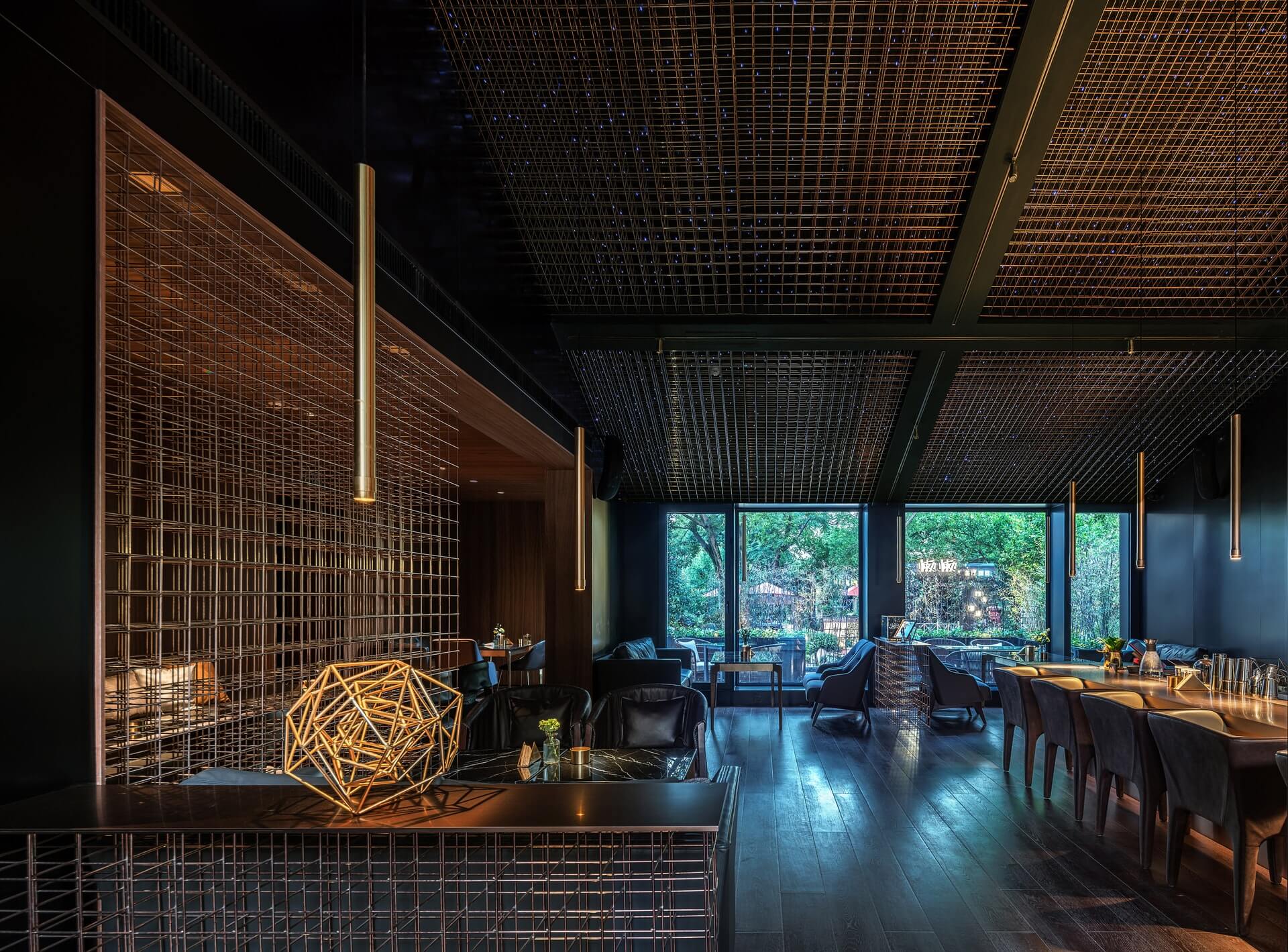
Interior of world's first crypto bar

Design driven by a story and narrative, technological innovation, and people’s desire to socialize are what’s next in hospitality design.

The influences above are factoring into the current approach to design in the F&B space. Be it a hotel or restaurant, the F&B landscape is going to look different for several reasons.

Five leading industry experts addressed this topic during HD Expo 2022‘s “F&B Trends: What’s Next?” panel.

Technology

Well, let’s start with arguably the biggest “trend” in F&B. Our industry is finally making major advancements in the area of technology.

It may not seem like it to some, but speaking generally, hospitality hasn’t always found itself on tech’s bleeding edge. That’s changing.

In fact, some industry experts feel we may be moving too quickly. For example, an interesting prediction from Restaurant Leadership Conference 2022 is a more deliberate approach to developing and implementing hospitality-specific tech.

Now, that doesn’t mean we’ll see a significant slowdown in tech innovation. Rather, innovators may take a more calculated approach to truly relieve hospitality pain points.

For example, Adam Crocini, senior vice president and global head of food and beverage brands for Hilton, points to a few innovations now common throughout the industry. Digital order, digital pay, and the ability to deliver food essentially anywhere within a hotel, resort or casino property are tech solutions driving efficiency.

However, Crocini sees one segment in need of a specific solution. In the luxury segment, guests prefer in-person engagement with staff and tactile engagement with physical menus.

Ari Kastrati, chief hospitality officer for MGM Resorts International, seems to agree. Tech, says Kastrati, shouldn’t replace human connections. Rather, technology needs to enable and enhance.

The Experience

When it comes to design, much of the focus is on the impact it will have on the guest or consumer. However, the end user is hardly the starting point.

For Kastrati, a successful project begins with the development of a relationship. That relationship is between the designer, the operator, and the concept. If care isn’t taken to nurture that relationship, it will likely show in the final product.

In Crocini’s eyes, that relationship informs the development of the operator’s concept. How? Through the development of a story and narrative.

If the designer and operator can develop a story, the design can be grounded in said story. Further, every element of a design can be held up against that story to see if it “fits.” If it does, the design will deliver a holistic experience and engage the guest or consumer.

In terms of F&B, Kastrati and Crocini make similar points. Both feel knowing the guest and anticipating their needs is crucial.

Addressing design elements that impact the experience, Crocini believes design should start with lighting. A design without proper lighting, Crocini says, is like a Scorsese film without the score.

Alexis Readinger, founder of Preen, is focusing in part on unique floorplan design. In particular, Readinger likes features that encourage interaction between guests, such as communal loveseats. However, “protecting the introverts” is also important for some guests’ comfort levels.

It’s safe to say that Caroline Landry Farouki, partner at Farouki Farouki, agrees with Readinger and Crocini. Seating, says Landry Farouki, can create different levels of intimacy to engage extroverts and introverts, and lighting designers are crucial and can really tell the story.

F&B Trends

In terms of consumer trends, Kastrati points to something specific he’s seeing in Las Vegas. People are seeking out specialty restaurants and luxury retail. At least anecdotally, this confirms what many reports and experts have been saying for the past few years: Consumers are showing increased interest in luxury.

However, Kastrati’s focus in the F&B space isn’t solely on guests and consumers. Rather, he suggests that the next step is bringing people back to the workforce. As Kastrati says, there’s no hospitality without people. Kastrati believes all of us in the industry need to encourage people to pursue hospitality careers.

Switching gears, Jessica Gidari, director of design and concept development for Union Square Hospitality Group, points to an effective pivot as a possible industry trend.

At least one concept in the Union Square portfolio has pivoted from a restaurant to a cocktail bar. A menu with shareable plates leverages guest desire to socialize and share. Gidari also says doing away with some traditional two- and four-top tables and replacing them with communal seating can “rebrand” a space as a “convivial” lounge.

Landry Farouki thinks operators can count on two compelling trends in the F&B space. One is the return of the restaurant as “the bar.” As someone who lives and works in Las Vegas, I can attest to treating restaurants more as bars myself.

Another possible trend Landry Farouki predicts is “mature dining” replacing fine dining. Explaining mature dining, Landry Farouki says such a concept is chef-driven but doesn’t focus solely on the chef.

Trend predictions must be taken with a grain of salt. However, I only see upside for design that helps operators engage guests more from the start.

Image: LYCS Architecture on Unsplash

by David Klemt David Klemt No Comments

TOTC 2022 Agenda and Tickets Now Live

Tales of the Cocktail 2022 Conference Agenda and Tickets Now Available

by David Klemt

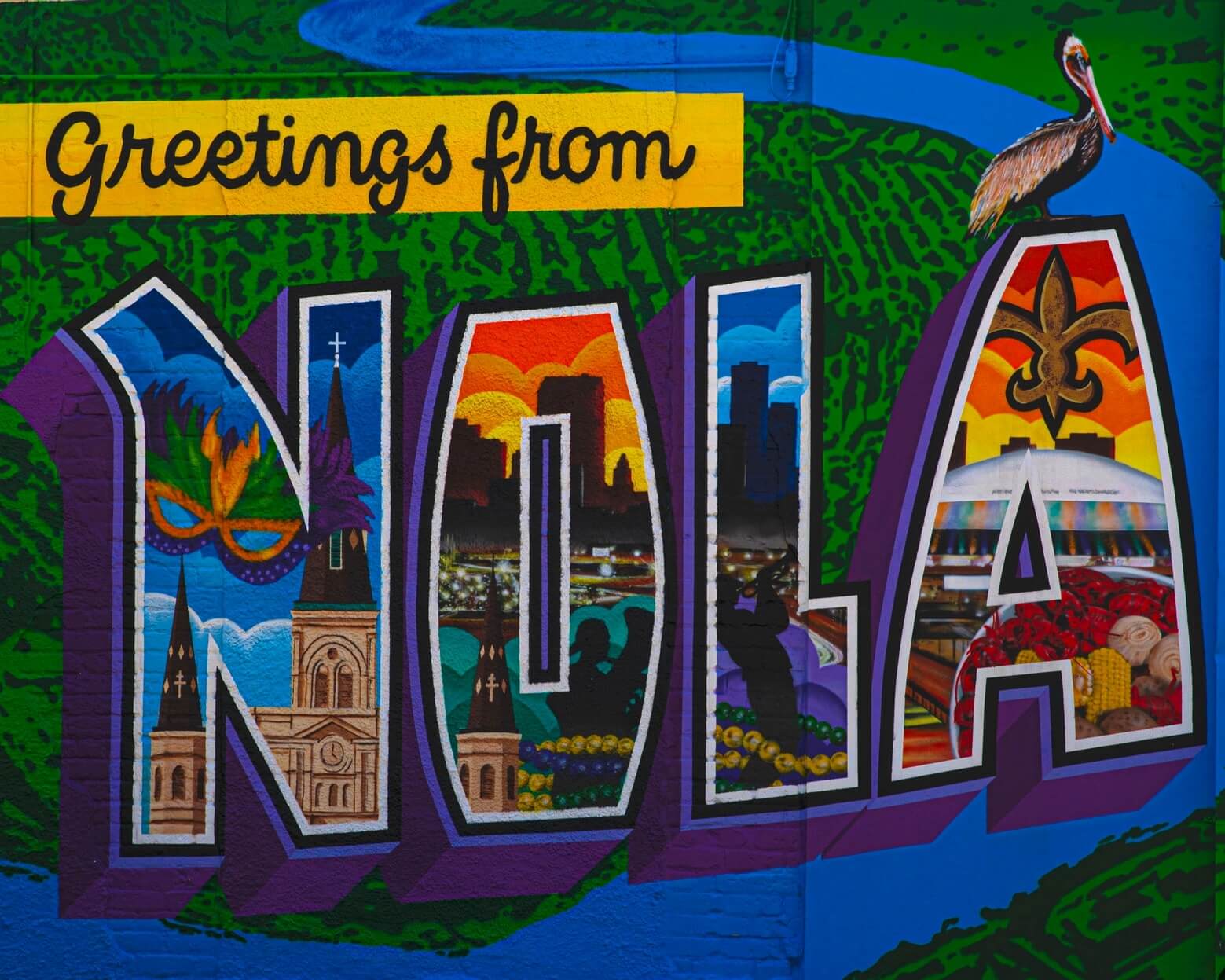
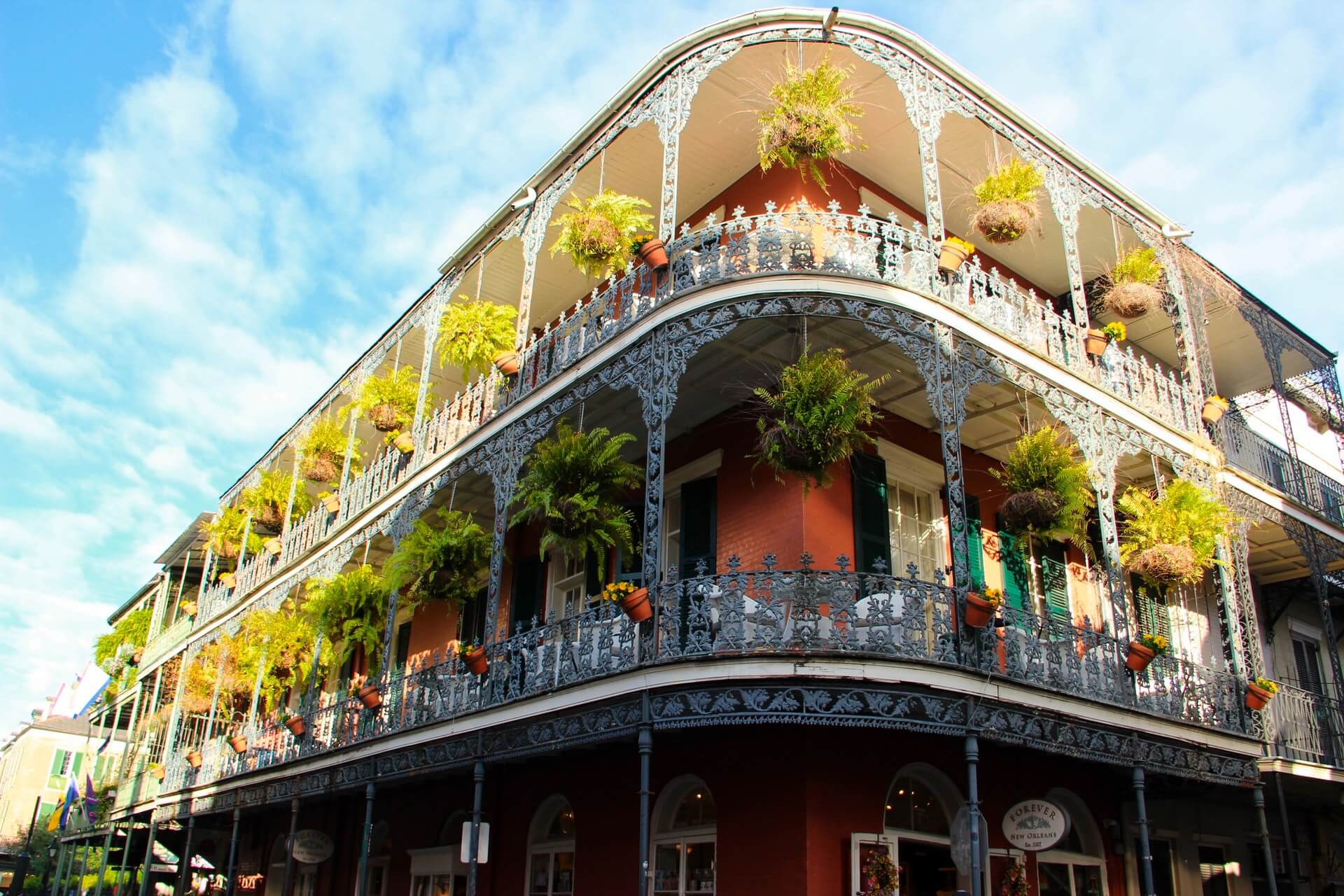
Greetings from NOLA artwork

The time is now to grab your Tales of the Cocktail tickets and plan your trip to New Orleans for the last week of July.

Not only are tickets available for purchase via this link right now, you can also check out the schedule here.

Of particular note is the amount of complimentary programming available to 20th anniversary TOTC attendees.

Free to Attend

Attendees will have access to several activations and workshops that are free to attend.

Beginning Sunday, complimentary programming is available throughout the week. For example, the Day of Service on Sunday, July 24 is free attend and a way to give back.

Also on Sunday, the 11th annual Pig & Punch Volunteer Day of Service. This is another opportunity for those in the industry to do some good in the NOLA community.

The return of Pig & Punch was mentioned by an excited Lola Thomas on episode 72 of the Bar Hacks podcast.

On Monday, all attendees can attend the keynote address; Diversity Distilled Career Fair; the Welcome to Wellness! therapeutic stretch and self-massage session; and “#FromTheBarToTheFarm” sustainability workshop.

There are several more workshops—such as “Safe Bars: Crafting a New Culture of Safety and Respect” and the immersive “Mind Full” experience—that are free to attend on Tuesday and Wednesday.

Incredible Activations

More reasons to plan your trip around an action-packed Sunday? Speed Rack Redemption, the National Tequila Day Pool Party at the Royal Sonesta, and Ode to the Bowl.

The rest of the week is absolutely packed. From workshops to seminars, cocktail tours to tasting rooms, and all manner of activations, parties, and events in between, the 20th anniversary celebration of Tales of the Cocktail will be an experience to remember.

On the subject of cocktail tours, there are eight such experiences available during this year’s Tales. For example, attendees can register and secure tickets for Hunting Down the Sazerac, Downriver: Bars Beyond the French Quarter, the Big Gay Bar Tour, and Bourbon Street and How it Got that Way.

Learn More

To be honest, there’s simply too much going on at this year’s TOTC to list here. The sheer number of workshops, seminars, and activations must be checked out online.

And that’s to say nothing of the industry icons that will be presenting seminars and workshops, and hosting activations and special events.

Simply put, there’s programming for everyone. Health and wellness? Yes. Furthering your career? Absolutely. Perfecting technique and tasting new products? Of course. Business, culture, advocacy, diversity, inclusion, equity… Check, check, check, check, check, check!

We hope to see you at Tales of the Cocktail 2022! Be sure to check out the agenda and grab your tickets today.

Image: mana5280 on Unsplash

by David Klemt David Klemt No Comments

Key Themes from HD Expo 2022

Key Themes from HD Expo 2022

by David Klemt

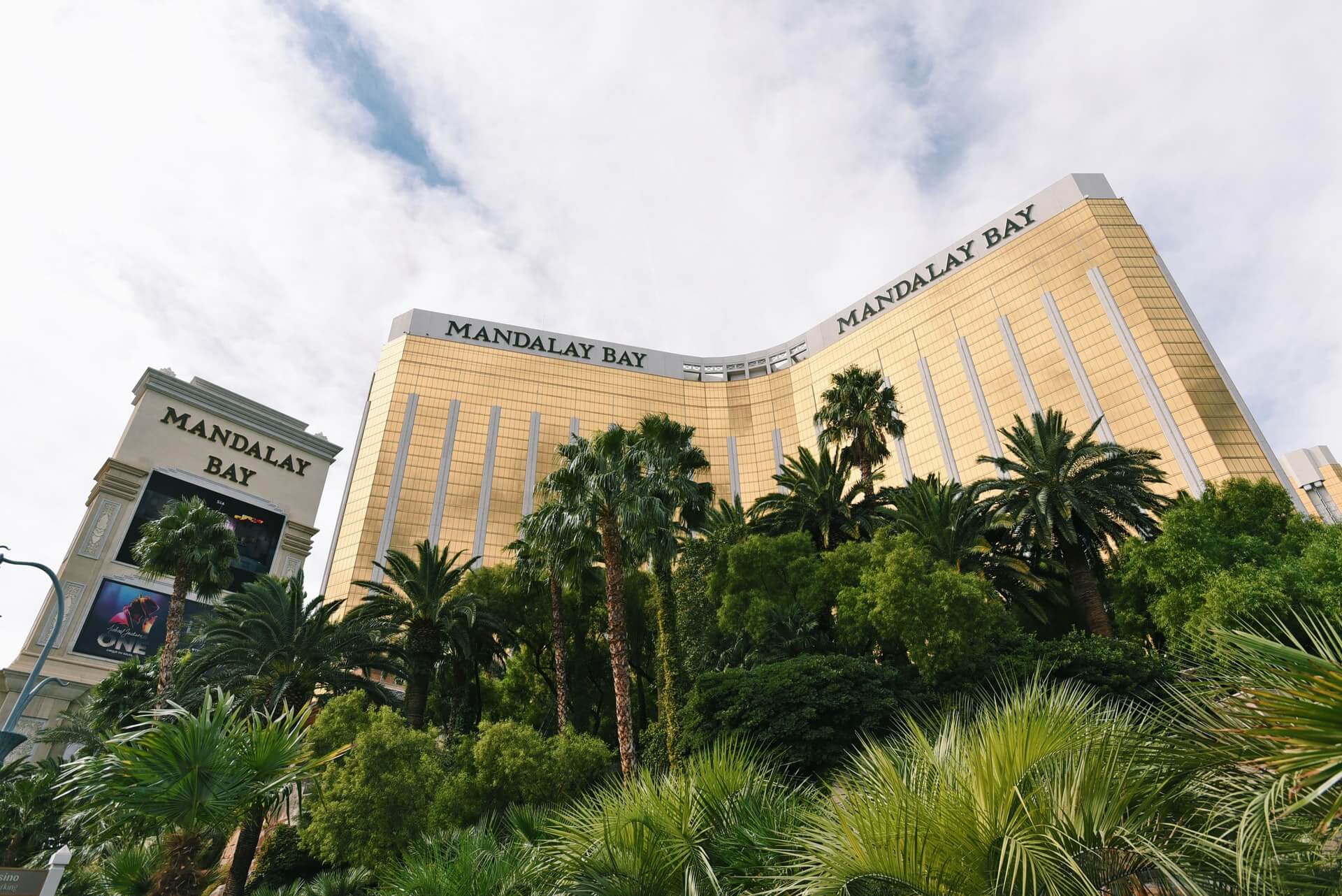
Mandalay Bay Resort & Casino Las Vegas

The educational conference sessions at Hospitality Design Expo 2022 in Las Vegas were connected by a number of key, overarching themes.

Hosted by the Mandalay Bay Convention Center, HD Expo packed each day with invaluable education. Founders, designers, highly placed executives, and other influential industry professionals addressed a wide range of crucial topics.

Below are five key topics and themes from HD Expo 2022.

Sustainability

Unsurprisingly, sustainability was one of the most-discussed topics.

Of course, conversations about sustainable design, construction, and operational practices have been at the forefront of hospitality for several years now. However, the topic seemed supercharged this year at HD Expo.

Drilling down, speakers at the 2022 show are focusing on “building performance,” light-touch construction, and waste recovery, to name but a few session topics.

When some think about sustainability, they think of low- and no-waste practices, energy efficiency, and upcycling. For others, being sustainable means building in an eco-friendly or green way.

However, several HD Expo 2022 speakers, their teams and agencies, and their partners and clients are thinking more locally. The impact of building and operating on local communities is now a greater focus.

For example, Victor Body-Lawson, founder and principal of Body Lawson Associates Architects & Planners. During a panel he co-presented, Body-Lawson addressed the importance of designing, building, and operating for the local community.

In short, he explained how not using local materials and labor has a significant negative impact on the environment. Additionally, Body-Lawson feels that the objective of design is that whomever engages with end product—commercial or residential—comes out better.

Wellness

Refreshingly, it appears the stigma surrounding wellness is dissipating. More people seem to be more comfortable discussing their mental and emotional health openly.

Designers and their clients, particularly in the hotel and resort space, are taking note.

Long a staple amenity, the health center is undergoing reinvention. In fact, many resorts and hotels are focusing on wellness centers and programming.

In fact, a number of concepts are more wellness and healing getaway than hotel or resort. One such project coming to market is the Jenesis House.

The creation of Jenesis Laforcarde, this concept’s focus is explicitly mental health, physical well-being, and self-care. Additional core values are community, hiring local, and engaging with local small businesses.

Diversity, Equity, Inclusion

Like the topic of wellness, DEI has received more earnest attention during the pandemic. And why not? Diversity, inclusion, and equity are inextricably connected to wellness.

Of course, DEI is also connected to community. Moving forward, designers, their partners, and their clients must focus on DEI within their companies and local communities.

One hotel brand that seeks to embody this mission is Caption, part of the Hyatt portfolio. Crystal Vinisse Thomas, VP and global brand leader of lifestyle and luxury brands for Hyatt, is bringing Caption to market.

At this brand’s core is community. Locals are as important as the travelers staying at a Caption property. And, again, why shouldn’t that be the case?

Locals will work at the hotel. Locals will use the hotel. And locals will feel the impact—positive or negative—of the hotel.

A visit to the website provides all the proof anyone needs that Caption is committed to locals:

  • “The people make the place here. We hire local, buy local, and vibe local.”
  • “We strive to be a good neighbor.”

Interestingly, Thomas tied DEI and the community together. While it may be a difficult conversation to start, if a designer, executive, partner, or client sees that a project isn’t representing the community, they need to address it.

Staying silent isn’t how things move forward. In fact, it’s a sure-fire way to take steps backward.

Discovery

What keeps guests coming back? Is it the amenities of a hotel? The food and beverage? Do guests return because of the service they receive?

Of course. However, a shift in guest behavior and expectations shows that F&B, amenities, and service may no longer be enough to motivate repeat visits.

When it comes to hotel and resort design, the future is discovery. Another way to think about discovery is the “hotel within the hotel,” or “resort inside the resort.” A concept that embraces this approach reveals layers that guests can discover.

Perhaps their first stay is in the main or more traditional space. Then, the guest discovers that there are different areas they can book for a stay. These could be villas, luxury tents, a pre-fab luxury Moliving unit (as an example)…

The point is that the guest knows they can engage with the property differently during each stay. While there are core elements that define a particular brand, they can deliver different experiences on the same property.

Of course, such a concept also ties into the themes of community and wellness. Many brands are eschewing the traditional operational ethos of attempting to keep a guest on property for as long as possible. Instead, the local community is a key experiential element of a hotel or resort.

The future of hospitality design—indeed, of hospitality as a whole—encompasses each of these themes. Perhaps most importantly, each theme serves a greater concept: Community.

Image: tommao wang on Unsplash
by David Klemt David Klemt No Comments

Código 1530 Pursuing Low-waste Initiatives

Código 1530 Pursuing Low-waste Initiatives

by David Klemt

Blue Weber agave plant in Tequila, Mexico

Tequila Código 1530 is making the upcycling of the agave they use a cornerstone of the brand’s sustainability efforts.

Some agave growers and tequila producers the plant as mulch, fertilizer, and biofuel. Bagasse, the fibrous material distillers separate from agave piñas, along with the leaves, is composted and used to fertilize agave fields.

While not common, some distillers will even take other producers’ agave bagasse and leaves to compost it.

However, Código 1530 is now doing even more with their agave.

Agave Sustainability

According to some in the spirits and hospitality industries, tequila may end vodka’s dominance in the US this year. Obviously, this would be the result of an increase in consumer demand.

Well, that necessitates an increase in production. So, it follows that agave growers have motivation to grow and harvest as much mature agave as possible.

However, it takes about eight years for some agave plants to mature. Others take more than ten years. For some rarer species, maturation takes twelve years or more.

Of course, production leads to waste. In simple terms, that’s the problem producers must solve.

One definition of “sustainability” is striking an ecological balance that preserves natural resources. For tequila production in particular, this means finding ways to meet consumer demand while harvesting agave reponsibly.

While composting and mulching is a great idea, Código 1530 sees the need to take things further.

More than Mulch

We’ve probably all been given at least one drink served with a paper straw. Unfortunately, that means most of us know how quickly that experience can become less than enjoyable.

Even some of the best-made paper straws can turn soggy long before a drink is finished. On the operator side, that’s not great for the guest experience, to say nothing of the costs associated with stocking paper straws.

However, some operators and their guests are willing to stick with paper straws to be sustainable. That’s admirable but there may be a better way, and it involves agave.

“We quickly realized that after harvesting agave to distill Código 1530 Tequila, the remaining agave was only being used as mulch to top our soil for future plants or burned as a fuel source,” explains George Strait. “We are still using some of the excess agave fiber as mulch, and now have begun producing straws and cups in a sustainable and eco-friendly manner.”

Strait, as some may know, is an investor in Código 1530. A lesser-known fact is that Strait graduated Texas State University (formerly known as Southwest Texas State University) with a degree in agriculture.

“This is a lifesaving program for sea life affected by plastic pollution,” says Strait of Código 1530’s new agave sustainability efforts.

Unlike paper straws, agave straws don’t get soggy or deform. Additionally, they can be thrown out in normal trash after use as they’re biodegradable.

However, this agave initiative doesn’t end with straws. Código 1530 is also making agave fiber cups, coffee cups, cocktail shakers, and shot glasses.

Tea-quila

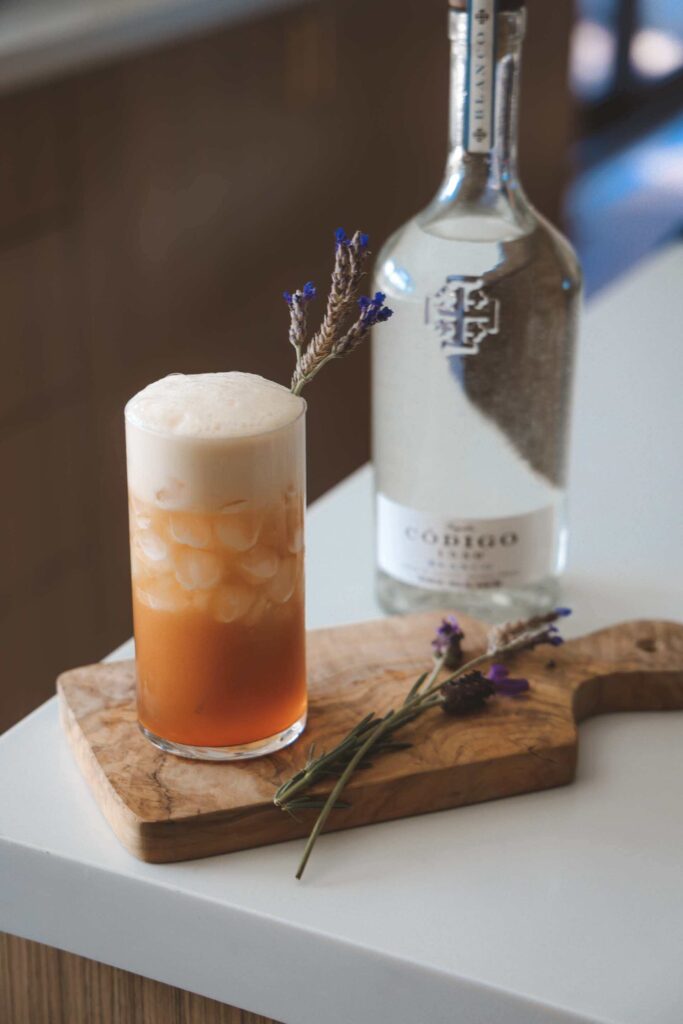
To celebrate Earth Day and their sustainability efforts, Código 1530 has created the drink below.

Codigo 1530 low waste tequila cocktail

Image: Amir Shafii, Código 1530

  • 1.5 oz. Código 1530 Blanco
  • 3 oz. Bergamot tea
  • 0.75 oz. Lemon juice
  • 0.5 oz. Lavender simple syrup
  • Lavender sprig to garnish

Housemade simple cuts down on the waste associated with producing and shipping bottles of syrup. To make the lavender simple syrup, bring one cup of water and one cup of sugar to a boil. Add ten sprigs of lavender while water and sugar are boiling, let cool, then strain. For this low-waste cocktail build, add all ingredients and ice to a shaker. Shake, then strain into a Collins glass with ice. Garnish with a sprig of lavender.

Image: BRUNO EMMANUELLE on Unsplash

by David Klemt David Klemt No Comments

Metallica Supports World Central Kitchen

Metallica Supports World Central Kitchen

by David Klemt

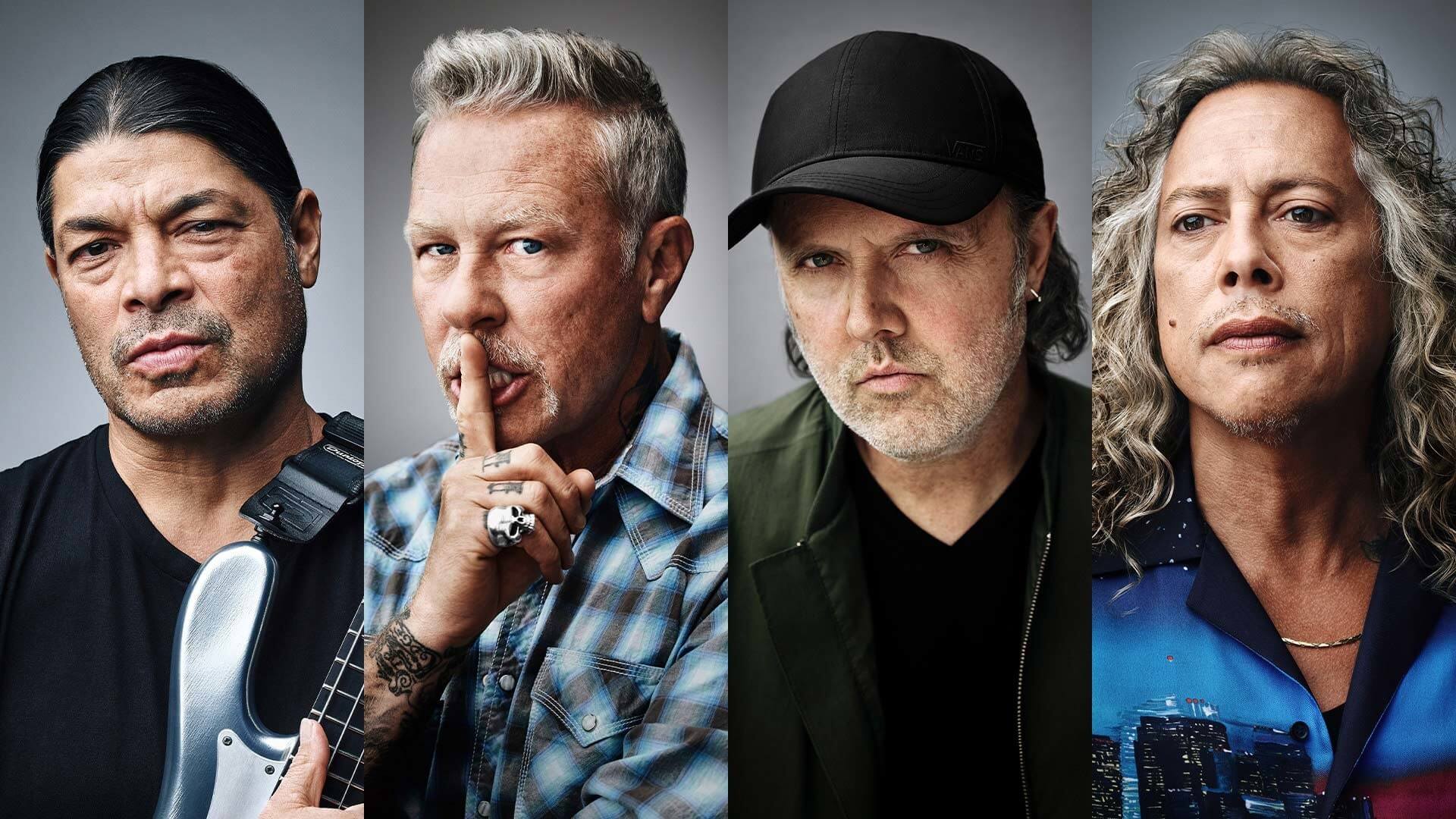
Metallica band member portraits

Metallica is supporting World Central Kitchen to #StandWithUkraine via donations made through their non-profit organization, All Within My Hands.

To start off AWMH’s annual Month of Giving, the band and their philanthropic organization awarded WCK a $100,000 grant. They then donated $500,000 to the humanitarian non-profit founded by Chef José Andrés and his wife Patricia.

However, Metallica and AWMH aren’t done there. The iconic metal band and their non-profit have committed to the goal of donating another $400,000 to WCK.

Additionally, Metallica and AWMH have unveiled the Month of Giving 2022 T-shirt.


View this post on Instagram


A post shared by Metallica (@metallica)

The shirt can be pre-ordered here (I placed my order last Monday). Proceeds will go to the WCK #ChefsForUkraine campaign. Artist Andrew Cremeans created the brand-new design and donated it to AWMH.

People interested in making a donation to AWMH that will benefit WCK but who don’t want the T-shirt can click here.

All Within My Hands

The All Within My Hands Foundation was founded in 2017. Metallica and the band’s management are the founding members.

James Hetfield, Lars Ulrich, Kirk Hammett, and Robert Trujillo are members of AWMH’s board of directors. In addition, the organization’s advisory board has eight members:

  • Chris Anthony (Salesforce)
  • Howard Ellin (Skadden, Arps)
  • Brenda Goodman (BGood Marketing)
  • Bill Moore (WRVI Capital)
  • Doug Palladini (Vans)
  • Gregg Perloff (Another Planet Entertainment)
  • Michael Rapino (Live Nation)
  • Paula Wagner (Chestnut Ridge Productions)

AWMH’s mission focuses on three crucial pillars:

  • Workforce education with partner American Association of Community Colleges. The Metallica Scholars Initiative is now supported by 23 schools across the US. To date, $4.1 in grants have been awarded.
  • Fighting hunger in collaboration with partner Feeding America. Food banks are a heavy focus of Metallica and AWMH, with proceeds from tour ticket sales going to the fight against hunger.
  • Critical local services with their partner Direct Relief, which is active in all 50 states of America and more than 80 other countries.

#ChefsForUkraine

World Central Kitchen mobilized incredibly quickly in response to Russia’s attack on Ukraine. Initially, WCK set up in Poland.

However, the the hunger-fighting organization has expanded operations to an additional six countries.

Further, WCK is now operating in over 30 cities located in Ukraine. As of this week, the non-profit is providing nearly 300,000 meals daily to those in need.

In staggering news, WCK has provided six million meals to the region in just over a month.

To donate to WCK directly, please click here.

Image: MasterClass

by David Klemt David Klemt No Comments

House Votes to Replenish RRF

House Votes to Replenish RRF

by David Klemt

United States Capitol Building dome in greyscale

Eleven months after the closure of the Restaurant Revitalization Fund application portal, Congress has voted on RRF replenishment.

Earlier today, the House voted “yes” on $42 billion for the RRF via the Relief for Restaurants and Other Hard Hit Small Businesses Act of 2022 (HR 3807).

To clarify, the intent is that funds go to original applicants who were left out when the portal closed.

Neither the $1.7 trillion Build Back Better Act nor the $1.5 trillion omnibus spending bill passed in March included the RRF Replenishment Act.

So, this news is obviously fantastic. However, it’s also long overdue.

We’ve waited nearly 11 months for movement on relief for our ravaged industry. In comparison to the hospitality industry, the legislative process often moves at a glacial pace.

For obvious reasons, the long delay in replenishing the RRF has been devastating.

Nearly a month ago, I wrote and published “Congress is Abandoning Us.” Some considered the article harsh, others agreed with what I wrote.

To be clear, I stand by what I said after ten months of inaction. However, I’m relieved—cautiously—that the House proved their support for our industry today.

$55 Billion Lifeline

In its current form, the House bill would provide $42 billion. This is the amount believed to be enough to award grants to the original applicants from May of 2021.

Additionally, there’s another $13 billion for businesses in other hard-hit industries. So, the House bill provides a total of $55 billion in relief.

Per bill co-author Rep. Earl Blumenauer (D-OR), those who applied last year for the first (and only) round of RRF relief won’t have to re-apply.

Rep. Blumenauer reportedly told Nation’s Restaurant News that “[t]he independent restaurant is the foundation of a livable community.”

Continuing, Rep. Blumenauer told NRN, “We need to have these institutions to provide a foundation for our neighborhoods.”

As far as the source of the $55 billion, the money is supposed to come from funds recovered from 2020 and 2021 pandemic relief programs. This includes billions of dollars stolen through fraudulent relief program claims.

In an effort to combat further fraud and show the public that the funds are indeed going to the correct recipients, the SBA will be required to be transparent about its process.

As it stands, grant recipients will need to spend the funds on eligible uses by March 11, 2023.

Bittersweet

While this is huge news for our industry, it’s somewhat difficult to let go of my frustration fully. The RRF portal opened May 3, 2021. It closed just 21 days later, shutting out an estimated 177,000 grant applicants.

In June of last year, Sens. Kyrsten Sinema (D-AZ) and Roger Wicker (R-MS), and Reps. Earl Blumenauer (D-PA) and Brian Fitzpatrick (R-PA) introduced a bill to replenish the RRF.

That was followed in July by the ENTREE Act, introduced by Rep. Blaine Luetkemeyer (R-MO).

Then, in August, Sen. Rand Paul (R-KY) objected to a unanimous consent motion to fund the RRF. Essentially, after that occurred, it was crickets.

As stated above, when the Build Back Better Act was passed in November, relief for our industry was nowhere to be found.

Given all of this, and the fact that the bill must now go before senators for debate and a vote, I find myself still uneasy about the fate of the RRF.

We often say hope isn’t a strategy. However, I hope our senators do the right thing and pass the relief our industry so desperately needs and deserves.

Image: Joshua Sukoff on Unsplash

by David Klemt David Klemt No Comments

XDar Vodka Resumes Ukraine Production

XDar Vodka Resumes Production in Ukraine

by David Klemt

XDar Vodka distillery in Ukraine

Over the past several weeks, the people of Ukraine have shown the world their resilience, tenacity, and refusal to submit to Russia.

The sovereign European nation has endured attacks and atrocities that began on February 24 of this year. Nearly six weeks since the invasion, Ukraine has resisted and repelled the vaunted Russian military.

There’s no end in sight. The world is learning daily about the atrocities and possible war crimes being perpetrated in Ukraine.

Because of this, any good news coming from Ukraine is welcome.

“Gift of Grain”

Incredibly, Ukrainian distiller XDar Vodka is resuming production. The brand, whose name translates to “gift of grain,” is reopening their distillery.

Now, this is all no small feat: XDar Vodka’s distillery is in the Cherkassy region of Ukraine. So, when I say XDar Vodka is a Ukrainian product, I mean they distill their spirits in Ukraine.

This wheat vodka is made using the region’s artesian water. Impressively, the result is a clean vodka that scored 92 points in the 2016 Ultimate Spirits Challenge.

Further, XDar Vodka flies in the face of the “definition” of vodka. Supposedly, vodka is meant to be odorless, colorless, and flavorless. Not XDar.

Instead, tasting notes include wet sand, floral notes, vanilla, cotton candy, burnt sugar, and a touch of sweetness.

And yes, XDar does have distribution in North America via Liquorum Imports, Inc. In addition, XDar can be purchased through Royal Wine Merchants.

Those who want to try XDar Vodka as well as support this tenacious Ukrainian brand can also place orders through Drizly.

Bittersweet Anniversary

2022 marks XDar’s 20th anniversary. Obviously, this is bittersweet for the brand and its 4,400 employees.

To that point, XDar stopped production when Russia attacked Ukraine. However, the distillery continued to pay its workers.

“The people at XDar are committed to their employees,” says Natalya Kolosok of Liquorum Imports, Inc. “They are some of the strongest people in the world.”

XDar Vodka production line

Now, the brand is resuming production. According to the distillery, XDar is doing so safely. According to a statement from Kolosok, this is in part due to the desires of the distillery’s team.

“The employees, while grateful for the assistance, don’t just want a check, they want purpose,” says Kolosok. “They want to work, which is why, as safely as possible, XDar opened up their facility to resume production.”

That’s resilience. That’s tenacity. And those characteristics exemplify the people of Ukraine.

Images provided by KLG Public Relations

by David Klemt David Klemt No Comments

TOTC Launches New Philanthropic Committee

TOTC Launches New Philanthropic Committee

by David Klemt

New Orleans, Louisiana, architecture in the French Quarter

Continuing their growth and commitment to supporting the spirits and hospitality industries, Tales of the Cocktail announces a new committee.

Formerly known as the Grants Committee, this committee will act as an advisory board to TOTC Foundation. In this capacity, the new Philanthropy & Development Committee will guide decisions regarding the TOTCF’s portfolio of philanthropic endeavors.

In launching the Philanthropy & Development Committee, the TOTCF is responding directly to the needs of the spirits community.

Commitment to Philanthropy

Supporting the industry is a TOTCF cornerstone. This commitment was supercharged when the Solomon Group and Neal Bodenheimer, Jr. took over in 2018.

Upon purchasing the rights, the Solomon family and Bodenheimer, Jr. transformed TOTC into a non-profit. Since then, the organization has developed ways to benefit New Orleans and the spirits and hospitality industries.

One major avenue of support came by way of the TOTCF Grants Committee. Their mission was straightforward and lofty: “to support nascent or existing programs, non-profit organizations, and individuals developing a specific project that will impact the global hospitality community present day and beyond.”

In selecting recipients, the Grants Committee reviewed submissions. Recipients needed to support the TOTCF’s core pillars with a focus on diversity, representation, and inclusivity: Advancement, education, and support.

One such recipient that exemplifies the Grant Committee’s work is Turning Tables. From their website:

“Turning Tables advocates for equity in the hospitality industry by providing mentorship, educational tools, and platforms for exposure in a system of support for the black and brown communities of New Orleans.”

New Name, Bigger Mission

To be clear, the Philanthropy & Development Committee is still offering grants. However, the past two years saw the expansion of the Grants Committee’s mission.

In addition to grants, the committee:

  • provided direct relief to industry professionals;
  • entered into more non-profit partnerships;
  • boosted the number of Beyond the Bar activations;
  • engaged in advocacy and policy efforts;
  • and expanded mental health and wellness capabilities.

Given the evolution of the committee’s work, transforming to the Philanthropy & Development Committee better communicates the mission.

“I’m really excited about this new era of the committee,” says Philanthropy & Development Committee co-chair Kellie Thorn. “While grant-giving will still be a focus, we will now have the opportunity to diversify the way that we serve the drinks community as well as continue to provide thoughtful insight to the Foundation about our industry.”

Continental Drift and Drift Kitchen owner Eric Bennett co-chairs the committee alongside consultant and educator Thorn. The eleven current committee members are:

  • Tiffanie Barriere
  • Chris Cabrera
  • Claudia Cabrera
  • Samuel Jimenez
  • Nandini Khaund
  • Yisell Muxo
  • Lisa Nguyen
  • Chris Patino
  • Vivian Pei
  • Kelsey Ramage
  • Morgan Schick

To learn more about the Philanthropy & Development Committee, click here.

Image: Aya Salman on Unsplash

by David Klemt David Klemt No Comments

NRA Sends Survey Results to Congress

NRA Sends Economic Survey Results to Congress

by David Klemt

United States Capitol Building beneath cloudy skies

On the heels of the IRC’s National Day of Action to Save Restaurants, the National Restaurant Association has sent a letter to Congress.

Sent by Sean Kennedy, executive vice president of the NRA, the letter urges Congress to finally replenish the RRF.

“After two years of closures, COVID-19 variants, worker shortages, and inflationary pressure,” reads the letter, in part, “a dangerous number of restaurants are at the end of the line.”

A Critical Moment

As I’ve written several times (exhaustively, some would say), the bill meant to replenish the Restaurant Revitalization Fund was first introduced in June 2021. We’re now a week away from February 2022.

In August of last year, a unanimous consent vote to provide $43 billion in emergency funding to the industry was shot down by Senator Rand Paul (R-KY). Build Back Better passed the House in November 2021. However, it didn’t include the Restaurant Revitalization Fund Replenishment Act.

As expressed by Sean Kennedy in an email sent yesterday, we’re at a critical juncture. Kennedy points to two dates when making his point: February 18 and March 1.

All government spending expires on the former date, and President Joe Biden delivers his State of the Union Address on the latter date. Kennedy suggests that the only large-scale spending bill of 2022 will be passed between those dates.

So, it’s probable that we have mere weeks to pressure Congress into replenishing the RRF.

The Numbers

Kennedy’s letter to Congress is addressed to Nancy Pelosi (D-CA), Chuck Schumer (D-NY), Kevin McCarthy (R-CA), and Mitch McConnell (R-KY).

Citing the results of the NRA’s largest-ever economic survey, Kennedy urges action on the RRF from Congress. The NRA’s executive vice president estimates that replenishing the RRF will save over 1.6 million restaurant jobs.

Below are the survey results included in Kennedy’s letter to Congress:

  • 88 percent of restaurants saw decline in customer demand for indoor on-premises dining due to the omicron variant.
  • 76 percent of operators report that business conditions are worse now than they were just three months prior.
  • 74 percent of operators say their restaurant is less profitable now than it was prior to the pandemic.
  • Almost 50 percent of restaurant operators who didn’t receive RRF grants feel it’s unlikely that they’ll stay in business beyond the pandemic without a grant.
  • 94 percent of restaurant operators who applied for an RRF grant but did not receive funding said a future grant would enable them to retain or hire back employees.
  • 96 percent of recipients said the RRF grant made it more likely that they would be able to remain in business.
  • 92 percent of recipients said the RRF grant they received helped them pay expenses or debt that had accumulated since the beginning of the pandemic.
  • The initial round of grants, per the NRA, likely saved more than 900,000 restaurant jobs.

Now is not the time to relent—we need to keep up the pressure. If Kennedy and the NRA are correct, we have only weeks to receive the help our industry needs and deserves.

Image: Harold Mendoza on Unsplash

by David Klemt David Klemt No Comments

SevenRooms Kicks Off 2022 with Growth

SevenRooms Kicks Off 2022 with Growth

by David Klemt

Restaurant worker using SevenRooms on tablet

SevenRooms continues their growth by kicking off 2022 with the announcement of a new, crucial addition to the team.

Today, the hospitality technology company announces the hiring of Brent-Stig Kraus. Formerly the senior vice president of sales for ChowNow, Kraus will take on the role of chief revenue officer at SevenRooms.

As CRO, Kraus will play a crucial role in further accelerating SevenRooms’ impressive global growth. The company’s new CRO will accomplish this goal by identifying and pursuing partnership opportunities, targeting high-growth sales, and scaling sales globally.

Steady Growth

In March of last year, SevenRooms brought on Pamela Martinez as the company’s chief financial officer.

By September of 2021, the platform announced a multi-year partnership with TheFork. In particular, this was major news for operators throughout Europe and Australia. Additionally, this partnership illustrates how SevenRooms is pursuing long-term global growth.

A month later, in October of last year, the company entered into a partnership with Olo. In doing so, SevenRooms ensures clients who also use Olo can capture their off-premise customers’ information. That data then creates profiles for those customers automatically, meaning operators can learn more about and effectively market to customers who engage with them via online orders.

In December of 2021, SevenRooms and ThinkFoodGroup—the hospitality company behind Chef José Andrés’ portfolio of restaurants—announced their partnership. Interestingly, this partnership sees ThinkFoodGroup joining SevenRooms in an advisory role.

And it’s not just filling crucial C-suite roles and entering into partnerships that benefit operators and the industry that are examples of SevenRooms’ rapid growth.

Along with hiring Martinez as CFO, the platform launched Direct Delivery in March 2021. This online ordering solution helped operators eliminate third-party fees; retain control of guest data; and fulfill guest desire to order from restaurants directly and seamlessly.

Finally, the company ended 2021 by sharing their 2022 trend predictions.

Why this Matters

Tech innovations are crucial to the long-term future of the hospitality industry. Restaurateurs, bar owners, and hoteliers, were once wary of adopting new tech.

Now, they’re investing more to streamline operations; automate reservations, online ordering, and marketing campaigns; and improving customer and staff relationships.

However, without growth a platform eventually becomes outdated. When that happens, the investment made by an operator to include it in their tech stack becomes a burden and liability.

As SevenRooms continues their growth, they prove worthy of an operator’s support and investment. We continue to support SevenRooms—without receiving any compensation for doing so—in large part because of the platform’s growth.

In addition to their available tools, we’re always eager to see what they’ll release next to make life simpler for operators.

Image: SevenRooms

by David Klemt David Klemt No Comments

January 18 is National Day of Action

January 18 is National Day of Action to Save Restaurants

by David Klemt

Full restaurant dining room at gastrolounge Rusted Crow in Detroit, Michigan

Tomorrow, January 18, the Independent Restaurant Coalition is spearheading the National Day of Action to Save Restaurants.

The IRC is asking all hospitality professionals, vendors, guests and communities to participate.

In short, the time for asking nicely is over. On Tuesday, we must all demand that Congress actually put action to their professed support of the hospitality industry.

On Tuesday, the IRC will send out an email detailing how everyone can push for action on replenishing the RRF. So, click here to sign up for email updates from the coalition.

People can also follow them on Instagram for National Day of Action to Save Restaurants details.

A Dire Situation

According to an email sent out by the IRC (again, you should sign up), a significant number of restaurants and bars find themselves in dire situations.

Per IRC survey results:

  • more than one in four restaurants (28 percent) that didn’t receive RRF grants are facing eviction;
  • almost 50 percent are facing bankruptcy; and
  • close to 60 percent of restaurants are reporting sales drops of more than 50 percent during the surge in Omicron infections.

For context, let’s review how RRF grants helped some recipients survive:

  • Ten percent are facing eviction.
  • Twenty percent are facing bankruptcy.

Is an RRF grant a silver bullet? No, but it’s certainly valuable ammunition in the fight for the survival of independent restaurants and operators, and therefore the industry itself.

Time is Up

Actually, time ran out months ago. Congress has allowed months to go by without taking any meaningful action.

In fact, one US Senator, Rand Paul (R-KY), blocked a vote to provide the industry with $43 billion in emergency funding. The senator killed the unanimous consent motion back in August of 2021.

As a refresher, the RRF grant application portal was closed last year on May 24. A bipartisan group introduced the Restaurant Revitalization Fund Replenishment Act of 2021 in June.

And like I mentioned, emergency funding was smacked off the table just two months later.

In November, Build Back Better was passed. Of course, it didn’t include the RRF Replenishment Act. So, apparently building America back better doesn’t include restaurants, bars, lounges, etc.

It’s clear that America’s politicians and lawmakers are content to not accomplish much. “Owning” one’s opponents via social media and sound bites is apparently much more important.

Sniping at one another, not doing the jobs they were elected to do, is the order of the day. Meanwhile, independent owners and operators are being left out in the cold and crushed under the weight of a web of inconsistent Covid-19-related mandates and guidelines. Their staff members are expected to act as the Covid police, risking their health and safety.

I could go on but we all know what’s happening: The people elected to represent the people are abusing the privilege by ignoring us.

The time for asking nicely for Congress to take action is over. It’s time to demand action.

Image: Stanford Smith on Unsplash

by David Klemt David Klemt No Comments

Top 2021 KRG Hospitality Articles

Top 2021 KRG Hospitality Articles

by David Klemt

Page in Olympia typewriter with "2021" typed onto it

We’ve gathered the top KRG Hospitality articles from 2021 and separated them into five distinct categories: Food, Beverage, Operations, Marketing & Promotions, and Industry News

Food

Delivery and Takeout Food Trends for 2021: Canada

It should come as no surprise that interest in what food items Canadian consumers wanted to order for delivery and takeout skyrocketed last year. (link)

Delivery and Takeout Food Trends for 2021: United States

Obviously, owners, operators and management wanted to stay current on consumer food trends in the USA as well. (link)

Have a Slice of Nostalgia: The Return of Viennetta

Never underestimate the marketing, promotions, and profitability power of nostalgia. This is particularly true when people are seeking comfort. (link)

Beverage

Uncorked: 2021 Wine Trends to Watch

Understanding what wines are trending is an effective way to boost profits and overcome wine intimidation. (link)

Fever-Tree Cola: Set Aside Your Soda Gun

Outright eliminating soda guns may be a long shot. However, cocktails crafted using bottled craft ingredients can justify premium prices. (link)

These are the Drinking Trends to Watch in 2021

We may not have a crystal ball but we have the next best thing: Data. (link)

Operations

Container Kitchens: The New Footprint

Several industry experts and intelligence agencies predict smaller restaurant footprints moving forward. Container kitchens are certainly a viable method to shrink venue sizes. (link)

The Reality of Hiring Right Now

It really doesn’t need to be said but I’ll do it anyway: The labor shortage and “Great Resignation” are real. (link)

The 5 Ds of Bystander Intervention

Sure, great food and beverage are crucial to luring people in, wowing them, and converting them to repeat guests. However, so is the experience. A key element of a positive memorable experience is ensuring guests feel safe. (link)

SevenRooms Reveals Third Party Delivery Impact

The high-tech reservation platform shows what many suspected to be true: Direct delivery is better for operators than third-party delivery. (link)

Marketing & Promotions

How SevenRooms Improves Operations

Not only does SevenRooms make handling reservations easier, it also makes setting up marketing campaigns simple and effective. (link)

This Generation is Most Likely to Dine In

If you want to know who to market in-person dining to, here’s your answer. (link)

0.0 to 0.5 Beers to Know for Dry January and Beyond

Dry January (along with Damp January) is here to stay. This is a sampling of alcohol-free and low-ABV craft beers to offer Dry and Damp January guests. (link)

Industry News

I Tried the Mask Made for & by Hospitality

None of us enjoy wearing face masks. This mask is comfortable to wear and amplifies the wearer’s voice. (link)

What’s the RRF Replenishment Act?

Well, here’s one take on an answer to this question: It’s the bill to replenish the RRF that has made zero progress since June of 2021. (link)

Build Back Better…Without Restaurants or Bars?

The BBB Act was passed in November. Of course, it didn’t include the Replenish RRF or ENTREE acts. It’s much easier for politicians and lawmakers to say they care about and support our industry than actually prove it. (link)

Image: Markus Winkler on Unsplash

Top