Author: krghospitality

by krghospitality krghospitality No Comments

Kitchen Parlance, Part One

Kitchen Parlance, Part One

by Nathen Dubé

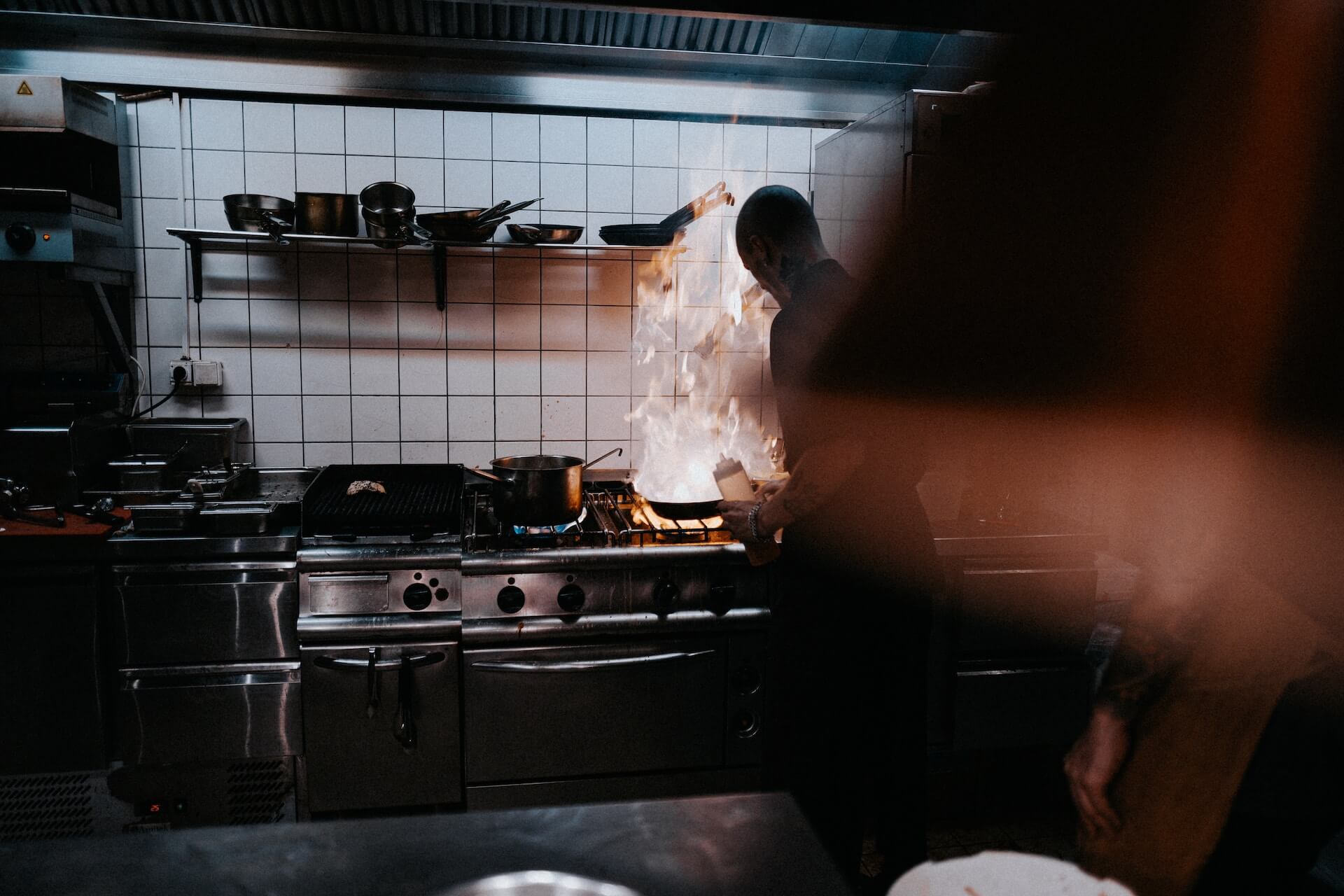
Chef handling flaming pan in commercial kitchen

Entering a professional kitchen might seem like a whole different realm with its own governing rules, and certainly its very own language.

“Clopen?” “All day?” “Behind?” “Covers?” “Deuce,” “dying on the pass”… If these terms sound foreign and made up to you, you’re not alone!

A busy kitchen can be a hot, intense, and stressful environment. Having a full-on conversation takes up valuable time when minutes and even seconds are the difference between a perfectly cooked plate of food and trash.

When actions need to be conveyed quickly and efficiently between two parties or a full team in a loud and fast-paced environment, slang develops out of necessity. Kitchens are no different, with their use of a creative and interesting lexicon.

New owners and operators opening their own concept may find many words and phrases they hear from the kitchen and servers strange at first. This is particularly true of owners and operators who may have little to no back-of-house or serving experience.

To lend a hand to hopeful operators or those opening their doors for the first time, let’s take a look at some of the more popular kitchen terms.

Operational & Equipment Terms

First, let’s take a look at the structural element of a restaurant and how they’re referred to.

Floor

The dining room (or whatever is deemed as guest seating in your establishment) is referred to as “the floor.” When someone asks, “who is on the floor tonight?”, they’re referring to the staff—usually servers—working the floor. Managers will walk the floor to check on guests and aid in service.

Note: The bar area, although it may have counter seating and its own tables, is referred to separately from the floor.

Low Boy

An under-counter refrigerator is called a “low boy” for its below-the-waist positioning, requiring cooks to bend down low to gather ingredients. This can include freezers as well. There are a variety of door configurations, including swinging, and drawer-style. Some even have salad tops where ingredients are kept in the top, under a lid.

Walk-In

A (very) large fridge or freezer, often constructed on site. It has a big swinging door that can be opened from both sides for safety reasons. The majority of raw ingredients—plus some prep and leftovers—are stored here. If you’re wondering where the word comes from, the clue is in the name: it’s so large, you can walk into it.

The walk-in is also notorious for being where restaurant staff go to scream some stress away, as the excellent insulation creates a nice sound barrier from guests.

Mise

The word “mise,” pronounced “meez,” is a slang term for “mise en place.” Mise en place is the French term for “having everything in its place” prior to service. Cooks use “mise” to refer to their own specific set of prepared ingredients, whether in terms of having it ready or not, or even worse, missing.

On the Line

The line, and the term “on the line,” refers to the area in the kitchen where the cooking equipment is located. Of course, this where chefs do most of the cooking during service. A typical line includes a walkway where the cooks work, and a flat table space—usually at the “window” or “pass” (see below)—where they plate, on the opposite side. Not surprisingly, that opposite side is referred to as the “plating area.”

If a concept requires it, there are separate “hot” lines where the hot cooking is done, and “cold” lines, where dishes that don’t require cooking are prepared. Deep fryers, ovens, and ranges are located in the former, and salad stations are located in the latter area. In classic French terms, the garde manger cook usually prepares most dishes on a cold line.

Pass / Window

The pass or window is the area opposite the cooking line where completed orders are placed for server pick-up. Think of passing dishes from the kitchen and you’ll understand this term immediately. Sometimes it will be referred to as a “window” in restaurants that have actual windows into the kitchen line from which food is passed to servers. The pass area is typically where the heat lamps are located, meant to keep dishes warm during a busy service.

The Rail / Board

The term “rail” or “board” refers to a strip of metal mounted to the food window that holds the food tickets (orders) from the kitchen printer in place. This keeps the flow organized and is normally overseen by the chef or line supervisor.

“Calling the board” means the person in charge reads out tickets as they come in, and directs cooking traffic to the other line cooks. Doing so helps to avoid disagreements and chaos in the kitchen. This position is reserved for the highest-ranking or most-talented cook, as it requires excellent cooking and communication skills. “Clear the board or rail” means completing all orders that have come in for the time being.

Chit / Ticket

When a server enters an order into the POS system, a chit or ticket, or even “dupe” (meaning “duplicate,” from the fact that some systems use three-color paper that prints a kitchen copy, a server copy, and an expo, bar, cold line, or pasty section copy), is printed to the kitchen. That ticket is then read aloud to the cooks before being placed in queue on the rail or board. When the food on the order is complete, the copy is marked in some fashion (stamp, marker, pen) and placed under the plate in the window. The server then picks up the food and the chit is “stabbed” on to a spike.

Don’t let spiked tickets fall out of the rail or all hell can break loose and derail a service!

Two-Top / Three-Top

Dining room tables are referred to as “tops” and are identified by how many guests they can accommodate (seats). A table with two chairs is a “two-top” or “deuce.” Tables with four or six chairs are “four-tops” and “six-tops,” respectively.

Covers

Each person who enters the restaurant is a cover: they “cover” one seat. The more covers, the busier a service will be, and vice versa. These numbers are used to project future numbers, staffing requirements, and inventory required. Covers are also a point of pride for kitchen staff. The more covers, the busier the service, and if you can navigate it with few mistakes, the adrenaline rush can directly convince yourself of your own talents.

Dead Plate

A dead plate is a dish of food that’s no longer worthy of the dining room. Sitting in the window too long, incorrect preparation, or even worse, being sent back by a guest results in a dead plate. Untouched dead plates are usually given to dish washing staff or porters; those sent back by guests are tossed in the bin.

Section

A section is how the floor is divided amongst serving staff. Typically, the more talented or senior staff get a bigger section. Designating sections, with all their tables in one close area, helps servers move efficiently during busy periods and keep close tabs on guests. Managers and floor captains will oversee a few or all sections and offer help to the individual servers during busy times or for large parties.

Server Alley

The front-of-house equivalent of the kitchen hot line. This is where everything servers need to do their jobs is located. Extra napkins, spare side plates, cutlery rolls, and cleaning supplies for clearing tables can all be found here. There are usually a few POS terminals here for entering orders.

Team & Guest Terms

These next few slang words are used to talk about certain people.

Expo

“Expo” is the shortened term for “expediter,” or the position of organizing, plating, and (in some cases) garnishing food at the pass. The main responsibility is to makes sure each dish is correct before the food runner or server brings it to the table. This role can be the liaison between front of house and back of house, allowing both teams to do their jobs without having to stop and coordinate.

Busser

Part of the porter team, the busser is the person who clears dishes from a table when guests leave, and drops them in the dish-washing area. The term refers to the bus bin or large plastic tub into which the bussers put all the dishes, flatware, glasses, and debris. They might also be tasked with wiping down tables and resetting them for new guests. Sometimes, the busser will pull double duty and also wash the dishes they bring back to the kitchen.

Trail / Stage

Note: In the foodservice world, “stage” is pronounced “staahj.”

A trail is essentially a training shift during which new team member will “trail” behind a cook or server. This provides the new hire the ability to learn, get comfortable with SOPs, and mitigates any potential mistakes. However, not all establishments have the staffing to offer this scenario and will train a new hire during live action.

A stage is a longer-term trail for a designated period of time. This can be a couple of weeks, a month or two, or an entire season at destination-style dining places, like Michelin-starred restaurants and hotels. The expectation is that this is a learning experience for the cook, who is exposed to new ingredients, recipes, and techniques. An agreed upon time frame is set and the cook trades labor for education.

A Personal Note on Stage

The short-term stage commitment includes the understanding that the restaurant won’t reward you monetarily. We all know the costs of training staff. Imagine investing all that effort and having that person leave after just a month or two.

Now, I despise the term “free labor” for the kitchen or benefiting restaurant. There’s a new argument that has been surfacing over the last few years that stages should be paid internships. I have two problems with this thought process.

One, these are often highly touted restaurants that operate at an elite level, and they’re extremely busy. Having a new body takes up valuable focus and resources from somebody in that kitchen. They are willing to work with you and share all their knowledge and experience.

Often times, there isn’t a chance in hell in getting a job there, and this can be the only way to get a chance at learning from these masters of the craft. Having gained valuable career experience from stages myself, they can be a great alternative if you can’t gain employment with the venues.

Two, those who raise these arguments have no experience in doing them; think they have learned nothing from the stages they may have done; had a bad experience overall; or really have no other alternatives to the points I just mentioned.

Hot tip: If you don’t like working for free, don’t! If you the value in stage, go for it!

Campers

This is a term for people who linger at their table well after they’ve finished and paid. While all guests are welcome to make themselves at home, the problem with campers is that they can take up valuable real estate during busy periods. This is the reason for table time caps at operations that run on the reservation system. They also prevent servers from “turning” tables to serve more guests and increase their tips.

Action Terms

These are some random terms that indicate actions and requests.

Fire

The process of finishing a dish. When an order is printed out, it may have courses such as appetizer, main, and dessert. All courses might be started and cooked to 80 percent completion and then held. The main wouldn’t be fired until after the appetizer. When the person in charge of the line says, “Fire table six mains,” that means finish cooking, plate the dishes, and send them to the pass.

All Day

A very quick way for a cook to request a tally of all the dishes ordered from their section. The line lead will provide totals of each dish, instead of reading out each table’s order. For example, a cook will ask for an all-day on fryers, and the lead will call back, “Six large fry, three medium fry, two poutine, and one chicken nugget.” The cook can quickly add up what they have cooking or need to prepare to fire.

Behind

As you can imagine, in a busy, happening kitchen, there are people racing in all directions in tight spaces. One quick way to avoid collisions around hot equipment and sharp objects is to yell “behind” when passing someone or a station of people. It gives them time to either move out of the way or stay in place to avoid catastrophe.

Other variations include “hot” to indicate hot pots or pans, or the potential of getting burnt. “Sharp” means a knife, and “corner” means coming around the corner. “Behind hot” and “hot, corner” are combinations which mean exactly what you think they mean.

Flash

To reheat a dish, or an item on a plate that sat under the heat lamp too long, or if a guest has requested something cooked further. Usually under a salamander, a convection oven, or a deep fryer for fried food. I’m sure for some establishments (I started out in places where this was the norm), “flashing” means “cooking” an item to well done via microwave.

Heard / Heard That

The acknowledgement that an order has been read by the person running the pass or the line and understood by all in the kitchen. Also works for a direct order to an individual.

In the Weeds

When one station is receiving the majority of the orders at any given time, or the dining room has filled up all at once and all the orders are coming in together, this can create a downward spiral between starting to cook and plating or finishing existing dishes. This is known as being “in the weeds.” The only way to survive is to put your head down and cook your way out. I’ve experienced surviving the weeds and having it ruin an entire service. It all depends on the resilience and talent of the cooks, servers, and leaders involved.

On the Fly

The request for something that is needed quickly. Perhaps the item was missed, dropped, or incorrect, and the rest of the dishes are at the table. Whatever is needed “on the fly” takes precedence over everything else or, worst-case scenario, gets shoehorned into orders coming up.

Stretch It

Kitchen lingo for getting as many portions out of something nearing its end as possible. For example, a saucepan only has enough for four steaks but five are needed. The sauce has completed cooking and the plates are waiting. So, the kitchen needs to “stretch it” and make it work or be down five plates of food.

Waxing a Table

This means giving a table special treatment. This person or these people could be VIPs, return guests, the owner’s family and friends, or an influential food writer. Whoever the are, they’ve been identified and are given a little extra attention by staff.

86

When a menu item has completely run out, the kitchen manager will say the item has been “86ed.” It’s important for the kitchen staff to communicate this to servers as soon as possible so that no more orders are placed for the item.

Family Meal

The pre-service meal enjoyed by all staff on premises. Usually made by the staff from leftovers as a way to showcase creativity and skill.

Comp

Referring to items removed from the bill for an error or because the guest didn’t like it. A comp also comes from waxing a table, of course. It’s important to track comped items for accounting purposes. Comps can be a great way to make guests happy in a pinch. However, owners, operators, executive chefs, and lead bartenders need to be aware of how often comps are being handed out; they can be indicative of quality-control problems or employee theft.

Clopen

This is a portmanteau of “close” and “open.” The dreaded weekend brunch shift comes to mind. Working a busy late Friday or Saturday service and having to come back in the following morning to sling eggs to hungover patrons is a difficult and thankless task. In short, a team member who works back-to-back closing and opening shifts is working a clopen.

FIFO

This stands for “first in, first out,” and references inventory organization, crucial for perishable items. The new items go behind the older ones so that the items that were there first get used first, ensuring freshness and quality. I once had a chef who decided that “FIFO” stood for “fit in, or f*ck off.”

These are just some of the slang terms in the culinary lexicon used to convey quick understanding when under fire. You might also hear differences in dialect between cultures and regions. I’ve worked in both Toronto and Montréal, and there are similarities and differences between terms used in Ontario and Québec, French and English, and English and South American Spanish.

So, next time you’re out dining and you hear one of these words or phrases, you might be able to figure out what’s going on behind the scenes. Tip well, be polite, and try something new!

Image: lasse bergqvist on Unsplash

KRG Hospitality menu development. Restaurant. Bar. Cafe. Lounge. Hotel. Resort. Food. Drinks.

by krghospitality krghospitality No Comments

Fire and Ice: Bring Your Teams Together

Fire and Ice: Bring Your Teams Together

by Jared Boller

Ice on fire inside of a Martini glass

If you want to elevate your concept you need to ensure the front- and back-of-house teams are working with each other, not against one another.

There’s nothing wrong with a healthy rivalry and competition, of course. But the key word there is “healthy.” Both teams are crucial to your success, even if they seem like polar opposites.

Analogies are one of the singular greatest educational selling points when you have a group of people in front of you. Not only do they help you get your point across, they also help you to make a topic relatable to the listening novice.

In hospitality there are numerous ways to use analogies as teaching tools. When it comes to mixology or bartending, I like to use fire and ice to represent the kitchen and the bar.

I take this approach because the bar (ice) is the friendly counterpart to the fast and furious kitchen (fire). If you follow my train of thought, you’ll see why I preferthis approach: ultimately, we’re speaking about temperature and its importance in both spaces.

Consider the art of crafting cocktails. You and your bar team should understand dilution and melting rates the same way you know how important temperatures are to steaks. Nine times out of ten, individuals at the table have a personal preference regarding the temperature of their steak.

Guests don’t hesitate to relay this information to the server. Next, the chef and their brigade uses fire and cooking times to ensure each state is cooked properly. Not only that, the mastery of their craft leads to each steak coming out at the same time, cooked to each guest’s preference.

This process is the same for the bar. Stirred, shaken, egg-white cocktails… Bartenders must master their craft to ensure they understand the different types and uses of ice (or no ice) when building drinks. Moreover, they need to use that knowledge to ensure each drink for a table or group comes out at the same time, with the appropriate level of coldness.

In the end, when drinks hit the pass or server’s station, we want drink orders to be delivered as quickly as possible because they’re on the clock. The ice in the drinks start to melt. Hot food begins to get cold. We’re fighting time.

Understanding temperatures and times relates directly to the guest experience. We can tell how well-oiled and skillful front- and back-of-house teams are by watching drinks and dishes hit tables.

Fire

According to Anthropologist Richard Wrangham, who wrote the book Catching fire: How Cooking Made Us Human, people started cooking over open fire more than two million years ago.

Wrangham states that cooking was first seen as “simply chunking a raw hunk of something into flames and watching it sizzle.” Modern chefs may not agree with this style but we are able to see that early human “cooks” came to a few realizations regarding their use of fire. Their food was healthier, tastier, and they may have had more revitalized immune systems.

Obviously, the evolution of modern cooking techniques have advanced through tools, techniques, and vessels over the years. However, regardless of how much innovation we introduce to our kitchens, we’re still using fire and heat to cook our food.

Unless they’re expecting a salad, sushi, or another amazing raw or cold food, guests anticipate their food will be hot or warm upon arriving in front of them. Great chefs take control of their kitchens, techniques, and tools. Their masters of temperature. They have a nearly supernatural understanding of timing.

It’s always a site to behold when someone is masterful in the kitchen. A seemingly endless number of pots and pans raging on burners. Infinite elements of dishes flowing in and out of ovens. Chaos to the novice’s eyes but in reality, flawlessly composed dishes arriving at perfect temperatures.

Ice

We can trace the use of ice in drinks as far back as ancient Egypt. Icy drinks are also well documented by first-century Roman society; emperors, it’s claimed, enjoyed “chilled” cocktails via glacier runoff extracted from the mountains.

Emperors, according to some historians, would store giant blocks of ice in cool cellars, garnishing their tipples with shards of ice. This was both a decadent display of their elite status, and evidence that humans have long appreciated a cold, refreshing drink.

It wasn’t until early 1800s Boston that humankind really began to master ice. A young entrepreneur, Frederic “The Ice King” Tudor, pursued an idea with his brother and launched the ice or frozen water trade. Over the course of just a few decades, the New England-based trade was able to ship ice worldwide.

The Wenham Lake Ice Company, established in the 1840s, harvested giant blocks from the eponymous lake and stored them in a network of ice houses, accessed by a small railroad system. Once a luxury, ice was on its way to going mainstream. Everyone was coming to the realization that drinks tasted better with a bit of dilution and colder temperatures.

Eventually, ice production led to ice harvesting innovations. For example, Clinebell machines that use cold plates to 300-pound, crystal-clear blocks. Along with being clear, the ice blocks are super dense to reduce dilution rates significantly. From glaciers to “harvesting” ice from lakes to full-on factory production, our obsession with ice has led to technological innovation.

Interestingly, however, early 19th century methods of ice extraction are once again in vogue. A cadre of passionate bartenders who view ice as a premium ingredient in and of itself are hand carving ice cubes, spheres, and spears for perfectly curated Negronis or Old-fashioneds.

Takeaway

The bottom line is, temperature is important to anyone working in hospitality. Kitchen and bar teams need to work together to create the best possible products.

Some people think of food or drinks when asked to consider the best restaurants and bars in the world. However, those are products. What sets the best concepts apart is the teams they’ve each built and nurtured.

It’s the passion of each team member and their consideration of the fine details that makes a restaurant or bar notable. So, when we think about fire and ice, we can consider this idea the ultimate geekery in regard to our profession.

Take it from me: When the front of the house and back of the house collaborate, then they’re in sync with one another and nail the small details, they transform first-time guests to repeat brand evangelists.

They may not understand why their experience was so incredible but they’ll become outspoken ambassadors.

Image: Alexander Startsev on Unsplash

KRG Hospitality Mixology Training with Jared Boller

by krghospitality krghospitality No Comments

Use this Powerful Communication Style

The Powerful Communication Style You Should Be Using

by Jennifer Radkey

Graffiti that reads, "It doesn't have to be so complicated"

There’s a powerful method of communication operators can learn to use that promotes workplace collaboration and solves problems.

How to communicate with team members is a topic that comes up regularly in my coaching sessions with restaurant, bar, and hotel owners. Most of the concerns center around how to speak to employees when they are not following company policy; their level of service is not meeting company standards; or the quality of their work has decreased.

These are legitimate concerns when you are attempting to not only run a successful business but foster a positive work culture in your establishment.

After coaching my clients through understanding what their current style of communication looks like and how it is or is not working for them, I introduce them to a style of communication that I feel leads to the most effective overall results: the use of declarative language.

The declarative language approach was first introduced to me through a positive parenting online conference I attended. Author Linda Murphy wrote the Declarative Language Handbook, which teaches parents, caregivers, educators, and others how to communicate with children (particularly those with social learning challenges) to feel competent, connected, and understood.

As I dove into learning about this style of communication, I realized just how powerful it would be in the workplace. It is a method that can promote respect, collaboration, and empowerment. It can also, in turn, remove judgment, assumptions, hostility, and blame.

What is Declarative Language?

To answer this question, I’ll need to take you back for a quick grammar lesson.

Sentences can be categorized under four main types: declarative, interrogative, imperative, and exclamatory.

Declarative sentences are statements. These can be a statement of a fact, an observation, or a feeling. For example: “It is raining out.” “I’m going to open a new bar next month.” “Pineapple should never be on pizza.”

Interrogative sentences ask a question: “Why are you late for your shift?” “How can I make a million dollars this quarter?” “Who ever thought it was a good idea to put pineapple on pizza?”

Imperative sentences give a command. “Go clean those tables.” “Follow me.” “Pick off the pineapple from that pizza.”

Exclamatory sentences show something that we would shout or emphasize with an exclamation mark: “I made a million dollars this quarter!” “Yikes!” “Pineapple on pizza is the best ever!”

Powerful Communication

So, now that you’ve had a grammar refresher, let’s take a look at how declarative language can be a powerful method for communicating, and why the other styles may not be creating the results you want to see.

As an owner or manager, you may often find yourself falling into the use of interrogative and imperative statements. The problem with this is that both styles can stir up negative emotions in the person on the receiving end.

Interrogative statements (questions) tend to incite the fight, flight, or freeze mode. People feel put on the spot and may become defensive or anxious.

Imperative statements (commands) tend to be authoritarian in nature and have the potential to create fear and/or resentment. Employees are looking for team leaders who they can respect and turn to for guidance, not someone who is constantly telling them what to do.

Declarative language, when used to state observations, can be a way to open up discussions without defensiveness or fear. It also leaves room for facts instead of assumptions. The declarative language approach that I suggest my clients use looks something like this:

  • Make an observation statement.
  • Be silent.
  • Actively listen.
  • Collaborate.
  • Actively listen.
  • Proactively decide on solutions.
  • Gratitude/Positivity.

The easiest way to demonstrate this practice is through an example or two. First, we’ll look at an example with “Sam.”

Example #1

Sam just showed up for his shift at the quick-service restaurant he works at out of uniform. His manager notices and approaches him. The declarative language approach would look something like the example below.

Manager: Hey Sam, I notice that you aren’t wearing your uniform. (Declarative observation that quietly gives time for Sam to respond.)

Sam: Yeah, sorry, I spilled coffee all down the front of my shirt on the way here and didn’t have time to go home to change.

Manager: Okay, I understand, life happens. Any ideas on how we can resolve this? (Puts power to solve the problem in Sam’s hands.)

Sam: Do you have an extra shirt I can borrow for today’s shift?

Manager: Yeah, I actually do. Great plan. Let me go grab it for you and you can use the staff washroom to get changed.

Sam: Thanks.

Manager: No problem. Have a great shift! See you out there.

As you can see from this exchange, the manager did not make any assumptions as to why Sam wasn’t in uniform. Instead, they demonstrated empathy and respect. By asking if Sam had any ideas for resolving the issue, the manager provided room for collaboration as a team. Further, this approach empowered Sam to take responsibility and come up with the solution.

Example #2

Now, let’s look at “Lisa.”

Lisa is typically very punctual for her shift working concierge at a hotel. However, the past two weeks she has been regularly showing up 10 to 15 minutes late. Below, how the owner of the hotel would use the declarative language approach to discuss this issue with Lisa.

Owner: Hi Lisa, I’ve noticed that you have been starting your shift 10 to 15 mins late the past couple of weeks. You aren’t typically late for work. I’m curious about what’s changed. (Declarative observation; the owner then waits quietly for Lisa to respond.)

Lisa: I’m so sorry, I had to switch my child’s daycare and it’s on the other side of town. I’m struggling making it here on time with traffic.

Owner: That sounds stressful. What do you think we can do to work with this change to ensure that you can still arrive on time for your shifts?

Lisa: Would it be possible to switch my shift to a later time?

Owner: Let me look into that option for you. You are an asset to our team and I’m sure we will find a solution to this. I’ll get back to you later with some options, and you can let me know what would work best.

Lisa: Thank you so much for understanding.

In this exchange, the owner does not make assumptions as to why Lisa has been late. Rather, they show genuine curiosity as to what’s going on. Again, the owner empathizes with Lisa’s situation and then places power back into Lisa’s hands to think of a solution. The conversation ends on a positive note with gained clarity, respect, and appreciation.

Lead by Example

If you are looking to build a team of empowered individuals who can solve problems and collaborate, you need to lead by example. The use of declarative language can help you accomplish exactly that.

However, it is crucial to note that if you decide to try this method of communication, your intention needs to be positive. Declarative statements will not be as successful if your tone is sarcastic or accusing. Your approach must be casual, caring, respectful, and matter of fact.

Additionally, not every conversation will go smoothly using this method. You may receive “I don’t know” or “I’m not sure” as an answer. But for the most part, this method of communication allows for respectful discussion that acknowledges facts, promotes responsibility for one’s own actions, and decreases assumptions.

If you would like more information on how to use the declarative language approach, or would like to set up a coaching session to be coached on how to use this communication style with your team, please reach out to me!

Cheers to professional and personal well-being!

Image: Jon Tyson on Unsplash

KRG Hospitality Mindset Coaching, 2023 Icon

by krghospitality krghospitality No Comments

Consultant Versus Coach

Consultant vs. Coach: Similarities and Differences

by Jennifer Radkey

Double arrow, street ends sign

At some point in your journey as a business owner it’s inevitable that you’ll come up against a challenge that you struggle to overcome on your own; you may need to reach out for advice or guidance.

There are countless reasons why you may seek an expert’s help. Perhaps you’ve come up against a roadblock trying to reach a goal. Maybe you’re unexpectedly forced into a major transition. You may decide you’re ready to take your business to the next level but are unsure how to proceed.

The situation you find yourself in could be as big as the opening of a new restaurant or bar, or as vague as a general sense of something not being “right.”

Whatever the reason may be, you’ve exhausted your own pool of resources and are ready to seek outside help. So, who do you turn to?

Most likely you’ll be looking to hire either a consultant or a coach. Of course, this begs the question: Which do you choose?

I’m both the vice president of KRG Hospitality and a certified life coach. My husband Doug Radkey is the president of KRG Hospitality and our agency’s lead consultant. “Do I need a consultant or coach” is a question people ask of us quite often.

The answer is simple once you understand the similarities and differences between the two.

Similarities

Coaches and consultants are both third parties who provide an outsider’s clarity while maintaining an unbiased point of view.

They’re both knowledgeable and have their own unique approaches and expertise. Coaches and consultants come with the intention of helping you achieve your goals. While the majority of coaching and consulting is done one-on-one, team consulting and coaching are also options.

The differences between coaching and consulting can be found in the approaches used to help you achieve your goals.

Differences

The easiest way to learn the differences between a coach and a consultant is to take a closer look at how each one approaches how they help you. It’s an understanding of these differences that provide the clarity needed for you to choose the best solution.

Consultants

Consultants are industry-specific experts. When presented with a challenge you want to overcome or a goal you want to achieve, a consultant finds the solution using their knowledge and experience. They also diagnose any problems that are evident in your business and then make recommendations to correct them.

A consultant is someone you can turn to for technical and professional advice.

Once the consultant has determined the root of the problem or determined the best path forward to achieve your goal, the answers will be provided to you. And along with the answers come the steps necessary to solve the problem or reach the goal. You’ll be given a clear, detailed plan.

Consultants listen carefully to what’s going on. They ask specific questions, watch how your team interacts with your guests, and study your steps of service. Additionally, consultants analyze data and conduct research, and then communicate their findings clearly with you. Again, consultants give you the tools you need to execute a plan—including processes and proven methods—to achieve success.

If you’re in need of specific industry advice and expertise, a consultant is who you need to hire.

Coaches

Coaches are experts in placing the power in your hands to discover your own solutions and answers. You hire a coach to discover yourself, inspire confidence, explore possibilities, and find your own clarity. Entrepreneurs turn to coaches to help them transform into great leaders.

Through sincere and thoughtful inquiry, coaches will pull answers out of you that you didn’t know that you already had. They’ll also help you become aware of self-imposed limitations so you can overcome them. Rather than just giving you a plan, coaches help you develop your own strategies for uncovering your truth, and then help you understand how to move forward.

Coaches are sounding boards for discussing both personal and professional issues, providing a safe, judgment-free place for you to be heard. They’re interested in long-term results and the overall well-being of their client.

If you’re looking for overall growth and a better understanding of how you can reach your own goals and potential, a coach is who you need to hire.

Hiring a consultant or a coach is a positive step towards achieving both short-term and long-term goals. Knowing the difference between the two now empowers you to choose the best person to help you where you want to go.

Cheers to personal and professional growth!

Image: Robert Linder on Unsplash

KRG Hospitality Mindset Coaching, 2023 Icon

by krghospitality krghospitality No Comments

Kitchen Doctrine: The Culinary Holy Trinity Across Cuisines

To some, the Holy Trinity refers to the Christian doctrine of the Father, the Son, and the Holy Spirit. But what’s the Cajun Holy Trinity?

Well, that’s a whole different story with which some people may not be as familiar. However, it carries equal weight in certain kitchens of the world.

Lending its name from religious credo, the Cajun Holy Trinity was developed in the state of Louisiana in the southern United States. Chef Paul Prudhomme gets the credit for introducing the term in 1981, along its popularization.

Cajun or Creole cuisine evolved from French, Spanish, and West African immigrants. French traditions blended into a melting pot of West African, Spanish, and Native American cuisines. The French and the Acadians (French colonists deported from Acadia in what is now Nova Scotia, Canada) both influenced Louisiana’s cuisine. The Acadians became known as Cajuns to English speakers, and thus Cajun cooking grew out of necessity in Louisiana.

It’s incredible what three (and sometimes just one or two more) simple ingredients can do to create incredible dishes.

by Nathen Dubé

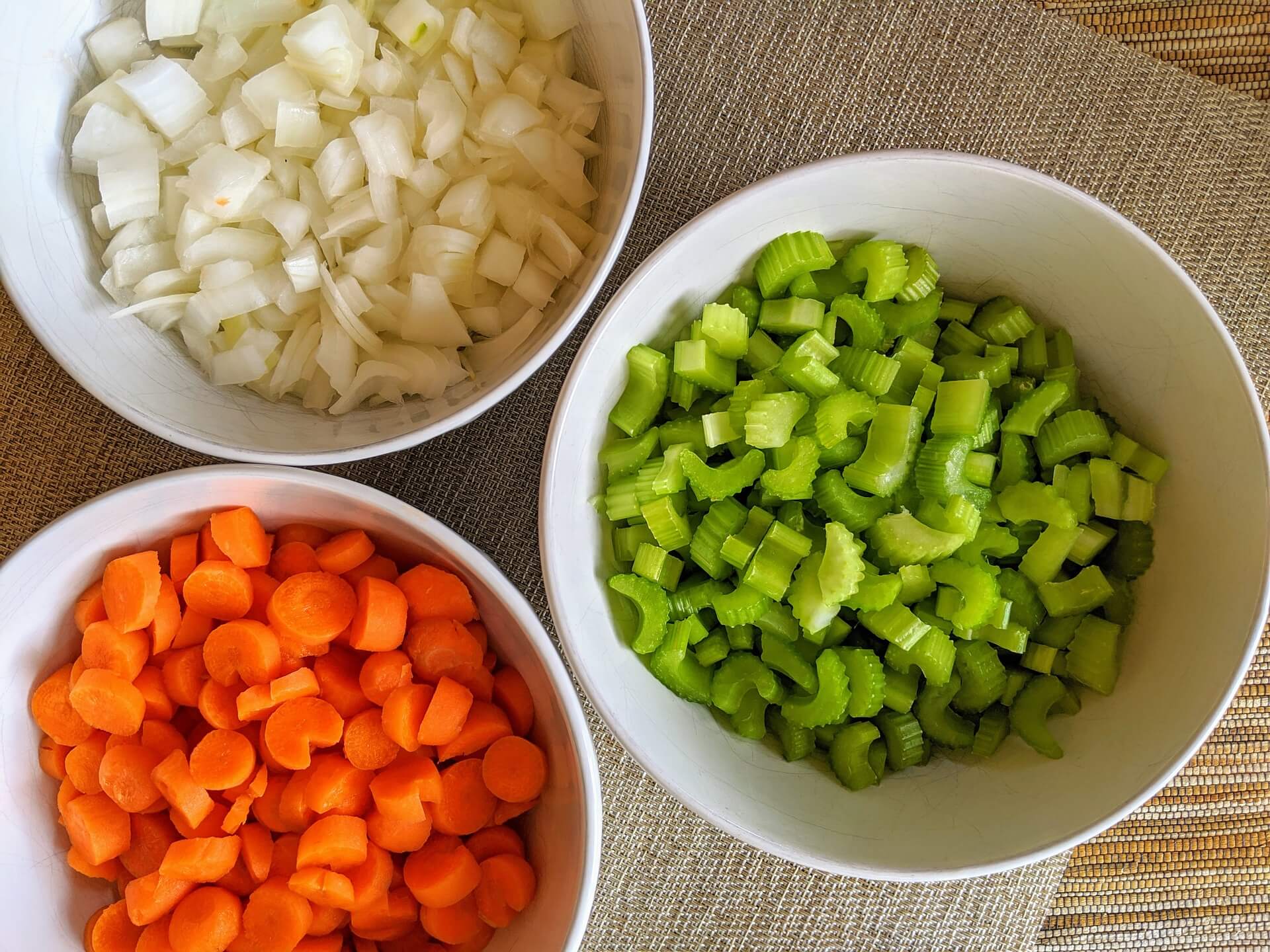
Carrots, celery and onions

Understanding the Culinary Holy Trinity

Mirepoix 101

The French contributed two staples directly to Cajun and Creole cooking: roux-based cooking and the trinity of mirepoix, or onions, celery, and carrots. In Louisiana, however, carrots didn’t grow as easily as bell peppers. So, bell peppers, typically the more bitter green version, replaced them.

Some cooks were so bold as to add garlic to the Holy Trinity, referring to it as the Pope. Other variants use garlic, parsley, or shallots in addition to the three Trinity ingredients. Unlike the elaborate French dishes using mirepoix, the Holy Trinity is more symbolic of rustic, family-style meals.

These ingredients are the first to go into the pot or skillet, creating a flavorful foundation for gumbo, jambalaya, crawfish étouffée, and more. Often, by adding a bit of flour and whisking, a roux is built right on top of these sweet and colorful aromatics to form a thicker base.

The ratio is also overturned from the traditional mirepoix of two parts onion, one part celery, one part carrot, with three parts onions to two parts celery to one part bell pepper.

Practical Application

So, now that we know what it is, how do we use it?

First, the ingredients are finely diced, then sauteed in oil, fat, or butter until translucent and tender. This stage of cooking draws the water from the vegetables, concentrating their natural flavors.

You can continue cooking the ingredients down until they’re caramelized, which is to say the sugars come out and brown them in the pan. They’ll become easy to break down with the back of a spoon. There’s a further concentration of flavors but we’re approaching the law of diminishing returns.

The shorter the cooking time of the end dish, the smaller size the pieces should be. For longer times, they can be cut into larger pieces. For obvious reasons, we want our ingredients to cook evenly, as well as withstand the timeframe of the cooking. You don’t want minced vegetables in a stock that’s going to simmer for 10 hours, the same way we don’t want giant chunks in a soup that’s done in 30 minutes. Texture of the end product are also important, not just flavor.

Here are examples of some recipes that include the Cajun Holy Trinity:

  • Chicken and Sausage Jambalaya
  • Cajun Gumbo with Andouille Sausage
  • Chicken and Okra Gumbo

Looking at other cuisines of the world, we’ll find some interesting variations. Interestingly, however, we’ll find similarities in the use of a category of vegetables and herbs called “aromatics.” In the Western world, these are vegetables like garlic, onions, carrots, celery, and herbs like bay leaves, thyme, parsley, and peppercorns.

In Asia you’ll find green onions, ginger, garlic, and warming spices like cinnamon and clove. These mixes are usually sautéed to slowly draw out flavors that can carry a dish. Sofrito and its Italian counterpart, soffritto, literally mean to stir-fry.

French Cuisine

The term mirepoix is encountered regularly in French culinary texts by the 19th century.

In 1814, Antoine Beauvillier wrote a recipe for Sauce à la Mirepoix in his book L’Art du Cuisinier. It’s a short recipe for a buttery, wine-laced stock garnished with an aromatic mixture of carrots, onions, and a bouquet garni. Marie-Antoine Carême created a similar recipe in 1816, calling it simply “Mire-poix.”

The origins are cloudy but what’s clear is the basic mirepoix ratio: two parts onions, one part celery, one part carrots by weight. These vegetables are often finely chopped and sautéed, but they can be used whole or roughly chopped in slowly simmered stocks or braises. A simple ratio for bones to mirepoix for a stock is 10:1.

When chopping, be particular about uniformity. This ensures even cooking when sweating or deeply browning them for a heartier flavor.

If cooking further, the addition of tomato purée creates a mixture called pinçage, which smells incredibly rich and transforms a braise into a near-religious experience. The addition of some chopped thyme and rosemary elevates further.

Another alternative is the mirepoix au gras (“with fat”): the addition of diced ham or pork belly.

Hands down, however, the most famous example of the power of French mirepoix is the humble chicken soup. It capitalizes on the aromatic qualities and depth of the caramelized vegetables. Similar combinations—both in and out of the French culinary repertoire—can include leeks, parsnips, garlic, tomatoes, shallots, mushrooms, bell peppers, chilies, and ginger.

White mirepoix (which substitutes leeks and parsnips for the onions and carrots) is used when you want a white color in the final dish. It might be a stretch to include the French duxelles (mushrooms and often onion or shallot and herbs, reduced to a paste), but leave no stone unturned, I say.

Mirepoix Recipes to Try

  • Roasted meats, like turkey
  • Chicken Noodle Soup
  • Braised Short Ribs
  • Vegetable soups

Italian Soffritto

Referred to as battuto before it’s cooked, soffritto is the combination of onions, celery, carrots, garlic, and parsley, although there are quite a few variations on this mixture. Soffritto can also include bell peppers, fennel, and finely diced cured meats like pancetta or prosciutto.

There’s no set ratio for the ingredients. This combination forms the foundation for soups like minestrone, the base for pasta sauces such as ragù, stews, and braises throughout Italian cuisine.

While both mirepoix and soffritto serve as building blocks of flavor, there are a few subtle differences.

Mirepoix is made by sweating onions, celery, and carrots. Soffritto uses minced rather than diced vegetables. And, indicative of Italy, the use of olive oil trumps butter in the cooking process.

Soffritto recipes to try

  • Ragú Bolognese
  • Italian Wedding Soup
  • Pasta e Fagioli (Pasta and Bean Soup)
  • Braised Sausage, and Kale with Rosemary

Spanish Sofrito

While saffron and seafood are the clear stars of the classic paella, it’s sofrito—the mixture of onion, garlic, bell peppers, and tomatoes (sometimes paprika) cooked in olive oil—that sets the stage. Although it may seem ludicrous, the removal of the sofrito and not the prime seafood on top would do more damage to the final dish.

This is where we begin to see the introduction of the New World. After the 16th century, Catalonia in particular “discovered” the tomato and began using it in everything. Bell peppers, onions, and garlic are the other ingredients that make up sofrito.

The medieval recipe book Libre de Sent Sovi shows that Catalan cuisine historically used native ingredients to make sofregit. Most Old World-style dishes call for onions, leeks, carrots, and salt pork, in place of the yet to be discovered tomato, so the sofritos of the 1300s can be interpreted loosely.

From the Mexican American border to the tip of Argentina, and all of the islands in between, Latin America has taken the Spanish sofrito and adapted it to its local offerings. Cuban sofrito tends to look the closest to Chef Prudhomme’s Holy Trinity, but with more garlic, while the Ecuadorian version includes freshly toasted cumin, tomatoes, onions, garlic, and sweet cubanelle peppers.

Sofrito recipes to try

  • Seafood Paella
  • Spanish Beef Stew with Pimentón and Piquillo Peppers
  • Spanish Chickpea and Spinach Stew
  • Nicaraguan Arroz con Pollo

Puerto Rican Sofrito

In Puerto Rico, many dishes start with recaíto, the perfumed flavor of culantro, ají dulce, onions, cubanelle peppers, and garlic. Often referred to as “blessed thistle,” the long, jagged-edged, leafy culantro has a similar taste to cilantro.

For this Caribbean island’s sofrito, known as recaíto, culantro leaves are minced and added to ajíes dulces, small but essential chilies in Puerto Rican cuisine. Add onions, cubanelles, garlic, and cilantro, and you have a mild, bright-green paste that adds a fresh, herbal punch to stews and rice dishes.

In the Caribbean, sofrito refers to a wide variety of mixtures; one common type includes lard colored with annatto seeds and mixed with ingredients like chiles, bell peppers, onion, cilantro, oregano, and ham. You can find variations on this sofrito throughout Central and South America.

Suppengrün

In case the umlaut didn’t give it away, the German answer to mirepoix—suppengrün—translates to “soup greens.” The Dutch equivalent is soepgroente.

Suppengrün typically consists of carrots, celery root, and leeks in no set ratio. Sometimes onions, parsnips, and potatoes are added. It may also contain parsley, thyme, celery leaves, rutabaga (a.k.a. swede), or parsley root.

The mix depends on regional traditions. Vegetables used are cold-climate roots and bulbs with long shelf lives. Suppengrün acts like herbs and imparts hearty, strong flavors to the soup or sauce, providing a foil for other strong-tasting ingredients such as dried peas and beans, or pot roast.

Large chunks of vegetables can be slow cooked to make rich soups and stocks, and are discarded when they have given up most of their flavor. Finely chopped suppengrün are browned in fat and create the base for a finished sauce. The vegetables may be cooked long enough to fall apart and become part of the sauce or pureed.

Suppengrün recipes to try

  • Beef Sauerbraten with Red Cabbage and Pretzel Dumplings

Włoszczyzna

From Poland, włoszczyzna is similar to its German counterpart but with red cabbage as the main ingredient.

Włoszczyzna is the Polish word for “soup vegetables” or greens. The literal translation is “Italian stuff,” stemming from Queen Bona Sforza d’Aragona—who was Italian—who married Polish King Sigismund I the Old in 1518. The queen no doubt brought her own cooks to the Polish court and introduced this concept to Polish cuisine.

A włoszczyzna may consist of carrots, parsnips or parsley root, celery root or celeriac, leeks, and savoy or white cabbage leaves. Sometimes, cooks also use celery leaves and flat-leaf parsley. Bay leaves and allspice grains are found in certain iterations.

The most typical packaged combination is celery root, parsley root, carrots, and leeks. Włoszczyzna is usually cut to uniform size and boiled as a flavor base for soups and stews.

Włoszczyzna recipes to try

  • Pork, Cabbage, and Potato
  • Barszcz (traditional Polish borscht)

Other Variations from Around the World

The Ukrainian or Russian smazhennya or zazharka consists of onion, carrot, and beets (and sometimes celery).

Refogado is the Portuguese base is made from onions, olive oil, minced garlic, and bay leaf. There’s a variation with tomato paste instead of fresh tomato influenced by the Eastern Mediterranean and Balkans regions.

Chinese/Cantonese cooking uses a base of scallions, ginger, and garlic. In Sichuan cooking you’ll often find a mixture of chili peppers, Sichuan peppercorns, and white pepper.

The amount of varied flavors and spices in Indian cuisine is incredibly vast and can differ from neighbor to neighbor. However, many of these dishes begin with basic mixture of garlic, ginger, and onion.

West African cuisine is another example of a huge amount of variety, but one common flavor base is the trio of tomatoes, onions, and spicy chiles.

The Haitian Epis has African origins with similarities to sofrito which is used in Hispanic cuisine. Parsley, scallions, garlic, citrus juice, and Scotch bonnet peppers are combined to create this base. Haitian Epis is used for finishing sauces, marinating meat and fish, and flavoring rice and bean dishes, as well as soups, and stews.

Hopefully you’re now inspired to try out a new combination or two, or even make up your own Holy Trinity. The possibilities are literally endless. But first, you owe it to yourself to learn a new Cajun recipe, starting with Chef Prudhomme’s Holy Trinity.

Image: Cindy from Pixabay

Related Reading

Work with Us

Click the image below to work with us on your restaurant concept.

Client Intake Form - KRG Hospitality

by krghospitality krghospitality No Comments

Loneliness and the Entrepreneur

5 Steps Entrepreneurs can take to Combat Loneliness

by Jennifer Radkey

Empty road leading off to the horizon

Author John Donne may have penned the quote, “No man is an island,” in the 17th century but, like many truths of human nature, it’s still relevant today.

We’re all attached to each other in some way; our humanity is intertwined. It’s when we lose sight of this that we may start to feel lonely. We may also feel as though we’re in isolation from the world around us.

Entrepreneurs often walk a lonely road. The success of your business relies on the effort you put into it daily. With a drive to succeed and a passion for what you are doing, it can often be hard to separate life as an entrepreneur from anything else.

There can be a level of pride in the entrepreneur’s journey that makes it challenging to acknowledge that there’s genuine struggle. When society paints a rosy picture of the life of the entrepreneur—setting your own schedule, doing what you love, earning your own riches, etc.—it can feel as if you aren’t doing something “right” when you’re running a successful business yet feel stress, loneliness, and gloom.

Being an entrepreneur has its perks and many would tell you they can’t imagine doing anything other than running their own business. However, this doesn’t mean that the path is easy or without its risks of social isolation, anxiety, burnout, and depression.

It’s time that we acknowledge all aspects of being an entrepreneur—the good, the bad, and the ugly—to peel back the façade of perfection. We need to allow space for honesty, connection, and self-care.

Below are five steps entrepreneurs can take to combat loneliness as an entrepreneur.

1. Find like-minded individuals who can relate.

Often, entrepreneurs may feel as if no one else understands them, no matter how well-meaning or supportive friends and family may be.

Connect with people who you can be honest with and who will listen with little judgement. This can be through a social group that connects entrepreneurs not for the purpose of business growth and networking, but to build friendships and share stories.

If a group like this does not exist, consider starting one yourself.

2. Practice mindfulness with your external relationships.

 Share with loved ones when you’re feeling particularly disconnected or stressed. They may not understand life as an entrepreneur, but they have your best interest at heart and can help you find balance between your work life and personal life.

Finding time to spend with the people who care for you as a whole person is important. Doing so can remind you to acknowledge and respect all the different sides of who you are, not just the entrepreneur side.

3. Learn how to be in a healthy relationship with yourself.

Acknowledge when you need social time. Recognize when you’re not getting enough sleep. Take time to enjoy hobbies or participate in physical activity. Take time to appreciate your accomplishments and feel proud of what you achieve.

Try journaling or participating in the things you loved doing before you became an entrepreneur to create connections and feel less alone.

4. Share the burden.

As an entrepreneur you often quietly place a tremendous amount of responsibility onto your shoulders. This can lead to feeling entirely on your own—even if you have a team surrounding you.

Learn to place trust in your team and to release some of those responsibilities to others. If you are a solopreneur, perhaps look to other professionals to whom you can outsource some of your tasks ( virtual assistant, social marketer, etc.).

5. Seek professional help if needed.

If you feel alone in the process and don’t have anyone you feel you can speak to, consider seeking a professional to help.

Consider hiring a professional life coach If you’re looking to create stronger social connections; need help with work/life balance or stress management; or wish to manage external relationships better.

If you suspect a mental illness, such as an anxiety disorder or depression, reach out to a registered therapist. There’s no shame in asking for help if it means living a well-rounded life that’s successful not only professionally but personally.

Entrepreneurs are masters of paving the way for their visions to come to life. However, the road they pave doesn’t need to be a lonely one. Applying the same drive to your personal well-being as to the success of your business will only have positive outcomes!

Cheers to your personal and professional growth!

Image: Gustavo Zambelli on Unsplash

by krghospitality krghospitality No Comments

Empower Your Team to Make Decisions

Do You Empower Your Team to Make Decisions?

by Kim Richardson

Chess pieces on chess board in grayscale

Empowerment is about so much more than trusting someone to follow clearly defined rules; you must learn to trust your team’s judgement.

Yes, even when things don’t go according to plan. If you’re only training your team on the “rules,” you’re doing a disservice to them and yourself. So, let’s have a little chat about empowerment. What does it mean to you? What are your expectations of your team when you tell them they are empowered?

Looking back throughout your own work history, have you ever had a job where your boss told you that you were empowered to make decisions, but you didn’t actually know what to do or how to make decisions? Did anyone ever explain “the how” of decision making to you?

Now, look at yourself as a leader. Have you ever had employees that you’ve told are empowered to make decisions, yet they get a manager every time someone needs something out of the ordinary? Are you explaining to your staff “the how” of decision making, along with your expectations?

It’s frustrating to feel like the house might fall down when you’re not in it. That’s no way to operate a business. We all want our staff to be able to make educated decisions when we’re not around. We shouldn’t have to hold their hands and be part of every single decision.

Still, there are times when, left to their own devices, a team member doesn’t make the decision you’d want them to make. This makes owners and leadership team members feel as though they must be at work every second.

So, how do you move away from micromanagement and learn to trust your team’s decision making?

Leverage Teachable Moments

You’ll never be able to give an example of every possible situation that may arise. Therefore, you’ll never be able to train your team on everything that they’ll encounter on any shift.

How do you tell someone how to handle situations when you’re not around? You don’t, and I don’t suggest you even try. Instead, you need to instill a sense of empowerment in your team.

However, “empowerment” is just a word if you’re not educating your team. You need to teach staff how to make good decisions. And how do you even start to do that? Cash in on all the teachable moments that happen throughout the day!

Once upon a time we were all new to this industry. I’m sure you have a few stories of some mistakes you’ve made along the way. I know I certainly do.

Think back to those situations. Did someone explain to you why you made a mistake? More importantly, did they then help you understand what to do next time? Or did they just get mad and make you feel like a failure?

I’ve had the privilege of working with some amazing people over the years. There are several people that really put effort into teaching me. The different things they taught me helped me to understand the ins and outs of decision making, even in situations I know very little about.

Example 1: The Restaurant

For my first job ever, I was a hostess at an Italian restaurant and pizzeria. During the training process I was told to rotate sections when seating tables. That’s easy enough, right? Well…maybe not.

Sometimes I’d see exceptions to this rule. The same section would get sat twice in a row, for example. I watched exceptions to “the rule” get made with no clue as to why.

One day, I sat the same section twice in a row. I don’t remember why, but I do remember the server’s reaction.

Right after seating the second party in the server’s section she let me know how annoyed she was by my decision. Now, I knew I messed up immediately—she let me know. But I didn’t know why it wasn’t okay that I had double-sat her this time.

All I knew is there was a rule I was expected to follow…unless I wasn’t supposed to follow it. Sometimes it was okay to disregard the rule, sometimes not. The rule wasn’t clarified before I began my role as a hostess, it wasn’t explained during training, and it wasn’t explained in the moment I “broke” the rule.

At some point it was explained to me that there were several factors that influenced the “double-seating rule.” For instance, you might skip a section in the rotation if they were just sat a big party. You might double-seat someone if they were regulars, family or friends and the server was able to accommodate an additional table. Of course, there were several other factors that could come into play.

The biggest issue is that none of that was explained to me during training. Moreover, I was left to figure out the nuances of seating on my own.

Example 2: The Hotel Sales Office

I worked at a hotel in the sales office for my first job out of college handling group room blocks.

The contracts I sent out to clients had cutoff dates 30 days prior to the event. Again, sounds pretty simple, doesn’t it?

One day a bride emailed me asking if she could extend the cutoff date. The cutoff date fell on a holiday weekend and she was concerned that people might not have time to book their rooms. I wrote her back and very politely told her no. So she reached out to my boss, Jill, who told her yes.

And then I got called into Jill’s office.

I remember that conversation like it was yesterday. Jill was very nice about the situation and explained that it was okay to make exceptions for people sometimes. Sometime later, I extended a cutoff date for another group. Should be an acceptable exception, right?

Nope. I got my hand slapped on that one. There was a citywide event going on over those dates. The hotel was fully sold out and turning away business. In this circumstance, it was actually a huge problem to extend the cutoff date.

Great—here we go again with a rule that exists in a gray area, and no one explained its nuances. As it turns out, there are factors that go into extending a cutoff date, such as how many rooms the group has already picked up; how busy the hotel is over the dates of their room block; and the relationship you have with the client.

I don’t know if anyone ever flat out explained these gray areas to me. Instead, I was left to figure out the nuances through trial and error.

Example 3: The Dish Tub Incident

At that same hotel several years later I started handling banquet events. One day, a client told me their registration desk needed dish tubs lined with cloth napkins. I threw it on the banquet event order.

Well, I happened to work at a Five Diamond hotel. Dish tubs with napkins sitting out in view of the public? That’s not how we did things. Enter: Bruce the Banquet Manager.

No detail, however small, escaped Bruce. Referring to the dish tubs and napkins, Bruce asked me why they were necessary. I actually had no idea what the client wanted with the tubs and napkins. So, I reached out to the client.

Turns out all she needed was a way to store welcome packets for event attendees. These days, we just put up a QR code and call it good. Once I let Bruce know what the containers were actually for, he understood. However, we weren’t about to load unsightly dish tubs with welcome packets. Instead, we found something more aesthetically pleasing and in line with our level of service.

I spoke about the Dish Tub Incident with Jill. To her credit, she helped me understand that people who are planning meetings so frequently are sending standard specs. Sometimes there would be a request on a BEO that wouldn’t make sense for the venue. Crucially, she taught me that if I ever saw something that didn’t make sense I needed to ask questions.

Truthfully, I don’t remember if it was that conversation or another but Jill taught me one of the best lessons: Ask the client what goal they’re trying to achieve. By understanding their goals we could provide solutions that made sense for us and honored their wishes. Additionally, we’d deliver the excellent service they had come to expect.

Example 4: The Hotel Cafeteria

Let’s take a little break from talking about my mistakes and talk about somebody else’s.

Many years later, I was working at another hotel. One day, I went to the cafeteria and the fruit bowls had Asian pears in them. I love Asian pears, so I was really excited about those bowls.

Now, those particular pears were probably a day away from being spoiled. I went to the cafeteria the next week and there were the Asian pears again! This time, they were perfectly fresh, crisp pears.

Well, I certainly enjoyed that. You want to know who didn’t enjoy that? The executive chef!

As it turns out, Chef sent the pears that were about to go bad to the cafeteria because they were leftovers from something else. He didn’t want them to go to waste. But the fresh, crisp pears that were out the following week? Those were a different story.

There was a kitchen team member who saw the Asian pears go down the week before. When he was setting up the cafeteria the following week he threw some in the fruit bowl. No one had told him that Asian pears are expensive. Also, no one had told him the pears were just going down to the cafeteria because they were close to spoiling. They’re not typically the type of thing set out in the employee cafeteria.

While I would never expect Chef to stop and explain every single decision he’s making, it’s the perfect example of seeing one of your superiors doing something and thinking you’re supposed to do the same.

Leaders Teach

When I look back on some of the mistakes I made, they seem pretty obvious with many years of hindsight.

The solutions to unexpected situations are common knowledge to me now. If you also have some years in this industry, they’re likely common knowledge to you.

And that’s my point.

I was young. I was inexperienced. People didn’t always tell me the things they had learned that were common knowledge to them. So, they also didn’t share their expectations with me.

I can only assume that you have people on your team that are young and inexperienced. As seasoned hospitality professionals, we all make decisions every day that can be teaching moments. These moments are part of the learning experience. Using them to shape your team will help your business run better.

Have you implemented an onboarding process? Do you have a detailed employee manual? Do you have actual systems in place? If so, great—you’re ahead of the curve.

But do you think that you’re training new and existing employees on every situation that will ever pop up during their shifts? Really, that’s impossible. Instead, be on the lookout for teachable moments. Put people on your leadership and empower them to do the same.

In turn, they’ll help empower your staff to make the “right” decisions for your business. And importantly, they’ll feel empowered to learn from mistakes so they don’t repeat them. Over time, and it won’t take long, you and your leadership team will be able to step away and work on other parts of the business. In fact, you’ll find that you can step away from the business from time to time.

People are going to make mistakes. That includes you. Don’t let these teachable opportunities go to waste.

Image: Hassan Pasha on Unsplash

KRG Hospitality. Boutique Hotels. Resorts. Properties. Consultant. Feasibility Study. Business Plan

by krghospitality krghospitality No Comments

KRG Hospitality now Serving Midwest Region

KRG Hospitality adds Midwest Region

Marina City Towers in Chicago, Illinois

KRG HOSPITALITY NOW SERVING MIDWEST REGION

Toronto-based hospitality industry consulting firm with offices throughout Canada and the USA now serving the Midwest through Chicago office.

CHICAGO, IL (March 17, 2023)—Today, KRG Hospitality announces the addition of the Midwest region of the US to their North American service area. The team will operate out of an office in Chicago, Illinois. However, the agency will serve Midwest markets outside of Chicago as well.

KRG is excited to announce their presence in the region and their ability to serve clients effectively. The agency will offer the full suite of their proven hospitality solutions, including: hourly consulting and coaching; complete feasibility studies, fully customized concept plans; in-depth, focused business plans; project support and management; food and/or drink menu development and consulting; and personalized F&B education.

“I was born in Chicago and first entered the hospitality industry in the Northwest Suburbs. I got my first taste of nightlife in Chicago’s incredible bar and nightclub scene,” says David Klemt, partner and director of business development of KRG Hospitality. “Those experiences shaped my entire hospitality career trajectory. It will be an honor to serve the great people of the Midwest and bring their hospitality visions to life.”

“2023 is turning into quite the growth year for KRG, with the addition of team members Kim Richardson and Jared Boller, and now an exciting new market,” says Doug Radkey, KRG Hospitality founder, president, and project manager. “We see great opportunity in the Midwest, not only in Chicago, but many of the surrounding regions. The food, beverage, and hotel scene is incredibly strong, and we’re open to the challenge of not only helping launch new hospitality brands but helping transform existing brands scale and be successful in the new era ahead.”

KRG is ready to work with clients of all experience levels in the Midwest. The consulting agency’s suite of solutions serve new operators looking to open their first concept and veterans seeking a rebrand or expansion. From independent pizzerias and QSRs to multi-unit regional chains and boutique hotels, and everything in between, the KRG team is eager to take client visions and transform them into brick-and-mortar realities.

To schedule an introductory call to learn how the KRG Hospitality team serves clients, please follow this link.

About KRG Hospitality

KRG Hospitality is a storied and respected agency with proven success over the past decade, delivering exceptional and award-winning concepts throughout a variety of markets found within Canada, the United States, and abroad since 2009. Specializing in startups, KRG is known for originality and innovation, rejecting cookie-cutter approaches to client projects. The agency provides clients with a clear framework tailored to their specific projects, helping to realize their vision for a scalable, sustainable, profitable, memorable, and consistent business. Learn more at KRGHospitality.com. Connect with KRG Hospitality and the Bar Hacks podcast on social: KRG Twitter, Bar Hacks Twitter, KRG Media Twitter, KRG LinkedIn.

Image: Tobias Brunner from Pixabay

KRG Hospitality Start-Up Restaurant Bar Hotel Consulting Consultant Solutions Plans Services

by krghospitality krghospitality No Comments

Do Goals Have an Expiration Date?

Do Goals Expire?

by Jennifer Radkey

Hourglass against red background

A compelling question came up in a recent coaching call with a client: When is the last time you took inventory of your goals?

Like many other people, my client is a goal-setter, and not just small goals but big life goals. These goals follow all of the “rules” of goal setting: they are clearly written, attainable, and measurable.

Some of the goals are achieved and checked off the list and new goals have been made. And yet there is still a feeling of dissatisfaction.

So where is this feeling coming from?

We are always changing and adapting to the world around us. We are changed by life circumstances. We’re influenced by the places we visit and the people we meet. We grow, and over time we come to deeper understandings of what we value and want from life.

As we grow and change our goals do as well…but what do we do with our old goals? What do we do with goals that are no longer applicable to our life?

Do goals expire?

The answer is yes. Goals can expire. What you wanted for your life when you were 16 is most likely not what you want for your life now. The career goals you set in your early 20s probably do not apply to you in your 30s. The goals geared towards interests you had in your 30s may not apply in your 40s, etc.

This doesn’t just apply to personal goals, either.

If you own a business, the goals you have for your business can expire as well. It’s why business plans need to be revisited yearly.

The goals you had when you first opened may have changed in the year(s) since. A business can be likened to a living, breathing entity. It grows and adapts and interacts with the environment surrounding it.

Targets will be hit, new objectives will be identified. So, what do we do with our old goals?

If old, unmet goals are not recognized and processed, they will sit as unfinished business in the back of your mind. You may be acquiring all kinds of levels of success and achieving new goals, but if you are allowing old goals to remain without acknowledging them, it will show up in your mindset.

This can manifest as dissatisfaction, disappointment, confusion, anxiousness, a general feeling that something is “off,” or a never-ending quest for perfection.

So, what do we do with expired goals?

It’s time to sit down and take inventory of all of the goals you have for your life or business. The new and the old. The unmet and those in progress.

If you are like many of us on the path to success and self-improvement, this may be a lengthy list. Try categorizing goals to make them more approachable.

Once you have listed all of your goals it’s time to get real with them and ask yourself some questions:

  • Why was this goal unmet?
  • Why was it important, at the time, to have this goal?
  • What feelings are associated with this goal?
  • Most importantly: Does this goal serve me now?

If the goal no longer fits in your life, if it no longer serves a purpose, it is time for that goal to expire.

It’s okay to let go and move on.

Make peace with the fact that a goal can belong in a previous part of your life but does not need to be a part of your life now.

Accept that it was not completed, give yourself compassion, and move on. That goal does not need to take up space in your thoughts anymore.

If a goal still serves a purpose now and you would like to keep it, ask yourself why it is so important to you to keep that goal. Then ask yourself why it hasn’t been achieved yet.

Is this goal important enough to keep it and strategize new ways to break it down and make it achievable? If the answer is yes, great! Sit down with that goal, rewrite it, and come up with a new action plan to achieve it.

If the answer is no, let that goal expire, and let it go.

This process will take time and introspection but will provide you with overwhelming relief and a new sense of clarity.

Life is too short to hold onto expired dreams and goals! Give yourself freedom to be present and future focused, without unfinished business holding you down.

Cheers to personal and professional growth!

Image: Daniele Franchi on Unsplash

KRG Hospitality Mindset Coaching, 2023 Icon

by krghospitality krghospitality No Comments

Say Hi to Your Mother Sauces for Me

Say Hi to Your Mother Sauces for Me

by Nathen Dubé

Chef pouring espagnole or brown sauce

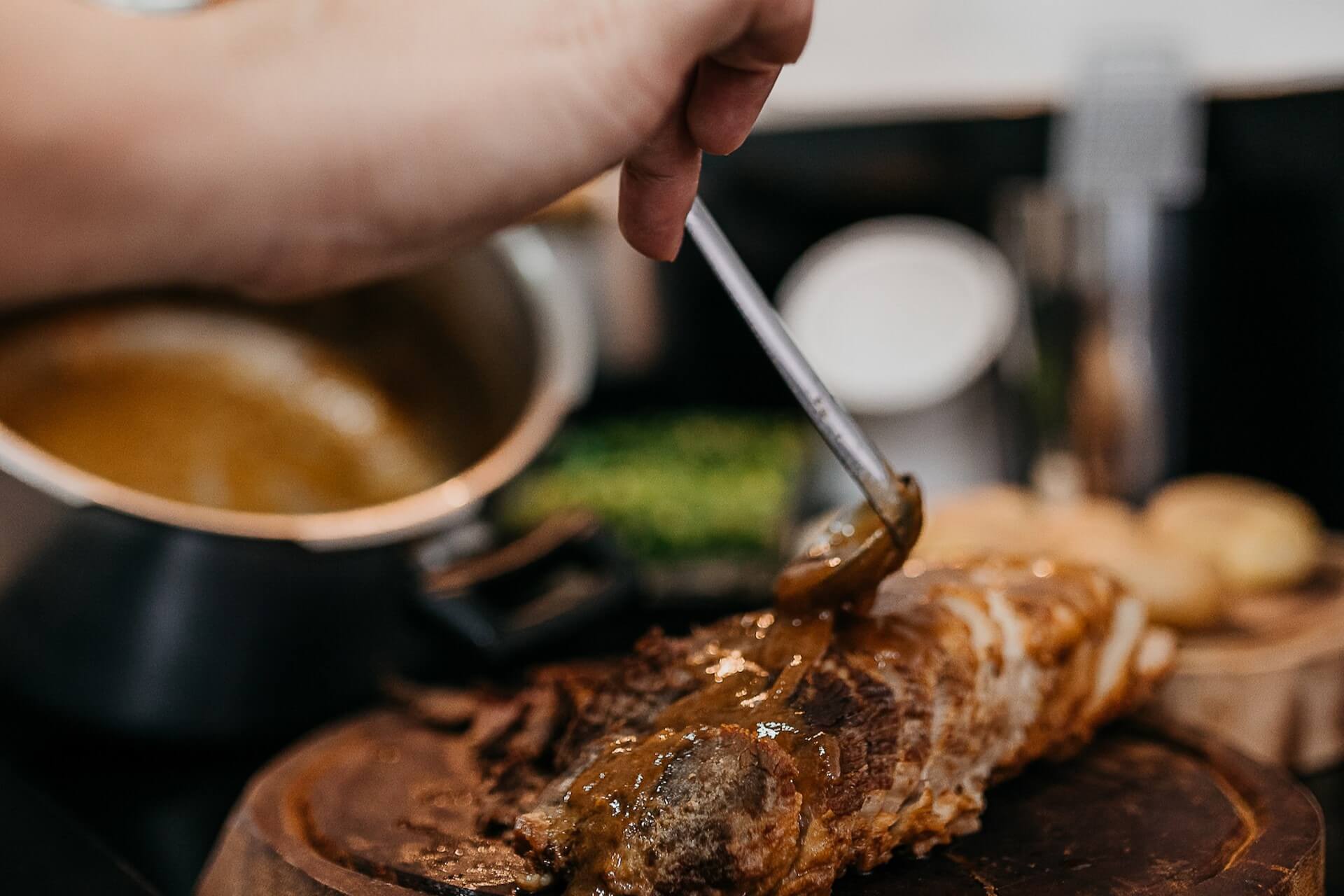
A well-crafted sauce can elevate a dish, tying all the elements together, adding richness, texture, and colour to almost any recipe.

French cuisine in particular is renowned for its liberal use of flavorful sauces. Developed in the 19th century by French chef Auguste Escoffier, the five mother sauces are basic recipes that serve as the foundation for any number of secondary sauce variations. Each mother sauce is categorized primarily according to its unique base and thickener.

The five French mother sauces are: béchamel, velouté, espagnole, hollandaise, and tomato. Historically, Chef Escoffier originally designated only four mother sauces, and mayonnaise as a cold mother sauce, with Hollandaise below that.

Interestingly, when his book was translated to English, mayonnaise was forgotten or omitted; Hollandaise was listed as the fifth mother sauce.

Beginning culinary students and experienced cooks alike commit these five sauces to memory. They learn that by tweaking their basic formulas, all manner of great sauces can be crafted.

Please meet the five mother sauces below. I explain: how each is made; their basic uses; and some secondary sauces you can make from them.

1. Béchamel

Béchamel, or white sauce, is a simple milk-based sauce made from butter, flour, and milk.

You know béchamel as the white sauce that gives chicken pot pie its texture, or as the vehicle of cheesy goodness and binding agent in delicious mac ‘n’ cheese creations. The sauce can be found in everything from scalloped potatoes and lasagne to gravy iterations.

In classical cuisine, béchamel was poured over fish, eggs, or steamed chicken. While béchamel has a generally neutral taste on its own, the classic mother sauce adds a unique creamy texture that is both hearty and comforting.

My personal favorite base recipe is Joel Robuchon’s equation of one liter of milk, 60 grams of butter, and 60 grams of flour. It works perfectly every time.

To make béchamel, start by cooking butter and flour in a saucepan until it forms a substance called a roux. The roux is responsible for thickening the sauce. To remove the floury taste, cook the roux over medium heat for a few minutes.

When the roux is ready, slowly whisk in warm milk and simmer until it forms a creamy sauce. Strain the liquid after it thickens to get rid of any sediment, then add salt and pepper. (You can add other ingredients as well, such as bay leaves, nutmeg, onion, clove, or even cheese.)

With the addition of a few extra seasonings like salt, pepper, and cloves, béchamel is complete — though it may be used as a base for many other sauces.

Béchamel sauces include:

  • Mornay: onion, cloves, Gruyère, and Parmesan cheese
  • Alfredo: garlic with heavy cream
  • Soubise: butter and caramelized onions
  • Cheddar sauce (used for mac ‘n’ cheese or nacho-style sauces): whole milk and cheddar cheese

2. Velouté

Velouté means “velvet” in French, and that is the texture you get with this original sauce.

A velouté is a simple sauce made from butter, flour, and clear stock. Chicken, turkey, and fish stock are most commonly used, but these days, although it’s not traditional, you can also find vegetarian velouté using vegetable stock.

This mother sauce is similar to béchamel in that it’s a white sauce thickened with roux. However, it uses stock for the base in place of milk. As a reminder, stock is a savory, flavorful cooking liquid created by simmering bones, herbs, and aromatic vegetables for several hours. Chicken stock is most common, but you can also use other white stocks, such as those made from veal or fish.

To make velouté, start by making a white roux with butter and flour. Next, slowly stir in warm stock and let it simmer until a creamy, light sauce forms.

When finished, velouté has a delicate, light flavor and a smooth texture. The sauce is usually served over poached or steamed fish or chicken; the light flavors of the sauce compliment the light, delicate meat. By adding wine, lemon, or other flavorings such as herbs, cooks can adjust the flavour of this mother sauce.

Some popular sauces derived from velouté include:

  • Supreme: chicken velouté with heavy cream and mushrooms
  • Venetian: chicken or fish velouté with tarragon, shallots, and parsley
  • Hungarian: chicken or veal velouté with onion, paprika, and white wine

3. Espagnole

Espagnole, otherwise known as brown sauce, is a rich, dark sauce made from roux-thickened stock, puréed tomatoes, and mirepoix (carrots, onions, and celery that’s used as a base). Brown stock, which is made from beef or veal bones that have been roasted and simmered, gives espagnole a particularly rich, complex flavor.

This dark brown sauce—one of the original mother sauces—and its derivative sauces tend to be heavy and thick. They lend a signature richness to such dishes as bœuf bourguignon, lamb, duck, and veal.

Like velouté, espagnole uses roux and stock as the main ingredients. However, instead of white roux and stock, it calls for brown stock and brown roux. In this case, the flour paste (butter, flour) is cooked until the flour browns.

It’s important that cooks stir the roux while it browns so the paste does not stick and burn or scorch. You can imagine how this would ruin the finished product, of course. When the roux has finished cooking, browned mirepoix, pureed tomato, and beef or veal stock are added.

Espagnole is the base for:

  • Demi-glace: additional beef or veal stock, herbs, and spices that’s reduced to a thick, gravy-like consistency
  • Sauce Robert (or Robert Sauce): espagnole with lemon juice, dry mustard, white wine, and onions.
  • Mushroom sauce: mushrooms, shallots, sherry, and lemon juice
  • Burgundy sauce: espagnole with red wine and shallots

4. Sauce Tomate

Sauce tomate, also known as sauce tomat, or tomato sauce, bears slight resemblance to the Italian-style tomato sauce served with pasta.

Tomato sauce is arguably the most popular of the French mother sauces. It is often served on top of pastas (gnocchi, in particular) or polenta, or with grilled meats or vegetables.

Trigger warning for Italians: The original mother sauce tomate was thickened with a roux, but thankfully this is no longer the case.

The classical French tomato sauce can be (but usually is not) thickened with roux and seasoned with pork, herbs, and aromatic vegetables. However, most modern tomato sauces consist primarily of puréed tomatoes seasoned with herbs and reduced into a rich, flavorful sauce.

Marie-Antoine Carême classified sauce tomate as a mother sauce in the early 20th century. They are remarkably versatile and can be served with stewed or roasted meats, fish, vegetables, eggs, and of course, pasta dishes. You’ll even find it used as pizza sauce.

The best tomato sauces are made with fresh, vine-ripened tomatoes. If you can make big batches when they’re in peak season, you’ll be able to enjoy flavorful sauce year-round.

Probably the most well-known sauces, you can make the following with sauce tomate:

  • Marinara: tomato sauce with garlic, onions, and herbs)
  • Sauce Portugaise or Portuguese sauce: tomato sauce with garlic, onions, sugar, salt, parsley, and peeled tomatoes
  • Creole sauce: tomato sauce with white wine, garlic, onion, cayenne pepper, and red bell peppers

5. Hollandaise

Like sauce tomate, this sauce was a later addition to Carême’s list. Brunch-goers will recognize hollandaise from Eggs Benedict variations. People will also know it from topping steamed asparagus or smothering a steak or lobster tail.

Both the original recipe and its derivative sauces are commonly served over eggs, vegetables, fish, or chicken. It’s worth mentioning that hollandaise is derived from mayonnaise and hasn’t always been classified as a mother sauce.

Hollandaise stands out from the other French mother sauces because it relies on the emulsification—or mixing—of egg yolks and butter in place of roux. The tangy, creamy sauce is made from butter, raw egg yolks, lemon juice, and optional flavorings like cayenne pepper or white wine vinegar.

Rookies often struggle with Hollandaise, and jokes will be made that the ingredients can sense fear and intimidation. The tendency for butter and egg yolks to resist combining—much like water and oil—coupled with the gentle heat of a bain-maire (steam bath) can cause the sauce to split or a pile of scrambled eggs to appear.

The key to making a proper hollandaise is slightly warm egg yolks, room temperature butter, and steady, constant whisking. It’s essential to add the butter to the yolks slowly and incrementally so that the ingredients remain stable and don’t separate.

Hollandaise and its derivative sauces are often served over eggs, vegetables, or lighter meats like poultry and fish. Speaking of derivatives, even though hollandaise is delicious on its own:

  • Béarnaise (beef’s perfect match): hollandaise with white wine, tarragon, and peppercorn
  • Choron: hollandaise with tarragon and tomato
  • Sauce Maltaise: hollandaise with blood orange juice
  • Sauce Mousseline: hollandaise with whipped heavy cream

There you have it—the five mother sauces. Master these and an entire world of sauce and dip creation opens up to you.

Image: Vitor Monthay on Unsplash

KRG Hospitality Restaurants & Cafes, 2023 icon

by krghospitality krghospitality No Comments

Focus: See Your Business for the Trees

Focus: See Your Business for the Trees

by Jennifer Radkey

Trees along forest path

It happens to us all: Sometimes we get so caught up in the small details of our day-to-day lives that we fail to see the bigger picture.

So common is this element of the human experience there’s a popular saying about it: “Sometimes it’s hard to see the forest through the trees.”

Today, however, I’m going to suggest that the opposite can also be true: “Sometimes it’s hard to see the trees when immersed in the forest.” In other words, when walking along the same path in a forest every day, we often stop seeing the individual trees.

Okay, forests and trees, nature and walks along paths—what does any of this have to do with operating a successful restaurant, bar, or hotel? Stick with me.

The forest is your venue. Your path is your daily routine from the minute you step into your venue until the minute you walk out the door at the end of your day.

The trees? They’re all the little details that make up your establishment: your team, the signage, tables and chairs, music playing, lighting, decor, food, drinks, website, online reviews, social media posts… These, plus many more, are the little things that add up to create your “forest.”

You walk through your venue daily and have become, for the most part, so used to your surroundings that you’re almost blind to them. This can sometimes lead to a false sense of everything being “fine.” You miss small details you need to improve, and also things that you and your team need to celebrate.

What I would like to challenge you to do is to take a step back, clear your mind, pretend you’re experiencing your venue for the very first time, and really notice the details. Walk a new path through your forest and see the trees.

How do you do that? Pretend you’re a guest visiting your establishment and follow the guest journey.

Here’s a list of five places you should stop along your path to gain a fresh perspective.

Your Online Presence

Start with your website.

When did you last update it? Are pictures fresh and eye-catching? Is the website easy to navigate on mobile devices? Is the menu easy to access? Can you make a reservation easily? What story is your website telling?

Next, scroll through your social media (if it exists).

When did you post last? What content are you sharing? Does it tell a story? Does it make you want to visit your venue? Are people engaging with your content? Are you engaging with others?

How about online reviews? See what people are saying about you.

Have you responded to reviews, good and bad? How are you responding? If you were a potential new guest would these reviews and your responses keep you away or entice you to visit?

More often than not, the first impression a guest has of your business happens long before they actually step foot inside your venue for the first time. What impression are you giving them?

Curb Appeal

The next place you want to stop on your path is right in front of your venue.

As you drive up, what do you notice? What’s the condition of your signage? Is it welcoming and attention-grabbing?

When walking up to the entrance, look for things that you may overlook but a first-time guest may not. Cleanliness of the front entrance area, proper lighting, current signage, these should all be checkpoints on your list.

Also, how does it feel to enter your venue? Is it welcoming? Exciting? Does it feel safe?

If you have stellar curb appeal with awesome signage are you celebrating and promoting it through great photos for your website and social media?

These are all things to consider when viewing your venue from the curb.

Interior

Next up on your path is the interior of your venue.

Is it clean? Are there any minor repairs that need to be done? Is the lighting just right?

Have a seat in a few different places in your venue. What’s your customer’s visual experience when they come to visit you?

You want the interior of your venue to represent your brand and its values, and you want it to appeal to your target market. Is it doing those things?

Again, if you have an amazing interior design element, are you showcasing it to its fullest in person and online? Make any notes of things you would like to change or improve upon.

One more note on the interior: Do not forget the washrooms. Nothing turns a visit into an unpleasant experience faster than an unclean washroom.

Service

As you’re viewing your venue with clarity, take a few minutes to step back and watch how your staff engages with your guests.

Whatever your brand’s values are for the guest experience, are they being conveyed through your staff’s engagement?

If you’re promoting a fun, energetic vibe, is your staff upbeat, positive, and energized when communicating with guests? Are the pillars of excellent customer service in place? When your guest leaves are they going to say, “Wow, our server was so friendly/nice/funny/knowledgeable,” etc.

Or are they going to leave saying nothing at all?

If staff appear unmotivated, what can you do to help inspire your team? If they’re stellar employees are you recognizing their incredible work?

Food and Drink

When was the last time you sat and really enjoyed a meal at your own establishment? Before you answer: As if you were a guest and not the owner.

Is food coming out in a timely manner? How does it look, smell, and, of course, taste?

Would you grab for your phone before taking the first sip or bite to snap a photo for Instagram? If you would, have you done exactly that for your own social media feeds?

As an owner you can become very attached to your menu, but pay attention to see if your guests and staff are raving about your food and drink.

Final Steps

The final steps of your path will be the same as your guest’s final steps.

Is your bill brought to the table when you’re ready to leave? Is payment easy to make? What are the final last impressions you’re left with? How is your team bidding farewell to guests? What will entice them to return?

You want your guests to feel satisfied and to tell their friends and family about what an amazing experience they had.

It can feel strange to step back from the forest and to notice the trees, but it will lead to improved clarity and perhaps even a roadmap for change and improvements to take your hospitality venue to the next level. Stepping back will also improve your overall mindset as you experience your business through the eyes of another.

So step back, clear your mind, and see what you may have been missing all this time.

Cheers to professional and personal growth!

Image: Lucas Parker on Unsplash

KRG Hospitality Mindset Coaching, 2023 Icon

by krghospitality krghospitality No Comments

5 Toxic Mindsets that Hinder Success

5 Toxic Mindsets that Hinder the Success of Your Business

by Jennifer Radkey

Your frame of mind matters, and if you want a team and business that’s thriving and growing, it’s time to examine your own mindset.

How you show up day to day in your business and in your life will either hinder or promote your success. Like the popular phrase goes, “It starts from the top.”

You can set the tone for the day with the energy you bring. As Anese Cavanaugh, author of the book Contagious You, states, “Whatever we put out there and whatever we take on affects our ability to influence, lead, and create the impact we want.”

A positive mindset is contagious: it can inspire, motivate, and make others feel good. A toxic mindset is equally as contagious: it can halt growth, increase unhappiness, and lower productivity.

Here’s a list of five toxic thoughts that lead to a negative mindset and can hinder success.

Blame Game

Always looking for someone else to lay the blame on when things go wrong is a surefire way to a toxic team environment. If you’re quick to blame others when things go wrong, perhaps it’s time to take a step back and examine why something went wrong in the first place.

Was there inadequate training provided? Are there no clear systems to follow? Do you have an environment that’s hostile to asking for help? Fault rarely lies in one person only; there are typically several factors in play.

A positive mindset will examine facts, look at all potential causes, and then come up with solutions. Blame never enters the picture.

Second Guessing

Not being confident in the choices you make hinders growth. Uncertainty in your decision making leads others to question or doubt your role as leader.

If you don’t have the utmost confidence in making decisions, and it’s your business, how can you expect your team to have confidence in you or the work that they do?

This doesn’t mean that you have to make snap decisions without thinking them over. Planning and deliberating over the right move to make is critical to success. But once the decision is made…it’s made. If it doesn’t work out you can then problem solve to get back on the right path.

Second guessing your decisions along the entire way is only going to slow you and your business down.

Absolutism

“It’s my way or the highway.” Absolutism is the inability or refusal to consider others’ ideas. This toxic thought process destroys team culture and growth.

As an owner, you’re heavily invested in your business. Therefore, it can be challenging to let go of how you think things should be done and consider different approaches. However, failing to listen to the ideas of others on your team will build walls and possibly create resentment. That’s definitely not a positive atmosphere to work in.

Be open-minded to doing things differently and show interest in the recommendations of others to promote instead of hinder success.

Hyper-negativity

Sometimes when you want to succeed it’s easy to zone in on the negatives: “This isn’t good enough.” “We aren’t making enough money.” “We don’t have enough followers online,” etc.

The desire to do well can make you hyper-focused on what isn’t right in order to fix it, instead of noticing what’s really great and celebrating that instead. Yes, you need to be aware of areas that need improvement, but you also need to be equally aware of the positive and promote it.

Think of a conversation with two random people you meet at a party. The first person grumbles about the weather, complains about the food, music, etc., and scowls. The second person is smiling, laughing at jokes, and genuinely interested in getting to know you.

Who would you rather be around?

Settling for Average

Nothing will kill growth and success faster than settling for the way things are because “that’s the way it’s always been,” or because “it’s working.” You want more than just “it’s working.”

You want to thrive, to make more money, to gain more followers, to hire more team members, to open more locations. If you aren’t living your absolute best life, if your business isn’t performing at its absolute highest level, then there should be no settling.

Settling for average teaches your team to settle for average, and that means your customer is settling for average. Avoid this toxic mindset by continuously setting goals (even small ones) and looking for ways to do better, feel better, and be better.

While it’s completely normal to fall into these toxic thoughts from time to time, it’s refusing to allow them to become you daily mindset that’s important.

The amazing thing about the human mind is that it can be changed—you can work on improving your mindset. Trust me when I say that you will not regret it.

Cheers to professional and personal growth!

Image: Nathan Dumlao on Unsplash

by krghospitality krghospitality No Comments

KRG Makes First Addition to Team for 2023

KRG Hospitality Makes First Addition to Team for 2023

KRG Hospitality Licensing Program logo

Jared Boller joins the KRG Hospitality team, serving as the agency’s in-house beverage educator, trainer, and menu developer.

TORONTO, ONTARIO—Today, KRG Hospitality is delighted to announce a new addition to their team. Jared Boller, a professional mixologist with two decades of experience, will be available to the agency’s clients for beverage menu development and training. He’ll serve as KRG’s master mixologist for North America.

Boller’s creativity, passion, and humility as a professional mixologist have led him on a journey around the globe. He has established himself as an industry leader, developing award-winning beverage programs in restaurants, bars, hotels, and casinos in several markets, including Denver, New York, Florida, Toronto. Throughout his career, Boller has won several cocktail competitions, educated teams for brands and industry organizations, and appeared in numerous publications.

“Restaurants, bars, hotels, and hospitality are in dire need of not only great employees but educated employees who can execute an owner’s vision,” says Boller. “I look forward to the next stage of my hospitality career with KRG, helping to inspire the future generations in everything related to beverage. My life’s journey has led me to the perfect opportunity with the team at KRG to collectively build future and existing brands.”

Additionally, he was the featured guest on episode 12 of the Bar Hacks podcast. People curious to learn more about Boller can listen to his Bar Hacks episode on Spotify, Apple Podcasts, and Google Podcasts.

With a growing list of accolades and numerous publications to his name, Boller most recently spent three years as the national whiskey ambassador for Proximo spirits. He prides himself on educating consumers and future bartenders on artistry behind the bar and providing history lessons to everyone that will listen. Boller is eager to share his extensive knowledge of spirits, cocktails, menu development, beverage innovation, and service.

“It’s an exciting time for KRG Hospitality, adding to the team just days into 2023,” says David Klemt, director of business development at KRG. “With Jared on the team our beverage programming, menu development and curation, training, and consulting will be even stronger. I know we’re all looking forward to our clients having the opportunity to work with Jared.”

About KRG Hospitality

KRG Hospitality is a storied and respected agency with proven success over the past decade, delivering exceptional and award-winning concepts throughout a variety of markets found within Canada, the United States, and abroad since 2009. Specializing in startups, KRG is known for originality and innovation, rejecting cookie-cutter approaches to client projects. The agency provides clients with a clear framework tailored to their specific projects, helping to realize their vision for a scalable, sustainable, profitable, memorable, and consistent business. Learn more at KRGHospitality.com. Connect with KRG Hospitality and the Bar Hacks podcast on social: KRG Twitter, Bar Hacks Twitter, KRG Media Twitter, KRG LinkedIn.

Image: KRG Hospitality

by krghospitality krghospitality No Comments

Dynamic Pricing or Dynamic Menus?

Dynamic Pricing or Dynamic Menus?

by Doug Radkey

Two sportbikes racing

A key phrase used throughout 2022 was “the new normal.” In 2023, a key term you will likely hear a lot is “dynamic pricing.”

What is dynamic pricing? It can get quite complex, but the global consulting company, McKinsey, defines dynamic pricing as “the (fully or partially) automated adjustment of prices.”

The term is not entirely new to hospitality. Hotels and the overall travel industry have used modules of the pricing model for years. But for restaurants and even bars, yes, it is something new.

It is also a model getting a lot of attention of late, which begs the following question: Why?

As the bar and restaurant industry recovers from the effects of the pandemic, a dynamic pricing model that optimizes revenue opportunities may seem quite attractive. After all, our industry is looking to rejuvenate its sales to pre-pandemic levels.

Essentially, a dynamic pricing model within this industry would work like this: increase prices when demand is up (peak periods), decrease prices to draw guests in when demand is down (off-peak times).

But should this be a model that disrupts the industry in 2023 and into 2024?

While I am all for a little disruption, the industry needs to tread carefully through this potential transition to dynamic pricing (or perhaps just around the phrase itself) that’s based on demand levels.

Guest Experiences

We all know (or should know) that we do not sell a product. What we sell is an experience.

If we can create a positive, memorable guest experience first and foremost, the revenue will follow.

While hotels and travel, as examples, have boasted “positive financial results” over the years through their different approaches to dynamic pricing (while still trying to focus on the end-user guest experience), independent bar and restaurant brands must be careful not to create a hostile brand perception.

Why? Because many consumers view changing prices based solely on levels of demand as being unfair.

Being unfair will certainly create a negative guest experience and/or brand perception. The hotel and airline industries have been able to navigate this perception successfully by offering alternatives. For example, different rooms and amenities or less convenient flight times at different price points. Essentially, companies in lodging and travel provide options and flexibility before customers make the choice to spend.

What about rideshare and surge pricing as another example? Many of you reading this have likely been burned by surge pricing as a consumer, which can be by definition a form of dynamic pricing.

Have you ever tried to book a rideshare during peak periods in a major market? What would normally be a $20 ride is suddenly $40 to $60 (or more) because of their dynamic pricing model.

What did I do in this situation during a recent business trip? I walked another 25 feet up to the cab staging area of the airport and got my ride for $25.

The end results? I had a negative customer experience with the rideshare company, first and foremost. Additionally, that negative experience drove me to the competition. The key here is I was given a choice.

Now let’s switch that scenario to a restaurant.

The Restaurant Scenario

You book a table at your favorite restaurant and order that incredible steak dinner you always enjoy. But instead of it being $50 like you have grown accustomed to, it is now $75 or more. How are you as a consumer going to feel about this new price just because you visited your favorite spot during a “peak period” on a Saturday night? Were you given a choice before the spend?

Of course, this can work in the opposite direction: ordering a meal during a non-peak time and getting it for a cheaper price, thereby getting a discount.

But should we be confusing our customers based on their chosen, convenient time to visit your restaurant or bar? Should you also focus on “discounting” to drive people to your business?

I have even seen recommendations for offering an increased price for peak period but using what was the previous regular price during the non-peak times, labeling the normal price a “discount.”

Should we be framing our regular priced menu options as a discount just so we can charge and make more during a peak period? Is this being fair and ethical to your loyal customers? Should we be going down this road?

With this model (and the phrase “dynamic pricing”), which is based on demand, it is very easy to see how you can quickly confuse or alienate your loyal guests. Unless the industry in its entirety migrates over to this demand-driven model, a similar scenario as outlined above can play out for you and your guests.

Without extremely strong but transparent communication systems in place (which will be a challenge in itself), it is safe to assume that they will likely visit another restaurant up the street and/or provide negative feedback because they feel your pricing model is confusing or unfair.

Dynamic Menus

The phrase that is much more simplified and will be more easily embraced by both operators and guests is “dynamic menu.”

So, what’s the difference?

While it is still by definition “the (fully or partially) automated adjustment of prices,” it is not based on demand throughout the day. Rather, pricing is based on simple supply chain and operational cost adjustments.

According to the National Restaurant Association:

  • 95 percent of restaurants have recently had significant supply delays or shortages of key food items; and
  • 75 percent of restaurants have had to change their menu because of supply chain issues.

With a more dynamic menu, you can adjust pricing to suit those changes accordingly, through the lens of real-time ingredient cost, labor costs, productivity levels, and even the availability of certain menu items.

This simply means that the incredible steak dinner a guest has always enjoyed at your place is perhaps now $53 instead of $50 because the price of beef went up the past week or month. This ensures that as an operator, you will have a minimal gap between your theoretical and actual food costs.

Again, this should work both ways, meaning if the price of beef has gone down, so too should the price.

This means that your guests are paying an accurate value for each item, based on your intended sales mix and contributions, without a loss in margin on your end or negative experience on the guest end.

This means that everything on your menu is “market price” or MP. Where have we seen that before…?

Market Price

We all know restaurant menus will commonly deduct a price and replace it with the term “market price” (often abbreviated to “MP”). This means the price of the menu item depends on the market price of the ingredients, and the price is available upon request. It has been used for years for seafood in particular—most notably lobsters and oysters—in many restaurants.

Therefore, this pricing model is not entirely new. So, why should it stop at just high-priced seafood?

The reason many operators would use the abbreviated MP was because they did not want to reprint menus every single day as the prices fluctuated greatly.

As we move towards digitally savvy restaurant operations, implementing integrated technology and menus, we can begin to find alternatives and ensure that we are actively pricing our menus accordingly based on the market (and overhead costs) to strengthen top- and bottom-line results.

Knowledge is Power

To make a dynamic menu work, whether you’re a QSR, sports bar, casual-dining or fine-dining concept, or any other category of bar or restaurant, you need to know your target customers, provide a targeted menu, and know your numbers (the data).

Curating and engineering a menu should be a simplified process. To be honest, this should have been streamlined prior to the pandemic.

Your menu should be developed based on data, consumer sentiment, regional ingredients, regional suppliers, and local talent within the confines of the overall concept. Food and beverage programs should be developed with thought, care, speed, precision, execution, and last-but-not-least: consistent profits in mind.

Keeping menus “small” (10 to 12 or even 15 items at maximum) will be the new threshold of a successful, more profitable operation. This size of menu will allow bars and kitchens to operate more efficiently; keep inventory costs both low and controlled; control training and labor costs; and provide guests with the most flavorful and exciting items that they truly want.

Be Nimble

You also want to provide menu flexibility by continually reviewing your supply chain. Maintaining a strong personal relationship with your suppliers is imperative. You must also review your costs and inventory on a daily and weekly basis to make dynamic menus work.

To keep inventory, purchase orders, and potential waste to a minimum, it will be crucial that you to ensure your menu is small but innovative. The only way to accomplish this is through effective data management.

However, the new challenge for many independent brands is making data timely, relevant, digestible, and actionable for operators and their leadership teams. The ability to collect, interpret, and effectively react to key datapoints is going to be crucial for anyone who wants to implement a dynamic menu, and for moving forward in general.

At the end of the day, profiting from a dynamic menu is all about making decisions based on accurate cost and productivity data. Of course, there’s only one way to obtain data: embrace technology and create strategic clarity around it.

The Tech Stack

The key to successfully implementing a dynamic menu is integrating a stack of technology that provides real-time data and trend reports.

From point-of-sale software and reports to accounting software, inventory and recipe management software, and invoice management software or a suite that includes all of the above that’s integrated and working together, you can obtain real-time data to adjust your pricing based on real-time ingredient and productivity costs on a daily or weekly basis.

You want seamless movement of data from front- to back-of-house that will position you to make decisions and have a more complete picture of inventory stock levels, costs, and ordering needs, plus itemized sales, contribution margins, and productivity levels.

In Summary

While we must find ways to be innovative, potentially price-gouging our guests during peak periods and discounting during slow periods is not the way for this industry to recuperate and build loyal customers.

Building a strong brand through the creation of memorable experiences and by building connection with your community along with strategic planning, effective marketing, the elements of culture, and efficient operations, you can build sustainable revenue and profit channels.

By following a more dynamic menu approach within your operations, you can still maintain transparency with your guests with less challenging communication methods, remain a fair and well-respected brand within your community, and improve your margins by three to five percent or more with the right people and systems in place.

That sounds like a pretty good deal to me. The question here remains: Are you Team Dynamic Pricing or Team Dynamic Menus?

Image: Joe Neric on Unsplash

by krghospitality krghospitality No Comments

KRG Unveils 2023 Start-Up Guide

KRG Hospitality Unveils 2023 Restaurant Start-Up Cost Report + Checklist

2023 KRG Hospitality Start-up Costs Guide

KRG HOSPITALITY RELEASES FIFTH ANNUAL RESTAURANT START-UP COST REPORT + CHECKLIST

Toronto-based hospitality industry consulting firm with offices in key markets throughout Canada and the United States of America unveils their latest restaurant cost report, milestone checklist, and interactive hospitality calculator.

December 15, 2023 (TORONTO)—Today, KRG Hospitality unveils their 2023 Restaurant Start-up Cost Report + Checklist. The Toronto-based consulting firm specializes in startup restaurant and bar projects along with boutique hotels, experiential concepts, and entertainment venues. KRG also has offices in key markets throughout the United States of America.

For the past five years KRG has researched, reviewed, and published the annual start-up cost guide, one of the industry’s leading resources dedicated to restaurant project costing.

And each year this informative and transparent guide is used as a trusted budgeting tool by developers, lenders, contractors, consultants, and aspiring restaurateurs. The guide is founded upon KRG Hospitality’s proprietary database of previous project costs, which includes project data from restaurants, bars, and cafes developed over the past 24 months.

Further, this annual KRG Hospitality also includes a start-up checklist that identifies an array of crucial milestones: KRG president Doug Radkey has identified 500 unique tasks that must be completed for a successful restaurant opening.

This year’s checklist reveals a number of these crucial tasks. Updated for 2023, the guide also includes the interactive KRG Hospitality Calculator.

The costs to start a restaurant have been on a steady rise over the past 5 years. Major drivers are increases in inflation, interest, labor, construction, equipment. Of course, there are also the unique materials required to deliver a scalable, sustainable, memorable, profitable, and consistent on-premise, off-premise, or hybrid-style concept.

Drawing upon this comprehensive guide, an industry-leading expert has analyzed the information and provided a succinct and user-friendly summary of the findings for each major start-up category. This isn’t simply a couple of pages identifying a few costs. Rather, the fifth annual guide is a deep dive that provides real insight into what to expect in 2023.

The Checklist

As stated, there are 500 unique tasks an operator needs to complete over the course of developing and opening the doors to their concept.

To make it simple to navigate, the 2023 checklist is organized into sections: Planning & Admin, the Support Team, Site Development, Operations Development, Brand Development, and Team Development.

From starting off with the targeted, customized, and in-depth feasibility to planning and executing the soft opening, KRG identifies dozens of key milestones in this year’s guide.

Download your copy of the 2023 KRG Hospitality Restaurant Start-up Cost Report + Checklist today! Click here.

About KRG Hospitality

KRG Hospitality is a storied and respected agency with proven success over the past decade, delivering exceptional and award-winning concepts throughout a variety of markets found within Canada, the United States, and abroad since 2009. Specializing in startups, KRG is known for originality and innovation, rejecting cookie-cutter approaches to client projects. The agency provides clients with a clear framework tailored to their specific projects, helping to realize their vision for a scalable, sustainable, profitable, memorable, and consistent business. Learn more at KRGHospitality.com. Connect with KRG Hospitality and the Bar Hacks podcast on social: KRG Twitter, Bar Hacks Twitter, KRG Media Twitter, KRG LinkedIn.

Disclaimer

While using this guide helps develop a rough preliminary financial and strategic milestone plan, it is strongly recommended that you seek professional expert advice to provide you with a more precise, project specific estimate as each concept and market will be slightly different. KRG Hospitality Inc. is not responsible for any project that is not currently under contract within the company.

Image: KRG Hospitality
by krghospitality krghospitality No Comments

KRG Hospitality Adds to Team

KRG Hospitality Enters New Era of Growth with Addition to Team

by David Klemt

KRG Hospitality Licensing Program logo

Kim Richardson joins the KRG Hospitality team, representing Philadelphia and the Northeastern US region via the agency’s new license program.

PHILADELPHIA, PA—KRG Hospitality today announces an exciting new addition to the consulting agency’s team. Following several years of success, KRG is now entering a new phase of growth.

Kim Richardson, who has more than 23 years of experience in the hotel and restaurant industry, will represent KRG at the agency’s Philadelphia office. Further, Richardson will be KRG’s representative for the Northeastern region of the United States, serving Connecticut, Delaware, Maine, Massachusetts, New Hampshire, Maryland, New Jersey, New York, Pennsylvania, Rhode Island, and Vermont.

As the newest member of the KRG team, Richardson is excited to bring all her hospitality industry knowledge and experience to the Philadelphia area. From Five Diamond Hotels to brick-and-mortar restaurants, she has had her hands in the Philadelphia hospitality scene since moving to the city in 2003. With an admiration for the industry since a very young age, she has a passion for all things hospitality. Most importantly, Richardson brings with her a passion and eagerness to help grow the industry and lead others to success.

“There’s nothing more rewarding than understanding a client’s dream, perfecting it, and bringing that vision to life,” says Richardson.

This exciting new addition to the KRG team represents the launch of the agency’s new licensed consultant program. KRG operates in several key markets—Toronto, Las Vegas, Calgary, Vancouver, Philadelphia, Nashville, Orlando, and the Caribbean—and is planning to add more partners as regional representatives throughout 2023.

“As we move forward from the pandemic era, we look forward to positioning the brand for continued and further success,” says KRG Hospitality president Doug Radkey. “Creating a licensed consultant program provides us the opportunity to reach a wider audience, provide additional value and support for our clients, and help push this exciting industry forward.”

About KRG Hospitality

KRG Hospitality is a storied and respected agency with proven success over the past decade, delivering exceptional and award-winning concepts throughout a variety of markets found within Canada, the United States, and abroad since 2009. Specializing in startups, KRG is known for originality and innovation, rejecting cookie-cutter approaches to client projects. The agency provides clients with a clear framework tailored to their specific projects, helping to realize their vision for a scalable, sustainable, profitable, memorable, and consistent business. Learn more at KRGHospitality.com. Connect with KRG Hospitality and the Bar Hacks podcast on social: KRG Twitter, Bar Hacks Twitter, KRG Media Twitter, KRG LinkedIn.

Image: KRG Hospitality

by krghospitality krghospitality No Comments

2023: Year of the POS Systems?

2023: Year of the POS Systems?

by David Klemt

SpotOn POS system on laptop

Image from SpotOn press release

According to SpotOn, the industry could be in for a tech revolution next year as independent operators pursue more powerful POS solutions.

The results of a survey conducted by the cloud-based POS platform are rather revealing. In an effort to better understand where the industry is heading, SpotOn surveyed 300 independent and small-chain restaurant operators.

Both full-service and limited-service (LSR) concept operators participated in this SpotOn survey. Intended to identify the challenges operators face currently, the results reveal much more.

Below, the picture these survey results paint for the industry.

Legacy vs. Innovation

This isn’t the first time I’ve stated the following: Our industry hasn’t been the fastest to implement new technology.

However, we did appear to turn that around in 2021. Now, heading into 2023, our industry may be pursuing cutting-edge tech solutions even more fervently. Today’s guest expects more tech, and your team likely wants access to more modern tech that makes their jobs easier.

Per SpotOn’s survey, 81 percent of independent operators still use so-called “legacy” POS systems. These are “traditional” systems from companies that have been around for quite some time.

It’s not difficult to understand why the vast majority of independent operators continue using legacy systems:

  • Investing in a new platform requires expenditures of money and time.
  • Introducing a new POS platform requires staff training.
  • Staff need to grow adept at using the new system.
  • It can be daunting to research the available platforms and implementing change.

So, independent and small-chain operators have a choice to make: Stick with the familiar or invest in the future. Change can not only be intimidating, it can be expensive.

However, it seems that most operators are ready to throw comfort to the wayside and embrace innovation.

State-of-the-art Benefits

Should the SpotOn survey prove to be accurate snapshot of the industry, 75 percent of operators will implement new tech next year. According to SpotOn, this is largely in response to growing labor challenges, such as scheduling and retention.

The restaurant, bar, nightclub, and food truck platform found that operators are spending as much as 20 hours per week on administrative tasks. State-of-the-art POS systems can slash those hours by:

  • streamlining operations;
  • making scheduling simpler;
  • calculating tips and payout for payroll; and
  • managing overtime, an increasingly common task.

More modern POS platforms can automate labor management tasks, saving operators time, money, and frustration. Automation and streamlining give operators something invaluable: time.

In particular, innovative and helpful tech solutions provide an operator with time to focus on growing their business. When weighing whether to keep a familiar but less feature-rich POS system or invest in a modern platform that seamlessly integrates many solutions, ask yourself a couple important questions:

  • What’s my time worth?
  • What am I focusing on every day?
  • Am I growing my business or stagnating?
  • Is my current POS system helping or hindering my team?
  • Does my POS system streamline and automate any tasks?

Image: SpotOn

by krghospitality krghospitality No Comments

These are the World’s 50 Best Bars in 2022

These are the World’s 50 Best Bars in 2022

by David Klemt

Map of France and Spain

The long wait is over and we finally know which venues across the world are numbers one through 50 on the 2022 World’s 50 Best Bars list.

Congratulations to the World’s 50 Best Bars, class of 2022!

Regardless of people’s opinions of industry awards, these bars deserve recognition. Moreover, they’re successful examples from which other operators can learn. Iron, as they say, sharpens iron.

To review the World’s Best Bars, numbers 51 through 100, click here. As you’ll see, Singapore dominates that particular list.

If you want to learn more about the World’s 50 Best Bars, listen to episode 82 of the Bar Hacks podcast.

The 50 Best

As you’ll see when you scroll down, history was made today. For the first time since the inception of the World’s 50 Best Bars, neither a bar from London nor New York takes the number one spot.

However, New York did just fine this year. The city claims six of eight American bars on this year’s top 50 list. In fact, two bars in New York are among the top ten.

Bars in Chicago and Miami claim two spots as well. Las Vegas, sadly, doesn’t find itself with a bar in the top 50 or the expanded 51 to 100 list.

Unfortunately, the same holds true for the entirety of Canada.

However, Mexico City crushes it for North America with not only four winners but one bar representing the Best Bar in North America and taking the Rémy Martin Legend of the List award.

Athens, Dubai, Buenos Aires, and Barcelona each claim three spots, with the latter city’s winners all in the top ten. London boasts five bars on the top 50 list.

And as I predicted, two bars in Singapore earned placement this year. The Southeast Asian city-state didn’t crack this year’s top ten. However, when combined with bars 51 through 100, ten percent of the bars are in Singapore.

Individual Awards

Of course, the World’s 50 Best Bars does more than simply judge and rank bars.

Now in his fourteenth year at the helm of the Connaught Bar in London, England, Agostino Perrone scores the Roku Industry Icon Award. Jean Trinh of Alquímico in Cartagena, Colombia, is the 2022 Altos Bartender’s Bartender.

Röda Huset, number 78 on the World’s 50 Best Bars, numbers 51 to 100, is the Campari One to Watch. This particular award means this bar has been judged as the one most likely to find itself ranked somewhere among the top fifty. Further, Hanky Panky in Mexico City takes the Michter’s Art of Hospitality Award this year.

Regional and other individual awards are listed next to the bars below.

Congratulations to the bars and their dedicated teams!

The World’s 50 Best Bars 2022: 50 to 1

  1. Bulgari Bar (Dubai)
  2. Lucy’s Flower Shop (Stockholm)
  3. Bar Benfiddich (Tokyo)
  4. Employees Only (New York)
  5. L’Antiquario (Naples)
  6. Galaxy Bar (Dubai)
  7. Carnaval (Lima)
  8. Himkok (Oslo)
  9. CoChinChina (Buenos Aires)
  10. Cantina OK! (Sydney)
  11. Red Frog (Lisbon)
  12. Locale Firenze (Florence)
  13. Zuma (Dubai)(The Best Bar in the Middle East and Africa sponsored by Paragon Cordials)
  14. 🔶🟥🔵 A Bar with Shapes for a Name (London)
  15. Dante (New York)
  16. 1930 (Milan)
  17. Overstory (New York)
  18. Manhattan (Singapore)
  19. Baltra Bar (Mexico City)
  20. Line (Athens)
  21. Swift (London)
  22. Maybe Sammy (Sydney)(The Best Bar in Australia sponsored by Torres Brandy)
  23. Argo (Hong Kong)
  24. Tres Monos (Buenos Aires)
  25. Sidecar (New Delhi)
  26. Kumiko (Chicago)
  27. Tropic City (Bangkok)
  28. Satan’s Whiskers (London)
  29. Attaboy (New York)
  30. Café La Trova (Miami)
  31. Baba au Rum (Athens)
  32. The Clumsies (Athens)
  33. Florería Atlántico (Buenos Aires)
  34. Coa (Hong Kong)
  35. Drink Kong (Rome)
  36. Salmon Guru (Madrid)
  37. BKK Social Club (Bangkok)(London Essence Best New Opening Award)
  38. Hanky Panky (Mexico City)(Michter’s Art of Hospitality Award)
  39. Jigger & Pony (Singapore)(The Best Bar in Asia sponsored by Naked Pony)
  40. Handshake Speakeasy (Mexico City)
  41. Alquímico (Cartagena)(The Best Bar in South America sponsored by Tia Maria)
  42. Katana Kitten (New York)
  43. Connaught Bar (London)
  44. Two Schmucks (Barcelona)
  45. Double Chicken Please (New York)(Disaronno Highest New Entry Award)
  46. Little Red Door (Paris)(Ketel One Sustainable Bar Award)
  47. Licorería Limantour (Mexico City)(The Best Bar in North America sponsored by Rémy Martin)(Rémy Martin Legend of the List)
  48. Sips (Barcelona)(Nikka Highest Climber sponsored by Nikka Whisky)
  49. Tayēr + Elementary (London)
  50. Paradiso (Barcelona)(The Best Bar in Europe sponsored by Perrier)

Image: Ian on Unsplash

by krghospitality krghospitality No Comments

Stand Out with Weird Holidays: Oct. 2022

Stand Out with Weird Holidays: October 2022

by David Klemt

Stay Weird neon sign with purple background

Want to stand out from from other restaurants and bars in your area? Then commit to keeping it weird.

Several “holidays” are set against every date on the calendar, and October is no exception. These holidays range from mainstream (Halloween, anyone?) to “weird.”

Pay attention to the latter to raise eyebrows, carve out a niche for your restaurant or bar, and attract more guests. Why do what everyone else is already doing?

Of course, you shouldn’t try to celebrate every holiday, weird or otherwise. And this month’s list in no way includes every odd holiday.

Focus on the days that are authentic to your brand; resonate with your guests; and help you grab attention on social media.

For September’s list, click here.

October 5: Chic Spy Day

Of course, there’s one holiday this month that simply will not allow anyone to ignore it: Halloween. So, why not lean into it early? Encourage guests to show up looking like a chic spy, perfect your Vesper Martini, and show spy movies. In other words, task your guests with really getting into the spy theme, and create a menu that shows off your creativity as well.

October 6: National Orange Wine Day

No, there aren’t any oranges used in the production of orange wine. Rather, it’s white wine with which the grape skins and seeds remain in contact. The result is an orange hue. And as we all know, orange is one of the key colors of October and Halloween. To celebrate National Orange Wine Day, put some orange wines on your menu.

October 7: National LED Light Day

They say there’s a holiday for just about everything. The existence of this holiday points to that sentiment being accurate.

To wow your guests and get them in the mood for your ultimate October promotion, a Halloween bash, drop food-safe, waterproof LEDs into cocktails for a “spooky,” otherworldly effect.

October 13: National Train Your Brain Day

You know what’s an excellent way to train your brain and stay sharp? Trivia! And do you know what a lot of guests like to do at bars? Trivia! Guest what you should plan for National Train Your Brain Day…

October 17: Wear Something Gaudy Day

I mean, it’s Halloween month and people want to dress up. Guide their costume ambitions by encouraging them to get gaudy and tacky on Wear Something Gaudy Day.

October 18: National Chocolate Cupcake Day

Okay, so this isn’t a weird holiday. There’s nothing strange about chocolate cupcakes. What they are is delicious, and your kitchen staff can always decorate chocolate cupcakes with fall and Halloween themes.

October 20: International Sloth Day

Ah, the sloth. It really has the right idea most days: slow down. On this day, encourage your guests to slow down and relax at your restaurant or bar. Comfort food, delicious beer, and classic brunch cocktails are the order of the day.

October 21: National Count Your Buttons Day

There are several ways to celebrate this day. However, I think a good, old-fashioned “Guess How Many Buttons are in This Jar” contest is the way to go. Give away a bottle, a meal, a bar tab, etc. The sky’s the limit.

October 22: National Make a Dog’s Day

Is your business dog-friendly? Can your kitchen come up with dog-safe menu items? Then encourage your guests to come in and pamper their pooches.

October 25: National Greasy Food Day

There’s no point in competing or programming against Halloween. Not for most operators, anyway. So, celebrate this debaucherous, indulgent day with greasy bar and comfort food ahead of your Halloween promotion.

Image: Dan Parlante on Unsplash

by krghospitality krghospitality No Comments

5 Reasons Why You Need a Calendar Audit

5 Reasons You Need to Conduct a Calendar Audit

by Jennifer Radkey

Apple iPad and Apple Pencil with calendar on screen

Keeping a hospitality business running smoothly takes an immense amount of organization, and at times you may feel pulled in a million directions at once.

As an operator of a restaurant or bar, your daily calendar may seem like an endless stream of tasks.

You are most likely already using some sort of organizational tool: an agenda, calendar, your phone, or Post-Its all over your office walls. But when was the last time you actually analyzed your calendar?

I’m going to challenge you to sit with your calendar and take a deep-dive audit of just how you are spending your time.

Here are the five reasons you need to do a calendar audit today.

You Aren’t Making Money or Reaching Goals

As the operator of your hospitality establishment, you are responsible for your business’ success. So, dissect your calendar.

What actions are you taking on a daily or weekly basis that directly lead to making money? What percentage of your time is spent on growing your business, rather than running your business? There is a difference.

You are Burnt Out

When you are not at your best, your business will not be at its best. It’s as simple as that.

How many daily operational tasks are you taking on that could be delegated to someone else? You don’t need to be involved in every aspect of the daily operations of your business.

Take a look at your calendar and highlight any tasks you have been doing that could easily be done by someone else on your team. Then, give those tasks away.

Team Morale is Low

Go back and audit your calendar.

When was the last time you scheduled a team meeting? How about individual meetings with employees to go over their successes, growth opportunities, etc.? Is there regular time delegated to improving your workplace culture?

Carve some time out for the people who choose to spend their days working for you, and watch team morale improve.

You Feel Stuck in a Rut

Maybe your business is doing well but has plateaued. Maybe you aren’t excited to go to work anymore. Take a close look at your calendar.

What have you done in the past week or month to create excitement? For example, did you attend any industry related shows or events?

As operators, it is easy to get stuck in a daily routine that doesn’t allow time for creativity. However, it is imperative to schedule time to be inspired.

Your Work/Life Balance is Off

The hours can be long, and with so much to do, you can often feel as if your entire life is your work. Take a close look at your calendar.

Are you scheduling in family time? Time for friends? Time for physical health? Hobbies? Fun?

This can be as simple as scheduling time for something you enjoy that changes up your week:

  • A 15-minute call with your mom every Monday morning.
  • Walking/biking to work twice a week.
  • Meeting up with a friend once a week for a coffee.

We often say that we will do these things. However, unless they are prioritized and written down they aren’t going to happen as much as we need them to.

Performing a calendar audit can be eye-opening and give us an entirely new perspective on how we are using our time. Doing so can help us improve time management, productivity, happiness, and goal achievement.

So, go ahead and mark some time for a calendar audit into your calendar. You will thank yourself later that you did.

Cheers to professional and personal well-being!

Image: Omar Al-Ghosson on Unsplash

by krghospitality krghospitality No Comments

Why You Should Take Part on Giving Tuesday

Why You Should Take Part on Giving Tuesday

by Jennifer Radkey

Kindness is a Superpower stencil graffiti on brick wall in black and white

You are most likely familiar with Black Friday and Cyber Monday, days that encourage consumerism and support the economy.

However, after these two days comes a global movement that you may not yet be familiar with but need to be: Giving Tuesday.

Created in 2012, Giving Tuesday will be celebrating its ninth year Tuesday, November 30th. It is a global movement in which organizations, businesses, charities, and individuals all come together to support their favourite causes.

From large monetary donations to simple acts of kindness, it is a day that encourages people to do good and to bring about positive change in their communities.

Why Generosity?

Generosity not only benefits the charity or person who is on the receiving end, it has huge benefits to those on the giving end.

From increased happiness to a sense of shared community, being generous with your time, resources, or money is often a simple act with big rewards.

A 2008 study by Harvard Business School professor Michael Norton and colleagues found that giving money to someone else lifts participants’ happiness more than spending money on themselves.

This is true even when the participants anticipate prior to the act of giving that spending the money on themselves would make them happier. Research also suggests that similar well-being benefits come from giving monetary gifts/donations or volunteering your time.

In other words, it doesn’t matter how you give, it is the act of giving in itself that gives us that “warm glow” feeling that we typically associate with the holiday season.

Hospitality and Generosity

The words hospitality and generosity go hand in hand.

To be a welcoming hospitality brand you need to be generous with your time and your kindness. You need to be willing to create an atmosphere in which people come to not just eat a meal, have a drink, or spend a night, but to create memories, to socialize, and to have an experience.

Over the past (nearly) two years, we have asked our communities to support hospitality businesses as we faced lockdowns and restrictions. In many ways, our communities did just that.

Guests ate on patios when the weather was not pleasant. They supported through ordering takeout. #SupportLocal movements popped up not just in the U.S. and Canada but globally. Through their extra efforts, many businesses were able to keep their doors open and their staff employed.

Now it is time to take that generosity shown to us and give it back to our community.

Giving Back

So, as a hospitality business, how can you contribute to Giving Tuesday?

Firstly, discuss it with your team! If you are able to contribute a monetary donation to your community in some way, which charity or organization speaks most to the values you all share?

If you aren’t able to contribute a monetary donation, how can you volunteer your time as a team? Maybe you can make your space available free of charge for a local organization or charity to host an event. Perhaps you can cook meals or bake goods as a team to provide to those in need, or who work tirelessly to make your community a better place.

The opportunities for giving back are endless and you can be as creative as you like. Host a breakfast with Santa for a local children’s group or do a hot chocolate and cookie drop off at a senior’s centre.

Brainstorm as many ideas as possible with your team. The process of thinking of charitable acts alone will brighten your team’s mood and get everyone in the giving spirit.

Share, Share, and Share Some More

Once you decide how you will participate in Giving Tuesday, tell the world about it!

Take photos, share the link to the charity or organization you are giving to, and encourage others to give alongside you. Tell a story.

However, do not engage with Giving Tuesday cynically with the goal of social media exposure. Be truly kind and generous.

Generosity is contagious. Your act of kindness will encourage others to do the same. It will also shine a bright spotlight on your hospitality brand, so make certain you’re engaging in kindness authentically and not just to score points with your community.

For more information on Giving Tuesday, please visit www.givingtuesday.org. Cheers to professional and personal well-being!

Image: Andrew Thornebrooke on Unsplash

by krghospitality krghospitality No Comments

Creating a Strengths Profile

Creating a Strengths Profile

by Jennifer Radkey

Unsolved Rubik's Cube against black background

When looking to improve the performance of your hospitality business it is natural to seek out weaknesses and attempt to “fix” them.

What if you were to take an entirely different approach?

Instead of focusing on weaknesses to improve upon, we should seek to identify and build upon our strengths.

Why Strengths?

Using our strengths is like writing with a dominant hand. It comes naturally and easily.

Strengths can be cultivated and used to assist in overcoming challenges and in improving upon weaknesses. If we were to focus only on improving our weaknesses it would be tiring, and the probability of giving up could increase.

However, if we focus on building upon our strengths, it would be motivating and energizing, therefore making us stronger and then more likely to overcome our weaknesses.

Lost and Found

Do you ever visit a restaurant, bar, or hotel and get no clear sense of their identity?

Maybe their menu is confusing, their social media presence is either nonexistent or only shares their daily specials, there is no consistency in service. They just seem…lost.

Now seriously take a minute and walk through your establishment with fresh eyes as if it were your first time there. Is your brand’s identity clear or lost? As we get wrapped up in the day-to-day operations and stressors, becoming lost can easily happen.

Identifying your brand’s strength profile can help you find your distinct identity again. Even if you aren’t lost there is always room to strengthen your brand.

The Background

In the field of positive psychology, psychologists Chris Peterson and Marty Seligman headed a project to seek out what characteristics describe humans at their very best.

After scouring literature, media, music, etc., spanning countries and history, they compiled a list of 24 character strengths that appear to be valued over time and culture.

This list was referred to as the Values in Action Classification of Character Strengths and Virtues (VIA). The VIA is meant to classify individual strengths but can also be applied to organizations and businesses.

The 24 Character Strengths

The list of strengths is as follows:

  • Creativity
  • Curiosity
  • Open-mindedness
  • Love of Learning
  • Perspective and Wisdom
  • Bravery
  • Persistence
  • Integrity
  • Vitality
  • Capacity to Love and be Loved
  • Kindness
  • Social Intelligence
  • Citizenship
  • Fairness
  • Leadership
  • Forgiveness
  • Humility/Modesty
  • Self-Regulation
  • Appreciation of Beauty and Excellence
  • Gratitude
  • Hope/Optimism
  • Humour
  • Spirituality

If you want to dive deeper into the VIA character strengths or would like to take the free survey yourself to find out what your top character strengths are, please visit www.authentichappiness.org through Penn State University and take the VIA Survey.

Creating a Strengths Profile for Your Hospitality Business

Now that you have the list of 24 character strengths, think about the top three strengths that you believe capture your brand at its very best. Think both about your venue’s operations and its messaging when deciding upon the top three.

Then ask your team to do the same. Hold a team meeting in which everyone shares which three character strengths they chose and why.

I recently did this with our team here at KRG Hospitality and found the process enlightening. It was fascinating to see which character strengths were repeated, providing clarity into our brand’s strengths profile.

Establishing Your Top Three

As you review everyone’s answers as to the character strengths they feel best capture your brand at its very best, take note of strengths that repeat themselves.

For us at KRG Hospitality, creativity, perspective and wisdom, and love of learning were the most common replies. We then had our strengths profile.

Discuss what you feel the strengths profile for your brand is with your team and solidify a top three.

What Next?

Once you have a strengths profile built, it’s time to dissect it.

How are you already using these strengths in both your day-to-day operations and in how you are representing yourself to the outside world? How can you use them in new and unique ways?

For example: If one of your strengths is creativity, are you using it to your advantage in many aspects of your business? Maybe your menu is super creative, but your social media posts are dull. Maybe your interior design is creative and fresh, but your training lacks creativity.

Is one of your top strengths kindness? What are you doing to emphasize that strength and is your community aware and benefiting from it?

Think about your strengths in new and exciting ways to energize your team and build an overall stronger business.

Shout it Out!

Take pride in your brand’s strengths. Make it known to your team, potential new hires, guests and potential guests what your strengths are by living them and growing them each and every day.

The stronger your team and your brand is, the more confidence you will have. With strong confidence you can approach weaknesses and obstacles with a healthy mindset and higher chance of success.

Take the time to really know your brand and understand how you are representing yourself and you won’t be disappointed. Cheers to personal and professional well-being!

Image: Pixabay on Pexels

by krghospitality krghospitality No Comments

Hiring and Training Staff for Consistency

Hiring and Training Staff for Consistency

by Nathen Dube

Happy and well-trained In N Out kitchen staff

Every restaurant needs to hire staff. This is probably the second most important pre-opening task after deciding on a concept.

Hiring can be an arduous process and hiring the wrong person is often detrimental to success. It costs time, money, and effort to replace and repair the damages.

Putting a fully developed onboarding plan in place—compelling job ads, effective interview and selection processes, in-depth training manuals, and training schedules—can help streamline hiring and retention, and make new hires feel welcome and confident in their roles.

Hiring and Onboarding

Creating a strategy to onboard all staff, adjusting for differing positions (cooks, servers, managers, etc.), will help to identify potential employees that fit your needs skill- and attitude-wise.

A strategic plan will streamline the entire process, start to finish. Think of it as your recruiting and hiring “recipe.”

Answering phone calls, scribbling notes, writing emails, losing phone numbers… Operating without a plan can be very frustrating and time consuming for everyone. After all, running your restaurant is far more important than being your own HR department.

The problem is that many organizations see training as an expense and not as an investment. Untrained employees will, inevitably, lack the motivation and knowledge to use company resources properly.

A lack of training in the hospitality industry leads to:

  • costly waste;
  • employees who feel unappreciated in their job;
  • employees with a general sense that their job doesn’t matter; and
  • unsatisfactory guest interactions that impact guest retention negatively.

At this point, employees either leave or get fired for poor performance.

While it may seem simple just to replace one worker with another, consider this: Hiring someone can cost up to 30 percent of the job’s salary. For an employee that makes $40,000 a year, that could equal around $12,000 to hire someone new.

However, training an existing employee correctly might only cost a few hundred dollars, reducing invested time. Even if replacing one employee doesn’t sound that bad, consider that for every three employees who need to be replaced, that will equal an entire salary with no real gains.

Clearly Define Roles and Responsibilities

From the outset, outlining job roles and daily responsibilities properly is extremely important to ensure that all staff are on the same page.

Building and maintaining a well-oiled machine takes time and planning. However, identifying and distributing responsibilities as equitably as possible will help things flow smoothly.

Differing service times can lead to staff friction when tasks are not being completed effectively for the next shift. The lack of a clear plan regarding responsibilities such as prep, stocking fridges, putting away orders, cleaning, and maintenance will inevitably cause confusion.

Yes, writing out a daily walkthrough and task list from shift start shift end time for each role in your organization will take some time and effort. No, it isn’t the most fun job you’ll do.

But doing so will make onboarding and training a seamless and less time-consuming transition overall.

How to Train New Restaurant Employees

When you’ve completed the interviews, made your hire, and are now bringing in your new staff, where do you start? Who is responsible for training? (Yes, this should be delegated in your plan!) What station do they start on and what is the timeline for moving them along?

Having a plan for onboarding that is mapped out in an employee manual will help to clearly explain your company’s policies and expectations; training modules; and all other helpful information to a new hire.

Expecting a line cook, who may even be green themselves, to convey this to a new employee is like playing the telephone game in grade one: it doesn’t work and is irresponsible.

Setting up detailed, specific workstation plans is the first step. The second step is to plan training shifts and specify who is going to be training new hires.

Batch training can make this process easier. Have your head chef or front-of-house manager spend time to train all the new hires, not just the one or two who happen to be working that day. Be sure to include other positions like sous chefs and floor staff.

This last step, along with a solid training manual, helps eliminate starting the whole process over again every time a position turns over. It also completely mitigates the disaster of staff members being trained differently. Consistency will be solid across the board.

Different Strategies for Part-time Staff

A great part-time employee program can elevate your full-time staff.

With the peaks and valleys of busy restaurant periods fluctuating around lunch and dinner, for example, full-time staff can be overworked and then swiftly underutilized. Part-time employees on the other hand, when scheduled correctly don’t experience the swing in workload.

Although part-time staff offer flexibility in scheduling, it can be difficult to find time to train them. However, part-time workers should not be excluded from training just because their hours are limited.

Organizing training specifically for your part-time employees is crucial to the success of your team. Scheduling a part-timer to come in on a busy Saturday lunch shift and flounder around strains and stresses out the rest of the staff. That’s the last thing you want or need.

Part-time staff benefit from shorter periods of training engagement than your full-time staff. You do want to include them in your large training sessions but will certainly have some who can’t make it.

Since their schedules are limited, you can train part-time staff via 15-minute lessons during pre-shift meetings. These talks can cover can anything from kitchen hygiene reminders, menu walkthroughs, customer service, and proper table setting.

Using your best staff for on-the-job training can also be beneficial to your part-timers. Shadowing during shifts provides a visual, real-world representation of everything written out in your employee manual. Following in the footsteps of someone in the role a part-timer has been hired for is an excellent way for them to understand their responsibilities and tasks in real-time.

Not only is it an opportunity to understand how the whole team functions, it’s a chance to meet colleagues and bond with the team.

Streamline Your Menu

As mentioned in a previous post, the streamlining of your menu benefits everyone from the top down.

Trying to train a new employee on how to cook (or serve) every single item on a large menu can be daunting. Keeping your menu narrow and focused will make an employee’s transition into their new position.

This is where your employee manual will come into play again. Recipes and pictures, along with training and tastings, will give new staff the confidence to cook and serve the dishes skillfully. Shadow shifts will complete the picture for them with hands-on training.

Conversely, having a large menu creates unnecessary confusion and takes a longer time for staff to feel comfortable.

Everything on your menu needs to be something that your kitchen and serving staff can handle efficiently without putting undue burden on your staff. Choose recipes that include ingredients that you know fit within your budget and concentrate on making them the best they can be. Good food is more about taste than presentation.

Seasonal menu changes should be addressed via staff meetings, updated recipe cards, tastings, and even testing for all staff. Consider using these events to train and onboard your new staff to start them on the right foot and avoid them having to play catch-up.

Don’t Discount Human Communication

Everyone wants to implement the latest technology to save money, resources, labour costs, and to deliver superior product.

One thing that needs to be remembered when training staff is this: even with all these new processes, human interaction is still necessary for a functioning business.

That is, human skill is still required to cook and plate delicious, Instagram-worthy food, and to deliver that food to the guests at the table. For the time being, human interaction is what creates memorable dining experiences and keeps guests coming back!

The opposite end of that spectrum happens when technology fails or crashes. Troubleshooting and problem-solving skills are required by your staff every day.

Train staff how to utilize your technology stack but also understand the “old-fashioned” ways.

Effective Troubleshooting Ability: Importance of Teamwork, Repetition, Consistency

 A solid training strategy produces a staff that values teamwork, a team with effective troubleshooting skills, and consistent results.

When you identify the roles you are looking and the responsibilities that come along with them, plus delegate and train properly, you are essentially giving your staff the ability to individually and collectively trouble shoot any issues that arise.

These problems can relate to customer service, broken equipment, inventory problems, and other issues that might come up when you or your leadership team aren’t there to fix things.

Everything talked about here is the foundation you should be building on to create an environment that thrives on teamwork. From the minute you onboard new staff they are comfortable in what is being asked of them and are given plenty of opportunity to work alongside colleagues.

Excellent teamwork leads to consistency and repetition of food, drinks, and service regardless of who is working the front or back of house. There is nothing more disappointing than returning to a restaurant only to have a substandard experience.

Implementing these programs even before opening day will help to keep you and, more importantly, your staff happy, thriving, and creating an amazing experience for your guests time and again!

Image: nick jenkins on Unsplash

by krghospitality krghospitality No Comments

Why You Should Hire for Grit

Why You Should Hire for Grit

by Jennifer Radkey

Punch today in the face motivation print

It’s no secret that the hospitality industry is currently struggling to fill empty positions.

In an industry that suffered immensely throughout the pandemic with closures and restrictions, the desire for workers to return is low. Add in underlying issues such as low wages, unappealing hours, and sometimes undesirable work culture, and it makes the hunt for great employees seem even more daunting.

But what do you do when the resumes do come in? How do you select team members who will make your business stronger and help you strive towards success?

I’m going to suggest that you start by looking for one key characteristic: Grit.

What is Grit?

Psychologist and grit specialist Angela Duckworth states that, “Grit is sustained passion and perseverance for long term goals.” Grit is showing stamina in order to achieve success. It is often a better predictor of success than talent or skill alone.

If you want to do a deep dive into the benefits of grit to learn how and why grit is a better predictor of success than talent or intelligence, I highly suggest reading Duckworth’s book Grit: The Power of Passion and Perseverance. You can also check out her Ted Talks.

Why Grit?

Gritty individuals are more likely to deal with adversity better. These are the people you want on your team, especially in leadership roles. They are individuals who see success as a marathon and do not quit.

In an industry known for high turnover, the number one quality you should be scouting for is perseverance. Who is going to stick with you when times are stressful? Who is going to push for personal and professional growth? These are the individuals you need to look for.

Hiring for Skill

Many restaurant and bar owners will look at skill first when hiring new staff. I get it. If someone has previous experience and has demonstrated job specific skills, then it means less training on your part. If they “know what they’re doing,” that individual should be a good hire, right?

While finding someone with skill may prove that they can do the day-to-day tasks, it says nothing about how dedicated they will be to your business, what their growth potential is, or what their values may be. Skill can be easily taught; values, grit, and a growth mindset, however, can not.

Hiring for Grit

It starts with your job ad. An individual with grit is on the search for growth opportunities and for challenges.

What are you offering your team members? Are you offering learning opportunities, tuition assistance, training experiences? Are you making this clear from the very start that these opportunities are available?

If you want dedicated employees who are of a growth mindset you need to attract them to you with what they are searching for.

The Resume

Resumes may not be plentiful, and you may need to fill a position ASAP, but you still need to take the time to carefully analyze a resume if you want to hire for long-term success.

When reading a resume there are clues to indicate if the candidate has grit. Firstly, check to see how long they have stuck with previous jobs, teams, hobbies, volunteer positions, etc. Do they have a lot of experience but have switched jobs every one to two years? Have they done a lot of volunteer work but only for very brief stints?

Secondly, what level of achievement did they receive in these? For example, an individual who was on a varsity basketball team for four years, was made captain, and won a championship shows more grit than someone who played recreational basketball for a year and didn’t win any major awards.

One more example: An individual who started off as host, stayed with the restaurant for several years, and during that time made his way to the management team shows more grit than an individual who has more years of experience but it is spread over various establishments and each stint is less than a year in length.

The Hiring Process

A person with grit will not make you hunt them down. If anything, they will hunt you down!

The individuals who go out of their way to research your establishment before an interview, who follow up in a timely way for setting up interviews, and who follow up after their resume is sent and after they have an interview are the type of people you want on your team.

Do not overlook these individuals (even if they don’t have a ton of experience) because they are demonstrating respect, a keen interest in working for you, and dedication. Remember, skill can easily be taught but key qualities such as grit and growth mindset can not.

The Interview

There are some key questions you can ask during the interview process to determine if a candidate has grit:

  • “Tell me about a big goal you had and how you went about achieving that goal.” Look for specific details about how they reached their goal.
  • “Tell me about a time when you gave up on a goal, and why.” People give up on goals all the time. Perhaps it turned out to just not be feasible. Maybe a major life-changing event happened. A person with grit will typically only give up on a goal for a significant reason.
  • “Tell me about a major obstacle or challenge that you recently had to overcome, and how you did so.” The hospitality industry is full of obstacles and daily challenges both big and small. You need an idea of if and how your team members can overcome these obstacles.
  • “Who is a successful person that you admire, and why?” Does the candidate admire someone successful because of work ethic, grit, perseverance, bravery, etc.? Or do they admire the person for talent, success, material wealth, and popularity? What we admire in others is often what we try to achieve for ourselves.

These are all questions that will give you an idea of someone’s level of grit.

The Bottom Line

Turnover hurts everyone, and it hurts our bottom line. In our industry it is inevitable, but it doesn’t need to be a continuous revolving door of employees.

Start by attracting the right people, look for signs of grit during the hiring process, and then do your part by creating a rewarding and positive work environment to create longevity.

Is hiring stressful? You bet. But if you do it right, hopefully you won’t have to do it often! Here’s to personal and professional well-being. Cheers!

Image: Johnson Wang on Unsplash

Chat with Doug