Bar Operations

by David Klemt David Klemt No Comments

Datassential Finds Operators Optimistic

Datassential Finds Operators Optimistic

by David Klemt

Restaurant open sign hanging in window

The latest report from Datassential finds that the vast majority of operators are optimistic or at least confident their businesses will survive the pandemic.

Per Datassential, operator outlook appears to be more positive than it was in December.

That’s largely due to the distribution of the Covid-19 vaccine.

Datassential Covid-19 Resources & Reports

Datassential has been releasing informative Covid-19 reports throughout the pandemic to provide helpful industry, consumer and operator data.

Trending Upward” is Datassential’s 46th installment, and the research firm provides their Covid-19 resources at no charge.

For this report, Datassential surveyed 400 “decision makers for restaurants and on-site foodservice locations.”

Operator Outlook

Most of the operators surveyed, 220 or 55 percent, are still concerned about the challenges facing them and the industry. However, they’re “fairly confident” that their businesses will make it through.

That 55 percent represents no change from December of last year, when Datassential last gauged operator outlook.

The next two survey respondent segments tell the tale of optimism.

Of the 400 operators surveyed, 148 or 37 percent are “cautiously optimistic.” In fact, they expect to be even stronger post-pandemic.

Compared to December, that’s a seven-percent increase in operators who feel optimistic. That seven percent shifted from the “very nervous” segment,

Just 32 of survey respondents (eight percent) reported that they don’t think they’ll survive the pandemic. Losing any businesses to the pandemic and its terrible impact on the industry is beyond horrific, and the results of this Datassential report in no way minimize that awful truth. However, the percentage of operators who feel “very nervous” or otherwise pessimistic reducing by nearly half provides at least a semblance of hope for the future of the industry.

Staff Cuts

According to Datassential, more than 80 percent of operators who were forced to cut staff at some point during the pandemic have been able to bring back some of their workers.

Of the 400 respondents surveyed by Datassential, 21 percent of operators reported they hadn’t laid off any of their employees

Another 20 percent had to cut staff but were able to rehire all of them.

Nearly half (48 percent) have only been able to hire some of the staff they laid off back. Twelve percent have been unable to rehire any of the staff they had to let go.

Takeaway

Optimism is great for emotional and mental health. So is targeted relief. Operators and employees will likely feel far more confident and relieved if the industry receives actual targeted relief. This Datassential report’s findings are positive but we need Congress to act.

Click here to tell your representatives to pass the RESTAURANTS Act now.

Image: Artem Beliaikin from Pexels

by krghospitality krghospitality No Comments

I Tried the Mask Made for & by Hospitality

I Tried the Mask Made for & by Hospitality

by David Klemt


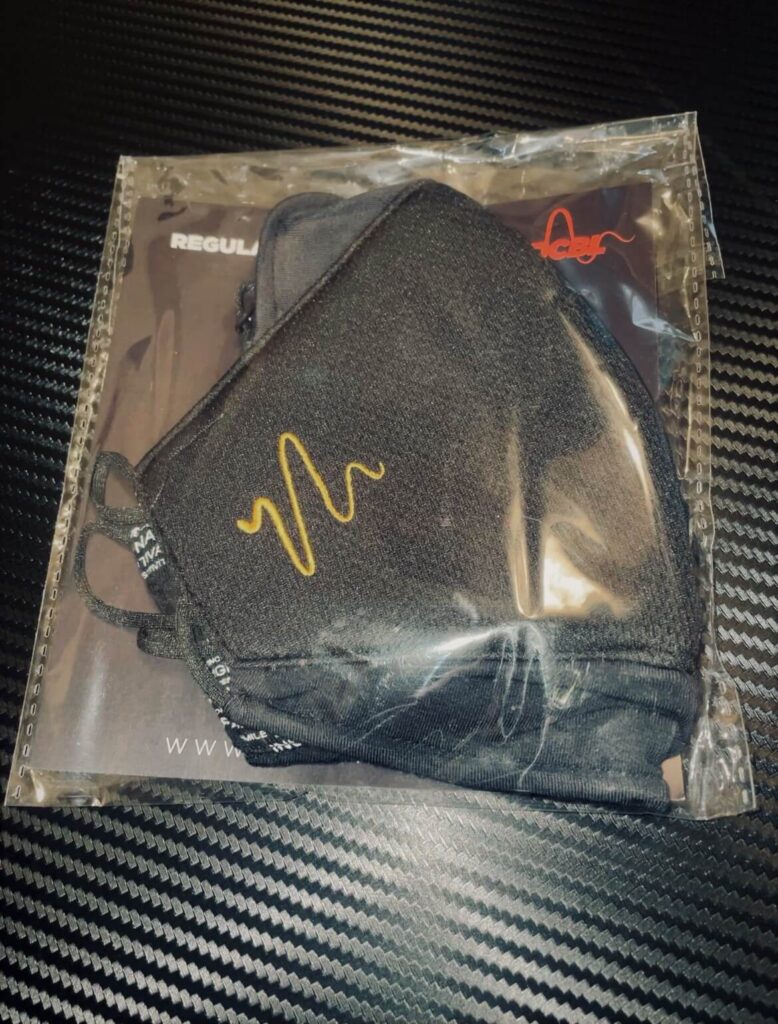
DCBL X-1 Mask, made by hospitality professionals for the hospitality industry

Wearing a mask is part of everyday life, particularly for hospitality industry professionals.

DCBL Masks was designed by hospitality professionals for the hospitality industry, born out of their reverence for the workers putting themselves at risk so the communities they serve can retain a semblance of their normal lives.

Their first mask, the X-1, is intended to provide solutions to the problems presented by other face coverings.

Thoughtful Design

One problem with the standard masks and face coverings we’ve grown accustomed to is their tendency to muffle voices. One of the driving design elements behind the DCBL X-1 is the projection of the wearer’s voice.

The X-1 is a three-piece mask and its second layer is what sets it apart from others. The middle layer is sound-enhancing, sculpted foam that allows the wearer’s voice to carry. No more going hoarse from yelling, no more (or less, at least) repeating oneself, no more guests leaning in or stepping closer to hear what’s being said (hopefully).

That second layer is also intended to improve breathability. The inside layer’s design provides an air pocket for similar breathing functionality. It’s also made of natural bamboo so it’s soft, moisture-wicking and cooling, and it receives an antimicrobial treatment.

The X-1’s outer layer is polyester and resists dust and moisture while also protecting against UV rays. There are two flexible “suspension” systems, one for the nose and one to seal the bottom of the mask. Straps are Spandex, ear loops are adjustable, and there’s a clasp system so the wearer can choose how to secure the mask to their head.

Designed by Industry Pros

DCBL is the brainchild of industry veterans Michael Tipps and Homan Taghdiri. Tipps and Taghdiri are the co-founders of both DCBL Masks and Invictus Hospitality, a consulting agency headquartered in Los Angeles.

Tipps boasts over two decades’ experience in hospitality. He got his start in South Florida and has worked every front-of-house position. His journey through hospitality helped him gain perspective regarding the challenges inherent to the industry, and he eventually co-founded Invictus.

Taghdiri worked in hospitaity for 13 years before becoming a licensed attorney in California. He has worked every position in the industry. While he no longer studies law, when he did, he specialized in real estate, business and the hospitality industry.

DCBL’s Mission

There are three main goals DCBL seeks to achieve: Protection, projection, and connection. I’ve explained how they achieve the first two goals.

If the first goal isn’t realized, goals two and three don’t matter. If DCBL whiffs on the second goal, the third is unachievable. The X-1 seeks to make conversation easier when wearing masks so people can feel more connected. Being separated by masks, distance, barriers, and staying at home is detrimental to us all. The DCBL X-1 addresses that issue.

As the DCBL website says, “Staying safe and making a living shouldn’t be as challenging as it has been.” I feel the brand accomplishes their deceptively simple goals.

Impressions

First things first, I didn’t receive my X-1 in exchange for this post or any monetary compensation. I was genuinely curious about the mask and placed an order for two.

My masks arrived in a black bubble mailer, making them seem a little cooler from the start. They were each sealed in their own packet with an insert that explained the three layers, different methods for securing the X-1, machine washing instructions, and more.

DCBL X-1 mask packaging

In my experience, the mask felt soft and comfortable before even putting it on. The X-1 feels like a well-constructed, high-quality mask.

DCBL X-1 Mask

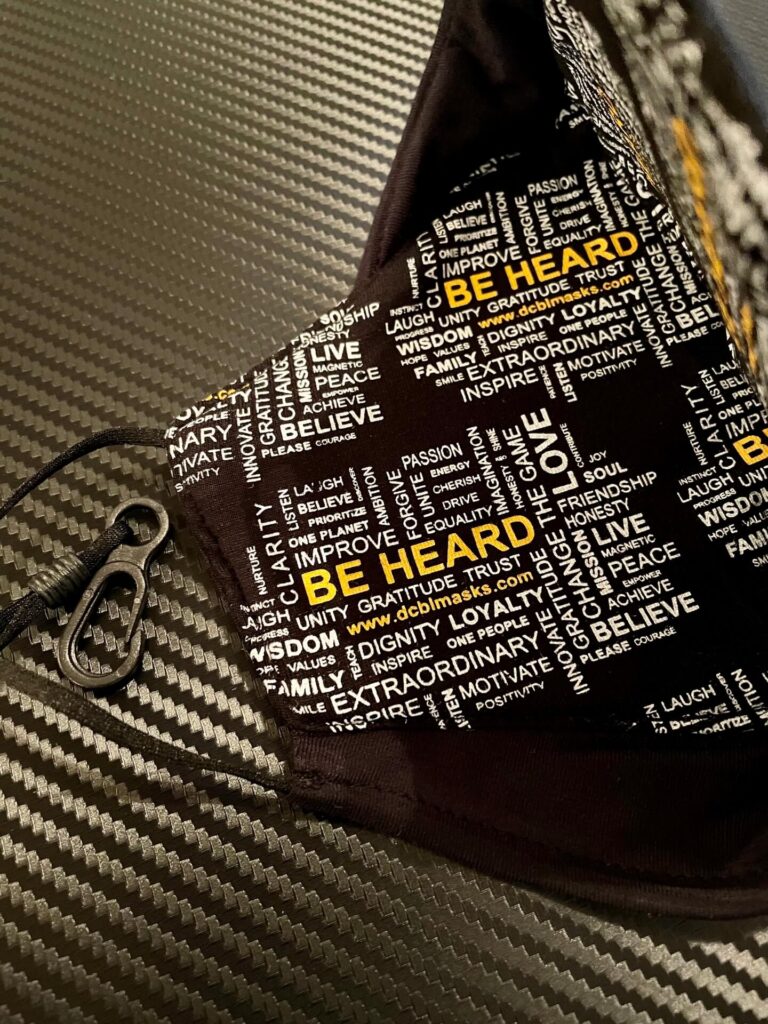
I have to say, I dig the interior layer. Not only is it soft and comfortable, the design detail is a nice departure from the white, black or pale blue to which we’ve all become accustomed:

Inside layer of DCBL X-1 face mask

It’s comfortable on my face and it allows me to speak comfortably, clearly and loudly no extra effort. I wore mine around my place and while writing this article. The ear loops are comfortable for me but the X-1 can be worn easily with an ear loop extension or toward the top of the head with the clasp system.

My glasses did fog slightly at first, but that became a non-issue after I adjusted the nose bridge suspension area.

Other people’s mileage may very, of course, but I feel that the mask delivers on DCBL’s mission statement: Be Heard.

To learn more and order the X-1, click here. connect with DCBL on Instagram and Facebook. Contact hello@dcblmasks.com for wholesale orders.

Disclaimer: The DCBL X-1 is not a medical-grade mask and is not intended as a replacement for medical-grade equipment or other recommended measures to stop the community spread of any viruses.

Images taken by author.

by David Klemt David Klemt No Comments

This Generation is Most Likely to Dine In

This Generation is Most Likely to Dine In

by David Klemt

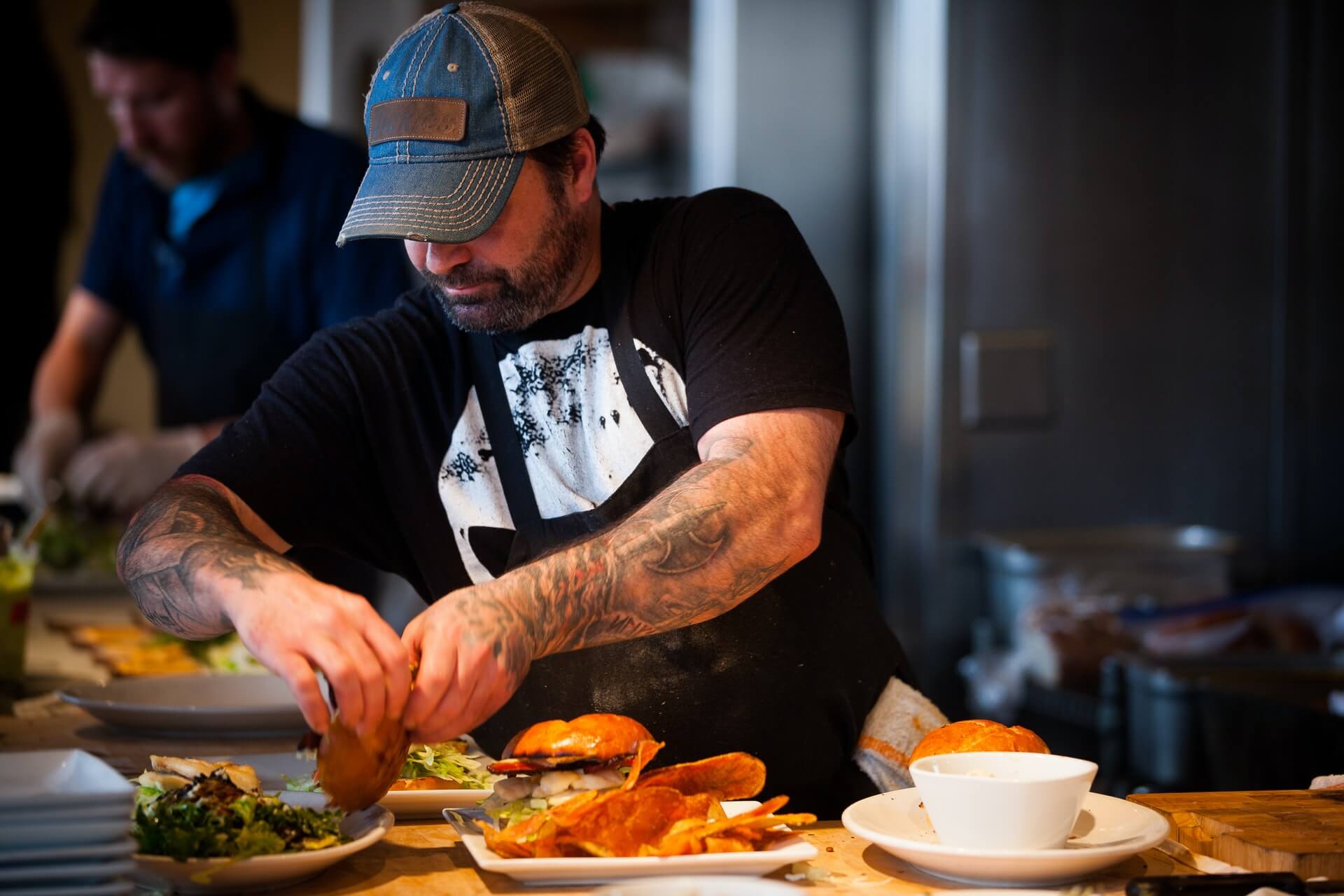
Chef preparing burgers inside restaurant

The National Restaurant Association’s 2021 State of the Restaurant Industry report revealed the generation most likely to dine in-person at a restaurant.

That is, of course, if such restaurant service—from quick-service to fine dining—is permitted where they’re located.

So, do you have a guess? Because we have the answer.

Most Likely to Dine In

Per an NRA survey, Gen Z is most eager to return to in-person restaurant dining.

However, it’s more of a simple majority that’s after a restaurant experience beyond delivery, takeout and curbside pickup than an overwhelming one.

Just 53 percent of adult members of Gen Z surveyed by the NRA are willing to dine inside restaurants over the course of the next few months.

Overall, 67 percent of Gen Z, Millennial, Gen X and Baby Boomer adults would like to engage with restaurants like they did before the pandemic. That’s not a huge stretch, of course; we all want to return to normal and put Covid-19 behind us.

Still, the survey results make it clear there’s demand for in-person dining. The convenience of interacting with and ordering from restaurants is here to stay. However, that convenience hasn’t replaced the desire to dine (and socialize) out.

So, Who’s Most Likely to Order In?

You’d be forgiven for assuming the answer to this question is also Gen Z. After all, just about every development regarding technology and how people engage with the world has been laid at their feet.

When Gen Z isn’t being accused of “killing” a tradition, sense of normalcy or an entire industry, the finger is pointed at Millennials.

Well, it turns out the usual finger-pointing suspects are the consumers most likely to order from restaurants.

According to the NRA’s report, 81 percent of Boomers and 80 percent of Gen X will continue to order from restaurants, at least for the next few months.

Put it All Together

At least for the next several months, the industry’s recovery will hinge on the full-strength return of in-person service and the convenience of delivery and takeout.

In other words, some consumers are champing at the bit to once again make restaurant visits a regular part of their lives while others plan to proceed with caution. Successful restaurant operations will maintain a mixture of traditional and digitally-driven services.

Nearly 90 percent of adults surveyed by the NRA say they enjoy going out to restaurants and that doing so with family and friends is a better way to spend leisure time than cooking at home.

“Restaurants are the cornerstone of our communities, and our research shows a clear consumer desire to enjoy restaurants on-premises more than they have been able to during the pandemic. We’ve also found that even as the vaccine becomes more available and more social occasions return to restaurants, consumers will continue to desire expanded off-premises options going forward. Both will continue to be key for industry growth,” said Hudson Riehle, senior vice president, Research and Knowledge Group, NRA, in a press release announcing the Association’s 2021 State of the Restaurant Industry. “With more than half of adults saying that restaurants are an essential part of their lifestyle, we are confident that, with time, the industry is positioned for successful recovery.”

The NRA predicts foodservice sales to reach $731 billion in 2021, an 11 percent increase over 2020. Unfortunately, that estimate is about 15 percent lower than sales generated in 2019.

Still, that’s a reason to be optimistic. Consumers are pent-up and eager to make restaurants a significant part of their lives once again.

Nobody is more eager, evidently, than Gen Z.

Image: Jesson Mata on Unsplash

by David Klemt David Klemt No Comments

2021 Technomic Outlook: United States

2021 Technomic Outlook: United States

by David Klemt

Technomic has been providing the foodservice industry with valuable insights on a global level for 50 years.

The research and consulting firm has been one of my go-to information sources for at least a decade.

A few weeks ago, I reviewed American food delivery trends from multiple sources. This week, I’m taking a look at Technomic’s foodservice predictions for the US.

Unprecedented and Unpredictable

Before we proceed, keep this in mind: predictions are best guesses. Technomic’s approach is scientific and data-driven but it’s important to approach any prediction with caution.

As the firm itself points out in their 2021 foodservice report, the global pandemic has plunged the industry deep into unprecedented territory.

It seems the only thing predictable about Covid-19 in relation to restaurants, bars and other hospitality businesses is that this industry will continue to bear the brunt of closures and restrictions.

That said, I trust Technomic to lead the industry through unprecedented and unpredictable moments in time.

7 Key Trends

Technomic has made seven predictions for foodservice in the US.

  1. Streamlined menus. Technomic expects the trend toward reducing SKUs to continue. However, that may lead to innovative and healthy items replaced removed items. Leafy greens, environmentally-friendly, and health-conscience items such as immune boosters are expected to be menued.
  2. Tech is the future. This prediction can be summed up quickly: If it’s a tech-based, can improve operations and help a brand differentiate itself from others, the industry is going to implement it.
  3. Top three cuisines. Chinese, Italian and Mexican food and drink are expected by Technomic to perform the best in 2021, particularly if operators move beyond the classics and incorporate lesser-known ingredients. However, Technomic expects more interest in West African and Caribbean cuisine.
  4. Social justice. Operators will have to be transparent about their stances on social justice issues and make meaningful statements—hashtags won’t cut it with younger consumers.
  5. Umami will reign supreme. Technomic uses the phrase “new-mami” to describe “intense, mouthwatering fare.” Think fruit vinegars beyond apple, candy cap mushrooms, seafood meatballs, and so much more.
  6. Communal concepts must adapt. Food halls, eatertainment concepts, and venues with communal seating will have to reimagine their spaces and how guests use them during an era characterized by social distancing, constant sanitizing, and off-premise business models. Traditional guest experiences may return but there’s no telling when that will happen.
  7. Revenue recovery. Technomic expects the industry to start recovering in 2021. However, sales levels are unlikely to reach those of 2019.

Bring it all Together

Chasing trends can be a fool’s errand. Not every prediction made by Technomic will work for every restaurant or bar in Canada.

Just like Technomic collects and analyzes industry data, operators must review their guest, sales and operations data to make informed decisions. This is another reason it’s crucial to own the guest journey in its entirety.

Click here to view Technomic’s “2021 U.S. Trend Outlook” webinar.

Image: Justin Cron on Unsplash

by David Klemt David Klemt No Comments

2021 Technomic Outlook: Canada

2021 Technomic Outlook: Canada

by David Klemt

Technomic has been providing the foodservice industry with valuable insights on a global level for five decades.

The research and consulting firm has been one of my go-to information sources for at least ten years.

A few weeks ago, I reviewed Canadian food delivery trends from multiple sources. This week, I’m taking a look at Technomic’s foodservice predictions for Canada.

Unprecedented and Unpredictable

First things first: predictions are best guesses. Technomic’s approach is scientific and data-driven but it’s important to approach any prediction with caution.

As the firm itself points out in their 2021 foodservice report, the global pandemic has thrown the industry into unprecedented territory.

It seems the only predictable element related to Covid-19 is that restaurants, bars and other hospitality businesses will bear the brunt of closures and restrictions.

That said, I trust Technomic to lead the industry through unpredictable, unprecedented moments in time.

5 Key Trends

Technomic has made five predictions for foodservice in Canada.

  1. 2021 will represent the start of financial recovery for foodservice. Technomic predicts moderate sales growth this year, below levels of 2019. However, limited-service restaurants are expected to perform better than their counterparts and return to 2019 revenue levels. Not surprisingly, Technomic expects full-service restaurants to be the most challenged.
  2. Operators will make their stances on social issues known. Multiple sources say today’s consumers want transparency from the brands they support. They want to know what company’s believe about climate change, food insecurity, social inequalities, diversity and hiring practices, fair pay for employees, and other issues. Technomic expects more operators to “double down” on transparency.
  3. On-premise operations will invest in off-premise business models. Again, multiple sources have reported that significant percentages of consumers are uncertain or uncomfortable about returning to restaurants and bars for in-person dining and drinking. Technomic expects operators to invest in smaller dining rooms so they can offer more limited-contact and contactless options to guests: walk-up ordering windows, multiple drive-thru lanes, designated curbside pickup locations, and in-store pickup and grab-and-go stations. The firm also expects more operators to embrace first-party/direct delivery, along with technologies like mobile ordering and geofencing.
  4. Comfort, quirkiness and indulgence. Technomic expects comfort foods to continue to perform well and encourages operators to get creative—even quirky—with this category. They caution that health will still be a focus of many guests and suggest that some operators will “disguise better-for-you meals as indulgent.”
  5. Our home and native land. Hyperlocality will play a crucial role in driving traffic given the travel restrictions imposed throughout Canada. Operators will likely forge relationships with local farms to attract local visitors to their venues. Technomic expects to see grassroots movements promoting support for small regional chains and local independent operations to gain traction.

Bring it all Together

Chasing trends can be a fool’s errand. Not every prediction made by Technomic will work for every restaurant or bar in Canada.

Just like Technomic collects and analyzes industry data, operators must review their guest, sales and operations data to make informed decisions. This is another reason it’s crucial to own the guest journey in its entirety.

Click here to view Technomic’s “2021 Canadian Trends Outlook” webinar.

Image: Hermes Rivera on Unsplash

by David Klemt David Klemt No Comments

Introducing KRG Mindset Coaching

Introducing KRG Mindset Coaching

by David Klemt

KRG Hospitality Mindset Coaching

Seeking an alternative to complete start-up planning and project management? The solution you’re looking for is KRG Mindset Coaching.

Just like every operator is unique, each project brings with it distinct challenges that require individual approaches and plans.

Some projects are already under way but need help moving forward. KRG Mindset gives these projects the help needed to cross the finish line and achieve long-term success.

What is Mindset Coaching?

Owning a hospitality business may look great on paper, but starting a hospitality business can be really quite stressful:

  • There are what seem to be endless hours of planning.
  • There are numerous third-parties involved.
  • There are often hundreds of thousands of dollars at stake.
  • There are over 500 unique tasks to complete.

It doesn’t matter if this is your first, fifth, or twentieth project—it’s crucial that you be both prepared and organized when opening a new concept or expanding operations.

However, not every project requires our full suite of targeted solutions, which includes feasibility studies, conceptual planning, business planning, brand development, guest experience strategies, food & beverage programs, and operational assessments.

If you’re beyond the idea stage but find your project is struggling to reach the finish line, we’re here to help. And just like a project in its earliest days, you’ll receive the unique, fully customized KRG treatment.

Is Mindset the Solution for You?

KRG Mindset provides a unique, coaching-style program that helps your start-up make continual forward progress:

  • Receive a dedicated consultant who will be an approachable advisor for you and your project. They’ll review and navigate your start-up questions and challenges, and be your compass to provide you with a clear path towards a successful opening.
  • Weekly 1-on-1 video/phone sessions with access to a private calendar: a weekly session in which we evaluate the past week and define required actions for the next week with a focus on budgets, timelines, and industry-specific consulting.
  • Your dedicated consultant is also available for second opinions and the review of: key documents, location, concept, branding, layouts, equipment, menu, service, technology, labor and financial optimization, system development, operations, marketing, and overall strategic clarity.
  • Your consultant will help you see the blind spots throughout your project, positioning you to maintain your budget and desired opening date.
  • Your consultant will help you make strong, educated decisions throughout your start-up project that will have a positive impact on the successful start of your restaurant, bar or hospitality brand.
  • And finally, your advisor will coach you so you become more confident, energized, and motivated about your opening while holding you accountable and helping you become a better leader through the creation of new habits, communication methods, and decision-making processes.

Click here to schedule a call.

Or, if you’re looking for a more hands-on approach where we develop the winning plans and property for and with you, we invite you to learn more by choosing your preferred option: Restaurants & Cafes, Bars & Lounges, Boutique Hotel & Resorts, or Golf, Gaming & Entertainment.

Images: KRG Hospitality

by David Klemt David Klemt No Comments

What You Need to Know About SBA Form 3508S

What You Need to Know About SBA Form 3508S

by David Klemt

Midway through last month, the Small Business Administration maneuvered to make the PPP loan forgiveness process simpler for loans up to $150,000.

In December of 2020, Congress passed a Covid-19 relief bill that pumped $284 billion into the Paycheck Protection Program.

Twelve billion dollars were made available to minority-owned and “very small” businesses, and $15 billion were made available to independent movie theaters, live music venues, and cultural institutions.

What is SBA Form 3508S?

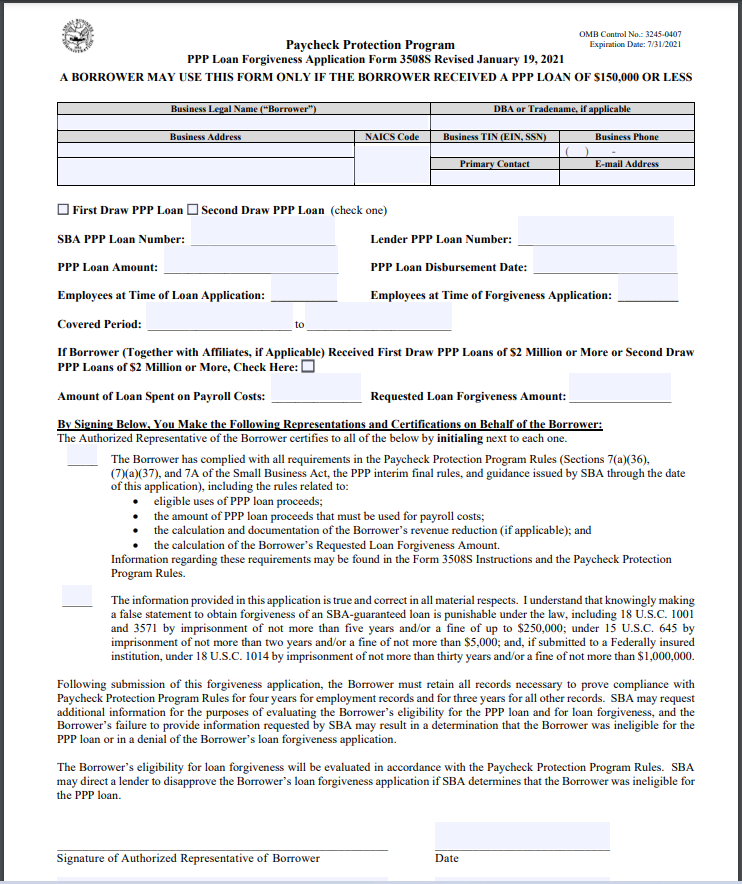
Simply put, 3508S is a simplified, one-page PPP loan forgiveness form.

When Congress passed December’s relief bill, they included a requirement for the SBA to offer streamlined loan forgiveness forms.

To that end, 3508S is for businesses that received loans of $150K or less. Again, it’s a single page. As you’ll see when you check out SBA Form 3508S, the form comes with instructions.

What information do you need to provide?

With Form 3508S, you’re not even filling out an entire page. And the first roughly third is simple. Assuming you’re the person filling out, certifying and signing the form:

  • Business legal name (“Borrower”)
  • If applicable, the DBA or Tradename
  • Business address
  • North American Industry Classification System (NAICS) code (Accommodation and Food Services is 72; Arts, Entertainment and Recreation is 71, for reference)
  • Business Taxpayer Identification Number (TIN), Employer Identification Number (EIN), or Social Security Number (SSN)
  • Primary contact
  • Email address

After filling out that section and ticking the box for first-draw PPP loans or second draw, you’ll need the following info:

  • SBA PPP loan number
  • Lender PPP loan number
  • PPP loan amount
  • PPP loan disbursement date
  • The number of employees at the time of the loan application
  • Number of employees at time of loan forgiveness application
  • Covered period of PPP loan. Per the form instructions, “The Covered Period begins on the date the loan was originally disbursed. It ends on a date selected by the
    Borrower that is at least 8 weeks following the date of loan disbursement and not more than 24 weeks after the date of loan disbursement.”
  • Total amount of loan spent on payroll costs
  • Requested amount of loan forgiveness

From there, you initial two boxes–if you can do so accurately and honestly–next to certification statements. Then you sign, print and the date form and include your title.

There’s an optional demographic information section at the top of page two of Form 3508S.

SBA Form 3508A. Sample only.

What additional documentation must you provide?

None, which is what makes this form so simple. In fact, you’re not even required to show any of your calculations corresponding form sections. However, we strongly suggest you run those calculations as you’ll need to certify that you did so and you’ll need them if the SBA audits the loan.

And while you don’t have to submit additional documents, it’s likewise required and smart that you retain required documentation for a number of years. The SBA may ask for certain documents when your application comes up for review, so you’ll want to know where they are to make the process as smooth as possible.

What’s the loan forgiveness deadline?

There’s no specific date in terms of an SBA PPP loan deadline. However, the SBA’s PPP loan forgiveness FAQ states the following:

  • “Borrowers may submit a loan forgiveness application any time before the maturity date of the loan, which is either two or five years from loan origination.”
  • “[I]f a borrower does not apply for loan forgiveness within 10 months after the last day of the borrower’s loan forgiveness covered period, loan payments are no longer deferred and the borrower must begin making payments on the loan.

You may notice that Form 3508S has an expiration date of July 31, 2021 in the upper right-hand corner. This simply indicates the SBA’s compliance with the Paperwork
Reduction Act.

There are other SBA PPP loan forgiveness applications as well. SBA Form 3508-EZ is for borrowers who meet specific conditions, and Form 3508D is for borrowers to disclose controlling interests in the business by other companies, along with government officials involved in the business.

If none of those forms are right for you, you’ll have to fill out the standard, five-page Form 3508.

Image: Cytonn Photography from Pexels

by David Klemt David Klemt No Comments

Finalizing Your Big Game Menu? Google is Here to Help

Finalizing Your Big Game Menu? Google is Here to Help

by David Klemt

Operators putting the final touches on their delivery, takeout, meal kit and Big Game menus for February 7 could probably use some help.

None of us have a crystal ball but we do all have access to Google Trends intel, which is often just as good.

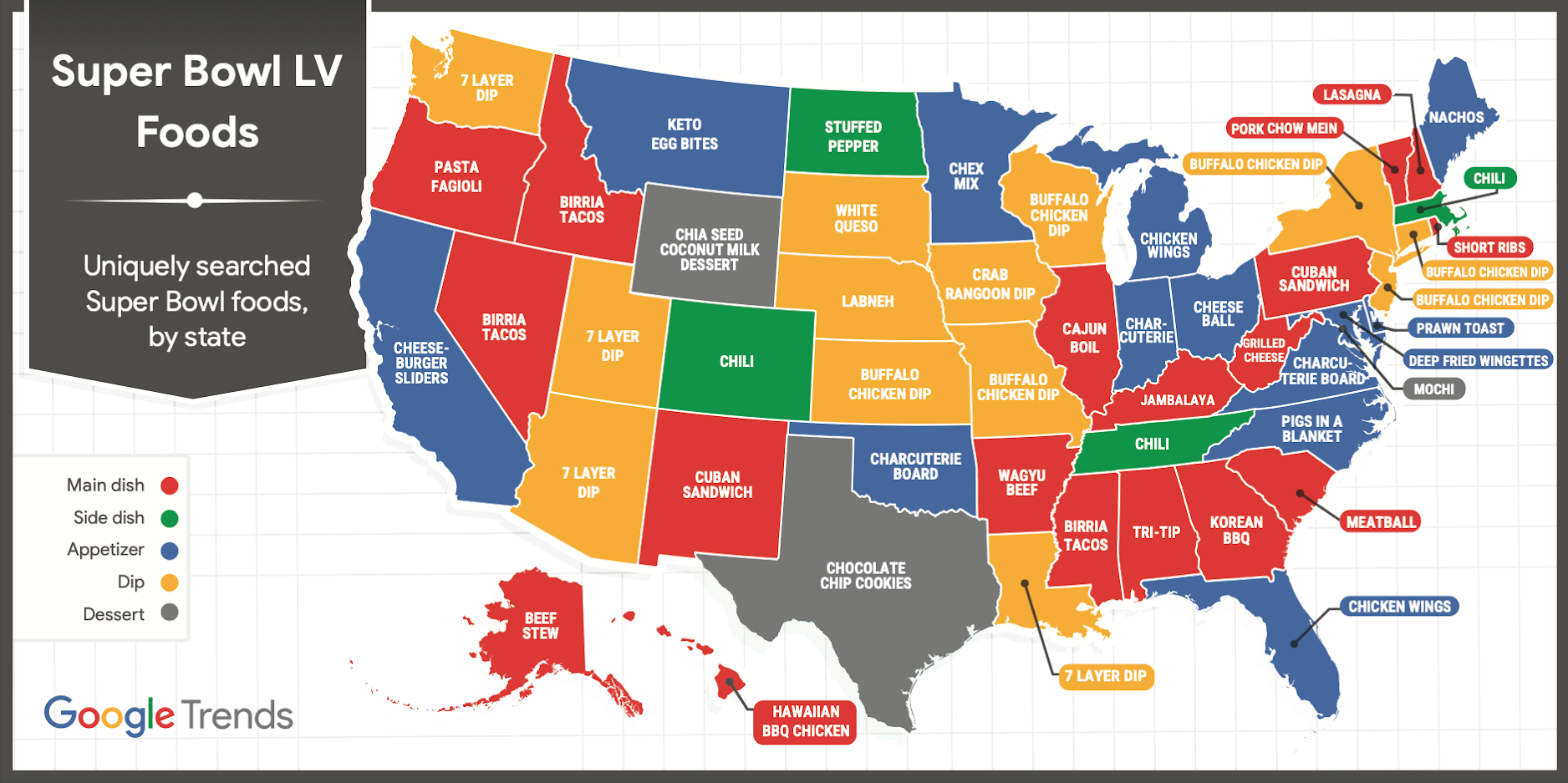
Google’s latest data-driven infographic is just in time for this coming weekend: Uniquely searched Super Bowl foods, by state.”

The information, neatly categorized by food item type, provides insight into what people in each state are interested in ordering from restaurants or featuring at their at-home gathering. Such data can help operators dial in their menus and create Big Game packages, offering customers a convenient way to enjoy their favorite foods while they watch the Big Game.

Unique Super Bowl Food Searches

Google color-coded their infographic. Red represents main dishes, green is for side dishes, appetizers are blue, dip is yellow, and grey denotes dessert. As the Google map shows, several states are more into snacks than entrees.

Eighteen states are red. Interestingly, a specific item is the top search in three states. Nevada, Idaho and Mississippi are dominated by birria tacos. Cuban sandwich was the top search in two states: New Mexico and Pennsylvania. The other 13 states each have top searches unique to them:

  • Oregon: Pasta fagioli
  • Alaska: Beef stew
  • Hawaii: Hawaiian BBQ chicken
  • Illinois: Cajun boil
  • Arkansas: Wagyu beef
  • Kentucky: Jambalaya
  • Alabama: Tri-tip
  • Georgia: Korean BBQ
  • South Carolina: Meatball
  • West Virginia: Grilled cheese
  • Rhode Island: Short ribs
  • Vermont: Pork chow mein
  • New Hampshire: Lasagna

Just four states are green, and chili is the top search in 75 percent of those: Colorado, Tennessee and Massachusetts. North Dakota is the outlier with stuffed peppers.

There are 13 states colored blue. The top football food search in three of those—Oklahoma, Virginia and Indiana—is charcuterie board. Surprisingly, chicken wings are the top search in just two states, and neither is their state of origin: Michigan and Florida. The most unique appetizer, at least in our view, is Montana’s interest in keto egg bites. Although, Maryland’s search for deep fried wingettes is very specific and Delaware’s search for prawn toast is rather distinct. What’s commonly assumed to be a sports bar and Super Bowl staple, nachos, was only the top search in one state: Maine. California searched for cheeseburger sliders, Minnesota looked up Chex Mix, Ohio is most interested in cheese ball, and North Carolina is all about pigs in a blanket.

Another 13 states are most interested, per Google data, in dip (yellow states). In particular, Buffalo chicken dip reigns supreme. It’s the top search in six states: Kansas, Missouri, Wisconsin, New Jersey, Connecticut and, somewhat predictably, New York. However, 7-layer dip is a close second, dominating four states: Washington, Arizona, Utah and Louisiana. Nebraska may lay claim to Most Unique Dip Search with labneh. South Dakota looked up white queso the most, and Iowa prefers crab rangoon dip.

Only two states and Washington, DC, searched for dessert items the most. Wyoming’s top search was incredibly specific: chia seed coconut milk dessert. Texas wants chocolate chip cookies, and our nation’s capital searched for mochi.

Unfortunately, this Google Trends data doesn’t include Puerto Rico. You can view the infographic by scrolling down.

Takeaways

Top main dish: Birria tacos

Top side dish: Chili

Top appetizer: Charcuterie board

Top dip: Buffalo chicken

Google Trends most unique Super Bowl LV food search

Super Bowl LV: Uniquely searched Super Bowl Foods, by state. Google Trends.

Map image: Google

Featured image: Jeswin Thomas on Unsplash

by David Klemt David Klemt No Comments

Los Angeles Restaurants Face New Outdoor Dining Restrictions

After Weeks of Prohibition, This is What Los Angeles Restaurants are Facing

by David Klemt

Limited to delivery and takeout for several weeks, Los Angeles restaurants and breweries may now offer outdoor dining.

Of course, that easing of restrictions comes with a raft of new limitations.

The outdoor dining ban was lifted last Friday, January 29. Governor Gavin Newsom rescinded California’s statewide stay-at-home order four days prior, January 25.

Operators, still caught firmly in the vortex of opens, closures and ever-shifting restrictions, will have to weigh the potential to generate in-person dining revenue against limitations and costs.

Outdoor dining capacity of restaurants, breweries and wineries (able to open for outdoor tastings) is restricted to 50 percent. Even an operator with a significant outdoor footprint may find the revenue generated from in-person dining incapable of offsetting associated costs.

Speaking of footprint, operators must also contend with new distance requirements. Outdoor tables must now be spaced a minimum of eight feet apart to ensure guests aren’t seated back to back. This increase from six feet must be measured from the edges of each table.

Any employee who “may come in contact” with a guest is required to wear a face mask and a face shield for the duration of such an interaction, which can’t include tableside preparations.

No live entertainment is permitted, and televisions must remain turned off. Couple the television ban with a prohibition on “coordinated, organized or invited events or gatherings” and Super Bowl parties are clearly not permitted.

Additional limitations pertain to guests and group size. No more than six people may be seated at a table, and each guest must be a member of the same household. Signage informing guests of the household requirement must be posted, and guests must also be given this information verbally.

A “household” in Los Angeles County is defined as “persons living together as a single living unit.” Click here for the County of Los Angeles Department of Public Health’s “Protocol for Restaurants, Breweries and Wineries: Appendix I.”

According to Dr. Barbara Ferrer, Los Angeles County health director, operators can expect increased scrutiny and enforcement of Covid-19 protocols.

Evidence of enhanced enforcement efforts was seen last week. LA County filed two suits on January 27 against Cronies Sports Grill in Agoura Hills and Tinhorn Flats in Burbank for failing to adhere to health directives. Both suits label the establishments as “public nuisances.”

Some Los Angeles operators may find limited outdoor dining better than no in-person dining at all. However, others may conclude that labor and PPE costs alone aren’t worth restricted reopening, to say nothing of contending with increased governmental scrutiny.

Image: David Mark from Pixabay

by krghospitality krghospitality No Comments

National Restaurant Association Opposes Elimination of Tip Credit

National Restaurant Association Opposes Elimination of Tip Credit

by David Klemt

Citing a 600-percent increase in labor costs, the National Restaurant Association opposes the elimination of the tip credit.

An email sent out yesterday by NRA executive vice president of public affairs, Sean Kennedy, stated that doing away with the credit would present “an impossible challenge to restaurant owners” to remain open.

The email also opposes boosting the national minimum wage to $15 per hour.

Not every operation would see labor costs potentially skyrocket to untenable levels but wage changes could see restaurants, bars and other businesses in some states hit the cited 600-percent increase. If the majority of restaurant operators saw sales decline last month, as a previous NRA report said operators predicted, and that trend continues, the association’s standpoint could be proven right.

While the NRA continues its support for making the RESTAURANTS Act part of any new stimulus relief bill, the association has made their positions on the matter of a minimum wage hike and elimination of the tip credit clear:

“But now is not the time to insert wage changes–a hike in the minimum wage and elimination of the tip credit–to a stimulus bill. Tipped servers generally earn between $19-$25 dollars per hour, and this plan would punish these workers who use restaurant jobs to make a better life for themselves.”

The NRA appears concerned that the Biden administration’s efforts to quickly get Congress to pass a Covid-19 relief bill are short-sighted and will end up hurting tipped workers and the hospitality industry overall.

According to the message sent out yesterday, the majority of tipped workers across the country have, historically, opposed efforts to eliminate the tip credit. Per the NRA, tipped workers earn between $19 to $25 per hour when the tip credit remains intact.

Instead, the NRA prefers the next stimulus relief bill–there are currently two competing bills, one for $1.9 trillion plan and a GOP counterplan with a price tag of around $600 billion–to go with the Senate version of the RESTAURANTS Act.

If you agree with the NRA’s concerns, click here to take action.

Image: Mathieu Turle on Unsplash

by David Klemt David Klemt No Comments

Current Restaurant, Bar and Travel Restrictions: Eastern Caribbean

Current Restaurant, Bar and Travel Restrictions: Eastern Caribbean

by David Klemt

KRG Hospitality has turned hospitality industry visions into reality throughout the Eastern Caribbean for several years.

We’ve reviewed and gathered the current Covid-19-based travel and operator restrictions for Puerto Rico, the US Virgin Islands, the British Virgin Islands, St. Martin and Sint Maarten to help current operators and those considering taking the next steps in their journey toward opening their own businesses.

To book a 15-minute introductory call to discuss your project and how we can help you realize your vision, click here.

Puerto Rico

Earlier this month, Governor Pedro Pierluisi revised Puerto Rico’s Covid-19 protocols.

Travel Requirements

  • Complete travel declaration and:
  • arrive with proof of a negative (molecule-based) Covid-19 test; or
  • self-quarantine (at traveler’s expense) either 14 days or the duration of your trip, whichever is shorter.
  • While in Puerto Rico, travelers must:
    • wear a mask at all times when in public;
    • wash hands frequently;
    • wipe down high-touch surfaces;
    • practice social distancing; and
    • keep track of and minimize places visited and interactions with people.

Requirements

  • Island-wide curfew from 11:00 PM to 5:00 AM.
  • Hotels: Common areas closed from 11:00 PM to 5:00 AM.
  • Restaurants: Limited to 30-percent capacity.
  • Bars and Discos: Closed.
  • Movie theaters and casinos: Limited to 30-percent capacity.
  • All businesses must close by 10:00 PM.

Recommendations

  • Reservations for restaurants visits.

US Virgin Islands

The Virgin Islands Department of Health has provided incredibly detailed guidance for restaurants, bars and nightclubs. Click here for the full details. The USVI include the main islands of Saint Croix, Saint John, and Saint Thomas, and several so-called “minor” islands.

Travel Requirements

  • All air and sea travelers to the US Virgin Islands five years of age or older are required to use the USVI Travel Portal and submit a Covid-19 test before travel. This includes anyone in-transit to another destination.
    • Acceptable tests: COVID-19 molecular from a nasal or throat or saliva swab, COVID-19 antigen (rapid) test from a nasal or throat swab, Covid-19 antibody finger stick or blood draw.
  • Travelers who originate in the USVI and return to the territory, including those who return within a five-day period, are required to take a Covid-19 test before returning or have proof of a positive antibody test result within the previous four months.

Requirements

  • All restaurant, bar and nightclub employees reporting for work must be screened for Covid-19 using this questionnaire.
  • Employers can either conduct temperature checks onsite with a no-touch thermometer or employees may check their temperatures before arriving at the workplace and have the results verified by management onsite. Temperatures should not exceed 100.3 degrees Fahrenheit.
  • Employees and guests must wear masks at all times unless eating or drinking.
  • At the minimum, ask guests the following questions before allowing entry:
    • Have you been in close contact with a confirmed case of COVID-19?
    • Are you experiencing a cough, shortness of breath or sore throat?
    • Have you had a fever in the last 48 hours?
  • Capacity is limited to 50 percent (as defined by Business License or the Fire Marshall) or 100 guests, whichever is fewer.
  • Space tables and barstools six feet apart.
  • No more than six guests may be seated at the same table.
  • Serving alcohol at bar counters is prohibited.
  • Guests picking up takeout orders must wait outside until their order is ready.
  • The sale of alcohol between 11:00 PM and 8:00 AM by all restaurants and establishments with a Tavern Keeper A or Tavern Keeper B license is prohibited.
  • Restaurants must remain closed between the hours of midnight and 6:00 AM.
  • All bars and nightclubs are permitted to operate only for seated service.
  • Cabarets remain closed.
  • Last call for bars and nightclubs—without exception—is at 11:00 PM.
  • Guests of bars and nightclubs are required to wear masks unless seated at their designated table.
  • Live music and DJs must cease performances at closing time: Midnight.

Recommendations

  • Whenever possible, require reservations for visits and deliveries.
  • If possible, prioritize curbside pickup and takeout over in-person dining.

British Virgin Islands

The BVI, which consist of Tortola, Virgin Gorda, Anegada, and Jost Van Dyke and more than 50 smaller islands and cays, were closed for nine months before reopening to travelers on December 1, 2020. The Government of the Virgin Islands, however, imposed a travel ban on anyone travelling from the United Kingdom and the Dominican Republic to the BVI effective January 11.

Travel Requirements

  • Travelers must start their application no later than 48 hours before travel.
  • Applications on the BVI Gateway portal must be completed a minimum of 24 hours before travel date and time.
  • All applicants who are in “pending” status and haven’t completed their necessary requirements 24 hours prior to travelling will be denied entry.
  • Travelers must have proof of negative Covid-19 PCR test taken within 5 days prior to day of travel and proof of medical insurance that includes coverage for Covid-19.
  • Visitors are required to quarantine for four days on the property of their approved accommodations or at their own home. Arrival day is considered day zero.
  • Air travelers: Visitors can arrive at the Terrance B. Lettsome Airport (EIS) on Tortola.
  • Sea travelers: Visitors can arrive at Road Town Ferry Terminal.

Requirements

  • As of January 28, a curfew is in place from 2:01 AM to 4:59 AM daily until February 11. Businesses are permitted to operate between the hours of 5:00 AM to 2:00 AM daily if they’ve been inspected and approved by the Social Distancing Monitoring Task Force and certified by the Environmental Health Division.
  • Gold Seal Professional Level Certification: A nine-hour training course (three hours over three days) that incorporates COVID-19 training and professional-level hospitality service training required for front-line personnel across all hospitality industry sectors, specifically front desk representatives, guest room attendants, restaurant servers and kitchen cooks.

St. Martin and Sint Maarten

This 37-square-mile island has two sides, the St. Martin (the French) and Sint Maarten (the Dutch).

Travel Requirements

  • All travelers arriving by air must complete Electronic Health Authorization System (EHAS) application.
  • As of January 27, 2021, all travelers embarking in Aruba are required to submit a negative rt-PCR test within 72 hours before departure to Sint Maarten (until further notice)
  • As of February 12, 2021, the rt-PCR test time frame will be reduced from 120 to 72 hours, before departure to St. Maarten for all travelers originating from a high-risk country (last leg in case of connecting flights).
  • Travelers arriving via sea from a low-risk country are exempt from Covid-19 testing.
  • Travelers arriving via sea from a moderate- to high-risk country must complete an rt-PCR test 120 hours prior to departure from last port (must be the immediate last departure point).

Requirements

  • Restaurants, bars and nightclubs must close by midnight. This applies to the Dutch side of St. Maarten as well.
  • Casinos on the Dutch side must close by 2:00 AM.
  • No more than 6 people may be seated at any given table.
  • Tables and contact surfaces must be thoroughly disinfected with an antiviral product.
  • It is mandatory for staff and customers to wear a mask when moving around.

Last updated: January 28, 2021. Please note that Covid-19 guidance, restrictions and protocols are subject to swift change. One should monitor their jurisdictions for the latest updates.

Image: Colin Chong on Unsplash

by David Klemt David Klemt No Comments

Current Restaurant and Bar Restrictions: Las Vegas, Nashville, Philadelphia, Orlando

Current Restaurant and Bar Restrictions: Las Vegas, Nashville, Philadelphia, Orlando

by David Klemt

KRG Hospitality has turned hospitality industry visions into reality throughout the United States for several years.

Currently, we operate in Las Vegas, Nashville, Philadelphia and Orlando, along with the surrounding areas. Of course, we’re available to take projects from the idea phase to opening doors and beyond in other markets.

We’ve reviewed and gathered the current Covid-19-based restrictions for each of the four main US markets in which KRG operates to help current operators and those considering taking the next steps in their journey toward opening their own businesses.

To book a 15-minute introductory call to discuss your project and how we can help you realize your vision, click here.

Las Vegas

Set to expire on January 15, Nevada’s statewide “pause,” first implemented on November 24, was extended January 11 for a further 30 days. Guidance can be found here.

Requirements

  • Restaurants and bars must reduce capacity from 50 percent to 25 percent for both indoor and outdoor dining.
  • Bar seating must be social distanced.
  • Walk-ins are prohibited. Guests must make reservations.
  • Masks must be worn when a guest isn’t eating or drinking.
  • No more than four people may share the same table.
  • Nightclubs and dayclubs aren’t permitted to open.

Recommendations

  • Curbside, delivery, and/or takeout are encouraged.
  • Restaurants and bars should continue to make hand sanitizer available and conduct health screenings and/or temperature checks.
  • Limit personal gatherings to ten people from a maximum of two families.
  • Wear masks at indoor and outdoor gatherings.

Nashville

Among Nashville’s restaurant and bar guidance is the “No Seat, No Service” mantra. Additional requirements and recommendations are below, and detailed information can be found here.

Requirements

  • All residents and all visitors must wear face coverings when in public.
  • Restaurants and bars limited to 5o-percent capacity, with social distancing.
  • Tables must be socially distanced. Limited to eight people per table.
  • Surfaces must be cleaned after they’ve been used by patrons.
  • Standing at the bar is prohibited–bars are seated-service only.
  • Remember “No Shirt, No Service”? The new rule is “No Seat, No Service.”
  • Customers must wear a mask when standing up and walking through the restaurant or bar.
  • Entertainment is permitted but barriers must be in place between performers and customers. However, dance floors are prohibited.
  • Bar games and activities like darts, arcade games, etc., must be sanitized in between uses.
  • Last call for service is 10:00 PM, which is also the cutoff for entry.
  • No self-service food or condiments are permitted.

Recommendations

  • Governor Bill Lee urges Tennesseans to wear a mask, gather only with immediate household members.
  • Display this sign to show commitment to mandated and recommended health and safety rules and practices.
  • Use contactless, virtual or disposable menus.

Philadelphia

The current restrictions went into effect November 20. Click here for the full list of requirements and recommendations. You’ll find the city’s complete hotel guidance here.

Requirements

  • Required protections: Masks, Barriers, Staff education, Employee symptom screening and isolation of infected employees, Ensure employees can remain six feet away from one another; Handwashing on employee arrival and in accordance to established food safety precautions, Follow Department of Public Health Food Safety regulations.
  • 25-percent capacity of stated fire code occupancy.
  • Guests may not stand in the restaurant or sit at the bar.
  • Alcohol may only be served on-premises if it’s part of the same transaction as a meal.
  • Table capacity of four people of the same household or less.
  • Outdoor dining capacity limited to fewer than 50 people.
  • Operators must plan for inclement weather in regards to outdoor dining.
  • No entertainment permitted.
  • Indoor catered events prohibited.
  • Last call for orders must take place at 11:00. Business must be closed for service by midnight.

Recommendations

  • Servers should wear face shields and/or goggles along with a mask.
  • Temperature checks for employees and customers aren’t required but no-touch thermometer should be used by establishments that choose to conduct them. Anyone with a temperature of 100.4 degrees or higher should be turned away.
  • Consider using physical barriers in between tables.
  • Use contactless payment methods.
  • Promote online ordering, delivery, and curbside pickup options.

Hotel Requirements

  • Required protections: Provide masks to employees, Staff education, Employee symptom screening and isolation of infected employees, Ensure employees can remain six feet away from one another; Provide employees hourly handwashing breaks.
  • Separate staff from customers at ticket and information desks with plastic barriers.
  • Utilize contactless room service delivery.
  • Outdoor events and gatherings are prohibited from exceeding 10 percent of maximum occupancy (maximum of 2,000 persons), even with masks and social distancing. If no maximum occupancy is known, occupancy may not exceed more than 10 persons per 1,000 square feet.
  • Remove self-serve F&B stations from public areas.
  • Remove magazines, menus, and other reusable items that can’t be cleaned from guest rooms.
  • Indoor gatherings and events are prohibited.

Hotel Recommendations

  • Use contactless payment methods.
  • Increase building ventilation.

Orlando

Unlike Las Vegas, Nashville and Philadelphia, Orlando, because it’s located in Florida, has lifted restrictions on restaurants. Section 3: Restaurants of Executive Order 20-244 states:

“Pursuant to Chapter 252, including sections 252.36(5)(b ), (g) and (h), Florida Statutes, and in order to safeguard the economic vitality of this state, any restaurant may operate as set forth below.

“A. Restaurants, including any establishment with a food service license, may not be limited by a COVID-19 emergency order by any local government to less than fifty
percent (50%) of their indoor capacity. If a restaurant is limited to less than one hundred percent (100%) of its indoor capacity, such COVID-19 emergency order
must on its face satisfy the following:

“1. quantify the economic impact of each limitation or requirement on those restaurants; and 2. explain why each limitation or requirement is necessary for public health.

“B. Nothing in this order preempts or supersedes a non-COVID-19 municipal or county order.

“Section 4. Suspension of COVID-19-related Individual Fines and Penalties This order, consistent with Executive Order 20-92, suspends the collection of fines and
penalties associated with COVID-19 enforced upon individuals.”

The order that closed bars has also been rescinded: “Bars and other alcoholic beverage vendors may operate for consumption on premise effective Monday, Sept. 14th
under Phase 2… Adhere to social distancing rules, table seating [six feet] between tables. Alcohol allowed for take-out and delivery.”

However, Executive Order 20-192 is still in place and states:

“WHEREAS, on March 17, 2020, I issued Executive Order 20-68, as extended by Executive Order 20-112, which authorized the Department of Business and Professional
Regulation to ensure all restaurants implement employee screening and to prohibit any restaurant employee from entering the restaurant premises if he or she meets certain criteria indicative of concerns related to COVID-19.”

More details can be found here.

Last updated: January 27, 2021. Please note that Covid-19 guidance, restrictions and protocols are subject to swift change. One should monitor their state, county and city for the latest updates.

Image: Katy Anne on Unsplash

by David Klemt David Klemt No Comments

Current Restaurant and Bar Restrictions: Toronto, Calgary, Vancouver

Current Restaurant and Bar Restrictions: Toronto, Calgary, Vancouver

by David Klemt

For more than a decade, KRG Hospitality has turned hospitality industry visions into reality throughout Canada.

Currently, we operate in Toronto, Calgary and Vancouver and the surrounding areas.

We’ve reviewed and gathered the current Covid-19-based restrictions in Ontario, Alberta and British Columbia to help current operators and those considering taking the next steps in their journey toward opening their own businesses.

To book a 15-minute introductory call to discuss your project and how we can help you realize your vision, click here.

Toronto

On January 25, the province of Ontario officially extended the current state of emergency (which includes a stay-at-home order) by 14 days by Premier Doug Ford. Had Premier Ford not extended the emergency order, it would’ve expired Tuesday of this week. Unless extended again, it will expire February 11.

What this means for restaurants, bars and other types of F&B establishments is that indoor and outdoor dining are banned currently. Delivery, takeout and drive-through service are permitted.

Individuals face $750 fines (up to a maximum of $100,000) and corporations could be hit with $1,000 fines (up to a maximum of $500,000 for a director or officer) for a violation of emergency orders.

When the state of emergency expires or is otherwise rescinded, Ontario is expected to revert to the regulations found within the Reopening Ontario Act (currently suspended). Should Ontario find itself immediately colour-coded Grey, the current restrictions on restaurants and bars will remain identical: only delivery, takeout and drive-through service will be allowed.

Among other restrictions, a Red control level means restaurants are restricted to indoor dining capacity of ten people, outdoor dining is permitted, customers must be seated and two metres apart from one another, liquor may only be sold within a 9:00 AM to 9:00 PM window, face coverings must be worn except when eating or drinking, and nightclubs may only operate as a restaurant or bar.

Orange level restrictions include a 50-person capacity limit, a maximum of four people per table, customers must be screened before entry, liquor may only be sold between the hours of 9:00 AM and 9:00 PM, establishments must close by 10:00 PM, and gentlemen’s clubs must remain closed.

The Yellow control level is marked by the following restrictions: no more than six people may be seated at the same table, liquor may only be sold between 9:00 AM and 11:00 PM, establishments must close by midnight, music levels may not exceed that of a “normal conversation,” and all seated patrons must provide contact information.

Green control doesn’t mean everything is back to pre-pandemic “normalcy.” Tables must still be at least two metres apart, customers must be seated, face coverings must be worn except when eating or drinking, no buffet-style service is permitted, nightclubs may only operate as restaurants or bars, and contact information for at least one person per party must be collected. Restricted dancing, singing, performing and karaoke (no private rooms) are permitted.

Calgary

On December 13, 2020, indoor and outdoor dining was banned throughout Alberta. Current Covid-19-related public health measures and restrictions have been extended until further notice. The province’s restrictions affect restaurants, bars, cafes, pubs, and lounges (and other businesses, of course).

Only delivery, takeout and curbside pickup are permitted in Alberta. However, this is expected to change on February 8, 2021.

Hotels, motels and lodges are open but may not offer access to gyms, pools or spas. Indoor dining is banned but room service permitted. Casinos must remain closed.

Movie theatres, bowling alleys, pool halls and other entertainment businesses may not open for business.

If Alberta returns to the previous relaunch strategy, the province will be subject to a three-stage reopening. However, the document hasn’t been updated since June 2020.

Update: Alberta allowed restaurants and bars to reopen for in-person services yesterday, February 8. Indoor alcohol service must end by 10:00 PM, and indoor dining service must cease by 11:00 PM. Contact information from one person of the dining party must be collected, there’s a limit of six people maximum per table and each individual must be from the same household. Alternatively, the maximum per table for an individual living alone is there two close contacts. Tables must be spaced two metres apart and no entertainment is permitted.

Vancouver

British Columbia is far less restrictive than Ontario and Alberta, at least at the moment. The restrictions in place currently affect restaurants, bars, cafes, cafeterias, coffee shops, lounges, and tasting rooms. Nightclubs, however, must remain closed.

Requirements

  • Unless a physical barrier is in place, customers not in the same party must be at least two metres away from one another.
  • No more than six people may be seated at the same table or booth, even if they’re members of the same party.
  • If seated at a counter, customers must be two metres apart unless they’re in the same party or physical barriers are in place.
  • No more than six customers of the same party may be seated at a counter less than two metres from one another.
  • Businesses that offer self-serve food or non-alcohol drink stations must: ensure alcohol-based hand sanitizer or handwashing facilities are “within easy reach”; signage reminding customers to wash or sanitize their hands before touching anything on the stations and to maintain two metres from other customers must be present; utensils and high-touch surfaces at the stations must be cleaned and sanitized “frequently.”
  • Dance floors must be closed, and karaoke, singing, jam sessions, open mic sessions, and dancing are prohibited.
  • Background music or sounds may not be amplified or exceed the volume of a “normal” conversation.

Further details can be found here.

Last updated: February 9, 2021. Please note that Covid-19 guidance, restrictions and protocols are subject to swift change. One should monitor the country, provinces and cities for the latest updates.

Image: James Wheeler from Pexels

by David Klemt David Klemt No Comments

Rise of the ‘Not’ Delivery Platforms

Rise of the ‘Not’ Delivery Platforms

by David Klemt

The big third-party delivery services are facing pushback in the form of community-based competition.

We’ve kept our eye on this burgeoning trend and the push for operators to implement first-party delivery, also known as direct delivery.

It isn’t directly related to hospitality but the first of the “not” sites that grabbed our attention was Not Amazon. As the name suggests, Not Amazon is…well…not Amazon.

The founder highlights businesses owned and operated by women and BIPOC and LGBTQA+ people. However, Not Amazon goes even further, as illustrated in their mission statement:

“Providing the most we can, while taking as little as possible, in order to build a new kind of community.”

Community and neighborhood support is at the core of Not Amazon. The digital era has been marked by local, mom-and-pop brick-and-mortar businesses suffering in the wake of online shopping. Convenience has outweighed community. More often than not, women-, BIPOC- and LGBTQA+-owned businesses have been disproportionately affected by “convenience.”

Of course, it makes sense with a global pandemic to shop online. Not Amazon, which currently serves Calgary, Halifax, Toronto and Vancouver, provides a viable alternative to its behemoth of an online retail counterpart.

That brings us to two compelling hospitality industry-specific platforms.

It’s not a secret that KRG Hospitality supports first-party and last-mile delivery. In fact, we’ve very clearly explained that operators lose guest data and control over the guest journey when they sign with a third-party delivery company.

That’s to say nothing of the fees third-party services charge their F&B “partners.” Is it convenient that DoorDash, UberEats, Postmates and other companies provide a semblance of infrastructure, the lure of reaching a larger pool of customers, and drivers (including the associated liability)? Sure.

But are the costs associated with doing business with a third-party delivery company worth it? Most likely not.

Studies have also shown that when a delivery goes wrong on the third-party’s end–cold food, for instance–it’s the restaurant that tends to get the blame.

There are two websites that, like Not Amazon, have popped up to put supporting local restaurants front and center: Not UberEats and NotGrubhub.

The former serves Toronto and operates as a non-profit, according to their FAQ page. The latter is mainly focused on the United States, offers the option to purchase gift cards, and is powered by Lunchbox. NotGubhub also boasts more than 100,000 direct ordering links.

Both operate in similar fashion: Restaurants submit their information to be added to the respective platforms, provide an ordering link, and obtain a listing. From there, people can search by location for restaurants in their area to place a delivery order.

In the case of NotUberEats, deliveries are fulfilled by Ritual or DoorDash. As noted on their FAQ page, Ritual is offering Toronto restaurants free delivery through 2021. Restaurants can also DoorDash because, as NotUberEats explains in their FAQs, the service is charging a flat rate and not collecting any commissions.

People can also send restaurant information to NotUberEats to help grow their listings. Anyone who wishes to do so is asked to provide at least 50 businesses in their city and submit them here.

Operators ready to make the move to first-party/direct delivery and own their guest journey should consider the following platforms:

With delivery here to stay, the sooner operators transition to direct delivery, the better. There’s no longer a reason to lose control of guests, a profitable operational element, or costs.

Image: Nathan Dumlao on Unsplash

by David Klemt David Klemt No Comments

Tobin Ellis and Barmagic’s Relief Dashboard Contains Hundreds of Restaurant and Bar Resources

Tobin Ellis and Barmagic’s Relief Dashboard Contains Hundreds of Restaurant and Bar Resources

by David Klemt

In keeping with this week’s focus on good news, KRG Hospitality would like to shine a light on Barmagic’s Bar & Restaurant Revival Guide.

First, some background.

Tobin Ellis founded Barmagic of Las Vegas in 1997. He’s done so much for the hospitality industry that it feels almost criminal to just attach a few labels to describe him, but here we are.

Ellis is a hospitality industry innovator, advocate, designer, marketer and consultant. Anyone who has ever attended an hospitality trade show and sat in on a presentation, panel or Q&A session featuring him knows he’s passionate, quick-witted, real-world solution-oriented, and doesn’t suffer pretenders lightly.

He’s also more than put in the work to for the recognition he deserves as an industry icon. Ellis has been in the trenches for decades, beginning his hospitality journey washing dishes in upstate New York. He has worked around the world in essentially every type of venue, from sleepy dives to hyperkinetic high-volume cocktail bars, and everything in between.

A few years back, Perlick partnered with Ellis to create the Tobin Ellis Signature Cocktail Station. This innovative hardware was designed with ergonomics in mind, focusing on improving bar team member’s physical comfort and safety.

Since restaurants and bars found themselves fully in the devastating and nearly inescapable grip of the pandemic, Ellis has focused on the health and longevity of the industry as a whole.

To help operators navigate the pandemic and the myriad challenges (again, a criminal label for what operators and workers have been facing for almost 12 months) it continues to present, Ellis added a Hospitality Relief dashboard to the Barmagic website.

Visitors will find hundreds of links for US- and Canada-based resources, including a relief map for those who need aid or who want to donate to relief efforts. There’s also a link to the Barmagic Bar & Restaurant Revival Guide, a 96-page download loaded with information and ideas that Ellis hopes “might just spark a thought or two” in the minds of restaurant and bar owners, operators, leaders and workers.

We’re not going to get through this if we don’t come together, save as many businesses as possible, and help new venues open and flourish. We applaud the Barmagic relief resources—more like this, please.

Image:

by David Klemt David Klemt No Comments

The 2021 Restaurant Start-Up Cost Guide & Checklist is Here! Download Today

The 2021 Restaurant Start-Up Cost Guide & Checklist is Here! Download Today

by David Klemt

This guide gives anyone starting a restaurant, bar, brewpub or other F&B venue the best chance for success in 2021.

Hospitality has endured a nearly endless thrashing for almost an entire year. The calendar has ticked over to 2021 but still, the pummeling doesn’t have an end date.

However, the industry has endured and continues to do so. We don’t know when Covid-19 will cease presenting a threat but we know this: there’s no end to the fight in those in the hospitality community.

Veteran and neophyte owners and operators are still going to open new venues in 2021, pandemic be damned. That fact means it’s more crucial than ever before that owners are positioned for success.

The KRG Hospitality 2021 Restaurant Start-Up Cost Guide & Checklist aims to structure the process of opening a restaurant or bar to maximize an owner’s opportunity. The guide contains 2021 start-up costs, renovation costs, scaled costs, an in-depth milestone checklist, and more that will help readers understand the process and keep them on track to go from concept to opening doors as smoothly as possible.

Click here to download the guide and start down the path of restaurant or bar success today.

by David Klemt David Klemt No Comments

0.0 to 0.5 Beers to Know for Dry January and Beyond

0.0 to 0.5 Beers to Know for Dry January and Beyond

by David Klemt

As consumers become more conscious of their drinking habits, alcohol-free beer options are becoming more appealing.

Interest in NA beers grows during Dry January, but shifting consumer habits show that it’s wise to offer alcohol-free options year-round.

Putting both quality non-alcohol and true-zero beers on your menu as part of everyday operations is just good business. Doing so makes guests who have given up alcohol permanently or temporarily will feel included and they’ll remember that your business offered them a complete and enjoyable experience.

Below are several options that will help you develop the NA portion of your menu thoughtfully, split into two categories: 0.5 or lower and true zero.

0.5 or Lower Beers

Mikkeller: The world-famous, revered Danish brewer prepared for Dry January by curating a bundle of five 0.0 to 0.3 beers. Mikkeller Limbo Riesling and Drink’in the Sun are 0.3, and Kinder Series Xtra Grapefruit, Weird Weather and Limbo Raspberry complete the five-pack.

BrewDog: The manifesto for this awesome brewer states that BrewDog is “determined to make a stand for independence, a stand for quality and stand for craft.” This extends to their alcohol-free beers. There are six BrewDog alcohol-free beers, one of which, Ghost Walker, is a collaboration with metal band Lamb of God.

Partake Brewing: Founder and CEO Ted Fleming created Partake Brewing in response to the lack of quality, drinkable alcohol-free beers on the market. Fleming gave up alcohol more than ten years ago but missed drinking a good beer. The Canadian craft brewer has been making inroads into the United States, providing Americans with a high-quality NA beer choice. There are five styles in the Partake Brewing portfolio: Blonde, Pale, IPA, Red, and Stout.

Athletic Brewing Co.: Bill Shufelt, the founder of Athletic Brewing, explains on the Connecticut company’s website that he chose to lead an alcohol-free lifestyle but still enjoyed going out to bars and restaurants. What he didn’t enjoy were the subpar alcohol-free beers that were the only options at most places he visited. So, he filled that void with Athletic Brewing, which currently offers six non-alcohol brews.

Surreal Brewing Company: Husband and wife team Tammer Zein-El-Abedein and Donna Hockey, who live an alcohol-free lifestyle, felt excluded by the lack of quality beer choices available. So, they did something about it: they created their own craft NA beer company operating in California. There are currently seven brews in the Surreal Brewing Company portfolio: Natural Bridges Kolsch, Creatives IPA, Juicy Mavs Hazy IPA, Milkshake IPA, Chandelier Red IPA, 17 Mile Porter, and Pastry Porter.

WellBeing Brewing: This Missouri-based brewer has a singular focus—brewing craft alcohol-free beer. Founder Jeff Stevens, similar to other founders and CEOs of brewers who gave up drinking alcohol, still liked going out to bars and live-music venues. He also ran into a similar problem: NA beers that didn’t offer an enjoyable experience. WellBeing Brewing currently offers five non-alcohol beers, three of which are vegan and therefore work for Veganuary: Heavenly Body Golden Wheat, Hellraiser Dark Amber, and WellBeing Victory Wheat Sports Brew (with electrolytes). Intentional IPA and Intrepid Traveler Coffee Cream Stout round out the portfolio.

Clausthaler: German brewer Clausthaler claims the title of most-awarded non-alcohol beer brewer. Clausthaler offers five alcohol-free options that taste, smell and look like beer: Original, Unfiltered, Dry Hopped, Lemon, and Grapefruit.

Lagunitas IPNA: A 0.5 beer, Lagunitas IPNA is brewed with Citra, Mosaic & CTZ (Columbus, Tomahawk, Zeus) hops so the alcohol-free offering is still as hoppy and full-bodied as its traditional counterparts.

Coors: Launched toward the end of 2019, Coors Edge replaced Coors Non-alcoholic and is intended to taste like Coors Banquet.

0.0 Beers

Budweiser 0.0: Brewed with two-row and six-row barley malt, Budweiser Zero achieves true zero-alcohol status and weighs in at just 50 calories and 11.5 grams of carbs.

Heineken 0.0: It took years, according to Heineken, to get the recipe for Heineken 0.0 just right, which uses the brewer’s famous A-Yeast.

Bitburger Drive: A completely alcohol-free brew from a brewer that adheres German Beer Purity Laws, Bitburger Drive is 0.0 pilsner.

Image: Alex Knight from Pexels

by David Klemt David Klemt No Comments

You Need to Watch “Restaurant Hustle 2020: All on the Line” Now

You Need to Watch Restaurant Hustle 2020: All on the Line Now

by David Klemt

Whether you own, operate, manage, are employed by or have ever spent time at a restaurant as a guest, you need to watch Food Network’s Restaurant Hustle 2020: All on the Line.

Guy Fieri, who has helped raise $24 million (and counting) for restaurant industry workers, executive produced and co-directed the documentary, which aired last night. He tasked skeleton production crews (one would assume given the pandemic) with following four incredible chefs—Marcus Samuelsson, Maneet Chauhan (and her husband Vivek), Christian Petroni, and Antonia Lofaso—and said he wanted them to keep the cameras rolling to capture “the good, the bad and the ugly.”

When the scope of Covid-19 became clearer and the industry began to see how much devastating its impact would be on restaurants, bars and other hospitality venues, Fieri says in the documentary that he had two thoughts: “’No way can this happen,’ and, ‘Oh my god, this is gonna be worse than we ever imagined.’”

He’s angry about what’s happening to the industry and millions of people it employs and feeds.

“I was mad. I’m still mad,” says Fieri in Restaurant Hustle 2020. “Wrecked lives, wrecked families… Changed the history of the industry.”

Per the documentary, Fieri felt compelled to help his “millions of brothers and sisters” in whatever ways possible: “There was no words. It’s coming. Prepare. Stick together. What can we do?”

The documentary begins with three indisputable facts that speak volumes to the importance of the industry: The restaurant industry employs over 15 million people. That equals up to 20 percent of America’s workforce. The industry generates over $850 billion in sales.

From there, Restaurant Hustle 2020 introduces the four chefs, their restaurants, their challenges, and their collective hustle. Like so many in this industry, there’s no giving up in these people—there’s only fight.

Chef Marcus Samuelsson

Seeking community after 9/11, Chef Samuelsson opened the Harlem location of Red Rooster in 2010. That location employed 180 people—Chef Samuelsson had 30 venues located in eight countries when Covid-19 hit. Pre-pandemic, Red Rooster in Harlem would see around 1,100 guests on a Saturday night, and Chef Samuelson was just a week out from opening the doors of Red Rooster in Miami.

“It’s taken me 25 years to build this moment, but it took ten days to tear it all down. I don’t wish it on my worst enemy,” says Chef Samuelsson.

Chef Maneet Chauhan

Chef Chauhan and her husband Vivek operate four restaurants and three breweries within the Morph Hospitality Group portfolio in Nashville, Tennessee. At their peak, they served 2,500 guests over the course of a weekend. Morph employed nearly 300 people but by March they made the heart-wrenching decision to close their doors. Recalling the difficult choice, Chef Chauhan is brought to tears talking about how gracious her employees were about it.

However, Chef Chauhan and husband Vivek are willing to fight for their dreams and their employees: “The thing is, we are scrappy. We are immigrants,” she says.

Vivek focused on developing and strategizing reopening plans, and the duo fully embody the meaning of the Hindi word “jugaad,” or “a flexible approach to a problem.” While it only represented maybe a tenth of their regular sales, Morph implemented curbside pickup at three of their venues. They rotated availability offering curbside at a different location on Friday, Saturday and Sunday. This allowed them to bring back a handful of employees.

Chef Christian Petroni

There are five locations of Chef Petroni‘s Italian restaurant concept Fortina throughout New York’s tri-state area: Armonk, Brooklyn, Rye Brook, Stamford, and Yonkers. Heading into 2020, they were set to have another amazing year after doing very well in 2019.

“We were just gearing up to take over the world,” says Chef Petroni.

The first Covid-19 death in the United States was reported on February 28 in King County in Washington State. As we know, on March 16, 2020, NYC shut down around 27,000 restaurants, resulting in the loss of 225,000 jobs. Chef Petroni employed nearly 300 people but had to reduce his workforce to less than twenty. To help the communities they serve and generate some revenue, Chef Lofaso created Pies for the People so customers were able to buy pies for those in need or who needed a morale boost (such as hospital workers and EMTs).

Chef Antonia Lofaso

Over the course of a decade, Chef Lofaso has built and operated three restaurant concepts in Los Angeles, California. Her restaurants employed almost 500 people and back in February, serving 1,200 guests over the course of just two weekend evenings was common. Chef Lofaso’s biggest passion is the hospitality aspect of restaurant operation and being “the facilitator of the good time.” That good time came crashing down in March.

“It’s taken me ten years to build these three restaurants and it took a matter of a week for it all to be torn down,” says Chef Lofaso.

She admits to feeling sadness and anger, in large part because she had to lay off nearly 500 employees. Chef Lofaso says that she feels responsible to her team members because they help her build her dream. By March she was able to bring back roughly 20 workers, convert her locations into markets, and sell liquor, which allowed her to bring back 90 percent of her back-of-house employees for at least two days per week and double sales.

For the rest of the story, people will have to watch Restaurant Hustle 2020. The importance of Food Network, Guy Fieri and these chefs capturing this crucial moment in history cannot be overstated.

As Fieri says in the documentary, it’s “a historical moment in time in an industry that is so important to all of us in so many ways, shapes and forms, and these four very brave chef-restaurant owners captured it. Something you’ve never seen. Something you’ll probably never see again.”

As we move forward into 2021, it’s crucial we remember that this story is still unfolding—we don’t know what the new year holds for this or any industry. We know that without targeted aid, the lives of millions of Americans are in jeopardy. We know that even with vaccines available, we’re not out of harm’s way yet.

We don’t know what the industry will look like when the world returns to “normal,” whatever that may be. But we know this industry is made up of fighters and we look out for our own. We’ll get through this together.

Food Network is available via several streaming platforms, including Amazon Fire TV, Roku and Apple TV.

Photo by Shangyou Shi on Unsplash

by David Klemt David Klemt No Comments

Is Texas the Model for Restaurant Operation During the Pandemic?

Is Texas the Model for Restaurant Operation During the Pandemic?

by David Klemt

The mass exodus to Texas has been all over the news lately.

Many new Texas residents moved to the Lone Star State moved from California. Some moved to escape exorbitant rent, home prices, and taxes. But others have left California due to what some deem over-reaching Covid-19 restrictions.

On December 5, a regional stay-at-home order took effect in five California regions. Included in that order was a restriction on “nonessential trips” between the hours of 10:00 P.M. and 5:00 A.M. Some California lawmakers disagreed with labeling the restriction a “curfew” but it certainly seemed like one to Californians.

Also included in the order was a full shutdown of businesses categorized as bars, while restaurants were restricted to delivery and takeout only. In response, a group of operators in Orange County formed the #OPENSAFE movement and made it known they intended to defy the order, which is expected to remain in place through at least Christmas.

It’s likely that some former Californians flocked to Texas due to Governor Gavin Newsom’s restrictive stay-at-home order and “Covid fatigue.”

But is Texas less restrictive than California?

Some counties in Texas did implement curfews. For example, a 10:00 P.M. to 5:00 A.M. curfew took effect in Bexar, El Paso and San Antonio Counties over the Thanksgiving holiday. However, they were short-lived and ended November 30.

According to reports, El Paso County Judge Ricardo Samaniego is mulling the idea of a “partial curfew” for the period between the Christmas holiday and New Year’s Eve.

One major difference between the orders implemented in California and those that were issued in Texas is that the latter weren’t blanket, statewide restrictions.

Another difference regards bars. Drinking establishments are closed throughout California. In Texas, according to this document located on the Texas Alcoholic Beverage Commission website, “[b]ars or similar establishments located in counties that have opted in may operate for in-person service up to 50% of the total listed occupancy inside the bar or similar establishment,” and guests must remained seated if they’re drinking or eating.

Interestingly, no occupancy limit exists for a bar’s (or “similar establishment’s”) outdoor area. Another interesting detail: “the County Judge of each county may choose to opt in with the Texas Alcoholic Beverage Commission (TABC) to allow bars or similar establishments to operate with in-person service.”

That statement relates to Texas’ GA-32 executive order. In counties where Covid-19-related hospitalization rates and case counts meet state requirements, county judges can opt-in to reopen bars. In fact, the TABC features a map—updated daily at 3:00 P.M. CST—that displays the counties in which bars are permitted to open their doors.

Bars are required to stop serving alcohol at 11:00 P.M. but don’t have to close for business or send guests away at that time.

Restrictions are different for Texas restaurants. According to the TABC’s website, “Restaurants may operate for dine-in service up to 75% of the total listed occupancy inside the restaurant; outdoor dining is not subject to an occupancy limit; and restaurant employees and contractors are not counted towards the occupancy limitation. This applies only to restaurants that have less than 51% of their gross sales from alcoholic beverages.”

Per news coverage, the cutoff rule Texas bars operate under doesn’t apply to restaurants, motivating the decision of thousands of bar owners to reopen their businesses as restaurants.

One of the highest-profile ex-Californians who made the move to Texas recently is Joe Rogan. Rogan speaks with Texas native and entrepreneur Richard Rawlings on the most recent episode of The Joe Rogan Experience podcast on Spotify. The subject of California comes up roughly 23 minutes into the discussion, with Rogan calling out California and saying that Californians “are recognizing” that “California itself doesn’t exist as everybody thought of it.”

Rogan goes on to say that California’s government is to blame for the exodus to Texas, saying, “Literally, it’s a case of now we know that if you have poor government, the government can ruin a state.”

He praises Texas Governor Greg Abbott and his approach to Covid-19. In particular, Rogan lauds Gov. Abbott for shutting down the state for a short period of time but allowing businesses to remain open. He mentions that while businesses are still struggling—capacity restrictions, social distancing protocols, mask requirements—at least they’re able to operate.

At around the 24-minute mark, the conversation shifts to restaurants in particular.

You can’t even go eat outside. There’s a 10:00 P.M. curfew in Los Angeles. It’s insane. There’s no science behind it, either. There’s no science that shows that if you get people to stay home after 10:00 P.M. that there’s less transmission,” says Rogan.” There’s no science, nothing. It’s arbitrary decisions that are made by politicians. And that’s the minimum: The outdoor dining thing is the most egregious because you have all these people that spent so much money to try to convert their restaurants and make these outdoor dining [spaces]—spent thousands of dollars that they didn’t even fucking have. They just wanted to stay open, and then they just get shut down.”

Rawlings then references the owner of Pineapple Hill Saloon & Grill, Angela Marsden, and the emotional, viral video she posted in response to Los Angeles restaurants being prohibited from offering outdoor dining.

Marsden claimed to have spent $80,000 to comply with L.A. County health requirements and create an outdoor dining area before the restriction was put in place. In the video, she shows a television production crew dining under tents set up next to her outdoor dining area. Ultimately, Marsden had to shut down after running out of funds.

I was pretty pissed off at that one because, you know, we shut down Gas Monkey Bar & Grill for the winter,” says Rawlings. “We’re just hanging out, see what happens.”

Texas hasn’t fully reopened and some may still view some of the state’s Covid-19 rules as arbitrary. However, capacity limitations for bars (up to 50 percent) and restaurants (up to 75 percent) are much more viable for operators.

There are other questions to consider regarding Covid-19 protocols and restrictions. If state lawmakers implement rules that ultimately encourage their residents to flee to other states, does that increase the risk of infection rates, hospitalizations and deaths rising in those states? Is America capable of setting aside our divisions and pulling in the same direction to flatten curves nationwide? Are our lawmakers capable of abandoning the arbitrary for the targeted and logical to provide relief and increase the survivability rates of restaurants, bars and other small businesses?

Covid-19 protocols can change in any state at any time, but for now, Texas may serve as the best model for restricted restaurant and bar operations in the United States.

Image: Thomas Park on Unsplash

by David Klemt David Klemt No Comments

Take Steps to Become a More Sustainable Operation this Green Monday

Take Steps to Become a More Sustainable Operation this Green Monday

by David Klemt

You’re probably being inundated with emails about Green Monday today.

Given how the meaning of the word “green” has evolved over the past couple of years, many people may think Green Monday is similar to Earth Day. In reality, it’s about the color of money.

Green Monday, a term coined by eBay, is sometimes called Cyber Monday 2. It’s the busiest online shopping day of December and second only to Cyber Monday in terms of online sales.

eBay and other retailers often promote the idea that shopping online is greener than shopping in person since people aren’t driving to and from stores. The reality is likely closer to the meaning of Black Friday—businesses are trying to boost revenue.

We’ve decided to take a different approach to Green Monday. Sustainability and responsible business practices are important to today’s consumer, including restaurant and bar guests. Significant swaths of people want to know they’re supporting businesses that share their values.

This Green Monday, take a look at the sustainability of your business. Evaluate what can be changed to make operations greener and implement those initiatives for 2021.

  1. Go local. Source produce and other ingredients from local farmers and suppliers to reduce carbon emissions.
  2. Go hyper-local. Grow produce using a restaurant garden or containers. Garnishes, items for salads, veggies for entrees… Get creative.
  3. Reduce and reuse. Inventory software can help reduce food waste by sending alerts when items are nearing their expiration dates. Reconsidering portion sizes can also help avoid food waste, as can cross-utilization: use as much of an item in as many ways as possible, such as tying food and beverage together with the same ingredients. If you can do so safely and legally in your area, donate excess food items before they expire.
  4. Recycle and compost. Getting in the habit of recycling can be as easy as placing dedicated bins in strategic locations throughout the back of house and bar. Composting can be more complicated, particularly for venues with limited space, but there are local organizations and farms that will pick up compostable items.
  5. Be efficient. The more energy-efficient pieces of equipment you can use, the better. Flow restrictors and low-flow toilets can save millions of gallons of water. Eco-friendly cleaners and sanitizers are safer for people and the environment.
  6. Audit your packaging. Are you using recyclable or compostable packaging?
  7. Audit your suppliers’ packaging. Many brands have committed to reducing packaging or opting for more sustainable materials. Speak with your suppliers and request reduced packaging.

Image: Bon Vivant on Unsplash
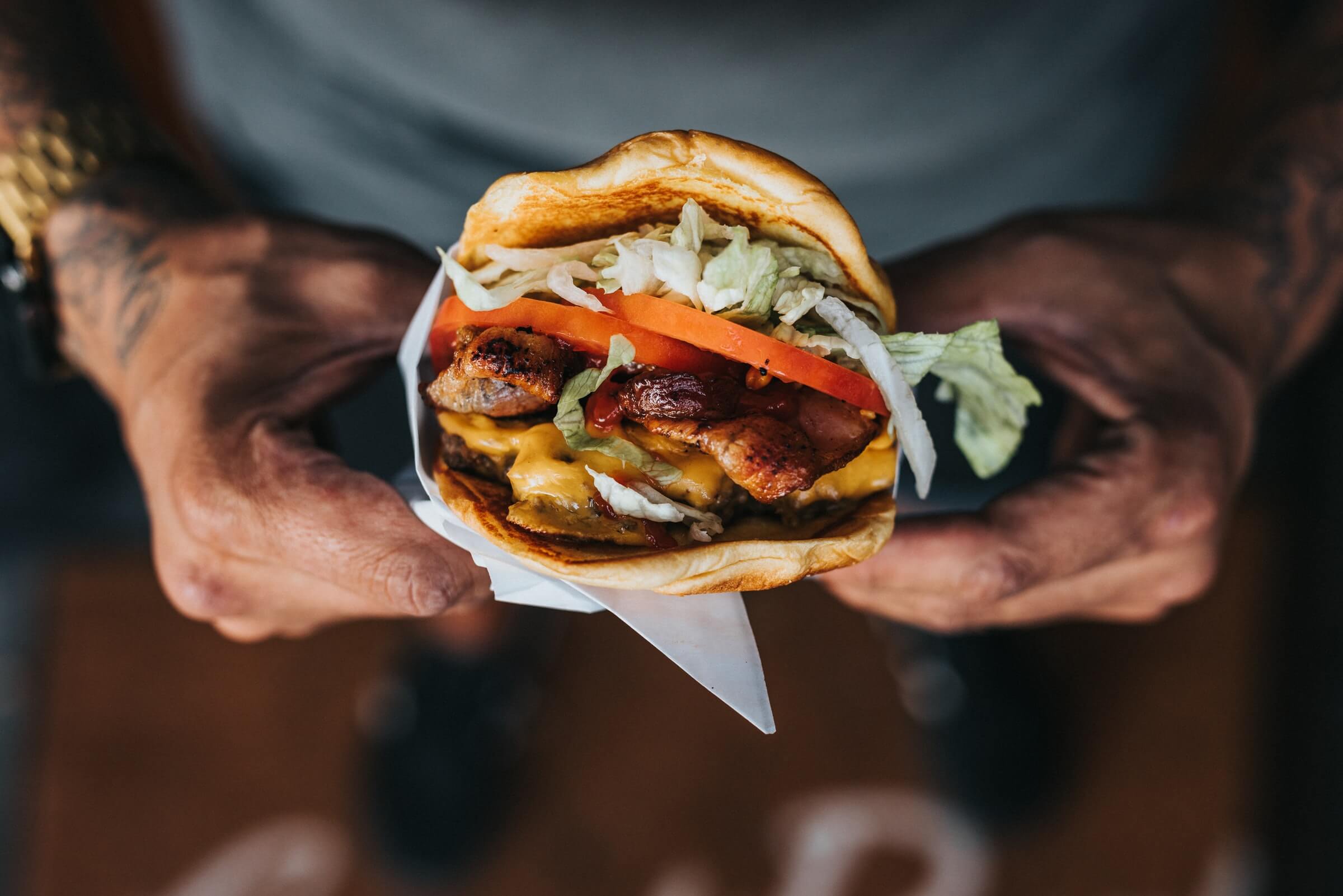
by David Klemt David Klemt No Comments

Orange County’s #OPENSAFE Restaurant Collective Defies Governor Newsom

Orange County’s #OPENSAFE Restaurant Collective Defies Governor Newsom

by David Klemt

A group of California restaurant operators is pushing back against current restrictions in defiance of orders they feel go too far.

Gov. Gavin Newsom’s stay-at-home order mandates that restaurants remain open only for delivery and takeout. The order affects five California regions: Northern California, the Bay Area, Greater Sacramento, the San Joaquin Valley, and Southern California.

Throughout 2020, similar orders have been issued throughout the United States. They’ve included an array of restrictions, from banning indoor and outdoor dining to choking traffic by imposing significant capacity restrictions.

Allowing only delivery and takeout is not the health and safety solution lawmakers believe it to be. Third-party delivery platforms and their policies can be detrimental to operators, worsening an already bad situation.

Several operators in Orange County, located in the Southern California region, are, per an Instagram post, refusing to comply with Gov. Newsom’s order.

The statement on publicist Alexandra Taylor’s Instagram account is posted in its entirety below:

“We, as responsible small business owners and operators, do hereby declare our intention to protest the current state stay home order and to maintain our safety standards of service as set forth by country and state health guidelines.

“We cannot, in good conscience, allow our employees and their families to have their health and safety jeopardized as resources to them have been exhausted.

“We will continue and strengthen our mitigation of the potential spread of SARS-Covid19 with the highest standards of safety protocol including, but not limited to: Outdoor Dining, Socially Distanced Seating, Mask Requirements when not seated, PPE, Readily Available Sanitizer to back of house/front of house staff, immediate quarantine and isolation of potentially infected employees, Barriers to prevent close quarters transmission between guests, limited capacity, etc.

“Although eating and drinking establishments (both indoor and outdoor) have shown to increase the potential for viral transmission, current data also indicates that travel and essential shopping have as much as a 10x more likely chance of transmission than these establishments based on CDC risk assessments.

“We agree, as responsible business owners, to commit to staying open with a dedication to public health.”

The image of the statement is accompanied by the hashtag #OPENSAFE and American flag emoji. More than 80 Orange County establishments that support the #OPENSAFE movement were listed in the caption of the post at the time of publication. The original post states that the list of venues is growing daily.

Taylor, the founder and president of The ATEAM, included a caption that read, in part:

“RESTAURANTS. I represent them, I invest in them, I celebrate them, I support them, I am passionate beyond words for them, for the PEOPLE behind them— and I will fight for them.

“This is a declaration for not only restaurants but all SMALL BUSINESS OWNERS to commit to STAY OPEN SAFELY and RESPONSIBLY, while giving their establishments, their employees, and their families a fighting chance to survive this BS.”

State and county officials across the nation can impose a number of penalties on businesses that defy orders. Fines and temporary suspensions of business licenses appear to be the most common. In Chicago, for example, operators can face fines in excess of $10,000. One restaurant, Ann Sather, owned by Chicago Alderman Tom Tunney, violated a ban on indoor dining and ignoring Covid-19 safety rules and faces a maximum fine of $10,500.

Earlier this year, a restaurant in Monterey County, located in California’s Bar Area region, faced fines of up to $35,000 violating shelter-in-place orders.

It’s unclear at the moment if the collective of defiant Orange County operators will face consequences for their civil disobedience. Orange County Sheriff Don Barnes has stated that the department has no intention of enforcing Gov. Newsom’s order closing restaurants.

“Orange County Sheriff’s deputies will not be dispatched to, or respond to, calls for service to enforce compliance with face coverings, social gatherings, or stay-at-home orders only,” said Sheriff Barnes. “Deputies will respond to calls for potential criminal behavior and for the protection of life and property. Our actions remain consistent with the protections of constitutional rights.”

Whether operators in other counties across America coalesce around their own #OPENSAFE movements remains to be seen. The consequences must be fully understood and weighed, and law enforcement’s stance on enforcing stay-at-home and shelter-in-place orders regarding bars and restaurants must also be considered.

Two things are, however, clear. One, operators have had enough. Two, government officials need to listen to restaurant and bar operators and workers about the impact of restrictions before issuing orders.

by David Klemt David Klemt No Comments

One Fair Wage Survey Results: Foodservice Professionals on Front Lines of Infection Risk and Hostility

One Fair Wage Survey Results: Foodservice Professionals on Front Lines of Infection Risk and Hostility

by David Klemt

Over a three-week period, One Fair Wage (OFW) surveyed 1,675 foodservice workers in five states and Washington, D.C.

The survey was initially sent to more than 61,000 applicants to the One Fair Wage Emergency Fund in Illinois, Massachusetts, New Jersey, New York, Pennsylvania and D.C. By November 9, 2,621 respondents had completed the OFW survey online. A total of 1,575 indicated they were currently employed and an additional 100 surveys were completed by phone.

One of the key takeaways of the survey is at once disturbing and unacceptable but not, infuriatingly, shocking. Not only did significant percentages of respondents report lax Covid-19 protocol training and enforcement along with increasingly hostile guests, close to half revealed “a dramatic increase in sexual harassment” since the pandemic struck.

Increased Sexual Harassment

Forty-one percent of survey respondents noted a marked shift in the frequency that guests are subjecting foodservice workers to unwanted sexualized comments. A quarter said they had personally experienced or witnessed “a significant” change in this manifestation of sexual harassment.

An analysis by OFW of the comments shared by respondents reveals the impact that this increase in sexual harassment has on the recipients. The comments have a negative effect on workers’ sense of safety in the workplace, financial security, physical health, and emotional and psychological health.

Of the 25 percent of the female respondents who had personally experienced or witnessed sexual harassment, 43 percent reported that comments were directly tied to social distancing and wearing masks, two pillars of Covid-19 health and safety protocols.

Identified by OFW as a “mild example” of the unwanted comments being made, “Take your mask off I want to see what’s underneath,” provides insight into the overall “theme” of the harassment being made. Many guests engaging in harassment appear to be sexualizing covered noses and mouths. Indeed, other comments support this analysis:

  • “Come on, sweetie. Lemme see that pretty face under there. Take it off for me, will you? Just a quick flash.”
  • “Please take the mask off, I want to see your lips.”
  • “Take off your mask so I know how much to tip you.”

When foodservice pros rebuff these unwanted advances, the responses tend toward hostility and smaller—or no—tips. In short order, these types of aggressors have found a way to weaponize the guest-server power dynamic and seemingly fetishize required Covid-19 protocols.

Increased Hostility

Whereas close to half of OFW survey respondents reported increased sexual harassment, more than three-quarters reported increased hostility from guests.

A staggering 78 percent of respondents said they had experienced or witnessed increased hostility as a response to following and enforcing Covid-19 protocols. Almost 60 percent said these incidents were occurring on a weekly basis.

Again, the power dynamic comes into play. Nearly 60 percent of respondents reported hesitation in enforcing Covid-19 protocols for fear doing so would affect their tips negatively. That concern is rooted in reality: 65 percent of respondents said they were tipped less on a weekly basis after enforcing health and safety protocols.

More than 80 percent said tips have decreased since the pandemic took hold, with 65 percent reporting that decrease to be 50 percent or more.

Impact of Subminimum Wage

One Fair Wage, as their name suggests and their mission clearly states, advocates and campaigns for all employers in America to pay full minimum wage. The organization also calls for tipped workers to receive full minimum wage plus their tips.

Per OFW, service workers—including people who work in salons and airports—are twice as likely to require food stamps to get by when compared to the rest of the workforce in the United States. Foodservice workers, however, are subjected to more sexual harassment than those workers in any other industry. The U.S. Equal Employment Opportunity Commission (EEOC), a federal agency, has identified the restaurant industry as the sector with the most sexual harassment charges filed by women.

This isn’t a digression. The OFW’s mission for a full minimum plus tips for tipped workers would have a direct impact on community health and safety. Infectious disease experts have warned that Covid-19 will not be the last pandemic with which we’ll have to contend. According to a report released by the CDC in September, the risk of contracting Covid-19 doubles for adults after dining inside a restaurant.

Were all service workers working for a full, living minimum wage, they’d likely be less concerned with incurring a guest’s wrath in the form of a reduced tip or no tip at all. The OFW survey findings that foodservice pros are being harassed to remove their masks or not socially distance—risking the health and safety of themselves and guests, then of family and friends, and therefore the community—and that 58 percent are reluctant to enforce Covid-19 protocols out of concern for their tips illustrates, in part, how subminimum wage for tipped workers can impact the health and safety of communities overall.

The pandemic has made foodservice workers and others who work with the public, by default, Covid-19 protocol enforcers. Clearly, significant swaths of the public feel zero compunction when it comes to responding with hostility, threats, harassment, and refusal to comply.

It’s also clear that guests who react with hostility and intimidation when employees are enforcing officially mandated health and safety requirements lest their employer face fines, the suspension of their business and/or liquor license, or any other form of punishment that puts their employment at risk won’t hesitate to wield the guest-server power dynamic as a weapon. That weapon can ultimately endanger an entire community.

The Good News

A mere ten percent of survey respondents reported their employers instruct employees to follow all Covid-19 health and safety protocols on a consistent basis, and just 31 percent of respondents said their employer follows all such protocols.

Those are startling numbers since ten percent of respondents said they had contracted Covid-19, 88 percent said they knew someone had contracted the infection, 44 percent reported that at least one coworker had contracted Covid-19, and a depressing 42 percent of those who reported knowing someone who had contracted the illness had died from it.

However, there were some positive pieces of data shared by survey respondents:

  • 92 percent reported their employers require all workers to wear masks.
  • 86 percent reported their employers require all workers to wash hands frequently.
  • 86 percent reported their employers require tables and chairs be wiped down and sanitized between uses.
  • 78 percent reported their employers provide employees with personal protective equipment (PPE).
  • 75 percent reported that a supervisor has told them they will have their back if they tell a guest or coworker to put on their mask whenever they’re within six feet of them.

In a perfect world, those percentages would all be one hundred. This isn’t a perfect world and there’s obviously major room for improvement. Management must step up in this time of crisis and uncertainty and embrace true leadership:

  • Respect the fact that employees are putting themselves at risk every shift. Put people first.
  • Avoid putting the bottom line ahead of health and safety.
  • Create and enforce a zero-tolerance sexual harassment policy—for employees and guests. Support employees when they report sexual harassment.
  • Communicate clearly and consistently. Transparency and targeted training must be priorities.
  • Display integrity when making decisions and enforcing rules.

Foodservice and hospitality industry professionals are on the front lines, sacrificing their own health and safety—and that of the people inside their bubble—to keep the industry afloat. Ownership and management need to protect them.

Read the entire OFW report here.

Image: engin akyurt on Unsplash

by David Klemt David Klemt No Comments

Significant, Permanent Restaurant Closures Expected to Rock Canada Unless Situation Improves

Significant, Permanent Restaurant Closures Expected to Rock Canada Unless Situation Improves

by David Klemt

Industry surveys continue to reveal how dire the situation is for operators.

On December 8, Restaurants Canada, a non-profit that represents and advocates for the Great White North’s restaurant industry, shared the results of a survey they had conducted between November 26 and December 4. A total of 511 surveys representing 3,000 restaurants were completed.

According to Restaurants Canada, the nation’s foodservice industry consists of 97,500 establishments ranging from QSRs to bars and full-service venues.

More than eight out of ten survey respondents answered that they are either barely staying afloat or are operating at a loss. Drilling deeper, significantly more restaurants are operating at a loss—65 percent of survey respondents fall into this category. Just 19 percent of restaurants represented by survey respondents are able to break even.

That’s 2,400 restaurants of 3,000 struggling to survive, and 78,000 restaurants out of 97,500, assuming the survey sample size accurately represents the overall industry in Canada.

To understand the long-term effects of government-mandated restrictions and shutdowns, one has only to digest another startling statistic: Restaurants operating in the red aren’t expecting to return to profitability for a minimum of 12 months.

Under optimal conditions, the average Canadian restaurant operates on razor-thin margins. Per Restaurants Canada, restaurants keep just five percent of every $10 in sales on average, or 50 cents. The industry is Canada’s fourth-largest employer (it’s number five in the United States, for comparison), accounting for 1.2 million jobs, 58 percent of which are held by women. Over thirty percent of owners, operators and staff belong to a visible minority, further illustrating how important restaurants are to diversity and the economy; half of all restaurants in Canada are operated by immigrants. Just like in the America, restaurants are the first employer for most Canadians.

The industry is crucial to Canada, but this vital resource is under serious threat. One of those threats comes from lawmakers whose restrictions are making it much more difficult for operators to wring any profits out already miniscule margins. Much like the situation afflicting the industry in the United States, the situation is going to get worse in short order without government relief.

Restrictions are simply nails in coffins unless they’re accompanied by relief.

“Our members are seeking a new year’s resolution from government, not only to support their survival but our industry’s vital role building back a stronger, more resilient Canada,” said  Todd Barclay, president and CEO of Restaurants Canada. “Restaurants Canada is calling for a national working group to pave the way for the foodservice sector’s revival, building on the commitment in the federal government’s 2020 Fall Economic Statement to provide targeted, sector-specific support to restaurants and other hardest hit businesses.”

That national working group, according to Restaurants Canada, should focus on providing businesses being affected by government-mandated restrictions with “sufficient, efficient and effective aid”; developing campaigns that make it clear to Canadians that restaurants are capable of safely and reliably providing safe meals; promoting delivery and takeout as a viable way for the public to support restaurants; connecting with operators to understand the industry’s needs and pain points to ensure they’re in as strong a position as possible when entering the post-pandemic economy.

The next six months are crucial to the survival of Canadian restaurants. If things don’t improve, should the government not address the industry’s situation and provide relief, 48 percent of single-unit operators surveyed by Restaurants Canada indicated they expect to close within six months. That number jumps to 56 percent for multi-unit operators, who expect to close at least one of their locations (also within six months).

Restaurants Canada is asking for anyone who supports the formation of a dedicated national working group to contact their Member of Parliament via this link.

Photo by Marcus Urbenz on Unsplash
by David Klemt David Klemt No Comments

How to Address Temporary Restaurant and Bar Closures: 5 Social Media Examples

How to Address Temporary Restaurant and Bar Closures: 5 Social Media Examples

by David Klemt – 12/1/2020

Repeated restaurant and bar closures have, tragically, become a hallmark of 2020.

Operators have had to learn how to communicate closures to potential indoor guests, as well as delivery and takeout guests.

For most operators, the possibility of closing their doors—temporarily or otherwise—has moved well past “if” territory. At this point, it’s not even a question of when a restaurant or bar will have to close, it’s a matter of when it will happen again.

There are a few reasons a F&B business will have to close due to the Covid-19 outbreak: official mandate, reduced indoor and outdoor dining capacities, and voluntary temporary closures.

Mandated closures are, on the surface, straightforward. Government officials decree that certain types of businesses must close their doors by a specific date and time, and owners are expected to comply.

Closures induced by capacity restrictions are less straightforward. It has become woefully apparent that most lawmakers don’t understand (or don’t care) that at a certain threshold, reducing indoor and outdoor dining capacities is as good as forcing a restaurant or bar to close; the value proposition of remaining open simply isn’t there.

A voluntary temporary closure can come about because of capacity limitations, but they can also be the result of other factors. A significant workforce reduction, lack of traffic, rising costs of goods, or an internal Covid infection.

The stark reality is that the likelihood today’s operators are going to have to craft social media posts and emails announcing temporary (and possibly extended) closures is anything but slim.

Below are four examples of effective closure announcements that bars across America have posted to Instagram recently.

Machine, an upscale cocktail bar and restaurant in Chicago, made the difficult decision to close their doors to in-person dining guests throughout the remainder of 2020. The post addressed the reason for the decision but made it clear that Machine would continue to operate for delivery and curbside pickup orders placed online. Community health and safety was held up as a priority, and though the news was disappointing and no doubt difficult to break, Machine’s post was positive.

Award-winning Chicago cocktail bar Lazy Bird, located in the basement of the Hoxton hotel, was forced to close due to indoor dining restrictions. The post image was short and to the point, with the caption explaining in detail why the bar was closing temporarily. Lazy Bird is part of the Boka Restaurant Group and their post included a call to action for people to support venues within the portfolio that would still be able to offer outdoor dining, delivery and takeout.

Three days ago, award-winning restaurant Compère Lapin announced a temporary closure due to a team member being exposed to Covid-19. Like the Machine post, Compère Lapin’s message explained their decision was based on safety. Similar to Lazy Bird, the restaurant urged guests to visit James Beard Award winner Chef Nina Compton’s other restaurant, Bywater American Bistro (BABs).

In Woburn, Massachusetts, just ten miles northwest of Boston, the Baldwin Bar alerted guests to their temporary closure because a staff member tested positive for Covid-19. The message, like that of Machine’s, was transparent, straightforward, reassuring, and positive overall. Not only did the Baldwin Bar share that the venue was undergoing a deep clean, they named the company tasked with providing the service.

The Baldwin Bar, thankfully, got to post the following message a little more than a day after posting their closure announcement:

Operators who find themselves in the terrible and frightening position of having to announce a temporary closure would do well to follow the examples above. While hope isn’t a viable business strategy, a hopeful tone can help garner support from the community.

Equally important are an emphasis on health, safety and cleanliness so guests feel comfortable placing orders for delivery and takeout, and returning when the doors open once again. As difficult as it may be when faced with closure, focusing on the well-being of the guests can help ensure there are guests lined up upon reopening.

Image: Photo by Kelly Sikkema on Unsplash

Top