General

by David Klemt David Klemt No Comments

Intersection of Streaming & Sports Betting

The Intersection of Streaming and Sports Betting

by David Klemt

Closeup shot of the NFL logo painted onto turf or grass

The popularity and ubiquity of sports betting is exploding throughout the US, and its seemingly inescapable presence is due in large part to streaming.

This is one topic we learned about during our first visit to the Global Gaming Expo, also known as G2E.

It’s true that gaming and hospitality are two distinct, different industries. However, they’re inextricably connected. And with gaming platforms and mobile devices making it even easier to place bets on sports, that connection is only getting stronger.

Now, I’m going to take a moment to make my relationship with gaming clear. First, I’m not an expert on the industry. Second, I rarely partake in gaming even though I live in Las Vegas. I’ll throw the odd twenty into a small handful of specific slot machines, but that’s the extent of my gaming experience. I think it has been a decade since I last played craps.

So, I’m going to do my best to share what I learned during G2E. The show is an educational experience for me, and I feel that hospitality business operators can benefit from its sessions.

As far as the hospitality-gaming relationship, however, I certainly believe they’re complementary industries. This is absolutely true in Las Vegas, and it’s true in other markets as well. If casinos weren’t aware that hospitality is crucial to keeping guests returning and risking their cash on games, they wouldn’t bother focusing on dining, drinking, nightlife, and other hospitality amenities.

I’m also confident saying Las Vegas in particular wouldn’t have generated nearly $15 billion in 2022. And casinos throughout America wouldn’t have generated over $60 billion last year.

In summary, the connection between hospitality and gaming is what drew me to G2E this year.

Watershed Moments

One of the sessions I attended was “Streaming X Sports Betting: The Future of Engaging Gen Z.” Adam I. Kaplan, the chief operating officer of SportsGrid, was the speaker.

SportsGrid, I’ve since learned, is a multimedia sports betting network. According to Kaplan, the ad-supported network is available on more than 40 platforms and accessed by millions upon millions of mobile devices

Users can access SportsGrid 24/7 via smart TV or their dedicated app. Additionally, people can stream SportsGrid via other platforms, such as:

  • Roku;
  • Prime Video;
  • YouTube TV;
  • Sling;
  • Freevee; and
  • Plex.

Per Kaplan, we can trace the creation of SportsGrid to two genesis points: the creation of Napster, and the introduction of the iPhone.

The launch of Napster in June of 1999 was, of course, a watershed moment. And its influence on society is undeniable. According to Kaplan, the platform’s influence included the belief that content should be free.

When the iPhone hit the scene in January of 2007, it, too, was a massive milestone. Part of its success, as Kaplan pointed out, was how easy it made for users to engage with content.

Taken together, Napster and the iPhone have “taught” people that content should be free and easy to access. And their launches have led to the rise of iGaming and sports betting.

Sports Betting Repeal Day

Like hospitality, sports betting has their own Repeal Day. Whereas bars and restaurants celebrate on December 5, gaming would celebrate May 14.

That’s the day in 2018 that the United States Supreme Court struck down the Professional and Amateur Sports Protection Act (PASPA) of 1992. Essentially, PASPA banned sports betting in the US, with narrow exceptions for four or five states.

When PASPA was overturned on the basis that the act violated the Tenth Amendment (states’ rights), several states made moves to legalize sports betting. Currently, sports betting is legal in some form in more than 30 states and Washington, DC.

During the five-year period following the end of PASPA, sports betting has gained massive traction throughout the US. Several publications report that the NFL in particular sees the most betting action.

According to the American Gaming Association, 73 million Americans plan to bet on the 2023-2024 NFL season specifically. That’s up from 46 million in 2022, a huge leap.

Of all adults who said they’d bet on sports this year, 14 percent (more than 35 million people) plan to place their bets online.

Per SportsGrid’s Kaplan, people aged 40 and under—so, Millennials and legal-age Gen Z—make up the majority of sports bettors. Looking at sports betting as an engagement driver, businesses should see the opportunity to attract sports bettors as customers and keep them loyal.

Skin in the Game

As Kaplan points out, one reason that sports betting drives engagement is the sense a bettor has of having “skin in the game.”

Well, they aren’t the only people who want skin in the sports betting game.

Since PASPA ended, hospitality venues across the country have attempted to get in on the sports betting phenomenon. This makes perfect sense, particularly for sports bars.

What operator in that space wouldn’t love the ability to stream content from a platform like SportsGrid, FanDuel TV, or DraftKings Network, with their guests permitted to place bets while inside the venue, legally?

That opportunity could prove incredibly lucrative, generating significant traffic and sales. And that’s to say nothing of the marketing, promotions, and guest loyalty opportunities. Think of what legalized on-premise sports betting could do to attract fantasy sports league participants…

Additionally, venues that can stream sports betting content and encourage betting on-premise (again, legally) could prove incredibly popular with one of the age groups operators focus on the most: the 21- to 34-year-old segment.

So, it appears one of the next frontiers for hospitality is pushing for the legalization of sports betting on-premise. Operators in favor of guests being allowed to place bets while onsite can either wait and see or actively engage their lawmakers.

What a time, eh?

Image: Adrian Curiel on Unsplash

KRG Hospitality. Gaming. Entertainment. Consultant. Food Service. Bowling Alley. Golf. Simulator. Arcades. Eatertainment.

by David Klemt David Klemt No Comments

5 Books to Read this Month: August 2023

5 Books to Read this Month: August 2023

by David Klemt

Flipping through an open book

Our inspiring and informative August book selections will help you and your bar team take your front of house and bar program to the next level.

For this month’s list we’re showcasing the 17th annual Spirited Awards finalists in the Best New Cocktail or Bartending Book category. So, below you’ll find the top-four nominees in that particular category, plus an additional self-improvement book.

To review the book recommendations from July 2023, click here.

Let’s jump in!

The Bartender’s Manifesto: How to Think, Drink, and Create Cocktails Like a Pro

First up, this book from June 2022 by Toby Maloney with Emma Janzen. Not only has this book won a James Beard Award, it took home this year’s Spirited Award for Best New Cocktail or Bartending Book.

From Amazon: “Take a raucous romp through the essential stages of fashioning cocktails and learn the hows and whys of bartending with acclaimed mixologist Toby Maloney and the team from The Violet Hour. When the pioneering cocktail bar opened in Chicago in 2007, it set a high standard with an innovative training program that teaches not just how to replicate classic cocktail recipes flawlessly, but how to embrace ingenuity, make smart decisions, and create original, inspired recipes from rote.”

Pick up the hardcover here.

Mindful Mixology: A Comprehensive Guide to No- and Low-Alcohol Cocktails with 60 Recipes

Next, Mindful Mixology by Derek Brown, with a foreword by Julia Bainbridge. As all operators should know by now, low- and no-ABV cocktails are here to stay. From aperitivo hour and zero-alcohol to simply drinking less but better, consumers are changing their relationships with cocktails. This book will help operators and their teams navigate the moderation movement.

From Amazon: “Creating these drinks isn’t as simple as removing the alcohol. No- and low-proof cocktails still have to be balanced and still have to be delicious, but they don’t operate exactly like cocktails with alcohol. The drinks Brown presents in this book are meticulously choreographed around taste, texture, body, and piquancy to result in surprisingly complex ‘adult beverages’ minus the booze.”

Grab the hardcover today.

Modern Classic Cocktails: 60+ Stories and Recipes from the New Golden Age in Drinks

Robert Simonson is also a James Beard Award-winning author up for a 2023 Spirited Award. Not only are there more than 60 cocktail recipes in Simonson’s book, he explores what it means for someone to create a modern classic cocktail. No, your bar team can’t simply “invent” a new drink and declare it a modern classicthere are actual considerations, like public opinion, that make it so.

From Amazon: “What elevates a modern cocktail into the echelon of a modern classic? A host of reasons, all delineated by Simonson in these pages. But, above all, a modern classic cocktail must be popular. People have to order it, not just during its initial heyday, but for years afterward. Tommy’s Margarita, invented in the 1990s, is still beloved, and the Porn Star Martini is the most popular cocktail in the United Kingdom, twenty years after its creation.”

Make sure to get your hardcover copy today.

The New York Times Essential Book of Cocktails (Second Edition): Over 400 Classic Drink Recipes With Great Writing from The New York Times

If you want hundreds of cocktail recipes and amazing writing, this is the book for you. There are more than 400 recipes in this book, from classics to modern craft drinks. Oh, and there are essays from an array of fantastic writers, including Rebekah Peppler, David Wondrich, Robert Simonson, and Jim Meehan. There are also interviews with icons like Ivy Mix and Sother Teague.

Truly, this is one of the most comprehensive cocktail books every printed.

Pick up this book in hardcover format now.

Atomic Habits: An Easy & Proven Way to Build Good Habits & Break Bad Ones

A couple of weeks back, we had a KRG Hospitality team meeting about habits. Habits we’re proud to have developed, habits we’d like to focus on developing, and habits we’d like to work on losing. This book, from James Clear, is one of the resources we talked about.

From Amazon: “Clear is known for his ability to distill complex topics into simple behaviors that can be easily applied to daily life and work. Here, he draws on the most proven ideas from biology, psychology, and neuroscience to create an easy-to-understand guide for making good habits inevitable and bad habits impossible. Along the way, listeners will be inspired and entertained with true stories from Olympic gold medalists, award-winning artists, business leaders, life-saving physicians, and star comedians who have used the science of small habits to master their craft and vault to the top of their field.”

Order the paperback today.

Image: Mikołaj on Unsplash
KRG Hospitality Mindset Coaching

by David Klemt David Klemt No Comments

5 Books to Read this Month: July 2023

5 Books to Read this Month: July 2023

by David Klemt

Flipping through an open book

Our inspiring and informative June book selections will take your front and back of house to the next level, and help develop your leadership skills.

To review the book recommendations from June 2023, click here.

Let’s jump in!

Sugar Shack Au Pied de Cochon (Cabane à Sucre Au Pied de Cochon)

This is the English-language edition of the 2012 World Gourmand Book of the Year. You can pick it up at Amazon via this link, but it will cost you over $150 to do so. So, here’s the link to the book from the Au Pied de Cochon online store.

Those who have read this book describe it as one part recipe book, one part art piece. It’s difficult to categorize this book at all, really. It’s a journal, a recipe book, a culinary masterpiece, and a collection of scientific knowledge. In less than 400 pages, Martin Picard chronicles a year in the life of his restaurant, and shares 100 recipes and 2000 photographs, along a depth of culinary information, the value of which can’t be overstated. Pick it up today or find it at a library if you can.

Catching Fire: How Cooking Made Us Human

If you look at your role in foodservice as more than just a paycheck, you already view cooking as important. It has real value and inspires you, stoking your passion for this business. But what if the importance of cooking is beyond just “important”? What if it’s directly responsible for human evolution? This book by anthropologist and primatologist Richard Wrangham puts forth and defends this evolutionary theory.

From Amazon: “In a groundbreaking theory of our origins, Wrangham shows that the shift from raw to cooked foods was the key factor in human evolution. When our ancestors adapted to using fire, humanity began. Once our hominid ancestors began cooking their food, the human digestive tract shrank and the brain grew. Time once spent chewing tough raw food could be used instead to hunt and to tend camp. Cooking became the basis for pair bonding and marriage, created the household, and even led to a sexual division of labor.

“Tracing the contemporary implications of our ancestors diets, Catching Fire sheds new light on how we came to be the social, intelligent, and sexual species we are today. A pathbreaking new theory of human evolution, Catching Fire will provoke controversy and fascinate anyone interested in our ancient origins – or in our modern eating habits.”

The Subtle Art of Not Giving a F*ck: A Counterintuitive Approach to Living a Good Life

If you prefer your self-improvement and leadership books coated in gobs of sugar and wrapped in sheets of positivity, prepare for a shock. Author Mark Manson isn’t a sunshine, daisies, unicorns, and lemons-to-lemonade type of person. Instead, Manson thinks people need to toughen up and learn how to simply deal with being handed lemons. However, this isn’t a nonstop punch to the gut or blast to the chops. Rather, Manson wants people to change their mindset and focus on what should matter.

From Amazon: “Manson makes the argument, backed by both academic research and well-timed poop jokes, that improving our lives hinges not on our ability to turn lemons into lemonade but on learning to stomach lemons better. Human beings are flawed and limited – “not everybody can be extraordinary; there are winners and losers in society, and some of it is not fair or your fault”. Manson advises us to get to know our limitations and accept them. Once we embrace our fears, faults, and uncertainties, once we stop running and avoiding and start confronting painful truths, we can begin to find the courage, perseverance, honesty, responsibility, curiosity, and forgiveness we seek.

“There are only so many things we can give a f*ck about, so we need to figure out which ones really matter, Manson makes clear. While money is nice, caring about what you do with your life is better, because true wealth is about experience. A much-needed grab-you-by-the-shoulders-and-look-you-in-the-eye moment of real talk, filled with entertaining stories and profane, ruthless humor, The Subtle Art of Not Giving a F*ck is a refreshing slap for a generation to help them lead contented, grounded lives.”

Pick this book up here!

Samsung Rising: The Inside Story of the South Korean Giant That Set Out to Beat Apple and Conquer Tech

During a recent team meeting, KRG Hospitality executive chef and culinary expert Nathen Dubé recommended this book. And while it’s the story of a massive corporation, it doesn’t read like a collection of boring essays. Rather, Samsung Rising is the true story of a family-run business that has grown from 40 employees to more than 300,000. After taking big risks and committing to building a technology empire, Samsung has nearly doubled in size in comparison to rivals Apple and Google. However, the road to creating a dynasty has been anything but smooth.

From Amazon: “Forty years ago, Samsung was a rickety Korean agricultural conglomerate that produced sugar, paper, and fertilizer, located in a backward country with a third-world economy. With the rise of the PC revolution, though, Chairman Lee Byung-chul began a bold experiment: to make Samsung a major supplier of computer chips. The multimillion- dollar plan was incredibly risky. But Lee, wowed by a young Steve Jobs, who sat down with the chairman to offer his advice, became obsessed with creating a tech empire. And in Samsung Rising, we follow Samsung behind the scenes as the company fights its way to the top of tech. It is one of Apple’s chief suppliers of technology critical to the iPhone, and its own Galaxy phone outsells the iPhone.”

Grab Samsung Rising today.

Salt & Straw Ice Cream Cookbook

Recently, we had the opportunity to attend a pre-opening event for the first Las Vegas location of Salt & Straw. Those who have visited a Salt & Straw ice cream shop know how creative the brand is when it comes to flavors. We also found their team’s service to be impeccable.

The Salt & Straw Ice Cream Cookbook, as you may imagine, shares the brand’s recipes. Impressively, these all spring from a “base” recipe that takes just five minutes to make. This recipe book should help to inspire your own desserts.

From Amazon: “Based out of Portland, Oregon, Salt & Straw is the brainchild of two cousins, Tyler and Kim Malek, who had a vision but no recipes. They turned to their friends for advice—chefs, chocolatiers, brewers, and food experts of all kinds—and what came out is a super-simple base that takes five minutes to make, and an ice cream company that sees new flavors and inspiration everywhere they look.

“Using that base recipe, you can make dozens of Salt & Straw’s most beloved, unique (and a little controversial) flavors, including Sea Salt with Caramel Ribbons, Roasted Strawberry and Toasted White Chocolate, and Buttered Mashed Potatoes and Gravy.

“But more importantly, this book reveals what they’ve learned, how to tap your own creativity, and how to invent flavors of your own, based on whatever you see around you. Because ice cream isn’t just a thing you eat, it’s a way to live.”

Image: Mikołaj on Unsplash
KRG Hospitality. Business Coach. Restaurant Coach. Hotel Coach. Hospitality Coach. Mindset Coach.

by David Klemt David Klemt No Comments

Kitchen Parlance, Part One

Kitchen Parlance, Part One

by Nathen Dubé

Chef handling flaming pan in commercial kitchen

Entering a professional kitchen might seem like a whole different realm with its own governing rules, and certainly its very own language.

“Clopen?” “All day?” “Behind?” “Covers?” “Deuce,” “dying on the pass”… If these terms sound foreign and made up to you, you’re not alone!

A busy kitchen can be a hot, intense, and stressful environment. Having a full-on conversation takes up valuable time when minutes and even seconds are the difference between a perfectly cooked plate of food and trash.

When actions need to be conveyed quickly and efficiently between two parties or a full team in a loud and fast-paced environment, slang develops out of necessity. Kitchens are no different, with their use of a creative and interesting lexicon.

New owners and operators opening their own concept may find many words and phrases they hear from the kitchen and servers strange at first. This is particularly true of owners and operators who may have little to no back-of-house or serving experience.

To lend a hand to hopeful operators or those opening their doors for the first time, let’s take a look at some of the more popular kitchen terms.

Operational & Equipment Terms

First, let’s take a look at the structural element of a restaurant and how they’re referred to.

Floor

The dining room (or whatever is deemed as guest seating in your establishment) is referred to as “the floor.” When someone asks, “who is on the floor tonight?”, they’re referring to the staff—usually servers—working the floor. Managers will walk the floor to check on guests and aid in service.

Note: The bar area, although it may have counter seating and its own tables, is referred to separately from the floor.

Low Boy

An under-counter refrigerator is called a “low boy” for its below-the-waist positioning, requiring cooks to bend down low to gather ingredients. This can include freezers as well. There are a variety of door configurations, including swinging, and drawer-style. Some even have salad tops where ingredients are kept in the top, under a lid.

Walk-In

A (very) large fridge or freezer, often constructed on site. It has a big swinging door that can be opened from both sides for safety reasons. The majority of raw ingredients—plus some prep and leftovers—are stored here. If you’re wondering where the word comes from, the clue is in the name: it’s so large, you can walk into it.

The walk-in is also notorious for being where restaurant staff go to scream some stress away, as the excellent insulation creates a nice sound barrier from guests.

Mise

The word “mise,” pronounced “meez,” is a slang term for “mise en place.” Mise en place is the French term for “having everything in its place” prior to service. Cooks use “mise” to refer to their own specific set of prepared ingredients, whether in terms of having it ready or not, or even worse, missing.

On the Line

The line, and the term “on the line,” refers to the area in the kitchen where the cooking equipment is located. Of course, this where chefs do most of the cooking during service. A typical line includes a walkway where the cooks work, and a flat table space—usually at the “window” or “pass” (see below)—where they plate, on the opposite side. Not surprisingly, that opposite side is referred to as the “plating area.”

If a concept requires it, there are separate “hot” lines where the hot cooking is done, and “cold” lines, where dishes that don’t require cooking are prepared. Deep fryers, ovens, and ranges are located in the former, and salad stations are located in the latter area. In classic French terms, the garde manger cook usually prepares most dishes on a cold line.

Pass / Window

The pass or window is the area opposite the cooking line where completed orders are placed for server pick-up. Think of passing dishes from the kitchen and you’ll understand this term immediately. Sometimes it will be referred to as a “window” in restaurants that have actual windows into the kitchen line from which food is passed to servers. The pass area is typically where the heat lamps are located, meant to keep dishes warm during a busy service.

The Rail / Board

The term “rail” or “board” refers to a strip of metal mounted to the food window that holds the food tickets (orders) from the kitchen printer in place. This keeps the flow organized and is normally overseen by the chef or line supervisor.

“Calling the board” means the person in charge reads out tickets as they come in, and directs cooking traffic to the other line cooks. Doing so helps to avoid disagreements and chaos in the kitchen. This position is reserved for the highest-ranking or most-talented cook, as it requires excellent cooking and communication skills. “Clear the board or rail” means completing all orders that have come in for the time being.

Chit / Ticket

When a server enters an order into the POS system, a chit or ticket, or even “dupe” (meaning “duplicate,” from the fact that some systems use three-color paper that prints a kitchen copy, a server copy, and an expo, bar, cold line, or pasty section copy), is printed to the kitchen. That ticket is then read aloud to the cooks before being placed in queue on the rail or board. When the food on the order is complete, the copy is marked in some fashion (stamp, marker, pen) and placed under the plate in the window. The server then picks up the food and the chit is “stabbed” on to a spike.

Don’t let spiked tickets fall out of the rail or all hell can break loose and derail a service!

Two-Top / Three-Top

Dining room tables are referred to as “tops” and are identified by how many guests they can accommodate (seats). A table with two chairs is a “two-top” or “deuce.” Tables with four or six chairs are “four-tops” and “six-tops,” respectively.

Covers

Each person who enters the restaurant is a cover: they “cover” one seat. The more covers, the busier a service will be, and vice versa. These numbers are used to project future numbers, staffing requirements, and inventory required. Covers are also a point of pride for kitchen staff. The more covers, the busier the service, and if you can navigate it with few mistakes, the adrenaline rush can directly convince yourself of your own talents.

Dead Plate

A dead plate is a dish of food that’s no longer worthy of the dining room. Sitting in the window too long, incorrect preparation, or even worse, being sent back by a guest results in a dead plate. Untouched dead plates are usually given to dish washing staff or porters; those sent back by guests are tossed in the bin.

Section

A section is how the floor is divided amongst serving staff. Typically, the more talented or senior staff get a bigger section. Designating sections, with all their tables in one close area, helps servers move efficiently during busy periods and keep close tabs on guests. Managers and floor captains will oversee a few or all sections and offer help to the individual servers during busy times or for large parties.

Server Alley

The front-of-house equivalent of the kitchen hot line. This is where everything servers need to do their jobs is located. Extra napkins, spare side plates, cutlery rolls, and cleaning supplies for clearing tables can all be found here. There are usually a few POS terminals here for entering orders.

Team & Guest Terms

These next few slang words are used to talk about certain people.

Expo

“Expo” is the shortened term for “expediter,” or the position of organizing, plating, and (in some cases) garnishing food at the pass. The main responsibility is to makes sure each dish is correct before the food runner or server brings it to the table. This role can be the liaison between front of house and back of house, allowing both teams to do their jobs without having to stop and coordinate.

Busser

Part of the porter team, the busser is the person who clears dishes from a table when guests leave, and drops them in the dish-washing area. The term refers to the bus bin or large plastic tub into which the bussers put all the dishes, flatware, glasses, and debris. They might also be tasked with wiping down tables and resetting them for new guests. Sometimes, the busser will pull double duty and also wash the dishes they bring back to the kitchen.

Trail / Stage

Note: In the foodservice world, “stage” is pronounced “staahj.”

A trail is essentially a training shift during which new team member will “trail” behind a cook or server. This provides the new hire the ability to learn, get comfortable with SOPs, and mitigates any potential mistakes. However, not all establishments have the staffing to offer this scenario and will train a new hire during live action.

A stage is a longer-term trail for a designated period of time. This can be a couple of weeks, a month or two, or an entire season at destination-style dining places, like Michelin-starred restaurants and hotels. The expectation is that this is a learning experience for the cook, who is exposed to new ingredients, recipes, and techniques. An agreed upon time frame is set and the cook trades labor for education.

A Personal Note on Stage

The short-term stage commitment includes the understanding that the restaurant won’t reward you monetarily. We all know the costs of training staff. Imagine investing all that effort and having that person leave after just a month or two.

Now, I despise the term “free labor” for the kitchen or benefiting restaurant. There’s a new argument that has been surfacing over the last few years that stages should be paid internships. I have two problems with this thought process.

One, these are often highly touted restaurants that operate at an elite level, and they’re extremely busy. Having a new body takes up valuable focus and resources from somebody in that kitchen. They are willing to work with you and share all their knowledge and experience.

Often times, there isn’t a chance in hell in getting a job there, and this can be the only way to get a chance at learning from these masters of the craft. Having gained valuable career experience from stages myself, they can be a great alternative if you can’t gain employment with the venues.

Two, those who raise these arguments have no experience in doing them; think they have learned nothing from the stages they may have done; had a bad experience overall; or really have no other alternatives to the points I just mentioned.

Hot tip: If you don’t like working for free, don’t! If you the value in stage, go for it!

Campers

This is a term for people who linger at their table well after they’ve finished and paid. While all guests are welcome to make themselves at home, the problem with campers is that they can take up valuable real estate during busy periods. This is the reason for table time caps at operations that run on the reservation system. They also prevent servers from “turning” tables to serve more guests and increase their tips.

Action Terms

These are some random terms that indicate actions and requests.

Fire

The process of finishing a dish. When an order is printed out, it may have courses such as appetizer, main, and dessert. All courses might be started and cooked to 80 percent completion and then held. The main wouldn’t be fired until after the appetizer. When the person in charge of the line says, “Fire table six mains,” that means finish cooking, plate the dishes, and send them to the pass.

All Day

A very quick way for a cook to request a tally of all the dishes ordered from their section. The line lead will provide totals of each dish, instead of reading out each table’s order. For example, a cook will ask for an all-day on fryers, and the lead will call back, “Six large fry, three medium fry, two poutine, and one chicken nugget.” The cook can quickly add up what they have cooking or need to prepare to fire.

Behind

As you can imagine, in a busy, happening kitchen, there are people racing in all directions in tight spaces. One quick way to avoid collisions around hot equipment and sharp objects is to yell “behind” when passing someone or a station of people. It gives them time to either move out of the way or stay in place to avoid catastrophe.

Other variations include “hot” to indicate hot pots or pans, or the potential of getting burnt. “Sharp” means a knife, and “corner” means coming around the corner. “Behind hot” and “hot, corner” are combinations which mean exactly what you think they mean.

Flash

To reheat a dish, or an item on a plate that sat under the heat lamp too long, or if a guest has requested something cooked further. Usually under a salamander, a convection oven, or a deep fryer for fried food. I’m sure for some establishments (I started out in places where this was the norm), “flashing” means “cooking” an item to well done via microwave.

Heard / Heard That

The acknowledgement that an order has been read by the person running the pass or the line and understood by all in the kitchen. Also works for a direct order to an individual.

In the Weeds

When one station is receiving the majority of the orders at any given time, or the dining room has filled up all at once and all the orders are coming in together, this can create a downward spiral between starting to cook and plating or finishing existing dishes. This is known as being “in the weeds.” The only way to survive is to put your head down and cook your way out. I’ve experienced surviving the weeds and having it ruin an entire service. It all depends on the resilience and talent of the cooks, servers, and leaders involved.

On the Fly

The request for something that is needed quickly. Perhaps the item was missed, dropped, or incorrect, and the rest of the dishes are at the table. Whatever is needed “on the fly” takes precedence over everything else or, worst-case scenario, gets shoehorned into orders coming up.

Stretch It

Kitchen lingo for getting as many portions out of something nearing its end as possible. For example, a saucepan only has enough for four steaks but five are needed. The sauce has completed cooking and the plates are waiting. So, the kitchen needs to “stretch it” and make it work or be down five plates of food.

Waxing a Table

This means giving a table special treatment. This person or these people could be VIPs, return guests, the owner’s family and friends, or an influential food writer. Whoever the are, they’ve been identified and are given a little extra attention by staff.

86

When a menu item has completely run out, the kitchen manager will say the item has been “86ed.” It’s important for the kitchen staff to communicate this to servers as soon as possible so that no more orders are placed for the item.

Family Meal

The pre-service meal enjoyed by all staff on premises. Usually made by the staff from leftovers as a way to showcase creativity and skill.

Comp

Referring to items removed from the bill for an error or because the guest didn’t like it. A comp also comes from waxing a table, of course. It’s important to track comped items for accounting purposes. Comps can be a great way to make guests happy in a pinch. However, owners, operators, executive chefs, and lead bartenders need to be aware of how often comps are being handed out; they can be indicative of quality-control problems or employee theft.

Clopen

This is a portmanteau of “close” and “open.” The dreaded weekend brunch shift comes to mind. Working a busy late Friday or Saturday service and having to come back in the following morning to sling eggs to hungover patrons is a difficult and thankless task. In short, a team member who works back-to-back closing and opening shifts is working a clopen.

FIFO

This stands for “first in, first out,” and references inventory organization, crucial for perishable items. The new items go behind the older ones so that the items that were there first get used first, ensuring freshness and quality. I once had a chef who decided that “FIFO” stood for “fit in, or f*ck off.”

These are just some of the slang terms in the culinary lexicon used to convey quick understanding when under fire. You might also hear differences in dialect between cultures and regions. I’ve worked in both Toronto and Montréal, and there are similarities and differences between terms used in Ontario and Québec, French and English, and English and South American Spanish.

So, next time you’re out dining and you hear one of these words or phrases, you might be able to figure out what’s going on behind the scenes. Tip well, be polite, and try something new!

Image: lasse bergqvist on Unsplash

KRG Hospitality menu development. Restaurant. Bar. Cafe. Lounge. Hotel. Resort. Food. Drinks.

by David Klemt David Klemt No Comments

Consultant Versus Coach

Consultant vs. Coach: Similarities and Differences

by Jennifer Radkey

Double arrow, street ends sign

At some point in your journey as a business owner it’s inevitable that you’ll come up against a challenge that you struggle to overcome on your own; you may need to reach out for advice or guidance.

There are countless reasons why you may seek an expert’s help. Perhaps you’ve come up against a roadblock trying to reach a goal. Maybe you’re unexpectedly forced into a major transition. You may decide you’re ready to take your business to the next level but are unsure how to proceed.

The situation you find yourself in could be as big as the opening of a new restaurant or bar, or as vague as a general sense of something not being “right.”

Whatever the reason may be, you’ve exhausted your own pool of resources and are ready to seek outside help. So, who do you turn to?

Most likely you’ll be looking to hire either a consultant or a coach. Of course, this begs the question: Which do you choose?

I’m both the vice president of KRG Hospitality and a certified life coach. My husband Doug Radkey is the president of KRG Hospitality and our agency’s lead consultant. “Do I need a consultant or coach” is a question people ask of us quite often.

The answer is simple once you understand the similarities and differences between the two.

Similarities

Coaches and consultants are both third parties who provide an outsider’s clarity while maintaining an unbiased point of view.

They’re both knowledgeable and have their own unique approaches and expertise. Coaches and consultants come with the intention of helping you achieve your goals. While the majority of coaching and consulting is done one-on-one, team consulting and coaching are also options.

The differences between coaching and consulting can be found in the approaches used to help you achieve your goals.

Differences

The easiest way to learn the differences between a coach and a consultant is to take a closer look at how each one approaches how they help you. It’s an understanding of these differences that provide the clarity needed for you to choose the best solution.

Consultants

Consultants are industry-specific experts. When presented with a challenge you want to overcome or a goal you want to achieve, a consultant finds the solution using their knowledge and experience. They also diagnose any problems that are evident in your business and then make recommendations to correct them.

A consultant is someone you can turn to for technical and professional advice.

Once the consultant has determined the root of the problem or determined the best path forward to achieve your goal, the answers will be provided to you. And along with the answers come the steps necessary to solve the problem or reach the goal. You’ll be given a clear, detailed plan.

Consultants listen carefully to what’s going on. They ask specific questions, watch how your team interacts with your guests, and study your steps of service. Additionally, consultants analyze data and conduct research, and then communicate their findings clearly with you. Again, consultants give you the tools you need to execute a plan—including processes and proven methods—to achieve success.

If you’re in need of specific industry advice and expertise, a consultant is who you need to hire.

Coaches

Coaches are experts in placing the power in your hands to discover your own solutions and answers. You hire a coach to discover yourself, inspire confidence, explore possibilities, and find your own clarity. Entrepreneurs turn to coaches to help them transform into great leaders.

Through sincere and thoughtful inquiry, coaches will pull answers out of you that you didn’t know that you already had. They’ll also help you become aware of self-imposed limitations so you can overcome them. Rather than just giving you a plan, coaches help you develop your own strategies for uncovering your truth, and then help you understand how to move forward.

Coaches are sounding boards for discussing both personal and professional issues, providing a safe, judgment-free place for you to be heard. They’re interested in long-term results and the overall well-being of their client.

If you’re looking for overall growth and a better understanding of how you can reach your own goals and potential, a coach is who you need to hire.

Hiring a consultant or a coach is a positive step towards achieving both short-term and long-term goals. Knowing the difference between the two now empowers you to choose the best person to help you where you want to go.

Cheers to personal and professional growth!

Image: Robert Linder on Unsplash

KRG Hospitality Mindset Coaching, 2023 Icon

by David Klemt David Klemt No Comments

Do Super Bowl Ads Work on Consumers?

Do Super Bowl Ads Work on Consumers?

by David Klemt

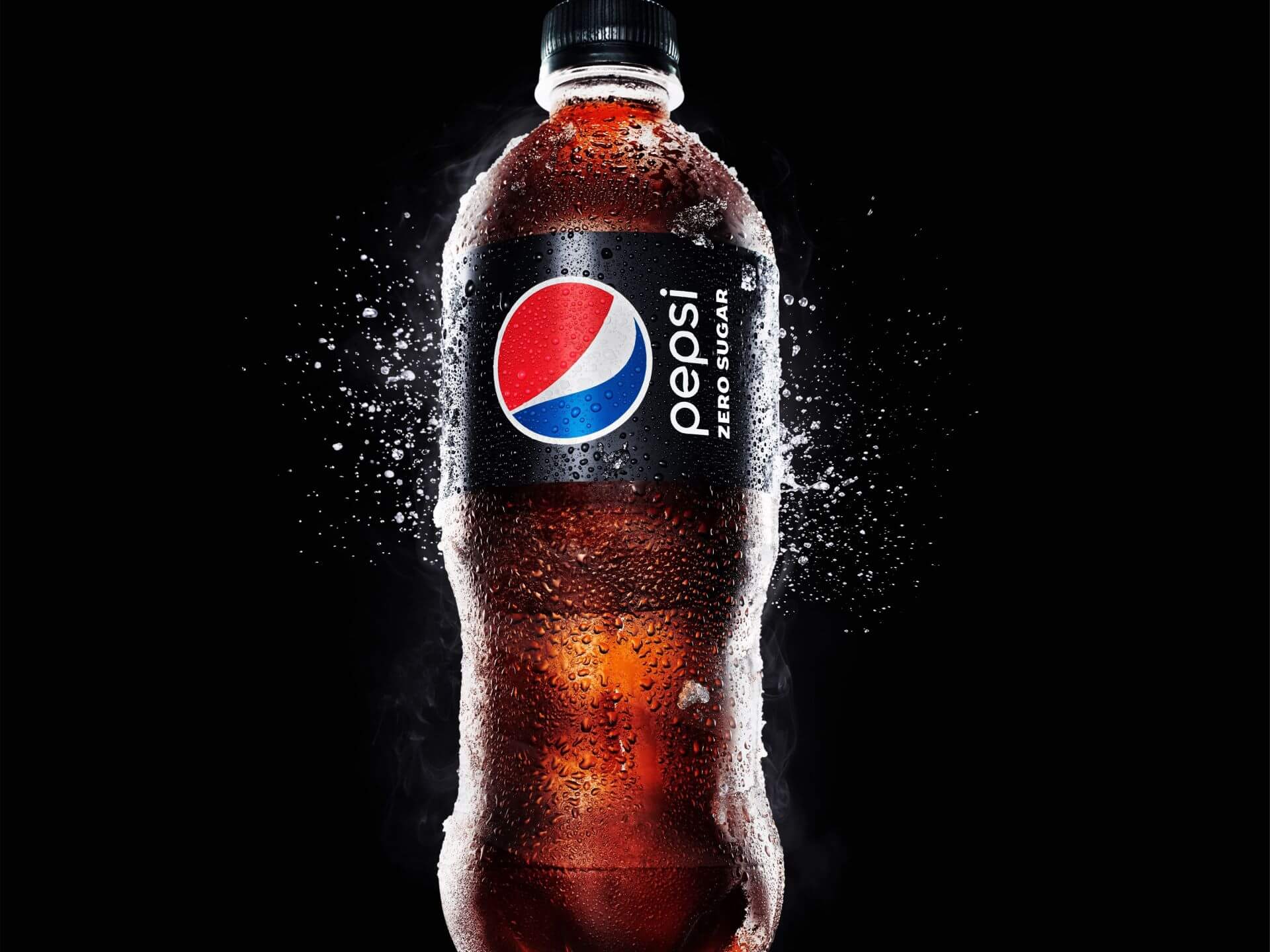
Pepsi Zero Sugar bottle

One of the biggest Super Bowl ad winners is Pepsi Zero Sugar.

Brands spent hundreds of millions of dollars to advertise during Super Bowl LVII, but do their ads actually translate to demand for their products?

A week ago we shared our ten favorite beverage-focused Big Game ads. Along with those ads we shared some numbers.

One of those numbers was $7 million, the cost of a 30-second Super Bowl ad on Fox. Other numbers? $500 million and $700 million, the range of revenue it’s estimated that Fox generated this year from Super Bowl ads.

At this point, these ads and the Halftime Show have essentially become their own entities. Some people watch the Big Game for the ads, some for the show halfway through. It stands to reason that brands are well aware of this development. So, they try to create the most impactful ad possible in the hopes of generating consumer demand.

In other words, these brands aren’t spending all this money just so they’re commercial can be deemed cool. Sure, brands want that buzz. But they also want an ROI on the millions they spend.

The big question is, then, are they seeing a return? Well, it just so happens that behavioral insight platform Veylinx has a data-driven answer to that question.

In short, the answer is yes. Of course, it’s a nuanced yes. For example, it appears Gen Z doesn’t care much about Super Bowl ads, as you’ll see below. Also, non-advertisers in the same categories as Super Bowl advertisers appear to see a benefit from the ads.

You’ll learn more from the Veylinx press release below. It’s an interesting read with valuable data for restaurant, bar, and hotel operators.

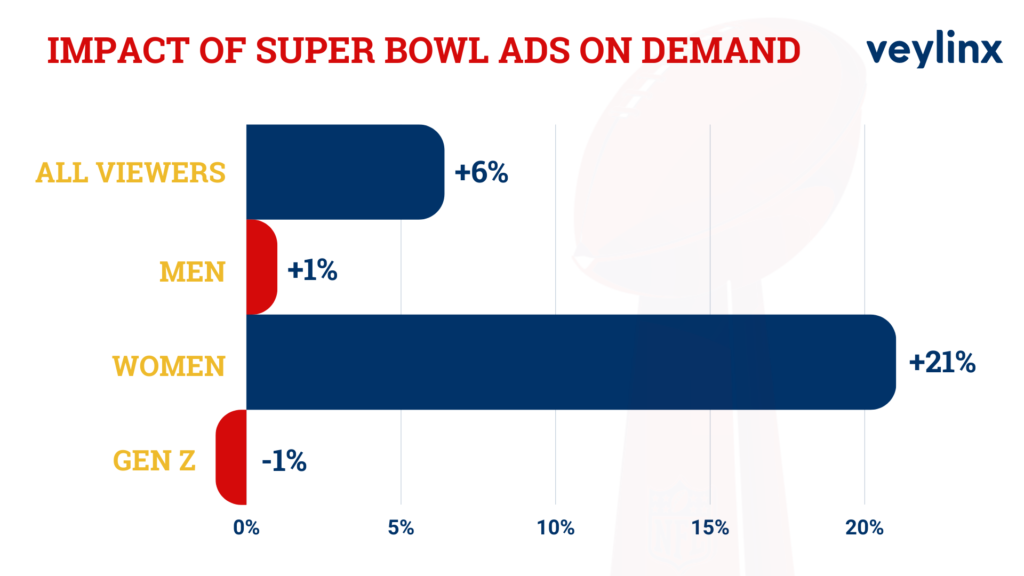
NEW YORK, Feb. 22, 2023 — A new study from behavioral research company Veylinx determined whether or not Super Bowl commercials boost consumer demand for the products advertised. The results show that 2023 Super Bowl advertising fueled a 6.4% increase in demand among viewers.

The overall increase in consumer demand was driven by women, who accounted for a 21% increase in demand growth. The commercials had minimal impact on men, yielding just 1% demand growth for the brands tested. Gen Z viewers were largely unimpressed by the Super Bowl ads, with demand among 18 to 25 year olds actually shrinking by 1%.

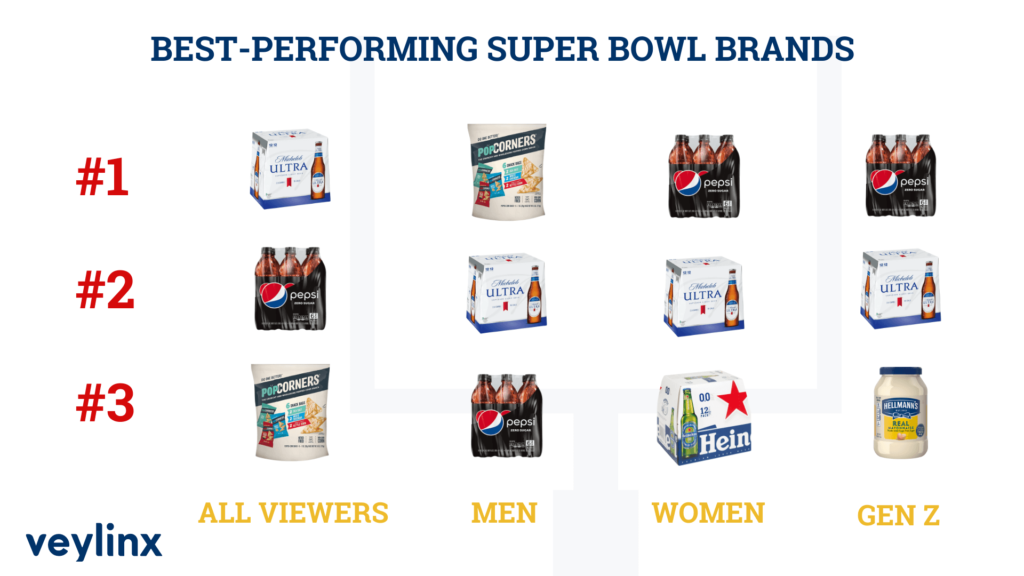
2023 Veylinx impact of Super Bowl ads on consumers chart

“It’s not really a surprise to see that Super Bowl ads improve sales, but the short term bump alone may not be enough to justify the $7 million price tag,” said Veylinx founder and CEO Anouar El Haji. 

Using Veylinx’s proprietary methodology—which measures actual demand rather than intent—the study tested purchase behavior during the week before the Super Bowl and again the week after. The research focused on measuring the change in consumer demand for eight brands with Super Bowl ads: Michelob Ultra, Heineken 0.0%, Hellmann’s Mayo, Downy Unstopables, Crown Royal Whisky, Frito-Lay PopCorners, Pringles and Pepsi Zero Sugar. 

Super Bowl Advertising Winners Overall

Michelob Ultra – 19% increase in demand

Pepsi Zero Sugar – 18% increase in demand

Frito-Lay PopCorners – 12% increase in demand

Heineken 0.0% – 11% increase in demand

Super Bowl Advertising Winners Among Women

Pepsi Zero Sugar – 45% increase in demand

Michelob Ultra – 40% increase in demand

Heineken 0.0% – 40% increase in demand

Crown Royal Whisky – 26% increase in demand

Veylinx, top performing brands during 2023 Super Bowl

Halo Effect for Non-Advertisers

The biggest winners were arguably brands in the same product categories as Super Bowl advertisers. Non-advertisers in those categories appeared to benefit nearly as much as the advertisers: demand grew by 4.2% percent for the study’s control group of non-advertising competitors. Corona Extra, Kraft Mayo and Lay’s STAX were the greatest beneficiaries in a control group that also included Budweiser Zero, Arm & Hammer Clean Scentsations, Canadian Club Whisky, Popchips, and Coke Zero Sugar. Notably, every non-advertiser saw at least a slight increase in post-Super Bowl demand.

“The goal of our study was to look specifically at how consumer demand is affected by running a commercial during the Super Bowl,” El Haji said. “It’s possible that the non-advertisers deployed other marketing efforts to offset or take advantage of the Super Bowl advertising—or they simply benefited from increased exposure for their categories.” 

Additional Findings

Study participants also answered a series of follow-up questions about their preferences, perceptions and how they watched the Super Bowl. More than three-quarters watched at home through various platforms, the most popular being the live cable/satellite broadcast (38%), followed by YouTube TV (15%) and Hulu (10%). When asked why they watched, it’s no surprise that participants were all about the game (64%)—but the commercials were the next most popular reason for watching (39%), followed by halftime (35%), the social aspect (26%) and fear of missing out (13%). 

About the Research

Veylinx studied the behavior of 1,610 U.S. consumers pre- and post- Super Bowl LVII. Unlike typical surveys where consumers are simply asked about their purchase intent, Veylinx measures whether consumers will pay for a product through a real bidding process. Consumers reveal their true willingness to pay by placing sealed bids on products and then answering follow-up questions.

For more information about the study and the Veylinx methodology, visit info.veylinx.com/super-bowl

About Veylinx

Veylinx is the most realistic behavioral insights platform for confidently answering critical business questions during all stages of product innovation. To reliably predict demand, Veylinx captures insights through a Nobel Prize-winning approach in which consumers have real skin in the game. This is a major advance from traditional market research practices that rely on what consumers say they would hypothetically buy. Veylinx’s unique research methodology is trusted by the world’s largest and most innovative consumer goods companies.

Main article image: PepsiCo / Article body images: Veylinx

KRG Hospitality Bars & Lounges, 2023 icon

by David Klemt David Klemt No Comments

WCK On the Ground in Türkiye and Syria

WCK On the Ground in Türkiye and Syria

by David Klemt

Building in Barış, Türkiye, damaged in 2023 earthquake

A week after deadly, devastating earthquakes struck Türkiye and Syria, World Central Kitchen has served more than one million meals.

KRG Hospitality supports WCK and their mission, and has done so for years. In fact, donating to WCK is a core element of our KRG Cares program.

There’s a lot of bleakness and darkness dominating headlines. Negativity continues to infect social media and public discourse. All too often, people are focusing on one another’s differences, feeding the drive to divide rather than unite.

However, it doesn’t have to be this way. We don’t have to give into cynicism and pessimism. We don’t have to take the bait and allow ourselves to wallow in outrage.

Look at what Chef José Andrés, Patricia Andrés, and the WCK team accomplish as an example. When disaster strikes, WCK is there to provide support and relief. The WCK Relief Team mobilizes, WCK organizes and finds support partners, and those in need get hot meals.

On February 6, two earthquakes Türkiye and Syria. The first earthquake registered 7.8 Mw (Moment Magnitude Scale), while the second was 7.7 Mw. According to recent reports, the death toll has surpassed 42,000. Millions of people in both countries lost their homes.

Yesterday, a 6.4 Mw quake struck the Türkiye-Syria border. Reports claim another eight people died and hundreds more were injured.

Making the monumental task of providing relief even more challenging is the conflict in Syria. Still, WCK, Gift of the Givers, and 25 restaurant partners are providing meals in Türkiye and Syria. Meals for those in Syria are prepared in Türkiye and then delivered to a hospital.

The Spirit of Hospitality

I don’t want to come off as preachy in this article. However, I think there’s been a departure from hospitality that our industry needs to address.

It behooves us to remember the role that restaurants, bars, and hotels have played traditionally in their communities. Ours are places of welcome, of warmth, of support.

In other words, our businesses are places of hospitality. That word isn’t simply an industry or trade designation.

Restaurants, bars, and hotels around the world have long been the cartilage of their communities; they brought everyone together. In many cases, hospitality was the beating heart of a community, not just the connective tissue.

Two people with opposing word views were able to set aside their differences over a drink and a bite to eat. We need to get back to that element of hospitality. Neighborhood restaurants and bars, regardless of category, are sanctuaries. Each one is an oasis, and we need to remember that. We’re about inclusion, not exclusion.

The WCK is perhaps an extreme example of what our industry can do for others. That makes the organization no less exemplary and deserving of emulation.

If you’re able to do so, please consider supporting WCK.

Image: World Central Kitchen via Twitter

KRG Hospitality Mindset Coaching, 2023 Icon

by David Klemt David Klemt No Comments

Metallica Supports World Central Kitchen

Metallica Supports World Central Kitchen

by David Klemt

Metallica band member portraits

Metallica is supporting World Central Kitchen to #StandWithUkraine via donations made through their non-profit organization, All Within My Hands.

To start off AWMH’s annual Month of Giving, the band and their philanthropic organization awarded WCK a $100,000 grant. They then donated $500,000 to the humanitarian non-profit founded by Chef José Andrés and his wife Patricia.

However, Metallica and AWMH aren’t done there. The iconic metal band and their non-profit have committed to the goal of donating another $400,000 to WCK.

Additionally, Metallica and AWMH have unveiled the Month of Giving 2022 T-shirt.


View this post on Instagram


A post shared by Metallica (@metallica)

The shirt can be pre-ordered here (I placed my order last Monday). Proceeds will go to the WCK #ChefsForUkraine campaign. Artist Andrew Cremeans created the brand-new design and donated it to AWMH.

People interested in making a donation to AWMH that will benefit WCK but who don’t want the T-shirt can click here.

All Within My Hands

The All Within My Hands Foundation was founded in 2017. Metallica and the band’s management are the founding members.

James Hetfield, Lars Ulrich, Kirk Hammett, and Robert Trujillo are members of AWMH’s board of directors. In addition, the organization’s advisory board has eight members:

  • Chris Anthony (Salesforce)
  • Howard Ellin (Skadden, Arps)
  • Brenda Goodman (BGood Marketing)
  • Bill Moore (WRVI Capital)
  • Doug Palladini (Vans)
  • Gregg Perloff (Another Planet Entertainment)
  • Michael Rapino (Live Nation)
  • Paula Wagner (Chestnut Ridge Productions)

AWMH’s mission focuses on three crucial pillars:

  • Workforce education with partner American Association of Community Colleges. The Metallica Scholars Initiative is now supported by 23 schools across the US. To date, $4.1 in grants have been awarded.
  • Fighting hunger in collaboration with partner Feeding America. Food banks are a heavy focus of Metallica and AWMH, with proceeds from tour ticket sales going to the fight against hunger.
  • Critical local services with their partner Direct Relief, which is active in all 50 states of America and more than 80 other countries.

#ChefsForUkraine

World Central Kitchen mobilized incredibly quickly in response to Russia’s attack on Ukraine. Initially, WCK set up in Poland.

However, the the hunger-fighting organization has expanded operations to an additional six countries.

Further, WCK is now operating in over 30 cities located in Ukraine. As of this week, the non-profit is providing nearly 300,000 meals daily to those in need.

In staggering news, WCK has provided six million meals to the region in just over a month.

To donate to WCK directly, please click here.

Image: MasterClass

by David Klemt David Klemt No Comments

Prepare for a Luxe Life Summer

Prepare for a Luxe Life Summer

by David Klemt

BMW M cars parked next to private airplane

When we think of restaurant and bar tech and platforms, we tend to think of POS and inventory solutions. But what about guest-facing services?

We’re all familiar with online ordering, reservation, and review platforms. What I’m talking about is guest-facing tech that focuses on the luxury lifestyle.

For those living the high-roller life, every convenience is at the tap of an icon, including private jets, helicopters, yachts, and luxury and exotic vehicles.

What does any of this have to do with hospitality? Anyone who serves or courts high-net-worth guests needs to understand how they live and what they expect. This is even more important as summer approaches, vaccine rates improve, and pandemic guidelines relax.

Additionally, there are partnerships and marketing opportunities for operators and luxury lifestyle platforms.

Flight

Flying private isn’t solely the domain of those who can afford to shell out several million dollars for the plane of their dreams.

The proliferation of the sharing economy means people can hop on a charter flight for a fraction of the cost.

Blade

Do you hate waiting in traffic, even if you’re not the one doing the driving? Wish you could just jump into the air and leapfrog a sea of cars keeping you from, say, an airport? With Blade, you can summon a helicopter and make your flight in minutes.

JSX

Formerly known as JetSuite X, JSX serves the western region of America and Texas. If the thought of flying commercial is unbearable at the moment, JSX makes it easy to jump onto a 30-seat set via private terminals for non-stop flights.

NetJets

We’ve all been there: We want our own private jet but it’s just slightly out of reach at the moment (by many millions of dollars). NetJet gives people fractional ownership of private jets and provides top-notch, personal service. The company’s fleet includes everything from six-passenger Embraer Phenom 300 jets to the high-speed, long-range 14-passenger Bombardier Global 7500.

Wheels Up

This company offers three levels of membership: Connect, Core and Business. Wheels Up is more than a transportation app—they’re a lifestyle brand. The company offers membership perks such as exclusive events and concierge services, which should be of particular interest to hospitality operators.

Float

There are a couple of tropes that come along with boat ownership. One is that the two happiest days for a boat owner are the day they take possession and the day they get rid of it.

And then there’s the classic “definition” of a boat: “A hole in the water into which one throws money.”

However, much like one can dial up a helicopter or grab a seat on a Gulfstream, people can now charter a yacht for a fraction of boat ownership. Choose the yacht that meets your yachtin’ needs, board it, and crank the yacht rock.

Float

Any boat that someone uses for cruising, leisure, pleasure or racing is a yacht. So, the yacht life isn’t exclusively for ocean-going vessels. Float lets customers “rent the lake life,” connecting boat owners with people who want to rent boats on lakes. One of the best parts of Float is that it doesn’t, as far as we can tell, cost thousands of dollars per day to rent a boat via the platform.

GetMyBoat

This is a huge platform. We found more than 12,100 boats available in America, more than 4,400 in Australia, and well over 28,000 in Europe on GetMyBoat. Given the size of the platform, there’s a large swing when it comes to rental costs, which makes sense. For instance, there was a 21-inch Sea Hunt Ultra 210 for $44/hour (four-hour minimum) in Virginia and a 40-foot VanDutch Ultra Luxury Yacht for $4,000 for eight hours.

YachtLife

Serving an array of locations with a rather impressive portfolio of boats, YachtLife offers three membership levels catering to various needs. Beyond living the yacht life, the company provides perks and specials from their partners. This platform should be of particular interest to our Florida and Eastern Caribbean clients.

Four Wheels

So, someone grabs a helicopter to a private hangar, looking forward to lounging on the their rental yacht.

Sure, they could take a limo to the marina, or they could use the car service their plane or boat membership offers.

But they could also decide to drive themselves. Obviously, not just any car rental will do.

Turo

There are various Porsches and Mercedes listings on Turo that cost well under $200 a day. But for those looking for something exotic, a Lamborghini Huracan is around $1,000 per day, and an Aventador is around $1,400. You can’t show up to the marina behind the wheel of just anything, right?

Image: Jakob Rosen on Unsplash

by David Klemt David Klemt No Comments

Let’s Talk About Bitcoin

Let’s Talk About Bitcoin

by David Klemt

A Bitcoin on top of a $100 bill

Bitcoin and cryptocurrency in general are no strangers to media attention, but it seems like the coverage is increasing.

Of course, it helps when people who are excellent at garnering attention talk about it. Consider the explosion in news stories and online conversations about cryptocurrencies when Elon Musk tweeted about Dogecoin.

Then there’s the mystery factor. Many people don’t understand Bitcoin, Ethereum or other forms of cryptocurrency. The word itself—”crypto”—lends to the enigmatic air of this form of currency.

As a business owner, you should at least have a cursory understanding of cryptocurrency. After all, some people may try to pay you with it and you should at least consider meeting these guests where they are.

Before we proceed: I’m not a cryptocurrency or financial expert. I’m sharing information I’ve come across in my research over the years. Don’t make any financial or business decisions solely based upon what you read here—learn more for yourself and consult with experts before making investment decisions.

Crypto is Relevant to Our Industry

I’ve written about cryptocurrency—Bitcoin in particular—in the past. In one article, I wrote about a “nightclub” within a nightclub in Las Vegas devoted to cryptocurrency.

The club, MORE, had its own “coin” (MORE Coin), accepted other cryptocurrencies, and tailored its experience to crypto fanatics. It has become more of a members’ club, offering access to and preferential treatment at an array of venues, along with other perks. The club’s coin is purchased via Bittrex, a popular exchange platform

There are also hotels in Las Vegas (and other cities, of course) that accept cryptocurrencies like Bitcoin for rooms. Bitcoin ATMs scattered throughout Vegas allow people to access their wallets and convert crypto to cash.

Paying with crypto may become more commonplace than we think, sooner than we think.

Crypto Basics

Let’s address the term “cryptocurrency.” In this case, “crypto” is a reference to the encryption technology that protects a cryptocurrency network.

Bitcoin and other digital tokens, such as Ethereum and Dogecoin, are decentralized currencies. That is, there’s no main server, no government, no bank that controls or owns the network.

A digital token is incredibly difficult—if not impossible—to counterfeit or “double-spend.” This is due to sophisticated encryption technology and the blockchain.

The blockchain is a peer-to-peer distributed ledger technology that makes it incredibly difficult (again, if not impossible) to take over a crypto network. Every transaction is public knowledge; open to inspection; duplicated and distributed throughout an entire network; and  unalterable.

It’s that last point that made Bitcoin viable. Unlike attempts in the past to create digital currencies, the blockchain makes crypto trustworthy in that someone can’t just make up a new currency, wait for people to buy in, and then take it all for themselves.

Bitcoin has become synonymous with cryptocurrency. It’s the first viable digital token as we know it, the most popular, and at the moment, the most valuable.

Interestingly, it’s widely accepted that Ethereum is the second-most popular digital token but the most-utilized blockchain.

Finally, Bitcoin is finite. There are exactly 21 million Bitcoins—that’s it. Once they’re all mined, no more will be made.

Beyond the Basics

Fewer than 2.4 million Bitcoins remain to be mined. Currently, one Bitcoin is worth about $58,000.

A person uses a digital “wallet” to send and receive Bitcoin. Some people store their unique wallet on their computer; a separate and dedicated hard drive; a thumb drive; or a “cold” wallet, a device that’s not connected to the Internet to protect it from hackers.

If a person loses their wallet or password, they lose their Bitcoin(s).  There’s no way yet to know how many of the 21 million Bitcoins have been lost.

Bitcoin is a software system. Therefore, it can be copied. That’s the reason crypto beyond Bitcoin—such as the aforementioned Ethereum and Elon Musk-promoted Dogecoin—exists.

One of the biggest questions people have about bitcoin is, “Is this a scam?” Search online and you’ll get a mix of results.

There are high-profile people like Jack Dorsey and Elon Musk who are apparently heavily invested in crypto. There are critics calling the whole thing a scam and fraud. Then there are some former critics, like Jordan “The Wolf of Wall Street” Belfort, who were highly critical and suspicious of crypto but have changed their tunes.

Support from hotels, restaurant chains, financial institutions and other legitimate businesses seems to answer the scam question. However, operators must proceed with caution, as they would for any change in their business or investment.

Accepting Bitcoin Payments

Businesses that decide to accept Bitcoin and/or other digital tokens will need a POS app or platform to do so.

Starbucks is reportedly using Bakkt to accept Bitcoin.

Other options include BitPay Checkout, Bitcoin Cash Register, Anypay, and Paytomat.

Some solutions create a QR code the guest scans with their phone to complete a transaction. Others convert digital tokens to cash to accept payment.

It’s important to note that the IRS treats cryptos differently than US dollars. Before choosing to accept cryptocurrencies as payment, consult with your tax professional and accountant to ensure you don’t run afoul of any laws.

Canadian operators should note that while crypto is legal in the country. However, only the Canadian considered official legal tender in Canada. Again, this is why it’s so important to consult relevant experts before proceeding with crypto in your business.

Disclaimer

The information provided in this post does not constitute investment advice, financial advice, trading advice, or any other sort of advice. Neither the author nor KRG Hospitality recommend that any cryptocurrency should be bought, sold, or held by you. Conduct your own due diligence and consult your financial advisor before making any investment decisions.

Image: Bermix Studio on Unsplash 

by David Klemt David Klemt No Comments

Why Hospitality Pros Need LinkedIn

Why Hospitality Pros Need LinkedIn

by David Klemt

LinkedIn logo with blue background

Contrary to popular opinion, LinkedIn isn’t just for serious and stuffy executives and “corporate” types.

In our view, all hospitality professionals should be building networks on the platform. Nobody in this industry is “just” a restaurant or bar worker—everyone is skilled.

When it comes to hospitality, anyone passionate about their role and interested in moving up is a professional.

Foodservice Jobs are Real Jobs

Just about everybody who works in a restaurant, bar, nightclub, lounge or brewpub faces this disrespectful question:

“When are you going to get a real job?”

One-third of Americans get their start in the workforce with jobs in foodservice.  In America, nearly half of adults will work in the industry at some point.

The first job for roughly one-quarter of Canadians is in foodservice.

Some people work in the industry to pay their way towards a degree. Some work in restaurants or bars while they hunt for jobs in their chosen industry. In some cases, people realize hospitality is their calling and they remain in the industry.

The point is, jobs in hospitality are real, skilled jobs. In other words, this is a real job.

Transferrable Skills & Opportunity

The skills hospitality professionals learn are valuable to more than just employers within the industry.

Leadership, teamwork, customer service, conflict resolution, crisis management, sales, marketing… These are just a handful of the skills companies in other sectors seek out and find valuable.

Further, a LinkedIn profile is valuable even if one isn’t looking to change jobs. Just filling one out effectively speaks to another important, transferrable skill: attention to detail. The same goes for building a resume that illustrates an understanding of transferrable skills.

Also, hospitality is, by its nature, a connected and engaging industry. It only makes sense, therefore, that hospitality professionals in all roles should have LinkedIn profiles to connect with one another and people in other industries.

One never knows where the next opportunity will come from.

Stay Informed

Generally speaking, Instagram is great for sharing memes and photos. Twitter…well, Twitter is often described as a chaotic dumpster fire.

Facebook has groups and there are people who present a professional image on the platform. However, LinkedIn is laser-focused on bringing professionals across several industries together.

Because of their approach, LinkedIn helps facilitate conversations about topics related to a vast array of sectors. People who take their careers seriously—whatever they may be—will likely find value in a platform not dominated by photos, memes, and users seeking nothing more than clout.

It’s common for LinkedIn users to share professional advice, company and career wins, and reports loaded with industry data.

Let’s Link

Connect with Doug Radkey, David Klemt and KRG Hospitality on LinkedIn today!

Image: Alexander Shatov on Unsplash
by David Klemt David Klemt No Comments

Buy a Shirt. Fight Cancer.

Buy a Shirt. Fight Cancer.

by David Klemt

It’s the giving season and the hospitality industry is one that takes care of its own.

We all have the opportunity to help an industry veteran and also support an incredible cause.

In July of this year, Chris Patino was diagnosed with stage four pancreatic cancer. One night he went to bed feeling fine and the next morning he was unable to get out of bed.

Patino is an industry advocate who has focused on elevating the art and craft of bartending, brand education, and executing incredible events. He’s a partner in the award-winning Raised by Wolves, founder of the strategic marketing agency Simple Serve, and a Bartender’s Weekend organizer.

Now, Patino has launched This T-Shirt Fights Cancer. The proceeds of each This T-Shirt Fights Cancer tee, designed by Dave Stolte, based on a design by Woodrow Guthrie, and originally sketched on the back of a napkin—so fitting for this industry—go to the Pancreatic Cancer Action Network (PANCAN).

Like Patino, PANCAN is dedicated to building community, sharing information, and advocacy. The organization fights to improve the lives of those living with pancreatic cancer through advancements in research.

As we near the end of the year, please consider joining the fight against cancer and purchasing a This T-Shirt Fights Cancer tee. To quote Patino on his campaign page, “And as always, f*ck cancer.”

Image: This T-Shirt Fights Cancer

by David Klemt David Klemt No Comments

Can Vending Machines Help Restaurants and Farmers Fight Food Waste and Generate Revenue?

Can Vending Machines Help Restaurants and Farmers Fight Food Waste and Generate Revenue?

by David Klemt

French farmers have found an innovative way to fight food waste, generate much-needed revenue, and provide fresh produce to the public: vending machines.

Last week, Barron’s, a publication dedicated to financial and investment news coverage, published an article about farmers in France finding more success selling produce via vending machines than their own farm stores.

All manner of items can be loaded into vending machines—fruits, vegetables, eggs and dairy products, for example—and famers are able to choose how many lockers their setups will include. For instance, one farmer invested in a 60-locker vending machine for €30,000, while another placed a machine with 88 lockers close to her farm.

Selling via vending machine was lauded by Barron’s as respectful of health and safety regulations since farmers and consumers aren’t interacting with one another directly.

This development begs the question: Would selling produce directly to consumers through vending machines prove viable in the United States and Canada?

The havoc afflicting the restaurant business doesn’t affect only the owners, operators and employees—it’s a shockwave ripping through other industries, such as farming and agriculture. For months, news coverage has included reports of farmers sharing stories of showing up to restaurants to deliver food only to find them closed, leaving farmers with surpluses of food destined to go to waste.

One option to make this work could include restaurant operators and local farmers partnering to set up vending machines (locker type, not the standard snack versions). This would help reduce the initial buy-in and both operators and farmers would have access: restaurants would use them for contactless meal and meal kit pickup, and farmers could accept direct-to-consumer orders of fresh produce fulfilled through the lockers.

In fact, creative operators may be able to build meal kits that combine their menu items with ingredients sourced from local farmers.

The partnership concept may prove more viable for connectivity reasons as well. In France, one major supplier of vending machines, according to Barron’s, indicated the machines required a reliable 4G connection, in part because they recommend only accepting credit card and online payments to reduce vandalism. Placing vending machines on-site should provide more stable connections and steadier consumer traffic.

Politicians continue to drag their feet and posture in regards to Covid-19 relief. It has been clear for months that the public and businesses without lobbying power are being left to fend for themselves. A partnership between restaurants and farmers could prove mutually beneficial for the survival of the restaurant, farming and agriculture industries.

When contacting their representatives to demand they help we the people and the restaurant industry, it could be wise to remind them that relief for restaurants is also relief for farmers, saving millions of jobs and thousands of farms at risk of permanent loss, along with avoiding literal tons of needless food waste.

Image: Alex Motoc on Unsplash

by David Klemt David Klemt No Comments

LCBO and SkipTheDishes Hit Pause on Partnership After Public Lashing

LCBO and SkipTheDishes Hit Pause on Partnership After Public Lashing

by David Klemt

The Liquor Control Board of Ontario (LCBO) faced outrage over the weekend, ultimately deciding to “pause” a controversial partnership after receiving a public lashing.

In case you missed it, the LCBO and SkipTheDishes announced on December 4 that they had partnered to offer home deliveries of beer, wine and spirits in Toronto. For those who are unfamiliar, SkipTheDishes is a food delivery service similiar to Grubhub that serves Canada. In fact, SkipTheDishes pulled out of the United States in 2020 and their services were handed over to Grubhub.

Just two days after the partnership was made public, it was announced by the LCBO that, due to “direction from the Ontario Government,” the deal had been suspended.

Restaurants and bars in Ontario have been allowed to offer alcohol for delivery and takeout since March via an emergency order due to the Covid-19 pandemic, shutdowns, and utter carnage that has befallen the industry. Many would like for the emergency order to be made permanent.

To understand the outrage, one must realize that restaurants and bars in Ontario have been operating under forced lockdowns. Premier Doug Ford announced the lockdown—which affected Toronto and Peel Region—on November 20. It went into effect a minute past midnight on November 23. No end date accompanied the mandate.

When the LCBO—which is able to make purchases and sales of beverage alcohol at lower wholesale prices than restaurant and bar owners and operators—arranged the deal with SkipTheDishes, those who operate in Toronto and Peel interpreted the move as undercutting their struggling businesses. Alcohol delivery and takeout is one of the only ways operators in those areas can generate any revenue and give themselves a fighting chance to keep from closing their doors permanently.

In terms of optics, the situation did anything but paint the LCBO and SkipTheDishes in a positive light. The LCBO, for those outside Canada, is what’s known as a Crown Corporation. That is, it’s entirely owned by the Sovereign of Canada—a state-owned enterprise. One could argue that it appeared the government in Ontario hobbled the LCBO’s competition—restaurants and bars—in an effort to boost their revenue and profits.

A tweet by operator and author Jen Agg regarding the timing of the partnership read, in part, “It is timed to UNDERCUT restaurants that are already bleeding out. It is timed to benefit companies that DONT NEED ANY HELP! It is timed to devastate restaurants and they damn well knew all of this.” (Emphasis Jen Agg’s.)

While the “pause” of the LCBO-SkipTheDishes partnership is a victory of sorts, countless operators—and likely customers and other small business supporters—would like to see this arrangement permanently dissolved. Several tweets have mentioned that the LCBO has increased profits during the pandemic, while others have pointed out that the Crown Corporation could help restaurants and bars by offering them wholesale pricing to reduce costs.

For now, operators in Ontario will need to keep their eyes and ears open, remaining vigilant should the LCBO and SkipTheDishes press play on their deal again.

Photo by Talha Atif on Unsplash

by David Klemt David Klemt No Comments

How Not to Handle a PR Crisis: Boston Market

How Not to Handle a PR Crisis: Boston Market

by David Klemt

So, you boasted about a significant boost in sales linked to one of America’s biggest holidays and then under-delivered to a catastrophic degree.

What do you do?

Certainly not what Boston Market did and is still doing: Proceed with your Thanksgiving-themed social media campaign and remain silent on your reported failures.

Last week, on Thanksgiving Eve, Randy Miller, president of Boston Market (which reportedly received a PPP loan of $5-10 million), told CNBC that Thanksgiving sales were up approximately 172 percent compared to 2019.

There are 346 Boston Market stores in the United States. Pop open Twitter, search “Boston Market,” and check out the tweets from about November 21 to today.

Twitter users, some of whom claimed to have spent $300 or more on preordered and prepaid Thanksgiving meals prepared by Boston Market, experienced a range of issues when they went to pick up their orders.

Tweets and reports abound of Boston Market customers experiencing one or more of the following:

  • Waits of up to three hours (if not longer). In a pandemic. On Thanksgiving Day.
  • Incomplete orders. Supposedly, this was due in some situations because walk-in guests were permitted to place orders they received before those waiting in line for preorders which, again, were paid for in advance.
  • Unprepared orders. Some Twitter users claimed they were given frozen or raw items to prepare themselves.
  • Missing orders. There are claims that some customers arrived to pick up their orders only to be told it wasn’t there.

Of course, that’s not the complete list of issues reported by Twitter users. Other tweets—and there are a lot—claim that people placed preorders, paid for them, and then received messages canceling their orders. Some of those cancellations allegedly occurred on Thanksgiving Day—and without refunds.

And what has Boston Market done so far? Continued to tweet on Thanksgiving, Black Friday and the following Sunday. Those tweets are still up, with a November 29 tweet about the final day of their Black Friday deal being the most current.

At the time of publication, there’s no tweet addressing Boston Market’s apparent Thanksgiving debacle. But there are plenty of replies with messages like this from one user:

“It’s not a happy thanksgiving when you tell us to wait in a very long line our Thanksgiving order that WE PAID $140 – and we’re here during our window.”

And this one, from a user who shared an image that purported to be of their $175.30 order:

“I’d be thankful if I could have waited in line for 2 hours to pickup our family’s Thanksgiving day meal. Unfortunately, the food was paid for, but never delivered to us. We’ll be eating sides from the grocery. Thanks Boston Market.”

The situation is no better on Instagram, with one user there commenting, in part, “Boston Market has taken NO RESPONSABILITY for the Thanksgiving disaster.” (Emphasis theirs).

Perhaps Boston Market is addressing or has already addressed affected customers offline. Perhaps some of the tweets weren’t real and posted by trolls doing their troll thing. Not everything, it turns out, on the Internet is real.

Boston Market still needs to release an official statement addressing what happened to many of their guests on Thanksgiving. That statement needs to be accompanied by social media posts.

How negative an impact Boston Market’s silence will have on their bottom line moving forward remains to be seen. However, as most owners and operators of customer-facing businesses know, an apology and offer to make things right goes a long way. Simply acknowledging a problem occurred and vowing to look into it can keep a bad situation from devolving further.

Saying nothing? Not a winning strategy.

Photo by Sara Kurfeß on Unsplash
by David Klemt David Klemt No Comments

Competing Stimulus Plans Fail to Include RESTAURANTS Act

Competing Stimulus Plans Fail to Include RESTAURANTS Act

by David Klemt – 12/3/2020

Talk out of Washington, D.C., about yet more stimulus relief package negotiations is making one thing starkly clear: We’re on our own.

There’s no help coming, not from the federal government.

Unfortunately—but perhaps unsurprisingly—it appears the bipartisan support the RESTAURANTS Act received in Congress was an exercise in optics. The result? Fleeting hope.

Without a signature from the president, it doesn’t matter that Congress voted to pass a revised HEROES Act two months ago. Lest anyone forget, the last time a meaningful Covid-19 relief package was signed by the current president on March 27 of this year.
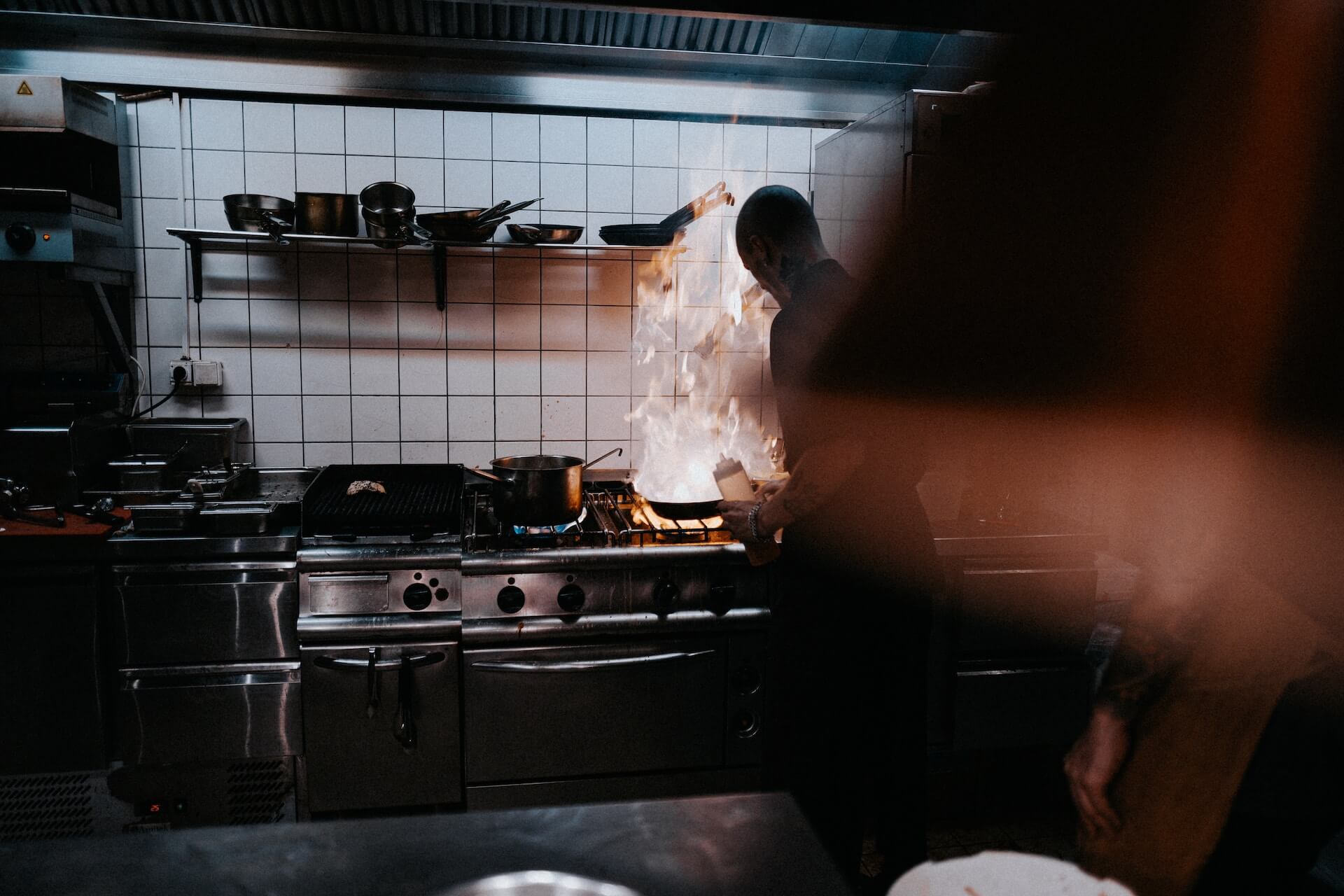
Another way to put that is that our elected officials haven’t managed to pass a stimulus package signed into law for 251 days. They did, however, find the time for a week-long recess for Thanksgiving.

It was announced just two days ago that a bipartisan group of congresspeople and senators had negotiated a $908 billion stimulus package. The intention was to strike a middle ground between Majority Leader Mitch McConnell’s (R-KY) desire for a $500 billion package and House Speaker Nancy Pelosi’s (D-CA) proposed $2 trillion-plus bill.

Yesterday, multiple sources reported that the $908 billion—which apparently didn’t include the RESTAURANTS Act—was dead on arrival.

Of note, at least to me, is that Senator Mark Warner (D-VA) is reported to have mentioned that this week’s touted bipartisan package had been negotiated “over pizza or pasta at people’s houses.” I have to wonder if the pizza or pasta was prepared, provided and delivered by restaurants that are among the hundreds of thousands facing permanent closure if the government doesn’t actually act in a meaningful way.

Treasury Secretary Steven Mnuchin, on his way to a House committee meeting, reportedly said, “The president will sign the McConnell proposal that he put forward yesterday, and we look forward to making progress on that.”

From what I was able to glean, the RESTAURANTS Act isn’t included in McConnell’s bill either. Neither are stimulus checks nor a federal boost to unemployment insurance payments. Supposedly it does include an extension of the problematic Paycheck Protection Program (PPP); liability protection for schools and businesses; and a $332 million grant for theaters and live venues.

If the tone of this article comes across as angry, I freely admit that’s an accurate assessment. The RESTAURANTS Act was first introduced to Congress on June 15. Elected officials have had 171 days to help the hospitality industry.

The industry that employs more than 16 million people—11 million of which are employed by independent restaurants. The industry that generates well over $760 billion in annual sales. The industry that accounts for 3.5 percent of America’s GDP. The industry that has for years provided venues, food and drinks for elected officials’ countless re-election campaign fundraisers.

The industry that, should tens or hundreds of thousands of restaurants close their doors permanently, will shed millions of jobs that will not return.

And that’s just what’s happening to the industry in the United States. The industry is similarly at extremely high risk for irreversible devastation in Canada and throughout the world.

So, yes—I’m angry. I’m angry that the millions of jobs and hundreds of billions of dollars this industry contributes just to America apparently don’t mean much to government officials.

I suppose I can only blame myself for holding out hope that the RESTAURANTS Act would be signed into law. After all, the president, speaking about restaurants back in March, said, “they’ll all come back in one form or another,” adding, “It may not be the same restaurant, it may not be the same ownership, but they’ll be back.”

They won’t be back. We’ve already suffered permanent closures. There was no prescience—or empathy—in the president’s statement. Let me make this clear: I’m not laying all of this solely at his feet. America’s politicians on all sides have failed the hospitality industry and therefore millions of Americans.

Restaurants, bars, lounges, nightclubs, hotels… This is an industry that consists of incredibly resilient people. There comes a point, however, that even the most resilient need help.

As hospitality professionals fight to return to their feet, bloodied and battered from countless blows, it doesn’t seem that the government is in their corner. Nothing would make me happier than to be proven wrong, but we’ve been at this crossroads for months now.

Image: Caleb Perez on Unsplash

by krghospitality krghospitality No Comments

KRG Hospitality Expands Team with Director of Business Development

KRG Hospitality Expands Team with Director of Business Development

by KRG Hospitality – 12/1/2020

December 1, 2020, Burlington, Ontario, Canada–KRG Hospitality, a strategic and creative hospitality consulting agency, today announces the addition of industry veteran and journalist David Klemt to the team. Mr. Klemt will take on the role of Director of Business Development at KRG Hospitality.

Before joining KRG Hospitality, Mr. Klemt gained decades of experience in hospitality working in multiple roles. He kicked off his career as a host at an international chain restaurant, worked as a server at restaurants big and small, became a bartender, co-founded a nightlife-specific valet company, and moved into nightlife marketing and promotions.

For the past 15 years, Mr. Klemt has reported on the industry as a hospitality business journalist. He held the title of editor for Nightclub & Bar’s digital publication for five years. Mr. Klemt founded hospitality news and resources site Hospitality Villains earlier this year after losing his editing job due to the Covid-19 pandemic.

“We’re entering a new era of hospitality brought on by the Covid-19 pandemic and an industry-wide reckoning with the old way of doing business that forced operators to accept single-digit profit margins,” said Mr. Klemt. “I’m excited and eager to help hospitality professionals thrive as the industry undergoes its next evolution. KRG Hospitality is a driven, dynamic and creative solutions-based agency that aligns with my values and passion for this industry.”

In his role as Director of Business Development at KRG Hospitality, Mr. Klemt will be responsible for developing the agency’s partner network, hosting the Bar Hacks podcast, writing informative articles, publishing expert contributors, and overseeing KRG Hospitality’s social media platforms.

About KRG Hospitality

KRG Hospitality is a storied brand with a proven track record. The agency has delivered exceptional and award-winning concepts throughout a variety of markets found within Canada, the United States, and abroad over the past decade. KRG Hospitality provides a clear framework tailored to each client, writing detailed strategic plans; creating award-winning concepts; facilitating start-up projects; finding gaps in existing strategies; developing solutions to known problems; identifying opportunities for growth; and inspiring others through unique seminars, workshops, and on-going coaching methods. Currently, KRG Hospitality operates in Toronto, Calgary, Vancouver, Las Vegas, Nashville, Orlando, Philadelphia, and the Eastern Caribbean. Visit KRGHospitality.com to learn more.

Image: Alex Knight on Unsplash

by krghospitality krghospitality No Comments

Turning Crisis into Confidence

Articles Submitted To Media Partners During Covid-19 Pandemic

By Doug Radkey (March 2020-July 2020)

Take Time to Recharge: Self-Care During a Crisis

During times of crisis, everyone feels something: sadness, confusion, fear, anxiety, or anger.

It can be easy for many within the industry to become overwhelmed with the amount of decisions that need to be made not only for their business, but for their family, staff, and community.

One area that often gets overlooked, particularly among business and community leaders, is their own self care.

From watching the news every hour to making tough decisions, to hours of volunteering, to scrolling through your social media a little too much, it’s easy to get lost in the noise of what’s going on around us in the time of crisis.

And you’re not alone in this……Continue Reading Here on Nightclub & Bar

Every Red Light Eventually Turns Green

When faced with a lengthy business shutdown, it can be a roller coaster of emotions when you learn it’s time to re-open. While it is understandable that you want to open your doors as quickly as possible, you also want to ensure you’re doing it correctly and in a way that will not cause further damage to your brand, bottom line, staff, or guests.

The truth is, as a variety of government bodies have indicated; you’re likely going to have to open your venue in a series of phases. Are you financially & mindfully prepared for that?

You are also going to have to pivot (are you tired of that word yet?) if you haven’t already in addition to diversifying your menu and offerings.

You are going to have to build a high level of trust with guests like never before….Continue Reading on Nightclub & Bar

Adapting to Change; Seating (Part 1)

Understanding flexibility and a willingness to embrace change will make you a valuable leader — one who can reliably deal with many different opportunities and scenarios. You will then find change is not something to fear, but something to welcome and turn into an advantage. For restaurants with a large on-premise business model, change is happening and you need to prepare – now!

The biggest fear factors for many with a significant dining room are the new seating recommendations and capacity levels for dine-in restaurants. Everyone reading this will be in a slightly different scenario, pending the size of venue, location, and style of concept, so it is hard to create a cookie-cutter solution.

However, there are some new strategies and standards to consider that will help you adapt, pivot, and embrace these changes. Continue Reading on Resto Biz

Adapting to Change; Seating (Part 2)

To maximize your seating, encourage guests to make reservations, preferably online. Your guests will want to pick their spots, their proximity to others, and their proximity to high-traffic areas. Your new seating arrangement should ideally be online to review and should also be flexible.

Having a reservation system will also allow your staff the appropriate time to fully sanitize and prepare each area for the next number of guests in a reserved party.

With reservations, it may be wise to also consider time restrictions; guests who are used to travelling to tourism hot spots will be accustomed to these types of rules. Don’t be scared to put a 60- or 90-minute timestamp on reservations to encourage more table flips, which you’ll want to do as many times as possible within safety guidelines. Continue Reading on Resto Biz

Maintaining Financial Health During Pandemic

You already know the majority of restaurants run their business on extremely thin margins, and in the the time of COVID-19, the financial health of the industry has become all the more precarious. In fact, a recent (U.S.) National Bureau of Economic Research paper gave restaurants a 30 per cent chance of reopening if the pandemic lasts four months; this estimate drops to 15 per cent if it lasts six months.

The average restaurant, it found, had enough cash on hand to last approximately two weeks. Why such little time? Because the 3- to 5-per cent profit margin of the average restaurant or bar simply can’t cut it in this environment.

Here’s the thing – we can’t continue down this doom and gloom route. The industry will prevail, and some will come out even stronger – if they push forward now. Restaurants must operate with the mindset of achieving 12- to 15-per cent profit margins – and the secret is, it is possible. Continue Reading on Resto Biz

Hotel F&B in a Post-Pandemic Landscape

early all of our favorite and most popular travel destinations around the world have been impacted by the Covid-19 pandemic, resulting in a horrendous financial loss for hotels, resorts, and the entire hospitality industry alike.

Research by the American Hotel & Lodging Institution suggests that hotel recovery to pre-COVID-19 levels could take until the year 2023—or perhaps even later with the expected ‘long-term’ loss of business travel and international leisure travellers.

There are numerous strategies and alterations to consider moving forward for the operation of a hotel property post-pandemic; but one area that can help properties regain their guests’ trust plus revenue and profits is that of the food & beverage program. Continue Reading on KRG Hospitality

Top