QSR

by David Klemt David Klemt No Comments

Alternatives to ServSafe

Just.Safe.Food. and More Alternatives to ServSafe

by David Klemt

Server carrying two plates with one hand

ServSafe, the National Restaurant Association‘s food safety training program, isn’t the only food handler training game in town.

Certainly, the program is the most well known in our industry. However, it’s fair to say that ServSafe is closer to infamous than just ubiquitous due to a New York Times article from January.

While it’s the most recognizable of the food safety programs, it’s not the only one. Although, ServSafe’s omnipresence likely gives many the impression that it’s ServSafe or nothing.

There are, however, alternatives to ServSafe. In fact, one challenger was announced a day after the explosive New York Times article that thrust ServSafe into a spotlight the NRA probably isn’t enjoying. (After all, one result of that article was a letter from six US senators demanding answers from the NRA about ServSafe by March 3.)

At any rate, the newest alternative to ServSafe comes from One Fair Wage. The program is Just.Safe.Food. and costs just $10. (As a reminder, ServSafe costs $15.)

For that $10, Just.Safe.Food. gives an individual three attempts to pass their exam and unlimited access to training materials. Additionally, One Fair Wage (OFW) says profits they raise from the program will go toward advocating for restaurant workers.

OFW, as many in the industry know, is owned and operated by restaurant workers. Two cornerstones of the organization’s mission are increasing the minimum wage, and ending the tip credit. OFW is also attempting to convince lawmakers to stop accepting donations from the NRA.

Basically, OFW and the NRA are—and it appears always have been—at odds with with one another.

Other ServSafe Alternatives

Before I list a few other alternatives, let me be clear: KRG Hospitality isn’t advocating for any food safety training program in particular. Operators and their team members will need to decide which program is best for them.

Whether that decision is based on employer requirements, state or local requirements, cost, ideology, or another reason makes no difference to us.

However, I will say that the more competent and comprehensive options there are, the better. Nobody should have a monopoly on food safety.

The key factor to consider is whether the particular state or county regulations are met by the program. If anyone is uncertain, they should reach out to their local health department before proceeding with any program. It’s likely the department only accepts food safety programs that are ANSI-certified.

That said, some alternatives to ServSafe are:

Operators and food-handler restaurant workers can also search for local programs that are accepted by their state/county.

Food Handler Requirements

Food safety isn’t, it turns out, universal throughout the US. Workers can be subject to state or county requirements. In some states, food handler certification is voluntary.

And then there are food safety manager regulations to consider, and those can also be state- or county-specific.

I can’t reiterate enough how important it is to know your state/county/local food handler requirements. As with many regulations, there are nuances and hospitality professionals need to know them.

Below, how different *states regulate food handler training.

State Requirements

  • Alabama
  • Alaska
  • California
  • Florida
  • Georgia
  • Hawaii
  • Illinois
  • North Carolina
  • Ohio
  • Oregon
  • South Carolina
  • Texas
  • Utah
  • Washington

County Requirements

  • Alabama
  • Arizona
  • Kansas
  • Kentucky
  • Missouri
  • Montana
  • Nebraska
  • Nevada
  • New Jersey
  • New Mexico
  • New York
  • North Dakota
  • Oklahoma
  • Virginia
  • West Virginia

Voluntary

  • Arkansas
  • Colorado
  • Connecticut
  • Delaware
  • Idaho
  • Indiana
  • Iowa
  • Louisiana
  • Maine
  • Maryland
  • Massachusetts
  • Michigan
  • Minnesota
  • Mississippi
  • New Hampshire
  • North Carolina
  • Pennsylvania
  • Rhode Island
  • South Dakota
  • Tennessee
  • Wyoming

*This information is believed accurate at the time of publication. No warranty of accuracy is given.

Image: Pixabay on Pexels

by krghospitality krghospitality No Comments

Dynamic Pricing or Dynamic Menus?

Dynamic Pricing or Dynamic Menus?

by Doug Radkey

Two sportbikes racing

A key phrase used throughout 2022 was “the new normal.” In 2023, a key term you will likely hear a lot is “dynamic pricing.”

What is dynamic pricing? It can get quite complex, but the global consulting company, McKinsey, defines dynamic pricing as “the (fully or partially) automated adjustment of prices.”

The term is not entirely new to hospitality. Hotels and the overall travel industry have used modules of the pricing model for years. But for restaurants and even bars, yes, it is something new.

It is also a model getting a lot of attention of late, which begs the following question: Why?

As the bar and restaurant industry recovers from the effects of the pandemic, a dynamic pricing model that optimizes revenue opportunities may seem quite attractive. After all, our industry is looking to rejuvenate its sales to pre-pandemic levels.

Essentially, a dynamic pricing model within this industry would work like this: increase prices when demand is up (peak periods), decrease prices to draw guests in when demand is down (off-peak times).

But should this be a model that disrupts the industry in 2023 and into 2024?

While I am all for a little disruption, the industry needs to tread carefully through this potential transition to dynamic pricing (or perhaps just around the phrase itself) that’s based on demand levels.

Guest Experiences

We all know (or should know) that we do not sell a product. What we sell is an experience.

If we can create a positive, memorable guest experience first and foremost, the revenue will follow.

While hotels and travel, as examples, have boasted “positive financial results” over the years through their different approaches to dynamic pricing (while still trying to focus on the end-user guest experience), independent bar and restaurant brands must be careful not to create a hostile brand perception.

Why? Because many consumers view changing prices based solely on levels of demand as being unfair.

Being unfair will certainly create a negative guest experience and/or brand perception. The hotel and airline industries have been able to navigate this perception successfully by offering alternatives. For example, different rooms and amenities or less convenient flight times at different price points. Essentially, companies in lodging and travel provide options and flexibility before customers make the choice to spend.

What about rideshare and surge pricing as another example? Many of you reading this have likely been burned by surge pricing as a consumer, which can be by definition a form of dynamic pricing.

Have you ever tried to book a rideshare during peak periods in a major market? What would normally be a $20 ride is suddenly $40 to $60 (or more) because of their dynamic pricing model.

What did I do in this situation during a recent business trip? I walked another 25 feet up to the cab staging area of the airport and got my ride for $25.

The end results? I had a negative customer experience with the rideshare company, first and foremost. Additionally, that negative experience drove me to the competition. The key here is I was given a choice.

Now let’s switch that scenario to a restaurant.

The Restaurant Scenario

You book a table at your favorite restaurant and order that incredible steak dinner you always enjoy. But instead of it being $50 like you have grown accustomed to, it is now $75 or more. How are you as a consumer going to feel about this new price just because you visited your favorite spot during a “peak period” on a Saturday night? Were you given a choice before the spend?

Of course, this can work in the opposite direction: ordering a meal during a non-peak time and getting it for a cheaper price, thereby getting a discount.

But should we be confusing our customers based on their chosen, convenient time to visit your restaurant or bar? Should you also focus on “discounting” to drive people to your business?

I have even seen recommendations for offering an increased price for peak period but using what was the previous regular price during the non-peak times, labeling the normal price a “discount.”

Should we be framing our regular priced menu options as a discount just so we can charge and make more during a peak period? Is this being fair and ethical to your loyal customers? Should we be going down this road?

With this model (and the phrase “dynamic pricing”), which is based on demand, it is very easy to see how you can quickly confuse or alienate your loyal guests. Unless the industry in its entirety migrates over to this demand-driven model, a similar scenario as outlined above can play out for you and your guests.

Without extremely strong but transparent communication systems in place (which will be a challenge in itself), it is safe to assume that they will likely visit another restaurant up the street and/or provide negative feedback because they feel your pricing model is confusing or unfair.

Dynamic Menus

The phrase that is much more simplified and will be more easily embraced by both operators and guests is “dynamic menu.”

So, what’s the difference?

While it is still by definition “the (fully or partially) automated adjustment of prices,” it is not based on demand throughout the day. Rather, pricing is based on simple supply chain and operational cost adjustments.

According to the National Restaurant Association:

  • 95 percent of restaurants have recently had significant supply delays or shortages of key food items; and
  • 75 percent of restaurants have had to change their menu because of supply chain issues.

With a more dynamic menu, you can adjust pricing to suit those changes accordingly, through the lens of real-time ingredient cost, labor costs, productivity levels, and even the availability of certain menu items.

This simply means that the incredible steak dinner a guest has always enjoyed at your place is perhaps now $53 instead of $50 because the price of beef went up the past week or month. This ensures that as an operator, you will have a minimal gap between your theoretical and actual food costs.

Again, this should work both ways, meaning if the price of beef has gone down, so too should the price.

This means that your guests are paying an accurate value for each item, based on your intended sales mix and contributions, without a loss in margin on your end or negative experience on the guest end.

This means that everything on your menu is “market price” or MP. Where have we seen that before…?

Market Price

We all know restaurant menus will commonly deduct a price and replace it with the term “market price” (often abbreviated to “MP”). This means the price of the menu item depends on the market price of the ingredients, and the price is available upon request. It has been used for years for seafood in particular—most notably lobsters and oysters—in many restaurants.

Therefore, this pricing model is not entirely new. So, why should it stop at just high-priced seafood?

The reason many operators would use the abbreviated MP was because they did not want to reprint menus every single day as the prices fluctuated greatly.

As we move towards digitally savvy restaurant operations, implementing integrated technology and menus, we can begin to find alternatives and ensure that we are actively pricing our menus accordingly based on the market (and overhead costs) to strengthen top- and bottom-line results.

Knowledge is Power

To make a dynamic menu work, whether you’re a QSR, sports bar, casual-dining or fine-dining concept, or any other category of bar or restaurant, you need to know your target customers, provide a targeted menu, and know your numbers (the data).

Curating and engineering a menu should be a simplified process. To be honest, this should have been streamlined prior to the pandemic.

Your menu should be developed based on data, consumer sentiment, regional ingredients, regional suppliers, and local talent within the confines of the overall concept. Food and beverage programs should be developed with thought, care, speed, precision, execution, and last-but-not-least: consistent profits in mind.

Keeping menus “small” (10 to 12 or even 15 items at maximum) will be the new threshold of a successful, more profitable operation. This size of menu will allow bars and kitchens to operate more efficiently; keep inventory costs both low and controlled; control training and labor costs; and provide guests with the most flavorful and exciting items that they truly want.

Be Nimble

You also want to provide menu flexibility by continually reviewing your supply chain. Maintaining a strong personal relationship with your suppliers is imperative. You must also review your costs and inventory on a daily and weekly basis to make dynamic menus work.

To keep inventory, purchase orders, and potential waste to a minimum, it will be crucial that you to ensure your menu is small but innovative. The only way to accomplish this is through effective data management.

However, the new challenge for many independent brands is making data timely, relevant, digestible, and actionable for operators and their leadership teams. The ability to collect, interpret, and effectively react to key datapoints is going to be crucial for anyone who wants to implement a dynamic menu, and for moving forward in general.

At the end of the day, profiting from a dynamic menu is all about making decisions based on accurate cost and productivity data. Of course, there’s only one way to obtain data: embrace technology and create strategic clarity around it.

The Tech Stack

The key to successfully implementing a dynamic menu is integrating a stack of technology that provides real-time data and trend reports.

From point-of-sale software and reports to accounting software, inventory and recipe management software, and invoice management software or a suite that includes all of the above that’s integrated and working together, you can obtain real-time data to adjust your pricing based on real-time ingredient and productivity costs on a daily or weekly basis.

You want seamless movement of data from front- to back-of-house that will position you to make decisions and have a more complete picture of inventory stock levels, costs, and ordering needs, plus itemized sales, contribution margins, and productivity levels.

In Summary

While we must find ways to be innovative, potentially price-gouging our guests during peak periods and discounting during slow periods is not the way for this industry to recuperate and build loyal customers.

Building a strong brand through the creation of memorable experiences and by building connection with your community along with strategic planning, effective marketing, the elements of culture, and efficient operations, you can build sustainable revenue and profit channels.

By following a more dynamic menu approach within your operations, you can still maintain transparency with your guests with less challenging communication methods, remain a fair and well-respected brand within your community, and improve your margins by three to five percent or more with the right people and systems in place.

That sounds like a pretty good deal to me. The question here remains: Are you Team Dynamic Pricing or Team Dynamic Menus?

Image: Joe Neric on Unsplash

by David Klemt David Klemt No Comments

FAST Act Dealt Knockdown Blow

FAST Act Dealt Knockdown Blow

by David Klemt

Boxer being knocked back by punch

A bill we think is one to watch, California’s Fast Food Accountability and Standards Recovery Act, may be on the ropes already.

Assembly Bill 257, known as the FAST Act, is “on hold” until 2024. So, while the Save Local Restaurants coalition and voters have yet to kill the bill, it may be out on its feet.

We reported two months ago that fast food chains were moving quickly to kill the FAST Act. It appears that the initial attack on AB-257 was successful.

That is, the chains and coalition got what they want: the ballot initiative vote has knocked down AB-257.

For those unfamiliar with the Save Local Restaurants Coalition, the following organizations are members: The National Restaurant Association (NRA), US Chamber of Commerce (USCC), and International Franchise Association (IFA). Further, fast-casual and QSR chain coalition members—including Starbucks, In N Out, McDonald’s, and Chipotle—threw nearly $13 million at the ballot measure that halted FAST.

What’s FAST?

To read AB-257, the FAST Act, in its entirety, click here.

In summary, FAST:

FAST does the following:

  • establishes the Fast Food Council, ten members appointed by the Governor, the Speaker of the Assembly, and the Senate Rules Committee. The council will operate until January 1, 2029;
  • defines “the characteristics of a fast food restaurant“;
  • gives the Fast Food Council the authority to set “minimum fast food restaurant employment standards, including standards on wages, working conditions, and training“;
  • provides the council the power to “issue, amend, and repeal any other rules and regulations, as necessary”; and
  • allows the formation of a Local Fast Food Council by a county, or a city that has a population of more than 200,000.

Voters effectively stopped California from implementing FAST until November 2024 at the earliest. (That is, if the California Secretary of State verifies that the referendum effort did indeed secure the required amount of signatures.)

Opposition

A statement from Save Local Restaurants reads, in part:

The quick-service restaurants targeted by the law – which include coffee shops, juice bars, pizzerias, delis, and salad shops – already operate on small, single-digit profit margins. These include more than 10,000 small businesses, including thousands of women- and minority-owned businesses.

If these restaurants are forced to absorb the costs, the result will be bad for workers and local communities. To survive, many restaurant owners will have no choice but to reduce worker hours or introduce automation. Some may choose to leave their communities entirely or go out of business.

As is often the case with overreaching California policies, this is likely only the beginning.

Additionally, the National Restaurant Association, a member of the coalition, has said the following:

The impacts of the FAST Act won’t be limited to quick service restaurants in California. The law allows the new regulating council to set a higher minimum wage for quick service restaurants. Independent restaurants will, however, be forced to increase their pay to match, so they can remain competitive when recruiting and retaining workforce.

Takeaway

We believe this bill is one to watch because similar efforts could spring up in other states. Also, just because the bill is on hold until 2024 in California doesn’t mean other states aren’t working on similar legislation right now.

Now, there are obviously two sides to consider. Opponents, as we see above, say FAST will raise prices, eliminate jobs, and hurt families.

Proponents believe FAST will protect the health, safety, and welfare of fast-food workers. Additionally, the Fast Food Council could increase the minimum wage for fast food workers above California’s $15.50 minimum (effective January 1, 2023).

We’ll keep an eye on FAST over the next couple of years. Perhaps the coalition can work with California on a bill that protects fast food workers and doesn’t hurt operators and the communities they serve.

At any rate, FAST is down but certainly not yet out.

Image: Johann Walter Bantz on Unsplash

by David Klemt David Klemt No Comments

Canada’s Single-use Plastics Ban

How Canada’s Single-use Plastics Ban Affects Operators

by David Klemt

Single-use plastic straws and utensils

With a few exceptions, Canada’s ban on the manufacture, importation, and sale of single-use plastics is now officially in effect.

However, that doesn’t mean restaurant and bar operators need to worry about current inventories just yet. While the Single-use Plastics Prohibition Regulations are in effect, operators have a year to deplete their stocks.

SUPPR is a crucial element of Canada’s overall plan to combat pollution and reach a goal of zero plastic waste by 2030. The single-use plastics ban was announced in June of this year.

“We promised Canadians we would deliver a ban on single-use plastics. Today, that’s exactly what we’ve done,” said Minister of Environment and Climate Change Steven Guilbeault the day SUPPR was announced. “By the end of the year, you won’t be able to manufacture or import these harmful plastics. After that, businesses will begin offering the sustainable solutions Canadians want, whether that’s paper straws or reusable bags. With these new regulations, we’re taking a historic step forward in reducing plastic pollution, and keeping our communities and the places we love clean.

Now, six months later, it’s the law of the land.

What’s Banned?

Essentially, Canadian operators must evaluate everything they use for delivery and takeout or pickup. If any items are single-use plastic, they must be gone by December 2023.

Per SUPPR, the manufacture, importation, and sale of the following is prohibited:

  • Checkout bags designed to carry purchased goods from a business and typically given to a customer at the retail point of sale.
  • Cutlery includes:
    • knives
    • forks
    • spoons
    • sporks
    • chopsticks
  • Foodservice ware designed for serving or transporting food or beverage that is ready to be consumed, and that:
    • contains
      • expanded polystyrene foam
      • extruded polystyrene foam
      • polyvinyl chloride
      • carbon black
      • an oxo-degradable plastic
    • are limited to the following items
      • clamshell containers
      • lidded containers
      • boxes
      • cups
      • plates
      • bowls
  • Ring carriers are flexible and designed to surround beverage containers in order to carry them together.
  • Stir sticks designed to stir or mix beverages, or to prevent a beverage from spilling from the lid of its container.
  • Straws include:
    • straight drinking straws, and
    • flexible straws, which have a corrugated section that allows the straw to bend, packaged with beverage containers (juice boxes and pouches)

For accuracy, the above comes from the Government of Canada website directly, unedited.

What does this mean for Operators?

Again, operators in Canada don’t need to toss their current stock of the above items.

However, Restaurants Canada does recommend that operators contact suppliers and customers if they import, export, or sell prohibited items currently.

The single most important thing for operators to do now is research single-use plastic alternatives. Items need testing as changes will affect F&B items and the guest experience.

Of course, it’s possible an operator’s current supplier already offers alternatives to single-use plastics. That could prove convenient but costs, supply chain reliability, and impact on menu items need careful consideration.

Sustainability and responsible practices are no longer just conversation topics within the industry. As of this week, in Canada, they’re the only way forward.

Image: Volodymyr Hryshchenko on Unsplash

by David Klemt David Klemt No Comments

Is Restaurant Revitalization Back?

Restaurant Revitalization Back on the Table?

by David Klemt

US Capitol Building and cloudy sky

After watching the Restaurant Revitalization Fund die a slow, painful death earlier this year, three senators are trying to help the industry again.

Three Democratic senators seem to think that the RRF battle isn’t over. Senators Ben Cardin (D-MD), Sherrod Brown (D-OH), and Patty Murray (D-WA) are trying once again to help RRF applicants. As a refresher, Sen. Cardin is among the original RRF legislation authors.

Last Thursday, the senators introduced the Restaurant Revitalization Tax Credit Act. Now, before we get into the details, it appears this bill is a stop-gap of sorts. A statement from Sen. Murray suggests as much.

Per a statement from Sen. Muray, the “Restaurant Revitalization Fund left too many behind. I believe we need to replenish the Fund and will keep pressing to do so. Until that happens, bills like the Restaurant Revitalization Tax Credit Act will help keep restaurants afloat.”

It’s safe to say a significant number of operators prefer replenishment of the RRF to a tax credit. However, this could represent a step in the right direction.

The Restaurant Revitalization Tax Credit Act

For those with an interest in dissecting the bill, the text in its entirety is here.

In summary, here’s what Sens. Cardin, Brown, and Murray want to see become law: a payroll offset of $25,000. Of course, it’s not that simple—there are requirements and nuances.

First, the only eligible restaurants are RRF applicants who didn’t receive a grant. Second, the restaurant must prove:

  • operating losses of at least 30 percent in 2020 and 2021 in comparison to 2019; or
  • losses of at least 50 percent in either 2020 or 2021 in comparison to 2019.

Additionally, applicants must have been operating at least as far back as March 14, 2020. There’s also a payroll tax requirement: the applicant restaurant must have paid the taxes in at least two quarters in 2021. But wait—it doesn’t end there.

Restaurants with ten or fewer employees could offset a maximum of $25,000 in payroll taxes for the entirety of 2023. However, for every employee over ten, the refund cap drops by $2,500.

So, this bill appears to target very small operations for assistance. Assistance, we can only hope, that’s meant to help until the Senate and House replenish the RRF.

After all, Sen. Murray did say this bill—”bills like,” to be precise—is meant to “help keep restaurants afloat.”

It’s difficult to view this effort through anything but a skeptical lens given what happened earlier this year. And hope, as the saying goes, isn’t a strategy. But I suppose this bill represents a glimmer of hope that the estimated 175,000-plus RRF applicants who never received a grant may still get the help they deserve.

Image: J. Amill Santiago on Unsplash

by David Klemt David Klemt No Comments

The NRA’s 2023 Culinary Trend Forecast

The National Restaurant Association’s 2023 Culinary Trend Forecast

by David Klemt

Cheesy chicken sandwich on paper wrapper

Ahead of the beginning of a new year, the National Restaurant Association unveils their culinary trend predictions for 2023.

The report is the result of a collaboration between the NRA, Technomic, and the American Culinary Federation (ACF).

For those unfamiliar, Technomic is at the forefront of foodservice trend tracking, industry research, and analysis. Likewise, the ACF is a premier industry organization. Tracing its founding to 1929, the ACF promotes “the professional image of American chefs worldwide through education of culinarians at all levels.”

To predict what will be “hot” next year, the NRA, Technomic, and ACF sent the 17th annual What’s Hot survey to thought leaders and chefs. In direct partnership with the Technomic Menu Research & Insights Division, the NRA predicted the top menu trends from 110 items spanning 11 categories.

Now, this isn’t a full dive into the report in its entirety. Rather, we strongly encourage our readers to download a copy of What’s Hot 2023 Culinary Forecast for themselves and their teams.

What readers will find below are the top 10 trends for 2023. Additionally, we’ll share the top three macro trends for next year, as forecast by the NRA and their partners.

More than Food

Somewhat surprisingly, the NRA’s top-ten list of culinary trends isn’t just a list of food items. Instead, this forecast paints a picture of where restaurants are heading in 2023.

While there are some specific cuisine predictions, the NRA’s top culinary predictions show us, in part, how consumers want to experience the restaurants they visit.

  1. Southeast Asian cuisines (examples: Vietnamese, Singaporean)
  2. Zero waste/Sustainability/Upcycled foods
  3. Globally inspired salads
  4. Sriracha variations
  5. Menu streamlining
  6. Flatbread sandwiches/Healthier wraps
  7. Comfort fare
  8. Charcuterie boards
  9. Fried chicken sandwiches and Chicken sandwiches “3.0” (example: fusion of flavors)
  10. Experiences/Local culture and community

As we can see, operators and consumers expect tighter, more concept-specific menus. Also, comfort foods; shareable (and “Instagrammable”) items like charcuterie boards; and items that show local and global influences may be hot in 2023.

One can consider, then, streamlining their menu to include their top sellers along with local and/or global flavors authentic to their brand.

Below, readers will see that three of the trends above make up the NRA’s top-three 2023 macro trends:

  1. Menu streamlining
  2. Comfort fare
  3. Experiences/Local culture and community

Operator and Consumer Behavioral Shifts

Looking at the macro trends, it’s reasonable to believe the past few years will influence 2023 heavily.

Operators are dealing with inflation, higher costs for everything, labor shortages. Further, according to Datassential, more than a third of American operators are experiencing low traffic and sales levels.

We can expect these issues to follow us into 2023, at least for Q1 and Q2. Therefore, the NRA’s macro trends forecast makes sense. Streamlining menus often leads to streamlining the back and front of house. In turn, doing so can lower costs and boost staff retention.

On the consumer side, it appears comfort foods, chicken sandwiches, and experiences are driving visits and online orders. These are, as we all know, behavioral shifts we can trace back to the start of the pandemic.

We always suggest proceeding with caution, logic, and data when considering embracing trends. Missing out on trends can be just as costly as latching onto a trend too late.

That said, the macro trends certainly seem reasonable. Only time will tell, but the NRA’s 2023 forecast certainly contains several items operators and their teams should give serious consideration.

Image: Arabi Ishaque on Unsplash

by David Klemt David Klemt No Comments

Merchants Support Credit Card Act

100s of Merchants Support Credit Card Competition Act

by David Klemt

Customer paying via Square terminal

Perhaps at least somewhat unsurprisingly, support for the Credit Card Competition Act is growing rapidly among merchants.

In fact, 1,802 merchants are making their position on the bill clear. Those hundreds of merchants drafted, signed, and sent a letter to the House and Senate.

The crux of that letter? To tell our lawmakers to support and pass the Credit Card Competition Act.

To view the letter, sent by the Merchants Payments Coalition (MPC), please click here. For the bill and its status, follow this link.

The Credit Card Competition Act: A Quick Summary

According to the MPC, credit and debit card transactions just in the US reached $3.49 trillion in 2021. Along with those transactions came $77.48 billion in merchant fees—just for Visa and MasterCard.

Why call those out those two processors in particular? Well, it’s because they’re behind about 576 million credit cards. Oh, and they also control 87 percent of the processing market.

In the span of just one decade, Visa and MasterCard swipe fees have risen 137 percent. So, it’s not surprising that merchants are supportive of the Credit Card Competition Act.

There are, indeed, restaurant and hospitality groups attached to the MPC’s letter to Congress. Taking a quick glance, Denny’s franchisees, Dutchman Hospitality Group, and Mandalay Hospitality Group are among the signees.

Obviously, this makes sense—swipe fees are among the highest costs operators face every day.

Where’s this Bill Currently?

It shouldn’t be too shocking to find that this has yet to make much progress. The bill’s sponsors, Sens. Richard Durbin (D-IL) and Richard Marshall (R-KS), introduced it in the senate at the end of July.

Three months later, October 28, an attempt was made to include the bill in the National Defense Authorization Act (NDAA). For those who are unfamiliar, the NDAA is known as a “must-pass” bill. After all, it specifies the US Department of Defense’s (DoD) budget and expenditures each year.

Along with a reported 900 other “riders,” Sens. Durbin and Marshall tried to get their bill passed within the NDAA. Unfortunately for the senators and supporters of the bill, the NDAA vote was pushed until the middle of November…which we’re now past.

Of course, the US did just undergo a mid-term election cycle. So, I suppose it’s reasonable to be a bit more patient with the Senate and the progress of this bill.

Those who work in or support our industry can make their opinion of this bill known. Just follow this link to the National Restaurant Association Credit Card Competition Act portal.

Image: Clay Banks on Unsplash

by David Klemt David Klemt No Comments

These are the Happiest Provinces in Canada

These are the Happiest Provinces in Canada

by David Klemt

Newfoundland and Labrador during daytime

If you’re wondering which province in Canada is the happiest, Statistics Canada has the answer—and the happiest may surprise you.

Of course, those who live and work in the happiest province won’t find it shocking. After all, they’re largely happy to be there.

However, if you expect the happiest province to be the home of Toronto, Vancouver, Montreal or Canada… Well, you’re in for a surprise.

Earlier this week we took a look at the happiest cities and states in America. Congratulations Fremont, California, and Hawaii, respectively. To learn where 181 other cities and 49 states rank, please click here.

The Happiness Survey

Or more accurately, the “life satisfaction” survey. For this survey, that’s what Statistics Canada reveals: life satisfaction.

Interestingly, the survey is very simple. Apparently, Statistics Canada simply asked participants to rate the satisfaction of living in their province, zero through ten. For this survey, zero is least satisfied, ten is most.

Ages 15 through 75 (and older) were able to participate. The survey was also broken down to gauge the satisfaction of men and women.

Before we jump into the breakdown of province satisfaction or happiness, some good news. Reviewing the Statistics Canada data, most participants across all age groups are happy. In fact, age groups 65 to 74 and 75-plus appear to be happiest.

On the other side, ages 15 to 54 had the most people who rated their life satisfaction between zero and five. Even so, just over 20 percent of survey respondents rated their satisfaction a five or less.

So, on the whole, Canadians seem satisfied or happy with their lives, regardless of the province in which they live. Personally, I find that to be great news.

The Happiest Province

Okay, let’s dive into the reason you’re here: to learn which province is the happiest.

  1. Newfoundland and Labrador
  2. Prince Edward Island
  3. Quebec
  4. New Brunswick
  5. Manitoba
  6. Alberta
  7. Saskatchewa
  8. Nova Scotia
  9. Ontario
  10. British Columbia

The above rankings are determined by the percentage of survey respondents who rated their life satisfaction eight, nine or ten. So, if you’re in Newfoundland and Labrador, Prince Edward Island or Quebec, wow—you’re apparently one incredibly happy person.

Conversely, below you’ll find the rankings as determined by the largest percentage of respondents who rated their satisfaction a five or lower. As you’ll find, the list below isn’t simply the inverse of the one above.

  1. Ontario
  2. British Columbia
  3. New Brunswick
  4. Alberta
  5. Nova Scotia
  6. Prince Edward Island
  7. Manitoba
  8. Saskatchewa
  9. Quebec
  10. Newfoundland and Labrador

As far as Canada overall, the results of this particular survey are positive. Just 19.4 percent of survey respondents rated their satisfaction or happiness zero through five. And only 28.9 percent provided a rating of six or seven.

More than half of Canadians, 51.7 percent, rate their lives an eight, nine or ten. That’s some great and welcome news.

Image: Erik Mclean on Unsplash

by krghospitality krghospitality No Comments

2023: Year of the POS Systems?

2023: Year of the POS Systems?

by David Klemt

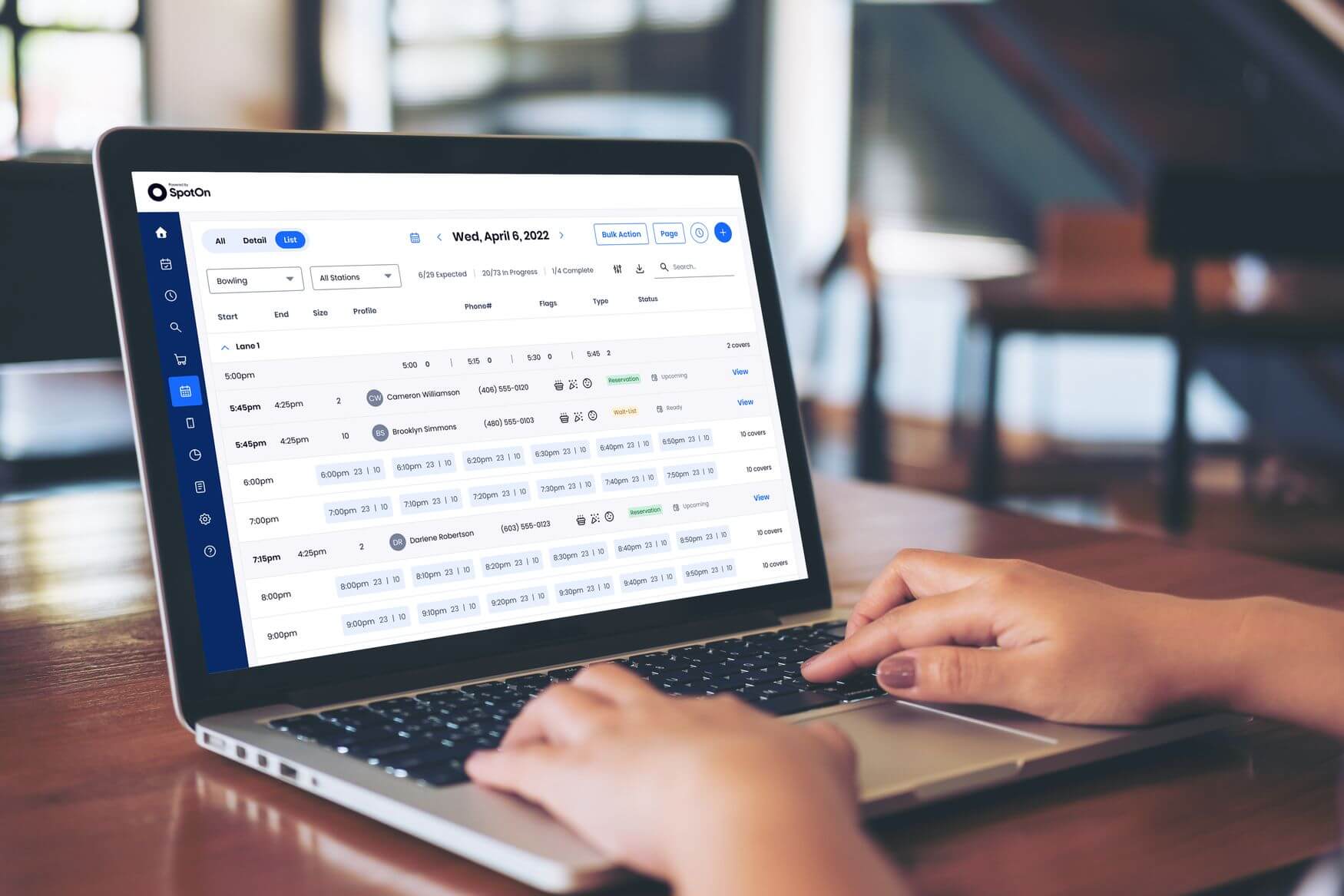
SpotOn POS system on laptop

Image from SpotOn press release

According to SpotOn, the industry could be in for a tech revolution next year as independent operators pursue more powerful POS solutions.

The results of a survey conducted by the cloud-based POS platform are rather revealing. In an effort to better understand where the industry is heading, SpotOn surveyed 300 independent and small-chain restaurant operators.

Both full-service and limited-service (LSR) concept operators participated in this SpotOn survey. Intended to identify the challenges operators face currently, the results reveal much more.

Below, the picture these survey results paint for the industry.

Legacy vs. Innovation

This isn’t the first time I’ve stated the following: Our industry hasn’t been the fastest to implement new technology.

However, we did appear to turn that around in 2021. Now, heading into 2023, our industry may be pursuing cutting-edge tech solutions even more fervently. Today’s guest expects more tech, and your team likely wants access to more modern tech that makes their jobs easier.

Per SpotOn’s survey, 81 percent of independent operators still use so-called “legacy” POS systems. These are “traditional” systems from companies that have been around for quite some time.

It’s not difficult to understand why the vast majority of independent operators continue using legacy systems:

  • Investing in a new platform requires expenditures of money and time.
  • Introducing a new POS platform requires staff training.
  • Staff need to grow adept at using the new system.
  • It can be daunting to research the available platforms and implementing change.

So, independent and small-chain operators have a choice to make: Stick with the familiar or invest in the future. Change can not only be intimidating, it can be expensive.

However, it seems that most operators are ready to throw comfort to the wayside and embrace innovation.

State-of-the-art Benefits

Should the SpotOn survey prove to be accurate snapshot of the industry, 75 percent of operators will implement new tech next year. According to SpotOn, this is largely in response to growing labor challenges, such as scheduling and retention.

The restaurant, bar, nightclub, and food truck platform found that operators are spending as much as 20 hours per week on administrative tasks. State-of-the-art POS systems can slash those hours by:

  • streamlining operations;
  • making scheduling simpler;
  • calculating tips and payout for payroll; and
  • managing overtime, an increasingly common task.

More modern POS platforms can automate labor management tasks, saving operators time, money, and frustration. Automation and streamlining give operators something invaluable: time.

In particular, innovative and helpful tech solutions provide an operator with time to focus on growing their business. When weighing whether to keep a familiar but less feature-rich POS system or invest in a modern platform that seamlessly integrates many solutions, ask yourself a couple important questions:

  • What’s my time worth?
  • What am I focusing on every day?
  • Am I growing my business or stagnating?
  • Is my current POS system helping or hindering my team?
  • Does my POS system streamline and automate any tasks?

Image: SpotOn

by David Klemt David Klemt No Comments

Tipping is on the Ballot in Washington, DC

Tipping is on the Ballot in Washington, DC

by David Klemt

Folded dollar bills

Out of concern that people who work for tips aren’t making minimum wage in Washington, DC, Initiative 82 is on the ballot.

This is interesting for several reasons. One of which is the fact this isn’t the first time this issue has been voted on in DC.

Back in 2018, Initiative 77 was presented to Washington, DC, voters. The initiative took the $3.33 per hour minimum wage for tipped workers up to $15 per hour, the full minimum wage.

In June 2018, the measure was approved by voters. However, the Washington, DC, Council held a vote and repealed Initiative 77 after if had been passed.

Phil Mendelson (D-Chairman) of the Washington, DC, Council, introduced the bill that ultimately repealed Initiative 77 in October 2018.

“The Council amends laws all the time. And if a law is a bad law it should be amended or repealed,” said Mendelson at the time. “It doesn’t matter if the law was adopted by Congress, the voters, or ourselves.”

Further, Mendelson claimed that tipped workers themselves—bartenders, servers, valets, manicurists, and more—didn’t hold a favorable view of the passing of the initiative.

“77 may be well-intentioned, but the very people the Initiative is intended to help are overwhelmingly opposed. If we want to help workers – protect them from harassment and exploitation – there are better ways than Initiative 77,” Mendelson said.

One council member, Mary Cheh (D-Ward 3), opposed repealing Initiative 77 and addressed claims that it was harmful to tipped workers.

“Although I take these claims seriously, in my view they are speculative and not borne out by the experience of the other jurisdictions that have one wage,” said Cheh.

Support

Whenever increasing tipped worker wages to full minimum wage comes up, we tend to encounter the same arguments for and against.

Currently, the tipped hourly wage in DC is $5.35 per hour. In comparison, full minimum wage in DC is $16.10 per hour.

Now, as the law reads, if a tipped worker’s wages don’t equate to full minimum wage, their employer is expected to bridge the gap.

The key argument for the passing of Initiative 82 is simple: tipped workers should make at least minimum wage. These workers deserve the stability of knowing how much they’ll make each shift and earning a living wage (consistently, hopefully).

Those who support Initiative 82 also say that since the measure doesn’t outlaw tipping, tipped workers would earn more than minimum wage.

Opposition

Opponents, however, argue that the initiative will harm tipped workers. Some say that operators will cut shifts and increase prices in response to Initiative 82 passing. This will, of course, lead to servers, bartenders, and other tipped workers making much less than they did in the past.

Traffic may also decrease because it’s assumed that operators will increase costs significantly.

There’s also the argument that’s often (if not always) made when this topic comes up: Tipped workers themselves don’t support these initiatives.

“I have not met a single server who wants this,” Washington, DC, bar owner David Perruzza told the Washington Blade. Perruzza added, “The people who support this don’t know anything about the service industry.”

A Few Questions…

I’ve made no secret of my cynicism when it comes to politicians and their relationships with our industry.

My main argument was made for me: the Restaurant Revitalization Fund saga. We watched for months as Congress failed to replenish the RRF, leaving more than 177,000 operators and their staffs to fend for themselves. This, after months of dangling replenishment in front of all of us. Ultimately, they abandoned us.

Tellingly, Senator Rand Paul (R-KY) referred to RRF replenishment as a “bailout.” And apparently he doesn’t think much of the challenges operators have faced since the start of the pandemic, asking, “Where’s the emergency?” The closures of tens of thousands of restaurants and bars, often the cornerstones of communities across the country, doesn’t rank as an emergency, apparently.

So, Initiative 77, Initiative 82, and similar measures beg a few questions:

  • Do politicians actually ask their tipped-wage constituents their thoughts on this topic before introducing these ballot measures?
  • When these initiatives are being considered, do people just ask a few operator friends their opinions?
  • Do local, state, and federal politicians really have a grasp of our industry?

One thing is certain: Industry eyes across the country are on Initiative 82. If it passes, we can likely expect similar measures to be introduced in cities and states. Should it fail, it may be a while before another jurisdiction sees this type of initiative again.

Image: Annie Spratt on Unsplash

by David Klemt David Klemt No Comments

F&B in Canada: Top Menu Items

F&B in Canada: Top Menu Items

by David Klemt

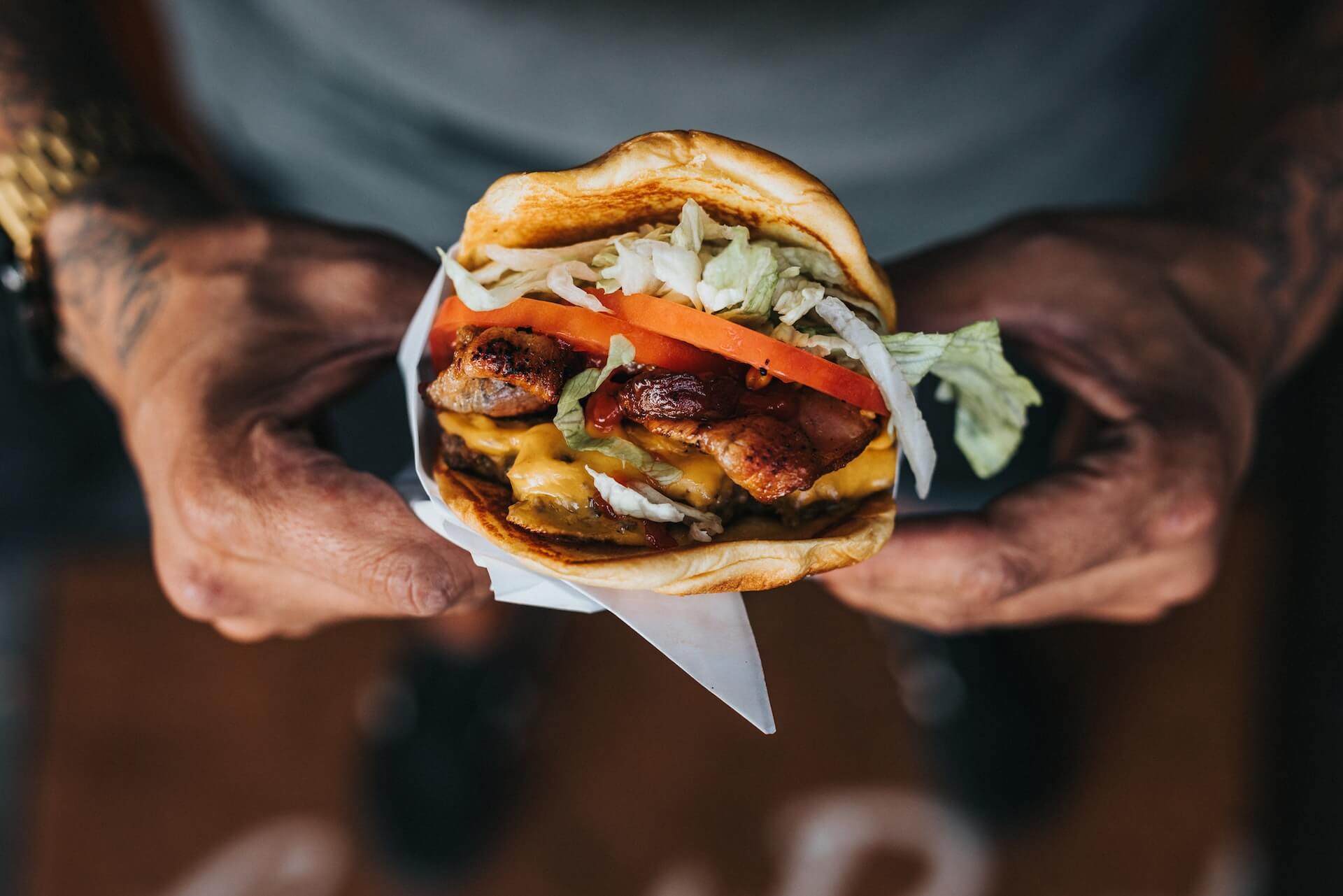
Closeup of hands holding burger

Those wondering what food and beverage menu items are performing best among consumers throughout Canada need wonder no more.

And why is that? Well, Restaurants Canada has the answers, revealing the top ten food and top ten beverage items.

Further, the organization compares each item’s performance. In this instance, Restaurants Canada analyses the percentage of orders that contained each food or beverage item from January to April 2022 in comparison to 2019.

These insights (and many more) are available in Restaurants Canada’s 2022 Foodservice Facts report. In fact, you can find our reviews of several of the restaurant advocacy group’s report topics via the links below:

For your own copy of this year’s Foodservice Facts report, click here.

Top 10 Canadian Drink Menu Trends

As you’ll see below, coffee is outperforming nearly every other beverage category. Specifically, Hot coffee is at the top, while Iced or frozen coffee is ranked third.

Unsurprisingly, Carbonated soft drinks / Pop / Soda split the two coffee categories. According to Restaurants Canada, the Carbonated soft drink category can credit its performance in large part to QSRs.

  1. Milk: 1.8% (2019) to 1.8% (2022)
  2. Iced tea: 2.9% (2019) to 1.6% (2022)
  3. Milkshakes / Smoothies: 2.1% (2019) to 2.0% (2022)
  4. Fruit juice: 3.8% (2019) to 3.0% (2022)
  5. Hot tea: 5.5% (2019) to 4.5% (2022)
  6. Alcohol beverages: 5.1% (2019) to 5.7% (2022)
  7. Water: 6.6% (2019) to 5.0% (2022)
  8. Iced or frozen coffee: 5.3% (2019) to 7.5% (2022)
  9. Carbonated soft drinks / Pop / Soda: 19.7% (2019) to 20.2% (2022)
  10. Hot coffee: 40.9% (2019) to 41.9% (2022)

Compellingly, Alcohol beverage performance in restaurants fluctuated by age group between 2021 and 2022. Alcohol order shares in restaurants, per Restaurants Canada:

  • Legal drinking Age (LDA) to 34: 46% (2021) to 43% (2022)
  • 35 to 49: 17% (2021) to 21% (2022)
  • 50-plus: 37% (2021) to 36% (2022)

Alcohol order shares in bars, according to Restaurants Canada:

  • LDA to 34: 35% (2021) to 35% (2022)
  • 35 to 49: 17% (2021) to 19% (2022)
  • 50-plus: 49% (2021) to 47% (2022)

Overall, the 35 to 49 age group appears to be consuming less alcohol in bars and restaurants in comparison to the LDA to 34 and 50-plus cohorts.

Top 10 Canadian Food Menu Trends

As Restaurants Canada notes, the Sandwich / Sub category has grown in 2022. Interestingly, the category just below it in growth, Chicken, is partially responsible for boosting Sandwich / Sub performance.

As far as entrees or “main attractions,” the Burger category remains at the top, beating out Breakfast, Sandwich / Sub, Chicken, and Pizza menu items.

  1. Cake / Squares / Muffins: 3.7% (2019) to 3.3% (2022)
  2. Salad: 4.3% (2019) to 3.8% (2022)
  3. Donuts / Beignets: 3.0% (2019) to 3.8% (2022)
  4. Breads: 4.3% (2019) to 3.4% (2022)
  5. Pizza / Panzerotti / Calzone: 4.1% (2019) to 4.3% (2022)
  6. Chicken: 7.6% (2019) to 8.5% (2022)
  7. Sandwich / Sub: 8.0% (2019) to 8.5% (2022)
  8. Breakfast: 10.8% (2019) to 11.4% (2022)
  9. Burger: 9.0% (2019) to 10.9% (2022)
  10. French fries / Potato / Sweet potato / Onion rings: 15.0% (2019) to 16.1% (2022)

Image: Nathan Dumlao on Unsplash

by David Klemt David Klemt No Comments

Bon Appétit Reveals Best New Restaurants

Bon Appétit Reveals the Best New Restaurants in 2022

by David Klemt

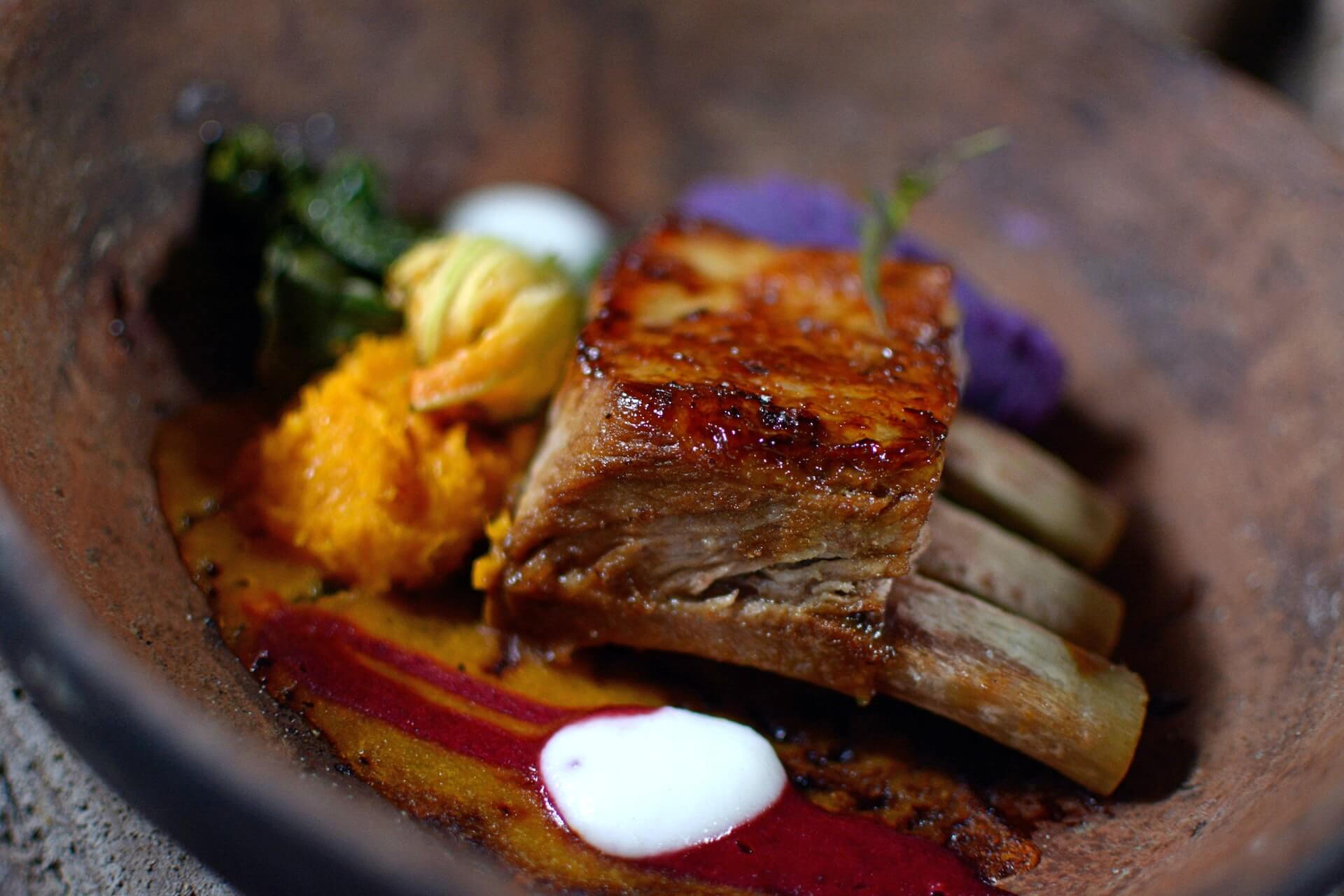
Fine dining Ecuadorian dish

Condé Nast’s American food and restaurant publication Bon Appétit identifies the 50 restaurants they deem the very best in 2022.

The intriguing list highlights the consumer desire to try a wide range of global cuisines. Indeed, were one to eat their through Bon Appétit‘s 2022 list, they’d enjoy both traditional and modern:

  • African (notably, Nigerian)
  • Cantonese
  • Caribbean
  • Eastern European (Hungarian, in particular)
  • Filipino
  • French
  • Indian (including Goan and Kashmiri)
  • Italian
  • Japanese
  • Jewish
  • Korean
  • Laotian
  • Mexican
  • Palestinian
  • Portuguese
  • Vietnamese

Of course, one will also find American cuisine. Of note, Texas barbecue, elements of Memphis barbecue, Low Country, Cajun cooking, and Midwest comfort food. There are also restaurants offering creative takes on traditional steakhouse fare. One restaurant’s focus, The Nicolett in Lubbock, Texas, is High Plains cuisine. (For those wondering, Bon Appétit describes this as “West Texas terroir.”)

This is a compelling list, showing that consumers crave a balance between comfort food and stepping outside of their comfort zones to discover cuisines that are new to them. I encourage everyone to look into these restaurants for inspiration and motivation.

Regional Performance

For simplicity, Bon Appétit arranges their list by dividing the US into four large regions: Midwest, Northeast & Mid-Atlantic, South, and West.

Interestingly, the South claims the most restaurants on this list of the 50 best, earning 17 spots. Northeast & Mid-Atlantic restaurants grab 15 spots, the West takes 12, and the Midwest claims just six.

When it comes to the South, Texas performs the best in terms of number of restaurants on the list. There are two in Austin, and one each in Fort Worth, Garland, Houston, Lubbock, and San Antonio.

However, Florida, Georgia and Louisiana also do well for the South, earning three spots each in the following cities:

  • Miami (2) and North Miami (1)
  • Atlanta (2) and Savannah (1)
  • New Orleans (3)

Unsurprisingly, New York leads the way for the Northeast & Mid-Atlantic region. Drilling down, Brooklyn boasts four of Bon Appétit‘s 50 Best New Restaurants 2022; New York City is the home of three; and one is in Hudson.

Pennsylvania, however, claims three spots, all in Philadelphia.

Equally as foreseeable, California boasts the most restaurants among this list of fifty. Predictably, most are in Los Angeles, which claims three in total. Oakland, San Diego, and San Francisco round out California’s spots with one each. Coming in second in terms of Western states with multiple restaurants on the list is Oregon, with two in Portland.

Unfortunately, the Midwest simply doesn’t perform nearly as well on this year’s list as its counterparts. In fact, it has just half the number of restaurants as the third-place region with six. Cincinnati, Ohio, takes a third of those spots. Surprisingly, Chicago is home to just one restaurant on this list.

The 50 Best New Restaurants

Below you’ll find Bon Appétit‘s list in alphabetical order.

  • Agi’s Counter (Brooklyn, NY)
  • Baba’s Pantry (Kansas City, MO)
  • Bacanora (Phoenix, AZ)
  • Bata (Tucson, AZ)
  • Birdie’s (Austin, TX)
  • Bocadillo Market (Chicago, IL)
  • Bonnie’s (Brooklyn, NY)
  • Cafe Mochiko (Cincinnati, OH)
  • Cafe Mutton (Hudson, NY)
  • Canje (Austin, TX)
  • Common Thread (Savannah, GA)
  • Daru (Washington, DC)
  • Daytrip (Oakland, CA)
  • Dear Annie (Cambridge, MA)
  • Dept. of Culture (Brooklyn, NY)
  • El Rincon del Maiz (Garland, TX)
  • Gage & Tollner (Brooklyn, NY)
  • Good Good Culture Club (San Francisco, CA)
  • Her Place (Philadelphia, PA)
  • Irwin’s (Philadelphia, PA)
  • Juniper Cafe (Atlanta, GA)
  • Kingfisher (San Diego, CA)
  • Korshak Bagels (Philadelphia, PA)
  • La Diabla Pozole y Mezcal (Denver, CO)
  • La Onda (Forth Worth, TX)
  • Lasita (Los Angeles, CA)
  • Lengua Madre (New Orleans, LA)
  • Los Félix (Miami, FL)
  • Lucian Books and Wine (Atlanta, GA)
  • Ma Der Lao Kitchen (Oklahoma City, OK)
  • March (Houston, TX)
  • Mid-City Restaurant (Cincinnati, OH)
  • Mister Mao (New Orleans, LA)
  • Morchella (Portland, OR)
  • The Nicolett (Lubbock, TX)
  • One White Street (New York, NY)
  • Paradis Books & Bread (North Miami, FL)
  • Phởcific Standard Time (Seattle, WA)
  • Quarter Sheets (Los Angeles, CA)
  • Reese Bros Barbecue (San Antonio, TX)
  • Regards (Portland, ME)
  • República (Portland, OR)
  • Seafood Sally’s (New Orleans, LA)
  • Semma (New York, NY)
  • Sozai (Clawson, MI)
  • Sunny’s Steakhouse (Miami, FL)
  • Supperland (Charlotte, NC)
  • Uncle Lou, New York, NY)
  • Yangban Society (Los Angeles, CA)
  • Z&Z Manoushe Bakery (Rockville, MD)

Image: Kiyoshi on Unsplash

by David Klemt David Klemt No Comments

Cali Chains Move Quickly to Kill FAST

California Chains Move Quickly to Kill FAST

by David Klemt

Huge pile of cash

If recent reporting is accurate, fast food chains with locations in California are fighting the Fast Food Accountability and Standards Recovery Act.

Several well-known restaurant chains have reportedly already dumped well over $10 million into a ballot drive effort. Among the chains lobbying to kill the bill are In N Out, McDonald’s, Wendy’s, and Chipotle.

In other words, the group of chains aiming to defeat AB-257 in California have very deep pockets. These heavy hitters are reaching deep to contribute millions of dollars to Save Local Restaurants, the coalition responsible for starting the ballot initiative.

And who are the Save Local Restaurants coalition members? The National Restaurant Association (NRA), US Chamber of Commerce (USCC), and International Franchise Association (IFA).

What is AB-257?

The Fast Food Accountability and Standards Recovery Act, also known as the FAST Act, is a California bill. Enacted on September 5 of this year, FAST amends a section of the state’s labor code that relates to food facilities and employment.

Click here to review the bill’s text in its entirety.

To summarize, FAST does the following:

  • Establishes the Fast Food Council, ten members appointed by the Governor, the Speaker of the Assembly, and the Senate Rules Committee. The council will operate until January 1, 2029.
  • Defines “the characteristics of a fast food restaurant.”
  • Gives the Fast Food Council the authority to set “minimum fast food restaurant employment standards, including standards on wages, working conditions, and training.”
  • Provides the council the power to “issue, amend, and repeal any other rules and regulations, as necessary.”
  • Allows the formation of a Local Fast Food Council by a county, or a city that has a population of more than 200,000.

It’s that third bullet point that likely stands out the most to chain operators. On January 1, 2023, California’s minimum wage increases to $15.50 an hour. If the Save Local Restaurants ballot initiative fails, the Fast Food Council could boost the minimum wage to $22 per hour right after we all yell, “Happy New Year!”

Proponents say the bill protects the health, safety, and welfare of fast-food workers. Opponents call it radical.

Fighting FAST

According to Save Local Restaurants, it’s not just chains that want to kill FAST:

“The FAST Act is opposed by small and family-owned businesses, minority-rights groups, workers, consumers, your favorite restaurants, taxpayers and community-based organizations,” reads their website.

Among their reasons for attempting to kill the bill are:

  • a resulting increase in the price of food;
  • the elimination of thousands of jobs in California;
  • an increase in the cost of living in the state; and
  • the millions of dollars the coalition claims the bill will cost California taxpayers annually.

Reportedly, full-service restaurant operators also oppose FAST. The reason is simple: If the Fast Food Council hikes fast-food worker minimum hourly wages significantly, FSRs will struggle to compete. FSR operators will have to hike menu item prices further, a situation that’s growing untenable as consumers balk at paying more at restaurants.

Then, there’s the fact that bills similar to FAST could pass in other states. So, chains are contributing millions to see that the Save Local Restaurants ballot initiative succeeds.

Should the effort be successful, FAST will be included on California’s 2024 ballot. That means it will be suspended until 2024 and be in the hands of the voters.

Image: Tima Miroshnichenko via Pexels

by David Klemt David Klemt No Comments

The Numbers on Food Delivery in Canada

The Numbers on Food Delivery in Canada

by David Klemt

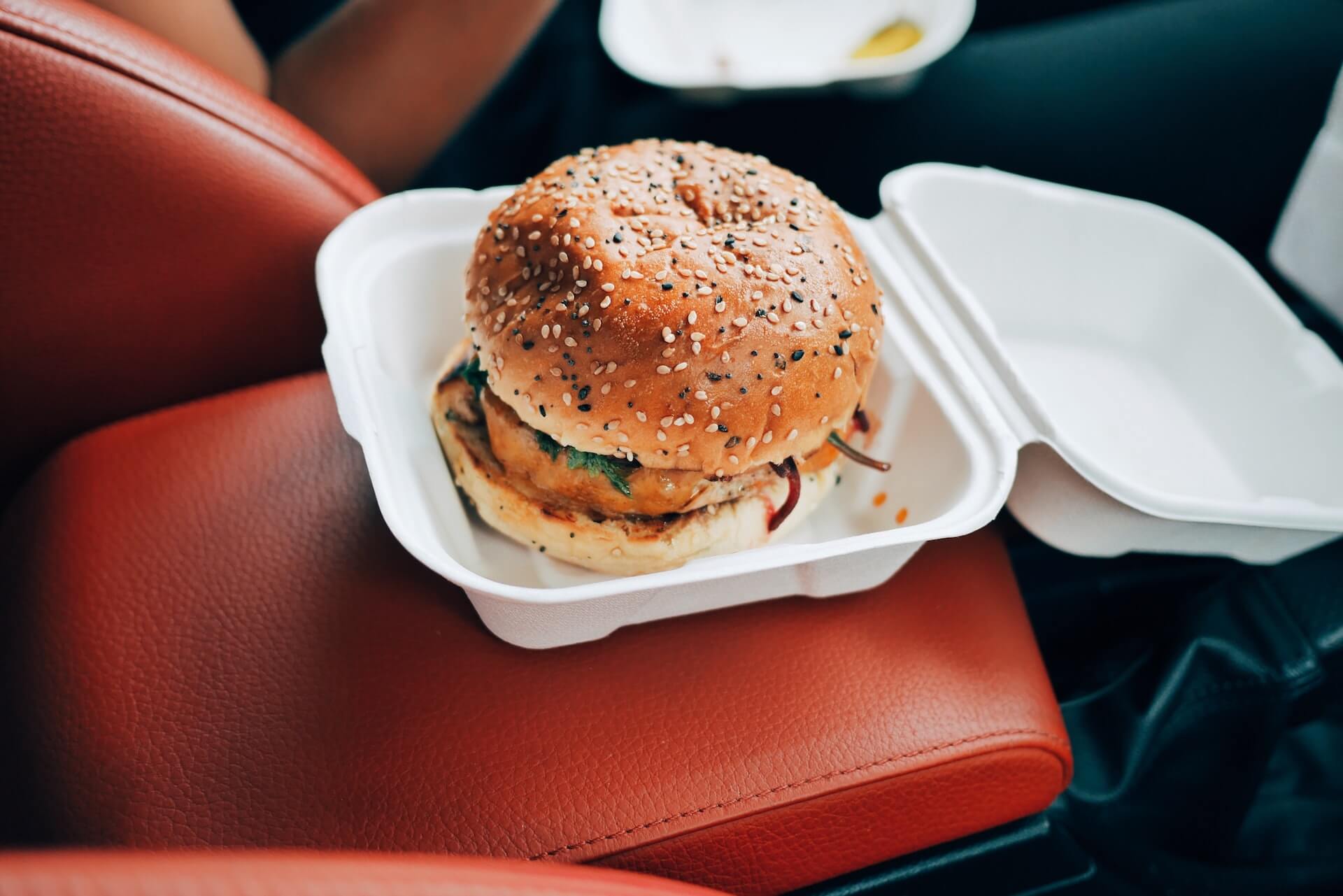
Burger in container inside car

For most restaurants, delivery is now a crucial service element rather than a “nice-to-have” option a small percentage of guests expect.

This is true whether your restaurant is in the US or Canada. But who’s placing orders? How are they ordering? And will they continue to order for the foreseeable future?

Well, Restaurants Canada has answers to all those questions and more. So, we let’s take a look at what their 2022 Foodservice Facts report says about delivery.

To download your own copy of this informative report, click here.

Who’s Placing Orders?

In their 2022 Foodservice Facts report, Restaurants Canada looks at three age groups:

  • 18 to 34
  • 35 to 54
  • 55-plus

Perhaps unsurprisingly, the 18- to 34-year-old cohort leads the charge when it comes to ordering delivery. It’s also not surprising that 35 to 54 comes in second, and 55 and older is third.

However, the first two groups are closer than some may assume. Eighty-three percent of the the 18 to 34 cohort placed orders at quick-service or full-service restaurants between December 2021 and May 2022.

That number does drop for the same time period among the 35 to 54 group, but not by a significant amount. Of that cohort, 77 percent ordered delivery. Just over half of the 55-plus group placed delivery orders: 52 percent.

Now, those numbers are down a bit from 2021, which makes sense. Things were much more restrictive in 2021 and people were just getting back to a sense of normalcy at the start of this year.

In 2021, the delivery order percentages were:

  • 18 to 34: 89 percent
  • 35 to 54: 81 percent
  • 55-plus: 67 percent

Looking at these numbers, it appears the 55-plus cohort is more comfortable dining out in person. Conversely, the 18 to 34 age group is clearly comfortable making delivery a part of their everyday lives.

How do People Want to Order?

Believe it or not, your website still matters. I’ve been saying this for years but the pervasiveness of delivery and takeout ordering is really driving this point home.

The fact is, a notable percentage of your guests want to support your restaurant and staff directly. Over the past couple of years, consumers have become well aware that third-party delivery services are incredibly costly for operators.

Consumers are also aware of third-party delivery debacles, such as the abysmal Grubhub “Free Lunch” mess from May of this year.

So, direct delivery is something that operators need to at least consider. Implementation is often less difficult than most business owners believe. And many platforms, SevenRooms, for example, make implementing direct delivery simple and affordable.

Interestingly, Restaurants Canada data supports the need for direct delivery. Back in May, the industry advocacy organization asked survey respondents how they prefer to place delivery orders from restaurants.

Preferences for QSR customers:

  • No preference: 10 percent
  • Over the phone: 19 percent
  • Third party: 35 percent
  • Restaurant website or app: 36 percent

Full-service customer preferences:

  • No preference: 8 percent
  • Over the phone: 28 percent
  • Third party: 29 percent
  • Restaurant website or app: 35 percent

Honestly, I find it surprising anyone calls a QSR to place an order. However, I suppose that makes sense for an office or catering.

At any rate, make sure your website is up-to-date, you offer direct or “last-mile” delivery, and make it easy to navigate your menu and the ordering process.

Is Ordering Here to Stay?

Now, we all know why restaurant delivery has been supercharged the past two years. However, consumer trend data show that delivery was on the rise before the Covid-19 pandemic.

But now that people are eager to return to normal and the industry is on its way to returning to pre-pandemic levels, is delivery really here to stay?

According to another question asked of survey respondents by Restaurants Canada, more than half of QSR and full-service restaurant customers plan to stick with delivery.

For their 2022 Foodservice Facts report, Restaurants Canada asked back in May how often consumers planned to place delivery orders in the next six months.

Order frequency for QSR customers:

  • Never placed a delivery order and don’t plan to now: 29 percent
  • Order less often: 20 percent
  • Will order with the same frequency: 45 percent
  • Will order more often: 7 percent

Frequency of orders for full-service customers:

  • Never placed a delivery order: 24 percent
  • Order less often: 23 percent
  • Will order with the same frequency: 44 percent
  • Will order more often: 9 percent

Here to Stay?

Of course, there are multiple factors feeding the numbers above. Some people simply don’t like ordering and waiting for delivery. For these consumers, the practice doesn’t just seem convenient.

There’s also the consumer demand to return to in-person dining, socializing with family and friends. And, of course, meeting new people while dining out.

We must also consider inflation and rising costs. Often, restaurant spending is among the first to be reduced when consumers need to be more frugal. Rising menu costs are sure to curtail some delivery spending.

That said, it’s clear delivery is here to stay and must be considered a crucial element for most restaurant operations. QSR and full-service operators need to bear in mind is placing orders; how often they’re placing orders; and get them in the habit of placing orders directly.

Image: Oliur on Unsplash

by David Klemt David Klemt No Comments

8 Glendalough Cocktail Recipes for St. Patrick’s Day and Beyond

Offer your guests something different for your St. Patrick’s Day promotion with Glendalough Distillery cocktail recipes.

Without a doubt, you should have plenty of the expected Irish whiskeys on hand. However, Glendalough Distillery Double Barrel, Pot Still, Wild Gin, and Rose Gin are extraordinary Irish whiskeys and gins.

Each spirit the distillery crafts honors the art of Irish distillation, a craft that stretches back centuries. What’s more, each whiskey Glendalough crafts is single malt—there are no light-bodied blends in their lineup.

To learn more, check out episode 71 of the Bar Hacks podcast with Glendalough Distillery co-founder and national brand ambassador Donal O’Gallachoir.

by David Klemt

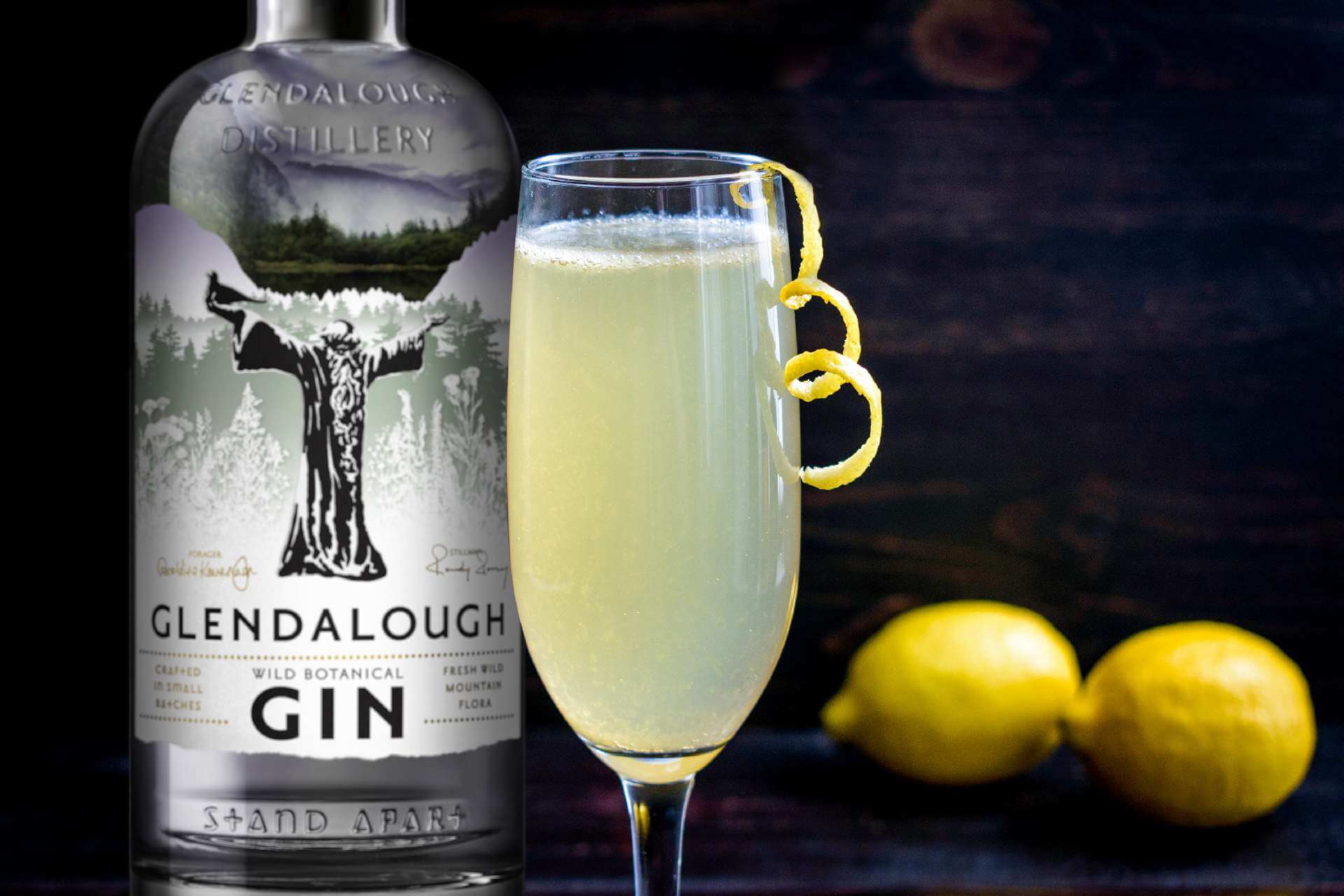
Glendalough Distillery Wild Gin Irish gin

8 Amazing Irish Whiskey and Gin Cocktails

Below, eight refreshing and sophisticated drink recipes made with Glendalough whiskeys and gins. Sláinte!

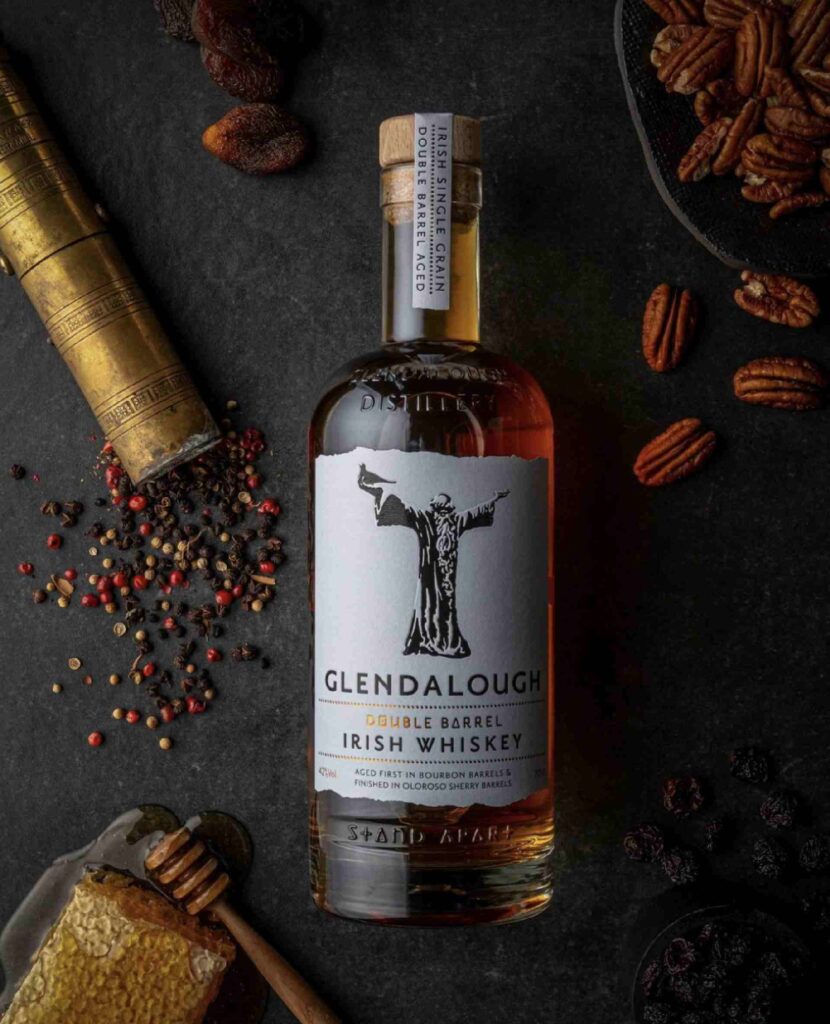
Glendalough Distillery Double Barrel Single Malt Irish Whiskey

The Lough Inn

This highball is made with Glendalough Double Barrel, a single-grain Irish whiskey aged in ex-bourbon barrels before being finished in Oloroso sherry casks.

  • 2 oz. Glendalough Double Barrel Single Grain Irish Whiskey
  • 1 oz. Spiced honey syrup (see note)
  • 1 oz. Fresh lemon juice
  • Soda to top
  • Lemon wheel or slice to garnish
  • Mint leaf to garnish
  • 1 cup Honey for spiced honey syrup
  • 0.5 cup Water for spiced honey syrup
  • 4 Cinnamon sticks for spiced honey syrup
  • 1 pod Star anise for spiced honey syrup

Add ice to a highball glass, then add first three ingredients. Top with soda water. Garnish with lemon wheel or slice and freshly torn mint leaf.

For spiced honey syrup: Add honey, water, cinnamon sticks, and star anise to pot. Bring to a boil, then stir. Strain into container.

Glendalough Distillery Pot Still single malt Irish whiskey

Pot Still Highball

Deceptively simple to build, this cocktail highlights the terroir of the land surrounding Glendalough Distillery.

  • 1.5 oz. Glendalough Pot Still
  • Soda to top
  • Grapefruit peel to garnish
  • Mint leaf to garnish (freshly torn and slapped, of course)

Prepare a highball glass with an ice shard, spear or cylinder. Pour in Glendalough Pot Still whiskey, then top with soda. Glendalough Distillery recommends a 1:2 ratio, Pot Still to soda. Garnish with mint leaf.

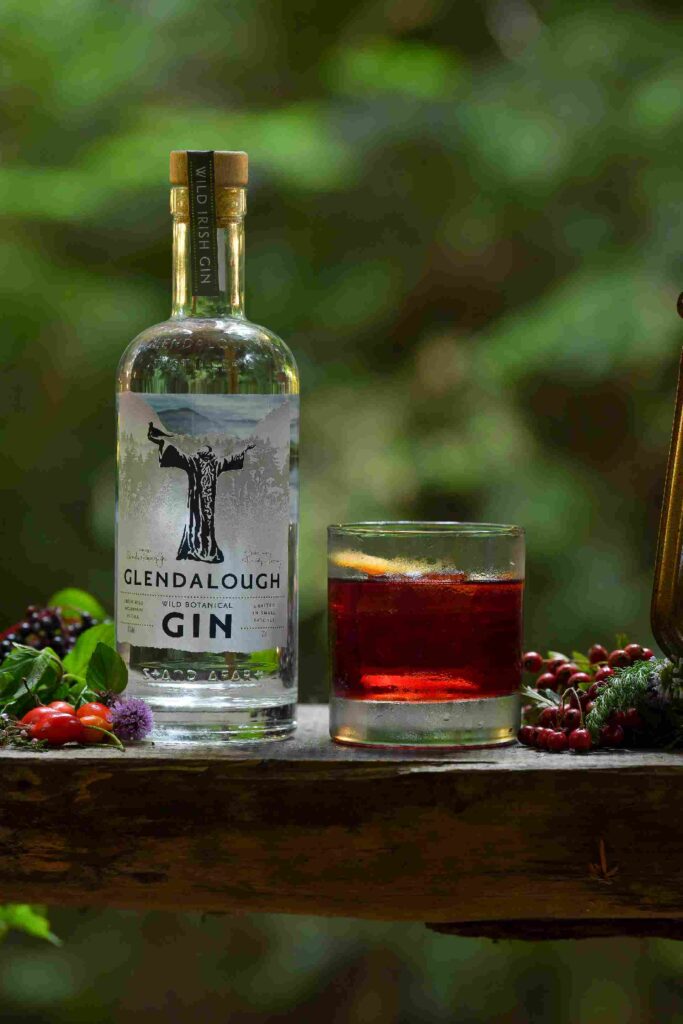
Glendalough Distillery Wild Gin Negroni cocktail

Glendalough Negroni

The foraged botanicals in Glendalough Wild Gin add even more complexity and depth to the classic Negroni. In fact, the flavors work so well this recipe maintains the Negroni’s crucial 1:1:1 ratio.

Prepare an Old Fashioned with ice. Add first three ingredients to glass in the above order. Add more ice if necessary. Stir, express orange peel, and place as garnish.

Glendalough Distillery Wild Gin Irish gin

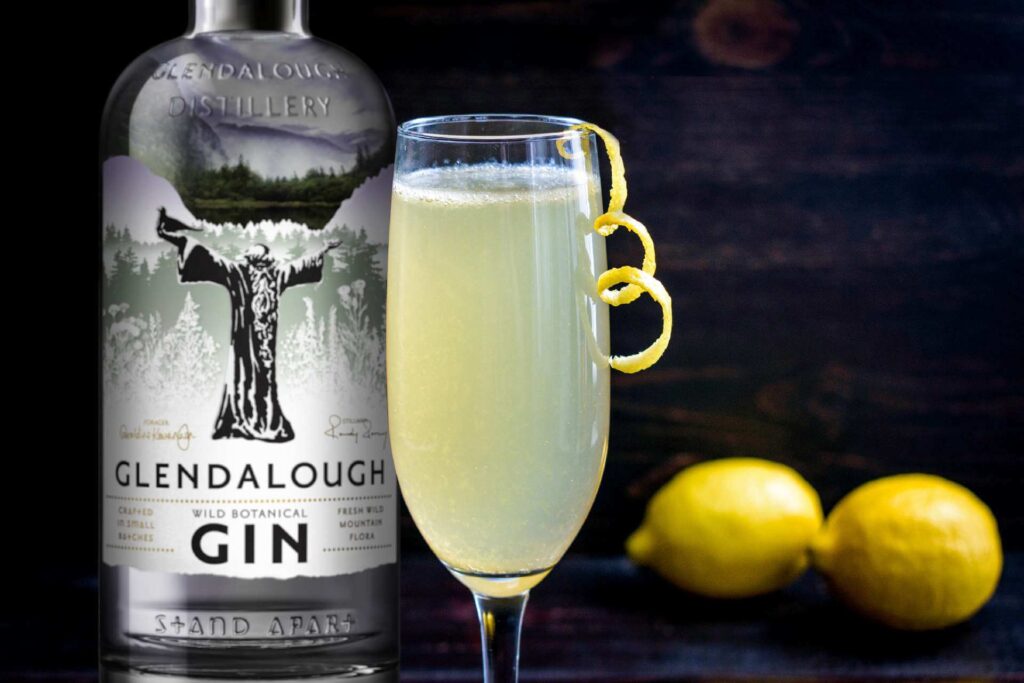
Glendalough Wicklow 75

Bubbles make everything better and everyone happier.

Add all ingredients to shaker. Add ice and shake until well chilled. Strain into Champagne flute, top with Prosecco, and garnish with lemon twist.

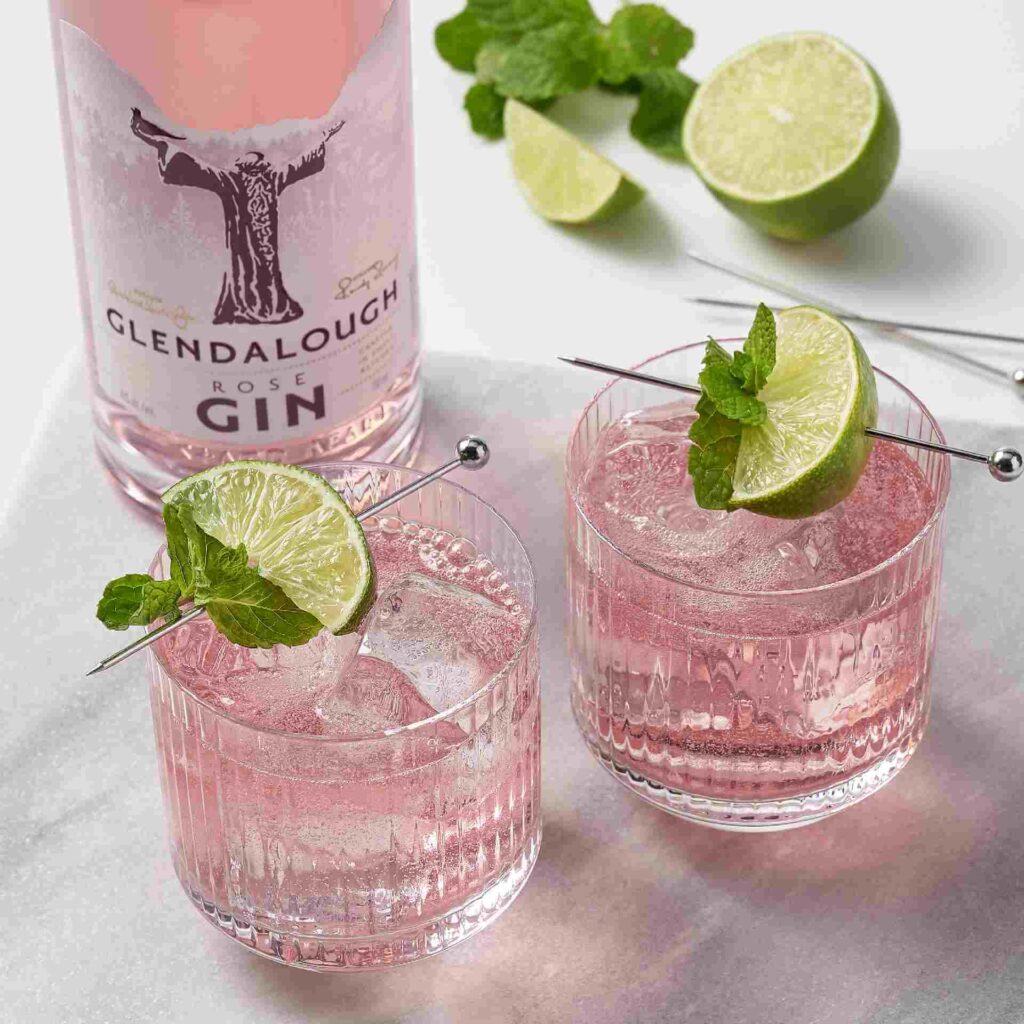
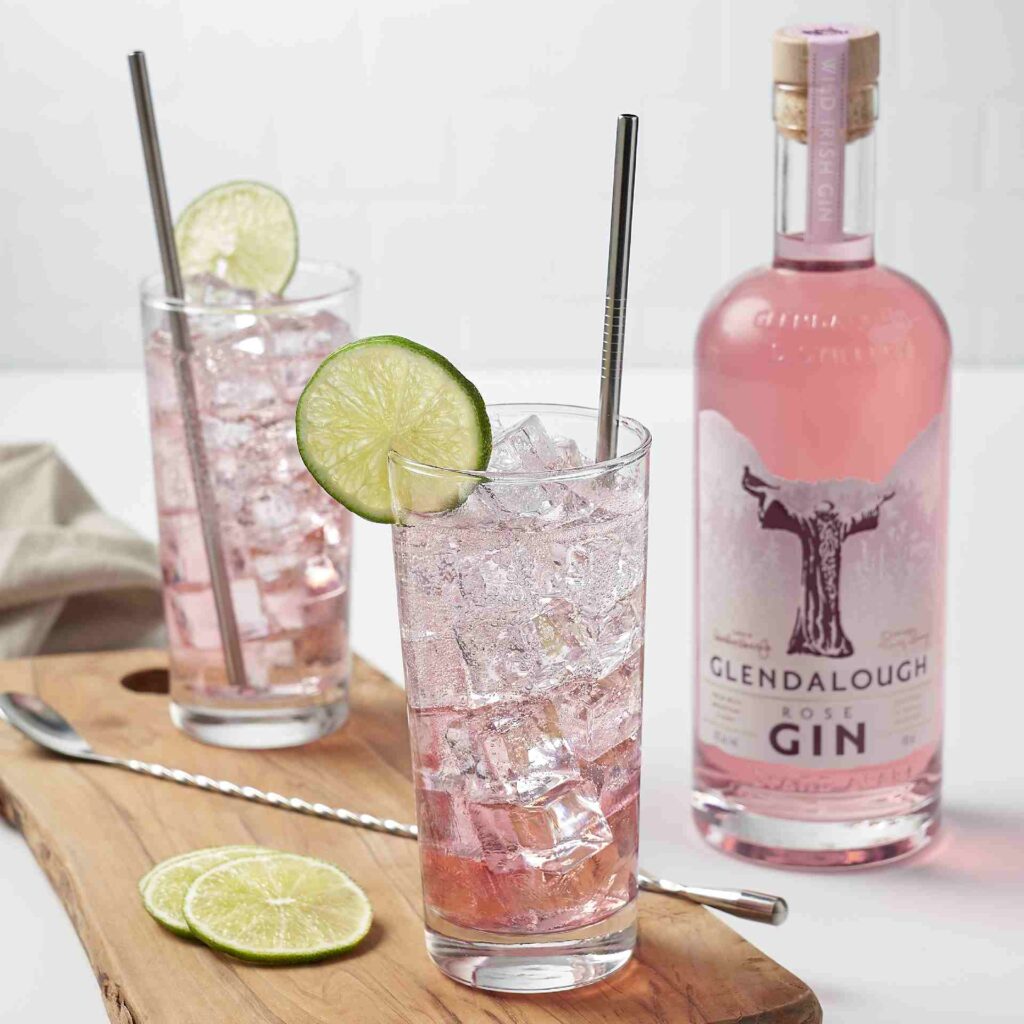
Glendalough Distillery Rose Gin Irish gin and cocktails

Glendalough Rose G&T

This simple classic receives a huge visual and aromatic boost from Glendalough Rose Gin.

  • 2 oz. Glendalough Rose Gin
  • Tonic to top (the higher the quality, the better)
  • Lime slice
  • Mint leaves

Add ice to glass, then add Rose Gin. Top with tonic, and garnish with lime slice and mint leaves.

Glendalough Distillery Rose Gin Fizz

Glendalough Rose Gin Fizz

One way to elevate the highball is to use a striking pink-hued Irish gin.

  • 1.5 oz. Glendalough Rose Gin
  • 0.5 oz. Elderflower liqueur
  • Raspberry & Lime sparkling water to top
  • Lime wheel to garnish

Add ice (spear, shard or cylinder for impact), Rose Gin, and liqueur to highball glass. Stir, then add sparkling water to top. Garnish with lime wheel.


View this post on Instagram


A post shared by Glendalough US (@glendaloughus)

Glendalough Rose Collins

Boost the classic Collins with Glendalough’s striking rose-petal gin.

  • 1.5 oz. of Glendalough Rose Gin
  • 1 oz. of Lemon juice (freshly squeezed)
  • 0.5 oz. of Sugar syrup (1:1 ratio, hot water to sugar)
  • Soda to top
  • Lemon peel to garnish
  • Cherry to garnish

Combine first three ingredients in a shaker with a cup of ice. Place an ice shard, spear or cylinder to a highball glass. Shake until well chilled, then strain into glass. Top with soda, and garnish with lemon peel and cherry.

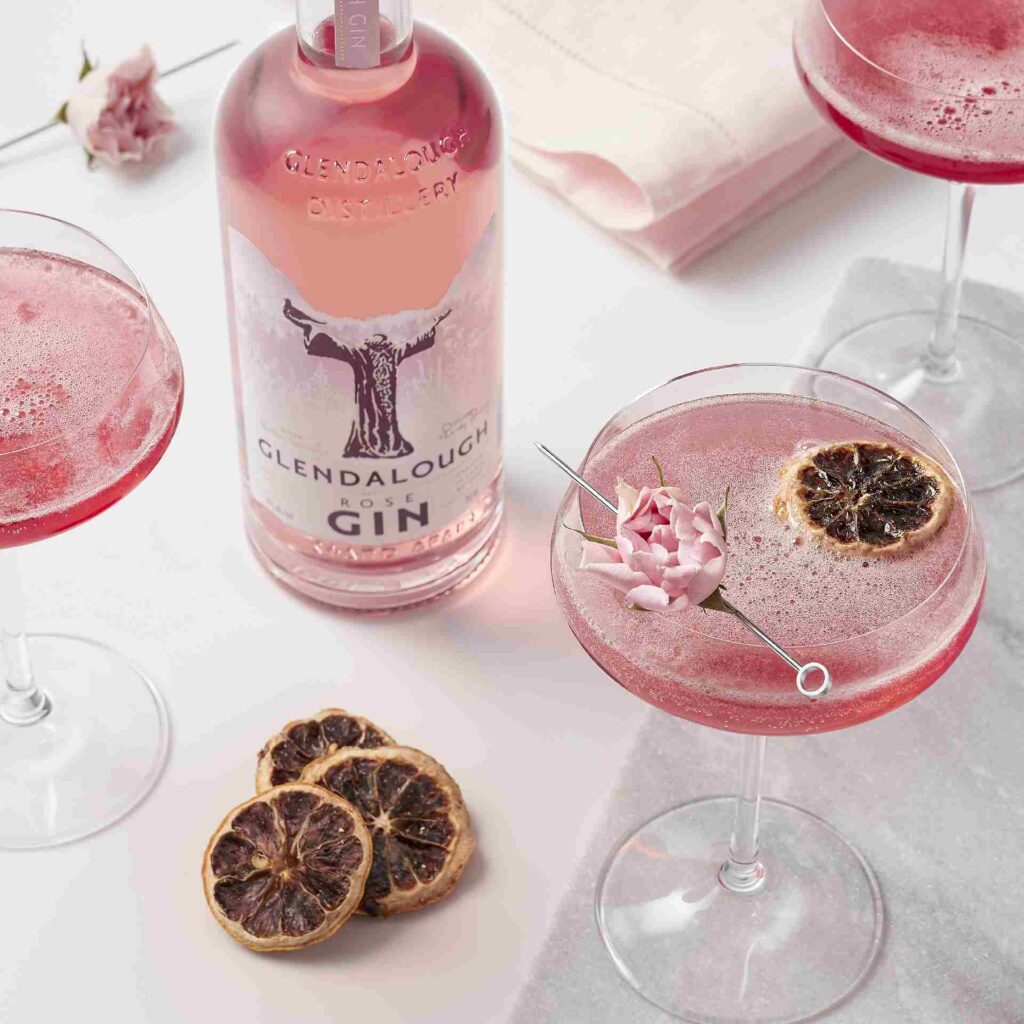
Glendalough Distillery Rose Gin Hibiscus Rose

Glendalough Hibiscus Rose

Refreshing and flavorful, the hibiscus tea syrup plays incredibly well with Glendalough Rose Gin.

  • 1.5 oz. Glendalough Rose Gin
  • 0.5 oz. Hibiscus tea syrup (see note)
  • 0.5 oz. Lemon juice (fresh squeezed)
  • Prosecco to top
  • Dehydrated lemon wheel to garnish
  • Rose petals to garnish
  • 33 oz. Water for hibiscus tea syrup
  • 16 oz. Sugar for hibiscus tea syrup

Add first three ingredients and ice to a shaker. Shake until well chilled and double strain into a coupe.  Top with Prosecco, and garnish with dehydrated lemon wheel and rose petals.

For the hibiscus tea syrup: Steep seven hibiscus tea bags in 33 ounces of water for 15 minutes. Add 16 ounces of sugar.

Images & Recipes: Glendalough Distillery

Related Reading

Work with Us

Click the image below to partner with us on your project.

Client Intake Form - KRG Hospitality

by David Klemt David Klemt No Comments

A Lesson in Guest Perception

A Lesson in Guest Perception

by David Klemt

Broadway-style McDonald's sign in Chicago, Illinois

At this point, it’s becoming more of a surprise to not be told that the ice cream machine isn’t working at a McDonald’s restaurant.

Per a report from earlier this year, 25 percent of their machines are broken at any time. In fact, the brand made a joke about it in 2020.

Interestingly, with all the road trips and flights I’ve taken, I had never encountered a nonfunctional ice cream at a McDonald’s. Until last week.

Feeling nostalgic, I drove to a McDonald’s near my home for a Shamrock Shake. Growing up, my father always enjoyed the Shamrock Shake LTO. I’ve had maybe one or two in my entire life.

So, I drove over, got in line, and confidently asked for a Shamrock Shake and a Mint Oreo Shamrock McFlurry. And then I heard the words I’d never heard before:

“I’m so sorry, our machine isn’t working.”

Devastated, I did what any well-adjusted adult would do: I ordered a double cheeseburger and a 10-piece Chicken McNuggets combo. Same thing as a shake and McFlurry, right?

Guest Perception

I won’t dive too far into the minutiae of the longstanding McDonald’s ice cream machine saga. By now, we’re all familiar:

  • These machines break so often there’s a website dedicated to the problem. McBroken shows people where ice cream machines are working and where they’re broken. (If only I had used that before my ill-fated visit…)
  • The machines reportedly take four hours per day to clean.
  • There are claims that Taylor, the manufacturer of the machines, makes 25 percent of their revenue from performing repairs.
  • Outlets have reported the FTC is investigating the situatithe machine’s manufacturer, Taylor.
  • The latest news is that Kytch is suing McDonald’s for $900 million.

I’m not a McDonald’s board member, nor am I a franchisee. So, I’m not privy to any discussions swirling around the ice cream machines in use currently.

However, I do find it surprising that a brand as massive as McDonald’s would allow this issue to continue. For a brand that claims nothing is more important than delivering a high-standard of quality food, this joke is no longer funny.

What’s more, the issue is an opening for their competitors.

Leave an Opening and a Competitor will Take it

Jack in the Box has roasted McDonald’s for their ice cream machines in the past. This month, however, they’ve amped up their trolling.

Now that the Shamrock Shake has returned, Jack in the Box has pounced.

It would’ve been enough for Jack to mock McDonald’s on Twitter during Shamrock Shake season. But nope—Jack is dragging McDonald’s even harder.

Head over to McBroken and you’ll see a huge banner that reads, “DON’T GET McSHAMMED.” You’ll notice that the map is now also populated with Jack in the Box locations.

Click the aforementioned banner and you’ll find yourself on the Jack in the Box website. More specifically, it’s a page promoting their mobile app.

Taking it further, there’s currently a promotion encouraging the download: using the code “McSHAMMED” scores the user a $2 shake.

Since we’re in Shamrock Shake season, Jack is offering their new Oreo Cookie Mint Shake. And yes, it’s green.

Innovation and Problem Solving are Crucial

Look, I’m in no position to tell McDonald’s how to run their business. If they’re comfortable with negative guest perception and experiences, that’s on them.

It’s also on them if they want to show their guests and competitors a failure to innovate, solve problems, and be agile.

The ice cream machine debacle should be a lesson for all operators. Leave an opening and your competition will take it, slamming it shut behind them.

At best, maybe you’ll be able to adapt and overcome. At worst, they’ll be social media and marketing savvy, and roast you publicly. Once a brand’s perception slips, it can be incredibly difficult to get it back to where it once was.

As an operator, you’re an entrepreneur. Entrepreneurs innovate and solve problems.

Image: Joshua Austin on Unsplash

by David Klemt David Klemt No Comments

Want Champagne Onion Rings with That?

Want Champagne Onion Rings with That $6,000 Burger?

by David Klemt

De Daltons gourmet Golden Boy hamburger, cropped image

Matthew McConaughey once said that the inventor of the hamburger was smart but creator of the cheeseburger was a genius.

So, what title should we bestow upon the person who created the first-ever gourmet burger?

Super-genius? Superhuman? Superhero?

Perhaps legend is high-enough praise for whomever made it acceptable to charge more than $10 for a simple menu item.

A Brief History of Haute Hamburgers

The United States is widely credited with the invention of the hamburger. However, the exact origin is unknown. Therefore, it remains heavily disputed.

Of course, we wouldn’t have today’s gourmet burgers without two decidedly standard burger powerhouses: White Castle and McDonald’s.

The former was founded 100 years ago this past March in 1921, while the latter really came into its own in 1955. However, thanks to films like The Founder, McDonald’s tends to get the lion’s share of modern burger and fast-food credit.

Regardless, the first haute cuisine burgers wouldn’t hit the market until the turn of this century. Chefs Daniel Boulud and Richard Blais are among the names that receive credit for creating the gourmet burger category.

Over the past several years, several high-dollar burgers have made headlines. For example, Corvallis, Oregon-located restaurant Juicys Outlaw Grill created a $5,000 burger ten years ago. Anyone interested in having one was required to provide 48-hours’ notice.

In 2017, Dutch chef Chef Diego Buik offered a $2,300-plus burger at South of Houston in the Hague. Just two years ago, Chef Hubert Keller featured a $5,000 burger on the menu at his Las Vegas restaurant Fleur.

Another Las Vegas restaurant, Burger Brasserie, has offered a $777 burger for nearly a decade.

Chef Gordon Ramsay’s latest restaurant, the cleverly named Gordon Ramsay Burger outpost in London (the original is in Las Vegas), features a burger that costs between $106 and $144. Oh, and it doesn’t come with fries—those come with an upcharge of ten bucks.

New King of Burgers

Now, there’s a new most-expensive burger making the scene. Interestingly, it’s not from an American restaurant.

De Daltons, a Dutch diner located about 40 minutes southeast of Amsterdam, is the home of a gourmet burger known as the Golden Boy.

De Daltons gourmet Golden Boy hamburger

Of course, this isn’t just any gourmet burger—at €5000, De Daltons is attempting to make it the gourmet burger.

So, what does one get for their nearly $6,000 investment in haute cuisine?

To start, there’s the burger. It’s made of ground A5 Wagyu brisket and chuck short rib. It’s topped with The Macallan- and Kopi Luwak coffee-infused barbecue sauce; truffled Cheddar cheese; Joselito vintage jamon (the best ham in the world); Dom Pérignon-battered onion rings; Beluga caviar; white truffle; Tiger tomato and cucumber that was pickled in matcha; smoked mayonnaise made saffron, chive and duck eggs; and king crab cooked in white wine.

Oh, and the burger is given a whiskey-smoked treatment before it’s served.

Speaking of service, what kind of bun is luxurious enough to hold the Golden Boy? A saffron- and Dom Pérignon-infused gold leaf one, of course.

Gourmet Gimmick?

The latest headline-grabbing burger is truly a hedonistic indulgence. Unlike some haute hamburgers from the past, however, it’s made with truly impressive ingredients.

Before the Golden Boy made its appearance, one simply had to make a BOUS (Burger of Unusual Size) to get attention. One could also go the “gourmet” route by pairing their signature burger with a pricey bottle of Champagne.

After those two routes turned a bit stale, chefs with impressive credentials could make news by making gourmet burgers from “fancy” meats, slapping foie gras and an aged cheese on top, and dusting the bun with gold.

De Daltons’ burger is clearly taking the gourmet burger in an ultra-luxe direction. All challengers to the King of Burger throne will have to follow suit.

Yes, the Golden Boy is a gimmick. Yes, it has helped De Daltons pull focus and grab the global restaurant spotlight. However, as ludicrous as many will find the price tag, the burger does deliver on luxe ingredients and pageantry.

So, am I suggesting that restaurateurs review their menus, local suppliers, and market to come up with their own headline-generating luxury menu item? Well, yeah.

If an operator’s kitchen team has the skills to execute on a specialty high-priced item while remaining authentic and without alienating loyal guests, go for it. If there’s only PR, marketing and revenue upside, creating one incredible “off-menu”item is worth the effort.

Again, this comes down to operators knowing their guests, their markets, and what they’re great at doing. The word “gimmick” doesn’t have to be a dirty word—it can be a positive if done correctly.

Image: De Daltons

by David Klemt David Klemt No Comments

Make Your Restaurant Concept ABSURᗡ in 2021

Make Your Restaurant Concept ABSURᗡ in 2021

by David Klemt

Those seeking new restaurant opportunities in 2021 should give serious consideration to Absurd! Kitchen Co., KRG Hospitality’s unique turnkey QSR.

Development of the concept was motivated by the realization that operators need to continue to pivot to survive the pandemic and thrive in a post-pandemic world.

“At KRG Hospitality, we immediately pivoted in March 2020 into ‘rescue mode,’ understanding the immediate needs of so many independent operators,” says Doug Radkey, president of KRG Hospitality.

Moving forward into 2021, guests will be more concerned health, safety and their comfort than ever before. Absurd! was developed as a response to heightened guest expectations and to create a path forward for operators in the post-Covid-19 era. Not only is the concept forward-looking, it’s designed for turnkey operation.

Restaurant guests were growing accustomed to the convenience of frictionless ordering, pick-up and delivery. Lock downs, restrictions, and health and safety concerns have pushed delivery and pickup closer to the forefront of guest expectation. Absurd! leverages the latest in technology and utilizes a subscription element to reward loyalty while offering a convenient and safe QSR experience.

In the new era of restaurant operation we can expect guests to be less tolerant of waiting in lines. Multiple publications have published articles hypothesizing that the Covid-19 pandemic we lead to the end of waiting. Considering the importance of social distancing and how commonplace curbside pickup has become, it’s understandable that many guests have developed a preference for speedy, safe service.

Equally understandable is a guest wishing to keep interactions with other people to a minimum. The ability to peruse a menu via QR code or pay their bill using their own device has offered a level of comfort to guests during the pandemic. It’s logical to believe these guest habits are here to stay.

At Absurd! locations there are no traditional lines. By design, there’s no contact between guests and staff. Guests interact with a location via designated pick-up or drive-through areas. In the pick-up area, guests access food-safe storage units through their mobile devices to grab their orders. The drive-throughs only serve delivery drivers or those who have placed pre-orders. Convenient, safe, time-saving restaurant features for a post-pandemic world.

Absurd! cuisine is inspired by Southern flavors and dishes such as loaded chicken strips, fried waffle sticks, breakfast bowls, and sandwiches. There are options for the full range of dietary needs and preferences, such as dairy-free, gluten-free and vegan meat alternatives. Along with a competitive, high-quality menu, KRG Hospitality has developed a retail offerings that include branded dry spices and meal kits, leveraging another trend that has seen significant growth during the pandemic. The concept’s packaging is sustainable, and adding a food truck can expand an Absurd! operation’s reach.

“Approximately 85 percent of the food menu will be prepared on-site, including the seasoning mix and ‘dredge’ for the fried chicken, which is intended to also be gluten-free and dairy-free,” says Radkey. “The brand is able to accomplish this by maintaining a small but robust and strategic menu mix over the breakfast, lunch, and dinner day-parts. Other food items such as the chile cornbread, breakfast biscuits, and sandwich buns will be sourced through regional partnerships.”

While developing Absurd!, KRG has created a loyalty program to go along with it that’s relevant to today’s guest preferences and consumer habits. Loyalty programs have made the news lately, with attention being paid to how they’ve been changing for the past couple of years. Tech has emerged as a driver for such programs, combining guest data and personalized digital interactions to increase loyalty. However, creativity is a crucial element as well. Recognizing the value of a unique but easily understood loyalty program that offers an attractive value proposition, KRG’s approach for Absurd! is a beverage-based subscription service.

“With a low monthly cost of approximately $8.99 USD per month, the Absurd! beverage subscription program, which is optional, gives the brand an easy way to attract customers and convince them to change their traditional F&B ordering habits while building a strong base of loyalty (and data),” says Radkey. “Consumers today are accustomed to low-cost monthly subscriptions. Therefore, we think it is time for restaurants to tap into that opportunity. The ‘unlimited drinks’ within this program include coffee, iced tea, lemonade, and an assortment of flavored soda waters.”

Absurd! Kitchen Co. isn’t unique for the sake of being different. First and foremost, the concept was designed for experienced and new operators alike so they can thrive in the new era of hospitality. The dedication of KRG Hospitality to helping operators flourish with concepts that are scalable, sustainable, profitable, memorable and consistent is ingrained in Absurd’s DNA.

The concept is a recession- and pandemic-proof QSR that doesn’t rely heavy upon day-to-day involvement by the owners, making it ideal for operators of any level, from the neophyte to the experienced hospitality group.

Click here to learn more about Absurd! and visit www.AbsurdKitchen.com to download this turnkey concept’s information packet.

Image: KRG Hospitality

Top